From Surf Wiki (app.surf) — the open knowledge base
Linfen
| Field | Value | |
|---|---|---|
| <!-- Basic info ----------------> | name | Linfen |
| native_name | 临汾市 | |
| native_name_lang | zh-Hans | |
| other_name | Pingyang | |
| settlement_type | Prefecture-level city | |
| image_skyline | File:J82023 Linfen 20140706-185139.07 Gulou.jpg | |
| image_caption | Drum Tower of Linfen | |
| image_map | Location of Linfen Prefecture within Shanxi (China).png | |
| map_caption | Location of Linfen City jurisdiction in Shanxi | |
| pushpin_map | Shanxi | |
| pushpin_label_position | right | |
| pushpin_mapsize | 240 | |
| <!-- Location ------------------> | pushpin_map_caption | Location of the city centre in Shanxi |
| coor_pinpoint | Linfen municipal government | |
| coordinates | ||
| <!-- Area/postal codes & others --------> | subdivision_type | Country |
| subdivision_name | People's Republic of China | |
| subdivision_type1 | Province | |
| subdivision_type2 | County-level divisions | |
| subdivision_name1 | Shanxi | |
| subdivision_name2 | 17 | |
| established_title | ||
| named_for | ||
| seat_type | Municipal seat | |
| seat | Yaodu District | |
| <!-- Politics -----------------> | government_type | Prefecture-level city |
| leader_title | CPC Linfen Secretary | |
| leader_name | Yue Puyu (岳普煜) | |
| leader_title1 | Mayor | |
| leader_name1 | Liu Yuqiang (刘予强) | |
| total_type | ||
| <!-- images and maps -----------> | unit_pref | |
| area_magnitude | ||
| area_total_km2 | 20275 | |
| area_land_km2 | ||
| area_blank1_title | Districts | |
| area_metro_km2 | 1307 | |
| area_urban_km2 | 1307 | |
| area_urban_footnotes | ||
| elevation_footnotes | tags-- | |
| elevation_m | 452 | |
| elevation_min_m | 385.1 | |
| population_total | 3976481 | |
| population_as_of | 2020 census | |
| population_footnotes | ||
| <!-- Population -----------------------> | population_density_km2 | auto |
| population_density_urban_km2 | auto | |
| population_density_metro_km2 | auto | |
| population_metro | 959198 | |
| population_urban | 959198 | |
| demographics_type2 | GDP | |
| demographics2_title1 | Prefecture-level city | |
| demographics2_info1 | CN¥ 150 billion | |
| US$ 23.7 billion | ||
| demographics2_title2 | Per capita | |
| demographics2_info2 | CN¥ 37,848 | |
| US$ 6,056 | ||
| postal_code_type | Postal code | |
| postal_code | 041000 | |
| area_code | 0357 | |
| website | ||
| elevation_max_m | 2346.8 | |
| timezone | China Standard | |
| utc_offset | +8 | |
| blank_name | Licence plates | |
| blank_info | 晋L | |
| blank1_name | Administrative division code | |
| blank1_info | 141000 | |
| iso_code | CN-SX-10 |
US$ 23.7 billion US$ 6,056 Jinzhou Pingyang
Linfen () is a prefecture-level city in the southwest of Shanxi province, China, bordering Shaanxi province to the west. Linfen City is located in the southern part of Shanxi Province, with the remaining branches of Taiyue to the east and the Luliang Mountains to the west. In the middle is a vast river valley plain, with the Fen River mainstream running across the north and south, and the land on both sides is fertile. It is situated along the banks of the Fen River. It has an area of 20275 km2{{cite web |archive-url=https://web.archive.org/web/20070217073553/http://www.linfen.gov.cn/go.shtml |url-status=dead |archive-date=February 17, 2007 |access-date=2008-09-09
Prior to 1978, Linfen was famous for its spring water, greenery and rich agriculture and therefore nicknamed "The Modern Fruit and Flower Town". Since then it has been developing into a main industrial center for coal mining, which has significantly damaged the city's environment, air quality, farming, health and its previous status as a green village.
Name
Linfen is named for the Fen River. Its former names include Jin, Jinzhou (晋州), and Pingyang (). Linfen was called Pingyang in ancient times and was said to be the ancient capital of Yao in the Tang Dynasty. It belonged to Han in the Spring and Autumn Period, and the Qin and Han Dynasties were Hedong prefectures. In the third year of Jin Yongjia during reign of the emperor Huai, Liu Yuan established his capital here.
History
Chinese archeologists and archaeogeneticists have argued that legendary ruler Yao's capital was located in Linfen, a confirmation of local legend responsible for the name of the city's Yaodu District. In that sense, Linfen city is the earliest capital of China.
The area was the center of the marchland and duchy of Jin, named for the Jin River ({{linktext|晋|水}}). The duchy collapsed in the 4th century BC but gave its name to a Chinese princely title used as the dynastic name of the Sima clan. Jin Prefecture was centered on the town, which took its name as Jin and Jinzhou. Later, it was renamed Pingyang Commandery, which was also adapted as the name for its chief town. The Xiongnu emperor of Former Zhao Liu Cong made Pingyang his residence in the fourth century. "He kept court at Pingyang in [Shanxi] and ruled over central and southern [Shanxi], over [Shaanxi] (except for the Han basin), northern [Henan] (except for Kaifeng), southern [Hebei], and northern [Shandong]." In the 10th century, the city's walls were considered "fortified beyond approach".
In the 1980s, Linfen was nicknamed "The Modern Fruit and Flower Town".
Geography
Linfen is located in the southwestern part of Shanxi, on the lower reaches of the Fen River, bounded by Changzhi and Jincheng to the east, the Yellow River to the west (which also forms the border with Shaanxi), Jinzhong and Lüliang to the north, and Yuncheng to the south. The prefecture ranges in latitude from 35° 23′ N to 36° 37′ N, spanning 170 km, and in longitude from 110° 22′ E to 112° 34′ E, spanning 200 km. In all, the city's administrative area, at 20275 km2, covers 13% of the province's area.
Within its borders Linfen City has a variety of topographical features. It is characterised as having a "U" shape, with its mountains, covering 29.2% of the prefectural area, on all four cardinal directions, a basin, the Linfen Basin (临汾盆地), covering 19.4%, in the middle, and intervening hills, covering 51.4%, in between. In the east, from north to south, are Mount Huo (霍山) and the Zhongtiao Mountains; in the west are the Lüliang Mountains, with elevations mostly above 1000 m. The highest point in the prefecture is the main peak of Mount Huo, at 2347 m, and the lowest is in Xiangning County, at 385 m. Important rivers in the area include the Yellow, Fen, Xinshui (昕水河), Qin (沁河), Hui (浍河), E (鄂河), and Qingshui Rivers (清水河).
The whole prefecture-level city features a great variety of terrain. The city itself sits in a basin, which aggravates the pollution.
Climate
Linfen has a continental, monsoon-influenced semi-arid climate (Köppen BSk), has a temperate continental climate with four distinct seasons, with rain and heat occurring at the same time. With moderately cold, but dry winters, and hot, somewhat humid summers. The monthly 24-hour average temperature ranges from −2.0 °C in January to 26.6 °C in July, and the annual mean is 12.6 °C. The annual precipitation stands at 455.1 mm, with close to 70% of this total falling from June to September. The frost-free period lasts on average 190 days per year. Extreme temperatures have ranged from −23.1 °C to 42.3 °C.
|Jan record high C = 15.2 |Jan record low C = -22.5 |Feb record high C = 21.5 |Feb record low C = -23.1 |Mar record high C = 29.2 |Mar record low C = -10.0 |Apr record high C = 36.5 |Apr record low C = -5.0 |May record high C = 38.4 |May record low C = 1.3 |Jun record high C = 42.3 |Jun record low C = 8.5 |Jul record high C = 41.0 |Jul record low C = 14.7 |Aug record high C = 39.2 |Aug record low C = 10.7 |Sep record high C = 39.1 |Sep record low C = 2.3 |Oct record high C = 32.5 |Oct record low C = -5.0 |Nov record high C = 25.0 |Nov record low C = -12.8 |Dec record high C = 15.5 |Dec record low C = -17.6 | script-title=zh:临汾 - 气象数据 -中国天气网 | access-date = 29 November 2022}}
Pollution
China's rapid industrialization and urbanization beginning in the 1990s (see reform and opening up) led to increased energy demand causing a dramatic increase in the price of coal. This led to a rapid expansion of loosely regulated private mines. Mining, cooking, smelting and other heavy industries which developed around the city have led to catastrophic environmental damage.
In 2006, the Blacksmith Institute included Linfen in its annual "10 worst" report, calling the city the most polluted city in China. It has also been listed as one of the world's ten dirtiest cities by the Popular Science website. The city has ranked at the bottom of the World Bank's air quality rankings.
From its low point, in 2004, with only fifteen days out of the year with an acceptable level of air pollution, the environmental situation has improved. After a series of negative reports on the extreme level of pollution in the city, efforts were made to clean up Linfen. Substandard mines were closed. Coal trucks were kept from entering the city, resulting in much less coal dust. The city has also switched much of its heating source from coal to gas. 197 large coal-fired boilers and more than 600 smaller boilers were decommissioned. As of 2007, 85% of population used natural gas rather than coal for their heating. The State Environmental Protection Agency (SEPA) has forced many of the less-efficient smaller factories to close and enforced stricter standards for larger factories including mandating the installation of sulfur scrubbers.
Since 2006, the government has taken a series of measures to modify industrial structure and economic development mode. Relevant policies was issued such as emission thresholds of industrial pollution. Over the last few years the Ministry of Environmental Protection has been closely monitoring Linfen's environment conditions. While the China Youth Daily reported in 2014 that Linfen was experiencing the great change from the "most polluted city" to "model city of environmental protection", other sources suggest that little progress has been made in combating pollution. In 2018, the Chinese government openly criticized the city's failure to meet pollution targets, and a 2019 report by the Chinese Ministry of Ecology and Environment found that the city's air pollution was the worst among the 168 cities the ministry monitored. Following the report, the city's government ordered further pollution controls for the city's industry.
Administrative divisions
The prefecture-level city of Linfen is divided in one district, two cities and fourteen counties. The information here presented uses the metric system and data from 2010 Census.
| Map | # | English name | Simplified | Traditional | Pinyin | Area | Population | Density |
|---|---|---|---|---|---|---|---|---|
| 1 | Yaodu District | 尧都区 | 堯都區 | Yáodū Qū | 1,316 | 944,050 | 717 | |
| 2 | Houma City | 侯马市 | 侯馬市 | Hóumǎ Shì | 274 | 240,005 | 876 | |
| 3 | Huozhou City | 霍州市 | Huòzhōu Shì | 765 | 282,907 | 370 | ||
| 4 | Quwo County | 曲沃县 | 曲沃縣 | Qǔwò Xiàn | 438 | 237,033 | 541 | |
| 5 | Yicheng County | 翼城县 | 翼城縣 | Yìchéng Xiàn | 1,163 | 311,471 | 268 | |
| 6 | Xiangfen County | 襄汾县 | 襄汾縣 | Xiāngfén Xiàn | 1,304 | 442,614 | 339 | |
| 7 | Hongtong County | 洪洞县 | 洪洞縣 | Hóngtóng Xiàn | 1,563 | 733,421 | 469 | |
| 8 | Gu County | 古县 | 古縣 | Gǔ Xiàn | 1,193 | 91,798 | 77 | |
| 9 | Anze County | 安泽县 | 安澤縣 | Ānzé Xiàn | 1,965 | 82,012 | 42 | |
| 10 | Fushan County | 浮山县 | 浮山縣 | Fúshān Xiàn | 946 | 127,831 | 135 | |
| 11 | Ji County | 吉县 | 吉縣 | Jí Xiàn | 1,777 | 106,407 | 60 | |
| 12 | Xiangning County | 乡宁县 | 鄉寧縣 | Xiāngníng Xiàn | 2,029 | 233,162 | 115 | |
| 13 | Pu County | 蒲县 | 蒲縣 | Pú Xiàn | 1,508 | 107,339 | 71 | |
| 14 | Daning County | 大宁县 | 大寧縣 | Dàníng Xiàn | 967 | 64,501 | 67 | |
| 15 | Yonghe County | 永和县 | 永和縣 | Yǒnghé Xiàn | 1,219 | 63,649 | 52 | |
| 16 | Xi County | 隰县 | 隰縣 | Xí Xiàn | 1,415 | 103,617 | 73 | |
| 17 | Fenxi County | 汾西县 | 汾西縣 | Fénxī Xiàn | 880 | 144,795 | 165 |
Tourism
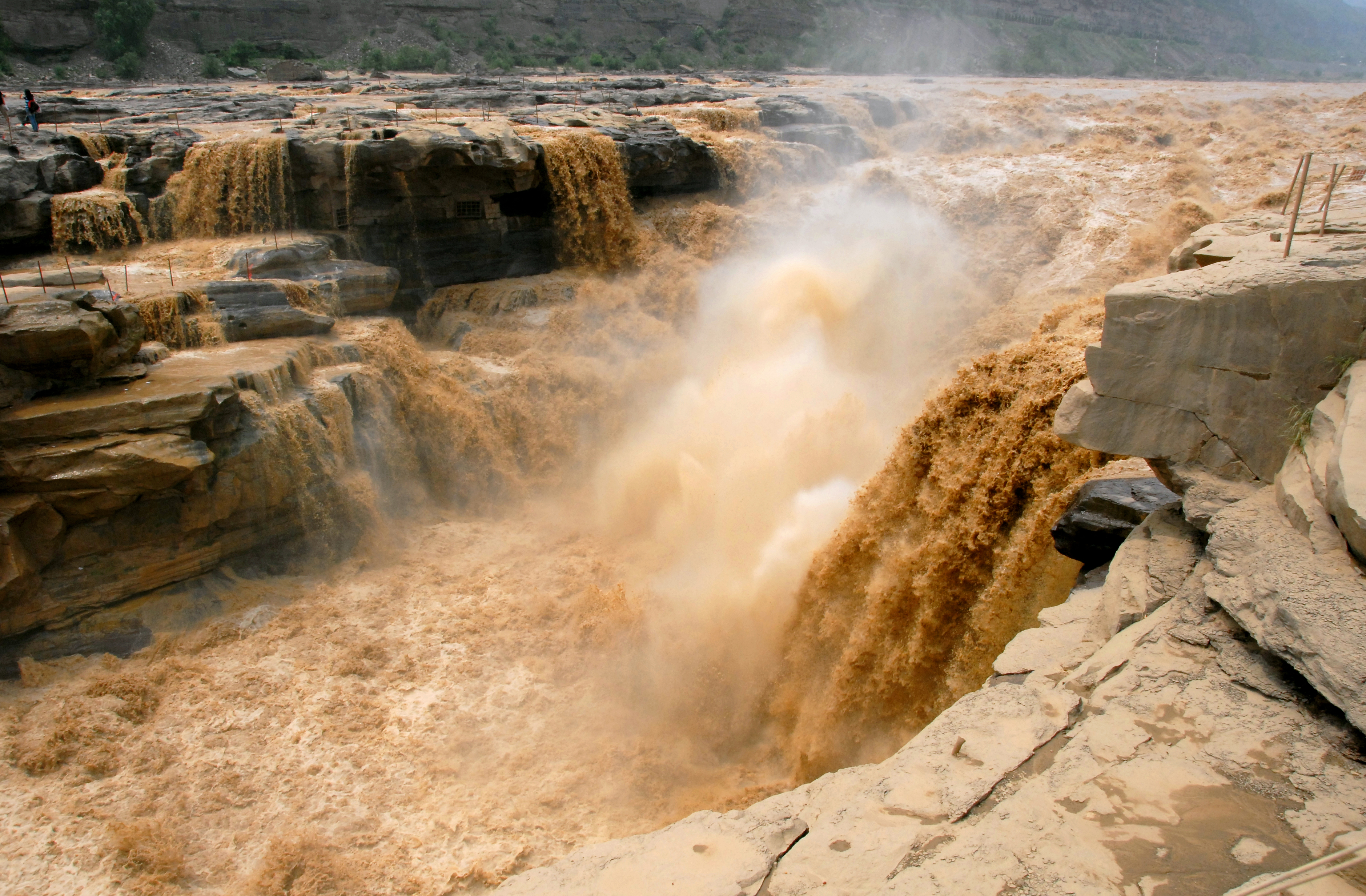
Linfen prefecture is home to several notable tourist attractions including the Hukou Waterfall which is the largest waterfall on the Yellow River and the second largest in China. Hukou Waterfall is located 150 km west of Linfen city in Jinshan Gorge.
Other attractions are mostly located in Hongtong county. Most notable among these is Guangsheng Temple, built in 147 CE. Located in the upper Guangsheng temple is the Feihong Pagoda (飞虹塔), the largest and best preserved glazed Chinese pagoda. Also in Hongtong county is the Susan Prison (苏三监狱), a restored Ming dynasty prison made famous by the Peking opera play (玉堂春). It is China's oldest surviving prison. Dahuaishu Ancestor Memorial Garden is a major shown for the mandatory population migration (aka Hongwu great migration, 洪武大移民) in the early Ming Dynasty.
Demographics
Linfen recorded a population of approximately 4,508,400 people as of 2019, an increase of 80,100 from 2018. The city reported 2,414,700 urban residents, and 2,093,700 rural residents, giving the city a 53.56% urbanization rate. There are 28 ethnic minorities in Linfen with a population exceeding 10,000 people: the Hui, the Manchu, the Tujia, Mongols, the Miao, the Zhuang, Koreans, the Yi, the Buyi, the Bai, Uyghurs, the Mulao, the She, Tibetans, the Li, the Dong, the Yao, Tajiks, the Gelao, the Daur, the Lahu, the Wa, the Hani, the Tu, the Xibo, the Lisu, the Qiang, and the Jingpo.
At the end of 2023 and the beginning of 2024, the permanent population will be 3.8872 million.
Economy
As of 2019, the city reported a GDP of 145.26 billion Renminbi. Linfen's primary sector makes up 7.1% of the city's GDP, the secondary sector contributes 43.3% of the city's GDP, and the tertiary sector makes up 49.6% of the city's GDP. The city's GDP in 2023 will be 231.25 billion yuan.
Industry
Linfen has rich mineral resources including coal, iron ore, copper, and lead. Hedong Coal Field, Huoxi Coal Field and Qinshui Coal Field together comprise 62.9 billion tons of coal reserves. Iron ore reserves exceed 420 million tons. Coal mining and dressing, coking, metallurgy, non-ferrous metal smelting, and chemicals are the principle industries.
After a World Bank report in 2006 called Linfen "the most polluted city in the world", the local government began closing a number of mines and factories, costing the city's economy $300 million in 2007 alone. A number of industries also refitted their facilities to track and reduce pollution. The city's economy stagnated in the following years.
Transportation

Air
Linfen Yaodu Airport, in Yaodu district, was built in 1958 and closed in 1965. The airport has been under renovation since September 2010 and started operation in January 2016.
Railway
Linfen railway station, in Yaodu district, was built in 1935 on the important southern Tongpu railway.Linfen Railway Station is located on Yingchun North Street, Linfen City, Shanxi Province. Founded in 1935. It is 274 kilometers away from Taiyuan Station and 254 kilometers away from Huashan Station (southern section of Tongpu Railway).
Linfen West railway station, in Yaodu district, was built in 2014. It is on the Datong–Xi'an high-speed railway. From this station, passengers can go to Beijing, Xi'an, Taiyuan and Shijiazhuang directly.
Road
- China National Highway 108
- China National Highway 309
- G5 Beijing–Kunming Expressway
- G22 Qingdao–Lanzhou Expressway
Education
- Shanxi Normal University (山西师范大学)
- Shanxi Institute of Electronic Science and Technology (山西电子科技学院)
Notable people
- Linjie Deng (born 1992) - multimedia artist
- Chai Jing, Chinese writer and host.
References
References
- (2019). "China Urban Construction Statistical Yearbook 2017". China Statistics Press.
- "China: Shānxī (Prefectures, Cities, Districts and Counties) - Population Statistics, Charts and Map".
- 山西省统计局、国家统计局山西调查总队. (December 2021). "《山西统计年鉴-2021》". [[China Statistics Press]].
- "临汾 - 气象数据 -中国天气网".
- Choi, Charles Q.. (October 18, 2006). "World's 10 Most Polluted Places". Livescience.com.
- "China sees fastest improvement in air quality globally - People's Daily Online".
- (2024-06-09). "临汾概述".
- "临汾各县市名字的来历,你知道吗?_安泽县_元年_晋国".
- [https://books.google.com/books?id=ZnlpAgAAQBAJ&pg=PA46 p. 46].
- Grousset, Rene. (1970). "The Empire of the Steppes". Rutgers University Press.
- [https://books.google.com/books?id=R0QpslzUi50C&pg=PA407 p. 407].
- "为什么临汾被称为花果城?原因在这里".
- (2024-06-09). "临汾气候背景分析".
- link. [[China Meteorological Administration]]
- (November 10, 2012). "China's 'most polluted city' breathes cleaner air". China Daily.
- "Top 10 Most Polluted Places". Blacksmith Institute.
- [http://www.popsci.com/environment/gallery/2008-06/worlds-dirtiest-cities The World's 10 Dirtiest Cities]
- Johnathan Watts. (March 26, 2007). "Fighting for air: frontline of war on global warming". The Guardian.
- FUnk, McKenzie. (July 7, 2007). "China's Green Evolution". Popular Science Magazine.
- China Youth Daily Feb 23, 2014
- (2019-04-15). "China coal hub Linfen to extend anti-pollution curbs to third quarter: draft plan". Reuters.
- (2003). "The Rough Guide to China".
- "Feihong Pagoda in Hongtong County of Shanxi Province". China Internet Information Center.
- Zhang, Zixuan. "Land of fairy tales". China Daily Asia Pacific.
- (2003). "The Rough Guide to China".
- link. (2020-03-10). Linfen People's Government
- "2024年[山西]临汾市人口总人数口有多少和第七次人口普查结果 年龄金字塔结构 民族组成情况-红黑人口库".
- link. Linfen People's Government
- "2023年临汾GDP突破2300亿元-调查数据-临汾市人民政府门户网站".
- (September 11, 2011). "Linfen (Shanxi) City Information".
- Chang, Emily. (2009-12-15). "Choking in China's polluted city - CNN.com".
- link
- "临汾尧都机场".
- sina_mobile. (2019-11-26). "山西省的第四大火车站——临汾站".
This article was imported from Wikipedia and is available under the Creative Commons Attribution-ShareAlike 4.0 License. Content has been adapted to SurfDoc format. Original contributors can be found on the article history page.
Ask Mako anything about Linfen — get instant answers, deeper analysis, and related topics.
Research with MakoFree with your Surf account
Create a free account to save articles, ask Mako questions, and organize your research.
Sign up freeThis content may have been generated or modified by AI. CloudSurf Software LLC is not responsible for the accuracy, completeness, or reliability of AI-generated content. Always verify important information from primary sources.
Report