From Surf Wiki (app.surf) — the open knowledge base
Line 1 (Madrid Metro)
Rapid transit line of the Madrid Metro
Rapid transit line of the Madrid Metro
| Field | Value |
|---|---|
| name | Line 1 |
| native_name | Línea 1 |
| native_name_lang | es |
| color | |
| logo | File:MetroMadridLogo.svg |
| logo_width | 100px |
| image | Madrid - Metro - Estación de Pinar de Chamartín (7190952974).jpg |
| image_alt | Terminal at Pinar de Chamartín |
| caption | Terminal at Pinar de Chamartín |
| type | Rapid transit |
| system | Madrid Metro |
| locale | Madrid |
| start | Pinar de Chamartín |
| end | Valdecarros |
| stations | 33 |
| ridership2 | 7.5 million monthly trips |
| planopen | |
| open | |
| yearcommenced | |
| yearcompleted | |
| close | |
| owner | CRTM |
| operator | CRTM |
| character | Underground |
| stock | CAF 2000-A |
| linelength_km | 23.876 |
| gauge | |
| website | |
| map | |
| map_state | collapsed |
| speed_km/h =
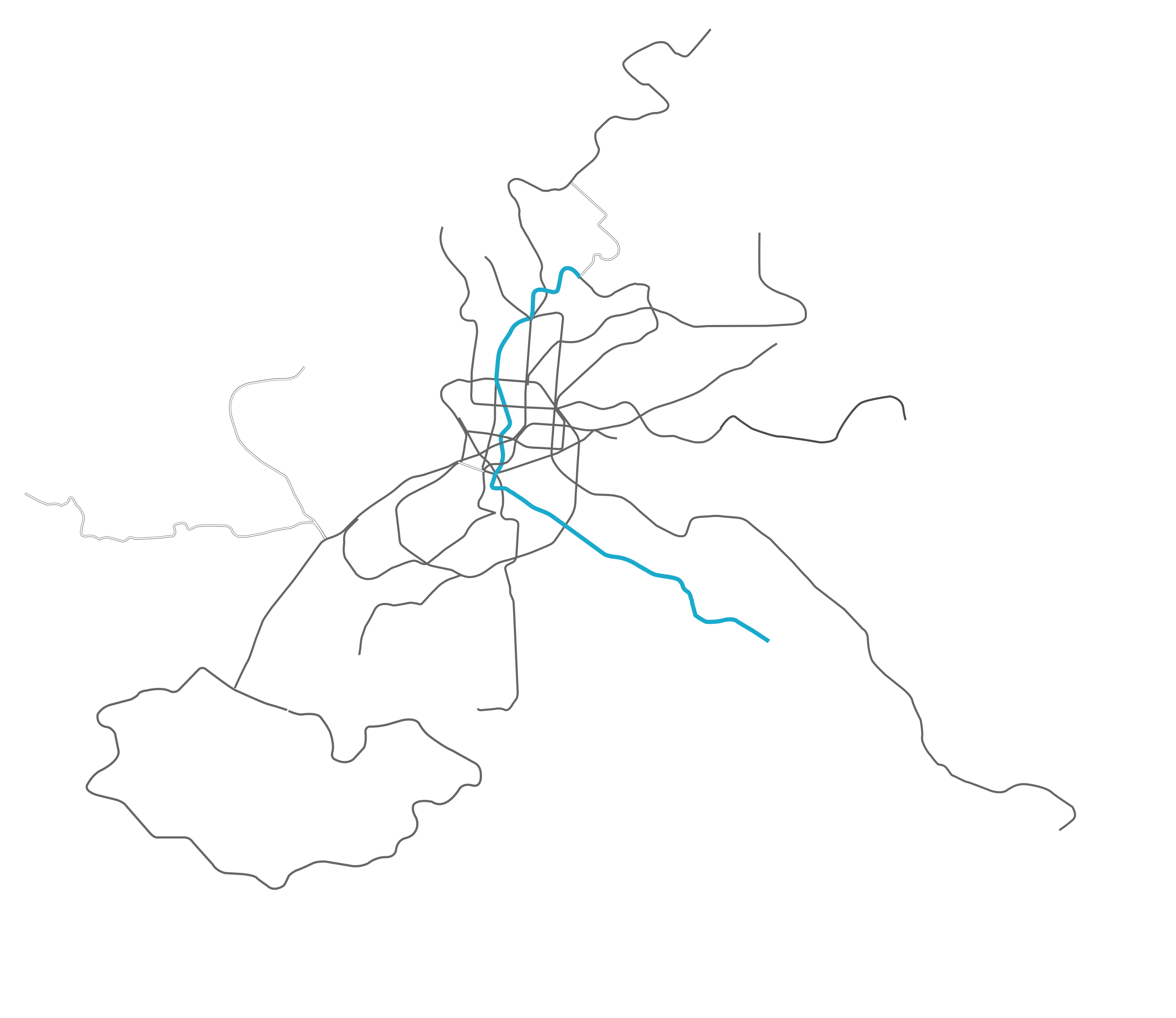
Line 1 of the Madrid Metro is an underground metro line running from Pinar de Chamartín in the north to Valdecarros in the southeast, via Sol. Today it has 33 stations (more than any other line on the Madrid Metro) and spans 24 km from end to end.
The line was the first metro line of the Madrid Metro, and the first metro line built in all of Spain. It originally contained only 8 stops connecting Cuatro Caminos in the north to the city center at Puerta del Sol. Line 1 marks the start of the Madrid Metro with its inauguration on 17 October 1919 and public service beginning 14 days later on 31 October. There have been various extensions to the line since it opened including the most recent northern extension to Pinar de Chamartin on 11 April 2007 and a southern extension on 16 May 2007 to Valdecarros.
Line 1 is the second busiest line on the Madrid Metro, behind Line 6, with more than 7.5 million monthly trips.
History
Original line and pre-war extensions

The Line 1 was the first line of the Madrid Metro, and was inaugurated on 17 October 1919. It was opened to the public on 31 October 1919. It originally ran from and , containing 6 intermediate stops: Red de San Luis (now Gran Vía), Hospicio (now Tribunal), Bilbao, Chamberí, Martinez Campos (now Iglesia), and Ríos Rosas.
The original line was extended from Sol to Atocha in 1921, then further to in 1923. It was extended from Cuatro Caminos to in 1929.
During Franquismo
The line was expanded from Tetuán to in 1961, and from Puente de Vallecas to in 1962.
From 1964 to 1966, station platforms were extended from 60 m to 90 m in order to allow 6-car trains, due to heavy increasing passenger flow. This resulted in the closing of Chamberí station, whose platforms could not be lengthened due to it being located on a sharp curve near Iglesia station. The old Chamberí station, however, was reopened to the public in 2008 as part of the Madrid Metro's project, now functioning primarily as a historic exhibition.
Recent improvements
In recent years, the line has been extended both north and south. Firstly, in 1988 was added between the stations of Atocha and Menéndez Pelayo to serve the new long-distance rail station of Atocha. On 1 April 1994, it was extended from Portazgo to Miguel Hernández and on 4 March 1999 from Miguel Hernández to Congosto.
In 2007, the line was extended to Pinar de Chamartín in two stages. First, on 30 March 2007, the line was extended from Plaza de Castilla to Chamartín, which provides interchange with Line 10 and Renfe services. The new metro complex has line 1 and in the future, line 11 on the lower level and line 10 on the upper level. On 11 April 2007 the extension to Pinar de Chamartín was completed. Here, there is interchange available to Line 4. There are two side platforms for arrivals and an island platform for departures. In May 2007, interchange to Metro Ligero 1 was available, which terminates one level higher.
On 16 May 2007, the line was extended south from Congosto to Valdecarros with two intermediate stations.
Line 1 was closed for reforms from 3 July 2016 to October 2016. 25 of the 33 stations were closed for a €70 million refurbishment project meant to modernize the line, the oldest in the system, and repair tunnel linings and replacing power cables. Replacement buses were offered to patrons during the closure.
Rolling stock
Since the summer of 2007, the line uses CAF class 2000A rolling stock trains. The trains are to be replaced by 40 new trains in the Late 2020s
Stations
| District | Station | Opened | Zone | Connections |
|---|---|---|---|---|
| Ciudad Lineal | 2007 | A | Madrid Metro: | |
| Metro Ligero: | ||||
| Chamartín | 2007 | A | ||
| 1961 | A | Madrid Metro: | ||
| Cercanías Madrid: | ||||
| Renfe Operadora: AVE, Alvia, Altaria, Talgo, Trenhotel | ||||
| Chamartín / Tetuán | 1961 | A | Madrid Metro: | |
| Tetuán | 1961 | A | ||
| 1929 | A | |||
| 1929 | A | |||
| 1929 | A | |||
| Tetuán / Chamberí | 1919 | A | Madrid Metro: | |
| Chamberí | 1919 | A | ||
| 1919 | A | |||
| Chamberí / Centro | 1919 | A | Madrid Metro: | |
| Centro | 1919 | A | Madrid Metro: | |
| 1919 | A | Madrid Metro: | ||
| Cercanías Madrid: | ||||
| 1919 | A | Madrid Metro: | ||
| Cercanías Madrid: | ||||
| 1921 | A | |||
| 1921 | A | |||
| Centro / Retiro | 1926 | A | ||
| Arganzuela | 1988 | A | Cercanías Madrid: | |
| Renfe Operadora: AVE, Alvia, Alaris, Altaria, Talgo | ||||
| Retiro | 1923 | A | ||
| 1923 | A | Madrid Metro: | ||
| Retiro / Puente de Vallecas | 1923 | A | ||
| Puente de Vallecas | 1962 | A | ||
| 1962 | A | |||
| 1994 | A | |||
| 1994 | A | |||
| 1994 | A | |||
| 1999 | A | Cercanías Madrid: | ||
| Villa de Vallecas | 1999 | A | ||
| 1999 | A | |||
| 2007 | A | |||
| 2007 | A | |||
| 2007 | A |
References
References
- "History 1919".
- "History". Metro de Madrid.
- "Map of the network 1925".
- "Map of the network 1932".
- "Map of the network 1964".
- "Andén Cero".
- Pérez-Lanzac, Carmen. (4 July 2016). "The long journey of the Vallecanos". [[El País]].
- (1 March 2016). "Upcoming Madrid subway line closures set to spark travel chaos". El País.
This article was imported from Wikipedia and is available under the Creative Commons Attribution-ShareAlike 4.0 License. Content has been adapted to SurfDoc format. Original contributors can be found on the article history page.
Ask Mako anything about Line 1 (Madrid Metro) — get instant answers, deeper analysis, and related topics.
Research with MakoFree with your Surf account
Create a free account to save articles, ask Mako questions, and organize your research.
Sign up freeThis content may have been generated or modified by AI. CloudSurf Software LLC is not responsible for the accuracy, completeness, or reliability of AI-generated content. Always verify important information from primary sources.
Report