From Surf Wiki (app.surf) — the open knowledge base
Lilium bosniacum
Species of lily
Species of lily
Lilium bosniacum is a lily native to Bosnia and Herzegovina. It is also known as zlatni ljiljan (Bosnian for golden lily) and Bosanski ljiljan (Bosnian lily).
L. bosniacum has often been lumped and split and lumped again. Some results of molecular studies support it as an infraspecific taxon of Lilium carniolicum. Lilium bosniacum, together with Lilium albanicum and Lilium jankae have been treated as varieties of Lilium carniolicum.
However, extensive DNA-analyses have shown that this group is polyphyletic.
Description
Lilium bosniacum Beck ex Fritsch 1909 Section 3b Syn.: L. carniolicum var. bosniacumno
Bulb: ovoid, 6–7 cm in diameter, yellowish.
Stem: 30–90 cm.
Leaves: densely scattered, horizontal with tips curved upwards, narrowly lanceolate with slightly hairy margins.
Flowers: 1–6 in a raceme, nodding, fragrant. Tepals strongly revolute, typical Turk's cap-shape, wax-like texture, yellow to orange without spots, ~6 cm in diameter. Seeds with delayed hypogeal germination. Flowering time ~July. 2n=24.
Origin: Bosnia and Herzegovina.
Symbolic use
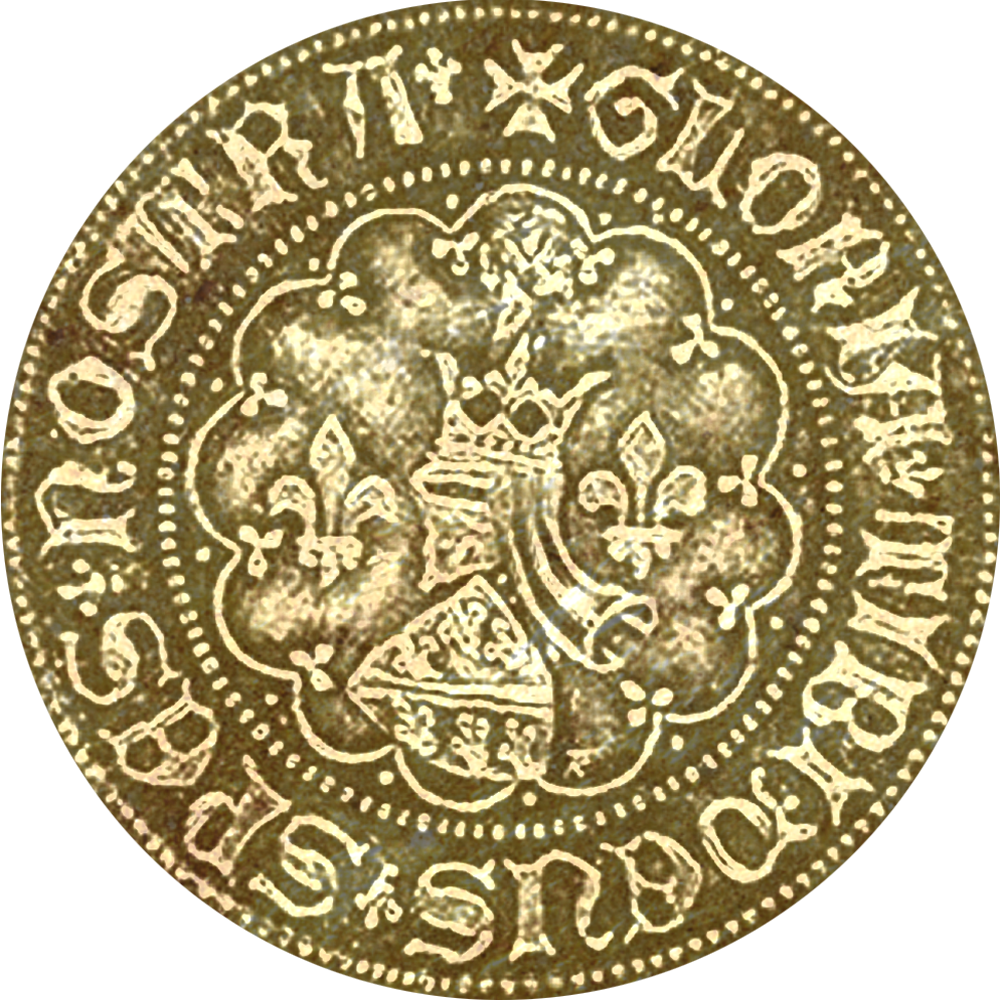
The fleurs-de-lis was the symbol of the House of Kotromanić, a ruling house in medieval Bosnia during the medieval Kingdom of Bosnia, adopted by the first Bosnian king, Tvrtko I, in recognition of the Capetian House of Anjou support in assuming the throne of Bosnia. The coat of arms contained six fleurs-de-lis, where the flower itself is today interpreted by some to be a representation of the autochthonous golden lily, Lilium bosniacum.
The emblem was revived in 1992 as a national symbol of the Republic of Bosnia and Herzegovina and was part of the flag of Bosnia-Herzegovina from 1992 to 1998. The state insignia were changed in 1999. The former flag of the Federation of Bosnia and Herzegovina contains a fleur-de-lis alongside the Croatian chequy. Fleurs also appear in the flags and arms of many cantons, municipalities, cities and towns. Today, it is a traditional symbol of the Bosniak people. It is still used as official insignia of the Bosniak Regiment of the Armed Forces of Bosnia and Herzegovina.
Fleurs-de-lis today also appear in the flags and arms of many cantons, municipalities, cities and towns of Bosnia and Herzegovina.
References
References
- I. Resetnik, Z. Liber, Z. Satovic, P. Cigic, T. Nikolic: ''Molecular phylogeny and systematics of the Lilium carniolicum group (Liliaceae) based on nuclear ITS sequences'', in: Plant Systematics and Evolution, 265: 45–58 (2007)
- [http://www.bgbm.org/willdenowia/w-pdf/wi36-2Ikinci+al.pdf Nursel Ikinci, Christoph Oberprieler, Adil Güner: On the origin of European lilies: phylogenetic analysis of Lilium section Liriotypus (Liliaceae) using sequences of the nuclear ribosomal transcribed spacers, In: Willdenowia 36, 2006, pp. 647–656.]
- Muratović, E., Bogunić, F., Soljan, D., & Siljak-Yakovlev, S. 2005: Does Lilium bosniacum merit species rank? A classical and molecular-cytogenetic analysis. Pl. Syst. Evolution 252: 97–109.
- Filipović, Emir O.. (2019-01-28). "‘Creatio Regni’ in the Great Seal of Bosnian King Tvrtko Kotromanić". Brill.
- "Republic of Bosnia and Herzegovina, 1992–1998". Flagspot.net.
- (4 May 2024). "Šest ljiljana vezenih u zlatu: Koja je simbolika prve zastave Bosne i Hercegovine".
- Resić, Senimir. (2010). "En historia om Balkan – Jugoslaviens uppgång och fall". Historiska Media.
- "SFOR – Bosnia and Herzegovina in ten flags".
- "Zakon o Zastavi Bosne i Hercegovine".
This article was imported from Wikipedia and is available under the Creative Commons Attribution-ShareAlike 4.0 License. Content has been adapted to SurfDoc format. Original contributors can be found on the article history page.
Ask Mako anything about Lilium bosniacum — get instant answers, deeper analysis, and related topics.
Research with MakoFree with your Surf account
Create a free account to save articles, ask Mako questions, and organize your research.
Sign up freeThis content may have been generated or modified by AI. CloudSurf Software LLC is not responsible for the accuracy, completeness, or reliability of AI-generated content. Always verify important information from primary sources.
Report