From Surf Wiki (app.surf) — the open knowledge base
Leukotriene A4
| NFPA-H = | NFPA-F = | NFPA-R = | NFPA-S =
Leukotriene A4 (LTA4) is a leukotriene, and is the precursor for the productions of leukotriene B4 (LTB4) and leukotriene C4 (LTC4).
Biosynthesis
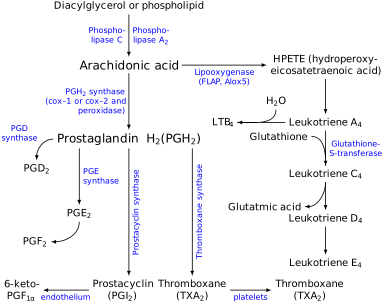
Following the biosynthesis of eicosanoid, triggered as a result of infection or inflammation, the resulting arachidonic acid substrate is released from the cell membrane phospholipid will enter the lipooxygenase pathway to produce leukotriene A4. In this pathway, arachidonic acid is converted into 5-hydroperoxyeicosatetraenoic acid (5-HPETE) as a result of a catalytic complex consisting of the enzyme 5-lipoxygenase (5-LO) and 5-lipoxygenase-activating protein (FLAP) in the presence of ATP and calcium ions. The resulting 5-HPETE yields the unstable allylic epoxide substrate LTA4 which is quickly hydrolyzed by the leukotriene A4 hydrolase (LTA4H) enzyme to produce LTB4, or synthesized by leukotriene C4 synthase (LTC4S) with the addition of glutathione to produce LTC4 which can be further metabolized to produce leukotriene D4 (LTD4) and leukotriene E4 (LTE4). The lipooxygenase pathway is one of several possible pathways including the cyclooxygenase pathway (also PGH synthase pathway), isoprostane pathway, and cytochrome P450 epoxygenases pathway following the arachidonic acid metabolism, but is the only pathway in which the subsequent steps will lead to the production of leukotrienes.
References
References
- (March 2000). "Leukotrienes in gynaecology: the hypothetical value of anti-leukotriene therapy in dysmenorrhoea and endometriosis". Human Reproduction Update.
- Marx, J.L.. (1982-03-12). "The leukotrienes in allergy and inflammation". Science.
- Nicolls, Mark R.. (2013-08-28). "Blocking Macrophage Leukotriene B4 Prevents Endothelial Injury and Reverses Pulmonary Hypertension". Science Translational Medicine.
- (1987-09-04). "Leukotrienes and lipoxins: structures, biosynthesis, and biological effects". Science.
- Nicolls, Mark R.. (2017-05-10). "Leukotriene B4 antagonism ameliorates experimental lymphedema". Science Translational Medicine.
- O'Connor, J. Patrick. (September 2008). "Celecoxib, NSAIDs and the skeleton". Drugs of Today.
This article was imported from Wikipedia and is available under the Creative Commons Attribution-ShareAlike 4.0 License. Content has been adapted to SurfDoc format. Original contributors can be found on the article history page.
Ask Mako anything about Leukotriene A4 — get instant answers, deeper analysis, and related topics.
Research with MakoFree with your Surf account
Create a free account to save articles, ask Mako questions, and organize your research.
Sign up freeThis content may have been generated or modified by AI. CloudSurf Software LLC is not responsible for the accuracy, completeness, or reliability of AI-generated content. Always verify important information from primary sources.
Report