From Surf Wiki (app.surf) — the open knowledge base
Leonardo (ISS module)
Italian module of the International Space Station
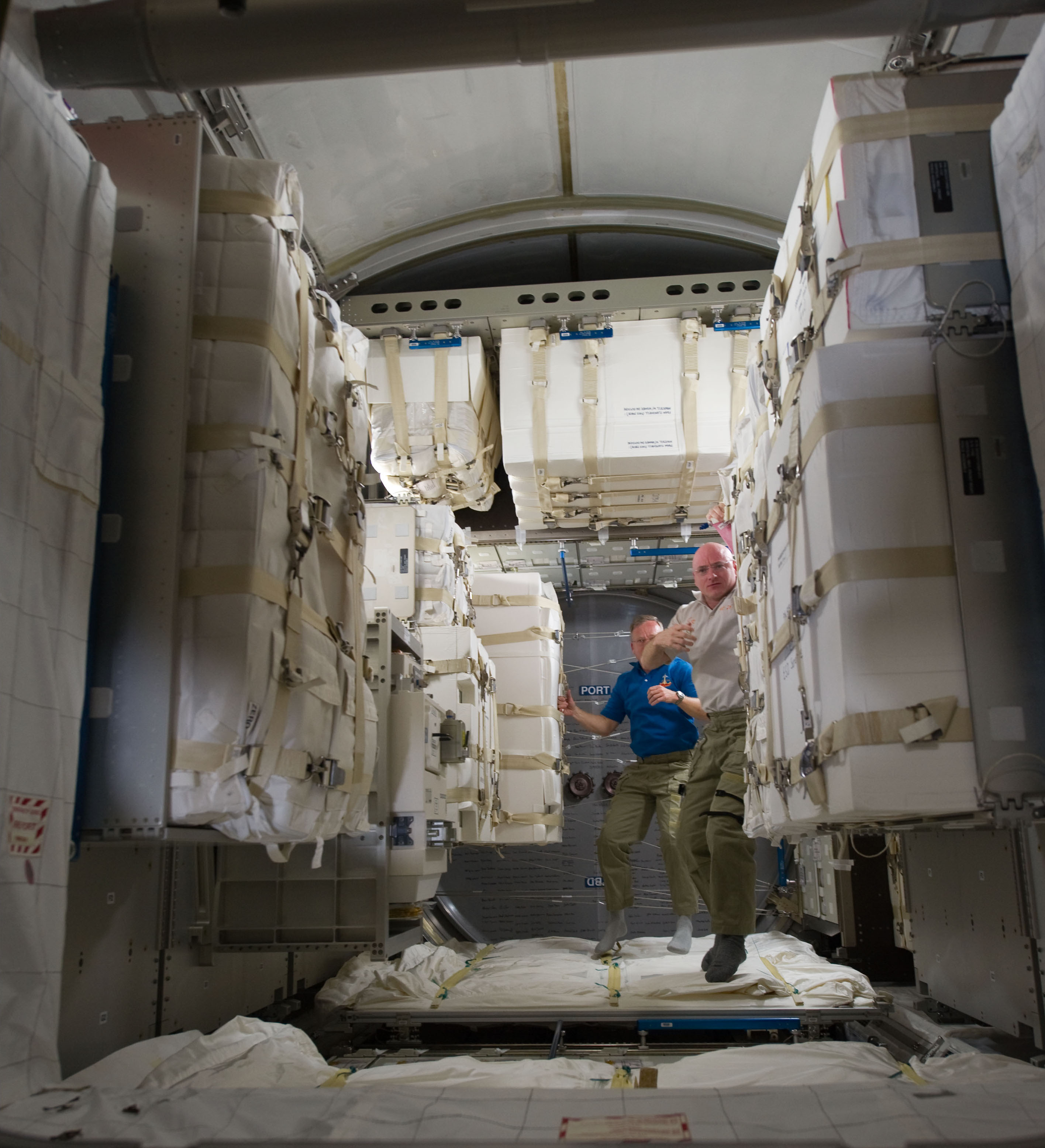
Italian module of the International Space Station
| Field | Value |
|---|---|
| spelling | us |
| module | *Leonardo* |
| module_image | STS-133 ISS-26 Permanent Multipurpose Module.jpg |
| module_image_caption | *Leonardo* Permanent Multipurpose Module |
| station | International Space Station |
| launch | February 24, 2011, 21:53:24UTC |
| launch_vehicle | |
| berthed | March 1, 2011 (*Unity* nadir) |
| mass | 21,817 lb |
| length | 6.6 m |
| diameter | 4.57 m |
| volume | 31 m3 |
| stats_ref |
Leonardo, also known as the Permanent Multipurpose Module (PMM) is a module of the International Space Station. It was flown into space aboard the Space Shuttle Discovery on STS-133 on February 24, 2011, and installed on March 1. Leonardo is primarily used for storage of spares, supplies and waste on the ISS, which was until then stored in many different places within the space station. It is also the personal hygiene area for the astronauts who live in the US Orbital Segment. The Leonardo PMM was a Multi-Purpose Logistics Module (MPLM) before 2011, then was modified into its current configuration. It was formerly one of two MPLM used for bringing cargo to and from the ISS with the Space Shuttle.
Like the other Multi-Purpose Logistics Modules, it was constructed by the Italian Space Agency, who chose to name it after the Italian polymath Leonardo da Vinci. Construction began in April 1996, and the module was delivered to NASA at the Kennedy Space Center in August 1998 by an Airbus Beluga aircraft.
Previous proposals
A European proposal suggested equipping the Donatello MPLM with enhanced micrometeoroid/orbital debris protection and cooling systems, and leaving it attached to the ISS after the Space Shuttle fleet was retired. Costs for such MPLM modifications were estimated at $20M to $40M per unit. The MPLM would then be called a Permanent Multipurpose Module (PMM), and it would house spare parts and supplies, allowing longer times between resupply missions. The proposal was rejected by NASA because it would require changes to existing plans and would entail additional costs. Internal discussions continued and managers considered the possibility of STS-133, which at that time was planned to be the last Shuttle flight, leaving its MPLM permanently attached. The United Launch Alliance also published a proposal for a system that could allow additional ISS modules to be launched on an EELV even after the retirement of the Shuttle.
On August 5, 2009, it was announced that STS-133 would indeed leave one MPLM permanently attached to the station. In October 2009, it was confirmed that Leonardo would be the MPLM converted to a PMM. It was launched on February 24, 2011. The PMM was transferred to the station using the Shuttle robotic arm and mated to the nadir (Earth) facing port of Unity.
On May 27, 2015, at 13:08 UTC, the PMM was relocated from the nadir port of the Unity module to the forward-facing port of the Tranquility module. This was done in order to allow Unity's nadir port to serve as a berthing port for resupply craft, which in turn frees up Harmonys zenith port for future U.S. Commercial Crew Development spacecraft.
After the re-location of Leonardo from the Unity module to the Tranquility module (which is where the toilet is located) in addition to its function as a storage module it is now the personal hygiene area for the ISS astronauts in the US Orbital Segment. Astronauts have much privacy in Leonardo and do sponge baths and change their clothes here.
Raffaello, a MPLM similar to Leonardo, might also be used on Axiom Station after the ISS is decommissioned.
Modifications
After returning to Earth on April 20, 2010, at the end of the STS-131 mission, the Leonardo MPLM was moved to the Space Station Processing Facility (SSPF) at the Kennedy Space Center in Florida to undergo modifications. To convert the Leonardo MPLM into the PMM, NASA made the following modifications: removal of +Y grapple fixture (Flight Releasable Grapple Fixture, or FRGF), removal of ROFU (Remotely Operated Fluid Umbilical) components, replacement of CBM seal, installation of new forward end cone MMOD shields, feed through seal replacement, and installation of visiting vehicle retro-reflectors.
In addition, the Multi-layer insulation (MLI) blankets from the never-flown Donatello MPLM were cannibalized for use on Leonardo. The blankets were removed and returned to Italy where they were reinforced with Nextel/Kevlar to provide better protection against micro-meteorites. The upgraded blankets were then installed on about two-thirds of Leonardos surface area.
The Leonardo PMM mass is 21,817 lb.
As an MPLM
The Leonardo MPLM, also known as MPLM-1, was one of three Multi-Purpose Logistics Modules which were operated by NASA to transfer supplies and equipment to and from the International Space Station. Leonardo was used for eight of the twelve MPLM flights to the space station, with Raffaello being used for the other four. It was the first MPLM to be launched, making its first flight in March 2001, aboard on STS-102.
Flights
| Mission | Orbiter | last=McDowell | first=Jonathan | title=Launch Log | url=http://planet4589.org/space/log/launchlog.txt | publisher=Jonathan's Space Page | access-date=May 17, 2010}} | Landing (UTC) | Remarks |
|---|---|---|---|---|---|---|---|---|---|
| STS-102 | *Discovery* | March 8, 2001 | March 21, 2001 | ||||||
| STS-105 | *Discovery* | August 10, 2001 | August 22, 2001 | ||||||
| STS-111 | *Endeavour* | June 5, 2002 | June 19, 2002 | ||||||
| STS-121 | *Discovery* | July 4, 2006 | July 17, 2006 | ||||||
| STS-126 | *Endeavour* | November 15, 2008 | November 30, 2008 | ||||||
| STS-128 | *Discovery* | August 29, 2009 | September 11, 2009 | ||||||
| STS-131 | *Discovery* | April 5, 2010 | April 20, 2010 | ||||||
| STS-133 | *Discovery* | February 24, 2011 | N/A | *Leonardo* was left on-station to become the PMM. |
References
References
- "What is MPLM?". NASA Marshall Space Flight Center.
- "Multi-Purpose Logistics Modules". NASA.
- Coppinger, Rob. (April 2, 2008). "NASA rejects European ISS logistics project". Flightglobal.com.
- Coppinger, Rob. (June 24, 2008). "NASA: MPLM may stay on orbit, docking rules to change and launch-on-need re-designated?". Flightglobal.com.
- Bergin, Chris. (May 5, 2009). "ISS considering the permanent attachment MPLM, advancement of STS-134". NASAspaceflight.com.
- Foster, Mark. "System-of-Space Systems Architecture Utilizing Existing Space Assets to Complete and Re-Supply the International Space Station".
- Gebhardt, Chris. (August 5, 2009). "STS-133 refined to a five crew, one EVA mission – will leave MPLM on ISS". NASAspaceflight.com.
- (September 27, 2009). "Shuttle Q&A Part 5". NASASpaceflight.com.
- (May 27, 2015). "Module Relocated Prepping Station for Commercial Crew {{!}} Space Station".
- https://www.youtube.com/watch?v=Snn1k_qEx20&t=34m11s . Courtesy of the European Space Agency, ESA. Retrieved December 12, 2020
- "Axiom Space Builds the World's First Commercial Space Station".
- "Spaceflight Now | STS-133 Shuttle Report | Roomy addition for space station ready to launch".
- "STS-133 Press Kit". NASA.
- McDowell, Jonathan. "Launch Log". Jonathan's Space Page.
This article was imported from Wikipedia and is available under the Creative Commons Attribution-ShareAlike 4.0 License. Content has been adapted to SurfDoc format. Original contributors can be found on the article history page.
Ask Mako anything about Leonardo (ISS module) — get instant answers, deeper analysis, and related topics.
Research with MakoFree with your Surf account
Create a free account to save articles, ask Mako questions, and organize your research.
Sign up freeThis content may have been generated or modified by AI. CloudSurf Software LLC is not responsible for the accuracy, completeness, or reliability of AI-generated content. Always verify important information from primary sources.
Report