From Surf Wiki (app.surf) — the open knowledge base
Lemniscate
Figure-eight-shaped curve

Figure-eight-shaped curve
In algebraic geometry, a lemniscate ( or ) is any of several figure-eight or ∞-shaped curves. The word comes from the Latin , meaning "decorated with ribbons", from the Greek (), meaning "ribbon", or which alternatively may refer to the wool from which the ribbons were made.
Curves that have been called a lemniscate include three quartic plane curves: the hippopede or lemniscate of Booth, the lemniscate of Bernoulli, and the lemniscate of Gerono. The hippopede was studied by Proclus (5th century), but the term "lemniscate" was not used until the work of Jacob Bernoulli in the late 17th century.
History and examples
Lemniscate of Booth
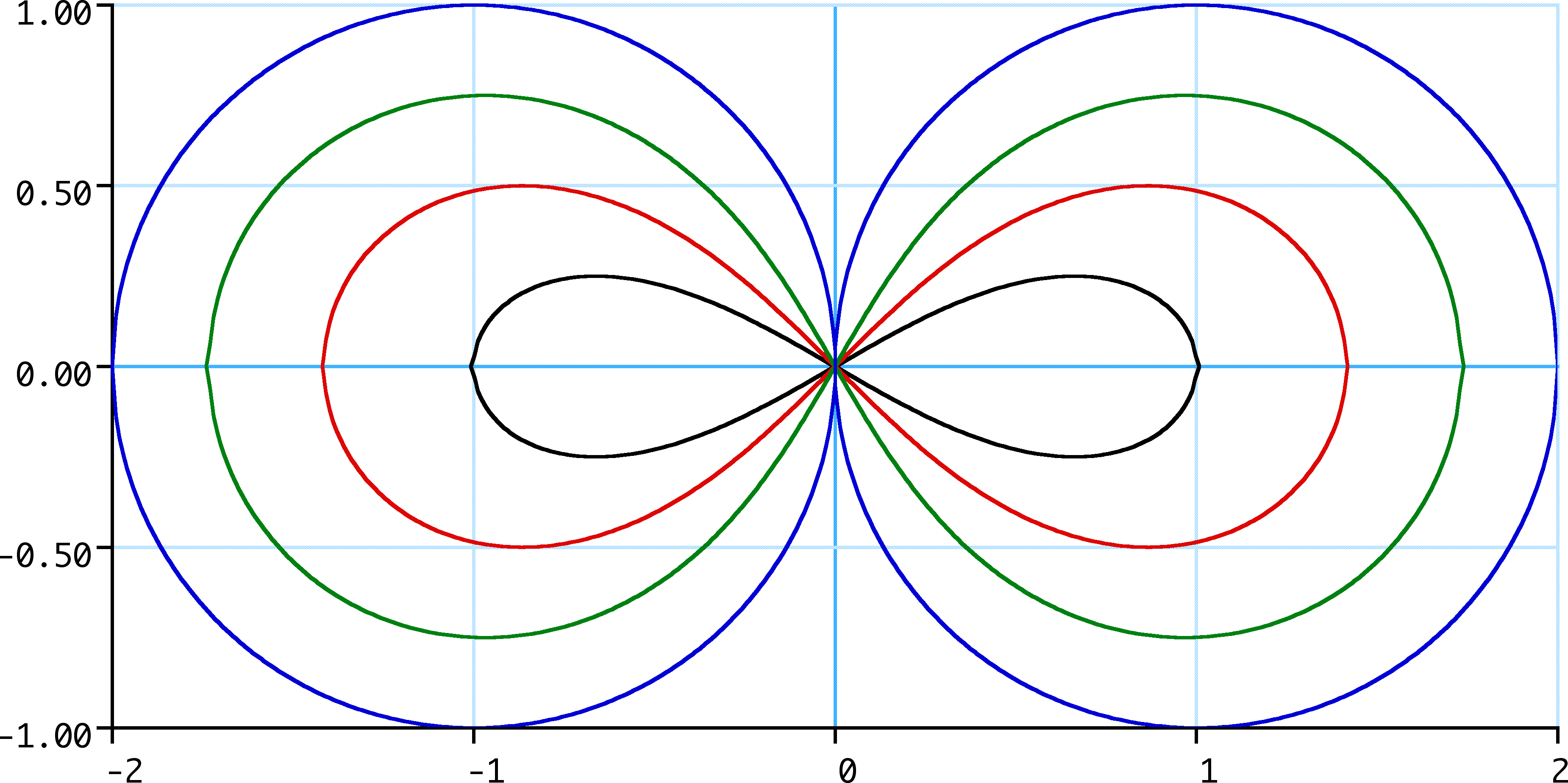
Main article: Hippopede
The consideration of curves with a figure-eight shape can be traced back to Proclus, a Greek Neoplatonist philosopher and mathematician who lived in the 5th century AD. Proclus considered the cross-sections of a torus by a plane parallel to the axis of the torus. As he observed, for most such sections the cross section consists of either one or two ovals; however, when the plane is tangent to the inner surface of the torus, the cross-section takes on a figure-eight shape, which Proclus called a horse fetter (a device for holding two feet of a horse together), or "hippopede" in Greek. The name "lemniscate of Booth" for this curve dates to its study by the 19th-century mathematician James Booth.{{citation
The lemniscate may be defined as an algebraic curve, the zero set of the quartic polynomial (x^2 + y^2)^2 - cx^2 - dy^2 when the parameter d is negative (or zero for the special case where the lemniscate becomes a pair of externally tangent circles). For positive values of d one instead obtains the oval of Booth.
Lemniscate of Bernoulli
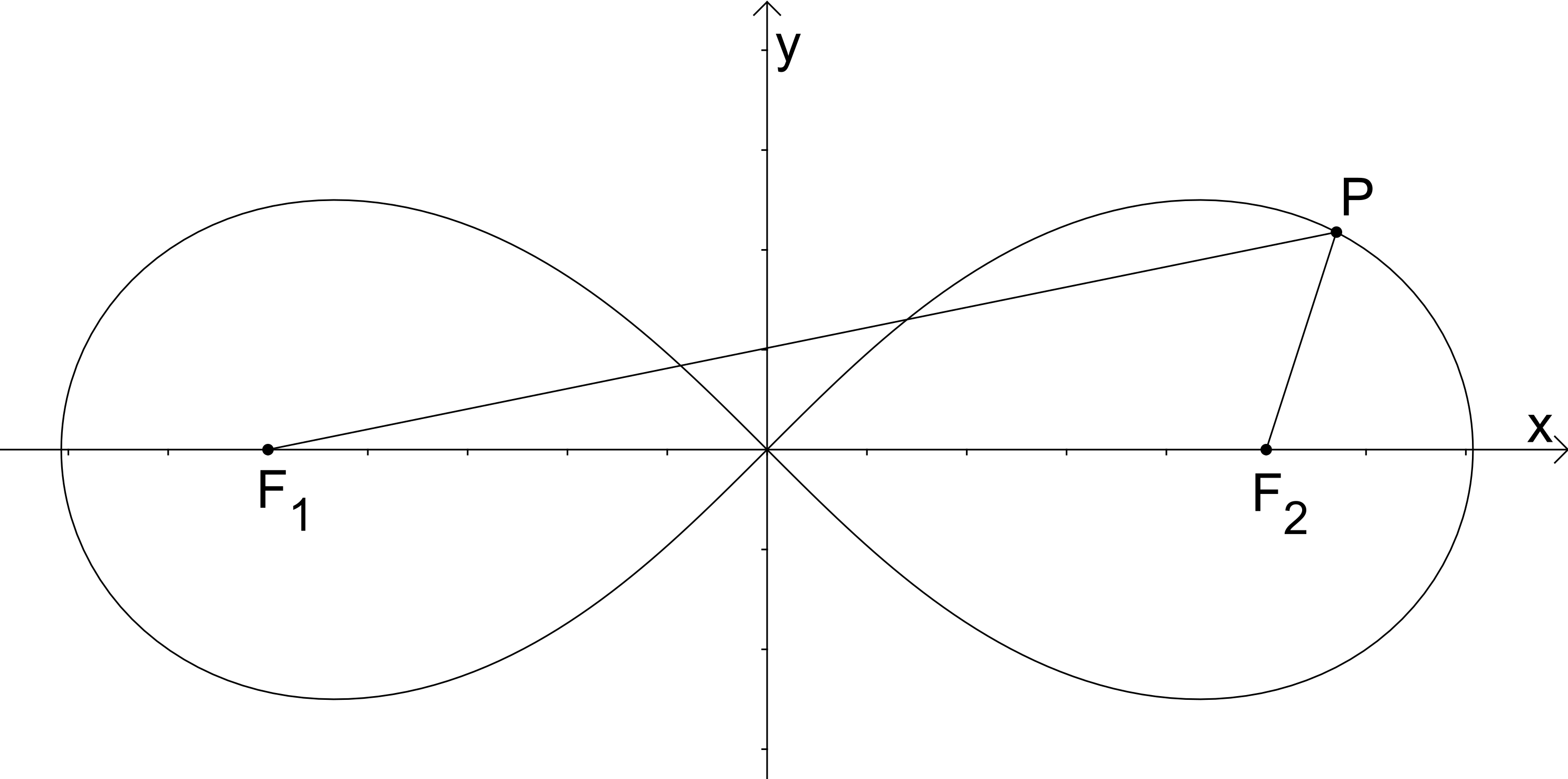
Main article: Lemniscate of Bernoulli
In 1680, Cassini studied a family of curves, now called the Cassini oval, defined as follows: the locus of all points, the product of whose distances from two fixed points, the curves' foci, is a constant. Under very particular circumstances (when the half-distance between the points is equal to the square root of the constant) this gives rise to a lemniscate.
In 1694, Johann Bernoulli studied the lemniscate case of the Cassini oval, now known as the lemniscate of Bernoulli (shown above), in connection with a problem of "isochrones" that had been posed earlier by Leibniz. Like the hippopede, it is an algebraic curve, the zero set of the polynomial (x^2 + y^2)^2 - a^2 (x^2 - y^2). Bernoulli's brother Jacob Bernoulli also studied the same curve in the same year, and gave it its name, the lemniscate.{{citation
Lemniscate of Gerono
Main article: Lemniscate of Gerono

Another lemniscate, the lemniscate of Gerono or lemniscate of Huygens, is the zero set of the quartic polynomial y^2-x^2(a^2-x^2). Viviani's curve, a three-dimensional curve formed by intersecting a sphere with a cylinder, also has a figure eight shape, and has the lemniscate of Gerono as its planar projection.
Others
Other figure-eight shaped algebraic curves include
- The Devil's curve, a curve defined by the quartic equation y^2 (y^2 - a^2) = x^2 (x^2 - b^2) in which one connected component has a figure-eight shape,
- Watt's curve, a figure-eight shaped curve formed by a mechanical linkage. Watt's curve is the zero set of the degree-six polynomial equation (x^2+y^2)(x^2+y^2-d^2)^2+4a^2y^2(x^2+y^2-b^2)=0 and has the lemniscate of Bernoulli as a special case.
References
References
- {{cite Dictionary.com. lemniscate
- {{L&S. lemniscatus. ref
- Erickson, Martin J.. (2011). "Beautiful Mathematics". [[Mathematical Association of America]].
- {{OEtymD. lemniscus
- {{L&S. lemniscus. ref
- {{LSJ. lhmni/skos. λημνίσκος. ref.
- {{LSJ. i(ppope/dh. ἱπποπέδη. shortref.
- Köller, Jürgen. "Acht-Kurve".
- Basset, Alfred Barnard. (1901). "An elementary treatise on cubic and quartic curves". Deighton, Bell.
- Chandrasekhar, S. (2003). "Newton's Principia for the common reader". Oxford University Press.
- (2005). "Aesthetics and architectural composition : proceedings of the Dresden International Symposium of Architecture 2004". Pro Literatur.
- Darling, David. (2004). "The Universal Book of Mathematics: From Abracadabra to Zeno's Paradoxes". John Wiley & Sons.
This article was imported from Wikipedia and is available under the Creative Commons Attribution-ShareAlike 4.0 License. Content has been adapted to SurfDoc format. Original contributors can be found on the article history page.
Ask Mako anything about Lemniscate — get instant answers, deeper analysis, and related topics.
Research with MakoFree with your Surf account
Create a free account to save articles, ask Mako questions, and organize your research.
Sign up freeThis content may have been generated or modified by AI. CloudSurf Software LLC is not responsible for the accuracy, completeness, or reliability of AI-generated content. Always verify important information from primary sources.
Report