From Surf Wiki (app.surf) — the open knowledge base
Languages of Europe
none

none
There are over 250 languages indigenous to Europe, and most belong to the Indo-European language family. Out of a total European population of 744 million as of 2018, some 94% are native speakers of an Indo-European language. The three largest phyla of the Indo-European language family in Europe are Romance, Germanic, and Slavic; they have more than 200 million speakers each, and together account for close to 90% of Europeans.
Smaller phyla of Indo-European found in Europe include Hellenic (Greek, 13 million), Baltic ( 4.5 million), Albanian ( 7.5 million), Celtic ( 4 million), and Armenian ( 4 million). Indo-Aryan, though a large subfamily of Indo-European, has a relatively small number of languages in Europe, and a small number of speakers (Romani, 1.5 million). However, a number of Indo-Aryan languages not native to Europe are spoken in Europe today.
Of the approximately 45 million Europeans speaking non-Indo-European languages, most speak languages within either the Uralic or Turkic families. Still smaller groups — such as Basque (language isolate), Semitic languages (Maltese, 0.5 million), and various languages of the Caucasus — account for less than 1% of the European population among them. Immigration has added sizeable communities of speakers of African and Asian languages, amounting to about 4% of the population, with Arabic being the most widely spoken of them.
Five languages have more than 50 million native speakers in Europe: Russian, German, French, Italian, and English. Russian is the most-spoken native language in Europe, and English has the largest number of speakers in total, including some 200 million speakers of English as a second or foreign language. (See English language in Europe.)
Indo-European languages
The Indo-European language family is descended from Proto-Indo-European, which is believed to have been spoken thousands of years ago. Early speakers of Indo-European daughter languages most likely expanded into Europe with the incipient Bronze Age, around 4,000 years ago (Bell-Beaker culture).
Germanic

The present-day distribution of the Germanic languages in Europe: North Germanic languages West Germanic Languages Dots indicate areas where multilingualism is common.]]
The Germanic languages make up the predominant language family in Western, Northern and Central Europe. It is estimated that over 500 million Europeans are speakers of Germanic languages, the largest groups being German ( 95 million), English ( 400 million), Dutch ( 24 million), Swedish ( 10 million), Danish ( 6 million), Norwegian ( 5 million) and Limburgish (c. 1.3 million).
There are two extant major sub-divisions: West Germanic and North Germanic. A third group, East Germanic, is now extinct; the only known surviving East Germanic texts are written in the Gothic language. West Germanic is divided into Anglo-Frisian (including English), Low German, Low Franconian (including Dutch) and High German (including Standard German).
Anglo-Frisian
Main article: Anglo-Frisian languages, English language in Europe
The Anglo-Frisian language family is now mostly represented by English (Anglic), descended from the Old English language spoken by the Anglo-Saxons:
- English, the main language of the United Kingdom and the most widespread language in the Republic of Ireland, also spoken as a second or third language by many Europeans.
- Scots, spoken in Scotland and Ulster, recognized by some as a language and by others as a dialect of English (not to be confused with Scots-Gaelic of the Celtic language family). The Frisian languages are spoken by about 400,000 () Frisians, who live on the southern coast of the North Sea in the Netherlands and Germany. These languages include West Frisian, East Frisian (of which the only surviving dialect is Saterlandic) and North Frisian.
Dutch
Main article: Dutch language#Europe{{!}}Dutch-speaking Europe, Dutch language, Low Franconian
Dutch is spoken throughout the Netherlands, the northern half of Belgium, as well as the Nord-Pas de Calais region of France. The traditional dialects of the Lower Rhine region of Germany are linguistically more closely related to Dutch than to modern German. In Belgian and French contexts, Dutch is sometimes referred to as Flemish. Dutch dialects are numerous and varied.
German
Main article: German language, Geographical distribution of German speakers
German is spoken throughout Germany, Austria, Liechtenstein, much of Switzerland, northern Italy (South Tyrol), Luxembourg, the East Cantons of Belgium and the Alsace and Lorraine regions of France.
There are several groups of German dialects:
- High German includes several dialect families:
- Standard German
- Central German dialects, spoken in central Germany and including Luxembourgish
- High Franconian, a family of transitional dialects between Central and Upper High German
- Upper German, including Bavarian and Swiss German
- Yiddish is a Jewish language developed in Germany and Eastern Europe. It shares many features of High German dialects and Hebrew.
[[Low German]]
Low German is spoken in various regions throughout Northern Germany and the northern and eastern parts of the Netherlands. It may be separated into West Low German and East Low German.
North Germanic (Scandinavian)
The North Germanic languages are spoken in Nordic countries and include Swedish (Sweden and parts of Finland), Danish (Denmark), Norwegian (Norway), Icelandic (Iceland), Faroese (Faroe Islands), and Elfdalian (in a small part of central Sweden).
English has a long history of contact with Scandinavian languages, given the immigration of Scandinavians early in the history of Britain, and shares various features with the Scandinavian languages. Even so, especially Dutch and Swedish, but also Danish and Norwegian, have strong vocabulary connections to the German language.
Romance
Roughly 215 million Europeans (primarily in Southern and Western Europe) are native speakers of Romance languages, the largest groups including:
French ( 72 million), Italian ( 65 million), Spanish ( 40 million), Romanian ( 24 million), Portuguese ( 10 million), Catalan ( 7 million), Neapolitan ( 6 million), Sicilian ( 5 million), Venetian ( 4 million), Galician ( 2 million), Sardinian ( 1 million), Occitan ( 500,000), besides numerous smaller communities.
The Romance languages evolved from varieties of Vulgar Latin spoken in the various parts of the Roman Empire in Late Antiquity. Latin was itself part of the (otherwise extinct) Italic branch of Indo-European. Romance languages are divided phylogenetically into Italo-Western, Eastern Romance (including Romanian) and Sardinian. The Romance-speaking area of Europe is occasionally referred to as Latin Europe.
Italo-Western can be further broken down into the Italo-Dalmatian languages (sometimes grouped with Eastern Romance), including the Tuscan-derived Italian and numerous local Romance languages in Italy as well as Dalmatian, and the Western Romance languages. The Western Romance languages in turn separate into the Gallo-Romance languages, including Langues d'oïl such as French, the Francoprovencalic languages Arpitan and Faetar, the Rhaeto-Romance languages, and the Gallo-Italic languages; the Occitano-Romance languages, grouped with either Gallo-Romance or East Iberian, including Occitanic languages such as Occitan and Gardiol, and Catalan; Aragonese, grouped in with either Occitano-Romance or West Iberian, and finally the West Iberian languages, including the Astur-Leonese languages, the Galician-Portuguese languages, and the Castilian languages.
Slavic
.svg)
]]
Slavic languages are spoken in large areas of Southern, Central and Eastern Europe. An estimated 315 million people speak a Slavic language, the largest groups being Russian ( 110 million in European Russia and adjacent parts of Eastern Europe, Russian forming the largest linguistic community in Europe), Polish ( 40 million), Ukrainian ( 33 million), Serbo-Croatian ( 18 million), Czech ( 11 million), Bulgarian ( 8 million), Slovak ( 5 million), Belarusian (c. 3.7 million), Slovene ( 2.3 million) and Macedonian ( 1.6 million).
Phylogenetically, Slavic is divided into three subgroups:
- West Slavic includes Polish, Polabian, Czech, Knaanic, Slovak, Lower Sorbian, Upper Sorbian, Silesian and Kashubian.
- East Slavic includes Russian, Ukrainian, Belarusian, Ruthenian, and Rusyn.
- South Slavic includes Slovene and Serbo-Croatian in the southwest and Bulgarian, Macedonian and Church Slavonic (a liturgical language) in the southeast, each with numerous distinctive dialects. South Slavic languages constitute a dialect continuum where standard Slovene, Macedonian and Bulgarian are each based on a distinct dialect, whereas pluricentric Serbo-Croatian boasts four mutually intelligible national standard varieties all based on a single dialect, Shtokavian.
Others
- Greek ( 13 million) is the official language of Greece and Cyprus, and there are Greek-speaking enclaves in Albania, Bulgaria, Italy, North Macedonia, Romania, Georgia, Ukraine, Lebanon, Egypt, Israel, Jordan, and Turkey, and in Greek communities around the world. Dialects of modern Greek that originate from Attic Greek (through Koine and then Medieval Greek) are Cappadocian, Pontic, Cretan, Cypriot, Katharevousa, and Yevanic.
- Italiot Greek is, debatably, a Doric dialect of Greek. It is spoken in southern Italy only, in the southern Calabria region (as Grecanic) and in the Salento region (as Griko). It was studied by the German linguist Gerhard Rohlfs during the 1930s and 1950s.
- Tsakonian is a Doric dialect of the Greek language spoken in the lower Arcadia region of the Peloponnese around the village of Leonidio
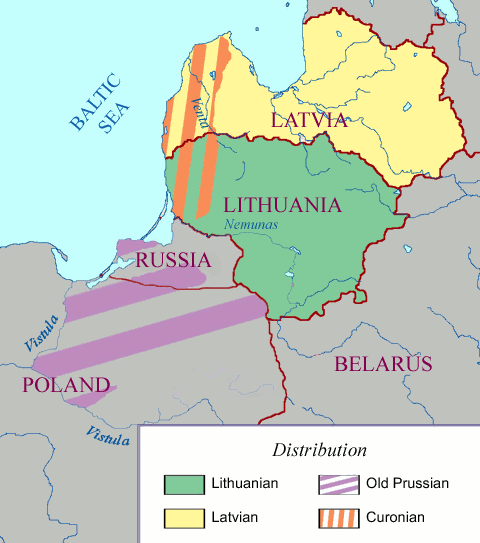
- The Baltic languages are spoken in Lithuania (Lithuanian ( 3 million), Samogitian) and Latvia (Latvian ( 1.5 million), Latgalian). Samogitian and Latgalian used to be considered dialects of Lithuanian and Latvian respectively.
- There are also several extinct Baltic languages, including: Curonian, Galindian, Old Prussian, Selonian, Semigallian, and Sudovian.
- Albanian ( 7.5 million) has two major dialects, Tosk Albanian and Gheg Albanian. It is spoken in Albania and Kosovo, neighboring North Macedonia, Serbia, Italy, and Montenegro. It is also widely spoken in the Albanian diaspora.
- Armenian ( 7 million) has two major forms, Western Armenian and Eastern Armenian. It is spoken in Armenia, Azerbaijan, Georgia (Samtskhe-Javakheti) and Abkhazia, also Russia, France, Italy, Turkey, Greece, and Cyprus. It is also widely spoken in the Armenian Diaspora.
- There are six living Celtic languages, spoken in areas of northwestern Europe dubbed the "Celtic nations". All six are members of the Insular Celtic family, which in turn is divided into:
- Brittonic family: Welsh (Wales, 843,500), Cornish (Cornwall, 500) and Breton (Brittany, 206,000)
- Goidelic family: Irish (Ireland, 1.7 million), Scottish Gaelic (Scotland, 57,400), and Manx (Isle of Man, 1,660) : Continental Celtic languages had previously been spoken across Europe from Iberia and Gaul to Asia Minor, but became extinct in the first millennium CE.
- The Indo-Aryan languages have one major representative: Romani ( 4.6 million speakers), introduced in Europe during the late medieval period. Lacking a nation state, Romani is spoken as a minority language throughout Europe.
- The Iranian languages in Europe are natively represented in the North Caucasus, notably with Ossetian ( 600,000).
Uralic languages
Main article: Uralic languages
.png)
The Uralic language family is native to northern Eurasia. Finnic languages include Finnish ( 5 million) and Estonian ( 1 million), as well as smaller languages such as Kven ( 8,000). Other languages of the Finno-Permic branch of the family include e.g. Mari (c. 400,000), and the Sami languages ( 30,000).
The Ugric branch of the language family is represented in Europe by the Hungarian language ( 13 million), historically introduced with the Hungarian conquest of the Carpathian Basin of the 9th century. The Samoyedic Nenets language is spoken in Nenets Autonomous Okrug of Russia, located in the far northeastern corner of Europe (as delimited by the Ural Mountains).
Semitic languages
Main article: Semitic languages
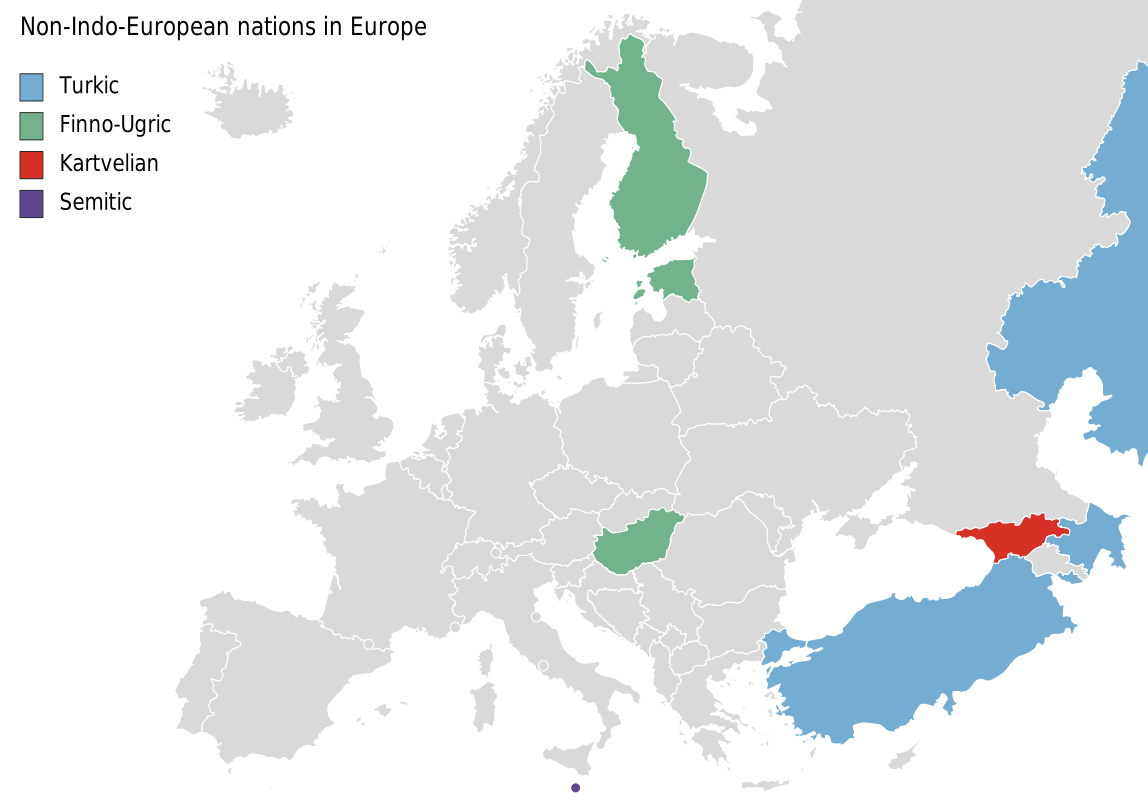
- Maltese ( 500,000) is a Semitic language with Romance and Germanic influences, spoken in Malta. It is based on Sicilian Arabic, with influences from Sicilian, Italian, French and, more recently, English. It is the only Semitic language whose standard form is written in Latin script. It is also the second smallest official language of the EU in terms of speakers (after Irish), and the only official Semitic language within the EU.
- Cypriot Maronite Arabic (also known as Cypriot Arabic) is a variety of Arabic spoken by Maronites in Cyprus. Most speakers live in Nicosia, but others are in the communities of Kormakiti and Lemesos. Brought to the island by Maronites fleeing Lebanon over 700 years ago, this variety of Arabic has been influenced by Greek in both phonology and vocabulary, while retaining certain unusually archaic features in other respects.
- Eastern Aramaic, a Semitic language is spoken by Assyrian communities in the Caucasus and southern Russia who fled the Assyrian Genocide during World War I, and also by Assyrian communities in the Assyrian diaspora in other parts of Europe.
Turkic languages
Main article: Turkic languages

- Oghuz languages in Europe include Turkish, spoken in East Thrace and by immigrant communities; Azerbaijani is spoken in Northeast Azerbaijan and parts of Southern Russia and Gagauz is spoken in Gagauzia.
- Kipchak languages in Europe include Karaim, Crimean Tatar and Krymchak, which is spoken mainly in Crimea; Tatar, which is spoken in Tatarstan; Bashkir, which is spoken in Bashkortostan; Karachay-Balkar, which is spoken in the North Caucasus, and Kazakh, which is spoken in Northwest Kazakhstan.
- Oghur languages were historically indigenous to much of Eastern Europe; however, most of them are extinct today, with the exception of Chuvash, which is spoken in Chuvashia.
Other languages
- The Basque language (or Euskara, 750,000) is a language isolate and the ancestral language of the Basque people who inhabit the Basque Country, a region in the western Pyrenees mountains mostly in northeastern Spain and partly in southwestern France of about 3 million inhabitants, where it is spoken fluently by about 750,000 and understood by more than 1.5 million people. Basque is directly related to ancient Aquitanian, and it is likely that an early form of the Basque language was present in Western Europe before the arrival of the Indo-European languages in the area in the Bronze Age.
- The Northwest Caucasian family (including Abkhaz and Circassian).
- The Northeast Caucasian family, spoken mainly in the border area of the southern Russian Federation (including Dagestan, Chechnya, and Ingushetia) and northern Azerbaijan.
- Kalmyk is a Mongolic language, spoken in the Republic of Kalmykia, part of the Russian Federation. Its speakers entered the Volga region in the early 17th century.
- Kartvelian languages (also known as South Caucasian languages), the most common of which is Georgian ( 3.5 million), others being Mingrelian, Laz and Svan, spoken mainly in the Caucasus and Anatolia.
Sign languages
Main article: List of sign languages#Europe
Several dozen manual languages exist across Europe, with the most widespread sign language family being the Francosign languages, with its languages found in countries from Iberia to the Balkans and the Baltics. Accurate historical information of sign and tactile languages is difficult to come by, with folk histories noting the existence signing communities across Europe hundreds of years ago. British Sign Language (BSL) and French Sign Language (LSF) are probably the oldest confirmed, continuously used sign languages. Alongside German Sign Language (DGS) according to Ethnologue, these three have the most numbers of signers, though very few institutions take appropriate statistics on contemporary signing populations, making legitimate data hard to find.
Notably, few European sign languages have overt connections with the local majority/oral languages, aside from standard language contact and borrowing, meaning grammatically the sign languages and the oral languages of Europe are quite distinct from one another. Due to (visual/aural) modality differences, most sign languages are named for the larger ethnic nation in which they are spoken, plus the words "sign language", rendering what is spoken across much of France, Wallonia and Romandy as French Sign Language or LSF for: langue des signes française.
Recognition of non-oral languages varies widely from region to region. Some countries afford legal recognition, even to official on a state level, whereas others continue to be actively suppressed.
Though "there is a widespread belief—among both Deaf people and sign language linguists—that there are sign language families," the actual relationship between sign languages is difficult to ascertain. Concepts and methods used in historical linguistics to describe language families for written and spoken languages are not easily mapped onto signed languages. Some of the current understandings of sign language relationships, however, provide some reasonable estimates about potential sign language families:
- Francosign languages, such as LSF, ASL, Dutch Sign Language, Flemish Sign Language, and Italian Sign Language.
- BANZSL languages, including British Sign Language (BSL), New Zealand Sign Language (NZSL), Australian Sign Language (Auslan), and Swedish Sign Language.
- Isolate languages, such as Albanian Sign Language, Armenian Sign Language, Caucasian Sign Language, Spanish Sign Language (LSE), Turkish Sign Language (TİD), and perhaps Ghardaia Sign Language.
- Many other sign languages, such as Irish Sign Language (ISL), have unclear origins.
History of standardization
Language and identity, standardization processes
In the Middle Ages the two most important defining elements of Europe were Christianitas and Latinitas.
The earliest dictionaries were glossaries: more or less structured lists of lexical pairs (in alphabetical order or according to conceptual fields). The Latin-German (Latin-Bavarian) Abrogans was among the first. A new wave of lexicography can be seen from the late 15th century onwards (after the introduction of the printing press, with the growing interest in standardization of languages).
The concept of the nation state began to emerge in the early modern period. Nations adopted particular dialects as their national language. This, together with improved communications, led to official efforts to standardize the national language, and a number of language academies were established: 1582 Accademia della Crusca in Florence, 1617 Fruchtbringende Gesellschaft in Weimar, 1635 Académie française in Paris, 1713 Real Academia Española in Madrid. Language became increasingly linked to nation as opposed to culture, and was also used to promote religious and ethnic identity: e.g. different Bible translations in the same language for Catholics and Protestants.
The first languages whose standardisation was promoted included Italian (questione della lingua: Modern Tuscan/Florentine vs. Old Tuscan/Florentine vs. Venetian → Modern Florentine + archaic Tuscan + Upper Italian), French (the standard is based on Parisian), English (the standard is based on the London dialect) and (High) German (based on the dialects of the chancellery of Meissen in Saxony, Middle German, and the chancellery of Prague in Bohemia ("Common German")). But several other nations also began to develop a standard variety in the 16th century.
Lingua franca
Europe has had a number of languages that were considered linguae francae over some ranges for some periods according to some historians. Typically in the rise of a national language the new language becomes a lingua franca to peoples in the range of the future nation until the consolidation and unification phases. If the nation becomes internationally influential, its language may become a lingua franca among nations that speak their own national languages. Europe has had no lingua franca ranging over its entire territory spoken by all or most of its populations during any historical period. Some linguae francae of past and present over some of its regions for some of its populations are:
- Classical Greek and then Koine Greek in the Mediterranean Basin from the Athenian Empire to the Eastern Roman Empire, being replaced by Modern Greek.
- Koine Greek and Modern Greek, in the Eastern Roman or Byzantine Empire and other parts of the Balkans south of the Jireček Line.
- Vulgar Latin and Late Latin among the uneducated and educated populations respectively of the Roman Empire and the states that followed it in the same range no later than 900 AD; Medieval Latin and Renaissance Latin among the educated populations of western, northern, central and part of eastern Europe until the rise of the national languages in that range, beginning with the first language academy in Italy in 1582/83; Neo-Latin written only in scholarly and scientific contexts by a small minority of the educated population at scattered locations over all of Europe; ecclesiastical Latin, in spoken and written contexts of liturgy and church administration only, over the range of the Roman Catholic Church.
- Old Occitan in central and southern France, north-western Italy and the main territories of the crown of Aragon (Catalonia, Valencia, the Balearic Islands and Aragon).
- Lingua Franca or Sabir, the original of the name, an Italian and Catalan-based pidgin language of mixed origins used by maritime commercial interests around the Mediterranean in the Middle Ages and early Modern Age.
- Old French in continental western European countries and in the Crusader states.
- Czech, mainly during the reign of Holy Roman Emperor Charles IV (14th century) but also during other periods of Bohemian control over the Holy Roman Empire.
- Middle Low German, around the 14th–16th century, during the heyday of the Hanseatic League, mainly in Northeastern Europe across the Baltic Sea.
- Spanish as Castilian in Spain and New Spain from the times of the Catholic Monarchs and Columbus, c. 1492; that is, after the Reconquista, until established as a national language in the times of Louis XIV, c. 1648; subsequently multinational in all nations in or formerly in the Spanish Empire.
- Polish, due to the Polish–Lithuanian Commonwealth (16th–18th centuries).
- Italian due to the Renaissance, the opera, the Italian Empire, the fashion industry and the influence of the Roman Catholic church.
- French from the golden age under Cardinal Richelieu and Louis XIV c. 1648; i.e., after the Thirty Years' War, in France and the French colonial empire, until established as the national language during the French Revolution of 1789 and subsequently multinational in all nations in or formerly in the various French Empires.
- German in Northern, Central, and Eastern Europe.
- English in Great Britain until its consolidation as a national language in the Renaissance and the rise of Modern English; subsequently internationally under the various states in or formerly in the British Empire; globally since the victories of the predominantly English speaking countries (United States, United Kingdom, Canada, Australia, New Zealand, and others) and their allies in the two world wars ending in 1918 (World War I) and 1945 (World War II) and the subsequent rise of the United States as a superpower and major cultural influence.
- Russian in the former Soviet Union and Russian Empire including Northern and Central Asia.
Linguistic minorities
Historical attitudes towards linguistic diversity are illustrated by two French laws: the Ordonnance de Villers-Cotterêts (1539), which said that every document in France should be written in French (neither in Latin nor in Occitan) and the Loi Toubon (1994), which aimed to eliminate anglicisms from official documents. States and populations within a state have often resorted to war to settle their differences. There have been attempts to prevent such hostilities: two such initiatives were promoted by the Council of Europe, founded in 1949, which affirms the right of minority language speakers to use their language fully and freely. The Council of Europe is committed to protecting linguistic diversity. Currently all European countries except France, Andorra and Turkey have signed the Framework Convention for the Protection of National Minorities, while Greece, Iceland and Luxembourg have signed it, but have not ratified it; this framework entered into force in 1998. Another European treaty, the European Charter for Regional or Minority Languages, was adopted in 1992 under the auspices of the Council of Europe: it entered into force in 1998, and while it is legally binding for 24 countries, France, Iceland, Italy, North Macedonia, Moldova and Russia have chosen to sign without ratifying the convention.
Scripts
]] ]]--
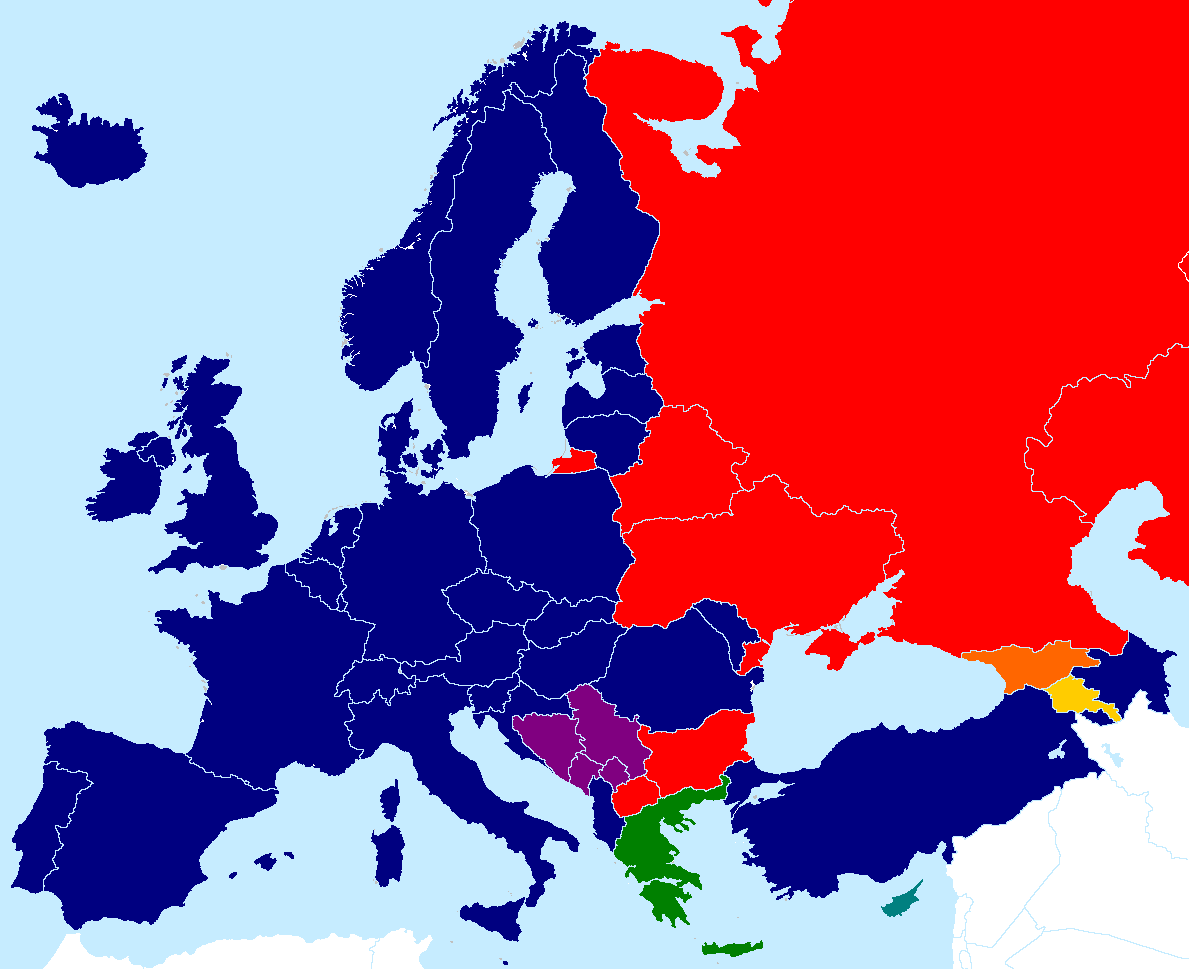
The main scripts used in Europe today are the Latin and Cyrillic.
The Greek alphabet was derived from the Phoenician alphabet, and Latin was derived from the Greek via the Old Italic alphabet. In the Early Middle Ages, Ogham was used in Ireland and runes (derived from Old Italic script) in Scandinavia. Both were replaced in general use by the Latin alphabet by the Late Middle Ages. The Cyrillic script was derived from the Greek with the first texts appearing around 940 AD.
Around 1900 there were mainly two typeface variants of the Latin alphabet used in Europe: Antiqua and Fraktur. Fraktur was used most for German, Estonian, Latvian, Norwegian and Danish whereas Antiqua was used for Italian, Spanish, French, Polish, Portuguese, English, Romanian, Swedish and Finnish. The Fraktur variant was banned by Hitler in 1941, having been described as "Schwabacher Jewish letters".Facsimile of Bormann's Memorandum (in German)
The memorandum itself is typed in Antiqua, but the NSDAP letterhead is printed in Fraktur. "For general attention, on behalf of the Führer, I make the following announcement: It is wrong to regard or to describe the so‑called Gothic script as a German script. In reality, the so‑called Gothic script consists of Schwabach Jew letters. Just as they later took control of the newspapers, upon the introduction of printing the Jews residing in Germany took control of the printing presses and thus in Germany the Schwabach Jew letters were forcefully introduced. Today the Führer, talking with Herr Reichsleiter Amann and Herr Book Publisher Adolf Müller, has decided that in the future the Antiqua script is to be described as normal script. All printed materials are to be gradually converted to this normal script. As soon as is feasible in terms of textbooks, only the normal script will be taught in village and state schools. The use of the Schwabach Jew letters by officials will in future cease; appointment certifications for functionaries, street signs, and so forth will in future be produced only in normal script. On behalf of the Führer, Herr Reichsleiter Amann will in future convert those newspapers and periodicals that already have foreign distribution, or whose foreign distribution is desired, to normal script". Other scripts have historically been in use in Europe, including Phoenician, from which modern Latin letters descend, Ancient Egyptian hieroglyphs on Egyptian artefacts traded during Antiquity, various runic systems used in Northern Europe preceding Christianisation, and Arabic during the era of the Ottoman Empire.
Hungarian rovás was used by the Hungarian people in the early Middle Ages, but it was gradually replaced with the Latin-based Hungarian alphabet when Hungary became a kingdom, though it was revived in the 20th century and has certain marginal, but growing area of usage since then.
European Union
Main article: Languages of the European Union
The European Union (as of 2021) had 27 member states accounting for a population of 447 million, or about 60% of the population of Europe.
The European Union has designated by agreement with the member states 24 languages as "official and working": Bulgarian, Croatian, Czech, Danish, Dutch, English, Estonian, Finnish, French, German, Greek, Hungarian, Irish, Italian, Latvian, Lithuanian, Maltese, Polish, Portuguese, Romanian, Slovak, Slovenian, Spanish and Swedish. This designation provides member states with two "entitlements": the member state may communicate with the EU in any of the designated languages, and view "EU regulations and other legislative documents" in that language.
The European Union and the Council of Europe have been collaborating in education of member populations in languages for "the promotion of plurilingualism" among EU member states. The joint document, "Common European Framework of Reference for Languages: Learning, Teaching, Assessment (CEFR)", is an educational standard defining "the competencies necessary for communication" and related knowledge for the benefit of educators in setting up educational programs. In a 2005 independent survey requested by the EU's Directorate-General for Education and Culture regarding the extent to which major European languages were spoken in member states. The results were published in a 2006 document, "Europeans and Their Languages", or "Eurobarometer 243". In this study, statistically relevant samples of the population in each country were asked to fill out a survey form concerning the languages that they spoke with sufficient competency "to be able to have a conversation".
List of languages
The following is a table of European languages. The number of speakers as a first or second language (L1 and L2 speakers) listed are speakers in Europe only; see list of languages by number of native speakers and list of languages by total number of speakers for global estimates on numbers of speakers.
The list is intended to include any language variety with an ISO 639 code. However, it omits sign languages. Because the ISO-639-2 and ISO-639-3 codes have different definitions, this means that some communities of speakers may be listed more than once. For instance, speakers of Bavarian are listed both under "Bavarian" (ISO-639-3 code bar) as well as under "German" (ISO-639-2 code de).
| Name | ISO- | |||||||||||||||
|---|---|---|---|---|---|---|---|---|---|---|---|---|---|---|---|---|
| 639 | Classification | Speakers in Europe | Official status | Native | Total | National | Regional | |||||||||
| Abaza | abq | Northwest Caucasian, Abazgi | 49,800 | Karachay-Cherkessia (Russia) | ||||||||||||
| Adyghe | ady | Northwest Caucasian, Circassian | 117,500 | Adygea (Russia) | ||||||||||||
| Aghul | agx | Northeast Caucasian, Lezgic | 29,300 | Dagestan (Russia) | ||||||||||||
| Akhvakh | akv | Northeast Caucasian, Avar–Andic | 210 | |||||||||||||
| Albanian (Shqip) | ||||||||||||||||
| Arbëresh | ||||||||||||||||
| Arvanitika | ||||||||||||||||
| sq | Indo-European | Albania, Kosovo, North Macedonia | Italy, Arbëresh dialect: Sicily, Calabria, Apulia, Molise, Basilicata, Abruzzo, Campania | |||||||||||||
| Montenegro (Ulcinj, Tuzi) | ||||||||||||||||
| Andi | ani | Northeast Caucasian, Avar–Andic | 5,800 | |||||||||||||
| Aragonese | an | Indo-European, Romance, Western, West Iberian | 25,000 | 55,000 | Northern Aragon (Spain) | |||||||||||
| Archi | acq | Northeast Caucasian, Lezgic | 970 | |||||||||||||
| Aromanian | rup | Indo-European, Romance, Eastern | 114,000 | North Macedonia (Kruševo) | ||||||||||||
| Asturian (Astur-Leonese) | ast | Indo-European, Romance, Western, West Iberian | 351,791 | 641,502 | Asturias | |||||||||||
| Avar | av | Northeast Caucasian, Avar–Andic | 760,000 | Dagestan (Russia) | ||||||||||||
| Azerbaijani | az | Turkic, Oghuz | 500,000 | Azerbaijan | Dagestan (Russia) | |||||||||||
| Bagvalal | kva | Northeast Caucasian, Avar–Andic | 1,500 | |||||||||||||
| Bashkir | ba | Turkic, Kipchak | 1,221,000 | Bashkortostan (Russia) | ||||||||||||
| Basque | eu | Basque | 750,000 | Basque Country: Basque Autonomous Community, Navarre (Spain), French Basque Country (France) | ||||||||||||
| Bavarian | bar | Indo-European, Germanic, West, High German, Upper, Bavarian | 14,000,000 | Austria (as German) | South Tyrol | |||||||||||
| Belarusian | be | Indo-European, Slavic, East | 3,300,000 | Belarus | ||||||||||||
| Bezhta | kap | Northeast Caucasian, Tsezic | 6,800 | |||||||||||||
| Bosnian | bs | Indo-European, Slavic, South, Western, Serbo-Croatian | 2,500,000 | Bosnia and Herzegovina | *Kosovo*, Montenegro | |||||||||||
| Botlikh | bph | Northeast Caucasian, Avar–Andic | 210 | |||||||||||||
| Breton | br | Indo-European, Celtic, Brittonic | 206,000 | None, de facto status in Brittany (France) | ||||||||||||
| Bulgarian | bg | Indo-European, Slavic, South, Eastern | 7,800,000 | Bulgaria | Mount Athos (Greece) | |||||||||||
| Catalan | ca | Indo-European, Romance, Western, Occitano-Romance | 4,000,000 | 10,000,000 | Andorra | Balearic Islands (Spain), Catalonia (Spain), Valencian Community (Spain), easternmost Aragon (Spain), Pyrénées-Orientales (France), Alghero (Italy) | ||||||||||
| Chamalal | cji | Northeast Caucasian, Avar–Andic | 500 | |||||||||||||
| Chechen | ce | Northeast Caucasian, Nakh | 1,400,000 | Chechnya & Dagestan (Russia) | ||||||||||||
| Chuvash | cv | Turkic, Oghur | 1,100,000 | Chuvashia (Russia) | ||||||||||||
| Cimbrian | cim | Indo-European, Germanic, West, High German, Upper, Bavarian | 400 | |||||||||||||
| Cornish | kw | Indo-European, Celtic, Brittonic | 563 | Cornwall (United Kingdom) | ||||||||||||
| Corsican | co | Indo-European, Romance, Italo-Dalmatian | cos | Corsican }} | 125,000 | Corsica (France), Sardinia (Italy) | ||||||||||
| Crimean Tatar | crh | Turkic, Kipchak | 480,000 | Crimea (Ukraine) | ||||||||||||
| Croatian | hr | Indo-European, Slavic, South, Western, Serbo-Croatian | 5,600,000 | Bosnia and Herzegovina, Croatia | Burgenland (Austria), Vojvodina (Serbia) | |||||||||||
| Czech | cs | Indo-European, Slavic, West, Czech–Slovak | 10,600,000 | Czech Republic | ||||||||||||
| Danish | da | Indo-European, Germanic, North | 5,500,000 | Denmark | url=https://web.archive.org/web/20180803163533/http://www.lexsoft.de/cgi-bin/lexsoft/justizportal_nrw.cgi?xid=148815,381 | date=3 August 2018 }}) | ||||||||||
| Dargwa | dar | Northeast Caucasian, Dargin | 490,000 | Dagestan (Russia) | ||||||||||||
| Dutch | nl | Indo-European, Germanic, West, Low Franconian | 22,000,000 | 24,000,000 | Belgium, Netherlands | |||||||||||
| Elfdalian | ovd | Indo-European, Germanic, North | 2000 | |||||||||||||
| Emilian | egl | Indo-European, Romance, Western, Gallo-Italic | ||||||||||||||
| English | en | Indo-European, Germanic, West, Anglo-Frisian, Anglic | 63,000,000 | url=https://web.archive.org/web/20160106183351/http://ec.europa.eu/public_opinion/archives/ebs/ebs_386_en.pdf | date=6 January 2016 }}, [Data for EU27](http://ec.europa.eu/public_opinion/archives/ebs/ebs_386_anx_en.pdf) , published in 2012. | Ireland, Malta, United Kingdom | ||||||||||
| Erzya | myv | Uralic, Finno-Ugric, Mordvinic | 120,000 | Mordovia (Russia) | ||||||||||||
| Estonian | et | Uralic, Finno-Ugric, Finnic | 1,165,400 | Estonia | ||||||||||||
| Extremaduran | ext | Indo-European, Romance, Western, West Iberian | 200,000 | |||||||||||||
| Fala | fax | Indo-European, Romance, Western, West Iberian | 11,000 | |||||||||||||
| Faroese | fo | Indo-European, Germanic, North | 66,150 | Faroe Islands (Denmark) | ||||||||||||
| Finnish | fi | Uralic, Finno-Ugric, Finnic | 5,400,000 | Finland | Sweden, Norway, Republic of Karelia (Russia) | |||||||||||
| Franco-Provençal (Arpitan) | frp | Indo-European, Romance, Western, Gallo-Romance | 140,000 | Aosta Valley (Italy) | ||||||||||||
| French | fr | Indo-European, Romance, Western, Gallo-Romance, Oïl | 81,000,000 | 210,000,000 | Belgium, France, Luxembourg, Monaco, Switzerland, Jersey | title=Le Statut spécial de la Vallée d'Aoste, Article 38, Title VI | publisher=Region Vallée d'Aoste | url=http://www.regione.vda.it/amministrazione/autonomia/statutospeciale/titolo6_f.asp | access-date=2 May 2014 | url-status=dead | archive-url=https://web.archive.org/web/20111104223214/http://www.regione.vda.it/amministrazione/autonomia/statutospeciale/titolo6_f.asp | archive-date= 4 November 2011 }} (Italy) | ||||
| Frisian | fry | |||||||||||||||
| frr | ||||||||||||||||
| stq | Indo-European, Germanic, West, Anglo-Frisian | 470,000 | Friesland (Netherlands), Schleswig-Holstein (Germany)recognized as official language in the Nordfriesland district and in Helgoland | |||||||||||||
| Friulan | fur | Indo-European, Romance, Western, Rhaeto-Romance | 600,000 | Friuli (Italy) | ||||||||||||
| Gagauz | gag | Turkic, Oghuz | 140,000 | Gagauzia (Moldova) | ||||||||||||
| Galician | gl | Indo-European, Romance, Western, West Iberian | 2,400,000 | Galicia (Spain), Eo-Navia (Asturias), Bierzo (Province of León) and Western Sanabria (Province of Zamora) | ||||||||||||
| German | de | Indo-European, Germanic, West, High German | 97,000,000 | |||||||||||||
| Godoberi | gin | Northeast Caucasian, Avar–Andic | 130 | |||||||||||||
| Greek | el | Indo-European, Hellenic | 13,500,000 | Cyprus, Greece | Albania (Finiq, Dropull) | |||||||||||
| Hinuq | gin | Northeast Caucasian, Tsezic | 350 | |||||||||||||
| Hungarian | hu | Uralic, Finno-Ugric, Ugric | 13,000,000 | Hungary | Burgenland (Austria), Vojvodina (Serbia), Romania, Slovakia, Subcarpathia (Ukraine), Prekmurje, (Slovenia) | |||||||||||
| Hunzib | bph | Northeast Caucasian, Tsezic | 1,400 | |||||||||||||
| Icelandic | is | Indo-European, Germanic, North | 330,000 | Iceland | ||||||||||||
| Ingrian | izh | Uralic, Finno-Ugric, Finnic | 120 | |||||||||||||
| Ingush | inh | Northeast Caucasian, Nakh | 300,000 | Ingushetia (Russia) | ||||||||||||
| Irish | ga | Indo-European, Celtic, Goidelic | 240,000 | 2,000,000 | Ireland | Northern Ireland (United Kingdom) | ||||||||||
| Istriot | ist | Indo-European, Romance | 900 | |||||||||||||
| Istro-Romanian | ruo | Indo-European, Romance, Eastern | 1,100 | |||||||||||||
| Italian | it | Indo-European, Romance, Italo-Dalmatian | 65,000,000 | 82,000,000 | Italy, San Marino, Switzerland, Vatican City | Istria County (Croatia), Slovenian Istria (Slovenia) | ||||||||||
| Judeo-Italian | itk | Indo-European, Romance, Italo-Dalmatian | 250 | |||||||||||||
| Judaeo-Spanish (Ladino) | lad | Indo-European, Romance, Western, West Iberian | 320,000 | fewSIL Ethnologue: | ||||||||||||
| Kabardian | kbd | Northwest Caucasian, Circassian | 530,000 | Kabardino-Balkaria & Karachay-Cherkessia (Russia) | ||||||||||||
| Kaitag | xdq | Northeast Caucasian, Dargin | 30,000 | |||||||||||||
| Kalmyk | xal | Mongolic | 80,500 | Kalmykia (Russia) | ||||||||||||
| Karata | kpt | Northeast Caucasian, Avar–Andic | 260 | |||||||||||||
| Karelian | krl | Uralic, Finno-Ugric, Finnic | 36,000 | Republic of Karelia (Russia) | ||||||||||||
| Karachay-Balkar | krc | Turkic, Kipchak | 300,000 | Kabardino-Balkaria & Karachay-Cherkessia (Russia) | ||||||||||||
| Kashubian | csb | Indo-European, Slavic, West, Lechitic | 50,000 | Poland | ||||||||||||
| Kazakh | kk | Turkic, Kipchak | 1,000,000 | Kazakhstan | Astrakhan Oblast (Russia) | |||||||||||
| Khwarshi | khv | Northeast Caucasian, Tsezic | 1,700 | |||||||||||||
| Komi | kv | Uralic, Finno-Ugric, Permic | 220,000220,000 native speakers out of an ethnic population of 550,000. | |||||||||||||
| Kubachi | ugh | Northeast Caucasian, Dargin | 7,000 | |||||||||||||
| Kumyk | kum | Turkic, Kipchak | 450,000 | Dagestan (Russia) | ||||||||||||
| Kven | fkv | Uralic, Finno-Ugric, Finnic | 2,000-10,000 | Norway | ||||||||||||
| Lak | lbe | Northeast Caucasian, Lak | 152,050 | Dagestan (Russia) | ||||||||||||
| Latin | la | Indo-European, Italic, Latino-Faliscan | extinct | few | Vatican City | |||||||||||
| Latvian | lv | Indo-European, Baltic | 1,750,000 | Latvia | ||||||||||||
| Lezgin | lez | Northeast Caucasian, Lezgic | 397,000 | Dagestan (Russia) | ||||||||||||
| Ligurian | lij | Indo-European, Romance, Western, Gallo-Italic | 500,000 | Monaco (Monégasque dialect is the "national language") | title=Legge Regionale 15 ottobre 1997, n. 26 | url=http://www.regione.sardegna.it/j/v/86?v=9&c=72&file=1997026 | publisher=Regione autonoma della Sardegna – Regione Autònoma de Sardigna | access-date=21 October 2021 | archive-date=26 February 2021 | archive-url=https://web.archive.org/web/20210226213750/http://www.regione.sardegna.it/j/v/86?v=9&c=72&file=1997026 | url-status=dead}} | |||||
| Limburgish | li | |||||||||||||||
| lim | Indo-European, Germanic, West, Low Franconian | 1,300,000 (2001) | Limburg (Belgium), Limburg (Netherlands) | |||||||||||||
| Lithuanian | lt | Indo-European, Baltic | 3,000,000 | Lithuania | ||||||||||||
| Livonian | liv | Uralic, Finno-Ugric, Finnic | 1 | 210 | Latvia | |||||||||||
| Lombard | lmo | Indo-European, Romance, Western, Gallo-Italic | 3,600,000 | Lombardy (Italy) | ||||||||||||
| Low German (Low Saxon) | nds | |||||||||||||||
| wep | Indo-European, Germanic, West | 1,000,0002.6 million cited as estimate of all Germans who speak Platt "well or very well" (including L2; 4.3 million cited as the number of all speakers including those with "moderate" knowledge) in 2009. [Heute in Bremen. „Ohne Zweifel gefährdet"](http://www.taz.de/1/archiv/print-archiv/printressorts/digi-artikel/?ressort=ra&dig=2009%2F02%2F21%2Fa0171&cHash=e05509f6d9/). Frerk Möller im Interview, taz, 21. Februar 2009. | ||||||||||||||
| Ludic | lud | Uralic, Finno-Ugric, Finnic | 300 | |||||||||||||
| Luxembourgish | lb | Indo-European, Germanic, West, High German | ltz | Luxembourgish }} | 386,000 | Luxembourg | Wallonia (Belgium) | |||||||||
| Macedonian | mk | Indo-European, Slavic, South, Eastern | 1,400,000 | North Macedonia | ||||||||||||
| Mainfränkisch | vmf | Indo-European, Germanic, West, High German, Upper | 4,900,000 | |||||||||||||
| Maltese | mt | Semitic, Arabic | 520,000 | Malta | ||||||||||||
| Manx | gv | Indo-European, Celtic, Goidelic | 230 | 2,300 | Isle of Man | |||||||||||
| Mari | chm | |||||||||||||||
| mhr | ||||||||||||||||
| mrj | Uralic, Finno-Ugric | 500,000 | Mari El (Russia) | |||||||||||||
| Meänkieli | fit | Uralic, Finno-Ugric, Finnic | title=Meänkieli nu och då | url=https://www.isof.se/nationella-minoritetssprak/meankieli/lar-dig-mer-om-meankieli/meankieli-nu-och-da | access-date=2025-01-08 | website=www.isof.se | language=sv}} | 55,000 | Sweden | |||||||
| Megleno-Romanian | ruq | Indo-European, Romance, Eastern | 3,000 | |||||||||||||
| Minderico | drc | Indo-European, Romance, Western, West Iberian | 500 | |||||||||||||
| Mirandese | mwl | Indo-European, Romance, Western, West Iberian | 15,000 | Miranda do Douro (Portugal) | ||||||||||||
| Moksha | mdf | Uralic, Finno-Ugric, Mordvinic | 2,000 | Mordovia (Russia) | ||||||||||||
| Montenegrin | cnr | Indo-European, Slavic, South, Western, Serbo-Croatian | 240,700 | Montenegro | Mali Iđoš (Serbia) | |||||||||||
| Neapolitan | nap | Indo-European, Romance, Italo-Dalmatian | 5,700,000 | Campania (Italy) | ||||||||||||
| Nenets | yrk | Uralic, Samoyedic | 4,000 | Nenets Autonomous Okrug (Russia) | ||||||||||||
| Nogai | nog | Turkic, Kipchak | 87,000 | Dagestan (Russia) | ||||||||||||
| Norman | nrf | Indo-European, Romance, Western, Gallo-Romance, Oïl | 50,000 | Guernsey (United Kingdom), Jersey (United Kingdom) | ||||||||||||
| Norwegian | no | Indo-European, Germanic, North | 5,200,000 | Norway | ||||||||||||
| Occitan | oc | Indo-European, Romance, Western, Occitano-Romance | 500,000. | |||||||||||||
| Ossetian | os | Indo-European, Indo-Iranian, Iranian, Eastern | 450,000 | North Ossetia-Alania (Russia), South Ossetia | ||||||||||||
| Palatinate German | pfl | Indo-European, Germanic, West, High German, Central | 1,000,000 | |||||||||||||
| Picard | pcd | Indo-European, Romance, Western, Gallo-Romance, Oïl | 200,000 | Wallonia (Belgium) | ||||||||||||
| Piedmontese | pms | Indo-European, Romance, Western, Gallo-Italic | 1,600,000 | Piedmont (Italy) | ||||||||||||
| Polish | pl | Indo-European, Slavic, West, Lechitic | 38,500,000 | Poland | ||||||||||||
| Portuguese | pt | Indo-European, Romance, Western, West Iberian | 10,000,000 | Portugal | ||||||||||||
| Rhaeto-Romance | fur | |||||||||||||||
| lld | ||||||||||||||||
| roh | Indo-European, Romance, Western | 370,000 | Switzerland | Veneto Belluno, Friuli-Venezia Giulia, South Tyrol, & Trentino (Italy) | ||||||||||||
| Ripuarian (Platt) | ksh | Indo-European, Germanic, West, High German, Central | 900,000 | |||||||||||||
| Romagnol | rgn | Indo-European, Romance, Western, Gallo-Italic | ||||||||||||||
| Romani | rom | Indo-European, Indo-Iranian, Indo-Aryan, Western | 1,500,000 | |||||||||||||
| Romanian | ro | Indo-European, Romance, Eastern | 24,000,000 | title=Româna | url=http://unilat.org/DPEL/Promotion/L_Odyssee_des_langues/Roumain/ro | website=unilat.org | publisher=Latin Union | access-date=2 April 2018 | language=ro | archive-date=29 October 2014 | archive-url=https://web.archive.org/web/20141029141605/http://unilat.org/DPEL/Promotion/L_Odyssee_des_langues/Roumain/ro | url-status=dead}} | Moldova, Romania | Mount Athos (Greece), Vojvodina (Serbia) | ||
| Russian | ru | Indo-European, Slavic, East | 106,000,000L1: 119 million in the Russian Federation (of which c. 83 million in European Russia), 14.3 million in Ukraine, 6.67 million in Belarus, 0.67 million in Latvia, 0.38 million in Estonia, 0.38 million in Moldova. | |||||||||||||
| Rusyn | rue | Indo-European, Slavic, East | 70,000 | |||||||||||||
| Rutul | rut | Northeast Caucasian, Lezgic | 36,400 | Dagestan (Russia) | ||||||||||||
| Sami | se | Uralic, Finno-Ugric | 23,000mostly Northern Sami (sma), ca. 20,000 speakers; smaller communities of Lule Sami (smj, c. 2,000 speakers) and other variants. , | |||||||||||||
| Sardinian | sc | Indo-European, Romance | 1,350,000 | Sardinia (Italy) | ||||||||||||
| Scots | sco | Indo-European, Germanic, West, Anglo-Frisian, Anglic | 110,000 | Scotland (United Kingdom), County Donegal (Republic of Ireland), Northern Ireland (United Kingdom) | ||||||||||||
| Scottish Gaelic | gd | Indo-European, Celtic, Goidelic | 57,000 | Scotland (United Kingdom) | ||||||||||||
| Serbian | sr | Indo-European, Slavic, South, Western, Serbo-Croatian | 9,000,000 | Bosnia and Herzegovina, Kosovo, Serbia | Croatia, Mount Athos (Greece), North Macedonia, Montenegro | |||||||||||
| Sicilian | scn | Indo-European, Romance, Italo-Dalmatian | 4,700,000 | Sicily (Italy) | ||||||||||||
| Silesian | szl | Indo-European, Slavic, West, Lechitic | 522,000 | |||||||||||||
| Silesian German | sli | Indo-European, Germanic, West, High German, Central | 11,000 | |||||||||||||
| Slovak | sk | Indo-European, Slavic, West, Czech–Slovak | 5,200,000 | Slovakia | Vojvodina (Serbia), Czech Republic | |||||||||||
| Slovene | sl | Indo-European, Slavic, South, Western | 2,100,000 | Slovenia | Carinthia]], Styria) | |||||||||||
| Sorbian (Wendish) | wen | Indo-European, Slavic, West | 20,000 | Brandenburg & Sachsen (Germany) | ||||||||||||
| Spanish | es | Indo-European, Romance, Western, West Iberian | 47,000,000 | 76,000,000 | Spain | Gibraltar (United Kingdom) | ||||||||||
| Swabian German | swg | Indo-European, Germanic, West, High German, Upper, Alemannic | 820,000 | |||||||||||||
| Swedish | sv | Indo-European, Germanic, North | swe | Swedish }} | 13,280,000 | Sweden, Finland, Åland and Estonia | ||||||||||
| Swiss German | gsw | Indo-European, Germanic, West, High German, Upper, Alemannic | 5,000,000 | Switzerland (as German) | ||||||||||||
| Tabasaran | tab | Northeast Caucasian, Lezgic | 126,900 | Dagestan (Russia) | ||||||||||||
| Tat | ttt | Indo-European, Iranian, Western | 30,000 | |||||||||||||
| Tatar | tt | Turkic, Kipchak | 4,300,000 | Tatarstan (Russia) | ||||||||||||
| Tindi | tin | Northeast Caucasian, Avar–Andic | 2,200 | |||||||||||||
| Tsez | ddo | Northeast Caucasian, Tsezic | 13,000 | |||||||||||||
| Turkish | tr | Turkic, Oghuz | 15,752,673 | Turkey, Cyprus | Northern Cyprus | |||||||||||
| Udmurt | udm | Uralic, Finno-Ugric, Permic | 340,000 | Udmurtia (Russia) | ||||||||||||
| Ukrainian | uk | Indo-European, Slavic, East | 32,600,000 | Ukraine | Left Bank of the Dniester (Moldova) | |||||||||||
| Upper Saxon | sxu | Indo-European, Germanic, West, High German, Central | 2,000,000 | |||||||||||||
| Vepsian | vep | Uralic, Finno-Ugric, Finnic | 1,640 | Republic of Karelia (Russia) | ||||||||||||
| Venetian | vec | Indo-European, Romance, Italo-Dalmatian | 3,800,000 | Veneto (Italy) | ||||||||||||
| Võro | vro | Uralic, Finno-Ugric, Finnic | 87,000 | Võru County (Estonia) | ||||||||||||
| Votic | vot | Uralic, Finno-Ugric, Finnic | 21 | |||||||||||||
| Walloon | wa | Indo-European, Romance, Western, Gallo-Romance, Oïl | 600,000 | Wallonia (Belgium) | ||||||||||||
| Walser German | wae | Indo-European, Germanic, West, High German, Upper, Alemannic | 20,000 | |||||||||||||
| Welsh | cy | Indo-European, Celtic, Brittonic | 562,000 | 750,000 | Wales (United Kingdom) | |||||||||||
| Wymysorys | wym | Indo-European, Germanic, West, High German | 70Moribund German dialect spoken in Wilamowice, | |||||||||||||
| Yenish | yec | Indo-European, Germanic, West, High German | 16,000 | Switzerland | ||||||||||||
| Yiddish | yi | Indo-European, Germanic, West, High German | 600,000 | Bosnia and Herzegovina, Netherlands, Poland, Romania, Sweden, Ukraine | ||||||||||||
| Zeelandic | zea | Indo-European, Germanic, West, Low Franconian | 220,000 |
Languages spoken in Armenia, Azerbaijan, Cyprus, Georgia, and Turkey
There are various definitions of Europe, which may or may not include all or parts of Turkey, Cyprus, Armenia, Azerbaijan, and Georgia. For convenience, the languages and associated statistics for all five of these countries are grouped together on this page, as they are usually presented at a national, rather than subnational, level.
| Name | ISO- | |||||||
|---|---|---|---|---|---|---|---|---|
| 639 | Classification | Speakers in expanded geopolitical Europe | Official status | L1 | L1+L2 | National | Regional | |
| Abkhaz | ab | Northwest Caucasian, Abazgi | Abkhazia/Georgia: 191,000 | |||||
| Turkey: 44,000{{cite web | editor-last = Lewis | editor-first = M. Paul | title = Ethnologue report for Turkey (Asia) | work = Ethnologue: Languages of the World | publisher = SIL International | |||
| Adyghe (West Circassian) | ady | Northwest Caucasian, Circassian | Turkey: 316,000 | |||||
| Albanian | sq | Indo-European, Albanian | Turkey: 66,000 (Tosk) | |||||
| Arabic | ar | Afro-Asiatic, Semitic, West | Turkey: 2,437,000 Not counting post-2014 Syrian refugees | |||||
| Armenian | hy | Indo-European, Armenian | Armenia: 3 million | |||||
| Azerbaijan: 145,000 | ||||||||
| Georgia: around 0.2 million ethnic Armenians (Abkhazia: 44,870) | ||||||||
| Turkey: 61,000 | Armenia | |||||||
| Azerbaijan | Cyprus | |||||||
| Azerbaijani | az | Turkic, Oghuz | Azerbaijan 9 million | |||||
| Turkey: 540,000 | ||||||||
| Georgia 0.2 million | Azerbaijan | |||||||
| Batsbi | bbl | Northeast Caucasian, Nakh | Georgia: 500 | |||||
| Bulgarian | bg | Indo-European, Slavic, South | Turkey: 351,000 | |||||
| Crimean Tatar | crh | Turkic, Kipchak | Turkey: 100,000 | |||||
| Georgian | ka | Kartvelian, Karto-Zan | Georgia: 3,224,696 | Georgia | ||||
| Greek | el | Indo-European, Hellenic | Cyprus: 679,883 | |||||
| Turkey: 3,600 | Cyprus | |||||||
| Juhuri | jdt | Indo-European, Indo-Iranian, Iranian, Southwest | Azerbaijan: 24,000 (1989) | |||||
| Kurdish | kur | Indo-European, Indo-Iranian, Iranian, Northwest | Turkey: 15 millionSIL *Ethnologue* gives estimates, broken down by dialect group, totalling 31 million, but with the caveat of "Very provisional figures for Northern Kurdish speaker population". *Ethnologue* estimates for dialect groups: | |||||
| Kurmanji | kmr | Indo-European, Indo-Iranian, Iranian, Northwest | Turkey: 8.13 million | |||||
| Armenia: 33,509 | ||||||||
| Georgia: 14,000 | Armenia | |||||||
| Laz | lzz | Kartvelian, Karto-Zan, Zan | Turkey: 20,000 | |||||
| Georgia: 2,000 | ||||||||
| Megleno-Romanian | ruq | Indo-European, Italic, Romance, East | Turkey: 4–5,000 | |||||
| Mingrelian | xmf | Kartvelian, Karto-Zan, Zan | Georgia (including Abkhazia): 344,000 | |||||
| Pontic Greek | pnt | Indo-European, Hellenic | Turkey: greater than 5,000 | |||||
| Armenia: 900 ethnic Caucasus Greeks | ||||||||
| Georgia: 5,689 Caucasus Greeks | ||||||||
| Romani language and Domari language | rom, dmt | Indo-European, Indo-Iranian, Indic | Turkey: 500,000 | |||||
| Russian | ru | Indo-European, Balto-Slavic, Slavic | Armenia: 15,000 | |||||
| Azerbaijan: 250,000 | ||||||||
| Georgia: 130,000 | Armenia: about 0.9 million | |||||||
| Azerbaijan: about 2.6 million | ||||||||
| Georgia: about 1 million | ||||||||
| Cyprus: 20,984 | Abkhazia | |||||||
| South Ossetia | Armenia | |||||||
| Azerbaijan | ||||||||
| Svan | sva | Kartvelian, Svan | Georgia (incl. Abkhazia): 30,000 | |||||
| Tat | ttt | Indo-European, Indo-Aryan, Iranian, Southwest | Azerbaijan: 10,000 | |||||
| Turkish | tr | Turkic, Oghuz | Turkey: 66,850,000 + 265,100 in the North | Turkey | ||||
| Cyprus | ||||||||
| Northern Cyprus | ||||||||
| Zazaki | zza | Indo-European, Indo-Iranian, Iranian, Northwest | Turkey: 3–4 million (2009) |
Immigrant communities
Recent (post–1945) immigration to Europe introduced substantial communities of speakers of non-European languages.
The largest such communities include Arabic speakers (see Arabs in Europe) and Turkish speakers (beyond European Turkey and the historical sphere of influence of the Ottoman Empire, see Turks in Europe). Armenians, Berbers, and Kurds have diaspora communities of 1–2,000,000 each. The various languages of Africa and languages of India form numerous smaller diaspora communities.
;List of the largest immigrant languages Distinguish the size of the ethnic diaspora from the number of actual native speakers according to national censuses. --
| Name | ISO 639 | Classification | Native | Ethnic diaspora |
|---|---|---|---|---|
| Arabic | ar | Afro-Asiatic, Semitic | 5,000,000 | |
| Turkish | tr | Turkic, Oghuz | 3,000,000 | |
| Armenian | hy | Indo-European | in Russia]] (2010 census), 100k in Ukraine ([SIL Ethnologue 2015](https://www.ethnologue.com/18/language/hye/)). | |
| Bengali | bn | Indo-European, Indo-Aryan | 600,000 | 1,000,000 |
| Kurdish | ku | Indo-European, Iranian, Western | 600,000 | 1,000,000 |
| Azerbaijani | az | Turkic, Oghuz | 500,000 | 700,000 |
| Kabyle | kab | Afro-Asiatic, Berber | 500,000 | 1,000,000 |
| Chinese | zh | Sino-Tibetan, Sinitic | 300,000 | 2,000,000 |
| Urdu | ur | Indo-European, Indo-Aryan | 300,000 | 1,800,000 |
| Uzbek | uz | Turkic, Karluk | 300,000 | 2,000,000 |
| Persian | fa | Indo-European, Iranian, Western | 300,000 | 400,000 |
| Punjabi | pa | Indo-European, Indo-Aryan | 300,000 | 700,000 |
| Gujarati | gu | Indo-European, Indo-Aryan | 200,000 | 600,000 |
| Tamil | ta | Dravidian | 200,000 | 500,000 |
| Somali | so | Afro-Asiatic, Cushitic | 200,000 |
Notes
References
References
- "Ethnologue: Statistics".
- "European Day of Languages > Facts > Language Facts".
- "International migrant stock: By destination and origin". United Nations.
- Emery, Chad. (2022-12-15). "34 of the Most Spoken Languages in Europe: Key Facts and Figures".
- (1994). "The Germanic languages". Routledge.
- Sipka, Danko. (2022). "The Geography of Words".
- (2017-01-01). "The Geography and Dialects of Old Saxon: River-basin communication networks and the distributional patterns of North Sea Germanic features in Old Saxon". Frisians and Their North Sea Neighbours.
- "The Evolution of English: Contribution of European Languages".
- (2023-12-05). "Scots language {{!}} History, Examples, & Facts {{!}} Britannica".
- (2020-11-01). "The Objective and Subjective Ethnolinguistic Vitality of West Frisian: Promotion and Perception of a Minority Language in the Netherlands". Sustainable Multilingualism.
- Winter, Christoph. (2022-12-21). "Frisian".
- (2023-12-15). "Dutch language {{!}} Definition, Origin, History, Countries, Examples, & Facts {{!}} Britannica".
- "German, Standard {{!}} Ethnologue Free".
- "Origins of Yiddish".
- (2023-12-28). "All You Need To Know About The Official Languages Of Germany".
- Russ, Charles. (2013-09-13). "The Dialects of Modern German".
- (2020). "The Cambridge Handbook of Germanic Linguistics". Cambridge University Press.
- "Linguist makes sensational claim: English is a Scandinavian language".
- (2019-02-21). "Linguistic variety in the Nordics".
- (August 4, 2021). "The role of loanwords in the intelligibility of written Danish among Swedes". [[Nordic Journal of Linguistics]].
- (2018-04-03). "Mutual intelligibility between closely related languages in Europe". International Journal of Multilingualism.
- Ti Alkire. (2010). "Romance languages: a Historical Introduction". Cambridge University Press.
- Sergio Lubello. (2016). "Manuale Di Linguistica Italiana, Manuals of Romance linguistics". De Gruyter.
- Autonomous Region of Sardinia. (1997-10-15). "Studi sardo-corsi. Dialettologia e storia della lingua tra le due isole". Taphros.
- (2025-02-06). "Romance languages {{!}} Definition, Origin, Characteristics, Classification, Map, & Facts {{!}} Britannica".
- (2003). "Legal Culture in the Age of Globalization: Latin America and Latin Europe". Stanford University Press.
- (2023-11-02). "Slavic languages {{!}} List, Definition, Origin, Map, Tree, History, & Number of Speakers {{!}} Britannica".
- {{e27. pol. Polish
- {{e27. ukr. Ukrainian
- {{e27. hbs. Serbo-Croatian
- {{e27. ces. Czech
- {{e27. bul. Bulgarian
- {{e27. slk. Slovak
- {{e27. bel. Belarusian
- {{e27. slv. Slovene
- . (12 January 2024). ["Macedonian Language"](https://www.britannica.com/topic/Macedonian-language). *Encyclopaedia Britannica*.
- "Slavic {{!}} Ethnologue Free".
- F. Violi, ''Lessico Grecanico-Italiano-Grecanico'', Apodiafàzzi, [[Reggio Calabria]], 1997.
- Paolo Martino, ''L'isola grecanica dell'Aspromonte. Aspetti sociolinguistici'', 1980. Risultati di un'inchiesta del 1977
- Filippo Violi, ''Storia degli studi e della letteratura popolare grecanica'', C.S.E. Bova ([[Province of Reggio Calabria. RC]]), 1992
- Filippo Condemi, ''Grammatica Grecanica'', Coop. Contezza, [[Reggio Calabria]], 1987;
- "In Salento e Calabria le voci della minoranza linguistica greca".
- "Grammatica storica dei dialetti italogreci". (No Title).
- Dansby, Angela. (December 16, 2020). "The last speakers of ancient Sparta".
- Pronk, Tijmen. (2017). "USQUE AD RADICES Indo-European studies in honour of Birgit Anette Olsen: Curonian accentuation". Museum Tusculanum Press.
- (July 2014). "Curonian linguistic elements in Livonian". Eesti ja Soome-Ugri Keeleteaduse Ajakiri.
- (2019). "Placing Kashubian in the Circum-Baltic (CB) area". Prace Filologiczne.
- Mažiulis, Vytautas J.. (July 26, 1999). "Baltic Languages".
- (January 2022). "Language Practices in a Family of Prussian Language Revivalists: Conclusions Based on Short-Term Participant Observation". Adeptus.
- (December 2023). "Albanian Dialect Classifications". Dialectologia.
- "Data am y Gymraeg o'r Arolwg Blynyddol o'r Boblogaeth: 2024".
- "Cornish {{!}} Ethnologue Free".
- "Breton {{!}} Ethnologue Free".
- "Irish {{!}} Ethnologue Free".
- "Scottish Gaelic {{!}} Ethnologue Free".
- "Manx {{!}} Ethnologue Free".
- "Department of Anglo-Saxon, Norse and Celtic".
- (2023-12-22). "Celtic languages {{!}} History, Features, Origin, Map, & Facts {{!}} Britannica".
- "ROMANI IN EUROPE". The Council of Europe.
- Thordarson, Fridrik. (1 January 2000). "CAUCASUS ii. Language contact".
- (2025-02-24). "Uralic languages {{!}} Finno-Ugric, Samoyedic, & Permic Groups {{!}} Britannica".
- Alexander, Marie. (2009). "2nd International Conference of Maltese Linguistics: Saturday, September 19 – Monday, September 21, 2009". International Association of Maltese Linguistics.
- Aquilina, J.. (1958). "Maltese as a Mixed Language". Journal of Semitic Studies.
- Aquilina, Joseph. (July–September 1960). "The Structure of Maltese". Journal of the American Oriental Society.
- (November–December 2004). "Europe's New Arabic Connection". Saudi Aramco World.
- "Assyrian Neo-Aramaic {{!}} Ethnologue Free".
- (2025-02-28). "Turkic languages {{!}} Geography, History, & Comparison {{!}} Britannica".
- Yükselen Peler, Gökçe. (2018). "Tarih İçinde Yunanistan'da Türk Dili: Hun-Avar-Bulgar Dönemi". Journal of Turkish Language and Literature.
- Gudava, T. E.. "North Caucasian languages".
- "Kalmyk".
- "Kartvelian languages {{!}} Kartvelian, Georgian, Svan & Laz".
- "La Langue des signes française (LSF) {{!}} Fondation pour l'audition".
- (2014). "The Encyclopedia of Applied Linguistics".
- (2015). "Linguistic Human Rights Discourse in Deaf Community Activism". Sign Language Studies.
- Reagan, Timothy. (2021). "Historical Linguistics and the Case for Sign Language Families". Sign Language Studies.
- Power, Justin M.. (2022). "Historical Linguistics of Sign Languages: Progress and Problems". Frontiers in Psychology.
- Andrews, Bruce. "The rich diversity of sign languages explained".
- "BANZSL".
- (2014-07-28). "Mouth Actions in Sign Languages". De Gruyter Mouton.
- Mark, Joshua. (28 June 2019). "Religion in the Middle Ages".
- Counelis, James Steve. (March 1976). "Review [untitled] of Ariadna Camariano-Cioran, Les Academies Princieres de Bucarest et de Jassy et leur Professeurs". Church History.
- "A troubadour literary koiné?".
- Wansbrough, John E.. (1996). "Lingua Franca in the Mediterranean". Routledge.
- Calvet, Louis Jean. (1998). "Language wars and linguistic politics". Oxford University Press.
- Jones, Branwen Gruffydd. (2006). "Decolonizing international relations". Rowman & Littlefield.
- Kahane, Henry. (September 1986). "A Typology of the Prestige Language". Language.
- (2006). "German as a Lingua Franca". Annual Review of Applied Linguistics.
- (1992). "European Charter for Regional or Minority Languages: Strasbourg, 5.XI.1992". Council of Europe.
- (2013-05-07). "Managing Ethnic Diversity in Russia". Routledge.
- Assembly, Council of Europe: Parliamentary. (2006-11-08). "Documents: working papers, 2006 ordinary session (first part), 23 -27 January 2006, Vol. 1: Documents 10711, 10712, 10715-10769". Council of Europe.
- Dimitrov, Bogoya. (2023-05-19). "Book Exhibition Dedicated to the Day of the Cyrillic Alphabet".
- Gleichgewicht, Daniel. (2020-04-30). "New illiberalism and the old Hungarian alphabet".
- "Population on 1 January".
- (4 June 2009). "Languages Policy: Linguistic diversity: Official languages of the EU". European Commission, European Union.
- (2009). "Languages of Europe: Official EU languages". European Commission, European Union.
- "Common European Framework of Reference for Languages: Learning, Teaching, Assessment (CEFR)". Council of Europe.
- (2006). "Europeans and Their Languages". European Commission.
- "Relationships to other parts of ISO 639 {{!}} ISO 639-3".
- {{e18. abq. Abaza
- {{e18. ady. Adyghe
- {{e18. agx. Aghul
- {{e18. akv. Akhvakh
- {{e18. sqi. Albanian
- "Albanian".
- "Norme per la tutela e la valorizzazione della lingua e del patrimonio culturale delle minoranze linguistiche e storiche di Calabria".
- {{e18. ani. Andi
- https://zaguan.unizar.es/record/60448 Report about Census of population 2011 of Aragonese Sociolinguistics Seminar and University of Zaragoza
- "Más de 50.000 personas hablan aragonés".
- {{e18. acq. Archi
- {{e18. rup. Aromanian
- [https://www.ehu.eus/documents/1457190/1547454/Avance+III+Encuesta+Sociolling%C3%BC%C3%ADstica+Asturias.pdf/aba19c6f-4dab-470c-8a33-157248373072 III Sociolinguistic Study of Asturias (2017)]. Euskobarometro.
- c. 130,000 in Dagestan. In addition, there are about 0.5 million speakers in immigrant communities in Russia, see [[#Immigrant communities]]. {{e18. aze. Azerbaijani
- {{e18. kva. Bagvalal
- {{e18. bak. Bashkort
- {{in lang. fr [http://www.mintzaira.fr/fileadmin/documents/Aktualitateak/015_VI_ENQUETE_PB__Fr.pdf VI° Enquête Sociolinguistique en Euskal herria (Communauté Autonome d'Euskadi, Navarre et Pays Basque Nord)] {{Webarchive. link. (21 August 2018 (2016).)
- [[German dialect]], {{e18. bar. Bavarian
- {{e18. bel. Belarusian
- {{e18. kap. Bezhta
- {{e18. bos. Bosnian
- {{e18. bph. Botlikh
- {{e18. bre. Breton
- {{e18. bul. Bulgarian
- (19 November 2019). "Catalan".
- "Informe sobre la Situació de la Llengua Catalana | Xarxa CRUSCAT. Coneixements, usos i representacions del català.".
- {{e18. cji. Chamalal
- {{e18. che. Chechen
- {{e18. chv. Chuvash
- [[German dialect]], {{e18. cim. Cimbrian
- "Main language (detailed)".
- {{e18. cos. Corsican
- {{e18. crh. Crimean Tatar
- {{e18. hrv. Croatian
- {{e18. ces. Czech
- {{e18. dan. Danish
- link. (3 August 2018 ))
- {{e18. dar. Dargwa
- {{e18. nld. Dutch
- (11 January 2016). "Feiten en cijfers - Wat iedereen zou moeten weten over het Nederlands". Rijksoverheid.
- {{e18. eng. English
- [http://ec.europa.eu/public_opinion/archives/ebs/ebs_386_en.pdf Europeans and their Languages] {{webarchive. link. (6 January 2016 , [http://ec.europa.eu/public_opinion/archives/ebs/ebs_386_anx_en.pdf Data for EU27] {{Webarchive). link. (29 April 2013 , published in 2012.)
- {{e18. myv. Erzya
- {{e18. est. Estonian
- {{e18. ext. Extremaduran
- {{e18. fax. Fala
- {{e18. fao. Faroese
- {{e18. fin. Finnish
- {{e18. frp. Franco-Provençal
- {{e18. fra. French
- "Le Statut spécial de la Vallée d'Aoste, Article 38, Title VI". Region Vallée d'Aoste.
- {{e18. fry. Frisian
- e18. fur. Friulan
- {{e18. gag. Gagauz
- {{e18. glg. Galician
- "Official website of the Autonomous Region of Friuli-Venezia Giulia".
- {{e18. gdo. Godoberi
- 11 million in Greece, out of 13.4 million in total. {{e18. ell. Greek
- {{e18. gin. Hinuq
- {{e18. hun. Hungarian
- {{e18. huz. Hunzib
- {{e18. isl. Icelandic
- {{e18. izh. Ingrian
- {{e18. inh. Ingush
- {{e18. gle. Irish
- {{e18. ist. Istriot
- {{e18. ruo. Istro-Romanian
- {{e18. ita. Italian
- {{e18. itk. Judeo-Italian
- {{e18. lad. Judaeo-Spanish
- {{e18. kbd. Kabardian
- {{e18. xdq. Kaitag
- {{e18. xal. Oirat
- {{e18. kpt. Karata
- {{e18. krl. Karelian
- {{e18. krc. Karachay-Balkar
- {{e18. csb. Kashubian
- About 10 million in Kazakhstan. {{e18. kaz. Kazakh . [[Border between Europe and Asia. Technically]], the westernmost portions of Kazakhstan ([[Atyrau Region]], [[West Kazakhstan Region]]) are in Europe, with a total population of less than one million.
- {{e18. khv. Khwarshi
- {{e18. ugh. Kubachi
- "2010 Russian Census".
- "Kvensk språk".
- {{e18. lbe. Lak
- [[Contemporary Latin]]: People fluent in Latin as a second language are probably in the dozens, not hundreds. [[Reginald Foster (Latinist). Reginald Foster]] (as of 2013) estimated "no more than 100" according to Robin Banerji, [https://www.bbc.com/news/magazine-21412604 Pope resignation: Who speaks Latin these days?], BBC News, 12 February 2013.
- {{e18. lav. Latvian
- {{e18. lez. Lezgic
- {{e18. lij. Ligurian
- "Legge Regionale 15 ottobre 1997, n. 26". Regione autonoma della Sardegna – Regione Autònoma de Sardigna.
- "Legge Regionale 3 Luglio 2018, n. 22". Regione autonoma della Sardegna – Regione Autònoma de Sardigna.
- (2019-11-19). "Redirected".
- {{e18. lit. Lithuanian
- (2022-10-18). ""Kūldaläpš. Zeltabērns" – izdota lībiešu valodas grāmata bērniem un vecākiem". Latvijas Sabiedriskie Mediji (LSM.lv).
- "LĪBIEŠU VALODAS SITUĀCIJA".
- {{e18. lmo. Lombard
- link. (3 August 2018 ).)
- {{e18. lud. Ludic
- {{e18. ltz. Luxembourgish
- {{e18. mkd. Macedonian
- [[German dialect]], {{e18. vmf. Main-Franconian
- {{e18. mlt. Maltese
- {{e18. glv. Manx
- (2 April 2015). "How the Manx language came back from the dead".
- {{e18. chm. Mari
- "Meänkieli nu och då".
- {{e18. ruq. Megleno-Romanian
- {{e18. drc. Minderico
- {{e18. mwl. Mirandese
- {{e18. mdf. Moksha
- "Montenegro". Ethnologue.
- Zivanovic, Maja. (2017-08-07). "Serbian Montenegrins Demand Official Language Rights".
- {{e18. nap. Neapolitan
- (15 October 2008). "Tutela del dialetto, primo via libera al Ddl campano". Il Denaro.
- total 22,000 native speakers (2010 Russian census) out of an ethnic population of 44,000. Most of these are in Siberia, with about 8,000 ethnic Nenets in European Russia (2010 census, mostly in [[Nenets Autonomous Okrug]])
- {{e18. nog. Nogai
- {{e18. nrf. Jèrriais
- "Norwegian". Ethnologue.
- Total 570,000, of which 450,000 in the Russian Federation. {{e18. oss. Ossetian
- [[German dialect]], {{e18. pfl. Palatinate German
- {{e18. pcd. Picard
- {{e18. pms. Piedmontese
- Piedmontese was recognised as Piedmont's regional language by the regional parliament in 1999. [http://www.consiglioregionale.piemonte.it/mzodgint/jsp/AttoSelezionato.jsp?ATTO=61118 Motion 1118 in the Piedmontese Regional Parliament, ''Approvazione da parte del Senato del Disegno di Legge che tutela le minoranze linguistiche sul territorio nazionale – Approfondimenti'', approved unanimously on 15 December 1999], [http://www.gioventurapiemonteisa.net/wp-content/uploads/2007/05/odg1118.pdf Text of motion 1118 in the Piedmontese Regional Parliament, ''Consiglio Regionale del Piemonte, Ordine del Giorno 1118''].
- {{e18. pol. Polish
- {{e18. por. Portuguese
- Includes [[Friulian language. Friulian]], [[Romansh language. Romansh]], [[Ladin language. Ladin]]. {{e18. fur. Friulian {{e18. lld. Ladin {{e18. roh. Romansch
- [http://www.regione.taa.it/normativa/statuto_speciale.pdf Statuto Speciale Per Il Trentino-Alto Adige] {{Webarchive. link. (26 November 2018 (1972), Art. 102.)
- [[German dialect]], {{e18. ksh. Kölsch
- [[Constitution of Kosovo]], [http://kushtetutakosoves.info/repository/docs/Constitution.of.the.Republic.of.Kosovo.pdf p. 8] {{Webarchive. link. (11 October 2017)
- {{e18. ron. Romanian
- "Româna". [[Latin Union]].
- {{e18. rue. Rusyn
- {{e18. rut. Rutul
- AA. VV. ''Calendario Atlante De Agostini 2017'', Novara, Istituto Geografico De Agostini, 2016, p. 230
- {{e18. sco. Scots
- {{e18. gla. Gaelic, Scottish
- {{e18. srp. Serbian
- {{e18. scn. Sicilian
- {{e19. szl. Silesian
- [[German dialect]], {{e18. sli. Lower Silesian
- {{e18. slk. Slovak
- {{e18. slv. Slovene
- {{e18. hsb. Sorbian, Upper
- GVG § 184 Satz 2; VwVfGBbg § 23 Abs. 5; SächsSorbG § 9, right to use Sorbian in communication with the authorities guaranteed for the "Sorbian settlement area" (''Sorbisches Siedlungsgebiet'', [[Lusatia]]).
- {{e18. spa. Spanish
- [[German dialect]], {{e18. swg. Swabian German
- {{e18. swe. Swedish
- [[German dialect]], {{e18. swg. Swiss German
- {{e18. tab. Tabassaran
- {{e18. tat. Tatar
- {{e18. tin. Tindi
- {{e18. ddi. Tsez
- c. 12 million in [[European Turkey]], 0.6 million in Bulgaria, 0.6 million in Cyprus and Northern Cyprus; and 2,679,765 L1 speakers in other countries in Europe according to a [[Eurobarometer]] survey in 2012: https://languageknowledge.eu/languages/turkish
- {{e18. udm. Udmurt
- {{e18. ukr. Ukrainian
- [[German dialect]], {{e18. sxu. Upper Saxon German
- Russian Census 2010. {{e18. vep. Veps
- {{e18. vec. Venetian
- "Consiglio Regionale Veneto – Leggi Regionali". Consiglioveneto.it.
- {{e18. vro. Võro
- "Итоги Всероссийской переписи населения 2020 года. Таблица 6. Население по родному языку.".
- {{e18. wln. Walloon
- [[Highest Alemannic]] dialects, {{e18. wae. Walser German
- {{e18. cym. Welsh
- {{e18. yec. Yenish
- Total population estimated at 1.5 million as of 1991, of which c. 40% in Ukraine. {{e18. yid. Yiddish , {{e18. ydd. Eastern Yiddish , {{e18. yih. Western Yiddish
- {{e18. zea. Zeelandic
- Abkhazia is a de facto state recognized by Russia and a handful of other states, but considered by Georgia to be ruling over a Georgian region
- {{e18. abk. Abkhazian
- "Armenian 2011 census data, chapter 5".
- "Ethno-Caucasus – Население Кавказа – Республика Абхазия – Население Абхазии".
- Council of Europe. (2014-01-16). "European Charter for Regional or Minority Languages. Fourth periodical presented to the Secretary General of the Council of Europe in accordance with Article 15 of the Charter. CYPRUS".
- Azeri community in Dagestan excluded
- "UNESCO Atlas of the World's Languages in danger".
- link. (30 November 2012)
- "Cyprus". Euromosaic III.
- "Ethnologue: Azerbaijan". Tedsnet.de.
- (1 December 2021). "Mutual intelligibility of a Kurmanji and a Zazaki dialect spoken in the province of Elazığ, Turkey". De Gruyter academic publishing.
- "Article".
- "Laz". [[Ethnologue]].
- [[Thede Kahl]] (2006): The islamisation of the Meglen Vlachs (Megleno-Romanians): The village of Nânti (Nótia) and the "Nântinets" in present-day Turkey, Nationalities Papers, 34:01, p80-81: "Assuming that nearly the total population of Nânti emigrated, then the number of emigrants must have been around 4,000. If the reported number of people living there today is added, the whole Meglen Vlachs population is c. 5,000. Although that number is only a rough estimate and may be exaggerated by the individual interviewees, it might correspond to reality."
- "Endangered Languages Project: Mingrelian".
- Özkan, Hakan. (2013). "The Pontic Greek spoken by Muslims in the villages of Beşköy in the province of present-day Trabzon". Byzantine and Modern Greek Studies.
- "2011 Armenian Census".
- "2014 Georgian census".
- link. Demoscope.ru. ""
- link. ""
- link. Demoscope.ru. ""
- "Endangered Languages Project: Svan".
- John M. Clifton, Gabriela Deckinga, Laura Lucht, Calvin Tiessen, [http://citeseerx.ist.psu.edu/viewdoc/download?doi=10.1.1.487.2395&rep=rep1&type=pdf "Sociolinguistic Situation of the Tat and Mountain Jews in Azerbaijan,"] In Clifton, ed., Studies in Languages of Azerbaijan, vol. 2 (Azerbaijan & St Petersburg, Russia: Academy of Sciences of Azerbaijan & SIL International 2005). Page 3.
- "Census.XLS".
- "Multitree | The LINGUIST List".
- "Glottolog 4.5 - Zaza".
- Cole, Jeffrey. (2011). "Ethnic Groups of Europe: An Encyclopedia". ABC-CLIO.
- Sylheti: 300k in the UK, Bengali: 221k in the UK.
- see [[British Indian]], [[Bangladeshi diaspora]], [[Bengali diaspora]].
- [[Kurdish population]]: mostly [[Kurds in Germany]], [[Kurds in France]], [[Kurds in Sweden]].
- 515k [[Languages of Russia#Migrant languages. in Russia]] (2010 census)
- [[Azerbaijani diaspora]]: Russia 600k, Ukraine 45k, not counting 400,000 in Azerbaijan's [[Quba-Khachmaz economic region. Quba-Khachmaz Region]] ([[Shabran District]], [[Khachmaz District]], [[Quba District (Azerbaijan). Quba District]], [[Qusar District]], [[Siazan District. Siyazan District]]) technically in Europe (being north of the [[Caucasus]] watershed).
- [[Kabyle people]] in France: 1,000,000.
- Germany 120k, Russia: 70k, UK 66k, Spain 20k.
- [[Overseas Chinese]]: France 700,000, UK: 500,000, Russia: 300,000, Italy: 300,000, Germany: 200,000, Spain: 100,000.
- [[Languages of the United Kingdom. UK]]: 269k (2011 census).
- [[Pakistani diaspora]], the majority [[Pakistanis in the UK]].
- Russia: 274k (2010 census)
- see [[Uzbeks in Russia]].
- UK: 76k, Sweden: 74k, Germany: 72k, France 40k.
- [[Iranian diaspora]]: Germany: 100k, Sweden: 100k, UK: 50k, Russia: 50k, Netherlands: 35k, Denmark: 20k.
- UK: 280k
- see [[British Punjabis]]
- UK: 213k
- see [[Gujarati people#Diaspora. Gujarati diaspora]]
- [[Languages of the United Kingdom. UK]]: 101k, https://www.ethnologue.com/country/DE Germany: 35k, [[Languages of Switzerland. Switzerland]]: 22k.
- [[Tamil diaspora]]: UK 300k, [[Tamils in France. France]] 100k, Germany 50k, Switzerland 40k, u Netherlands, 20k, Norway 10k.
This article was imported from Wikipedia and is available under the Creative Commons Attribution-ShareAlike 4.0 License. Content has been adapted to SurfDoc format. Original contributors can be found on the article history page.
Ask Mako anything about Languages of Europe — get instant answers, deeper analysis, and related topics.
Research with MakoFree with your Surf account
Create a free account to save articles, ask Mako questions, and organize your research.
Sign up freeThis content may have been generated or modified by AI. CloudSurf Software LLC is not responsible for the accuracy, completeness, or reliability of AI-generated content. Always verify important information from primary sources.
Report