From Surf Wiki (app.surf) — the open knowledge base
Languages of Africa
none

none
]]
The number of languages natively spoken in Africa is variously estimated (depending on the delineation of language vs. dialect) at between 1,250 and 2,100, and by some counts at over 3,000. Nigeria alone has over 500 languages (according to SIL Ethnologue), one of the greatest concentrations of linguistic diversity in the world. The languages of Africa belong to many distinct language families, among which the largest are:
- Niger–Congo, which include the large Atlantic-Congo and Bantu branches in West, Central, Southeast and Southern Africa.
- Afroasiatic languages are spread throughout Western Asia, North Africa, the Horn of Africa and parts of the Sahel.
- Saharan, Nilotic and Central Sudanic languages (grouped under the hypothetical Nilo-Saharan macro-family), are present in East Africa and Sahel.
- Austronesian languages are spoken in Madagascar and parts of the Comoros.
- Khoe–Kwadi languages are spoken mostly in Namibia and Botswana.
- Indo-European languages, while not indigenous to Africa, are spoken in South Africa and Namibia (Afrikaans, English, German) and are used as lingua francas in Liberia and the former colonies of the United Kingdom (English), former colonies of France and of Belgium (French), former colonies of Portugal (Portuguese), former colonies of Italy (Italian), former colonies of Spain (Spanish) and the current Spanish territories of Ceuta, Melilla and the Canary Islands and the current French territories of Mayotte and La Réunion.
There are several other small families and language isolates, as well as creoles and languages that have yet to be classified. In addition, Africa has a wide variety of sign languages, many of which are language isolates.
Around a hundred languages are widely used for interethnic communication. These include Arabic, Swahili, Amharic, Oromo, Igbo, Somali, Hausa, Manding, Fulani and Yoruba, which are spoken as a second (or non-first) language by millions of people. Although many African languages are used on the radio, in newspapers and in primary-school education, and some of the larger ones are considered national languages, only a few are official at the national level. In Sub-Saharan Africa, most official languages at the national level tend to be colonial languages such as French, Portuguese, or English.
The African Union declared 2006 the "Year of African Languages".
Language groups
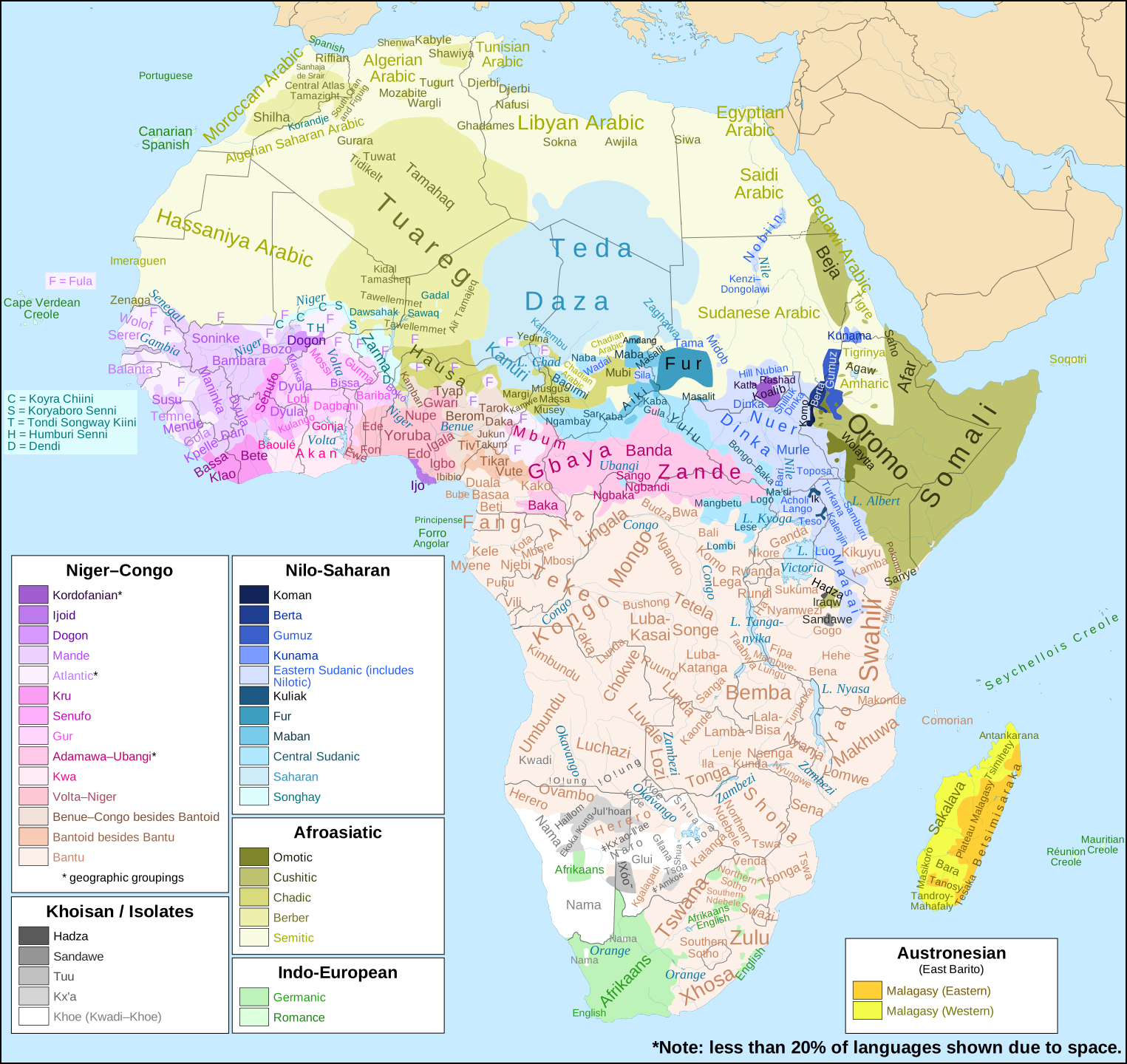
Most languages natively spoken in Africa belong to one of the two large language families that dominate the continent: Afroasiatic, or Niger–Congo. Another hundred belong to smaller families such as Ubangian, Nilotic, Saharan, and the various families previously grouped under the umbrella term Khoisan. In addition, the languages of Africa include several unclassified languages and sign languages.
The earliest Afroasiatic languages are associated with the Capsian culture, the Saharan languages are linked with the Khartoum Mesolithic/Neolithic cultures. Niger-Congo languages are correlated with the west and central African hoe-based farming traditions and the Khoisan languages are matched with the south and southeastern Wilton culture.
Afroasiatic languages
Main article: Afroasiatic languages
Afroasiatic languages are spoken throughout North Africa, the Horn of Africa, Western Asia and parts of the Sahel. There are approximately 375 Afroasiatic languages spoken by over 400 million people. The main subfamilies of Afroasiatic are Berber, Chadic, Cushitic, Omotic, Egyptian and Semitic. The Afroasiatic Urheimat is uncertain. The family's most extensive branch, the Semitic languages (including Arabic, Amharic and Hebrew among others), is the only branch of Afroasiatic that is spoken outside Africa.
Some of the most widely spoken Afroasiatic languages include Arabic (a Semitic language, and a recent arrival from West Asia), Somali (Cushitic), Berber (Berber), Hausa (Chadic), Amharic (Semitic) and Oromo (Cushitic). Of the world's surviving language families, Afroasiatic has the longest written history, as both the Akkadian language of Mesopotamia and Ancient Egyptian are members.
Nilo-Saharan languages
Main article: Nilo-Saharan languages
Nilo-Saharan languages are a proposed grouping of some one hundred diverse languages. Genealogical linkage between these languages has failed to be conclusively demonstrated, and support for the proposal is sparse among linguists. The languages share some unusual morphology, but if they are related, most of the branches must have undergone major restructuring since diverging from their common ancestor.
This hypothetical family would reach an expanse that stretches from the Nile Valley to northern Tanzania and into Nigeria and DR Congo, with the Songhay languages along the middle reaches of the Niger River as a geographic outlier. The inclusion of the Songhay languages is questionable, and doubts have been raised over the Koman, Gumuz and Kadu branches.
Some of the better known Nilo-Saharan languages are Kanuri, Fur, Songhay, Nobiin and the widespread Nilotic family, which includes the Luo, Dinka and Maasai. Most Nilo-Saharan languages are tonal, as are Niger-Congo languages.
Niger–Congo languages
Main article: Niger–Congo languages
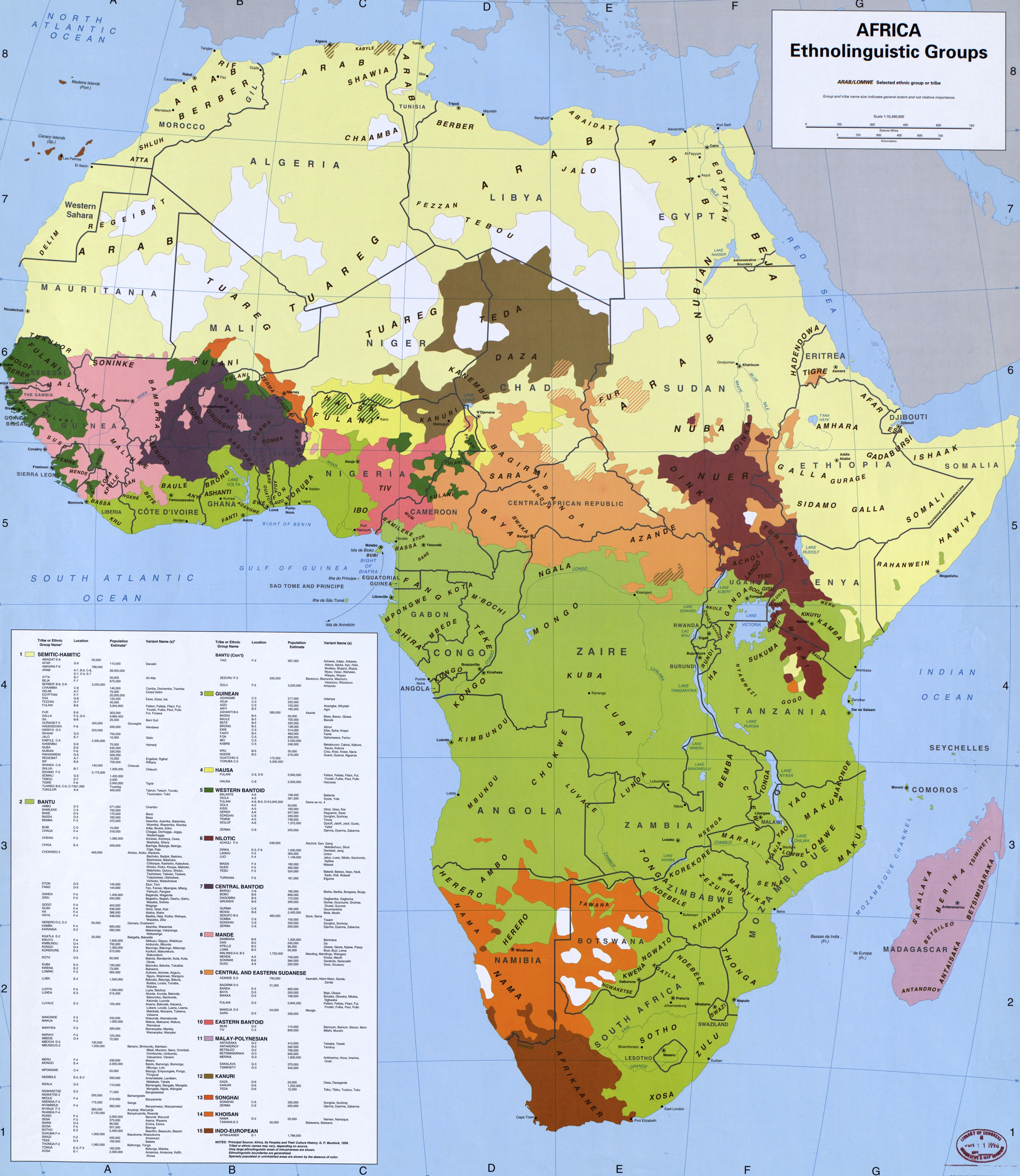
Niger-Congo: Nilo-Saharan: ]] The Niger–Congo languages constitute the largest language family spoken in West Africa and perhaps the world in terms of the number of languages. One of its salient features is an elaborate noun class system with grammatical concord. A large majority of languages of this family are tonal such as Yoruba and Igbo, Akan and Ewe language. A major branch of Niger–Congo languages is the Bantu phylum, which has a wider speech area than the rest of the family (see Niger–Congo B (Bantu) in the map above).
The Niger–Kordofanian language family, joining Niger–Congo with the Kordofanian languages of south-central Sudan, was proposed in the 1950s by Joseph Greenberg. Today, linguists often use "Niger–Congo" to refer to this entire family, including Kordofanian as a subfamily. One reason for this is that it is not clear whether Kordofanian was the first branch to diverge from rest of Niger–Congo. Mande has been claimed to be equally or more divergent. Niger–Congo is generally accepted by linguists, though a few question the inclusion of Mande and Dogon, and there is no conclusive evidence for the inclusion of Ubangian.
Other language families
Several languages spoken in Africa belong to language families concentrated or originating outside the African continent.
Austronesian
Malagasy belongs to the Austronesian languages and is the westernmost branch of the family. It is the national and co-official language of Madagascar, and a Malagasy dialect called Bushi is also spoken in Mayotte.
The ancestors of the Malagasy people migrated to Madagascar around 1,500 years ago from Southeast Asia, more specifically the island of Borneo. The origins of how they arrived to Madagascar remains a mystery, however the Austronesians are known for their seafaring culture. Despite the geographical isolation, Malagasy still has strong resemblance to Barito languages especially the Ma'anyan language of southern Borneo.
With more than 20 million speakers, Malagasy is one of the most widely spoken of the Austronesian languages.
Indo-European
Afrikaans is Indo-European, as is most of the vocabulary of most African creole languages. Afrikaans evolved from the Dutch vernacular of South Holland (Hollandic dialect) spoken by the mainly Dutch settlers of what is now South Africa, where it gradually began to develop distinguishing characteristics in the course of the 18th century, including the loss of verbal conjugation (save for 5 modal verbs), as well as grammatical case and gender. Most Afrikaans speakers live in South Africa. In Namibia it is the lingua franca. Overall 14 to 21 million people are estimated to speak Afrikaans.
Since the colonial era, Indo-European languages such as Afrikaans, English, French, Italian, Portuguese and Spanish have held official status in many countries, and are widely spoken, generally as lingua francas. (See African French and African Portuguese.) Additionally, languages like French, and Portuguese have become native languages in various countries.
French has become native in the urban areas of the DRC, and Gabon. Spanish is spoken as a native language by a small minority in Equatorial Guinea, primarily in larger cities.
German was once used in Germany's colonies there from the late 1800s until World War I, when Britain and France took over and revoked German's official status. Despite this, German is still spoken in Namibia, mostly among the white population. Although it lost its official status in the 1990s, it has been redesignated as a national language. Indo-Aryan languages such as Gujarati and Sindhi are spoken by South Asian expatriates exclusively. In earlier historical times, other Indo-European languages could be found in various parts of the continent, such as Old Persian and Greek in Egypt, Latin and Vandalic in North Africa and Modern Persian in the Horn of Africa.
Small families
The three small Khoisan families of southern Africa have not been shown to be closely related to any other major language family. In addition, there are various other families that have not been demonstrated to belong to one of these families. The classifications below follow Glottolog.
- Mande, some 70 languages, including the major languages of Mali and Guinea; these are generally thought to be divergent Niger–Congo, but debate persists
- Ubangian, some 70 languages, centered on the languages of the Central African Republic; may be Niger–Congo
- Te-Ne-Omotic, some 20 languages, previously classified under Afro-Asiatic, spoken in Ethiopia
- Khoe-Kwadi, around 10 languages, the primary family of Khoisan languages of Namibia and Botswana
- Surmic, some 11 languages, previously classified within either Sudanic or Nilo-Saharan
- Kxʼa, around five languages, with various dialects, spoken in Southern Africa
- South Omotic, around five languages; previously classified within Afro-Asiatic, spoken in Ethiopia
- Tuu, or Taa-ǃKwi, two surviving languages
- Hadza, an isolate of Tanzania
- Bangime, a likely isolate of Mali
- Jalaa, a likely isolate of Nigeria
- Sandawe, an isolate of Tanzania
- Laal, a possible isolate of Chad
Khoisan is a term of convenience covering some 30 languages spoken by around 300,000–400,000 people. There are five Khoisan families that have not been shown to be related to each other: Khoe, Tuu and Kxʼa, which are found mainly in Namibia and Botswana, as well as Sandawe and Hadza of Tanzania, which are language isolates. A striking feature of Khoisan languages, and the reason they are often grouped together, is their use of click consonants. Some neighbouring Bantu languages (notably Xhosa and Zulu) have clicks as well, but these were adopted from Khoisan languages. The Khoisan languages are also tonal.
Creole languages
Due partly to its multilingualism and its colonial past, a substantial proportion of the world's creole languages are to be found in Africa. Some are based on Indo-European languages (e.g. Krio from English in Sierra Leone and the very similar Pidgin in Nigeria, Ghana and parts of Cameroon; Cape Verdean Creole in Cape Verde and Guinea-Bissau Creole in Guinea-Bissau and Senegal, all from Portuguese; Seychellois Creole in the Seychelles and Mauritian Creole in Mauritius, both from French); some are based on Arabic (e.g. Juba Arabic in the southern Sudan, or Nubi in parts of Uganda and Kenya); some are based on local languages (e.g. Sango, the main language of the Central African Republic); while in Cameroon a creole based on French, English and local African languages known as Camfranglais has started to become popular.
Unclassified languages
A fair number of unclassified languages are reported in Africa. Many remain unclassified simply for lack of data; among the better-investigated ones that continue to resist easy classification are:
- possibly Afroasiatic: Ongota
- possibly Nilo-Saharan: Shabo
- possibly Niger–Congo: Jalaa, Mbre, Bayot
- unknown: Laal, Mpre Of these, Jalaa is perhaps the most likely to be an isolate.
Less-well investigated languages include Irimba, Luo, Mawa, Rer Bare (possibly Bantu languages), Bete (evidently Jukunoid), Bung (unclear), Kujarge (evidently Chadic), Lufu (Jukunoid), Meroitic (possibly Afroasiatic), Oropom (possibly spurious) and Weyto (evidently Cushitic). Several of these are extinct, and adequate comparative data is thus unlikely to be forthcoming. Hombert & Philippson (2009) list a number of African languages that have been classified as language isolates at one point or another. Many of these are simply unclassified, but Hombert & Philippson believe Africa has about twenty language families, including isolates. Beside the possibilities listed above, there are:
- Aasax or Aramanik (Tanzania) (South Cushitic? contains non-Cushitic lexicon)
- Imeraguen (Mauritania) – Hassaniyya Arabic restructured on an Azêr (Soninke) base
- Kara (Fer?) (Central African Republic)
- Oblo (Cameroon) (Adamawa? Extinct?)
Roger Blench notes a couple additional possibilities:
- Defaka (Nigeria)
- Dompo (Ghana)
Below is a list of language isolates and otherwise unclassified languages in Africa, from Vossen & Dimmendaal (2020:434):
| Language | Country |
|---|---|
| Bangi Me | Mali |
| Bayot | Senegal |
| Dompo | Ghana |
| Ega | Ivory Coast |
| Gomba | Ethiopia |
| Gumuz | Ethiopia, Sudan |
| Hadza | Tanzania |
| Irimba | Gabon |
| Jalaa | Nigeria |
| Kujarge | Chad |
| Laal | Chad |
| Lufu | Nigeria |
| Luo | Cameroon |
| Mawa | Nigeria |
| Meyobe | Benin, Togo |
| Mimi of Decorse; Mimi of Nachtigal | Chad |
| Mpra | Ghana |
| Oblo | Cameroon |
| Ongota | Ethiopia |
| Oropom | Kenya, Uganda |
| Rer Bare | Ethiopia |
| Shabo | Ethiopia |
| Weyto | Ethiopia |
| Wutana | Nigeria |
| Yeni | Cameroon |
Sign languages
Many African countries have national sign languages, such as Algerian Sign Language, Tunisian Sign Language, Ethiopian Sign Language. Other sign languages are restricted to small areas or single villages, such as Adamorobe Sign Language in Ghana. Tanzania has seven, one for each of its schools for the Deaf, all of which are discouraged. Not much is known, since little has been published on these languages
Sign language systems extant in Africa include the Paget Gorman Sign System used in Namibia and Angola, the Sudanese Sign languages used in Sudan and South Sudan, the Arab Sign languages used across the Arab Mideast, the Francosign languages used in Francophone Africa and other areas such as Ghana and Tunisia, and the Tanzanian Sign languages used in Tanzania.
Language in Africa
Throughout the long multilingual history of the African continent, African languages have been subject to phenomena like language contact, language expansion, language shift and language death. A case in point is the Bantu expansion, in which Bantu-speaking peoples expanded over most of Sub-Equatorial Africa, intermingling with Khoi-San speaking peoples from much of Southeast Africa and Southern Africa and other peoples from Central Africa. Another example is the Arab expansion in the 7th century, which led to the extension of Arabic from its homeland in Asia, into much of North Africa and the Horn of Africa.
Trade languages are another age-old phenomenon in the African linguistic landscape. Cultural and linguistic innovations spread along trade routes and languages of peoples dominant in trade developed into languages of wider communication (lingua franca). Of particular importance in this respect are Berber (North and West Africa), Jula (western West Africa), Fulfulde (West Africa), Hausa (West Africa), Lingala (Congo), Swahili (Southeast Africa), Somali (Horn of Africa) and Arabic (North Africa and Horn of Africa).
After gaining independence, many African countries, in the search for national unity, selected one language, generally the former Indo-European colonial language, to be used in government and education. However, in recent years, African countries have become increasingly supportive of maintaining linguistic diversity. Language policies that are being developed nowadays are mostly aimed at multilingualism. This presents a methodological complication when collecting data in Africa and limited literature exists. An analysis of Afrobarometer public opinion survey data of 36 countries suggested that survey interviewers and respondents could engage in various linguistic behaviors, such as code-switching during the survey. Moreover, some African countries have been considering removing their official former Indo-European colonial languages, like Mali and Burkina Faso which removed French as an official language in 2024.
Official languages

;Afroasiatic
- Berber (Amazigh):
- Standard Moroccan Amazigh in Morocco
- Standard Algerian Berber in Algeria
- Tamasheq in Mali
- Tawellemet in Mali
- Chadic:
- Hausa in Niger
- Cushitic:
- Afar in Ethiopia
- Oromo in Ethiopia and Kenya
- Somali in Somalia, Ethiopia, Kenya, and Djibouti
- Semitic:
- Amharic in Ethiopia
- Arabic in Algeria, Chad, Comoros, Djibouti, Egypt, Libya, Mauritania, Morocco, Somalia, Sudan, Tunisia and Zanzibar (Tanzania)
- Hassaniya Arabic in Mali
- Tigrinya in Ethiopia and Eritrea
;Austronesian
- Malagasy in Madagascar
;Ngbandi creole
- Sango in the Central African Republic
;French Creole
- Seychelles Creole in Seychelles
;Indo-European
- Afrikaans in South Africa
- English in Ghana, Gambia, Uganda, Zimbabwe, Nigeria, Cameroon, Kenya, South Africa, Liberia, Zambia, Malawi, Rwanda, Namibia, Seychelles, South Sudan, Sudan, Tanzania, Eswatini, Lesotho, and Mauritius.
- French in Benin, Burundi, Cameroon, Central African Republic, Chad, Comoros, Democratic Republic of Congo, Congo, Côte d'Ivoire, Djibouti, Gabon, Guinea, Madagascar, Rwanda, Senegal, Seychelles, and Togo.
- Portuguese in Angola, Mozambique, Guinea-Bissau, Cape Verde, São Tomé and Príncipe and Equatorial Guinea.
- Spanish in Equatorial Guinea
;Niger-Congo
- Bambara in Mali
- Bobo in Mali
- Bozo in Mali
- Chewa in Malawi and Zimbabwe
- Comorian in the Comoros
- Dogon in Mali
- Fula in Mali
- Kassonke in Mali
- Kongo in Angola, Democratic Republic of the Congo, Gabon, and Republic of the Congo
- Kinyarwanda in Rwanda
- Kirundi in Burundi
- Maninke in Mali
- Minyanka in Mali
- Senufo in Mali
- Sesotho in Lesotho, South Africa and Zimbabwe
- Setswana in Botswana and South Africa
- Shona, Sindebele in Zimbabwe
- Sepedi in South Africa
- Soninke in Mali
- Ndebele in South Africa
- Swahili in Tanzania, Kenya, Rwanda and Uganda
- Swati in Eswatini (Swaziland) and South Africa
- Tsonga in South Africa
- Venda in South Africa
- Xhosa in South Africa
- Zulu in South Africa
;Nilo-Saharan
- Songhay in Mali
| Language | Family | Official status per country |
|---|---|---|
| Afar | Afroasiatic | Ethiopia, Djibouti (national) |
| Amharic | Ethiopia | |
| Arabic | Algeria, Comoros, Chad, Djibouti, Egypt, Eritrea, Libya, Mauritania, Morocco, Somalia, Sudan | |
| Berber | Algeria, Morocco | |
| Hausa | Niger, Nigeria (national) | |
| Oromo | Ethiopia | |
| Somali | Somalia, Ethiopia, Djibouti (national) | |
| Tigrinya | Ethiopia, Eritrea (national) | |
| Malagasy | Austronesian | Madagascar |
| Seychelles Creole | French Creole | Seychelles |
| Afrikaans | Indo-European | South Africa |
| Sango | Ngbandi creole | Central African Republic |
| Chewa | Niger-Congo | Malawi, Zimbabwe |
| Comorian | Comoros | |
| Kikongo | Angola, Democratic Republic of the Congo, Republic of the Congo | |
| Kinyarwanda | Rwanda | |
| Kirundi | Burundi | |
| Ndebele | South Africa | |
| Sepedi | South Africa | |
| Sesotho | Lesotho, South Africa, Zimbabwe | |
| Setswana | Botswana, South Africa | |
| Shona | Zimbabwe | |
| Sindebele | Zimbabwe | |
| Swahili | Kenya, Rwanda, Tanzania, Uganda | |
| Swati | Eswatini, South Africa | |
| Tsonga | Mozambique, Zimbabwe, South Africa | |
| Venda | South Africa, Zimbabwe | |
| Xhosa | South Africa | |
| Zulu | South Africa |
Cross-border languages
The colonial borders established by European powers following the Berlin Conference in 1884–1885 divided a great many ethnic groups and African language speaking communities. This can cause divergence of a language on either side of a border (especially when the official languages are different), for example, in orthographic standards. Some notable cross-border languages include Berber (which stretches across much of North Africa and some parts of West Africa), Kikongo (that stretches across northern Angola, western and coastal Democratic Republic of the Congo, and western and coastal Republic of the Congo), Somali (stretches across most of the Horn of Africa), Swahili (spoken in the African Great Lakes region), Fula (in the Sahel and West Africa) and Luo (in Democratic Republic of the Congo, Ethiopia, Kenya, Tanzania, Uganda, South Sudan and Sudan).
Some prominent Africans such as former Malian president and former Chairman of the African Commission, Alpha Oumar Konaré, have referred to cross-border languages as a factor that can promote African unity.
Language change and planning
Language is not static in Africa any more than on other continents. In addition to the (likely modest) impact of borders, there are also cases of dialect levelling (such as in Igbo and probably many others), koinés (such as N'Ko and possibly Runyakitara) and emergence of new dialects (such as Sheng). In some countries, there are official efforts to develop standardized language versions.
There are also many less widely spoken languages that may be considered endangered languages.
Demographics
Of the 1 billion Africans (in 2009), about 17 percent speak an Arabic dialect. About 10 percent speak Swahili, the lingua franca of Southeast Africa; about 5 percent speak a Berber dialect; and about 5 percent speak Hausa, which serves as a lingua franca in much of the Sahel. Other large West African languages are Yoruba, Igbo, Akan and Fula. Major Horn of Africa languages are Somali, Amharic and Oromo. Lingala is important in Central Africa. Important South African languages are Sotho, Tswana, Pedi, Venda, Tsonga, Swazi, Southern Ndebele, Zulu, Xhosa and Afrikaans.
French, English, and Portuguese are important languages in Africa due to colonialism. About 320 million, 240 million and 35 million Africans, respectively, speak them as either native or secondary languages. Portuguese has become the national language of Angola and São Tomé and Príncipe, and Portuguese is the official language of Mozambique.
Linguistic features
Some linguistic features are particularly common among languages spoken in Africa, whereas others are less common. Such shared traits probably are not due to a common origin of all African languages. Instead, some may be due to language contact (resulting in borrowing) and specific idioms and phrases may be due to a similar cultural background.
Phonological
Some widespread phonetic features include:
- certain types of consonants, such as implosives (), ejectives (), the labiodental flap and in southern Africa, clicks (, ). True implosives are rare outside Africa, and clicks and the flap almost unheard of.
- doubly articulated labial-velar stops like and are found in places south of the Sahara.
- prenasalized consonants, like and , are widespread in Africa but not common outside it.
- sequences of stops and fricatives at the beginnings of words, such as , and .
- nasal stops which only occur with nasal vowels, such as vs. (but both and ), especially in West Africa.
- vowels contrasting an advanced or retracted tongue, commonly called "tense" and "lax".
- simple tone systems which are used for grammatical purposes.
Sounds that are relatively uncommon in African languages include uvular consonants, diphthongs and front rounded vowels
Tonal languages are found throughout the world but are especially common in Africa - in fact, there are far more tonal than non-tonal languages in Africa. Both the Nilo-Saharan and the Khoi-San phyla are fully tonal. The large majority of the Niger–Congo languages are also tonal. Tonal languages are also found in the Omotic, Chadic and South & East Cushitic branches of Afroasiatic. The most common type of tonal system opposes two tone levels, High (H) and Low (L). Contour tones do occur, and can often be analysed as two or more tones in succession on a single syllable. Tone melodies play an important role, meaning that it is often possible to state significant generalizations by separating tone sequences ("melodies") from the segments that bear them. Tonal sandhi processes like tone spread, tone shift, downstep and downdrift are common in African languages. African languages differ in the number of tone levels they have. Most African tonal languages have a two tone system.--
Syntactic
Widespread syntactical structures include the common use of adjectival verbs and the expression of comparison by means of a verb 'to surpass'. The Niger–Congo languages have large numbers of genders (noun classes) which cause agreement in verbs and other words. Case, tense and other categories may be distinguished only by tone. Auxiliary verbs are also widespread among African languages; the fusing of subject markers and TAM/polarity auxiliaries into what are known as tense pronouns are more common in auxiliary verb constructions in African languages than in most other parts of the world.
Semantic
Quite often, only one term is used for both animal and meat; the word nama or nyama for animal/meat is particularly widespread in otherwise widely divergent African languages.
Demographics
The following is a table displaying the number of speakers of prominent languages within Africa:
| Language | Family | Native speakers within Africa (L1) | All speakers around the world (L1 + L2) | Official status per country | ||||||||
|---|---|---|---|---|---|---|---|---|---|---|---|---|
| ǂKxʼaoǁʼae | Kxʼa | 978-0-19-513977-8}} | - | Native to Namibia and Botswana | ||||||||
| ǂʼAmkoe | Kxʼa | 20–50 Western ǂʼAmkoe (2015) | - | Native to Botswana | ||||||||
| Abon | Niger–Congo (Probable) | 800 (1990) | - | Native to Cameroon | ||||||||
| Abron | Niger–Congo | Abron]] at *Ethnologue* (26th ed., 2023) | - | Native to Ghana and Ivory Coast | ||||||||
| Acheron | Niger–Congo (Probable) | 20,000 (2006) | - | Native to Sudan | ||||||||
| Adara | Niger–Congo (Probable) | 300,000 (2011) | - | Native to Nigeria | ||||||||
| Afar | Afroasiatic | 2,500,000 (2019–2022)Afar at *Ethnologue* (27th ed., 2024) | - | Official in Ethiopia | ||||||||
| Afrikaans | Indo-European | title=Census 2011: Census in brief | url=http://www.statssa.gov.za/census/census_2011/census_products/Census_2011_Census_in_brief.pdf | publisher=Statistics South Africa | location=Pretoria | year=2012 | isbn=978-0-621-41388-5 | archive-url=https://web.archive.org/web/20150513171240/http://www.statssa.gov.za/census/census_2011/census_products/Census_2011_Census_in_brief.pdf | archive-date=13 May 2015 | url-status=live}} | 17,300,000 (2011, 2016) | National language in Namibia, co-official in South Africa |
| Aghem | Niger–Congo (Probable) | 27,000 (2000) | - | Native to Cameroon | ||||||||
| Aiki | Nilo-Saharan (Probable) | 19,000 Kibet (1983) | - | Native to Chad and Central African Republic | ||||||||
| Aja | Nilo-Saharan (Probable) | 200 (1993) | - | Native to South Sudan and Central African Republic | ||||||||
| Aka | Niger–Congo (Probable) | 30,000 (1986–1996) | - | Native to Central African Republic and Republic of Congo | ||||||||
| Akan | Niger–Congo | 8,900,000 (2013)Akan at *Ethnologue* (27th ed., 2024) | - | None. Government sponsored language of Ghana | ||||||||
| Ambo | Niger–Congo (Probable) | 1,000 or fewer (undated) | - | Native to Nigeria | ||||||||
| Amdang | Nilo-Saharan (Probable) | 170,000 (2024) | - | Native to Chad and Sudan | ||||||||
| Ambele | Niger–Congo (Probable) | 5,000 (2005) | - | Native to Cameroon | ||||||||
| Amharic | Afroasiatic | 35,000,000 (2020) | 60,000,000 (2019–2020) | Ethiopia | ||||||||
| Amira | Niger–Congo (Probable) | 5,100 (1984) | - | Native to Sudan | ||||||||
| Anaang | Niger–Congo (Probable) | 2,900,000 (2020) | - | Native to Nigeria | ||||||||
| Áncá | Niger–Congo (Probable) | 300 Áncá (2006) | - | Native to Cameroon | ||||||||
| Asoa | Nilo-Saharan (Probable) | 26,000 (2000) | - | Native to Democratic Republic of the Congo | ||||||||
| Atsam | Niger–Congo (Probable) | 30,000 (1982) | - | Native to Nigeria | ||||||||
| Arabic | Afroasiatic | 150,000,000 but with separate mutually unintelligible varieties | 481,000,000 (2020–2024) | Algeria, Chad, Comoros, Djibouti, Egypt, Libya, Mauritania, Morocco, Sahrawi Arab Democratic Republic, Somalia, Sudan, Tanzania (Zanzibar), Tunisia | ||||||||
| Aringa | Nilo-Saharan (Probable) | 495,000 (2014) | - | Native to Uganda | ||||||||
| Avokaya | Nilo-Saharan (Probable) | 100,000 (1989–2017) | - | Native to South Sudan and Democratic Republic of the Congo | ||||||||
| Awing | Niger–Congo (Probable) | 19,000 (2001) | - | Native to Cameroon | ||||||||
| Baba | Niger–Congo (Probable) | 25,000 (2005) | - | Native to Cameroon | ||||||||
| Babanki | Niger–Congo (Probable) | 39,000 (2011) | - | Native to Cameroon | ||||||||
| Baca | Niger–Congo (Probable) | 4,500 (2007) | - | Native to Cameroon | ||||||||
| Bacama | Afroasiatic | 300,000 (2020) | - | Native to Nigeria | ||||||||
| Bade | Afroasiatic | 360,000 (2020) | - | Native to Nigeria | ||||||||
| Baka | Nilo-Saharan (Probable) | 60,000 (2017) | - | Native to South Sudan and Democratic Republic of the Congo | ||||||||
| Barambu | Niger–Congo (Probable) | 26,000 (1990) | - | Native to Democratic Republic of the Congo | ||||||||
| Bariba | Niger–Congo (Probable) | 1,100,000 (1995–2021) | - | Recognized in Benin | ||||||||
| Bala | Niger–Congo (Probable) | 60,000 Lobala (2000) | - | Native to Democratic Republic of the Congo | ||||||||
| Balo | Niger–Congo (Probable) | 2,200 (2000) | - | Native to Cameroon | ||||||||
| Bamali | Niger–Congo (Probable) | 10,800 (2008) | - | Native to Cameroon | ||||||||
| Bambara | Niger–Congo (Probable) | 4,200,000 (2012) | - | Official in Mali | ||||||||
| Bambassi | Afroasiatic | 2,300 (2011) | - | Native to Ethiopia | ||||||||
| Bambalang | Niger–Congo (Probable) | 29,000 (2008) | - | Native to Cameroon | ||||||||
| Bamukumbit | Niger–Congo (Probable) | 12,000 (2008) | - | Native to Cameroon | ||||||||
| Bamum | Niger–Congo (Probable) | 420,000 (2005) | - | Native to Cameroon and Nigeria | ||||||||
| Bamwe | Niger–Congo (Probable) | 20,000 (1983) | - | Native to Democratic Republic of the Congo | ||||||||
| Bangala | Niger–Congo (Probable) | A few | - | Native to Democratic Republic of the Congo and Republic of the Congo | ||||||||
| Bangi | Niger–Congo (Probable) | 120,000 (2000)[Bangi](https://www.ethnologue.com/18/language/bni/) at *Ethnologue* (18th ed., 2015) (subscription required) | - | Native to Republic of Congo and Democratic Republic of the Congo | ||||||||
| Bangolan | Niger–Congo (Probable) | 14,000 (2011) | - | Native to Cameroon | ||||||||
| Bassari | Niger–Congo (Probable) | 31,000 (2017) | - | Native to Guinea and Senegal | ||||||||
| Baṭḥari | Afroasiatic | 16 (2016) | - | Native to Oman | ||||||||
| Batu | Niger–Congo (Probable) | 25,000 | - | Native to Nigeria | ||||||||
| Bebe | Niger–Congo (Probable) | 3,600 (2008) | - | Native to Cameroon | ||||||||
| Beba | Niger–Congo (Probable) | 3,000 (2002) | - | Native to Cameroon | ||||||||
| Beli | Nilo-Saharan (Probable) | 65,000 (2009) | - | Native to South Sudan | ||||||||
| Bemba | Niger–Congo (Probable) | 4,100,000 (2000–2010) | - | Recognized minority in Zambia | ||||||||
| Bembe | Niger–Congo (Probable) | 100,000 (2007) | - | Native to Republic of Congo | ||||||||
| Bembe | Niger–Congo (Probable) | 250,000 in DRC (1991)[Bembe](https://www.ethnologue.com/18/language/bmb/) at *Ethnologue* (18th ed., 2015) (subscription required) | - | Native to Democratic Republic of the Congo and Tanzania | ||||||||
| Berber | Afroasiatic | 16,000,000 (estimated) but with separate mutually unintelligible varieties | - | Morocco, Algeria | ||||||||
| Berta | Nilo-Saharan (Probable) | 380,000 (2006–2007)[Berta](https://www.ethnologue.com/25/language/wti) at *Ethnologue* (25th ed., 2022) | - | Native to Sudan and Ethiopia | ||||||||
| Besme | Niger–Congo (Probable) | 1,200 (1993) | - | Native to Chad | ||||||||
| Bhaca | Niger–Congo (Probable) | Unknown | - | Native to South Africa | ||||||||
| Bhojpuri | Indo-European | 65,300 (2011) | - | Native to Mauritius | ||||||||
| Bina | Niger–Congo (Probable) | 7,000 (2000) | - | Native to Nigeria | ||||||||
| Binza | Niger–Congo (Probable) | 10,000 (1986) | - | Native to Democratic Republic of the Congo | ||||||||
| Birri | Nilo-Saharan (Probable) | 200 (1996) | - | Native to Central African Republic | ||||||||
| Biseni | Niger–Congo (Probable) | 4,800 (1977) | - | Native to Nigeria | ||||||||
| Bissa | Niger–Congo (Probable) | 590,000 (1999–2003) | - | Native to Burkina Faso, Ghana, and Togo | ||||||||
| Bitare | Niger–Congo (Probable) | 52,000 (2000–2003) | - | Native to Cameroon and Nigeria | ||||||||
| Bobo | Niger–Congo (Probable) | 340,000 (1995–2021)Southern at *Ethnologue* (26th ed., 2023) | - | Native to Burkina Faso and Mali | ||||||||
| Bole | Afroasiatic | 250,000 (2023) | - | Native to Nigeria | ||||||||
| Bole | Niger–Congo (Probable) | 4,000 (2004) | - | Native to Republic of Congo | ||||||||
| Bolon | Niger–Congo (Probable) | 23,000 (1998) | - | Native to Burkina Faso | ||||||||
| Bomboli–Bozaba | Niger–Congo (Probable) | 8,000 (1983–1986)[Bomboli](https://www.ethnologue.com/24/language/bml) at *Ethnologue* (24th ed., 2021) | - | Native to Democratic Republic of the Congo | ||||||||
| Bomboma | Niger–Congo (Probable) | 23,000 (1983) | - | Native to Democratic Republic of the Congo | ||||||||
| Bomitaba | Niger–Congo (Probable) | 9,800 (2000) | - | Native to Republic of Congo and Central African Republic | ||||||||
| Bomu | Niger–Congo (Probable) | 320,000-380,000 (1991–2022) | - | Native to Burkina Faso and Mali | ||||||||
| Bongili | Niger–Congo (Probable) | 12,000 (2018) | - | Native to Republic of Congo | ||||||||
| Bongo | Nilo-Saharan (Probable) | 21,000 (2017) | - | Native to South Sudan | ||||||||
| Bonjo | Niger–Congo (Probable) | 3,000 | - | Native to Republic of Congo | ||||||||
| Bono | Niger–Congo (Probable) | 1,400,000 (2013) | - | Native to Ghana and Ivory Coast | ||||||||
| Bono | Niger–Congo (Probable) | 200,000 (2006) | - | Native to Nigeria | ||||||||
| Boon | Niger–Congo (Probable) | 60 (2000) | - | Native to Somalia | ||||||||
| Boko | Niger–Congo (Probable) | 150,000 (2012) | - | Native to Benin, Nigeria | ||||||||
| Boze | Niger–Congo (Probable) | Unknown | - | Native to Nigeria | ||||||||
| Bozo | Mande | 230,000 (apart from Tieyaxo) in Mali (2003–2009)[Hainyaxo](https://www.ethnologue.com/18/language/bzx/) at *Ethnologue* (18th ed., 2015) (subscription required) | - | Spoken in Mali | ||||||||
| Bube | Niger–Congo (Probable) | 51,000 (2011)[Bube](https://www.ethnologue.com/18/language/bvb/) at *Ethnologue* (18th ed., 2015) (subscription required) | - | Recognized minority in Equatorial Guinea and Bioko Island | ||||||||
| Budza | Niger–Congo (Probable) | 230,000 (1985)[Budza](https://www.ethnologue.com/18/language/bja/) at *Ethnologue* (18th ed., 2015) (subscription required) | - | Native to Democratic Republic of the Congo | ||||||||
| Buli | Niger–Congo (Probable) | 170,000 (2013) | - | Native to Ghana | ||||||||
| Bukusu | Niger–Congo (Probable) | 1,400,000 (2009) | - | Native to Kenya | ||||||||
| Bulu | Niger–Congo (Probable) | 860,000 (2007) | - | Native to Cameroon | ||||||||
| Bum | Niger–Congo (Probable) | 21,000 (2001) | - | Native to Cameroon | ||||||||
| Buru–Angwe | Niger–Congo (Probable) | 1,000 speakers of Buru; potentially substantially more of Angwe (uncited) | - | Native to Nigeria | ||||||||
| Busa | Niger–Congo (Probable) | 110,000 (2012)[Busa](https://www.ethnologue.com/18/language/bqp/) at *Ethnologue* (18th ed., 2015) (subscription required) | - | Native to Benin, Nigeria | ||||||||
| Bushong | Niger–Congo (Probable) | 160,000 (2000) | - | Native to Democratic Republic of the Congo | ||||||||
| Buu | Niger–Congo (Probable) | 100–200 (2012) | - | Native to Cameroon | ||||||||
| Buyu | Niger–Congo (Probable) | 10,000 (2002) | - | Native to Democratic Republic of the Congo | ||||||||
| Bwela | Niger–Congo (Probable) | 8,400 (2002) | - | Native to Democratic Republic of the Congo | ||||||||
| Caka | Niger–Congo (Probable) | 5,000 (1983) | - | Native to Cameroon | ||||||||
| Cape Verdean Creole | Portuguese Creole | 871,000 (2017) | - | National language in Cape Verde | ||||||||
| Cebaara | Niger–Congo (Probable) | 860,000 (1993)[Cebaara](https://www.ethnologue.com/18/language/sef/) at *Ethnologue* (18th ed., 2015) (subscription required) | - | Native to Ivory Coast | ||||||||
| Central Banda | Niger–Congo (Probable) | 580,000 (1984–1996)[Banda-Bambari](https://www.ethnologue.com/18/language/liy/) at *Ethnologue* (18th ed., 2015) (subscription required) | - | Native to Central African Republic, Democratic Republic of the Congo and South Sudan | ||||||||
| Chewa | Niger–Congo (Probable) | 7,000,000 (2007) | - | Malawi, Zimbabwe | ||||||||
| Chopi | Niger–Congo (Probable) | 1,100,000 (2017) | - | Native to Mozambique | ||||||||
| Chung | Niger–Congo (Probable) | 1,400 (2001) | - | Native to Cameroon | ||||||||
| Comorian | Niger–Congo (Probable) | 1,100,000 (2007–2011) | - | Comoros | ||||||||
| Dagaare | Niger–Congo (Probable) | 1,300,000 (1999–2021)Southern Dagaare at *Ethnologue* (26th ed., 2023) | - | Native to Burkina Faso, Ghana, and Ivory Coast | ||||||||
| Dagbani | Niger–Congo (Probable) | 1,200,000 (2013) | - | Native to Ghana, Togo | ||||||||
| Dangme | Niger–Congo (Probable) | 1,020,000 (2013) | - | Ghana | ||||||||
| Daza | Nilo-Saharan (Probable) | 700,000 (2019–2021) | - | Native to Chad and Niger | ||||||||
| Dciriku | Niger–Congo (Probable) | 82,000 (2004–2018) | - | Native to Namibia, Botswana and Angola | ||||||||
| Dendi | Nilo-Saharan (Probable) | 440,000 (2000–2021) | - | Native to Benin, Niger, and Nigeria | ||||||||
| Dengese | Niger–Congo (Probable) | 8,600 (2000) | - | Native to Democratic Republic of the Congo | ||||||||
| Defaka | Niger–Congo (Probable) | 200 (2001) | - | Spoken in Nigeria | ||||||||
| Dinka | Nilo-Saharan | 4,238,400 (2007) | - | South Sudan | ||||||||
| Djimini | Niger–Congo (Probable) | 96,000 (1993) | - | Spoken in Ivory Coast | ||||||||
| Doghose | Niger–Congo (Probable) | 20,000 (1991) | - | Native to Burkina Faso | ||||||||
| Dogoso | Niger–Congo (Probable) | 9,000 (1999) | - | Native to Burkina Faso and Ivory Coast | ||||||||
| Doko | Niger–Congo (Probable) | Unknown | - | Native to Democratic Republic of the Congo | ||||||||
| Dongo | Nilo-Saharan (Probable) | Unknown | - | Native to South Sudan | ||||||||
| Dyula | Niger–Congo (Probable) | 2,600,000 (2012–2021) | - | Native to Burkina Faso, Mali, and Ivory Coast | ||||||||
| Dzando | Niger–Congo (Probable) | 6,000 (1983) | - | Native to Democratic Republic of the Congo | ||||||||
| Dzodinka | Niger–Congo (Probable) | 2,600 (2000) | - | Native to Cameroon and Nigeria | ||||||||
| Ebira | Niger–Congo (Probable) | 2,200,000 (2020) | - | Native to Nigeria | ||||||||
| Ekoka ǃKung | Kxʼa | 16,500 (2013) | - | Native to South Africa, Namibia, and Angola | ||||||||
| Eman | Niger–Congo (Probable) | 800 (1990) | - | Native to Cameroon | ||||||||
| English | Indo-European | 6,500,000 (estimated) | - | See List of countries and territories where English is an official language | ||||||||
| Esimbi | Niger–Congo (Probable) | 34,800 (2005) | - | Native to Cameroon | ||||||||
| Eton | Niger–Congo (Probable) | 1,500,000 (2020)[Eton](https://www.ethnologue.com/18/language/eto/) at *Ethnologue* (18th ed., 2015) (subscription required) | - | Native to Cameroon | ||||||||
| Evant | Niger–Congo (Probable) | 10,000 (1996) | - | Native to Cameroon and Nigeria | ||||||||
| Ewondo | Niger–Congo (Probable) | 580,000 (1982) | - | Native to Cameroon | ||||||||
| Fang | Niger–Congo (Probable) | 1,000,000 (2006–2013) | - | Recognized minority in Equatorial Guinea and Gabon | ||||||||
| Fang | Niger–Congo (Probable) | 4,000 (2011) | - | Native to Cameroon | ||||||||
| Fanji | Niger–Congo (Probable) | 17,000 (2008) | - | Native to Cameroon | ||||||||
| Farefare | Niger–Congo (Probable) | 660,000 (1991–2013) | - | Native to Burkina Faso and Ghana | ||||||||
| Feʼfeʼ | Niger–Congo (Probable) | 140,000 (2005) | - | Native to Cameroon | ||||||||
| Fio | Niger–Congo (Probable) | Unknown but extant (2011–2015) | - | Native to Cameroon | ||||||||
| Fon | Niger–Congo | 2,300,000 (2019–2021) | - | Benin | ||||||||
| Fongoro | Nilo-Saharan (Probable) | a few elders (2007) | - | Native to Chad | ||||||||
| French | Indo-European | 1,200,000 (estimated) | 312,000,000 (2025) | See List of territorial entities where French is an official language and African French | ||||||||
| Fulani | Niger–Congo | 40,000,000 | Fulani]] at *Ethnologue* (26th ed., 2023) | |||||||||
| Fungor | Niger–Congo (Probable) | 2,700 (1984) | - | Native to Sudan | ||||||||
| Fur | Nilo-Saharan (Probable) | 790,000 (2004–2023) | - | Native to Chad and Sudan | ||||||||
| Furu | Nilo-Saharan (Probable) | 16,000 (1984–1996) | - | Native to Democratic Republic of the Congo | ||||||||
| Fut | Niger–Congo (Probable) | 100,000 (2009) | - | Native to Cameroon | ||||||||
| Fwe | Niger–Congo (Probable) | 15,000 | - | Native to Namibia and Zambia | ||||||||
| Gǀui | Khoe–Kwadi | 1,500 (2013) | - | Native to Botswana | ||||||||
| Ga | Niger–Congo (Probable) | 745,000 (2016) | - | Ghana | ||||||||
| German | Indo-European | - | National language of Namibia, special status in South Africa | |||||||||
| Gendza | Niger–Congo (Probable) | 43,000 (1986) | - | Native to Democratic Republic of the Congo | ||||||||
| Gengele Creole | Niger–Congo (Probable) | Unknown | - | Native to Democratic Republic of the Congo | ||||||||
| Geme | Niger–Congo (Probable) | 550 (1996) | - | Native to Central African Republic | ||||||||
| Ghomalaʼ | Niger–Congo (Probable) | 350,000 (2005) | - | Native to Cameroon | ||||||||
| Gikuyu | Niger–Congo (Probable) | 8,100,000 | - | Spoken in Kenya | ||||||||
| Goundo | Niger–Congo (Probable) | 30 (1998) | - | Native to Chad | ||||||||
| Gourmanché | Niger–Congo (Probable) | 1,500,000 (2012–2021) | - | Native to Benin, Burkina Faso, Ghana, Niger, Nigeria, and Togo | ||||||||
| Gumuz | Nilo-Saharan (Probable) | 160,000 in Ethiopia (2007) | - | Spoken in Ethiopia and Sudan | ||||||||
| Gwari | Niger–Congo (Probable) | 1,840,000 (2020)Gbagyi at *Ethnologue* (26th ed., 2023) | - | Native to Nigeria | ||||||||
| Gyong | Niger–Congo (Probable) | 25,000 (2000) | - | Native to Nigeria | ||||||||
| Hakaona | Niger–Congo (Probable) | Unknown | - | Native to Angola and Namibia | ||||||||
| Hanga | Niger–Congo (Probable) | 6,800 (2003) | - | Native to Ghana | ||||||||
| Ḥarsusi | Afroasiatic | 600 (2011) | - | Native to Oman | ||||||||
| Hassaniya Arabic | Afroasiatic | 5,200,000 (2014–2021) | - | Mali, Recognized in Morocco | ||||||||
| Hausa | Afroasiatic | 54,000,000 (2021–2023) | 94,000,000 (2023–2024) | Recognized in Nigeria, Ghana, and Niger | ||||||||
| Heiban | Niger–Congo (Probable) | 4,000 (1984) | - | Native to Sudan | ||||||||
| Hendo | Niger–Congo (Probable) | 50,000 (1982) | - | Native to Democratic Republic of Congo | ||||||||
| Herero | Niger–Congo (Probable) | 250,000 (2015–2018) | - | Native to Namibia, Botswana and Angola | ||||||||
| Hindi | Indo-European | - | Spoken in Mauritius | |||||||||
| Hlubi | Niger–Congo (Probable) | Unknown | - | Native to South Africa | ||||||||
| Hõne | Niger–Congo (Probable) | 7,000 (1999) | - | Native to Nigeria | ||||||||
| Hun-Saare | Niger–Congo (Probable) | 73,000 (1985)[Us-Saare](https://www.ethnologue.com/18/language/uss/) at *Ethnologue* (18th ed., 2015) (subscription required) | - | Native to Nigeria | ||||||||
| Humburi Senni | Nilo-Saharan (Probable) | 81,000 (1999–2021) | - | Spoken in Burkina Faso, and Mali | ||||||||
| Hyam | Niger–Congo (Probable) | 300,000 (2014) | - | Native to Nigeria | ||||||||
| Ibibio | Niger–Congo (Probable) | 6,300,000 (2020) | - | Native to Nigeria | ||||||||
| Iceve-Maci | Niger–Congo (Probable) | 12,000 (1990) | - | Native to Cameroon and Nigeria | ||||||||
| Idun | Niger–Congo (Probable) | 78,000 (2012) | - | Native to Nigeria | ||||||||
| Igala | Niger–Congo (Probable) | 1,600,000 (2020) | - | Native to Nigeria | ||||||||
| Igbo | Niger–Congo (Probable) | 31,000,000 (2020) | - | Native to Nigeria | ||||||||
| Ik | Nilo-Saharan (Probable) | 14,000 (2014) | - | Native to Uganda | ||||||||
| Ila | Niger–Congo (Probable) | 106,000 (2010)[Ila](https://www.ethnologue.com/18/language/ilb/) at *Ethnologue* (18th ed., 2015) (subscription required) | - | Native to Zambia | ||||||||
| Imraguen | Niger–Congo (Probable) | 530 (2006) | - | Native to Mauritania | ||||||||
| Ipulo | Niger–Congo (Probable) | 2,500 (1990) | - | Native to Cameroon | ||||||||
| Isu | Niger–Congo (Probable) | 15,000 (1993) | - | Native to Cameroon | ||||||||
| Iyive | Niger–Congo (Probable) | 2,000 (1996) | - | Native to Cameroon and Nigeria | ||||||||
| Izon | Niger–Congo (Probable) | 2,400,000 (2020) | - | Spoken in Nigeria | ||||||||
| Italian | Indo-European | - | Recognized in Eritrea and Somalia | |||||||||
| Jagham | Niger–Congo (Probable) | 120,000 (2000) | - | Native to Cameroon and Nigeria | ||||||||
| Jahanka | Niger–Congo (Probable) | 150,000 (2017–2022) | - | Native to Guinea | ||||||||
| Jarawa | Niger–Congo (Probable) | 250,000 (2006–2011)[Zhár (Bankal)](https://www.ethnologue.com/18/language/jjr/) at *Ethnologue* (18th ed., 2015) (subscription required) | - | Native to Nigeria | ||||||||
| Jelkung | Afro-Asiatic | 1,300 (2000) | - | Native to Chad | ||||||||
| Jiba | Niger–Congo (Probable) | 2,000 (1977) | - | Native to Nigeria | ||||||||
| Jju | Niger–Congo (Probable) | 600,000 (2020) | - | Native to Nigeria | ||||||||
| Juǀʼhoan | Kxʼa | 978-0-19-513977-8}} | - | Native to Namibia and Botswana | ||||||||
| Juba Arabic | Arabic-based creole | 250,000 (2020) | - | Native to South Sudan | ||||||||
| Jukun Takum | Niger–Congo (Probable) | 2,400 (2000) | - | Native to Cameroon and Nigeria | ||||||||
| Jur Modo | Nilo-Saharan (Probable) | 180,000 (2017) | - | Native to South Sudan | ||||||||
| Kabalai | Afro-Asiatic | 18,000 (1993) | - | Native to Chad | ||||||||
| Kadugli | Nilo-Saharan (Probable) | 75,000 (2004)[Kadugli](https://www.ethnologue.com/18/language/xtc/) at *Ethnologue* (18th ed., 2015) (subscription required) | - | Native to Sudan | ||||||||
| Kamara | Niger–Congo (Probable) | 3,000 (2003) | - | Native to Burkina Faso and Ghana | ||||||||
| Kanga | Nilo-Saharan (Probable) | 17,000 (2022) | - | Native to Sudan | ||||||||
| Kalabari | Niger–Congo (Probable) | 258,000 (2006) | - | Native to Nigeria | ||||||||
| Kalenjin | Nilo-Saharan (Probable) | 6,600,000 | - | Native to Kenya and Uganda | ||||||||
| Kanembu | Nilo-Saharan (Probable) | 880,000 (2019)[Kanembu](https://www.ethnologue.com/25/language/kbl) at *Ethnologue* (25th ed., 2022) | - | Native to Chad | ||||||||
| Kantosi | Niger–Congo (Probable) | 6,300 (2020) | - | Native to Burkina Faso and Ghana | ||||||||
| Kanuri | Nilo-Saharan (Probable) | 9,600,000 (1993–2021)Kanuri at *Ethnologue* (27th ed., 2024) | - | Native to Cameroon, Chad, Niger, and Nigeria | ||||||||
| Kar | Niger–Congo (Probable) | 40,000 (1995) | - | Native to Burkina Faso | ||||||||
| Karanga | Nilo-Saharan (Probable) | 10,000 (1999) | - | Native to Chad | ||||||||
| Kasena | Niger–Congo (Probable) | 250,000 (1998–2004) | - | Native to Burkina Faso and Ghana | ||||||||
| Kassonke | Niger–Congo (Probable) | 2,500,000 (2009–2022) | - | Recognized in Mali | ||||||||
| Katla | Niger–Congo (Probable) | 25,000 Julud (2009) | - | Native to Sudan | ||||||||
| Keiga | Nilo-Saharan (Probable) | 6,100 (1984) | - | Native to Sudan | ||||||||
| Kemezung | Niger–Congo (Probable) | 3,540 (2008) | - | Native to Cameroon | ||||||||
| Kendeje | Nilo-Saharan (Probable) | 1,900 (2000) | - | Native to Chad | ||||||||
| Kele | Niger–Congo (Probable) | 14,000 (2000–2007)[West Kele, Bubi](https://www.ethnologue.com/18/language/keb/) at *Ethnologue* (18th ed., 2015) (subscription required) | - | Native to Democratic Republic of Congo and Gabon | ||||||||
| Kele-Foma | Niger–Congo (Probable) | 160,000 (1980)[Kele](https://www.ethnologue.com/18/language/khy/) at *Ethnologue* (18th ed., 2015) (subscription required) | - | Native to Democratic Republic of Congo | ||||||||
| Keliko | Nilo-Saharan (Probable) | 42,500 (1989–2018) | - | Native to South Sudan and Democratic Republic of the Congo | ||||||||
| Kelo | Nilo-Saharan (Probable) | 200 (2009) | - | Native to Sudan | ||||||||
| Kgalagadi | Niger–Congo (Probable) | 65,400 (2015) | - | Native to Botswana | ||||||||
| Khwe | Khoe–Kwadi | 8,000 (2011) | - | Native to Namibia, Angola, Botswana, South Africa, and Zambia | ||||||||
| Khoekhoe | Khoe–Kwadi | 200,000 ± 10,000 (2011) | - | National language of Namibia | ||||||||
| Ki | Niger–Congo (Probable) | 26,000 (1982)[Ki](https://www.ethnologue.com/18/language/bag/) at *Ethnologue* (18th ed., 2015) (subscription required) | - | Native to Cameroon | ||||||||
| Kim | Niger–Congo (Probable) | 15,000 (1993) | - | Native to Chad | ||||||||
| Kimbundu | Niger–Congo (Probable) | 1,700,000 (2015) | - | Angola | ||||||||
| Kinyarwanda | Niger–Congo (Probable) | 15,000,000 (2014–2024) | - | Rwanda | ||||||||
| Kirundi | Niger–Congo (Probable) | 13,000,000 (2021) | - | Burundi | ||||||||
| Kisi | Niger–Congo (Probable) | 15,000 (2012) | - | Native to Tanzania | ||||||||
| Kissi | Niger–Congo (Probable) | 910,000 (2017–2020)[Southern Kissi](https://www.ethnologue.com/25/language/kss) at *Ethnologue* (25th ed., 2022) | - | Native to Guinea, Liberia, and Sierra Leone | ||||||||
| Kita Maninka | Niger–Congo (Probable) | 449,000 (2001–2014) | - | Recognized in Mali | ||||||||
| Kituba | Kongo-based creole | 13,000,000 (2018–2022)Kituba (RC) at *Ethnologue* (27th ed., 2024) | - | Democratic Republic of Congo, Republic of Congo | ||||||||
| Koalib | Niger–Congo (Probable) | 100,000 (2009) | - | Native to Sudan | ||||||||
| Korandje | Nilo-Saharan (Probable) | 3,000 (2010) | - | Native to Algeria | ||||||||
| Koro Wachi | Niger–Congo (Probable) | 150,000 (2006–2012)[Ashe](https://www.ethnologue.com/18/language/ahs/) at *Ethnologue* (18th ed., 2015) (subscription required) | - | Native to Nigeria | ||||||||
| Kom | Niger–Congo (Probable) | 210,000 (2005) | - | Native to Cameroon | ||||||||
| Komo | Nilo-Saharan (Probable) | 10,000 in Sudan (1979)[Komo](https://www.ethnologue.com/18/language/xom/) at *Ethnologue* (18th ed., 2015) (subscription required) | - | Native to Sudan, South Sudan, and Ethiopia | ||||||||
| Kongo | Niger–Congo (Probable) | 6,000,000 cited 1982–2021)Kongo at *Ethnologue* (27th ed., 2024) | - | Angola, recognised national language of Republic of Congo and Democratic Republic of Congo | ||||||||
| Konkomba | Niger–Congo (Probable) | 920,000 (2012–2013) | - | Native to Ghana and Togo | ||||||||
| Konni | Niger–Congo (Probable) | 3,800 (2003) | - | Native to Ghana | ||||||||
| Koshin | Niger–Congo (Probable) | 3,000 (2011) | - | Native to Cameroon | ||||||||
| Koyra Chiini | Nilo-Saharan (Probable) | 200,000 (1999)[Koyra Chiini](https://www.ethnologue.com/18/language/khq/) at *Ethnologue* (18th ed., 2015) (subscription required) | - | Native to Mali | ||||||||
| Koyraboro Senni | Nilo-Saharan (Probable) | 430,000 (2007)[Koyraboro Senni](https://www.ethnologue.com/18/language/ses/) at *Ethnologue* (18th ed., 2015) (subscription required) | - | Native to Mali | ||||||||
| Kulango | Niger–Congo (Probable) | 470,000 (2021)[Bouna](https://www.ethnologue.com/25/language/nku) at *Ethnologue* (25th ed., 2022) | - | Native to Ghana and Ivory Coast | ||||||||
| Kunda | Niger–Congo (Probable) | 160,000 (2000) | - | Native to Zimbabwe, Zambia, and Mozambique | ||||||||
| Kusaal | Niger–Congo (Probable) | 121,000 (2021 census) | - | Native to Burkina Faso, Ghana, and Togo | ||||||||
| Kusu | Niger–Congo (Probable) | 26,000 (1971) | - | Native to Democratic Republic of Congo | ||||||||
| Kresh | Nilo-Saharan (Probable) | 16,000 including Dongo (2013) | - | Native to South Sudan | ||||||||
| Krio | English Creole | 860,000 (2021) | - | Native to Sierra Leone | ||||||||
| Krongo | Nilo-Saharan (Probable) | 54,000 (2022) | - | Native to Sudan | ||||||||
| Kuba | Niger–Congo (Probable) | 30,000 (2000) | - | Native to Democratic Republic of Congo | ||||||||
| Kuk | Niger–Congo (Probable) | 3,000 (1993) | - | Native to Cameroon | ||||||||
| Kukelle | Niger–Congo (Probable) | 180,000 to 200,000 (2011) | - | Native to Nigeria | ||||||||
| Kunama | Nilo-Saharan (Probable) | 180,000 (2022) | - | Native to Eritrea, and Ethiopia | ||||||||
| Kung | Niger–Congo (Probable) | 12 | - | Native to Cameroon | ||||||||
| Kurama | Niger–Congo (Probable) | 40,000 (2000) | - | Native to Nigeria | ||||||||
| Kuranko | Niger–Congo (Probable) | 670,000 (2017–2021) | - | Native to Guinea and Sierra Leone | ||||||||
| Kuvale | Niger–Congo (Probable) | 70,000 (2015) | - | Native to Angola | ||||||||
| Kwaʼ | Niger–Congo (Probable) | 1,000 (2000) | - | Native to Cameroon | ||||||||
| Kwala | Niger–Congo (Probable) | 45,000 (2000) | - | Native to Republic of the Congo | ||||||||
| Kwama | Nilo-Saharan (Probable) | 15,000 (2015) | - | Native to Ethiopia | ||||||||
| Kwambi | Niger–Congo (Probable) | 33,000 (2006) | - | Native to Namibia and Angola | ||||||||
| Kwangali | Niger–Congo (Probable) | 152,000 (2018) | - | Native to Namibia and Angola | ||||||||
| Kwangwa | Niger–Congo (Probable) | 2,400 (2010) | - | Native to Zambia | ||||||||
| Kwanyama | Niger–Congo (Probable) | 670,000 (1993–2006) | - | Native to Namibia and Angola | ||||||||
| Kyenga | Niger–Congo (Probable) | 12,000 (1995–2012) | - | Native to Benin and Nigeria | ||||||||
| Kyoli | Niger–Congo (Probable) | 7,000-8,000 (2020) | - | Native to Nigeria | ||||||||
| Lala | Niger–Congo (Probable) | Unknown but extant (1999) | - | Native to South Africa | ||||||||
| Lala-Bisa | Niger–Congo (Probable) | 350,000 (2010) | - | Native to Zambia and Democratic Republic of the Congo | ||||||||
| Lamba | Niger–Congo (Probable) | 200,000 (2010) | - | Native to Zambia and Democratic Republic of the Congo | ||||||||
| Laimbue | Niger–Congo (Probable) | 5,000 (1994) | - | Native to Cameroon | ||||||||
| Laro | Niger–Congo (Probable) | 40,000 (2010) | - | Native to Sudan | ||||||||
| Lega | Niger–Congo (Probable) | 450,000 (1982–2000)[Shabunda Lega](https://www.ethnologue.com/18/language/lea/) at *Ethnologue* (18th ed., 2015) (subscription required) | - | Native to Democratic Republic of Congo | ||||||||
| Lele | Niger–Congo (Probable) | 26,000 (1971) | - | Native to Democratic Republic of Congo | ||||||||
| Lendu | Nilo-Saharan (Probable) | 760,000 (1996) | - | Native to Democratic Republic of Congo | ||||||||
| Lenje | Niger–Congo (Probable) | 130,000 (2010) | - | Native to Zambia | ||||||||
| Leti | Niger–Congo (Probable) | "small population" (2014)[Leti](https://www.ethnologue.com/18/language/leo/) at *Ethnologue* (18th ed., 2015) (subscription required) | - | Native to Cameroon | ||||||||
| Lia-Ntomba | Niger–Congo (Probable) | 200,000 (1980–2000)[Ntomba](https://www.ethnologue.com/18/language/nto/) at *Ethnologue* (18th ed., 2015) (subscription required) | - | Native to Democratic Republic of the Congo | ||||||||
| Ligbi | Niger–Congo (Probable) | 19,000 (1991–2003) | - | Native to Ghana | ||||||||
| Limba | Niger–Congo (Probable) | 2,200 (2001) | - | Native to Cameroon | ||||||||
| Limba | Niger–Congo (Probable) | 520,000 (1993–2019)"Limba, East". *Ethnologue*. Retrieved 2018-08-11. | - | Native to Guinea and Sierra Leone | ||||||||
| Limbum | Niger–Congo (Probable) | 130,000 (2005) | - | Native to Cameroon | ||||||||
| Lingala | Niger–Congo (Probable) | 21,000,000 (2021) | - | National language of Democratic Republic of Congo, Republic of Congo | ||||||||
| Lobedu | Niger–Congo (Probable) | 1,000,000 (estimated) | - | Native to South Africa | ||||||||
| Logol | Niger–Congo (Probable) | 13,000 (2022) | - | Native to Sudan | ||||||||
| Loki | Niger–Congo (Probable) | 4,200 | - | Native to Democratic Republic of the Congo | ||||||||
| Londo | Niger–Congo (Probable) | 3,000 (1983) | - | Native to Democratic Republic of the Congo | ||||||||
| Lorhon | Niger–Congo (Probable) | 8,000 (1991–1999) | - | Native to Burkina Faso and Ivory Coast | ||||||||
| Losengo | Niger–Congo (Probable) | 67,000 (1983–2002)[Losengo](https://www.ethnologue.com/18/language/lse/) at *Ethnologue* (18th ed., 2015) (subscription required) | - | Native to Democratic Republic of the Congo | ||||||||
| Lozi | Niger–Congo (Probable) | 725,000 (1982–2010) | - | Native to Angola, Botswana, Namibia, South Africa, Zambia, and Zimbabwe | ||||||||
| Luganda | Niger–Congo (Probable) | 5,600,000 (2014) | - | Native to Uganda | ||||||||
| Lugbara | Nilo-Saharan (Probable) | 1,600,000 (2014)[Lugbara](https://www.ethnologue.com/18/language/lgg/) at *Ethnologue* (18th ed., 2015) (subscription required) | - | Native to Uganda and Democratic Republic of Congo | ||||||||
| Kuhane | Niger–Congo (Probable) | 45,000 | - | Native to Namibia, Botswana, and Zambia | ||||||||
| Luhya | Niger–Congo (Probable) | 6,800,000 | - | Spoken in Kenya | ||||||||
| Lumun | Niger–Congo (Probable) | 15,000 (2014) | - | Native to Sudan | ||||||||
| Luo | Nilo-Saharan (Probable) | 4,200,000 (2009) | - | Kenya, Tanzania | ||||||||
| Luyana | Niger–Congo (Probable) | 3,380 (2010) | - | Native to Zambia | ||||||||
| Maba | Nilo-Saharan (Probable) | 570,000 (2019) | - | Native to Chad | ||||||||
| Ma'di | Nilo-Saharan (Probable) | 310,000 (1982–2002) | - | Native to Uganda and South Sudan | ||||||||
| Mada | Niger–Congo (Probable) | 100,000 (not counting Nunku) (1993) | - | Native to Nigeria | ||||||||
| Malagasy | Austronesian | url=https://www.ethnologue.com/language/mlg | title=Malagasy | website=Ethnologue}} | - | Madagascar | ||||||
| Marfa | Nilo-Saharan (Probable) | 5,000 (1999) | - | Native in Chad | ||||||||
| Marka | Niger–Congo (Probable) | 190,000 (2009–2014) | - | Spoken in Burkina Faso | ||||||||
| Mama | Niger–Congo (Probable) | 2,000–3,000 (2001) | - | Native to Nigeria | ||||||||
| Mampruli | Niger–Congo (Probable) | 230,000 (2004)Dagbani | - | Native to Burkina Faso, Ghana, Ivory Coast, Mali, and Togo | ||||||||
| Mandinka | Niger–Congo (Probable) | 2,100,000 (2017–2022)Mandinka at *Ethnologue* (26th ed., 2023) | - | Recognized in Senegal | ||||||||
| Mangbetu | Nilo-Saharan (Probable) | 662,000 (1985)[Mangbetu](https://www.ethnologue.com/25/language/mdj) at *Ethnologue* (13th ed., 1996). | - | Native to Democratic Republic of the Congo | ||||||||
| Maninka | Niger–Congo (Probable) | 4,600,000 (2012–2021)[Konyanka](https://www.ethnologue.com/25/language/mku) at *Ethnologue* (25th ed., 2022) | - | Spoken in Nigeria | ||||||||
| Mankon | Niger–Congo (Probable) | 19,000 (2002) | - | Native to Cameroon | ||||||||
| Manta | Niger–Congo (Probable) | 5,300 (2001)[Manta](https://www.ethnologue.com/18/language/myg/) at *Ethnologue* (18th ed., 2015) (subscription required) | - | Native to Cameroon | ||||||||
| Masaba | Niger–Congo (Probable) | 2,700,000 (2002 & 2009)[Masaba (Gisu, Kisu, Dadiri, Buya)](https://www.ethnologue.com/18/language/myx/) at *Ethnologue* (18th ed., 2015) (subscription required) | - | Native to Kenya | ||||||||
| Masalit | Nilo-Saharan (Probable) | 410,000 (2019–2022)Masalit at *Ethnologue* (27th ed., 2024) | - | Native to Chad and Sudan | ||||||||
| Mashi | Niger–Congo (Probable) | 22,000 (2000–2010)[Mashi](https://www.ethnologue.com/18/language/mho/) at *Ethnologue* (18th ed., 2015) (subscription required) | - | Native to Zambia and Angola | ||||||||
| Massa | Afro-Asiatic | 340,000 (1982–2019) | - | Native to Cameroon and Chad | ||||||||
| Mauritian Creole | French Creole | 1,100,000 (2016) | - | Native to Mauritius | ||||||||
| Mbamba Bay | Niger–Congo (Probable) | 6,000 (2004) | - | Native to Tanzania | ||||||||
| Mbandja | Ubangian | 360,000 (2000) | - | Native to Democratic Republic of the Congo, Republic of Congo and Central African Republic | ||||||||
| Mbati | Niger–Congo (Probable) | 60,000 (2010) | - | Native to Central African Republic | ||||||||
| Mbe | Niger–Congo (Probable) | 65,000 (2011) | - | Native to Nigeria | ||||||||
| Mbəʼ | Niger–Congo (Probable) | 1,500 (2000) | - | Native to Cameroon | ||||||||
| Mbessa | Niger–Congo (Probable) | 25,000 (2020) | - | Native to Cameroon | ||||||||
| Mbili-Mbui | Niger–Congo (Probable) | 10,000 (1983) | - | Native to Cameroon | ||||||||
| Mbowe | Niger–Congo (Probable) | 460 (2010) | - | Native to Cameroon | ||||||||
| Mbre | Niger–Congo (Probable) | 50 (2017) | - | Native to Ivory Coast | ||||||||
| Mbuʼ | Niger–Congo (Probable) | 200 (2011) | - | Native to Cameroon | ||||||||
| Mbuk | Niger–Congo (Probable) | 600 (2020) | - | Native to Cameroon | ||||||||
| Mbuko | Afro-Asiatic | 15,000 (2008) | - | Native to Cameroon | ||||||||
| Mbukushu | Niger–Congo (Probable) | 95,000 (2020) | - | National language in Namibia and Native to Angola, Botswana, and Zambia | ||||||||
| Mbwasa | Niger–Congo (Probable) | Unknown | - | Native to Cameroon | ||||||||
| Medumba | Niger–Congo (Probable) | 210,000 (1991) | - | Native to Cameroon | ||||||||
| Mehri | Afro-Asiatic | 230,000 (2020) | - | Native to Yemen, Oman and Saudi Arabia | ||||||||
| Menchum | Niger–Congo (Probable) | 3,000 (2000) | - | Native to Cameroon | ||||||||
| Mendankwe-Nkwen | Niger–Congo (Probable) | 28,000 (2005) | - | Native to Cameroon | ||||||||
| Mengaka | Niger–Congo (Probable) | 20,000 (1993) | - | Native to Cameroon | ||||||||
| Menyam | Niger–Congo (Probable) | 4,000 (1994) | - | Native to Cameroon | ||||||||
| Mesaka | Niger–Congo (Probable) | 14,000 (1982) | - | Native to Cameroon | ||||||||
| Mfumte | Niger–Congo (Probable) | 30,700 (1982–2000)[Mfumte](https://www.ethnologue.com/18/language/nfu/) at *Ethnologue* (18th ed., 2015) (subscription required) | - | Native to Cameroon | ||||||||
| Minyanka | Niger–Congo (Probable) | 740,000 (2000) | - | Native to Mali | ||||||||
| Missong | Niger–Congo (Probable) | 400 (2012) | - | Native to Cameroon | ||||||||
| Mmen | Niger–Congo (Probable) | 35,000 (2001) | - | Native to Cameroon | ||||||||
| Mmuock | Niger–Congo (Probable) | Unknown | - | Native to Cameroon | ||||||||
| Moba | Niger–Congo (Probable) | 440,000 (2004–2012)[Moba](https://www.ethnologue.com/18/language/mfq/) at *Ethnologue* (18th ed., 2015) (subscription required) | - | Native to Burkina Faso, Ghana, and Togo | ||||||||
| Moro | Niger–Congo (Probable) | 79,000 (2022) | - | Native to Sudan | ||||||||
| Morokodo | Nilo-Saharan (Probable) | 3,400 (2011)[Morokodo](https://www.ethnologue.com/18/language/mgc/) at *Ethnologue* (18th ed., 2015) (subscription required) | - | Native to South Sudan | ||||||||
| Moru | Nilo-Saharan (Probable) | 230,000 (2017) | - | Native to South Sudan | ||||||||
| Mossi | Niger–Congo (Probable) | Mooré]] at *Ethnologue* (27th ed., 2024) | - | Recognised regional language in Burkina Faso | ||||||||
| Mono | Niger–Congo (Probable) | 65,000 (1984) | - | Native to Democratic Republic of the Congo | ||||||||
| Mongo | Niger–Congo (Probable) | 400,000 (1995)[Mongo](https://www.ethnologue.com/18/language/lol/) at *Ethnologue* (18th ed., 2015) (subscription required) | - | Native to Democratic Republic of the Congo | ||||||||
| Mooré | Niger–Congo (Probable) | 12,000,000 (2012–2022) | - | Official in Burkina Faso | ||||||||
| Mundabli | Niger–Congo (Probable) | 500 (2011) | - | Native to Cameroon | ||||||||
| Mündü | Ubangian | 26,000 | - | Native to South Sudan and Democratic Republic of the Congo | ||||||||
| Mundum | Niger–Congo (Probable) | Unknown | - | Native to Cameroon | ||||||||
| Mungbam | Niger–Congo (Probable) | 1,900–2,200 (2012) | - | Native to Cameroon | ||||||||
| Munka | Niger–Congo (Probable) | 31,000 (2008) | - | Native to Cameroon | ||||||||
| Nabit | Niger–Congo (Probable) | 30,000 (estimated) (2015) | - | Native to Burkina Faso, Ghana | ||||||||
| Nafanan | Niger–Congo (Probable) | 89,000 (2017) | - | Native to Ghana and the Ivory Coast | ||||||||
| Nambya | Niger–Congo (Probable) | 100,000 (2000–2004) | - | Native to Zimbabwe | ||||||||
| Nancere | Afroasiatic | 144,000 (2019) | - | Native to Chad | ||||||||
| Nanerigé | Niger–Congo (Probable) | 50,000 (1985) | - | Native to Burkina Faso | ||||||||
| Naro | Khoe–Kwadi | 9,000 (2011–2014) | - | Native to Botswana and Namibia | ||||||||
| Nateni | Niger–Congo (Probable) | 110,000 (2021) | - | Native to Benin | ||||||||
| Naki | Niger–Congo (Probable) | 3,000 (1993)[Naki (Cameroon)](https://www.ethnologue.com/16/show_language/mff) at *Ethnologue* (16th ed., 2009) | - | Native to Cameroon, Nigeria | ||||||||
| Ntcham | Niger–Congo (Probable) | 390,000 (2004–2013)Ntcham at *Ethnologue* (26th ed., 2023) | - | Native to Ghana and Togo | ||||||||
| Ndaʼndaʼ | Niger–Congo (Probable) | 10,000 (1990) | - | Native to Cameroon | ||||||||
| Ndau | Niger–Congo (Probable) | 2,400,000 (2000–2006) | - | Zimbabwe | ||||||||
| Ndebele | Niger–Congo (Probable) | 1,100,000 (2011) | - | Statutory national language in South Africa | ||||||||
| Ndemli | Niger–Congo (Probable) | 10,000 (1999) | - | Native to Cameroon | ||||||||
| Nding | Niger–Congo (Probable) | 400 (2020) | - | Native to Sudan | ||||||||
| Ndombe | Niger–Congo (Probable) | 22,300 (2000) | - | Native to Angola | ||||||||
| Ndonga | Niger–Congo (Probable) | 810,000 (2006) | - | Native to Namibia and Angola | ||||||||
| Ndolo | Niger–Congo (Probable) | 8,000 (1983) | - | Native to Democratic Republic of the Congo | ||||||||
| Ndrulo | Nilo-Saharan (Probable) | 110,000 (2014–2018) | - | Native language of Uganda and Democratic Republic of Congo | ||||||||
| Ndzerem | Niger–Congo (Probable) | - | Native to Cameroon | |||||||||
| Ngaʼka | Niger–Congo (Probable) | 50,000 (1982) | - | Native to Cameroon | ||||||||
| Ngambwe | Niger–Congo (Probable) | Unknown | - | Native to Angola | ||||||||
| Ngando | Niger–Congo (Probable) | 5,000 (1996) | - | Native to Central African Republic | ||||||||
| Ngangam | Niger–Congo (Probable) | 200,000 (2012–2021) | - | Native to Benin and Togo | ||||||||
| Ngbundu | Ubangian | 16,000 (1984) | - | Native to Democratic Republic of the Congo | ||||||||
| Ngelima | Niger–Congo (Probable) | 14,000 (2000) | - | Native to Democratic Republic of the Congo | ||||||||
| Ngiemboon | Niger–Congo (Probable) | 250,000 (2007) | - | Native to Cameroon | ||||||||
| Ngile | Niger–Congo (Probable) | 39,000 (2024) | - | Native to Sudan | ||||||||
| Ngiri | Niger–Congo (Probable) | 80,000 (2000–2002)[Loi (Baloi)](https://www.ethnologue.com/18/language/biz/) at *Ethnologue* (18th ed., 2015) (subscription required) | - | Native to Democratic Republic of the Congo | ||||||||
| Ngiti | Nilo-Saharan (Probable) | 100,000 (1991) | - | Native to Democratic Republic of the Congo | ||||||||
| Ngondi | Niger–Congo (Probable) | 3,000 (2004) | - | Native to Republic of Congo | ||||||||
| Ngomba | Niger–Congo (Probable) | 63,000 (1999) | - | Native to Cameroon | ||||||||
| Ngombale | Niger–Congo (Probable) | 53,500 (2005) | - | Native to Cameroon | ||||||||
| Ngombe | Niger–Congo (Probable) | 150,000 (1971) | - | Native to Democratic Republic of the Congo | ||||||||
| Ngwe | Niger–Congo (Probable) | 73,000 (2001) | - | Native to Cameroon | ||||||||
| Nigerian Pidgin | Niger–Congo (Probable) | 4,700,000 | - | Native to Nigeria | ||||||||
| Ninzo | Niger–Congo (Probable) | 35,000 (1973) | - | Native to Nigeria | ||||||||
| Nkoroo | Niger–Congo (Probable) | 4,500 (1989) | - | Native to Nigeria | ||||||||
| Nkumbi | Niger–Congo (Probable) | 150,000 (1996) | - | Native to Angola | ||||||||
| Nkutu | Niger–Congo (Probable) | 40,000 (1972) | - | Native to Democratic Republic of the Congo | ||||||||
| Nsei | Niger–Congo (Probable) | 25,000 (2008) | - | Native to Cameroon | ||||||||
| Nsenga | Niger–Congo (Probable) | 600,000 in Zambia and Mozambique (2006 – 2010) | - | Native to Zambia, Mozambique, and Zimbabwe | ||||||||
| Nso | Niger–Congo (Probable) | 240,000 (2005) | - | Native to Cameroon | ||||||||
| Noni | Niger–Congo (Probable) | 50,000 (2005–2008)[Noone](https://www.ethnologue.com/18/language/nhu/) at *Ethnologue* (18th ed., 2015) (subscription required) | - | Native to Cameroon | ||||||||
| Noon | Niger–Congo (Probable) | 33,000 (2007) | - | Official in Senegal | ||||||||
| Northern Ndebele | Niger–Congo (Probable) | 2,600,000 (2023) | - | Official in Zimbabwe | ||||||||
| Northern Sotho | Niger–Congo (Probable) | 4,700,000 (2011)[Northern Sotho](https://www.ethnologue.com/18/language/nso/) at *Ethnologue* (18th ed., 2015) 2011 Census) (subscription required) | - | Official in [South Africa | ||||||||
| Nubi | Arabic-based creole | 50,000 (2014–2019) | - | Native to Uganda, Kenya | ||||||||
| Nuer | Nilo-Saharan | 1,700,000 (2007–2017) | - | Native to South Sudan and Ethiopia | ||||||||
| Numana | Niger–Congo (Probable) | 50,000 (2008) | - | Native to Nigeria | ||||||||
| Nupe | Niger–Congo (Probable) | 1,800,000 (2020) | - | Native to Nigeria | ||||||||
| Nyaneka | Niger–Congo (Probable) | 300,000 to 1.2 million (before 1996) | - | Native to Angola | ||||||||
| Nyanga | Niger–Congo (Probable) | 150,000 (1994) | - | Native to Democratic Republic of the Congo | ||||||||
| Nyankpa | Niger–Congo (Probable) | 70,000 (2012) | - | Native to Nigeria | ||||||||
| Nyarafolo | Niger–Congo (Probable) | 60,000 (2009) | - | Native to Ivory Coast | ||||||||
| Nyungwe | Niger–Congo (Probable) | 490,000 (2017) | - | Native to Mozambique | ||||||||
| Nzakara | Niger–Congo (Probable) | 50,000 (1996) | - | Native to Central African Republic, and Democratic Republic of the Congo | ||||||||
| Okodia | Niger–Congo (Probable) | 3,600 (1977) | - | Native to Nigeria | ||||||||
| Oku | Niger–Congo (Probable) | 87,000 (2005) | - | Native to Cameroon | ||||||||
| Ombo | Niger–Congo (Probable) | 8,400 (2002) | - | Native to Democratic Republic of the Congo | ||||||||
| Omi | Nilo-Saharan (Probable) | 91,000 (2005) | - | Native to Democratic Republic of the Congo | ||||||||
| Osatu | Niger–Congo (Probable) | 400 (2002) | - | Native to Cameroon | ||||||||
| Oluʼbo | Nilo-Saharan (Probable) | 33,000 (2017) | - | Native to South Sudan | ||||||||
| Opuo | Nilo-Saharan (Probable) | 20,000 (2014–2019)Opuuo at *Ethnologue* (27th ed., 2024) | - | Native to Ethiopia and South Sudan | ||||||||
| Oromo | Afroasiatic | 37,071,900 (2020) | - | Official in Ethiopia | ||||||||
| Oruma | Niger–Congo (Probable) | 5,000 (1995) | - | Native to Nigeria | ||||||||
| Otank | Niger–Congo (Probable) | 15,000 (2006) | - | Native to Cameroon and Nigeria | ||||||||
| Otoro | Niger–Congo (Probable) | 17,000 (2023) | - | Native to Sudan | ||||||||
| Ovambo | Niger–Congo (Probable) | 1,441,000 (1990)[Kwanyama](https://www.ethnologue.com/18/language/kua/) at *Ethnologue* (18th ed., 2015) (subscription required) | - | Native to Angola and Namibia | ||||||||
| Palaka | Niger–Congo (Probable) | 8,000 (1995) | - | Native to Ivory Coast | ||||||||
| Paleni | Niger–Congo (Probable) | 260 (2012) | - | Native to Burkina Faso | ||||||||
| Pambia | Niger–Congo (Probable) | 21,000 (1982) | - | Native to Democratic Republic of the Congo | ||||||||
| Pande | Niger–Congo (Probable) | 8,870 (2010) | - | Native to Central African Republic | ||||||||
| Phuthi | Niger–Congo (Probable) | 20,000 (1999) | - | Native to Lesotho and South Africa | ||||||||
| Pichinglis | English Creole | 6,000 (2011) | - | Native to Bioko and Equatorial Guinea | ||||||||
| Pinyin | Niger–Congo (Probable) | 25,000 (2001) | - | Native to Cameroon | ||||||||
| Piti | Niger–Congo (Probable) | 8,100 (2013) | - | Native to Niger | ||||||||
| Portuguese | Indo-European | 17,000,000 | - | Angola, Cape Verde, Guinea-Bissau, Equatorial Guinea, Mozambique, São Tomé and Príncipe | ||||||||
| Pretoria Sotho | Sotho-Tswana language creole | Unknown | - | Native to South Africa | ||||||||
| Rigwe | Niger–Congo (Probable) | 40,000 (1985) | - | Native to Niger | ||||||||
| Ronga | Niger–Congo (Probable) | 720,000 (2006) | - | Native to Mozambique and South Africa | ||||||||
| Saari | Niger–Congo (Probable) | 7,600 (2008) | - | Native to Cameroon | ||||||||
| Saba | Afroasiatic | 1,300 (2000) | - | Native to Chad | ||||||||
| Saho | Niger–Congo (Probable) | 180,000 (2007–2022) | - | Native to Eritrea and Ethiopia | ||||||||
| Samo | Niger–Congo (Probable) | 230,000 (1995–1999)[Matya](https://www.ethnologue.com/18/language/stj/) at *Ethnologue* (18th ed., 2015) (subscription required) | - | Native to Burkina Faso and Mali | ||||||||
| Samwe | Niger–Congo (Probable) | 4,500 (1993) | - | Native to Burkina Faso | ||||||||
| Sakata | Niger–Congo (Probable) | 75,000 (1982) | - | Native to Democratic Republic of the Congo | ||||||||
| Saya | Niger–Congo (Probable) | 300,000 (2013) | - | Native to Niger | ||||||||
| Sekele | Kxʼa | 20,000 (2013–2019)[Sekele](https://www.ethnologue.com/25/language/vaj) at *Ethnologue* (25th ed., 2022) | - | Native to Namibia, Angola | ||||||||
| Sena | Niger–Congo (Probable) | 2,869,000 (2017–2020)Mozambiquean Sena at *Ethnologue* (26th ed., 2023) | - | Official in Zimbabwe | ||||||||
| Senara | Niger–Congo (Probable) | 210,000 (1995–2010) | - | Native to Burkina Faso and Mali | ||||||||
| Sengele | Niger–Congo (Probable) | 17,000 (2002) | - | Native to Democratic Republic of the Congo | ||||||||
| Sepedi | Niger–Congo (Probable) | 4,700,000 (2011) | - | Official in South Africa | ||||||||
| Sesotho | Niger–Congo (Probable) | 5,600,000 (2001–2011) | - | Official in Lesotho, South Africa and Zimbabwe | ||||||||
| Setlôkwa | Niger–Congo (Probable) | Unknown (Possibly ~670,000) | - | Native to Lesotho and South Africa | ||||||||
| Seychellois Creole | French Creole | 73,000 (1998) | - | Official in Seychelles | ||||||||
| Shabo | Language isolate or possible Nilo-Saharan | 400 (2000) | - | Native to Ethiopia | ||||||||
| Shanjo | Niger–Congo (Probable) | 4,400 (2010) | - | Native to Zambia | ||||||||
| Shi | Niger–Congo (Probable) | 660,000 (1991)[Shi](https://www.ethnologue.com/18/language/shr/) at *Ethnologue* (18th ed., 2015) (subscription required) | - | Native to Democratic Republic of the Congo | ||||||||
| Shona | Niger–Congo (Probable) | 8,400,000 (2012–2017)Shona (Zezuru, Karanga, Korekore) at *Ethnologue* (27th ed., 2024) | 14,000,000 (2010–2023) | Official in Zimbabwe | ||||||||
| Shwai | Niger–Congo (Probable) | 3,500 (1989) | - | Native to Sudan | ||||||||
| Sighu | Niger–Congo (Probable) | 1,000 (1990) | - | Native to Gabon | ||||||||
| Simaa | Niger–Congo (Probable) | 17,000 (2010) | - | Native to Zambia | ||||||||
| Sinyar | Nilo-Saharan (Probable) | 33,000 (2023) | - | Native to Chad | ||||||||
| Siwu | Nilo-Saharan (Probable) | 27,000 (2003) | - | Native to Ghana | ||||||||
| Somali | Afroasiatic | title = Somali | work = Ethnologue (Free All) | publisher = SIL International | year = 2024 | url = https://www.ethnologue.com/language/som/ | access-date = 5 February 2024}} | 24,000,000 (2019–2024) | Official in Somalia, Djibouti, Ethiopia, and Kenya | |||
| Soninke | Niger–Congo (Probable) | 2,300,000 (2017–2021)Soninke at *Ethnologue* (27th ed., 2024) | - | Official in Mauritania, Mali, Senegal and The Gambia | ||||||||
| Soli | Niger–Congo (Probable) | 34,000 (2010) | - | Native to Zambia | ||||||||
| Sotho | Niger–Congo (Probable) | 5,600,000 (2001–2011) | - | Native to Lesotho, South Africa, and Zimbabwe | ||||||||
| South Banda | Ubangian | 200,000 (1996)[South Central Banda](https://www.ethnologue.com/18/language/lnl/) at *Ethnologue* (18th ed., 2015) (subscription required) | - | Native to Central African Republic and Democratic Republic of the Congo | ||||||||
| Southeast Ijo | Niger–Congo (Probable) | 72,000 (1977) | - | Native to Nigeria | ||||||||
| Southern Birifor | Niger–Congo (Probable) | 190,000 (2017) | - | Native to Ghana and Ivory Coast | ||||||||
| Suba | Niger–Congo (Probable) | 140,000 (2009) | - | Native to Kenya | ||||||||
| Suba-Simbiti | Niger–Congo (Probable) | 110,000 (2011) | - | Native to Tanzania | ||||||||
| Sucite | Niger–Congo (Probable) | 38,000 (1999–2007) | - | Native to Burkina Faso | ||||||||
| Suku | Niger–Congo (Probable) | 50,000 (1980) | - | Native to Democratic Republic of the Congo | ||||||||
| Sukur | Afroasiatic | 15,000 (1992) | - | Native to Nigeria | ||||||||
| Supyire | Niger–Congo (Probable) | 460,000 (1996–2007) | - | Native to Mali | ||||||||
| Sumayela Ndebele | Niger–Congo (Probable) | Unknown but extantJouni Filip Maho, 2009. [New Updated Guthrie List Online](https://web.archive.org/web/20180203191542/http://goto.glocalnet.net/mahopapers/nuglonline.pdf) | - | Native to South Africa | ||||||||
| Susu | Niger–Congo (Probable) | 2,400,000 (2017–2019) | - | Native to Guinea, Sierra Leone, and Guinea Bissau | ||||||||
| Suwu | Niger–Congo (Probable) | "few" (2007) | - | Native to Cameroon | ||||||||
| Spanish | Indo-European | 1,100,000 (2018) | 636,000,000 (2025) | Equatorial Guinea, Spain (Ceuta, Melilla, Canary Islands), still marginally spoken in Sahrawi Arab Democratic Republic, recognized in Morocco | ||||||||
| Songhoyboro Ciine | Nilo-Saharan (Probable) | 946,000 (2014) | - | Native to Niger | ||||||||
| Southern Ndebele | Niger–Congo | 1,100,000 (2011) | - | Official in South Africa | ||||||||
| Surbakhal | Nilo-Saharan (Probable) | 7,900 (2000) | - | Native to Chad | ||||||||
| Syer-Tenyer | Niger–Congo (Probable) | 30,000 (1991) | - | Native to Burkina Faso | ||||||||
| Swahili | Niger–Congo (Probable) | 5,300,000 (2019–2023)Swahili at *Ethnologue* (27th ed., 2024) | 97,300,000 (2019–2023) | Official in Tanzania, Kenya, Uganda, Rwanda, Democratic Republic of the Congo | ||||||||
| Swazi | Niger–Congo (Probable) | 2,300,000 (2013–2019) | - | Official in South Africa, Swaziland | ||||||||
| Taa | Tuu | 2,500 (2011) | - | Native to Botswana and Namibia | ||||||||
| Tadaksahak | Nilo-Saharan (Probable) | 170,000 (2022)Tadaksahak at *Ethnologue* (26th ed., 2023) | - | Native to Mali and Niger | ||||||||
| Tagdal | Nilo-Saharan (Probable) | 65,000 (2021)Tagdal at *Ethnologue* (26th ed., 2023) | - | Native to Niger | ||||||||
| Tagoi | Niger–Congo (Probable) | 29,000 (2022) | - | Native to Sudan | ||||||||
| Tagwana | Niger–Congo (Probable) | 140,000 (1993) | - | Native to Ivory Coast | ||||||||
| Talodi | Niger–Congo (Probable) | 1,500 (1989) | - | Native to Sudan | ||||||||
| Talni | Niger–Congo (Probable) | 100,000 (estimated) (2015) | - | Native to Burkina Faso and Ghana | ||||||||
| Tamil | Dravidian | - | Native to Mauritius | |||||||||
| Tasawaq | Nilo-Saharan (Probable) | 21,000 (2021)Tasawaq at *Ethnologue* (26th ed., 2023) | - | Native to Niger | ||||||||
| Teda | Nilo-Saharan (Probable) | 130,000 (2020–2024) | - | Native to Chad, Libya, and Niger | ||||||||
| Tegali | Niger–Congo (Probable) | 110,000 (2022) | - | Native to Sudan | ||||||||
| Tegem | Niger–Congo (Probable) | 5,100 (1984) | - | Native to Sudan | ||||||||
| Telugu | Dravidian | - | Native to Mauritius | |||||||||
| Tembo | Niger–Congo (Probable) | 150,000 (1994) | - | Native to Democratic Republic of the Congo | ||||||||
| Tetela | Niger–Congo (Probable) | 760,000 (1991)[Tetela](https://www.ethnologue.com/18/language/tll/) at *Ethnologue* (18th ed., 2015) (subscription required) | - | Native to Democratic Republic of the Congo | ||||||||
| Tigrinya | Afroasiatic | 9,700,000 (2022) | - | Official in Eritrea and Ethiopia | ||||||||
| Tikar | Niger–Congo (Probable) | 110,000 (2005) | - | Native to Cameroon | ||||||||
| Tiro | Niger–Congo (Probable) | 34,000 (2022) | - | Native to Sudan | ||||||||
| Tima | Niger–Congo (Probable) | 3,300 (2000) | - | Native to Sudan | ||||||||
| Tiv | Niger–Congo (Probable) | 5,200,000 (2024) | - | Native to Nigeria | ||||||||
| Tocho | Niger–Congo (Probable) | 2,700 (2013) | - | Native to Sudan | ||||||||
| Tondi Songway Kiini | Nilo-Saharan (Probable) | 3,000 (1998)Tondi Songway Kiini at *Ethnologue* (18th ed., 2015) (subscription required) | - | Native to Mali | ||||||||
| Tonga | Niger–Congo (Probable) | 1,500,000 (2001–2010)[Tonga](https://www.ethnologue.com/18/language/toi/) at *Ethnologue* (18th ed., 2015) (subscription required) | - | Official in Zimbabwe | ||||||||
| Tonga | Niger–Congo (Probable) | 330,000 (2017) | - | Native to Mozambique | ||||||||
| Tonga | Niger–Congo (Probable) | 165,000 (2018) | - | Recognized minority language in Malawi | ||||||||
| Totela | Niger–Congo (Probable) | 1,220 (2010) | - | Native to Namibia and Zambia | ||||||||
| Tsamai | Afroasiatic | 18,000 (2007) | - | Native to Ethiopia | ||||||||
| Tsotsitaal and Camtho, aka Iscamtho | Niger–Congo (Probable) | 500,000 (estimated)[Tsotsitaal](https://www.ethnologue.com/18/language/fly/) at *Ethnologue* (18th ed., 2015) (subscription required) | - | Native to South Africa | ||||||||
| Tshiluba | Niger–Congo (Probable) | 6,300,000 (1991) | - | National language of Democratic Republic of the Congo | ||||||||
| Tsonga or Xitsonga | Niger–Congo (Probable) | 3,700,000 (2006–2011) | - | Official in South Africa and Zimbabwe | ||||||||
| Tshivenda | Niger–Congo (Probable) | 1,300,000 (2011) | - | Official in South Africa and Zimbabwe | ||||||||
| Tswa | Niger–Congo (Probable) | 1,200,000 (2006) | - | Native to Mozambique | ||||||||
| Tswana | Niger–Congo (Probable) | 5,800,000 (2015) | - | Official in Botswana, South Africa, Zimbabwe | ||||||||
| Tulishi | Nilo-Saharan | 2,500 (2007) | - | Native to Sudan | ||||||||
| Tumbuka | Niger–Congo (Probable) | 7,100,000 (2024) | - | Recognized minority language in Malawi, Tanzania, Zambia | ||||||||
| Tumtum | Nilo-Saharan (Probable) | 17,000 (2022) | - | Native to Sudan | ||||||||
| Twi | Niger–Congo (Probable) | 630,000 | - | Regional language in Ghana | ||||||||
| Tyap | Niger–Congo (Probable) | 875,000 (2020) | - | Native to Nigeria | ||||||||
| Uduk | Nilo-Saharan (Probable) | 22,000 (presumably after 2005)Uduk at *Ethnologue* (17th ed., 2013) | - | Native to Sudan and South Sudan | ||||||||
| Umbundu | Niger–Congo (Probable) | 7,000,000 (2018) | - | Official in Angola | ||||||||
| Venda | Niger–Congo (Probable) | 1,300,000 (2011) | - | Official in South Africa, Zimbabwe | ||||||||
| Vengo | Niger–Congo (Probable) | 27,000 (2008) | - | Native to Cameroon | ||||||||
| Viemo | Niger–Congo (Probable) | 8,000 (1995) | - | Native to Burkina Faso | ||||||||
| Viti | Niger–Congo (Probable) | Unknown (one village) | - | Native to Nigeria | ||||||||
| Vori | Niger–Congo (Probable) | 3,000 (2016) | - | Native to Nigeria | ||||||||
| Voro | Niger–Congo (Probable) | Unknown | - | Native to Nigeria | ||||||||
| Wannu | Niger–Congo (Probable) | a few thousand (1998) | - | Native to Nigeria | ||||||||
| Wali | Niger–Congo (Probable) | 85,000 (2013) | - | Native to Ghana | ||||||||
| Wali | Nilo-Saharan (Probable) | 9,000 (2007) | - | Native to Sudan | ||||||||
| Wapan | Niger–Congo (Probable) | 100,000 (1994) | - | Native to Nigeria | ||||||||
| Weh | Niger–Congo (Probable) | 8,000 (1993) | - | Native to Cameroon | ||||||||
| Werni | Niger–Congo (Probable) | 1,100 (1956) | - | Native to Sudan | ||||||||
| West Banda | Ubangian | 7,500 (1982–1996) | - | Native to Central African Republic and South Sudan | ||||||||
| Wolof | Niger–Congo (Probable) | 7,100,000 (2020–2021)Wolof at *Ethnologue* (27th ed., 2024) | 18,000,000 (2022–2023) | Lingua franca in Senegal | ||||||||
| Wongo | Niger–Congo (Probable) | 13,000 (2000) | - | Native to Democratic Republic of the Congo | ||||||||
| Wushi | Niger–Congo (Probable) | 27,000 (2008)[Vengo](https://www.ethnologue.com/18/language/bav/) at *Ethnologue* (18th ed., 2015) (subscription required) | - | Native to Cameroon and possibly Nigeria | ||||||||
| Xhosa | Niger–Congo (Probable) | 7,600,000 (2013) | 11,000,000 (2002) | Official in South Africa, Zimbabwe | ||||||||
| Yamba | Niger–Congo (Probable) | 80,000 (2000) | - | Native to Cameroon and Nigeria | ||||||||
| Yangere | Ubangian | 27,000 (1996) | - | Native to Central African Republic | ||||||||
| Yalunka | Niger–Congo (Probable) | 181,000 (2002–2017) | - | Native to Guinea | ||||||||
| Yela-Kela | Niger–Congo (Probable) | 213,000 Kela (1972–1977)[Kela](https://www.ethnologue.com/18/language/kel/) at *Ethnologue* (18th ed., 2015) (subscription required) | - | Native to Democratic Republic of the Congo | ||||||||
| Yemba | Niger–Congo (Probable) | 500,000 estimated (2023) | - | Native to Cameroon | ||||||||
| Yeyi | Niger–Congo (Probable) | 55,000 (2001) | - | Native to Namibia and Botswana | ||||||||
| Yobe | Niger–Congo (Probable) | 22,000 (1991–2012) | - | Native to Benin and Togo | ||||||||
| Yoruba | Niger–Congo (Probable) | 45,000,000 (2021) | 50,000,000 | Nigeria, Benin, Togo | ||||||||
| Yulu | Nilo-Saharan (Probable) | 13,000 (1987–2011) | - | Native to Central African Republic, Democratic Republic of Congo, South Sudan, and Sudan | ||||||||
| Zaghawa | Nilo-Saharan (Probable) | 450,000 (2019–2022) | - | Native to Chad and Sudan | ||||||||
| Zande | Niger–Congo (Probable) | 1,800,000 (1996–2017) | - | Native to Democratic Republic of the Congo, Central African Republic, and South Sudan | ||||||||
| Zarma | Nilo-Saharan (Probable) | 6,000,000 (2021) | - | Native to Niger, Mali, Burkina Faso, and Nigeria | ||||||||
| Zemba | Niger–Congo (Probable) | 25,000 (2011–2016) | - | Native to Angola and Namibia | ||||||||
| Zhire | Niger–Congo (Probable) | 11,000 to 15,000 (2021) | - | Native to Nigeria | ||||||||
| Zhoa | Niger–Congo (Probable) | 2,000 (1995) | - | Native to Cameroon | ||||||||
| Zulu | Niger–Congo (Probable) | Zulu]] at *Ethnologue* (27th ed., 2024) | 28,000,000 | South Africa |
By region
Below is a list of the major languages of Africa by region, family and total number of primary language speakers in millions.
Notes
References
- Ethnologue.com's Africa: A listing of African languages and language families.
References
- {{harvcoltxt. Heine. Nurse. 2000
- (1998). "The Language of African Literature". Africa World Press.
- "Ethnologue report for Nigeria". Ethnologue Languages of the World.
- Oluwole, Victor. (2021-09-12). "A comprehensive list of all the English-speaking countries in Africa".
- Stein-Smith, Kathleen. (2022-03-17). "Africa and the French language are growing together in global importance".
- Yates, Y. "How Many People Speak Portuguese, And Where Is It Spoken?".
- "African Union Summit 2006: Khartoum, Sudan". Southern African Regional Poverty Network.
- Bender, M. Lionel. (1985). "Review of Ehred & Posnansky (eds.), ''The archaeological and linguistic reconstruction of African history''". Linguistic Society of America.
- Ehret, Christopher. (2000). "African Languages: An Introduction". Cambridge University Press.
- (2007). "A Glossary of Historical Linguistics". University of Utah Press.
- Matthews, P.H.. (2014). "Oxford Concise Dictionary of Linguistics". OUP Oxford.
- (16 December 2023). "Making Connections: Self-Study & Social Action". Peter Lang.
- Heese, J. A.. (1971). "Die herkoms van die Afrikaner, 1657–1867". A. A. Balkema.
- Kloeke, G.G.. (1950). "Herkomst en groei van het Afrikaans". Universitaire Pers Leiden.
- (2007). "The origin of Afrikaans pronunciation: a comparison to west Germanic languages and Dutch dialects".
- Coetzee, Abel. (1948). "Standaard Afrikaans". Afrikaner Pers.
- Tibategeza, Eustard. (January 2023). "Language-in-Education Policy and Practice in the Democratic Republic of Congo".
- Hugues Steve Ndinga-Koumba-Binza, Hugues Steve Ndinga-Koumba-Binza. (August 2011). "From foreign to national: a review of the status of French in Gabon".
- Facts, Victor Kiprop in World. (2018-09-24). "What Languages Are Spoken In Equatorial Guinea?".
- (2009). "Proceedings of Conference on Language Documentation and Linguistic Theory 2". SOAS.
- (2020). "The Oxford Handbook of African Languages". Oxford University Press..
- Lau, Charles. (2020-04-30). "The Essential Role of Language in Survey Research". RTI Press.
- AfricaNews. (26 July 2023). "Mali drops French as official language".
- AfricaNews. (2023-12-07). "Burkina abandons French as an official language".
- "Algeria reinstates term limit and recognises Berber language". BBC News.
- . (29 September 2017). ["JOURNAL OFFICIEL DE LA REPUBLIQUE DU MALI"](https://sgg-mali.ml/JO/2017/mali-jo-2017-39.pdf).
- [https://www.cia.gov/the-world-factbook/countries/mauritania/ CIA – The World Factbook].
- According to article 7 of [http://www.chr.up.ac.za/hr_docs/countries/docs/charterfeb04.pdf ''The Transitional Federal Charter of the Somali Republic''] {{webarchive. link. (18 December 2008: "The official languages of the Somali Republic shall be Somali (Maay and Maxaatiri) and Arabic. The second languages of the Transitional Federal Government shall be English and Italian".)
- Spencer, Erika Hope. "Research Guides: France & French Collections at the Library of Congress: Sub-Saharan Africa".
- Fehn, Anne-Maria. (2019). "African Linguistics in Official Portuguese- and Spanish-Speaking Africa". Cambridge University Press.
- "ABOUT EQUATORIAL GUINEA {{!}} Equatorial Guinea Embassy USA".
- [http://www.southafrica.info/about/people/language.htm "The languages of South Africa"] {{Webarchive. link. (4 March 2011 . ''southafrica.info''.)
- (4 March 2020). "ETHIOPIA TO ADD 4 MORE OFFICIAL LANGUAGES TO FOSTER UNITY". Ventures.
- "Ethiopia is adding four more official languages to Amharic as political instability mounts".
- "One to five: Ethiopia gets four new federal working languages".
- [http://www.acalan.org/ African languages for Africa's development] {{Webarchive. link. (24 May 2006 ACALAN (French & English).)
- (22 January 2011). "Tongues under threat". [[The Economist]].
- [https://www.odsef.fss.ulaval.ca/sites/odsef.fss.ulaval.ca/files/uploads/Pr%C3%A9sentation_FRANCOSCOPE_2023-03-15_Finale.pdf 327 millions de francophones dans le monde en 2023] odsef.fss.ulaval.ca (in French)
- Verdeau, Paul. (20 March 2023). "En 2023, 327 millions de personnes parlent français dans le monde, dont près de la moitié en Afrique".
- Anderson, Gregory D. S.. (2011). "Auxiliary verb constructions in the languages of Africa". Studies in African Linguistics.
- 978-0-19-513977-8
- Gerlach (2015: 14–15)
- [[ethnologue:abr. Abron]] at ''[[Ethnologue]]'' (26th ed., 2023)
- [https://www.ethnologue.com/18/language/acz/ Acheron] at ''[[Ethnologue]]'' (18th ed., 2015) (subscription required)
- [https://www.ethnologue.com/18/language/kad/ Adara] at ''[[Ethnologue]]'' (18th ed., 2015) (subscription required)
- (2012). "Census 2011: Census in brief". Statistics South Africa.
- [https://www.ethnologue.com/18/language/agq/ Aghem] at ''[[Ethnologue]]'' (18th ed., 2015) (subscription required)
- [https://www.ethnologue.com/18/language/aja/ Aja] at ''[[Ethnologue]]'' (18th ed., 2015) (subscription required)
- [https://www.ethnologue.com/18/language/axk/ Aka] at ''[[Ethnologue]]'' (18th ed., 2015) (subscription required)
- [https://www.ethnologue.com/18/language/amb/ Ambo] at ''[[Ethnologue]]'' (18th ed., 2015) (subscription required)
- [[ethnologue:amj. Amdang]] at ''[[Ethnologue]]'' (27th ed., 2024)
- [https://www.ethnologue.com/25/language/ael Ambele] at ''[[Ethnologue]]'' (25th ed., 2022)
- [[Amharic language. Amharic]] at ''[[Ethnologue]]'' (27th ed., 2024)
- [https://www.ethnologue.com/25/language/none Amira] at ''[[Ethnologue]]'' (25th ed., 2022)
- [https://www.ethnologue.com/25/language/anw Anaang] at ''[[Ethnologue]]'' (25th ed., 2022)
- [https://www.ethnologue.com/18/language/acb/ Áncá (?)] at ''[[Ethnologue]]'' (18th ed., 2015) (subscription required)
- [[Asoa language. Asoa]] at ''[[Ethnologue]]'' (18th ed., 2015) (subscription required)
- [https://www.ethnologue.com/18/language/cch/ Atsam] at ''[[Ethnologue]]'' (18th ed., 2015) (subscription required)
- "Arabic".
- [https://www.ethnologue.com/25/language/luc Aringa] at ''[[Ethnologue]]'' (25th ed., 2022)
- [https://www.ethnologue.com/25/language/avu Avokaya] at ''[[Ethnologue]]'' (25th ed., 2022)
- [https://www.ethnologue.com/18/language/azo/ Awing] at ''[[Ethnologue]]'' (18th ed., 2015) (subscription required)
- [https://www.ethnologue.com/18/language/bbw/ Baba] at ''[[Ethnologue]]'' (18th ed., 2015) (subscription required)
- [https://www.ethnologue.com/18/language/bbk/ Babanki] at ''[[Ethnologue]]'' (18th ed., 2015) (subscription required)
- [https://www.ethnologue.com/18/language/baf/ Baca] at ''[[Ethnologue]]'' (18th ed., 2015) (subscription required)
- [https://www.ethnologue.com/25/language/bcy Bacama] at ''[[Ethnologue]]'' (25th ed., 2022)
- [https://www.ethnologue.com/25/language/bde Bade] at ''[[Ethnologue]]'' (25th ed., 2022)
- [https://www.ethnologue.com/25/language/bdh Baka] at ''[[Ethnologue]]'' (25th ed., 2022)
- [https://www.ethnologue.com/18/language/brm/ Barambu] at ''[[Ethnologue]]'' (18th ed., 2015) (subscription required)
- [[ethnologue:bba. Bariba]] at ''[[Ethnologue]]'' (26th ed., 2023)
- [https://www.ethnologue.com/25/language/loq Lobala] at ''[[Ethnologue]]'' (25th ed., 2022)
- [https://www.ethnologue.com/25/language/bkp Iboko] at ''[[Ethnologue]]'' (25th ed., 2022)
- [[Balo language. Balo]] at ''[[Ethnologue]]'' (18th ed., 2015) (subscription required)
- [https://www.ethnologue.com/18/language/bbq/ Bamali] at ''[[Ethnologue]]'' (18th ed., 2015) (subscription required)
- (2024). "Bamanankan {{!}} Ethnologue Free". Ethnologue (Free All).
- [[ethnologue:myf. "Màwés Aasʼè"]]. ''Ethnologue''. Retrieved 2018-08-01
- [https://www.ethnologue.com/18/language/bmo/ Bambalang] at ''[[Ethnologue]]'' (18th ed., 2015) (subscription required)
- [[Bamukumbit language. Bamukumbit]] at ''[[Ethnologue]]'' (18th ed., 2015) (subscription required)
- [https://www.ethnologue.com/18/language/bax/ Bamum] at ''[[Ethnologue]]'' (18th ed., 2015) (subscription required)
- [https://www.ethnologue.com/18/language/bmg/ Bamwe] at ''[[Ethnologue]]'' (18th ed., 2015) (subscription required)
- [https://www.ethnologue.com/15/show_language/bxg Bangala] at ''[[Ethnologue]]'' (15th ed., 2005)
- [https://www.ethnologue.com/18/language/bgj/ Bangolan] at ''[[Ethnologue]]'' (18th ed., 2015) (subscription required)
- [[ethnologue:bsc. Basari]] at ''[[Ethnologue]]'' (26th ed., 2023)
- [[ethnologue:bhm. Bathari]] at ''[[Ethnologue]]'' (26th ed., 2023)
- [https://www.ethnologue.com/18/language/bzv/ Bebe] at ''[[Ethnologue]]'' (18th ed., 2015) (subscription required)
- [https://www.ethnologue.com/18/language/bfp/ Beba’] at ''[[Ethnologue]]'' (18th ed., 2015) (subscription required)
- [https://www.ethnologue.com/18/language/bem/ Bemba] at ''[[Ethnologue]]'' (18th ed., 2015) (subscription required)
- [[Bembe language (Kibembe). Bembe]] at ''[[Ethnologue]]'' (18th ed., 2015) (subscription required)
- "Berber".
- [https://www.ethnologue.com/18/language/bes/ Besme] at ''[[Ethnologue]]'' (18th ed., 2015) (subscription required)
- "Bhojpuri".
- [https://www.ethnologue.com/18/language/byj/ Bina] at ''[[Ethnologue]]'' (18th ed., 2015) (subscription required)
- [https://www.ethnologue.com/18/language/liz/ Binza] at ''[[Ethnologue]]'' (18th ed., 2015) (subscription required)
- [https://www.ethnologue.com/25/language/bvq Birri] at ''[[Ethnologue]]'' (25th ed., 2022)
- (2015). "Biseni". Ethnologue.
- [[Bissa language. Bissa]] at ''[[Ethnologue]]'' (18th ed., 2015) (subscription required)
- [https://www.ethnologue.com/18/language/brt/ Bitare] at ''[[Ethnologue]]'' (18th ed., 2015) (subscription required)
- [[ethnologue:bol. Bole]] at ''[[Ethnologue]]'' (27th ed., 2024)
- [https://www.ethnologue.com/18/language/bvx/ Bole] at ''[[Ethnologue]]'' (18th ed., 2015) (subscription required)
- [https://www.ethnologue.com/18/language/bof/ Bolon] at ''[[Ethnologue]]'' (18th ed., 2015) (subscription required)
- [https://www.ethnologue.com/18/language/bws/ Bomboma] at ''[[Ethnologue]]'' (18th ed., 2015) (subscription required)
- [https://www.ethnologue.com/18/language/zmx/ Bomitaba] at ''[[Ethnologue]]'' (18th ed., 2015) (subscription required)
- (2023). "Bomu {{!}} Ethnologue Free". Ethnologue (Free All).
- [https://www.ethnologue.com/25/language/bui Bongili] at ''[[Ethnologue]]'' (25th ed., 2022)
- [[ethnologue:bot. Bongo]] at ''[[Ethnologue]]'' (27th ed., 2024)
- [https://www.ethnologue.com/16/show_language/bok Bonjo] at ''[[Ethnologue]]'' (16th ed., 2009)
- [https://www.ethnologue.com/25/language/tan Tangale] at ''[[Ethnologue]]'' (25th ed., 2022)
- [https://www.ethnologue.com/18/language/bnl/ Boon] at ''[[Ethnologue]]'' (18th ed., 2015) (subscription required)
- [https://www.ethnologue.com/18/language/bqc/ Boko] at ''[[Ethnologue]]'' (18th ed., 2015) (subscription required)
- [[Buli language (Ghana). Buli]] at ''[[Ethnologue]]'' (25th ed., 2022)
- [https://www.ethnologue.com/18/language/bxk/ Bukusu] at ''[[Ethnologue]]'' (18th ed., 2015) (subscription required)
- [https://www.ethnologue.com/18/language/bum/ Bulu] at ''[[Ethnologue]]'' (18th ed., 2015) (subscription required)
- [https://www.ethnologue.com/18/language/bmv/ Bum] at ''[[Ethnologue]]'' (18th ed., 2015) (subscription required)
- [https://www.ethnologue.com/15/show_language/bqw Buru–Angwe] at ''[[Ethnologue]]'' (15th ed., 2005)
- [[Bushong language. Bushong]] at ''[[Ethnologue]]'' (18th ed., 2015) (subscription required)
- Pierpaolo Di Carlo & Jeff Good (2012) [http://www.acsu.buffalo.edu/~jcgood/DiCarloGood-LFIdeology.pdf What are we trying to preserve? Diversity, change, and ideology at the edge of the Cameroonian Grassfields]
- [https://www.ethnologue.com/18/language/byi/ Buyu] at ''[[Ethnologue]]'' (18th ed., 2015) (subscription required)
- [https://www.ethnologue.com/18/language/bwl/ Bwela] at ''[[Ethnologue]]'' (18th ed., 2015) (subscription required)
- [https://www.ethnologue.com/18/language/ckx/ Caka] at ''[[Ethnologue]]'' (18th ed., 2015) (subscription required)
- [https://www.ethnologue.com/19/language/kea/ Cape Verdean Creole] at ''[[Ethnologue]]'' (19th ed., 2016)
- Mikael Parkvall, "Världens 100 största språk 2007" (The World's 100 Largest Languages in 2007), in ''[[Nationalencyklopedin]]''
- [[ethnologue:cce. Chopi]] at ''[[Ethnologue]]'' (26th ed., 2023)
- [[Chung language. Chung]] at ''[[Ethnologue]]'' (25th ed., 2022)
- Lafon, Michel. "Le système Kamar-Eddine : une tentative originale d'écriture du comorien en graphie arabe".
- [[ethnologue:dag. Dagbani]] at ''[[Ethnologue]]'' (27th ed., 2024)
- [https://www.ethnologue.com/25/language/ada Dangme] at ''[[Ethnologue]]'' (25th ed., 2022)
- [[ethnologue:dzg. Daza]] at ''[[Ethnologue]]'' (26th ed., 2023)
- [https://www.ethnologue.com/25/language/diu Dciriku] at ''[[Ethnologue]]'' (25th ed., 2022)
- [[ethnologue:ddn. Dendi]] at ''[[Ethnologue]]'' (26th ed., 2023)
- [https://www.ethnologue.com/18/language/dez/ Dengese] at ''[[Ethnologue]]'' (18th ed., 2015) (subscription required)
- Blench, Roger. (2019). "An Atlas of Nigerian Languages". Kay Williamson Educational Foundation.
- [[ethnologue:din. Dinka]] at ''[[Ethnologue]]'' (26th ed., 2023)
- [https://www.ethnologue.com/18/language/dyi/ Djimini] at ''[[Ethnologue]]'' (18th ed., 2015) (subscription required)
- [https://www.ethnologue.com/25/language/dos Dogosé] at ''[[Ethnologue]]'' (25th ed., 2022)
- [https://www.ethnologue.com/18/language/dgs/ Dogoso] at ''[[Ethnologue]]'' (18th ed., 2015) (subscription required)
- [[ethnologue:dyu. Dyula]] at ''[[Ethnologue]]'' (27th ed., 2024)
- [https://www.ethnologue.com/25/language/dzn Dzando] at ''[[Ethnologue]]'' (25th ed., 2022)
- [https://www.ethnologue.com/18/language/add/ Dzodinka] at ''[[Ethnologue]]'' (18th ed., 2015) (subscription required)
- [https://www.ethnologue.com/25/language/igb Ebira] at ''[[Ethnologue]]'' (25th ed., 2022)
- [https://www.ethnologue.com/24/language/knw Ekoka ǃKung] at ''[[Ethnologue]]'' (24th ed., 2021)
- [[Eman language. Eman]] at ''[[Ethnologue]]'' (25th ed., 2022)
- "English".
- [https://www.ethnologue.com/25/language/ags Esimbi] at ''[[Ethnologue]]'' (25th ed., 2022)
- [https://www.ethnologue.com/25/language/bzz Evant] at ''[[Ethnologue]]'' (25th ed., 2022)
- [https://www.ethnologue.com/25/language/ewo Ewondo] at ''[[Ethnologue]]'' (25th ed., 2022)
- [https://www.ethnologue.com/18/language/fan/ Fang] at ''[[Ethnologue]]'' (18th ed., 2015) (subscription required)
- [[Fang language (Cameroon). Fang]] at ''[[Ethnologue]]'' (18th ed., 2015) (subscription required)
- [https://www.ethnologue.com/18/language/bfj/ Fanji] at ''[[Ethnologue]]'' (18th ed., 2015) (subscription required)
- [[ethnologue:gur. Farefare]] at ''[[Ethnologue]]'' (26th ed., 2023)
- [https://www.ethnologue.com/18/language/fmp/ Feʼfeʼ] at ''[[Ethnologue]]'' (18th ed., 2015) (subscription required)
- Di Carlo, Pierpaolo. (2011). "Lower Fungom linguistic diversity and its historical development: proposals from a multidisciplinary perspective". Africana Linguistica.
- Ivoline, Budji K.. (2015). "Spotlight on a Threatened Language: The Fio Language of the Bamenda Grassfields of North western Cameroon". Catholic University of Cameroon.
- [[ethnologue:fon. Fon]] at ''[[Ethnologue]]'' (26th ed., 2023)
- [https://www.ethnologue.com/18/language/fgr/ Fongoro] at ''[[Ethnologue]]'' (18th ed., 2015) (subscription required)
- "French".
- [https://www.ethnologue.com/18/language/fuj/ Fungor] at ''[[Ethnologue]]'' (18th ed., 2015) (subscription required)
- [[ethnologue:fvr. Fur]] at ''[[Ethnologue]]'' (27th ed., 2024)
- [https://www.ethnologue.com/18/language/fuu/ Furu] at ''[[Ethnologue]]'' (18th ed., 2015) (subscription required)
- [https://www.ethnologue.com/18/language/bfd/ Bafut] at ''[[Ethnologue]]'' (18th ed., 2015) (subscription required)
- ""The Mafwe People Group In All Countries"". Joshua Project.
- [[Gǀui dialect. Gǀui]] at ''[[Ethnologue]]'' (25th ed., 2022)
- [https://www.ethnologue.com/25/language/gaa Ga] at ''[[Ethnologue]]'' (25th ed., 2022)
- [https://www.ethnologue.com/25/language/lgz Gendza] at ''[[Ethnologue]]'' (25th ed., 2022)
- [https://www.ethnologue.com/25/language/geq Geme] at ''[[Ethnologue]]'' (25th ed., 2022)
- [https://www.ethnologue.com/18/language/bbj/ Ghomala] at ''[[Ethnologue]]'' (18th ed., 2015) (subscription required)
- "Gikuyu".
- [https://www.ethnologue.com/25/language/goy Goundo] at ''[[Ethnologue]]'' (25th ed., 2022)
- [[ethnologue:gux. Gourmanchéma]] at ''[[Ethnologue]]'' (26th ed., 2023)
- [https://www.ethnologue.com/18/language/kdm/ Gyong] at ''[[Ethnologue]]'' (18th ed., 2015) (subscription required)
- [https://www.ethnologue.com/18/language/hag/ Hanga] at ''[[Ethnologue]]'' (18th ed., 2015) (subscription required)
- [https://www.ethnologue.com/19/language/hss/ Harsusi] at ''[[Ethnologue]]'' (19th ed., 2016)
- (2024). "Hassaniyya {{!}} Ethnologue Free". Ethnologue (Free All).
- [[ethnologue:hau. Hausa]] at ''[[Ethnologue]]'' (27th ed., 2024)
- [https://www.ethnologue.com/25/language/hbn Heiban] at ''[[Ethnologue]]'' (25th ed., 2022)
- [https://www.ethnologue.com/25/language/soe Hendo] at ''[[Ethnologue]]'' (25th ed., 2022)
- [https://www.ethnologue.com/25/language/her OvaHerero] at ''[[Ethnologue]]'' (25th ed., 2022)
- [https://www.ethnologue.com/18/language/juh/ Hõne] at ''[[Ethnologue]]'' (18th ed., 2015) (subscription required)
- [[ethnologue:hmb. Humburi Senni]] at ''[[Ethnologue]]'' (26th ed., 2023)
- [https://www.ethnologue.com/18/language/jab/ Hyam] at ''[[Ethnologue]]'' (18th ed., 2015) (subscription required)
- [[ethnologue:ibb. Ibibio]] at ''[[Ethnologue]]'' (27th ed., 2024)
- [https://www.ethnologue.com/25/language/bec Ceve] at ''[[Ethnologue]]'' (25th ed., 2022)
- [https://www.ethnologue.com/18/language/ldb/ Idun] at ''[[Ethnologue]]'' (18th ed., 2015) (subscription required)
- [[ethnologue:igl. Igala]] at ''[[Ethnologue]]'' (26th ed., 2023)
- [[ethnologue:ibo. Igbo]] at ''[[Ethnologue]]'' (27th ed., 2024)
- [https://www.ethnologue.com/25/language/ikx Ik] at ''[[Ethnologue]]'' (25th ed., 2022)
- [https://people.umass.edu/nconstan/representatives/ "Language Representative Counts"]. Retrieved 2023-09-01.
- [https://www.ethnologue.com/25/language/ass Ipulo] at ''[[Ethnologue]]'' (25th ed., 2022)
- [https://www.ethnologue.com/25/language/isu Isu] at ''[[Ethnologue]]'' (25th ed., 2022)
- [https://www.ethnologue.com/25/language/uiv Iyive] at ''[[Ethnologue]]'' (25th ed., 2022)
- [https://www.ethnologue.com/25/language/ijc Izon] at ''[[Ethnologue]]'' (25th ed., 2022)
- [https://www.ethnologue.com/18/language/etu/ Ekoi] at ''[[Ethnologue]]'' (18th ed., 2015) (subscription required)
- [[ethnologue:jad. Jahanka]] at ''[[Ethnologue]]'' (26th ed., 2023)
- [https://www.ethnologue.com/18/language/saa/ Jelkung] at ''[[Ethnologue]]'' (18th ed., 2015) (subscription required)
- [https://www.ethnologue.com/25/language/juo Jiba] at ''[[Ethnologue]]'' (25th ed., 2022)
- [https://www.ethnologue.com/25/language/kaj Jju] at ''[[Ethnologue]]'' (25th ed., 2022)
- 978-0-19-513977-8
- [https://www.ethnologue.com/25/language/pga Juba Arabic] at ''[[Ethnologue]]'' (25th ed., 2022)
- [[ethnologue:jbu. Jukun]] at ''[[Ethnologue]]'' (26th ed., 2023)
- [https://www.ethnologue.com/25/language/bex Jur Modo] at ''[[Ethnologue]]'' (25th ed., 2022)
- [https://www.ethnologue.com/18/language/kvf/ Kabalai] at ''[[Ethnologue]]'' (18th ed., 2015) (subscription required)
- [https://www.ethnologue.com/18/language/jmr/ Kamara] at ''[[Ethnologue]]'' (18th ed., 2015) (subscription required)
- [[Kanga language. Kanga]] at ''[[Ethnologue]]'' (27th ed., 2024)
- (2013-08-15). "2006 Funded Projects".
- [[Kantosi language. Kantosi]] at ''[[Ethnologue]]'' (18th ed., 2015) (subscription required)
- [https://www.ethnologue.com/18/language/xrb/ Kar] at ''[[Ethnologue]]'' (18th ed., 2015) (subscription required)
- [https://www.ethnologue.com/18/language/kth/ Karanga] at ''[[Ethnologue]]'' (18th ed., 2015) (subscription required)
- [https://www.ethnologue.com/18/language/xsm/ Kasena] at ''[[Ethnologue]]'' (18th ed., 2015) (subscription required)
- [https://www.ethnologue.com/25/language/kao Kassonke] at ''[[Ethnologue]]'' (25th ed., 2022)
- [https://www.ethnologue.com/25/language/kcr Katla] at ''[[Ethnologue]]'' (25th ed., 2022)
- [https://www.ethnologue.com/17/language/kcr/ Katla] language at ''[[Ethnologue]]'' (17th ed., 2013)
- [https://www.ethnologue.com/18/language/kec/ Keiga] at ''[[Ethnologue]]'' (18th ed., 2015) (subscription required)
- [https://www.ethnologue.com/18/language/dmo/ Kemezung] at ''[[Ethnologue]]'' (18th ed., 2015) (subscription required)
- [https://www.ethnologue.com/18/language/klf/ Kendeje] at ''[[Ethnologue]]'' (18th ed., 2015) (subscription required)
- [https://www.ethnologue.com/25/language/kbo Keliko] at ''[[Ethnologue]]'' (25th ed., 2022)
- [https://www.ethnologue.com/16/show_language/xel Kelo] at ''[[Ethnologue]]'' (16th ed., 2009)
- [https://www.ethnologue.com/18/language/xkv/ Kgalagadi] at ''[[Ethnologue]]'' (18th ed., 2015) (subscription required)
- Brenzinger, Matthias (2011) "The twelve modern Khoisan languages." In Witzlack-Makarevich & Ernszt (eds.), ''Khoisan languages and linguistics: proceedings of the 3rd International Symposium, Riezlern / Kleinwalsertal'' (Research in Khoisan Studies 29). Cologne: Rüdiger Köppe Verlag.
- [https://www.ethnologue.com/18/language/kia/ Kim] at ''[[Ethnologue]]'' (18th ed., 2015) (subscription required)
- [https://www.ethnologue.com/25/language/kmb Kimbundu] at ''[[Ethnologue]]'' (25th ed., 2022)
- [[ethnologue:kin. Kinyarwanda]] at ''[[Ethnologue]]'' (27th ed., 2024)
- [[ethnologue:run. Rundi]] at ''[[Ethnologue]]'' (27th ed., 2024)
- [https://www.ethnologue.com/25/language/kiz Kisi] at ''[[Ethnologue]]'' (25th ed., 2022)
- [https://www.ethnologue.com/25/language/mwk Kita Maninka] at ''[[Ethnologue]]'' (25th ed., 2022)
- [https://www.ethnologue.com/25/language/kib Koalib] at ''[[Ethnologue]]'' (25th ed., 2022)
- [https://www.ethnologue.com/18/language/kcy/ Korandje] at ''[[Ethnologue]]'' (18th ed., 2015) (subscription required)
- [https://www.ethnologue.com/18/language/bkm/ Kom] at ''[[Ethnologue]]'' (18th ed., 2015) (subscription required)
- [http://www.csa.gov.et/images/documents/pdf_files/regional/CountryLevel.pdf Ethiopia 2007 Census]
- [https://www.ethnologue.com/25/language/xon Konkomba] at ''[[Ethnologue]]'' (25th ed., 2022)
- [[Konni language. Konni]] at ''[[Ethnologue]]'' (18th ed., 2015) (subscription required)
- [[Koshin language. Koshin]] at ''[[Ethnologue]]'' (18th ed., 2015) (subscription required)
- [https://www.ethnologue.com/18/language/kdn/ Kunda] at ''[[Ethnologue]]'' (18th ed., 2015) (subscription required)
- [https://www.ethnologue.com/18/language/kus/ Kusaal] at ''[[Ethnologue]]'' (18th ed., 2015) (subscription required)
- [https://www.ethnologue.com/18/language/ksv/ Kusu] at ''[[Ethnologue]]'' (18th ed., 2015) (subscription required)
- [https://www.ethnologue.com/18/language/krs/ Kresh] at ''[[Ethnologue]]'' (18th ed., 2015) (subscription required)
- [[ethnologue:kri. Sierra Leonean Creole]] at ''[[Ethnologue]]'' (27th ed., 2024)
- [[ethnologue:kgo. Krongo]] at ''[[Ethnologue]]'' (27th ed., 2024)
- [https://www.ethnologue.com/18/language/kxx/ Kuba] at ''[[Ethnologue]]'' (18th ed., 2015) (subscription required)
- [https://www.ethnologue.com/18/language/kfn/ Kuk] at ''[[Ethnologue]]'' (18th ed., 2015) (subscription required)
- [https://www.ethnologue.com/18/language/kez/ Kele] at ''[[Ethnologue]]'' (18th ed., 2015) (subscription required)
- [[ethnologue:kun. Kunama]] at ''[[Ethnologue]]'' (27th ed., 2024)
- [https://www.ethnologue.com/18/language/kfl/ Kung] at ''[[Ethnologue]]'' (18th ed., 2015) (subscription required)
- [https://www.ethnologue.com/18/language/krh/ Kurama] at ''[[Ethnologue]]'' (18th ed., 2015) (subscription required)
- [[ethnologue:knk. Kuranko]] at ''[[Ethnologue]]'' (27th ed., 2024)
- [[Kuvale language. Kuvale]] language at ''[[Ethnologue]]'' (19th ed., 2016)
- Kwaʼ at ''[[Ethnologue]]'' (18th ed., 2015) (subscription required)
- [https://www.ethnologue.com/18/language/kwc/ Kwala] at ''[[Ethnologue]]'' (18th ed., 2015) (subscription required)
- [https://www.ethnologue.com/25/language/kmq Kwama] at ''[[Ethnologue]]'' (25th ed., 2022)
- [https://www.ethnologue.com/18/language/kwm/ Kwambi] at ''[[Ethnologue]]'' (18th ed., 2015) (subscription required)
- [[Kwangali language. "Kwangali"]]. ''Ethnologue''. Retrieved 15 August 2018.
- [https://www.ethnologue.com/18/language/lyn/ Luyana] at ''[[Ethnologue]]'' (18th ed., 2015) (subscription required)
- [[Kwanyama]] at ''[[Ethnologue]]'' (18th ed., 2015) (subscription required)
- [https://www.ethnologue.com/18/language/tye/ Kyenga] at ''[[Ethnologue]]'' (18th ed., 2015) (subscription required)
- Decker, Ken, John Muniru, Julius Dabet, Benard Abraham and Jonah Innocent. 2020. [https://www.sil.org/resources/archives/86280 ''
A Sociolinguistic Profile of the Kyoli (Cori) [cry] Language of Kaduna State, Nigeria ''.] SIL Electronic Survey Reports. - [http://uir.unisa.ac.za/bitstream/handle/10500/17881/thesis_zungu_em.pdf?sequence=3&isAllowed=y "A comparative phonological and morphological analysis of the North and South Lala dialects of Tekela Nguni"]. University of South Africa (UNISA). 1999-12-01. Retrieved 2025-03-12.
- [https://www.ethnologue.com/18/language/leb/ Lala-Bisa] at ''[[Ethnologue]]'' (18th ed., 2015) (subscription required)
- [https://www.ethnologue.com/18/language/lam/ Lamba] at ''[[Ethnologue]]'' (18th ed., 2015) (subscription required)
- Laimbue at ''[[Ethnologue]]'' (18th ed., 2015) (subscription required)
- [https://www.ethnologue.com/18/language/lro/ Laro] at ''[[Ethnologue]]'' (18th ed., 2015) (subscription required)
- [https://www.ethnologue.com/18/language/lel/ Lele] at ''[[Ethnologue]]'' (18th ed., 2015) (subscription required)
- [https://www.ethnologue.com/18/language/led/ Lendu] at ''[[Ethnologue]]'' (18th ed., 2015) (subscription required)
- [https://www.ethnologue.com/18/language/lig/ Ligbi] at ''[[Ethnologue]]'' (18th ed., 2015) (subscription required)
- [https://www.ethnologue.com/18/language/mzd/ Limba] at ''[[Ethnologue]]'' (18th ed., 2015) (subscription required)
- [https://www.ethnologue.com/18/language/lmp/ Limbum] at ''[[Ethnologue]]'' (18th ed., 2015) (subscription required)
- [[ethnologue:lin. Lingala]] at ''[[Ethnologue]]'' (27th ed., 2024)
- Cohen, C (1968). ''Rider Haggard: His life and works''. United Kingdom: Palgrave Macmillan UK. {{ISBN. 1-349-00602-5.
- [[ethnologue:lof. Logol]] at ''[[Ethnologue]]'' (27th ed., 2024)
- [https://www.ethnologue.com/15/show_language/bkt Loki] at ''[[Ethnologue]]'' (15th ed., 2005)
- [https://www.ethnologue.com/18/language/bzm/ Londo] at ''[[Ethnologue]]'' (18th ed., 2015) (subscription required)
- [https://www.ethnologue.com/18/language/lor/ Lorhon] at ''[[Ethnologue]]'' (18th ed., 2015) (subscription required)
- [https://www.ethnologue.com/18/language/loz/ Lozi] at ''[[Ethnologue]]'' (18th ed., 2015) (subscription required)
- [https://www.ethnologue.com/25/language/lug Ganda] at ''[[Ethnologue]]'' (25th ed., 2022)
- Kuhane at ''[[Ethnologue]]'' (25th ed., 2022)
- "Luhya".
- [https://www.ethnologue.com/25/language/lmd Lumun] at ''[[Ethnologue]]'' (25th ed., 2022)
- [https://www.ethnologue.com/18/language/luo/ Luo] at ''[[Ethnologue]]'' (18th ed., 2015) (subscription required)
- [https://www.ethnologue.com/25/language/lyn Luyana] at ''[[Ethnologue]]'' (25th ed., 2022)
- [[ethnologue:mde. Maba]] at ''[[Ethnologue]]'' (27th ed., 2024)
- [[Ma'di language. Ma'di]] at ''[[Ethnologue]]'' (18th ed., 2015) (subscription required)
- [https://www.ethnologue.com/18/language/mda/ Mada] at ''[[Ethnologue]]'' (18th ed., 2015) (subscription required)
- "Malagasy".
- [https://www.ethnologue.com/25/language/mvu Marfa] at ''[[Ethnologue]]'' (25th ed., 2022)
- [https://www.ethnologue.com/25/language/rkm Marka] at ''[[Ethnologue]]'' (25th ed., 2022)
- [https://web.archive.org/web/20140907000403/http://www-01.sil.org/iso639-3/cr_files/2011-171_jkt.pdf "Archived copy"] (PDF). Archived from [http://www-01.sil.org/iso639-3/cr_files/2011-171_jkt.pdf the original] (PDF) on 2014-09-07. Retrieved 2015-02-20.
- [https://www.ethnologue.com/18/language/nge/ Mankon] at ''[[Ethnologue]]'' (18th ed., 2015) (subscription required)
- [https://www.ethnologue.com/25/language/mcn Massa] at ''[[Ethnologue]]'' (25th ed., 2022)
- "Morisyen".
- [https://www.ethnologue.com/18/language/mjh/ Mwera] at ''[[Ethnologue]]'' (18th ed., 2015) (subscription required)
- [https://www.ethnologue.com/18/language/zmz/ Mbandja] at ''[[Ethnologue]]'' (18th ed., 2015) (subscription required)
- [https://www.ethnologue.com/18/language/mdn/ Mbati] at ''[[Ethnologue]]'' (18th ed., 2015) (subscription required)
- [https://www.ethnologue.com/25/language/mfo Mbe] at ''[[Ethnologue]]'' (25th ed., 2022)
- [https://www.ethnologue.com/18/language/mtk/ Mbəʼ] at ''[[Ethnologue]]'' (18th ed., 2015) (subscription required)
- [[Mbessa language. Mbessa]] at ''[[Ethnologue]]'' (25th ed., 2022)
- [https://www.ethnologue.com/18/language/baw/ Mbili-Mbui] at ''[[Ethnologue]]'' (18th ed., 2015) (subscription required)
- [https://www.ethnologue.com/18/language/mxo/ Mbowe] at ''[[Ethnologue]]'' (18th ed., 2015) (subscription required)
- [https://www.ethnologue.com/25/language/mka Mbre] at ''[[Ethnologue]]'' (25th ed., 2022)
- [https://www.ethnologue.com/18/language/muc/ Mbuʼ] at ''[[Ethnologue]]'' (18th ed., 2015) (subscription required)
- [https://www.ethnologue.com/25/language/bpc Mbuk] at ''[[Ethnologue]]'' (25th ed., 2022)
- [https://www.ethnologue.com/18/language/mqb/ Mbuko] at ''[[Ethnologue]]'' (18th ed., 2015) (subscription required)
- [https://www.ethnologue.com/25/language/mhw Mbukushu] at ''[[Ethnologue]]'' (25th ed., 2022)
- Blench, Roger, 2011. ''[http://www.rogerblench.info/Language/Niger-Congo/Bantoid/General/Blench%20Bantu%20IV%20Berlin%20Bantoid%202011.pdf The membership and internal structure of Bantoid and the border with Bantu]''. ''Bantu IV'', Humboldt University, Berlin.
- [https://www.ethnologue.com/18/language/byv/ Medumba] at ''[[Ethnologue]]'' (18th ed., 2015) (subscription required)
- [https://www.ethnologue.com/18/language/bby/ Menchum] at ''[[Ethnologue]]'' (18th ed., 2015) (subscription required)
- [https://www.ethnologue.com/25/language/mfd Mendankwe-Nkwen] at ''[[Ethnologue]]'' (25th ed., 2022)
- [https://www.ethnologue.com/18/language/xmg/ Mengaka] at ''[[Ethnologue]]'' (18th ed., 2015) (subscription required)
- [https://www.ethnologue.com/18/language/bce/ Bamenyam] at ''[[Ethnologue]]'' (18th ed., 2015) (subscription required)
- [https://www.ethnologue.com/18/language/iyo/ Mesaka] at ''[[Ethnologue]]'' (18th ed., 2015) (subscription required)
- (2015). "Sénoufo, Mamara". Ethnologue.
- Pierpaolo Di Carlo & Jeff Good. 2012. [http://www.acsu.buffalo.edu/~jcgood/DiCarloGood-LFIdeology.pdf What are we trying to preserve?: Diversity, change, and ideology at the edge of the Cameroonian Grassfields]
- [[Mmen language. Mmen]] at ''[[Ethnologue]]'' (18th ed., 2015) (subscription required)
- [[ethnologue:mor. Moro]] at ''[[Ethnologue]]'' (27th ed., 2024)
- [https://www.ethnologue.com/25/language/mgd Moru] at ''[[Ethnologue]]'' (25th ed., 2022)
- [[ethnologue:mos. Mooré]] at ''[[Ethnologue]]'' (27th ed., 2024)
- [https://www.ethnologue.com/18/language/mnh/ Mono] at ''[[Ethnologue]]'' (18th ed., 2015) (subscription required)
- [https://www.ethnologue.com/18/language/boe/ Mundabli] at ''[[Ethnologue]]'' (18th ed., 2015) (subscription required
- [https://www.ethnologue.com/25/language/muh Mündü] at ''[[Ethnologue]]'' (25th ed., 2022)
- Di Carlo, Pierpaolo; Good, Jeff (30 October 2014). ''[https://academic.oup.com/british-academy-scholarship-online/book/325/chapter/134958481 Endangered Languages]''. British Academy.
- [https://www.ethnologue.com/18/language/bvm/ Munka] at ''[[Ethnologue]]'' (18th ed., 2015) (subscription required)
- Naden, Tony (2014-11-08). [https://iso639-3.sil.org/sites/iso639-3/files/change_requests/2015/2015-014_nbz.pdf "Request for New Language Code Element in ISO 639: nbz"] (PDF). [[SIL International]].
- [https://www.ethnologue.com/25/language/nfr Nafaanra] at ''[[Ethnologue]]'' (25th ed., 2022)
- [https://www.ethnologue.com/25/language/nmq Nambya] at ''[[Ethnologue]]'' (25th ed., 2022)
- [https://www.ethnologue.com/25/language/nnc Nancere] at ''[[Ethnologue]]'' (25th ed., 2022)
- [https://www.ethnologue.com/18/language/sen/ Nanerigé] at ''[[Ethnologue]]'' (18th ed., 2015) (subscription required)
- [https://www.ethnologue.com/18/language/nhr/ Naro] at ''[[Ethnologue]]'' (18th ed., 2015) (subscription required)
- [[Nateni language. Nateni]] at ''[[Ethnologue]]'' (26th ed., 2023)
- [https://www.ethnologue.com/18/language/nnz/ Ndaʼndaʼ] at ''[[Ethnologue]]'' (18th ed., 2015) (subscription required)
- [https://www.ethnologue.com/18/language/ndc/ Ndau] at ''[[Ethnologue]]'' (18th ed., 2015) (subscription required)
- (2015). "Ndebele". Ethnologue.
- [[Ndemli language. Ndemli]] at ''[[Ethnologue]]'' (18th ed., 2015) (subscription required)
- (2020). "Ethnoloɠue: Languages in Africa and Europe". SIL International Publications.
- [https://www.ethnologue.com/18/language/ndq/ Ndombe] at ''[[Ethnologue]]'' (18th ed., 2015) (subscription required)
- [[Ndonga]] at ''[[Ethnologue]]'' (18th ed., 2015) (subscription required)
- [https://www.ethnologue.com/18/language/ndl/ Ndolo] at ''[[Ethnologue]]'' (18th ed., 2015) (subscription required)
- [https://www.ethnologue.com/25/language/dno Ndrulo] at ''[[Ethnologue]]'' (25th ed., 2022)
- Roger Blench & Cameron Hamm (n.d.) ''The Nun Languages of the Grassfields of Cameroon''
- [https://www.ethnologue.com/18/language/mhk/ Ngaʼka] at ''[[Ethnologue]]'' (18th ed., 2015) (subscription required)
- [https://www.ethnologue.com/18/language/ngd/ Ngando] at ''[[Ethnologue]]'' (18th ed., 2015) (subscription required)
- [[ethnologue:gng. Ngangam]] at ''[[Ethnologue]]'' (26th ed., 2023)
- [https://www.ethnologue.com/18/language/nuu/ Ngbundu] at ''[[Ethnologue]]'' (18th ed., 2015) (subscription required)
- [https://www.ethnologue.com/18/language/agh/ Ngelima] at ''[[Ethnologue]]'' (18th ed., 2015) (subscription required)
- Anderson, Stephen C.. (2007). ""PRÉCIS D'ORTHOGRAPHE POUR LA LANGUE NGIEMBOON"".
- [[ethnologue:jle. Ngile]] at ''[[Ethnologue]]'' (27th ed., 2024)
- [https://www.ethnologue.com/18/language/niy/ Ngiti] at ''[[Ethnologue]]'' (18th ed., 2015) (subscription required)
- [https://www.ethnologue.com/18/language/ndn/ Ngondi] at ''[[Ethnologue]]'' (18th ed., 2015) (subscription required)
- [https://www.ethnologue.com/18/language/jgo/ Ngomba or Nguemba] at ''[[Ethnologue]]'' (18th ed., 2015) (subscription required)
- [https://www.ethnologue.com/25/language/nla Ngombale] at ''[[Ethnologue]]'' (25th ed., 2022)
- [https://www.ethnologue.com/18/language/ngc/ Ngombe] at ''[[Ethnologue]]'' (18th ed., 2015) (subscription required)
- [https://www.ethnologue.com/18/language/nwe/ Ngwe] at ''[[Ethnologue]]'' (18th ed., 2015) (subscription required)
- [[ethnologue:pcm. Nigerian Pidgin]] at ''[[Ethnologue]]'' (26th ed., 2023)
- [https://www.ethnologue.com/18/language/nin/ Ninzo] at ''[[Ethnologue]]'' (18th ed., 2015) (subscription required)
- (2015). "Nkoroo". Ethnologue.
- [https://www.ethnologue.com/18/language/khu/ Nkumbi] at ''[[Ethnologue]]'' (18th ed., 2015) (subscription required)
- [https://www.ethnologue.com/18/language/nkw/ Nkutu] at ''[[Ethnologue]]'' (18th ed., 2015) (subscription required)
- [https://www.ethnologue.com/18/language/ndb/ Nsei] at ''[[Ethnologue]]'' (18th ed., 2015) (subscription required)
- [[Nso language. Nsɔ]] at ''[[Ethnologue]]'' (18th ed., 2015) (subscription required)
- [https://www.ethnologue.com/25/language/snf Noon] at ''[[Ethnologue]]'' (25th ed., 2022)
- [https://www.ethnologue.com/18/language/nde/ Ndebele] at ''[[Ethnologue]]'' (18th ed., 2015) (subscription required)
- [https://www.ethnologue.com/25/language/kcn Nubi Arabic] at ''[[Ethnologue]]'' (25th ed., 2022)
- [[ethnologue:nus. Nuer]] at ''[[Ethnologue]]'' (26th ed., 2023)
- [https://www.ethnologue.com/25/language/nbr Numana] at ''[[Ethnologue]]'' (25th ed., 2022)
- [https://www.ethnologue.com/25/language/nup Nupe] at ''[[Ethnologue]]'' (25th ed., 2022)
- [https://www.ethnologue.com/18/language/nyk/ Nyaneka] at ''[[Ethnologue]]'' (18th ed., 2015) (subscription required)
- [[Nyanga language. Nyanga]] at ''[[Ethnologue]]'' (18th ed., 2015) (subscription required)
- [https://www.ethnologue.com/18/language/yes/ Nyankpa] at ''[[Ethnologue]]'' (18th ed., 2015) (subscription required)
- [https://www.ethnologue.com/18/language/sev/ Nyarafolo] at ''[[Ethnologue]]'' (18th ed., 2015) (subscription required)
- [[ethnologue:nyu. Nyungwe]] at ''[[Ethnologue]]'' (26th ed., 2023)
- [https://www.ethnologue.com/18/language/nzk/ Nzakara] at ''[[Ethnologue]]'' (18th ed., 2015) (subscription required)
- (2022). "Okodia". Ethnologue.
- [[Oku language. Oku]] at ''[[Ethnologue]]'' (18th ed., 2015) (subscription required)
- [https://www.ethnologue.com/18/language/oml/ Ombo] at ''[[Ethnologue]]'' (18th ed., 2015) (subscription required)
- [https://www.ethnologue.com/18/language/omi/ Omi] at ''[[Ethnologue]]'' (18th ed., 2015) (subscription required)
- [https://www.ethnologue.com/18/language/ost/ Osatu] at ''[[Ethnologue]]'' (18th ed., 2015) (subscription required)
- [https://www.ethnologue.com/25/language/lul Oluʼbo] at ''[[Ethnologue]]'' (25th ed., 2022)
- "Oromo first-language speakers at Ethnologue (23rd ed., 2020)". Ethnologue.
- (2022). "Oruma". Ethnologue.
- [[Otank language. Otank]] at ''[[Ethnologue]]'' (18th ed., 2015) (subscription required)
- [[ethnologue:otr. Otoro]] at ''[[Ethnologue]]'' (27th ed., 2024)
- [https://www.ethnologue.com/18/language/plr/ Palaka] at ''[[Ethnologue]]'' (18th ed., 2015) (subscription required)
- [https://www.ethnologue.com/18/language/pnl/ Paleni] at ''[[Ethnologue]]'' (18th ed., 2015) (subscription required)
- [https://www.ethnologue.com/18/language/pmb/ Pambia] at ''[[Ethnologue]]'' (18th ed., 2015) (subscription required)
- [https://www.ethnologue.com/18/language/bkj/ Pande] at ''[[Ethnologue]]'' (18th ed., 2015) (subscription required)
- [https://www.ethnologue.com/25/language/ssw Swati] at ''[[Ethnologue]]'' (25th ed., 2022)
- Donnelly 1999:114–115.
- [https://www.ethnologue.com/18/language/fpe/ Pichinglis] at ''[[Ethnologue]]'' (18th ed., 2015) (subscription required)
- [https://www.ethnologue.com/18/language/pny/ Pinyin] at ''[[Ethnologue]]'' (18th ed., 2015) (subscription required)
- [https://www.ethnologue.com/18/language/pcn/ Piti] at ''[[Ethnologue]]'' (18th ed., 2015) (subscription required)
- "Ethnologue report for Portuguese". SIL International.
- [https://www.ethnologue.com/18/language/iri/ Rigwe] at ''[[Ethnologue]]'' (18th ed., 2015) (subscription required)
- [[Ronga language. Ronga]] at ''[[Ethnologue]]'' (18th ed., 2015) (subscription required)
- [https://www.ethnologue.com/25/language/asj Saari] at ''[[Ethnologue]]'' (25th ed., 2022)
- [https://www.ethnologue.com/18/language/saa/ Saba] at ''[[Ethnologue]]'' (18th ed., 2015) (subscription required)
- [[ethnologue:ssy. Saho]] at ''[[Ethnologue]]'' (27th ed., 2024)
- [https://www.ethnologue.com/18/language/wbf/ Samwe] at ''[[Ethnologue]]'' (18th ed., 2015) (subscription required)
- [https://www.ethnologue.com/18/language/skt/ Sakata] at ''[[Ethnologue]]'' (18th ed., 2015) (subscription required)
- [https://www.ethnologue.com/18/language/say/ Saya] at ''[[Ethnologue]]'' (18th ed., 2015) (subscription required)
- [https://www.ethnologue.com/18/language/seq/ Senara] at ''[[Ethnologue]]'' (18th ed., 2015) (subscription required)
- [https://www.ethnologue.com/18/language/szg/ Sengele] at ''[[Ethnologue]]'' (18th ed., 2015) (subscription required)
- [[Northern Sotho]] at ''[[Ethnologue]]'' (18th ed., 2015) [2011 Census] (subscription required)
- [https://www.ethnologue.com/18/language/sot/ Sotho] at ''[[Ethnologue]]'' (18th ed., 2015) (subscription required)
- [https://www.ethnologue.com/18/language/crs/ Seychellois Creole] at ''[[Ethnologue]]'' (18th ed., 2015) (subscription required)
- [https://www.ethnologue.com/18/language/sbf/ Shabo] at ''[[Ethnologue]]'' (18th ed., 2015) (subscription required)
- [https://www.ethnologue.com/18/language/toi/ Tonga] at ''[[Ethnologue]]'' (18th ed., 2015) (subscription required)
- [https://www.ethnologue.com/18/language/shw/ Shwai] at ''[[Ethnologue]]'' (18th ed., 2015) (subscription required)
- [https://www.ethnologue.com/18/language/sxe/ Sigu] at ''[[Ethnologue]]'' (18th ed., 2015) (subscription required)
- [https://www.ethnologue.com/18/language/sie/ Simaa] at ''[[Ethnologue]]'' (18th ed., 2015) (subscription required)
- [[ethnologue:sys. Sinyar]] at ''[[Ethnologue]]'' (27th ed., 2024)
- [https://www.ethnologue.com/18/language/akp/ Siwu] at ''[[Ethnologue]]'' (18th ed., 2015) (subscription required)
- (2024). "Somali". [[SIL International]].
- [https://www.ethnologue.com/18/language/sby/ Soli] at ''[[Ethnologue]]'' (18th ed., 2015) (subscription required)
- "Ijo, Southeast". Ethnologue.
- [[ethnologue:biv. Southern Birifor]] at ''[[Ethnologue]]'' (26th ed., 2023)
- [https://www.ethnologue.com/18/language/sxb/ Suba] at ''[[Ethnologue]]'' (18th ed., 2015) (subscription required)
- [https://www.ethnologue.com/18/language/ssc/ Suba-Simbiti] at ''[[Ethnologue]]'' (18th ed., 2015) (subscription required)
- [https://www.ethnologue.com/18/language/sep/ Siccité] at ''[[Ethnologue]]'' (18th ed., 2015) (subscription required)
- [https://www.ethnologue.com/18/language/sub/ Suku] at ''[[Ethnologue]]'' (18th ed., 2015) (subscription required)
- [https://www.ethnologue.com/18/language/syk/ Sukur] at ''[[Ethnologue]]'' (18th ed., 2015) (subscription required)
- [https://www.ethnologue.com/18/language/spp/ Supyire] at ''[[Ethnologue]]'' (18th ed., 2015) (subscription required)
- hdl]]:[[hdl:2263/28563. 2263/28563]]
- [http://www.northernndebele.com/ "SiNdebele saseNyakatho"]. Northern Ndebele. 2017-06-09. Retrieved 2019-09-30.
- [http://www.salanguages.com/northernndebele/index.htm "South African Languages. Northern Ndebele"]. Salanguages.com. Retrieved 2019-09-30.
- [[ethnologue:sus. Susu]] at ''[[Ethnologue]]'' (26th ed., 2023)
- [https://www.ethnologue.com/18/language/szv/ Suwu] at ''[[Ethnologue]]'' (18th ed., 2015) (subscription required)
- "Spanish". Ethnologue.
- "L'aménagement: linguistique dans le monde".
- [https://www.ethnologue.com/18/language/nbl/ Ndebele] at ''[[Ethnologue]]'' (18th ed., 2015) (subscription required)
- [https://www.ethnologue.com/18/language/sbj/ Surbakhal] at ''[[Ethnologue]]'' (18th ed., 2015) (subscription required)
- [https://www.ethnologue.com/25/language/kza Syer-Tenyer] at ''[[Ethnologue]]'' (25th ed., 2022) (Paywalled)
- [[ethnologue:ssw. Swazi]] at ''[[Ethnologue]]'' (26th ed., 2023)
- [https://www.ethnologue.com/19/language/nmn/ Taa] at ''[[Ethnologue]]'' (19th ed., 2016)
- [[ethnologue:tag. Tagoi]] at ''[[Ethnologue]]'' (27th ed., 2024)
- [http://www-01.sil.org/iso639-3/cr_files/2015-014_tqi.pdf ISO change request]
- [[ethnologue:tuq. Teda]] at ''[[Ethnologue]]'' (27th ed., 2024)
- [[ethnologue:ras. Tegali]] at ''[[Ethnologue]]'' (27th ed., 2024)
- [https://www.ethnologue.com/25/language/none Tegem] at ''[[Ethnologue]]'' (25th ed., 2022)
- [https://www.ethnologue.com/18/language/tbt/ Tembo] at ''[[Ethnologue]]'' (18th ed., 2015) (subscription required)
- (2024). "Tigrigna".
- [https://www.ethnologue.com/18/language/tik/ Tikar] at ''[[Ethnologue]]'' (18th ed., 2015) (subscription required)
- [[ethnologue:tic. Tiro]] at ''[[Ethnologue]]'' (27th ed., 2024)
- [https://www.ethnologue.com/18/language/tms/ Tima] language at ''[[Ethnologue]]'' (18th ed., 2015) (subscription required)
- [https://www.ethnologue.com/25/language/tiv Tiv] at ''[[Ethnologue]]'' (25th ed., 2022)
- [https://www.ethnologue.com/18/language/taz/ Tocho] at ''[[Ethnologue]]'' (18th ed., 2015) (subscription required)
- [[ethnologue:toh. Tonga]] at ''[[Ethnologue]]'' (26th ed., 2023)
- [https://www.ethnologue.com/23/language/tog/ Tonga] at ''[[Ethnologue]]'' (23th ed., 2020) (subscription required)
- [https://www.ethnologue.com/18/language/ttl/ Totela] at ''[[Ethnologue]]'' (18th ed., 2015) (subscription required)
- [[ethnologue:tsb. Tsamai]] at ''[[Ethnologue]]'' (27th ed., 2024)
- "Luba-Kasai".
- [https://www.ethnologue.com/18/language/tso/ Tsonga] at ''[[Ethnologue]]'' (18th ed., 2015) (subscription required)
- [https://www.ethnologue.com/18/language/ven/ TshiVenda] at ''[[Ethnologue]]'' (18th ed., 2015) (subscription required)
- [[Tswa language. Tswa]] at ''[[Ethnologue]]'' (18th ed., 2015) (subscription required)
- (19 November 2019). "Tswana". Ethnologue.
- [https://www.ethnologue.com/18/language/tey/ Tulishi] at ''[[Ethnologue]]'' (18th ed., 2015) (subscription required)
- "Chitumbuka,Citumbuka,Tamboka,Tambuka,Tumboka,Tumbuka to English dictionary .".
- [[ethnologue:tbr. Tumtum]] at ''[[Ethnologue]]'' (27th ed., 2024)
- [[ethnologue:kcg. Tyap]] at ''[[Ethnologue]]'' (26th ed., 2023)
- [https://www.ethnologue.com/25/language/umb Umbundu] at ''[[Ethnologue]]'' (25th ed., 2022)
- [https://www.ethnologue.com/18/language/bav/ Vengo] at ''[[Ethnologue]]'' (18th ed., 2015) (subscription required)
- [https://www.ethnologue.com/18/language/vig/ Viemo] at ''[[Ethnologue]]'' (18th ed., 2015) (subscription required)
- [[ethnologue:vit. "Viti".]] ''Ethnologue''. Retrieved 2017-08-12.
- [https://www.ethnologue.com/25/language/sde Vori] at ''[[Ethnologue]]'' (25th ed., 2022)
- [https://www.ethnologue.com/16/show_language/jub Wannu] at ''[[Ethnologue]]'' (16th ed., 2009)
- [[Wali language (Gur). Wali]] at ''[[Ethnologue]]'' (26th ed., 2023)
- [https://www.ethnologue.com/25/language/wll Wali] at ''[[Ethnologue]]'' (25th ed., 2022)
- [https://www.ethnologue.com/18/language/juk/ Wapan] at ''[[Ethnologue]]'' (18th ed., 2015) (subscription required)
- [https://www.ethnologue.com/18/language/weh/ Weh] at ''[[Ethnologue]]'' (18th ed., 2015) (subscription required)
- [https://www.ethnologue.com/18/language/wrn/ Werni] at ''[[Ethnologue]]'' (18th ed., 2015) (subscription required)
- [https://www.ethnologue.com/18/language/bbp/ West Banda] at ''[[Ethnologue]]'' (18th ed., 2015) (subscription required)
- [https://www.ethnologue.com/18/language/won/ Wongo] at ''[[Ethnologue]]'' (18th ed., 2015) (subscription required)
- [https://www.ethnologue.com/18/language/yam/ Yamba] at ''[[Ethnologue]]'' (18th ed., 2015) (subscription required)
- [https://www.ethnologue.com/18/language/yaj/ Yangere] at ''[[Ethnologue]]'' (18th ed., 2015) (subscription required)
- [https://www.ethnologue.com/25/language/yal Yalunka] at ''[[Ethnologue]]'' (25th ed., 2022)
- [https://www.ethnologue.com/25/language/ybb Yemba] at ''[[Ethnologue]]'' (25th ed., 2022)
- [https://www.ethnologue.com/18/language/yey/ Yeyi] at ''[[Ethnologue]]'' (18th ed., 2015) (subscription required)
- [https://www.ethnologue.com/18/language/soy/ Miyobe] at ''[[Ethnologue]]'' (18th ed., 2015) (subscription required)
- [https://www.ethnologue.com/18/language/yul/ Yulu] at ''[[Ethnologue]]'' (18th ed., 2015) (subscription required)
- [[ethnologue:zag. Zaghawa]] at ''[[Ethnologue]]'' (27th ed., 2024)
- [[ethnologue:zne. Zande]] at ''[[Ethnologue]]'' (27th ed., 2024)
- [[ethnologue:dje. Zarma]] at ''[[Ethnologue]]'' (26th ed., 2023)
- [https://www.ethnologue.com/25/language/dhm Zemba] at ''[[Ethnologue]]'' (25th ed., 2022)
- "A Sociolinguistic Profile of the Zhire [zhi] Language of Kaduna State, Nigeria". SIL International Publications.
- [https://www.ethnologue.com/18/language/zhw/ Zhoa] at ''[[Ethnologue]]'' (18th ed., 2015) (subscription required)
- [[ethnologue:zul. Zulu]] at ''[[Ethnologue]]'' (27th ed., 2024)
- Mannan, Nuraddin. (2006-05-31). "Memories of Utopia- Infoshop, World Bank".
- "CORRECTION: Census shows South Sudan population at 8.2 million: report – Sudan Tribune: Plural news and views on Sudan".
- "unsudanig.org".
- [http://www.darfurcentre.ch/images/00_DRDC_documents/DRDC_Reports_Briefing_Papers/DRDC_Report_on_the_5th_Population_Census_in_Sudan.pdf DRDC Report on the 5th Population Census in Sudan] darfurcentre.ch {{Dead link. (October 2022)
- Shoup, John A.. (2011). "Ethnic Groups of Africa and the Middle East". Bloomsbury Publishing USA.
- (22 September 2021). "The World Factbook".
- (22 September 2021). "The World Factbook".
- (22 September 2021). "The World Factbook".
- (22 September 2021). "The World Factbook".
- (22 September 2021). "The World Factbook".
- (22 September 2021). "The World Factbook".
- (22 September 2021). "The World Factbook".
- (22 September 2021). "The World Factbook".
- (22 September 2021). "The World Factbook".
- (22 September 2021). "The World Factbook".
- (22 September 2021). "The World Factbook".
- (22 September 2021). "The World Factbook".
- "Welcome to Kenya National Bureau of Statistics".
- Racoma, Dine. (2012-04-22). "The Maasai of Kenya and Tanzania".
- (December 2008). "Summary and Statistical Report of the 2007 Population and Housing Census: Population Size by Age and Sex". Federal Democratic Republic of Ethiopia.
- (22 September 2021). "The World Factbook".
- "Report on minority groups in Somalia".
- (22 September 2021). "The World Factbook".
- (22 September 2021). "The World Factbook".
- "Learn Chokwe Language".
- (22 September 2021). "The World Factbook".
- (22 September 2021). "The World Factbook".
- (22 September 2021). "The World Factbook".
- (22 September 2021). "The World Factbook".
- (22 September 2021). "The World Factbook".
- (22 September 2021). "The World Factbook".
- (22 September 2021). "The World Factbook".
- (22 September 2021). "The World Factbook".
This article was imported from Wikipedia and is available under the Creative Commons Attribution-ShareAlike 4.0 License. Content has been adapted to SurfDoc format. Original contributors can be found on the article history page.
Ask Mako anything about Languages of Africa — get instant answers, deeper analysis, and related topics.
Research with MakoFree with your Surf account
Create a free account to save articles, ask Mako questions, and organize your research.
Sign up freeThis content may have been generated or modified by AI. CloudSurf Software LLC is not responsible for the accuracy, completeness, or reliability of AI-generated content. Always verify important information from primary sources.
Report