From Surf Wiki (app.surf) — the open knowledge base
Lake Geneva
Lake in Switzerland and France
Lake in Switzerland and France
| Field | Value | |
|---|---|---|
| name | Lake Geneva | |
| native_name | {{plainlist | |
| image | Lake Geneva by Sentinel-2.jpg | |
| caption | Satellite image | |
| location | Switzerland, France | |
| coords | ||
| lake_type | Glacial lake | |
| inflow | Rhône, Dranse | |
| outflow | Rhône | |
| catchment | 7975 km2 | |
| basin_countries | Switzerland, France | |
| length | 73 km | |
| width | 14 km | |
| area | 580.03 km2 | |
| depth | 153.4 m | |
| max-depth | 310 m | |
| volume | 89 km3 | |
| residence_time | 11.4 years | |
| shore | 156 km | |
| elevation | 372 m | |
| islands | Île de Peilz, Château de Chillon, Île de Salagnon, Île de la Harpe, Île Rousseau, Île de Choisi | |
| cities | Geneva (CH), Lausanne (CH), Évian (F), Montreux (CH), Thonon (F), Vevey (CH) (*see list*) | |
| pushpin_map | Alps#Canton of Vaud#Canton of Geneva#Canton of Valais#Switzerland#France Rhône-Alpes#France | |
| pushpin_label_position | bottom | |
| mapframe | yes | |
| mapframe-zoom | 9 | |
| embedded | {{Designation list | |
| embed | yes | |
| designation1 | Ramsar | |
| designation1_offname | Les Grangettes | |
| designation1_date | 11 September 1990 | |
| designation1_number | 504 | |
| designation2 | Ramsar | |
| designation2_offname | Rives du Lac Léman | |
| designation2_date | 8 April 1991 | |
| designation2_number | 519}} |
| max-depth = 310 m | mapframe-zoom = 9
Lake Geneva is a deep lake on the north side of the Alps, shared between Switzerland and France. It is one of the largest lakes in Western Europe and the largest on the course of the Rhône. Sixty percent (345.31 km2) of the lake belongs to Switzerland (the cantons of Vaud, Geneva and Valais) and forty percent (234.71 km2) to France (the department of Haute-Savoie).
Name
While the exact origins of the name are unknown, the name Lacus Lemanus was in use during the time of Julius Caesar. Lemannus comes from Ancient Greek Liménos Límnē (Λιμένος Λίμνη) meaning "port's lake". In Medieval Latin it was known as Lacus Lausonius, although this name was also used for a town or district on the lake, or Lacus Losanetes; the equivalent in Old French was Lac de Lausanne. Following the rise of Geneva it became Lac de Genève (translated into English as Lake Geneva), but Le Léman was the common name on all local maps and is the customary name in the French language. In contemporary English, the name Lake Geneva has become predominant.
Geography
Lake Geneva is divided into three parts because of its different types of formation (tectonic folding, glacial erosion, sedimentation):
- Haut Lac (), the eastern part from the Rhône estuary to the line of Meillerie–Rivaz
- Grand Lac (), the largest and deepest basin with the lake's largest width
- Petit Lac (), the most south-west, narrower, and less-deep part from Yvoire–Promenthoux next Prangins to the exit in Geneva
According to the Swiss Federal Office of Topography, Swisstopo, Lac de Genève designates that part of the Petit Lac which lies within the cantonal borders of Geneva (excluding the cantonal exclave Céligny), so about from Versoix–Hermance to the Rhône outflow in Geneva.
The Chablais Alps border is its southern shore, and the western Bernese Alps lie over its eastern side. The high summits of Grand Combin and Mont Blanc are visible from some places.
The lake lies on the course of the Rhône. The river has its source at the Rhône Glacier near the Grimsel Pass to the east of the lake and flows down through the canton of Valais, entering the lake between Villeneuve and Le Bouveret, before flowing slowly towards its egress at Geneva. Other tributaries are La Dranse, L'Aubonne, La Morges, La Venoge, La Vuachère, and La Veveyse.
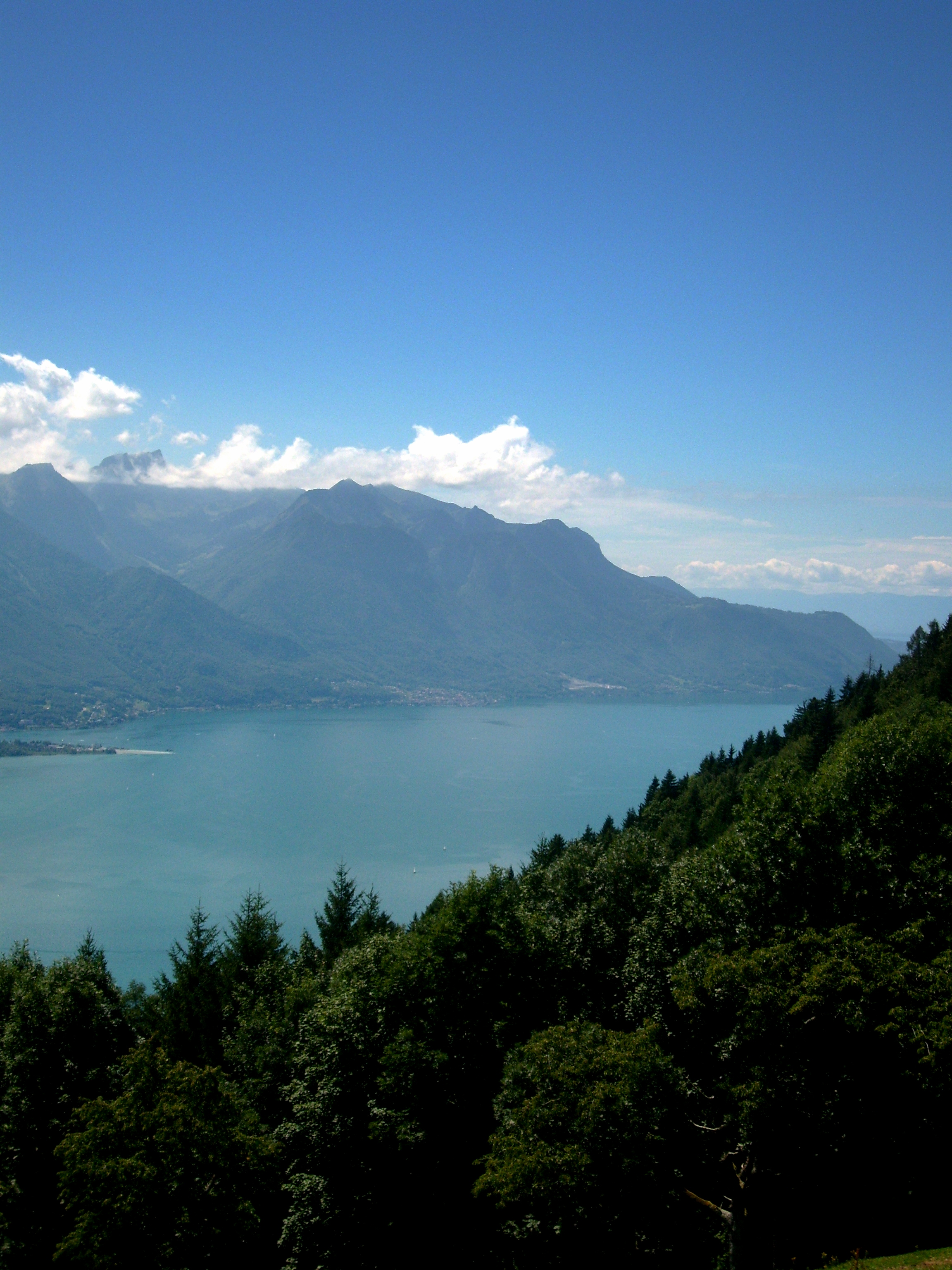
Lake Geneva is the largest body of water in Switzerland, and greatly exceeds in size all others that are connected with the main valleys of the Alps. It is in the shape of a crescent, with the horns pointing south, the northern shore being 95 km and the southern shore 72 km in length. The crescent form was more regular in a recent geological period, when the lake extended to Bex, about 18 km south of Villeneuve. The detritus of the Rhône has filled up this portion of the bed of the lake, and it appears that within the historical period, the waters extended about 2 km beyond the present eastern margin of the lake. The greatest depth of the lake, in the broad portion between Évian-les-Bains and Lausanne, where it is just 13 km in width, has been measured as 310 m, putting the bottom of the lake at 62 m above sea level. The lake's surface is the lowest point of the cantons of Valais and Vaud. The culminating point of the lake's drainage basin is Monte Rosa at 4,634 metres above sea level.
The beauty of the shores of the lake and of the sites of many of the places near its banks has long been celebrated. However, it is only from the eastern end of the lake, between Vevey and Villeneuve, that the scenery assumes an Alpine character. On the south side, the mountains of Savoy and Valais are for the most part rugged and sombre, while those of the northern shore fall in gentle vine-covered slopes, thickly set with villages and castles.
The snowy peaks of the Mont Blanc Massif are shut out from the western end of the lake by the Voirons mountain, and from its eastern end by the bolder summits of the Grammont, Cornettes de Bise, and Dent d'Oche, but are seen from Geneva, and between Nyon and Morges. From Vevey to Bex, where the lake originally extended, the shores are enclosed by comparatively high and bold mountains, and the vista terminates in the grand portal of the defile of St. Maurice, cleft to a depth of nearly 2700 m between the opposite peaks of the Dents du Midi and the Dent de Morcles.
The shore between Nyon and Lausanne is called La Côte because it is flatter. Between Lausanne and Vevey it is called Lavaux and is famous for its hilly vineyards.
The average surface elevation of 372 m above sea level is controlled by the in Geneva.
Climate
Due to climate change, the average temperature of deep water (more than 300 m deep) increased from 4.4 C in 1963 to 5.5 C in 2016 (an increase of 1.1 C-change in 53 years), while the average temperature of surface water (5 m deep) increased from 10.9 C in 1970 to 12.9 C in 2016 (up 2 C-change in 46 years). |Jan record high C = 17.3 |Feb record high C = 20.6 |Mar record high C = 24.9 |Apr record high C = 27.5 |May record high C = 33.8 |Jun record high C = 36.5 |Jul record high C = 39.7 |Aug record high C = 37.6 |Sep record high C = 34.8 |Oct record high C = 27.3 |Nov record high C = 23.2 |Dec record high C = 20.8 |Jan record low C = -19.9 |Feb record low C = -20.0 |Mar record low C = -13.3 |Apr record low C = -5.2 |May record low C = -2.2 |Jun record low C = 1.3 |Jul record low C = 3.0 |Aug record low C = 4.9 |Sep record low C = 0.2 |Oct record low C = -4.7 |Nov record low C = -10.9 |Dec record low C = -17.0 |year record low C =
|Jan record high C = 14.9 |Feb record high C = 15.8 |Mar record high C = 22.6 |Apr record high C = 25.5 |May record high C = 31.3 |Jun record high C = 33.6 |Jul record high C = 35.2 |Aug record high C = 37.1 |Sep record high C = 28.6 |Oct record high C = 25.4 |Nov record high C = 19.8 |Dec record high C = 17.7 |Jan record low C = -16.7 |Feb record low C = -12.7 |Mar record low C = -9.1 |Apr record low C = -2.9 |May record low C = 2.1 |Jun record low C = 5.2 |Jul record low C = 9 |Aug record low C = 8.2 |Sep record low C = 4.4 |Oct record low C = -1.2 |Nov record low C = -6.2 |Dec record low C = -10.1
Bise
Lake Geneva (and particularly the lakeside parts of the city of Geneva) can be affected by the cold Bise, a northeasterly wind. This can lead to severe icing in winter. The strength of the Bise wind can be determined by the difference in air pressure between Geneva and Güttingen in canton of Thurgau. The Bise arises when the air pressure in Güttingen is higher than in Geneva.
Environment

In the late 1960s, pollution made it dangerous to swim at some beaches of the lake, and visibility underwater was near zero. By the 1980s, intense environmental pollution (eutrophication) had almost wiped out all the fish. Endemic whitefish species Coregonus fera was last recorded in the lake in 1920 and is now extinct. Although the name fera is still used for the only coregonid present in the lake, this is not the original species but the introduced C. palaea. Today, pollution levels have been dramatically cut back, and it is again considered safe to swim in the lake. Major leisure activities practiced include sailing, wind surfing, boating (including water skiing and wake-boarding), rowing, scuba diving, and bathing.
Since 2016, the biodiversity of the lake has been dramatically changed due to the arrival of the invasive quagga mussel. Mussels now coat the entire floor of the lake, destroying the native food chain and leaving the lake vulnerable to poisonous blue-green algae. In 2024, scientists found that 100% of the biomass they sampled from the lake floor were Quagga mussels.
Sport events
Yacht racing is a popular sport, and high-performance catamarans have been developed specifically for the lake. The design of the Alinghi 5, the defender of the 2010 America's Cup, was influenced by those racing catamarans.
The Tour du Lac rowing event also takes place on Lake Geneva. Competitors row once around the entire lake, making this 160 km event the longest non-stop rowing regatta in the world.
Several competitions for swimmers are organised yearly, the longest of which spans the length of the lake from Chillon Castle to Geneva (70km) and is known as The Signature. Other events include the crossing of the lake from Lausanne to Evian (13km), from Montreux to Clarens (1.8 km), in Geneva (1.8 km), all in summer, and the Coupe de Noël, 125m in Geneva in December.
Towns and villages
The largest metropolitan areas along Lake Geneva, along with their populations, are:
- Geneva (190,000 city, 1 million metro area)
- Lausanne (130,000 city, 420,000 metro area)
- Thonon-les-Bains (32,000 town population)
- Montreux (25,000 town, 85,000 metro area)
| Southern shore | Northern shore | Haut Lac | Grand Lac | Petit Lac |
|---|
Topographic map
Notable residents
Edmund Ludlow, famous as one who had signed the death warrant of English King Charles I, was granted on 16 April 1662 protection in and continued to live at Vevey until his death in 1692. Mary and Percy Shelley and Lord Byron holidayed by the lake and wrote ghost stories, one of which became the basis for the novel Frankenstein. The Empress Elisabeth of Austria (Sisi) was stabbed to death on the quayside in Geneva in September 1898. Vladimir Lenin rented a little "chalet" at the French bank, near Geneva. Actor Charlie Chaplin spent his final years and died in Vevey (there is a memorial statue of him along the promenade; his home at Corsier-sur-Vevey is now a museum of his life and career). Actors Noël Coward, James Mason, Sir Peter Ustinov, Richard Burton, and Audrey Hepburn all lived in villages on the shores of or in view of the lake. David Bowie moved to a chalet to the north of Lake Geneva in 1976, which inspired him to take up painting and informed the first stages of the "Berlin Trilogy". Pop singer Phil Collins lives in a home overlooking the lake. Rock band Queen owned and operated Mountain Recording Studios (which is still in use today) in Montreux, and a statue of lead singer Freddie Mercury, who also owned a second home in Montreux, stands on the northern shore of the lake. Writer Vladimir Nabokov also took residence in Montreux, where he died in 1977. Former Formula 1 driver Michael Schumacher lives with his family in a home overlooking the lake.
Notable events
In 563, according to the writings of Gregory of Tours and Marius Aventicensis, a tsunami wave swept along the lake, destroying the fort of Tauredunum and other settlements, and causing numerous deaths in Geneva. Simulations indicate that this Tauredunum event was most likely caused by a massive landslide near the Rhône delta, which caused a wave 8 m high to reach Geneva within 70 minutes. In 888, the town was part of the new Kingdom of Burgundy, and, with it, was absorbed into the Holy Roman Empire in 1033.
In 1827, Lake Geneva was the site for the first measurement of the speed of sound in (fresh) water. French mathematician Jacques Charles François Sturm and Swiss physicist Daniel Collodon used two moored boats, separated by a measured distance, as the transmitting and receiving platforms for the sounds of exploding gunpowder. The loud airborne sound coupled into the lake, establishing a loud underwater sound that could be measured at a distance. The flash of the exploding gunpowder provided the visual starting cue for the timepiece, and the underwater explosion sound striking a bell provided the finish cue.
A total of four submarines have plied the depths of Lake Geneva. In 1964, Jacques Piccard launched a tourist-oriented submarine, the Auguste Piccard (named for his explorer father), for the Swiss National Exhibition, meant to honor the Expo 64 theme of accomplishments by Swiss engineers and industry. After operating through to 1965 in Lake Geneva, Piccard used the vessel for scientific exploration in other parts of the world. Piccard later built the F.-A. Forel, launched in Lake Geneva in 1978 and used primarily for scientific research until it was retired in 2005. In 2011, in a collaborative operation led by École Polytechnique Fédérale de Lausanne, two Mir submersibles were used for ten weeks to conduct extensive scientific research in Lake Geneva.
Notes
References
References
- "Les Grangettes".
- "Rives du Lac Léman".
- (2009). "03 - Suisse sud-ouest". Federal Office of Topography, swisstopo, Swiss Federal Department of Defence, Civil Protection and Sport.
- (2016-11-28). "What you call Lake Geneva really does matter, according to a poll".
- (1820). "Voyage pittoresque au lac de Genève ou Léman".
- "Le Léman". [[Swisstopo]].
- "Le Léman". [[Institut national de l'information géographique et forestière]].
- (2011). "270 - Genève". Federal Office of Topography, swisstopo, Swiss Federal Department of Defence, Civil Protection and Sport.
- [[John Ball (naturalist). John Ball]], ''A Guide to the Western Alps'', p. 254
- "1:25,000 topographic map". [[Swisstopo]].
- Cuckoo, Paul. (26 October 2007). "Switzerland mastering the art of wine making". India Times.
- Mourby, Adrian. (19 August 2007). "European Breaks: Three suns, one grape, a lot of flavour". The Independent.
- link. (7 July 2011 rhone-geneve.ch. Retrieved on 20 July 2009)
- [http://www.cipel.org/publications/lettre-leman-lecture/ La lettre du Léman], bulletin of the [[:fr:Commission internationale pour la protection des eaux du Léman. Commission internationale pour la protection des eaux du Léman]], number 54, June 2017, page 3.
- (2 July 2014). "Climate normals Genève–Cointrin (Reference period 1981–2010)". Swiss Federal Office of Metreology and Climatology, MeteoSwiss.
- "Genève–Cointrin extreme values". [[KNMI (institute).
- (2 July 2014). "Climate normals Pully (Reference period 1981−2010)". Swiss Federal Office of Metreology and Climatology, MeteoSwiss.
- {{in lang. link. (9 January 2021 .)
- (17 January 2017). "La bise va se calmer après une journée chaotique, mais plusieurs écoles vont rester fermées". [[Radio Télévision Suisse.
- "Bisendiagramm". MeteoGroup Schweiz AG.
- (16 November 1962). "Convention concerning protection of the waters of Lake Geneva against pollution.". United Nations Treaty Collection.
- Bergier, Jean-François. (2008). "Dictionnaire historique de la Suisse". Editions Gilles Attinger, Hauterive.
- (9 May 2007). "Baisse du Phosphore dans le Léman". Commission Internationale pour la Protection du Léman (CIPEL).
- Monna, F.. (1999). "Origin and evolution of Pb in sediments of Lake Geneva (Switzerland-France). Establishing a stable Pb record". American Chemical Society.
- "‘It’s an open invasion’: how millions of quagga mussels changed Lake Geneva for ever".
- "alinghi.com".
- "boldor.ch".
- "LGSA Signature swim".
- "13 km à la nage sur le Léman, entre Lausanne et Evian !".
- "Commune de Montreux - Traversée à la nage Montreux-Clarens".
- Mertenat, Thierry. (31 July 2016). "La traversée du lac à la nage réussit sa première édition". TDG.
- (15 December 2019). "Près de 2500 courageux à la Coupe de Noël". [[Tribune de Genève]].
- Macaulay, History of England, Vol 1, Page 400, J H Dent 1953.
- Sunstein, Emily W.. (1989). "Mary Shelley: Romance and Reality". Johns Hopkins University Press.
- (19 November 1985). "The summit: The Russians make their entrance". The NY Times.
- Michner, Joerg. (25 February 2007). "Fed-up Swiss taxpayers call time on concessions for wealthy foreigners". Telegraph.co.uk.
- (2012). "Giant Lake Geneva tsunami in AD 563". Nature Geoscience.
- (28 October 2012). "Tsunamis on Lake Geneva: Lake monsters". [[The Economist]].
- (28 October 2012). "Ancient tsunami devastated Lake Geneva shoreline". [[Nature (journal).
- Guichonnet, Paul. (2002). "Nature et histoire du Léman: le guide du Léman". Editions Cabedita.
- Dubuis, Etienne. (10 June 2011). "A la découverte du Léman". [[Le Temps]].
- Dubuis, Etienne. (10 June 2011). "Ces submersibles qui ont plongé dans le Léman". [[Le Temps]].
This article was imported from Wikipedia and is available under the Creative Commons Attribution-ShareAlike 4.0 License. Content has been adapted to SurfDoc format. Original contributors can be found on the article history page.
Ask Mako anything about Lake Geneva — get instant answers, deeper analysis, and related topics.
Research with MakoFree with your Surf account
Create a free account to save articles, ask Mako questions, and organize your research.
Sign up freeThis content may have been generated or modified by AI. CloudSurf Software LLC is not responsible for the accuracy, completeness, or reliability of AI-generated content. Always verify important information from primary sources.
Report