From Surf Wiki (app.surf) — the open knowledge base
Lady of the Mountain
National personification of Iceland
National personification of Iceland
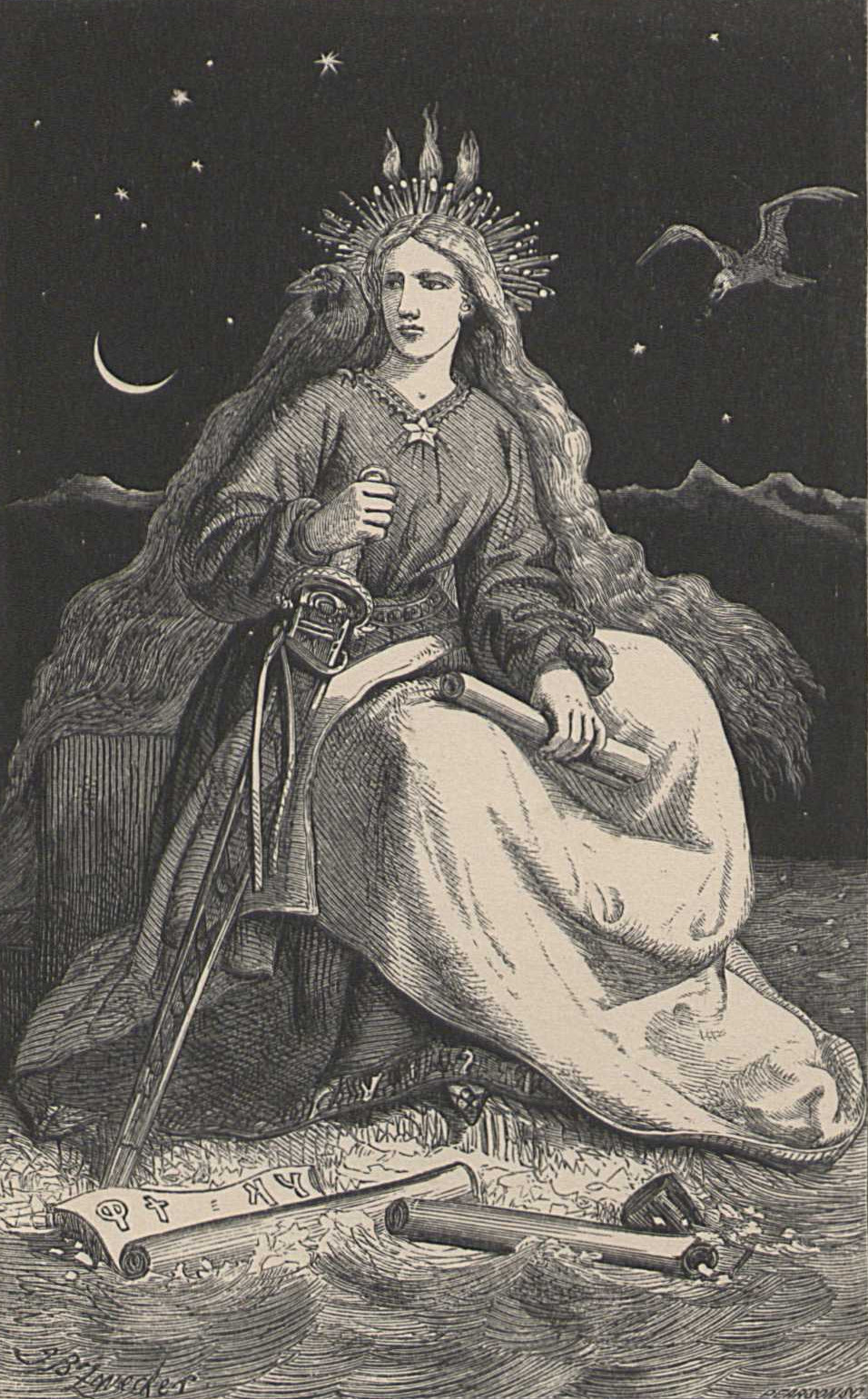
The Lady of the Mountain () is the female incarnation (national personification) of Iceland.
History in Iceland
The personification of a nation as a woman was widespread in eighteenth- and nineteenth-century Europe. The earliest image of Iceland personified as a woman seems to have appeared first in association with the poem Ofsjónir við jarðarför Lovísu drottningar 1752 ('Visions at the funeral of Queen Louise, 1752') by Eggert Ólafsson (1752), but this image does not survive.
The word fjallkonan is attested for the first time in the poem Eldgamla Ísafold by Bjarni Thorarensen from the first decade of the nineteenth century. From that moment onwards the Lady of the Mountain became a well-known symbol in Icelandic poetry.
An image of Lady of the Mountain was published in the last volume of an English translation of Icelandic folk-tales by Eiríkur Magnússon and G. E. J. Powell, Icelandic Legends, Collected by Jón Arnason (1864–66). It is the work of the German painter Johann Baptist Zwecker, who drew it to specifications provided by Eiríkur. Eiríkur described the picture in a letter to Jón Sigurðsson (11 April 1866) thus:
:: The picture of the woman is to represent Iceland, thus she has a crown of ice on her head, from which fires erupt. On her shoulder is the raven, Iceland's most characteristic bird, Óðinn's ancient friend and the favourite of poets, a great and knowledgeable carrier of news. Over the seas flutters a seagull, but across the surf of time and history are borne rune-staves to the land and up into the embrace of the woman, and she has picked one of them up. This is intended as a symbol of our land of literature and history. It is night, with a starry sky and the moon up. Behind are mountains, moonlight on the ridges.Description of the drawing of J.B. Zwecker by Eiríkur Magnússon in a letter to Jón Sigurðsson. Translated by Dick Ringler. Original text: "Konumyndin á að tákna Ísland, því hefur hún ískórónu á höfði, sem eldar gjósa upp úr. Á öxl hennar er hrafninn, Íslands einkennilegasti fugl, Óðins forni vin og skáldanna eftirlætisgoð, fréttafugl mikill og margkunnugur. Yfir sjónum flögrar már, en yfir brimsævi tíma og sögu berast rúnakefli að landi eða upp í fang konunni, og hefur hún þegar náð einu þeirra. Þetta átti svo sem að vera symbolum (tákn) bókmenntalandsins og sögulandsins okkar. Yfir er nótt og stirndur himinn og máninn uppi. Á bak við eru fjöll, tunglroðin á eggjunum."
Also very popular is the image designed by Benedikt Gröndal on a memorial card of the national holiday in 1874.
The idea of the Lady of the Mountain as motherland was a counterweight to the idea of the Danish King as "father" in nineteenth-century Iceland under Danish rule. After independence in 1944, it became one of the images through which feminism and the idea of powerful women, such as Iceland's first female president Vigdís Finnbogadóttir, were made to seem a natural part of Icelandic culture.
Icelandic National Day celebration
Since the establishment of the Icelandic republic in 1944 it has been traditional for a woman to play the role of the Lady of the Mountain during the Icelandic National Day celebrations (17 June). The woman chosen for the role is typically a well-known actress or an otherwise notable individual. She is dressed in skautbúningur (the national costume) and presents herself to read a single poem.
In 2019, actress Aldís Amah Hamilton was named Lady of the Mountain.
In popular culture
The Lady of the Mountain appeared on the cover of the Sólstafir last album, Endless Twilight of Codependent Love.
History in Canada
The image of the Lady of the Mountain has also been prominent among Vestur Íslendingar in Canada. A woman dressed as the Lady of the Mountain first appeared at the Iceland Days in Winnipeg, Manitoba, Canada in 1924. There too, the Lady of the Mountain has been deployed to promote feminism.
References
References
- [http://visindavefur.is/?id=6696 Árni Björnsson, 'Hver er uppruni fjallkonunnar og hvaða hlutverki gegnir hún?', ''Vísindavefurinn'' 22.6.2007. viewed 5.6.2014]
- Inga Dóra Björnsdóttir, 'The Mountain Woman and the Presidency', in ''Images of Contemporary Iceland: Everyday Lives and Global Contexts'', ed. by Gísli Pálsson and E. Paul Durrenberger (Iowa City: University of Iowa Press, 1996), pp. 106-25.
- "Hin íslenska fjallkona".
- (17 June 2019). "Fjallkonan í ár Aldís Amah Hamilton". [[RÚV]].
- (17 June 2019). "Mikill heiður að fá að vera brautryðjandi". [[Vísir.is]].
- (17 June 2019). "Segir einhver nei við þessu?". [[Morgunblaðið]].
- (2020-11-04). "SÓLSTAFIR premiere new album 'Endless Twilight of Codependent Love' live via Youtube".
- Anne Brydon, 'Mother to her Distant Children: The Icelandic ''Fjallkona'' in Canada', in Undisciplined Women: Tradition and Culture in Canada, ed. by Pauline Greenhill and Diane Tye (Montreal: McGill-Queen's University Press, 1997), pp. 87-100.
This article was imported from Wikipedia and is available under the Creative Commons Attribution-ShareAlike 4.0 License. Content has been adapted to SurfDoc format. Original contributors can be found on the article history page.
Ask Mako anything about Lady of the Mountain — get instant answers, deeper analysis, and related topics.
Research with MakoFree with your Surf account
Create a free account to save articles, ask Mako questions, and organize your research.
Sign up freeThis content may have been generated or modified by AI. CloudSurf Software LLC is not responsible for the accuracy, completeness, or reliability of AI-generated content. Always verify important information from primary sources.
Report