From Surf Wiki (app.surf) — the open knowledge base
Ladakh
Union territory of India
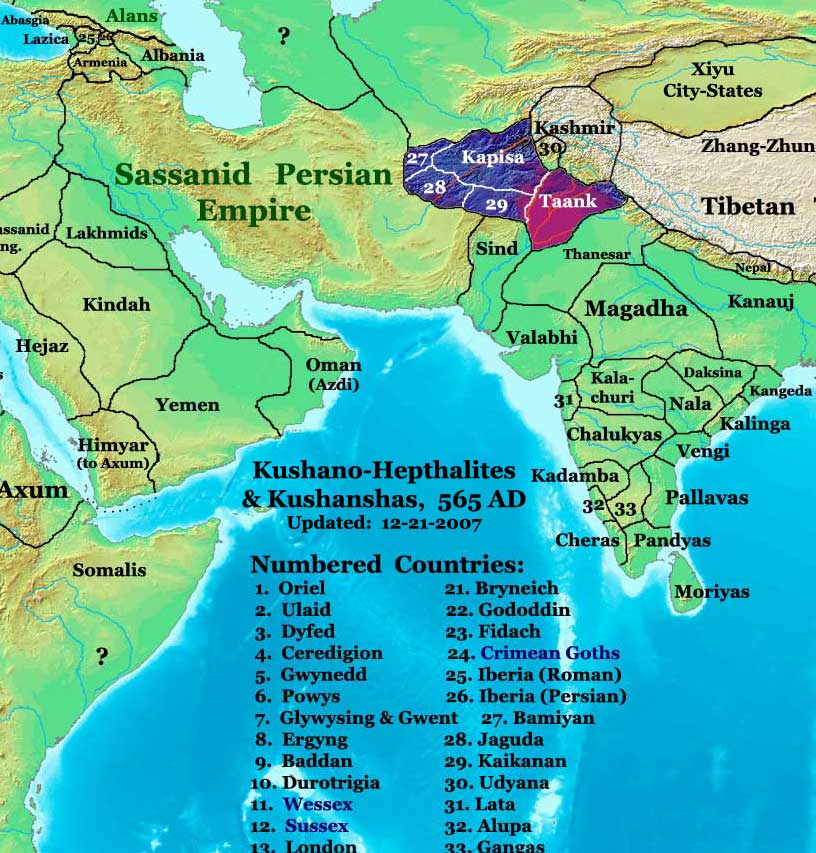
Union territory of India
| Field | Value |
|---|---|
| name | Ladakh |
| settlement_type | Region administered by India as a union territory |
| image_skyline | {{Photomontage |
| photo1a | Road Padum Zanskar Range Jun24 A7CR 00818.jpg |
| photo2a | Karzok Tso Moriri (cropped) 02.jpg |
| photo3a | Phyang Monastery 01.jpg |
| position | centre |
| size | 250 |
| border | 0 |
| foot_montage | *From top to bottom:* View of the Himalayas near Padum, Zanskar; Lake Moriri with Karzok village in the foreground, Phyang Monastery in Ladakh |
| image_map | File:Kashmir region. LOC 2003626427 - showing sub-regions administered by different countries.jpg |
| map_alt | Map of the disputed Kashmir region showing areas of control by India, Pakistan, and China |
| map_caption | A map of the disputed Kashmir region with the two Indian-administered areas shaded in tan |
| mapframe | yes |
| mapframe-zoom | 4 |
| mapframe-marker | city |
| coordinates | |
| subdivision_type | Administering state |
| subdivision_name | India |
| established_title | Union territory |
| established_date | 31 October 2019 |
| seat_type | Capitals |
| seat | |
| parts_type | Districts |
| parts_style | para |
| p1 | 7 |
| governing_body | Administration of Ladakh |
| leader_title | Lieutenant Governor |
| leader_name | Kavinder Gupta |
| leader_title1 | Member of Parliament |
| leader_name1 | Mohmad Haneefa (Independent) |
| leader_title2 | High Court |
| leader_name2 | High Court of Jammu & Kashmir and Ladakh |
| leader_title3 | Autonomous Hill Development Councils |
| leader_name3 | LAHDC Leh |
| LAHDC Kargil | |
| unit_pref | Metric |
| area_footnotes | |
| area_total_km2 | 59,146 |
| elevation_max_m | 7,742 |
| elevation_max_point | Saltoro Kangri |
| elevation_min_m | 2,550 |
| elevation_min_point | Indus River |
| population_total | 274,289 |
| population_as_of | 2011 |
| population_density_km2 | auto |
| population_demonym | Ladakhi |
| demographics_type1 | Languages |
| demographics1_title1 | Official |
| demographics1_info1 | |
| demographics1_title2 | Regional |
| demographics1_info2 | |
| timezone1 | IST |
| utc_offset1 | +05:30 |
| iso_code | IN-LA |
| postal_code_type | |
| postal_code | Leh: 194101; Kargil: 194103 |
| registration_plate | LA |
| blank1_name_sec1 | Literacy (2024) |
| blank1_info_sec1 | 81.0% (27th) |
| website |
| mapframe-zoom = 4 | mapframe-marker = city LAHDC Kargil
Ladakh (, ) is a region administered by India as a union territory and constitutes an eastern portion of the larger Kashmir region that has been the subject of a dispute between India and Pakistan since 1947 and India and China since 1959.The application of the term "administered" to the various regions of Kashmir and a mention of the Kashmir dispute is supported by the tertiary sources (a) through (e), reflecting due weight in the coverage. Although "controlled" and "held" are also applied neutrally to the names of the disputants or to the regions administered by them, as evidenced in sources (h) through (i) below, "held" is also considered politicised usage, as is the term "occupied", (see (j) below).
(a) (subscription required) Quote: "Kashmir, region of the northwestern Indian subcontinent ... has been the subject of dispute between India and Pakistan since the partition of the Indian subcontinent in 1947. The northern and western portions are administered by Pakistan and comprise three areas: Azad Kashmir, Gilgit, and Baltistan, the last two being part of a territory called the Northern Areas. Administered by India are the southern and southeastern portions, which constitute the state of Jammu and Kashmir but are slated to be split into two union territories.";
(b) (subscription required) Quote: "Aksai Chin, Chinese (Pinyin) Aksayqin, portion of the Kashmir region, at the northernmost extent of the Indian subcontinent in south-central Asia. It constitutes nearly all the territory of the Chinese-administered sector of Kashmir that is claimed by India to be part of the Ladakh area of Jammu and Kashmir state.";
(c) C. E Bosworth, University of Manchester Quote: "KASHMIR, kash'mer, the northernmost region of the Indian subcontinent, administered partlv by India, partly by Pakistan, and partly by China. The region has been the subject of a bitter dispute between India and Pakistan since they became independent in 1947";
(d) Quote: "Jammu and Kashmir: Territory in northwestern India, subject to a dispute between India and Pakistan. It has borders with Pakistan and China."
(e) Quote: "We move from a disputed international border to a dotted line on the map that represents a military border not recognized in international law. The line of control separates the Indian and Pakistani administered areas of the former Princely State of Jammu and Kashmir.";
(f)
(g)
(h) Quote: "J&K: Jammu and Kashmir. The former princely state that is the subject of the Kashmir dispute. Besides IJK (Indian-controlled Jammu and Kashmir. The larger and more populous part of the former princely state. It has a population of slightly over 10 million, and comprises three regions: Kashmir Valley, Jammu, and Ladakh.) and AJK ('Azad" (Free) Jammu and Kashmir. The more populous part of Pakistani-controlled J&K, with a population of approximately 2.5 million.), it includes the sparsely populated "Northern Areas" of Gilgit and Baltistan, remote mountainous regions which are directly administered, unlike AJK, by the Pakistani central authorities, and some high-altitude uninhabitable tracts under Chinese control."
(i) Quote: "Kashmir's identity remains hotly disputed with a UN-supervised "Line of Control" still separating Pakistani-held Azad ("Free") Kashmir from Indian-held Kashmir.";
(j) Quote:"Some politicised terms also are used to describe parts of J&K. These terms include the words 'occupied' and 'held'." Ladakh is bordered by the Tibet Autonomous Region of Chinato the east, the Indian state of Himachal Pradesh to the south, both the Indian-administered union territory of Jammu and Kashmir and the Pakistan-administered Gilgit-Baltistan to the west, and the southwest corner of Xinjiang across the Karakoram Pass in the far north. It extends from the Siachen Glacier in the Karakoram range to the north to the main Great Himalayas to the south. The eastern end, consisting of the uninhabited Aksai Chin plains, is claimed by the Indian Government as part of Ladakh, but has been under Chinese control.
In the past, Ladakh gained importance from its strategic location at the crossroads of important trade routes, but as Chinese authorities closed the borders between Tibet Autonomous Region and Ladakh in the 1960s, international trade dwindled. Since 1974, the Government of India has encouraged tourism in Ladakh. As Ladakh is strategically important, the Indian military maintains a strong presence in the region.
The largest city in Ladakh is Leh, followed by Kargil, each of which headquarters a district. The Leh district contains the Indus, Shyok and Nubra river valleys. The Kargil district contains the Suru, Dras and Zanskar river valleys. The main populated regions are the river valleys, but the mountain slopes also support pastoral Changpa nomads. The main religious groups in the region are Muslims (mainly Shia) (46%), Buddhists (mainly Tibetan Buddhists) (40%), and Hindus (12%) with the remaining 2% made of other religions. Ladakh is both the largest and the second least populous union territory of India. Its culture and history are closely related to those of Tibet.
Ladakh was established as a union territory of India on 31 October 2019, following the passage of the Jammu and Kashmir Reorganisation Act. Prior to that, it was part of the Jammu and Kashmir state.
Names and their etymology
The classical name in means the "land of high passes". Ladak is its pronunciation in several Tibetan dialects. The English spelling Ladakh is derived from . Quote: Ladakh, the Persian transliteration of the Tibetan La-dvags, is warranted by the pronunciation of the word in several Tibetan districts. The terminal gs has the sound of the guttural gh or even kh in various Tibetan dialects. (Volume II, page 93) Quote: The single most important source [of Ladakhi history] is the La dvags rgyal rabs, the royal chronicle of Ladakh, which dates back to the 17th century.
The region was previously known as Maryul (see page for etymology).
Medieval Islamic scholars called Ladakh the "Great Tibet" (derived from Turko-Arabic Ti-bat, meaning "highland"); Baltistan and other trans-Himalayan states in Kashmir's vicinity were referred to as "Little Tibets".
It has also been called Ma-Lo-Pho (by Hiuen Tsang) or Lal Bhumi. Names in the local language include Kanchapa (Land of snow) and Ripul (Country of mountains).
History
Main article: History of Ladakh
Ancient history
Rock carvings found in many parts of Ladakh indicate that the area has been inhabited from Neolithic times. Ladakh's earliest inhabitants consisted of nomads known as Kampa. Later settlements were established by Mons from Kullu and Brokpas who originated from Gilgit. Around the 1st century, Ladakh was a part of the Kushan Empire. Buddhism spread into western Ladakh from Kashmir in the 2nd century. The 7th-century Buddhist traveller Xuanzang describes the region in his accounts. Xuanzang's term of Ladakh is Mo-lo-so, which has been reconstructed by academics as *Malasa, *Marāsa, or *Mrāsa, which is believed to have been the original name of the region.
For much of the first millennium, western Tibet comprised Zhangzhung kingdom(s), which practised the Bon religion. Sandwiched between Kashmir and Zhangzhung, Ladakh is believed to have been alternatively under the control of one or other of these powers. Academics find strong influences of Zhangzhung language and culture in "upper Ladakh" (from the middle section of the Indus valley to the southeast).: "While the whole of Ladakh and adjacent regions were originally populated by speakers of Eastern Iranian (Scythian), Lower Ladakh (as well as Baltistan) was also subject to several immigration waves of Indoaryan (Dardic) speakers and other groups from Central Asia. Upper Ladakh and the neighbouring regions to the east, by contrast, seem to have been populated additionally by speakers of a non-Tibetan Tibeto-Burman language, namely West Himalayan (Old Zhangzhung;...)." The penultimate king of Zhangzhung is said to have been from Ladakh.
From around 660 CE, the Tang dynasty and the Tibetan Empire started contesting the "four garrisons" of the Tarim Basin (present day Xinjiang), a struggle that lasted three centuries. Zhangzhung fell victim to Tibet's ambitions in and disappeared. Karkota Empire and the Umayyad Caliphate too joined the contest for Xinjiang soon afterwards. Baltistan and Ladakh were at the centre of these struggles. Academics infer from the slant of Ladakhi chronicles that Ladakh may have owed its primary allegiance to Tibet during this time, but that it was more political than cultural. Ladakh remained Buddhist and its culture was not yet Tibetan.
Early medieval history


In the 9th century, Tibet's ruler Langdarma was assassinated and Tibet fragmented. Kyide Nyimagon, Langdarma's great-grandson, fled to West Tibet , and founded a new West Tibetan kingdom at the heart of the old Zhangzhung, now called Ngari in the Tibetan language.

Nyimagon's eldest son, Lhachen Palgyigon, is believed to have conquered the regions to the north, including Ladakh and Rutog. After the death of Nyimagon, his kingdom was divided among his three sons, Palgyigon receiving Ladakh, Rutog, Thok Jalung and an area referred to as Demchok Karpo (a holy mountain near the present-day Demchok village). The second son received Guge–Purang (called "Ngari Korsum") and the third son received Zanskar and Spiti (to the southwest of Ladakh). This three-way division of Nyimagon's empire was recognised as historic and remembered in the chronicles of all the three regions as a founding narrative.
He gave to each of his sons a separate kingdom, viz., to the eldest *Dpal-gyi-gon*, *Maryul* of *Mngah-ris*, the inhabitants using black bows; *ru-thogs* [Rutog] of the east and the Gold-mine of *Hgog* [possibly Thok Jalung]; nearer this way *Lde-mchog-dkar-po* [Demchok Karpo]; ... The first West Tibetan dynasty of Maryul founded by Palgyigon lasted five centuries, being weakened towards its end by the conquests of the Mongol/Mughal noble Mirza Haidar Dughlat. Throughout this period the region was called "Maryul", possibly from the original proper name **Mrasa* (Xuangzhang's, *Mo-lo-so*), but in the Tibetan language it was interpreted to mean "lowland" (the lowland of Ngari). Maryul remained staunchly Buddhist during this period, having participated in the second diffusion of Buddhism from India to Tibet via Kashmir and Zanskar. File:Alchi Rajputs.jpg|Ladakh horsemen, depicted in Alchi Monastery, circa 13th century CE File:The 9 Stupas.jpg|The nine stupas at Thiksey Monastery File:Likir Buddha.jpg|Statue of Maitreya at Likir Monastery, Leh district === Medieval history === Between the 1380s and early 1510s, many Islamic missionaries propagated Islam and proselytised the Ladakhi people. Sayyid Ali Hamadani, Sayyid Muhammad Nur Baksh and Mir Shamsuddin Iraqi were three important Sufi missionaries who propagated Islam to the locals. Mir Sayyid Ali was the first one to make Muslim converts in Ladakh and is often described as the founder of Islam in Ladakh. Several mosques were built in Ladakh during this period, including in Mulbhe, Padum and Shey, the capital of Ladakh. His principal disciple, Sayyid Muhammad Nur Baksh also propagated Islam to Ladakhis and the Balti people rapidly converted to Islam. Noorbakshia Islam is named after him and his followers are only found in Baltistan and Ladakh. During his youth, Sultan Zain-ul-Abidin expelled the mystic Sheikh Zain Shahwalli for showing disrespect to him. The sheikh then went to Ladakh and proselytised many people to Islam. In 1505, Shamsuddin Iraqi, a noted Shia scholar, visited Kashmir and Baltistan. He helped in spreading Shia Islam in Kashmir and converted the overwhelming majority of Muslims in Baltistan to his school of thought. It is unclear what happened to Islam after this period and it seems to have received a setback. Mirza Muhammad Haidar Dughlat who invaded and briefly conquered Ladakh in 1532, 1545 and 1548, does not record any presence of Islam in Leh during his invasion although Shia Islam and Noorbakshia Islam continued to flourish in other regions of Ladakh. King Bhagan reunited and strengthened Ladakh and founded the Namgyal dynasty (*Namgyal* means "victorious" in several Tibetan languages). The Namgyals repelled most Central Asian raiders and temporarily extended the kingdom as far as Nepal. During the Balti invasion led by Raja Ali Sher Khan Anchan, many Buddhist temples and artefacts were damaged. Ali Sher Khan took the king and his soldiers as captives. Jamyang Namgyal was later restored to the throne by Ali Sher Khan and given the hand of a Muslim princess in marriage. Her name was Gyal Khatun or Argyal Khatoom. She was to be the first queen and her son was to become the next ruler. Historical accounts differ upon who her father was. Some identify Ali's ally and Raja of Khaplu Yabgo Shey Gilazi as her father, while others identify Ali himself as the father. In the early 17th century efforts were made to restore the destroyed artefacts and *gonpas* by Sengge Namgyal, the son of Jamyang and Gyal. He expanded the kingdom into Zangskar and Spiti. Despite a defeat of Ladakh by the Mughals, who had already annexed Kashmir and Baltistan, Ladakh retained its independence. Islam begins to take root in the Leh area in the beginning of the 17th century after the Balti invasion and the marriage of Gyal to Jamyang. A large group of Muslim servants and musicians were sent along with Gyal to Ladakh and private mosques were built where they could pray. The Muslim musicians later settled in Leh. Several hundred Baltis migrated to the kingdom and according to oral tradition many Muslim traders were granted land to settle. Many other Muslims were invited over the following years for various purposes. In the late 17th century, Ladakh sided with Bhutan in its dispute with Tibet which, among other reasons, resulted in its invasion by the Tibetan Central Government. This event is known as the Tibet–Ladakh–Mughal war of 1679–1684. Kashmiri historians assert that the king converted to Islam in return for the assistance by Mughal Empire after this, however, Ladakhi chronicles do not mention such a thing. The king agreed to pay tribute to the Mughals in return for defending the kingdom. The Mughals, however, withdrew after being paid off by the [5th Dalai Lama](5th-dalai-lama). File:View of the Lakir Monastery.JPG|Likir Monastery, Ladakh File:Phyang Monastery 01.jpg|Phyang Gompa, Ladakh File:Hemis Monastery Ladakh 1876.jpg|Hemis Monastery in the 1870s === Princely state of Jammu and Kashmir === In 1834, the Sikh Zorawar Singh, a general of Raja Gulab Singh of Jammu, invaded and annexed Ladakh to Jammu under the suzerainty of the Sikh Empire. After the defeat of the Sikhs in the First Anglo-Sikh War, the state of Jammu and Kashmir was established as a separate princely state under British suzerainty. The Namgyal family was given the *jagir* of Stok, which it nominally retains to this day. European influence began in Ladakh in the 1850s and increased. Geologists, sportsmen, and tourists began exploring Ladakh. In 1885, Leh became the headquarters of a mission of the Moravian Church. Ladakh was administered as a *wazarat* under Dogra rule, with a governor termed *wazir-e-wazarat*. It had three tehsils, based at Leh, Skardu and Kargil. The headquarters of the *wazarat* was at Leh for six months of the year and at Skardu for six months. When the legislative assembly, called *Praja Sabha*, was established in 1934, Ladakh was given two nominated seats in the assembly. Ladakh was claimed as part of Tibet by Phuntsok Wangyal, a Tibetan Communist leader. === Indian state of Jammu and Kashmir === At the time of the partition of India in 1947, the Dogra ruler Maharaja Hari Singh chose to remain independent of India or Pakistan. Pakistani soldiers from Gilgit invaded in October and had reached Ladakh. To get defence assistance from India, Singh was told by Nehru to sign the Instrument of Accession to India, and military operations were initiated to counter the invasion. The wartime conversion of the pony trail from Sonamarg to Zoji La by army engineers permitted tanks to move up and successfully capture the pass. The advance continued. Dras, Kargil and Leh were taken and Ladakh cleared of the Pakistanis. In 1949, China closed the border between Nubra and Xinjiang, blocking old trade routes. In 1955 China began to build roads connecting Xinjiang and Tibet through the Aksai Chin area. The Indian effort to gain control of Aksai Chin led to the Sino-Indian War of 1962, which India lost. China also built the Karakoram highway jointly with Pakistan. India built the Srinagar-Leh Highway during this period, cutting the journey time between Srinagar and Leh from 16 days to two. The route, however, remains closed during the winter months due to heavy snowfall. Construction of a 6.5 km tunnel across Zoji La pass is under consideration to make the route functional throughout the year. The Kargil War of 1999, codenamed "Operation Vijay" by the Indian Army, saw infiltration by Pakistani troops into parts of Western Ladakh, namely Kargil, Dras, Mushkoh, Batalik and Chorbatla, overlooking key locations on the Srinagar-Leh highway. Extensive operations were launched in high altitudes by the Indian Army with considerable artillery and air force support. Pakistani troops were evicted from the Indian side of the Line of Control which the Indian government ordered was to be respected and which was not crossed by Indian troops. The Indian government was criticised by the Indian public because India respected geographical co-ordinates more than India's opponents: Pakistan and China. The Ladakh region was divided into the Kargil and Leh districts in 1979. In 1989, there were violent riots between Buddhists and Muslims. Following demands for autonomy from the Kashmiri-dominated state government, the Ladakh Autonomous Hill Development Council was created in the 1990s. Leh and Kargil districts now each have their own locally elected Hill Councils with some control over local policy and development funds. In 1991, a Peace Pagoda was erected in Leh by Nipponzan Myohoji. There was a heavy presence of Indian Army and Indo-Tibetan Border Police forces in Ladakh. These forces and People's Liberation Army forces from China have, since the 1962 Sino-Indian War, had frequent stand-offs along the Ladakh portion of the Line of Actual Control. Out of the 857 km border in Ladakh, only 368 km is the International Border, and the remaining 489 km is the Line of Actual Control. The stand-off involving the most troops was in September 2014 in the disputed Chumar region when 800 to 1,000 Indian troops and 1,500 Chinese troops came into close proximity to each other. ==== Ladakh Division ==== On 8 February 2019, Ladakh became a separate Revenue and Administrative Division within Jammu and Kashmir, having previously been part of the Kashmir Division. As a division, Ladakh was granted its own Divisional Commissioner and Inspector General of Police. Leh was initially chosen to be the headquarters of the new division however, following protests, it was announced that Leh and Kargil will jointly serve as the divisional headquarters, each hosting an Additional Divisional Commissioner to assist the Divisional Commissioner and Inspector General of Police who will spend half their time in each town. === Union territory of Ladakh === The people of Ladakh had been demanding Ladakh to be constituted as a separate territory since 1930s, because of perceived unfair treatment by Kashmir and Ladakh's cultural differences with predominantly Muslim Kashmir valley, while some people in Kargil opposed union territory status for Ladakh. The first organised agitation was launched against Kashmir's "dominance" in the year 1964. In late 1980s, a much larger mass agitation was launched to press their demand for union territory status. In August 2019, a reorganisation act was passed by the Parliament of India which contained provisions to reconstitute Ladakh as a union territory, separate from the rest of Jammu and Kashmir on 31 October 2019. Under the terms of the act, the union territory is administered by a Lieutenant Governor acting on behalf of the union Government of India and does not have an elected legislative assembly or chief minister. Each district within the union territory continues to elect an autonomous district council as done previously. The demand for Ladakh as separate union territory was first raised by the parliamentarian Kushok Bakula Rinpoche around 1955, which was later carried forward by another parliamentarian Thupstan Chhewang. The former Jammu and Kashmir state use to obtain large allocation of annual funds from the union government based on the fact that the large geographical area of the Ladakh (comprising 65% of total area), but Ladakh was allocated only 2% of the state budget based on its relative population. Within the first year of the formation of Ladakh as separate union territory, its annual budget allocation has increased 4 times from 57 crore to 232 crore. On 24 September 2025, the protest march led by Sonam Wangchuk demanded full statehood of Ladakh. == Geography == Ladakh is the highest plateau in India with most of it being over 3000 m. It extends from the Himalayan to the Kunlun Ranges and includes the upper Indus River valley. Historically, the region included the Baltistan (Baltiyul) valleys (now mostly in Pakistani-administered Kashmir), the entire upper Indus Valley, the remote Zanskar, Lahaul and Spiti districts to the south, much of Ngari (including the Rudok region and Guge in the east), Aksai Chin in the northeast, and the Nubra Valley to the north, over Khardong La in the Ladakh Range. Contemporary Ladakh borders Tibet to the east, the Lahaul and Spiti regions to the south, the Vale of Kashmir, Jammu and Baltiyul regions to the west, and the southwest corner of Xinjiang, China across the Karakoram Pass in the far north. The historically vague divide between Ladakh and the Tibetan Plateau commences to the north in an intricate maze of ridges to the east of Rudok, including Aling Kangri and Mavang Kangri, continuing southeastward toward northwestern Nepal. Before partition, Baltistan, now part of Pakistan, had been a district of Ladakh; Skardu was the winter capital of Ladakh, with Leh being the summer capital. The mountain ranges in this region were formed over 45 million years by the folding of the Indian Plate into the more stationary Eurasian Plate. The drift continues, causing frequent earthquakes in the Himalayan region. The peaks in the Ladakh Range are at a medium altitude close to the Zoji-la (5000 -) and increase toward southeast, culminating in the twin summits of Nun-Kun (7000 m). The Suru and Zanskar Valleys form a great trough, enclosed by the Himalayas and the Zanskar Range. Rangdum is the highest inhabited region in the Suru valley, after which the valley rises to 4400 m at Pensi-la, the gateway to Zanskar. Kargil, the only town in the Suru Valley, is the second-most important town in Ladakh. It was an important staging post on the routes of trade caravans prior to 1947, being more-or-less equidistant (at about 230 kilometres) from Srinagar, Leh, Skardu and Padum. The Zanskar Valley lies in the troughs of the rivers Stod and Lungnak. The region experiences heavy snowfall; the Pensi-la is open only between June and mid-October. Dras and the Mushkoh Valley form the western extremity of Ladakh. The Indus River is the backbone of Ladakh. Most major historical and current towns – Shey, Leh, Basgo and Tingmosgang (but not Kargil), are close to the Indus River. After the Indo-Pakistani War of 1947, the stretch of the Indus flowing through Ladakh became the only part of this river, which is greatly venerated in the Hindu religion and culture, that still flows through India. The Siachen Glacier is in the eastern Karakoram Range in the Himalaya Mountains along the disputed India-Pakistan border. The Karakoram Range forms a great watershed that separates China from the Indian subcontinent and is sometimes called the "Third Pole". The glacier lies between the Saltoro Ridge immediately to the west and the main Karakoram Range to the east. At 76 km long, it is the longest glacier in the Karakoram and second-longest in the world's non-polar areas. It falls from an altitude of 5753 m above sea level at its source at Indira Col on the China border down to 3620 m at its snout. Saser Kangri is the highest peak in the Saser Muztagh, the easternmost subrange of the Karakoram Range in India, Saser Kangri I having an altitude of 7672 m. The Ladakh Range has no major peaks; its average height is a little less than 6000 m, and few of its passes are less than 5000 m. The Pangong range runs parallel to the Ladakh Range for about 100 km northwest from Chushul along the southern shore of the Pangong Lake. Its highest point is about 6700 m and the northern slopes are heavily glaciated. The region comprising the valley of the Shayok and Nubra rivers is known as Nubra. The Karakoram Range in Ladakh is not as mighty as in Baltistan. The massifs to the north and east of the Nubra–Siachen line include the Apsarasas Group (highest point at 7245 m) the Rimo Muztagh (highest point at 7385 m) and the Teram Kangri Group (highest point at 7464 m) together with Mamostong Kangri (7526 m) and Singhi Kangri (7202 m). North of the Karakoram lies the Kunlun. Thus, between Leh and eastern Central Asia there is a triple barrier – the Ladakh Range, Karakoram Range, and Kunlun. Nevertheless, a major trade route was established between Leh and Yarkand. Ladakh is a high-altitude desert; the Himalayas create a rain shadow which generally denies passage of any monsoon clouds. The main source of water is the winter snowfall on the mountains. Recent flooding in the region (e.g., the [2010 floods](2010-leh-floods)) has been attributed to abnormal rain patterns and retreating glaciers, both of which have been found to be linked to global climate change. The Leh Nutrition Project, headed by Chewang Norphel—also known as the "Glacier Man"—creates artificial glaciers as one solution for retreating glaciers. The regions on the north flank of the Himalayas – Dras, the Suru valley and Zangskar – experience heavy snowfall and remain cut-off from the rest of the region for several months during the year, just as the entire region remains isolated by road from the rest of the country. Summers are short, though they are long enough to grow crops; summer weather is dry and pleasant. Peak temperatures range from 3 to in the summer and minimums range from -20 to in winter. The Zanskar (along with its tributaries) is the primary waterway of the region. The Zanskar freezes solid during the winter, and the famous Chadar trek takes place on the magnificent frozen river. === Flora and fauna === Vegetation is extremely sparse in Ladakh except along streambeds and wetlands, on high slopes, and irrigated places. About 1250 plant species, including crops, were reported from Ladakh. The plant *Ladakiella klimesii*, growing up to 6150 m above sea level, was first described here and named after this region. The first European to study the wildlife of this region was William Moorcroft in 1820, followed by Ferdinand Stoliczka, an Austrian-Czech palaeontologist, who carried out a massive expedition there in the 1870s. There are many lakes in Ladakh such as Kyago Tso. The bharal (or blue sheep) is the most abundant mountain ungulate in the Ladakh region, although it is not found in some parts of Zangskar and Sham areas. The bharal is one of the preferred choices of prey of the rare snow leopard. The Asiatic ibex is a mountain goat that is distributed in the western part of Ladakh. It is the second-most abundant mountain ungulate in the region, with a population of about 6,000 individuals. It is adapted to rugged areas where it easily climbs near-vertical rock faces when threatened. The Ladakhi urial is another unique mountain sheep that inhabits the mountains of Ladakh. The population is declining, however, and there are not more than 3,000 individuals left in Ladakh. The urial is endemic to Ladakh, where it is distributed only along two major river valleys, namely the Indus and Shayok. The animal is often persecuted by farmers, whose crops are allegedly damaged by flocks of urial. Its population declined dramatically in the late twentieth century, due to indiscriminate shooting by hunters along the Leh-Srinagar Highway. The Tibetan argali (or *nyan*) is the largest wild sheep species in the world, standing 3.5 to at the shoulder, possessing very large, curled horns measuring 900 -. It is distributed on the Tibetan Plateau and its marginal ranges, encompassing a total home range of 2.5 e6km2; however, there is only a small population, of about 400 animals, in Ladakh. Unlike other mountain sheep and goat species, the argali prefers open, grassy fields and rolling hills as it prefers to run, rather than climb into steep terrain, to flee from danger. The endangered Tibetan antelope, or *chiru* in Indian English (or Ladakhi *tsos*), has traditionally been hunted for its wool (*shahtoosh*), a natural fibre of some of the finest quality. The wool of the Tibetan antelope is prized for its lightweight feel and as a status symbol. The wool must be pulled out by hand, a process done after the animal is killed. The fibre is smuggled into Kashmir and woven into exquisite shawls by Kashmiri workers. Ladakh is also home to the Tibetan gazelle, which inhabits the vast rangelands in eastern Ladakh bordering Tibet. The kiang, or Tibetan wild ass, is common in the grasslands of Changthang, numbering about 2,500 individuals. These animals are in conflict with the nomadic people of Changthang who hold the Kiang responsible for pasture degradation. There are about 200 snow leopards in Ladakh of an estimated 7,000 worldwide. The Hemis High Altitude National Park in central Ladakh is an especially good habitat for this predator as it has abundant prey populations. The Eurasian lynx, is another rare cat that preys on smaller herbivores in Ladakh. It is mostly found in Nubra, Changthang and Zangskar. The Pallas's cat, which looks somewhat like a house cat, is very rare in Ladakh and not much is known about the species. The Tibetan wolf, which sometimes preys on the livestock of the Ladakhis, is the most persecuted among the predators. There are also a few brown bears in the Suru Valley and the area around Dras. The Tibetan sand fox has been discovered in this region. Among smaller animals, marmots, hares, and several types of pika and vole are common. ==== Flora ==== Scant precipitation makes Ladakh a high-altitude desert with extremely scarce vegetation over most of its area. Natural vegetation mainly occurs along water courses and on high altitude areas that receive more snow and cooler summer temperatures. Human settlements, however, are richly vegetated due to irrigation. Natural vegetation commonly seen along watercourses includes seabuckthorn (*Hippophae* spp.), wild roses of pink or yellow varieties, tamarisk (*Myricaria* spp.), caraway, stinging nettles, mint, *Physochlaina praealta*, and various grasses. == Administration == Under the terms of the Jammu and Kashmir Reorganisation Act, Ladakh is administered as a union territory without a legislative assembly or elected government. The head of government is a Lieutenant Governor appointed by the President of India who is assisted by civil servants of the Indian Administrative Service. === Districts === {| class="wikitable sortable" style="margin-bottom: 0;" ! District!! Headquarters !! Area (km2) !! Population (2011 Census) !Established !Predecessor!! Autonomous District Council !! URL |- | Kargil || Kargil || || |1979 |Leh|| Ladakh Autonomous Hill Development Council, Kargil || http://kargil.nic.in/ |- | Leh || Leh || * || |1979 |Ladakh|| Ladakh Autonomous Hill Development Council, Leh || http://leh.nic.in/ |- |Changthang |Changtang | | |2024 |Leh | | |- |Drass |Dras | | |2024 |Kargil | | |- |Nubra |Nubra | | |2024 |Leh | | |- |Sham |Sham Valley | | |2024 |Leh | | |- |Zanskar |Zanskar | | |2024 |Kargil | | |- |Total || ||* || | | || || |- |} ==== Municipalities ==== * Leh * Kargil ==== Autonomous District Councils ==== Ladakh is administered by 2 autonomous district councils, they are: *Ladakh Autonomous Hill Development Council, Kargil *Ladakh Autonomous Hill Development Council, Leh The two autonomous district councils work with village panchayats to take decisions on economic development, healthcare, education, land use, taxation, and local governance which are further reviewed at the block headquarters in the presence of the chief executive councillor and executive councillors. The government of Jammu and Kashmir looks after law and order, the judicial system, communications and the higher education in the region. The two autonomous district councils continue to exist following the formation of the union territory of Ladakh on 31 October 2019. Government of India announced the formation of 5 new districts, namely Zanskar, Drass, Sham, Nubra, and Changthang in Ladakh to ease administration and increase representation by the year 2028. With this move, the total number of districts in Ladakh will increase from two to seven. === Law enforcement and justice === Ladakh is under the jurisdiction of the High Court of Jammu & Kashmir and Ladakh. The union territory of Ladakh has its own police force headed by a director general of police. === Ladakh in the Parliament of India === Ladakh sends one member (MP) to the lower house of the Indian parliament, the Lok Sabha. The MP for the Ladakh constituency in the current Lok Sabha is Mohmad Haneefa, who was elected as an independent candidate. == Economy == The land is irrigated by a system of channels which funnel water from the ice and snow of the mountains. The principal crops are barley and wheat. Rice was previously a luxury in the Ladakhi diet, but, subsidised by the government, has now become a cheap staple. Naked barley (Ladakhi: *nas*, Urdu: *grim*) was traditionally a staple crop all over Ladakh. Growing times vary considerably with altitude. The extreme limit of cultivation is at Korzok, on the Tso-moriri lake, at 4600 m, which has what are widely considered to be the highest fields in the world. A minority of Ladakhi people were also employed as merchants and caravan traders, facilitating trade in textiles, carpets, dyestuffs and narcotics between Punjab and Xinjiang. However, since the Chinese Government closed the borders between Tibet Autonomous Region and Ladakh, this international trade has completely dried up. Indus river flowing in the Ladakh region is endowed with vast hydropower potential. Solar and wind power potentials are also substantial. Though the region is a remote hilly area without all-weather roads, the area is also rich in limestone deposits to manufacture cement from the locally available cheap electricity for various construction needs. Since 1974, the Indian Government has encouraged a shift in trekking and other tourist activities from the troubled Kashmir region to the relatively unaffected areas of Ladakh. Although tourism employs only 4% of Ladakh's working population, it accounted for 50% of the region's GNP in the year 2000. Since then, tourism has increased, exceeding 500,000 people in 2022 and 2023. The sharpest growth began after 2010 when the Bollywood film 3 Idiots —filmed in part on the Pangong Lake in Ladakh — became a big hit in India. This is a contrast to the population of Leh, 31,000. This increase adds to the economy but it is having negative effects on the land due to the increase in waste and increasing water scarcity. This era is recorded in Arthur Neves *The Tourist's Guide to Kashmir, Ladakh, and Skardo*, first published in 1911, described in the Lonely Planet travel guide in 2002. == Transportation == There are about 1800 km of roads in Ladakh of which 800 km are surfaced. The majority of roads in Ladakh are looked after by the Border Roads Organisation. There are two main roads that connect Ladakh with the rest of the country, NH1 connecting Srinagar to Kargil and Leh, and NH3 connecting Manali to Leh. A third road to Ladakh is the Nimmu–Padam–Darcha road, which is under construction. There is an airport in Leh, Kushok Bakula Rimpochee Airport, from which there are daily flights to Delhi and weekly flights to Srinagar and Jammu. There are two airstrips at Daulat Beg Oldie and Fukche for military transport. The airport at Kargil, Kargil Airport, was intended for civilian flights but is currently used by the Indian Army. The airport is a political issue for the locals who argue that the airport should serve its original purpose, i.e., should open up for civilian flights. Since past few years the Indian Air Force has been operating AN-32 air courier service to transport the locals during the winter seasons to Jammu, Srinagar and Chandigarh. A private aeroplane company Air Mantra landed a 17-seater aircraft at the airport, in presence of dignitaries like the Chief Minister Omar Abdullah, marking the first ever landing by a civilian airline company at Kargil Airport. == Demographics == {| class="wikitable" |+Population of Leh and Kargil districts |- ! rowspan="2"| Year || colspan="3"| Leh District || colspan="3"| Kargil District |- !| Population||Percentage change ||Females per 1000 males ||Population||Percentage change ||Females per 1000 males |- style="text-align:right;" | 1951 || 40,484 ||— ||1011|| 41,856 ||— || 970 |- style="text-align:right;" | 1961 || 43,587 ||0.74||1010|| 45,064 ||0.74 || 935 |- style="text-align:right;" | 1971 || 51,891 ||1.76 ||1002|| 53,400 ||1.71 || 949 |- style="text-align:right;" | 1981 || 68,380 ||2.80 ||886|| 65,992 ||2.14 || 853 |- style="text-align:right;" | 2001 || 117,637 ||2.75 ||805|| 115,287 ||2.83 || 901 |- style="text-align:right;" | 2011 || 133,487 || || 690|| 140,802 || || 810 |} The sex ratio for Leh district declined from 1011 females per 1000 males in 1951 to 805 in 2001, while for Kargil district it declined from 970 to 901. The urban sex ratio in both the districts is about 640. The adult sex ratio reflects large numbers of mostly male seasonal and migrant labourers and merchants. About 84% of Ladakh's population lives in villages. The average annual population growth rate from 1981 to 2001 was 2.75% in Leh District and 2.83% in Kargil district. ===Religion=== {{Pie chart }} The Dras and Dha-Hanu regions are habitated by Brokpa, Drokpa, Dard and Shinu tribes and Shina people respectively, who are predominately followers of Islam while small minorities follow Tibetan Buddhism and Hinduism. The region's population is split roughly in half between the districts of Leh and Kargil. 76.87% population of Kargil is Muslim (mostly Shia), with a total population of 140,802, while that of Leh is 66.40% Buddhist, with a total population of 133,487, as per the 2011 census. In 2024, five new districts were created. Currently Buddhism is the majority faith in five of the districts-Leh, Changthang, Zanskar, Sham and Nubra; and Islam is the majority faith in Kargil and Drass district. Majority Ladakhis, Changpa and Brokpa follow Buddhism. ===Languages=== {{Pie chart }} The predominant mother-tongue in Leh district is Ladakhi (also called Bauti), a Tibetic language. Purgi, sometimes considered a dialect of Balti, is the predominant mother-tongue of Kargil district. Within Ladakh, there is a range of dialects, so that the language of the Chang-pa people may differ markedly from that of the Purig-pa in Kargil, or the Zangskaris, but they are all mutually comprehensible. Most Ladakhi people (especially the younger generations) speak fluently in English and in Hindi too, due to the languages education at school. Administrative work and education are carried out in English. == Culture == Ladakhi culture is similar to Tibetan culture. === Cuisine === Ladakhi food has much in common with Tibetan food, the most prominent foods being *thukpa* (noodle soup) and *tsampa*, known in Ladakhi as *ngampe* (roasted barley flour). Edible without cooking, *tsampa* makes useful trekking food. Strictly Ladakhi dishes include *skyu* and *chutagi*, both heavy and rich soup pasta dishes, *skyu* being made with root vegetables and meat, and *chutagi* with leafy greens and vegetables. As Ladakh moves toward a cash-based economy, foods from the plains of India are becoming more common. As in other parts of Central Asia, tea in Ladakh is traditionally made with strong green tea, butter, and salt. It is mixed in a large churn and known as *gurgur cha*, after the sound it makes when mixed. Sweet tea (*cha ngarmo*) is common now, made in the Indian style with milk and sugar. Most of the surplus barley that is produced is fermented into *chang*, an alcoholic beverage drunk especially on festive occasions. === Music and dance === The music of Ladakhi Buddhist monastic festivals, like Tibetan music, often involves religious chanting in Tibetan as an integral part of the religion. These chants are complex, often recitations of sacred texts or in celebration of various festivals. *Yang* chanting, performed without metrical timing, is accompanied by resonant drums and low, sustained syllables. Religious mask dances are an important part of Ladakh's cultural life. Hemis monastery, a leading centre of the Drukpa tradition of Buddhism, holds an annual masked dance festival, as do all major Ladakhi monasteries. The dances typically narrate a story of the fight between good and evil, ending with the eventual victory of the former. Weaving is an important part of traditional life in eastern Ladakh. Both women and men weave, on different looms. === Sport === The most popular sport in Ladakh is ice hockey, which is played only on natural ice generally mid-December through mid-February. Cricket is also very popular. Archery is a traditional sport in Ladakh, and many villages hold archery festivals, which are as much about traditional dancing, drinking and gambling, as they are about the sport. The sport is conducted with strict etiquette, to the accompaniment of the music of *surna* and *daman* (shehnai and drum). Polo, the other traditional sport of Ladakh, is indigenous to Baltistan and Gilgit, and was probably introduced into Ladakh in the mid-17th century by King Singge Namgyal, whose mother was a Balti princess. Polo, popular among the Baltis, is an annual affair in the Dras region of Kargil district. The Ladakh Marathon is a high-altitude marathon held in Leh every year since 2012. Held at a height of 11500 to, it is one of the world's highest marathons. === Social status of women === A feature of Ladakhi society that distinguishes it from the rest of the state is the high status and relative emancipation enjoyed by women compared to other rural parts of India. Fraternal polyandry and inheritance by primogeniture were common in Ladakh until the early 1940s when these were made illegal by the government of Jammu and Kashmir. However, the practice remained in existence into the 1990s especially among the elderly and the more isolated rural populations. Another custom is known as *khang-bu*, or 'little house', in which the elders of a family, as soon as the eldest son has sufficiently matured, retire from participation in affairs, yielding the headship of the family to him and taking only enough of the property for their own sustenance. [[File:Ladakh Perak Headdress from the WOVENSOULS collection.jpg|thumb|Ladakhi Perak Headdress courtesy the Wovenosuls collection]] === Traditional medicine === Tibetan medicine has been the traditional health system of Ladakh for over a thousand years. This school of traditional healing contains elements of Ayurveda and Chinese medicine, combined with the philosophy and cosmology of Tibetan Buddhism. For centuries, the only medical system accessible to the people have been the *amchi*, traditional doctors following the Tibetan medical tradition. *Amchi* medicine remains a component of public health, especially in remote areas. Programmes by the government, local and international organisations are working to develop and rejuvenate this traditional system of healing. Efforts are underway to preserve the intellectual property rights of *amchi* medicine for the people of Ladakh. The government has also been trying to promote the sea buckthorn in the form of juice and jam, as some claim it possess medicinal properties. The National Research Institute for Sowa-Rigpa in Leh is an institute for research into traditional medicine and a hospital providing traditional treatments. == Education == According to the 2001 census, the overall literacy rate in Leh District is 62% (72% for males and 50% for females), and in Kargil District 58% (74% for males and 41% for females). Traditionally there was little or nothing by way of formal education except in the monasteries. Usually, one son from every family was obliged to master the Tibetan script in order to read the holy books. The Moravian Mission opened a school in Leh in October 1889, and the *Wazir-i Wazarat* (*ex officio* Joint Commissioner with a British officer) of Baltistan and Ladakh ordered that every family with more than one child should send one of them to school. This order met with great resistance from the local people who feared that the children would be forced to convert to Christianity. The school taught Tibetan, Urdu, English, Geography, Sciences, Nature study, Arithmetic, Geometry and Bible study. It is still in existence today. The first local school to provide western education was opened by a local Society called "Lamdon Social Welfare Society" in 1973. Later, with support from Dalai Lama and some international organisations, the school, now known as Lamdon Model Senior Secondary School, has grown to accommodate approximately two thousand pupils in several branches. It prides itself on preserving Ladakhi tradition and culture. Schools are well distributed throughout Ladakh but 75% of them provide only primary education. 65% of children attend school, but absenteeism of both students and teachers remains high. In both districts the failure rate at school-leaving level (class X) had for many years been around 85%–95%, while of those managing to scrape through, barely half succeeded in qualifying for college entrance (class XII). Before 1993, students were taught in Urdu until they were 14, after which the medium of instruction shifted to English. As of January 2022, there were 904 Government run schools in Ladakh and 113 publicly run private schools in Ladakh. In 1994 the Students' Educational and Cultural Movement of Ladakh (SECMOL) launched Operation New Hope (ONH), a campaign to provide "culturally appropriate and locally relevant education" and make government schools more functional and effective. Central Institute of Buddhist Studies a Deemed University in Leh is the oldest institution in this reason which mainly focuses on Buddhist philosophy but also offer degrees in different fields. The University of Ladakh with its two campuses (One each in Kargil & Leh) and its constituent colleges enables students to pursue higher education without having to leave Ladakh. A central University has also been approved to be set up in Ladakh by the Union Cabinet. The Indian Astronomical Observatory is located in Hanle and is operated by the Indian Institute of Astrophysics. In December 2019, the union minister of state for home affairs Mr G Kishan Reddy, in a written response has stated in Parliament that the Government of India has approved to establish a Medical College and National Research Institute for Sowa-Rigpa in the district of Leh. In August 2021, the Parliament of India amended the Central Universities Act to establish a central university in Ladakh named "Sindhu Central University". == Media == The government radio broadcaster All India Radio (AIR) and government television station Doordarshan have stations in Leh that broadcast local content for a few hours a day. Beyond that, Ladakhis produce feature films that are screened in auditoriums and community halls. They are often made on fairly modest budgets. On 14 December 2021, the first FM radio station in Ladakh was established in Leh. There are a handful of private news outlets. **Reach Ladakh Bulletin*, a biweekly newspaper in English, is the only print media published by and for Ladakhis. **Rangyul* or *Kargil Number* is a newspaper published from Kashmir covering Ladakh in English and Urdu. **Ladags Melong*, an initiative of SECMOL, was published from 1992 to 2005 in English and Ladakhi. **Sintic Magazine*, a lifestyle and tourist magazine of Ladakh, was started in 2018 in English. Some publications that cover Jammu and Kashmir as a whole provide some coverage of Ladakh. **The Daily Excelsior* claims to be "The largest circulated daily of Jammu and Kashmir". **Epilogue*, a monthly magazine covering Jammu and Kashmir. **Kashmir Times*, a daily newspaper covering Jammu and Kashmir. == Gallery == File:Khardung La (pass), Ladakh Range, North India, Himalaya.jpg|Khardung La File:Lake-on-shingo-la.jpg|Shingo La File:Shanti Stupa, Leh, 20180814.jpg|Shanti Stupa, Leh File:Thikse Monastery2.jpg|Thiksey Monastery File:Likir (224).jpg|Likir Monastery File:Leh, Trees, Ladakh, India.jpg|Trees in the Indus Valley near Leh File:Nubra Valley view with Reflection.jpg|Nubra Valley view with reflection File:Mune wall col.jpg|Carved stone tablets, each with the inscription "Om Mani Padme Hum" along the paths of Zanskar == See also == *Ladakh Buddhist Association *Ladakh Scouts *Ladakh Union Territory Front *Emblem of Ladakh *Polyandry in Tibet *List of ultras of the Himalayas == Notes == == References == === Citations === === Sources === * * * * * * * ** ** * * == Further reading == *Allan, Nigel J. R. 1995 *Karakorum Himalaya: Sourcebook for a Protected Area*. [IUCN](https://web.archive.org/web/20061110121202/http://www.iucn.org/places/pakistan/pdf/Karakoram-sourcebook.pdf). *Cunningham, Alexander. 1854. *Ladak: Physical, Statistical, and Historical; with notices of the surrounding countries*. Reprint: Sagar Publications, New Delhi. 1977. *Desideri, Ippolito (1932). *An Account of Tibet: The Travels of Ippolito Desideri 1712–1727*. Ippolito Desideri. Edited by Filippo De Filippi. Introduction by C. Wessels. Reproduced by Rupa & Co, New Delhi. 2005 *Drew, Federic. 1877. *The Northern Barrier of India: a popular account of the Jammoo and Kashmir Territories with Illustrations.* 1st edition: Edward Stanford, London. Reprint: Light & Life Publishers, Jammu. 1971. *Francke, A. H. (1914), 1920, 1926. *Antiquities of Indian Tibet. Vol. 1: Personal Narrative; Vol. 2: The Chronicles of Ladak and Minor Chronicles, texts and translations, with Notes and Maps*. Reprint: 1972. S. Chand & Co., New Delhi. ([Google Books](https://books.google.com/books?id=WG4J4IKd014C&q=Antiquities+of+indian+Tibet) ) *Gielen, U. P. 1998. "Gender roles in traditional Tibetan cultures". In L. L. Adler (Ed.), *International handbook on gender roles* (pp. 413–437). Westport, CT: Greenwood. *Gillespie, A. (2007). [Time, Self and the Other: The striving tourist in Ladakh, north India](https://lse.academia.edu/AlexGillespie/Papers/1347720/Time_self_and_the_other_the_striving_tourist) . In Livia Simao and Jaan Valsiner (eds) *Otherness in question: Development of the self*. Greenwich, CT: Information Age Publishing, Inc. *Gillespie, A. (2007). [In the other we trust: Buying souvenirs in Ladakh, north India](https://lse.academia.edu/AlexGillespie/Papers/97290/In_the_other_we_trust_Buying_souvenirs_in_Ladakh_North_India) . In Ivana Markova and Alex Gillespie (Eds.), *Trust and distrust: Sociocultural perspectives*. Greenwich, CT: Information Age Publishing, Inc. **The Road to Lamaland* by Martin Louis Alan Gompertz **Magic Ladakh* by Martin Louis Alan Gompertz *Gordon, T. E. 1876. *The Roof of the World: Being the Narrative of a Journey over the high plateau of Tibet to the Russian Frontier and the Oxus sources on Pamir.* Edinburgh. Edmonston and Douglas. Reprint: Ch'eng Wen Publishing Company. Tapei. 1971. *Ham, Peter Van. 2015. * Indian Tibet Tibetan India: The Cultural Legacy of the Western Himalayas*. Niyogi Books. . *Halkias, Georgios (2009) "Until the Feathers of the Winged Black Raven Turn White: Sources for the Tibet-Bashahr Treaty of 1679–1684", in *Mountains, Monasteries and Mosques*, ed. John Bray. Supplement to Rivista Orientali, pp. 59–79.[Until the Feathers of the Winged Black Raven Turn White: Sources for the Tibet-Bashahr Treaty of 1679–1684](https://www.academia.edu/601756/Until_the_Feathers_of_the_Winged_Black_Raven_Turn_White_Sources_for_the_Tibet-Bashahr_Treaty_of_1679-1684) *Halkias, Georgios (2010). *The Muslim Queens of the Himalayas: Princess Exchange in Ladakh and Baltistan.* In Islam-Tibet: Interactions along the Musk Routes, eds. Anna Akasoy et al. Ashgate Publications, 231–252. [The Muslim Queens of the Himalayas: Princess Exchanges in Baltistan and Ladakh](https://www.academia.edu/601746/The_Muslim_Queens_of_the_Himalayas_Princess_Exchanges_in_Baltistan_and_Ladakh) *Harvey, Andrew. 1983. *A Journey in Ladakh*. Houghton Mifflin Company, New York. *Pandit, K. N. (1986). *Ladakh, life & culture.* Srinagar, Kashmir, India: Centre of Central Asian Studies, Kashmir University. *Knight, E. F. 1893. *Where Three Empires Meet: A Narrative of Recent Travel in: Kashmir, Western Tibet, Gilgit, and the adjoining countries*. Longmans, Green, and Co., London. Reprint: Ch'eng Wen Publishing Company, Taipei. 1971. *Knight, William, Henry. 1863. *Diary of a Pedestrian in Cashmere and Thibet*. Richard Bentley, London. Reprint 1998: Asian Educational Services, New Delhi. *Moorcroft, William and Trebeck, George. 1841. *Travels in the Himalayan Provinces of Hindustan and the Panjab; in Ladakh and Kashmir, in Peshawar, Kabul, Kunduz, and Bokhara ... from 1819 to 1825*, Vol. II. Reprint: New Delhi, Sagar Publications, 1971. *Norberg-Hodge, Helena. 2000. *Ancient Futures: Learning from Ladakh*. Rider Books, London. *Peissel, Michel. 1984. *The Ants' Gold: The Discovery of the Greek El Dorado in the Himalayas*. Harvill Press, London. *Rizvi, Janet. 1998. *Ladakh, Crossroads of High Asia*. Oxford University Press. 1st edition 1963. 2nd revised edition 1996. 3rd impression 2001. . *Sen, Sohini. 2015. *Ladakh: A Photo Travelogue*. Niyogi Books. . **Trekking in Zanskar & Ladakh: Nubra Valley, Tso Moriri & Pangong Lake, Step By step Details of Every Trek: a Most Authentic & Colourful Trekkers' guide with maps 2001–2002* *Zeisler, Bettina. (2010). "East of the Moon and West of the Sun? Approaches to a Land with Many Names, North of Ancient India and South of Khotan." In: *The Tibet Journal*, Special issue. Autumn 2009 vol XXXIV n. 3-Summer 2010 vol XXXV n. 2. "The Earth Ox Papers", edited by Roberto Vitali, pp. 371–463. == External links == *[Government of Ladakh official website](http://ladakh.nic.in/) [[Category:Regions of India]] [[Category:Ladakh| ]] [[Category:States and territories established in 2019]] [[Category:Union territories of India]] [[Category:North India|*]] [[Category:History of the Republic of India]] [[Category:2019 establishments in India]] [[Category:Territorial disputes of Pakistan]] [[Category:Territorial disputes of China]] [[Category:Disputed territories in Asia]] [[Category:States and union territories of India]] [[Category:Ultra-prominent peaks of Asia]]
References
- "The Gazette of India".
- (17 October 2019). "Ladakh Gets Civil Secretariat".
- (12 November 2019). "LG, UT Hqrs, Head of Police to have Sectts at both Leh, Kargil: Mathur". [[Daily Excelsior]].
- "MHA.nic.in". MHA.nic.in.
- "Saltoro Kangri, India/Pakistan".
- (2 June 2025). "The Ladakh Official Languages Regulation, 2025". The Gazette of India.
- (25 November 2019). "Part II—Section 3—Sub-section (ii)". Controller of Publications, Delhi-110054.
- (23 September 2024). "Annual Report, Periodic Labour Force Survey (PLFS) (July 2023 – June 2024)". National Sample Survey Office, Ministry of Statistics and Programme Implementation, Government of India.
- OED Online. (December 2020). "Ladakhi, n.". Oxford University Press.
- (1 March 2021). "Encyclopaedia Britannica". Encyclopædia Britannica.
- (1986). "China". UN.
- {{harvp. Jina, Ladakh. 1996
- (19 May 2011). "In Depth – Kashmir Flashpoint, Kashmir options. Maps showing the options and pitfalls of possible solutions". [[BBC News]].
- (2008). "The Columbia Gazetteer of the World". [[Columbia University Press]].
- [[Alastair Lamb]]. (25 March 2023). "The China-India Border--the Origins Of Disputed Boundaries".
- (9 March 2022). "As India and China clash, JFK's 'forgotten crisis' is back".
- (8 February 2012). "Fantasy frontiers". The Economist.
- Rizvi, Janet. (2001). "Trans-Himalayan Caravans – Merchant Princes and Peasant Traders in Ladakh". Oxford India Paperbacks.
- Osada et al. (2000), p. 298.
- Sandhu, Kamaljit Kaur. (4 June 2019). "Government planning to redraw Jammu and Kashmir assembly constituency borders: Sources".
- Rizvi, Janet. (1996). "Ladakh – Crossroads of High Asia". [[Oxford University Press]].
- "Ladakh".
- (1 August 2019). "Ladakh: the good, bad and ugly sides to India's 'Little Tibet', high in the Himalayas". South Chinan Morning Post.
- Petech, Luciano. (July 2022). "The Kingdom of Ladakh, c. 950–1842 A.D.". Instituto Italiano Per il Medio ed Estremo Oriente.
- (2003). "History of Civilizations of Central Asia, Vol. V — Development in contrast: From the sixteenth to the mid-nineteenth century". UNESCO.
- (2010). "Narratives of the Mission of George Bogle to Tibet: And of the Journey of Thomas Manning to Lhasa". Cambridge University Press.
- Mann, R.S.. (2002). "Ladakh Then and Now: Cultural, Ecological, and Political". Mittal Publications.
- Zutshi, Rattan. (13 January 2016). "My Journey of Discovery". Partridge Publishing.
- {{harvp. Petech, The Kingdom of Ladakh. 1977. li]]'', the road is very difficult, with cold wind and flying snow; thus one arrives in the kingdom of ''Mo-lo-so''". Petech states, "geographically speaking, the region thus indicated is unmistakably Ladakh."
- Bellezza, John Vincent. (2014). "The Dawn of Tibet: The Ancient Civilization on the Roof of the World". Rowman & Littlefield Publishers.
- {{harvp. Fisher, Rose & Huttenback, Himalayan Battleground. 1963
- (2017). "A Turk in the Dukhang? Comparative Perspectives on Elite Dress in Medieval Ladakh and the Caucasus". Austrian Academy of Science Press.
- Howard, Neil. (1997). "Recent Research on Ladakh 6". Motilal Banarsidass.
- Sheikh, Abdul Ghani. (1995). "Recent Research on Ladakh 4 & 5". Motilal Banarsidass.
- (1 January 2001). "Buddhist Western Himalaya: A politico-religious history". Indus Publishing.
- (1992). "Ladakh Through the Ages, Towards a New Identity". Indus.
- (1996). "Ladakh". Indus.
- (1995). "Recent Research on Ladakh 4 & 5". Motilal Banarsidass Publ..
- (2004). "Ladakh". Anamika Publishers & Distributors.
- (1998). "Rediscovery of Ladakh". Indus.
- (1995). "Recent Research on Ladakh 4 & 5". Motilal Banarsidass Publ..
- See the following studies (1) Halkias, T. Georgios(2009) "Until the Feathers of the Winged Black Raven Turn White: Sources for the Tibet-Bashahr Treaty of 1679–1684," in ''Mountains, Monasteries and Mosques'', ed. John Bray. Supplement to Rivista Orientali, pp. 59–79; (2) Emmer, Gerhard(2007) "Dga' ldan tshe dbang dpal bzang po and the Tibet-Ladakh-Mughal War of 1679–84," in ''The Mongolia-Tibet Interface. Opening new Research Terrains in Inner Asia'', eds. Uradyn Bulag, Hildegard Diemberger, Leiden, Brill, pp. 81–107; (3) Ahmad, Zahiruddin (1968) "New Light on the Tibet-Ladakh-Mughal War of 1679–84." ''East and West'', XVIII, 3, pp. 340–361; (4) Petech, Luciano(1947) "The Tibet-Ladakhi Moghul War of 1681–83." ''The Indian Historical Quarterly'', XXIII, 3, pp. 169–199.
- (1998). "India-China Border Dispute". APH.
- (1998). "Rediscovery of Ladakh". Indus.
- Johan Elverskog. (6 June 2011). "Buddhism and Islam on the Silk Road". University of Pennsylvania Press.
- (12 March 2013). "The Tibetan History Reader". Columbia University Press.
- Menon, P.M & Proudfoot, C.L., ''The [[Madras Sappers]], 1947–1980'', 1989, Thomson Press, Faridabad, India.
- (16 July 2012). "Government may clear all weather tunnel to Leh today". [[The Times of India]].
- Bammi, Y.M., ''Kargil 1999 – the impregnable conquered.'' (2002) Natraj Publishers, Dehradun.
- (26 May 2020). "As China intrudes across LAC, India must be alert to a larger strategic shift". [[The Indian Express]].
- (28 May 2020). "Ladakh concern overrides LAC dispute". [[The Tribune (Chandigarh)]].
- Kulkarni, Pranav. (26 September 2014). "Ground report: Half of Chinese troops leave, rest to follow". [[The Indian Express]].
- link. (26 June 2019 , Government of Jammu and Kashmir)
- (15 February 2019). "Ladakh division headquarters to shuttle between Leh and Kargil: Governor Malik".
- Loram, Charlie. (2004). "Trekking in Ladakh". Trailblazer Publications.
- (2003). "Kargil Council For Greater Ladakh". The Statesman, 9 August 2003.
- "Ladakh had been demanding UT status for a long time".
- (6 August 2019). "Article 370 revoked Updates: Jammu & Kashmir is now a Union Territory, Lok Sabha passes bifurcation bill". [[Business Today (India)]].
- [https://www.ndtv.com/india-news/bill-to-bifurcate-jammu-and-kashmir-into-2-union-territories-passed-by-rajya-sabha-2080688 Already, Rajya Sabha Clears J&K As Union Territory Instead Of State] {{Webarchive. link. (6 August 2019 , NDTV, 5 August 2019.)
- (2019). "The Jammu and Kashmir Reorganisation Bill, 2019". Ministry of Home Affairs.
- (30 August 2019). "LAHDC Act would continue and the Amendments of 2018 to be protected: Governor". [[Daily Excelsior]].
- [https://timesofindia.indiatimes.com/india/one-year-of-union-territory-status-ladakh-brims-with-hope/articleshow/77326052.cms One year of union territory status: Ladakh brims with hope] {{Webarchive. link. (3 August 2020 , Times of India, 3 August 2020.)
- (24 September 2025). "Ladakh statehood protest turns violent; BJP office in Leh attacked amid shutdown seeking for sixth schedule extension". The Hindu.
- (25 September 2025). "At least four killed in protests for statehood in India's Ladakh, sources say". Reuters.
- The [[Gazetteer]] of Kashmir and Ladák published in 1890 Compiled under the direction of the Quarter Master General in India in the Intelligence Branch in fact unequivocally states inter alia in pages 520 and 364 that Khotán is "a province in the Chinese Empire lying to the north of the Eastern Kuenlun (Kun Lun) range, which here forms the ''boundary'' of Ladák" and "The eastern range forms the southern boundary of Khotán, and is crossed by two passes, the Yangi or Elchi Díwan, crossed in 1865 by Johnson and the Hindútak Díwan, crossed by Robert Schlagentweit in 1857".
- (2007). "Multi-hazard Map of India". [[United Nations Development Program]].
- Strzepek, Kenneth M.. (1995). "As Climate Changes: International Impacts and Implications". Cambridge University Press.
- (2 July 2007). "OneWorld South Asia – Glacier man Chewang Norphel brings water to Ladakh".
- "Edugreen.teri.res.in". Edugreen.teri.res.in.
- "Climate in Ladakh". LehLadakhIndia.com.
- Dvorský, Miroslav. (2018). "A field guide to the flora of Ladakh". Academia.
- (1 December 2010). "Nomenclatural novelties in miscellaneous Asian Brassicaceae (Cruciferae)". Nordic Journal of Botany.
- (2004). "Habitat segregation between sympatric Tibetan argali Ovis ammon hodgsoni and blue sheep Pseudois nayaur in the Indian Trans-Himalaya". reg.wur.nl.
- (2006). "Winter Habitat Partitioning between Asiatic Ibex and Blue Sheep in Ladakh, Northern India". Journal of Mountain Ecology.
- Namgail, T. (2006). Trans-Himalayan large herbivores: status, conservation, and niche relationships. Report submitted to the Wildlife Conservation Society, Bronx Zoo, New York.
- (2007). "Habitat shift and time budget of the Tibetan argali: the influence of livestock grazing". Ecological Research.
- (2008). "Distributional correlates of the Tibetan gazelle in northern India: Towards a recovery programme". Oryx.
- (2006). "Perceived conflicts between pastoralism and conservation of the Kiang Equus kiang in the Ladakh Trans- Himalaya". Environmental Management.
- (2004). "Eurasian lynx in Ladakh". Cat News.
- (2007). "Carnivore-caused livestock mortality in Trans-Himalaya". Environmental Management.
- (2005). "Occurrence of the Tibetan sand fox Vulpes ferrilata Hodgson in Ladakh: A new record for the Indian sub-Continent". Journal of the Bombay Natural History Society.
- (2006). "Small mammalian herbivores as mediators of plant community dynamics in the high-altitude arid rangelands of Trans-Himalayas". Biological Conservation.
- Vishwas S. Kale. (23 May 2014). "Landscapes and Landforms of India". Springer.
- Satish K. Sharma. (2006). "Temperate Horticulture: Current Scenario". New India Publisher.
- "Ladakh mountaineer successfully summits Mt Everest | the Administration of Union Territory of Ladakh | India".
- (5 August 2019). "New J&K to be like Puducherry: Here is how India's new Union territory J&K will function". The Economic Times.
- ET Times. (26 August 2024). "Ladakh gets five new districts".
- "India". Allrefer country study guide.
- Precious, Rongmei. (27 August 2024). "5 new districts in Ladakh that will come up in 2028".
- (5 October 2019). "Kashmir updates: Rajya Sabha passes bill that divides J&K, Ladakh with 125 votes in favour, 61 against". Business Today.
- (6 August 2019). "लद्दाख की अपनी होगी खाकी, जम्मू-कश्मीर पुलिस भी दिल्ली की तरह उप राज्यपाल को करेगी रिपोर्ट". Amar Ujala.
- (4 June 2024). "Independent candidate Mohmad Haneefa wins Ladakh Lok Sabha constituency". [[The Telegraph (India).
- (4 June 2024). "Lok Sabha elections 2024: Independent candidate wins Ladakh constituency". [[Business Standard]].
- Weare, Garry. (2002). "Trekking in the Indian Himalaya". [[Lonely Planet]].
- "Distribution of Rocks and Minerals in J&K state".
- Yen, Le Hoang Ngoc. (10 May 2025). "Tourism in India's Ladakh border region reaches tipping point". [[East Asia Forum]].
- (2001). "State Development Report—Jammu and Kashmir, Chapter 3A". Planning Commission of India.
- (5 September 2020). "LAC stand-off: BRO's new highway untraceable by enemy, saves hours and gives 365-day connectivity". The Times of India.
- IAF craft makes successful landing near China border. (4 November 2008). "NDTV.com". NDTV.com.
- "Air Courier Service From Kargil Begins Operation". news.outlookindia.com.
- (3 December 2010). "IAF to start air services to Kargil during winter from December 6". NDTV.com.
- (7 January 2013). "Kargil gets first civil air connectivity". [[The Hindu]].
- GK News Network. (2 January 2013). "Air Mantra to operate flights to Kargil". [[Greater Kashmir]].
- (1999). "State Development Report—Jammu and Kashmir, Chapter 2 – Demographics". Planning Commission of India.
- (1999). "Rural population". Education for all in India.
- "Religion Data of Census 2011: XXXIII JK-HP-ST".
- (30 January 2008). "Endangered Ladakh". [[The Times of India]].
- "C-1 Population By Religious Community – Jammu & Kashmir". Office of the Registrar General & Census Commissioner, India.
- "Kargil District Population Census 2011-2020, Jammu and Kashmir literacy sex ratio and density".
- "Leh District Population Census 2011-2020, Jammu and Kashmir literacy sex ratio and density".
- Gillani, Syed Shadab Ali. (26 August 2024). "Will Ladakh's New Districts Have Autonomous Hill Councils Too, Congress Asks".
- "C-16 Population By Mother Tongue – Jammu & Kashmir". Office of the Registrar General & Census Commissioner, India.
- Rather, Ali Mohammad. (September 1999). "Kargil: The Post-War Scenario". International Center for Peace Studies.
- "Ladakhi Language & Phrasebook". Leh-Ladakh Taxi Booking.
- "About Ladakh".
- "Ladakh Festival – a Cultural Spectacle". EF News International.
- Motup, Sonam. "Food & Cuisine: 10 Best Dishes to Eat in Leh-Ladakh 🥄🥣".
- (2019). "Dhontang: Food in Ladakh". Central Institute of Buddhist Studies, Local Futures.
- Norberg-Hodge, Helena. (2000). "Ancient Futures: Learning from Ladakh". Oxford India Paperbacks.
- (12 January 2003). "Masks: Reflections of Culture and Religion". Dolls of India.
- "Living Fabric: Weaving Among the Nomads of Ladakh Himalaya".
- Sherlip, Adam. "Hockey Foundation".
- "Ladakh culture". Jammu and Kashmir Tourism.
- (10 July 2011). "Lalit Group Organises Polo Tourney in Drass, Celebrating 100 Years, Sports Events Imperative To Showcase Talent: Omar". [[Greater Kashmir]].
- Khagta, Himanshu. (18 July 2011). "Traditonal [sic] Polo in Drass, Ladakh | Himanshu Khagta – Travel Photographer in India".
- (12 June 2012). "Manipur lifts Lalit Suri Polo Cup". [[State Times]].
- "Business Hotels in India – Event Planning in India – The Lalit Hotels".
- (15 September 2014). "LAHDC organises 3rd Ladakh Marathon at Leh | Business Standard News". Business-standard.com.
- Gielen, Uwe. (1998). "Gender roles in traditional Tibetan cultures". In L.L Adler (Ed.), International Handbook on Gender Roles. Westport, CT: Greenwood..
- "Plantlife.org project on medicinal plants of importance to amchi medicine". Plantlife.org.uk.
- "A government of India project in support of Sowa Rigpa-'amchi' medicine". Cbhi-hsprod.nic.in.
- (28 November 2019). "Modi govt to promote Tibetan healing system with AIIMS-like Sowa-Rigpa hospital in Leh".
- (2001). "District-specific Literates and Literacy Rates". Education for all website.
- Ray, John. (2005). "Ladakhi Histories – Local and Regional Perspectives". Koninklijke Brill NV.
- "Leh, Ladakh. A History of Lamdon School". The Lamdon Social Welfare Society.
- "Profile | Department of School Education UT Ladakh | Ladakh | GoI".
- Justin Shilad. (2009). "Education reform, interrupted". Himal Southasian.
- "The Central Institute of Buddhist Studies".
- "About Us".
- (23 July 2021). "Cabinet approves setting up central university in Ladakh".
- (21 September 2018). "New gamma ray telescope coming up in Ladakh to observe exploding stars, black holes".
- (10 December 2019). "Two AIIMS-like institutions, 8 medical colleges in Jammu-Kashmir, Ladakh: Govt".
- "Parliament passes Bill to set up Central university in Ladakh".
- "Sindhu Central University in Ladakh".
- "AIR Leh". [[Prasar Bharati]].
- "List of Doordarshan studios".
- (10 October 2009). "Thaindia News". Thaindian.com.
- (14 December 2021). "Ladakh gets its first-ever FM radio station". [[The Indian Express]].
- Deptt, Information. "ReachLadakh.com". ReachLadakh.com.
- "The Daily Excelsior".
- "Epilogue's website". Epilogue.in.
- "The Kashmir Times".
This article was imported from Wikipedia and is available under the Creative Commons Attribution-ShareAlike 4.0 License. Content has been adapted to SurfDoc format. Original contributors can be found on the article history page.
Ask Mako anything about Ladakh — get instant answers, deeper analysis, and related topics.
Research with MakoFree with your Surf account
Create a free account to save articles, ask Mako questions, and organize your research.
Sign up freeThis content may have been generated or modified by AI. CloudSurf Software LLC is not responsible for the accuracy, completeness, or reliability of AI-generated content. Always verify important information from primary sources.
Report