From Surf Wiki (app.surf) — the open knowledge base
Lacunary function
Analytic function in mathematics
Analytic function in mathematics
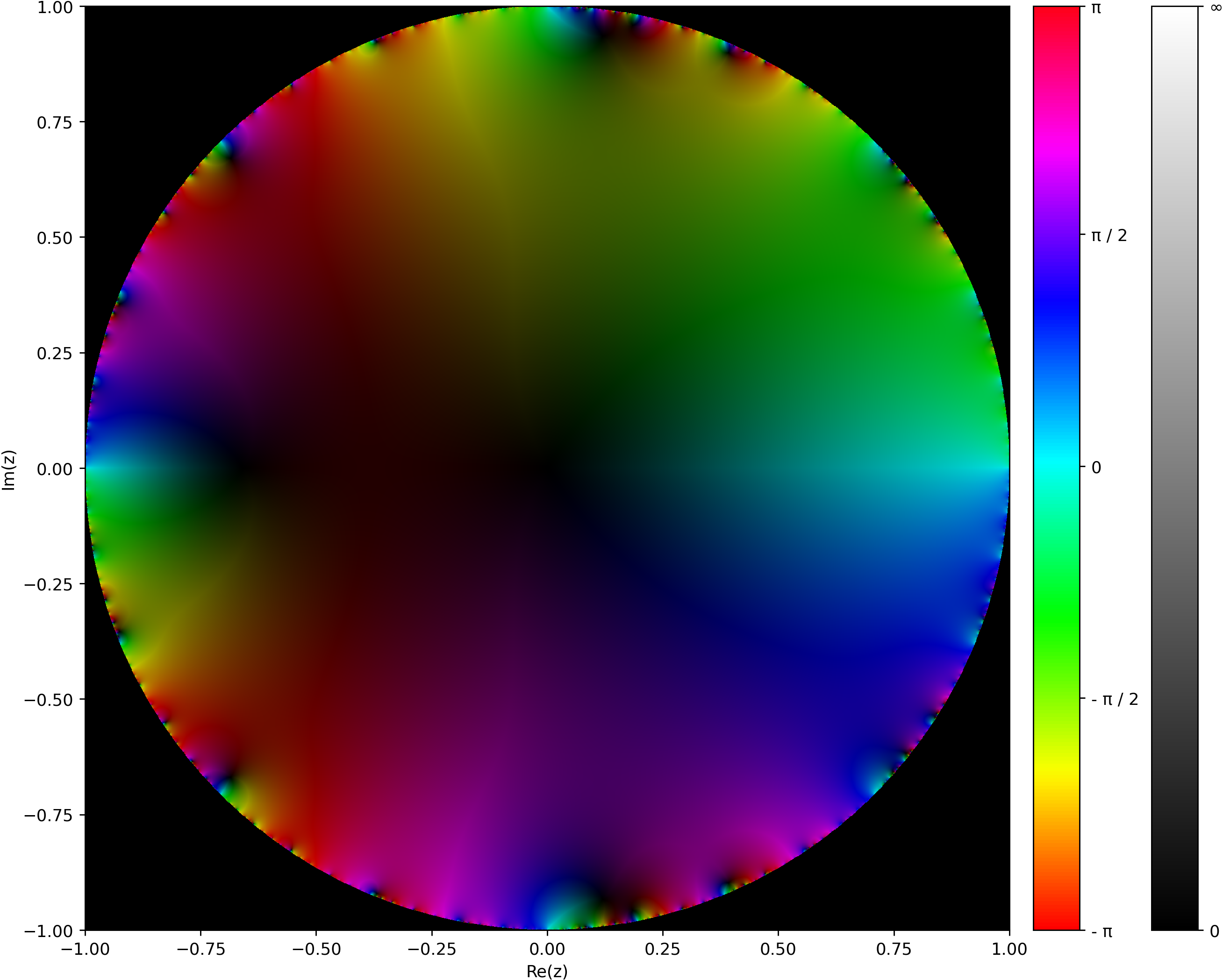
In analysis, a lacunary function or series is an analytic function that cannot be analytically continued anywhere outside the radius of convergence within which it is defined by a power series. The word lacunary is derived from lacuna (pl. lacunae), meaning gap, or vacancy.
The first examples of lacunary functions involved Taylor series with large gaps, or lacunae, between the non-zero coefficients of their expansions. More recent investigations examine Fourier series with similar gaps between non-zero coefficients. In modern usaage, a lacunary series may be either a Taylor series or a Fourier series.
A simple example
Pick an integer a \geq 2. Consider the following function defined by a power series:
: f(z) = \sum_{n=0}^\infty z^{a^n} = z + z^a + z^{a^2} + z^{a^3} + z^{a^4} + \cdots,
The power series converges locally uniform on any open domain |z|
Clearly f has a singularity at z = 1, because
: f(1) = 1 + 1 + 1 + \cdots,
is a divergent series. But if z is allowed to be non-real, problems arise, since
: f\left(z^a\right) = f(z) - z \qquad f\left(z^{a^2}\right) = f(z^a) - z^a \qquad f\left(z^{a^3}\right) = f\left(z^{a^2}\right) - z^{a^2} \qquad \cdots \qquad f\left(z^{a^{n+1}}\right) = f\left(z^{a^n}\right)-z^{a^n}
we can see that f has a singularity at a point z when za = 1, and also when za2 = 1. By the induction suggested by the above equations, f must have a singularity at each of the a**n-th roots of unity for all natural numbers n. The set of all such singularities is dense on the unit circle; so it impossible to define f on any open set containing the unit circle, precluding analytic continuation.
An elementary result
The argument above shows that certain series define lacunary functions. What is not so evident is that the gaps between the powers of z can grow much more slowly, and the resulting series will still define a lacunary function. To make this notion more precise some additional notation is needed.
We write
: f(z) = \sum_{k=1}^\infty a_kz^{\lambda_k} = \sum_{n=1}^\infty b_n z^n,
where b**n = a**k when n = λk, and b**n = 0 otherwise. The stretches where the coefficients b**n in the second series are all zero are the lacunae in the coefficients. The monotonically increasing sequence of positive natural numbers {λk} specifies the powers of z which are in the power series for f(z).
Now a theorem of Hadamard can be stated. If
: \frac{\lambda_k}{\lambda_{k-1}} 1 + \delta ,
for all k, where δ 0 is an arbitrary positive constant, then f(z) is a lacunary function that cannot be continued outside its circle of convergence. In other words, the sequence {λk} doesn't have to grow as fast as 2k for f(z) to be a lacunary function – it just has to grow as fast as some geometric progression (1 + δ)k. A series for which λk grows this quickly is said to contain Hadamard gaps. See Ostrowski–Hadamard gap theorem.
Lacunary trigonometric series
Mathematicians have also investigated the properties of lacunary trigonometric series
: S((\lambda_k)k,\theta) = \sum{k=1}^\infty a_k \cos(\lambda_k\theta) \qquad S((\lambda_k)k,\theta,\omega) = \sum{k=1}^\infty a_k \cos(\lambda_k\theta + \omega) ,
for which the λk are far apart. Here the coefficients a**k are real numbers. In this context, attention has been focused on criteria sufficient to guarantee convergence of the trigonometric series almost everywhere (that is, for almost every value of the angle θ and of the distortion factor ω).
- Kolmogorov showed that if the sequence {λ*k} contains Hadamard gaps, then the series S(λ*k, θ, ω) converges (diverges) almost everywhere when
:: \sum_{k=1}^\infty a_k^2
:converges (diverges).
- Zygmund showed under the same condition that S(λk, θ, ω) is not a Fourier series representing an integrable function when this sum of squares of the *a*k is a divergent series.
A unified view
Greater insight into the underlying question that motivates the investigation of lacunary power series and lacunary trigonometric series can be gained by re-examining the simple example above. In that example we used the geometric series
: g(z) = \sum_{n=1}^\infty z^n ,
and the Weierstrass M-test to demonstrate that the simple example defines an analytic function on the open unit disk.
The geometric series itself defines an analytic function that converges everywhere on the closed unit disk except when z = 1, where g(z) has a simple pole. And, since z = e**iθ for points on the unit circle, the geometric series becomes
: g(z) = \sum_{n=1}^\infty e^{in\theta} = \sum_{n=1}^\infty \left(\cos n\theta + i\sin n\theta\right) ,
at a particular z, |z| = 1. From this perspective, then, mathematicians who investigate lacunary series are asking the question: How much does the geometric series have to be distorted – by chopping big sections out, and by introducing coefficients a**k ≠ 1 – before the resulting mathematical object is transformed from a nice smooth meromorphic function into something that exhibits a primitive form of chaotic behavior?
Notes
References
- Katusi Fukuyama and Shigeru Takahashi, Proceedings of the American Mathematical Society, vol. 127 #2 pp. 599–608 (1999), "The Central Limit Theorem for Lacunary Series".
- Szolem Mandelbrojt and Edward Roy Cecil Miles, The Rice Institute Pamphlet, vol. 14 #4 pp. 261–284 (1927), "Lacunary Functions".
- E. T. Whittaker and G. N. Watson, A Course in Modern Analysis, fourth edition, Cambridge University Press, 1927.
References
- (Whittaker and Watson, 1927, p. 98) This example apparently originated with Weierstrass.
- (Mandelbrojt and Miles, 1927)
- (Fukuyama and Takahashi, 1999)
- This can be shown by applying [[Abel's test]] to the geometric series ''g''(''z''). It can also be understood directly, by recognizing that the geometric series is the [[Maclaurin series]] for ''g''(''z'') = ''z''/(1−''z'').
This article was imported from Wikipedia and is available under the Creative Commons Attribution-ShareAlike 4.0 License. Content has been adapted to SurfDoc format. Original contributors can be found on the article history page.
Ask Mako anything about Lacunary function — get instant answers, deeper analysis, and related topics.
Research with MakoFree with your Surf account
Create a free account to save articles, ask Mako questions, and organize your research.
Sign up freeThis content may have been generated or modified by AI. CloudSurf Software LLC is not responsible for the accuracy, completeness, or reliability of AI-generated content. Always verify important information from primary sources.
Report