From Surf Wiki (app.surf) — the open knowledge base
Lactation
Release of milk from the mammary glands

Release of milk from the mammary glands
In most species, lactation is a sign that the female has been pregnant at some point in her life, although in humans and goats, it can happen without pregnancy. Nearly every species of mammal has teats; except for monotremes, egg-laying mammals, which instead release milk through ducts in the abdomen. In only a handful of species of mammals, certain bat species, is milk production a normal male function.
Galactopoiesis is the maintenance of milk production. This stage requires prolactin. Oxytocin is critical for the milk let-down reflex in response to suckling. Galactorrhea is milk production unrelated to nursing. It can occur in males and females of many mammal species as result of hormonal imbalances such as hyperprolactinaemia.
File:White Cat Nursing Four Kittens HQ.jpg|Kittens nursing File:Lactating Female Coyote - cropped.jpg|Lactating Coyote, with noticeable teats File:Collared Peccary lactating towards two pups.jpg|Collared Peccary nursing its young in the Parque de las Leyendas zoo
Purpose
The chief function of a lactation is to provide nutrition and immune protection to the young after birth. Due to lactation, the mother-young pair can survive even if food is scarce or too hard for the young to attain, expanding the environmental conditions the species can withstand. The costly investment of energy and resources into milk is outweighed by the benefit to offspring survival. Lactation is accompanied by a period of infertility (in humans, lactational amenorrhea) that ensures adequate birth spacing, increasing the odds of survival for the offspring.
Human
Hormonal influences
From the eighteenth week of pregnancy (the second and third trimesters), a woman's body produces hormones that stimulate the growth of the milk duct system in the breasts:
- Progesterone influences the growth in size of alveoli and lobes; high levels of progesterone inhibit lactation before birth. Progesterone levels drop after birth; this triggers the onset of copious milk production.
- Estrogen stimulates the milk duct system to grow and differentiate. Like progesterone, high levels of estrogen also inhibit lactation. Estrogen levels also drop at delivery and remain low for the first several months of breastfeeding. Breastfeeding mothers should avoid estrogen based birth control methods, as a spike in estrogen levels may reduce a mother's milk supply.
- Prolactin contributes to the increased growth and differentiation of the alveoli, and also influences differentiation of ductal structures. High levels of prolactin during pregnancy and breastfeeding also increase insulin resistance, increase growth factor levels (IGF-1) and modify lipid metabolism in preparation for breastfeeding. During lactation, prolactin is the main factor maintaining tight junctions of the ductal epithelium and regulating milk production through osmotic balance.
- Human placental lactogen (HPL) – from the second month of pregnancy, the placenta releases large amounts of HPL. This hormone is closely associated with prolactin and appears to be instrumental in breast, nipple, and areola growth before birth.
- Follicle stimulating hormone (FSH), luteinizing hormone (LH), and human chorionic gonadotropin (hCG), through control of estrogen and progesterone production, and also, by extension, prolactin and growth hormone production, are essential.
- Growth hormone (GH) is structurally very similar to prolactin and independently contributes to its galactopoiesis.
- Adrenocorticotropic hormone (ACTH) and glucocorticoids such as cortisol have an important lactation inducing function in several animal species, including humans. Glucocorticoids play a complex regulating role in the maintenance of tight junctions.
- Thyroid-stimulating hormone (TSH) and thyrotropin-releasing hormone (TRH) are very important galactopoietic hormones whose levels are naturally increased during pregnancy.
- Oxytocin contracts the smooth muscle of the uterus during and after birth, and during orgasm(s). After birth, oxytocin contracts the smooth muscle layer of band-like cells surrounding the alveoli to squeeze the newly produced milk into the duct system. Oxytocin is necessary for the milk ejection reflex, or let-down, in response to suckling, to occur.
It is also possible to induce lactation without pregnancy through combinations of birth control pills, galactagogues, and milk expression using a breast pump.

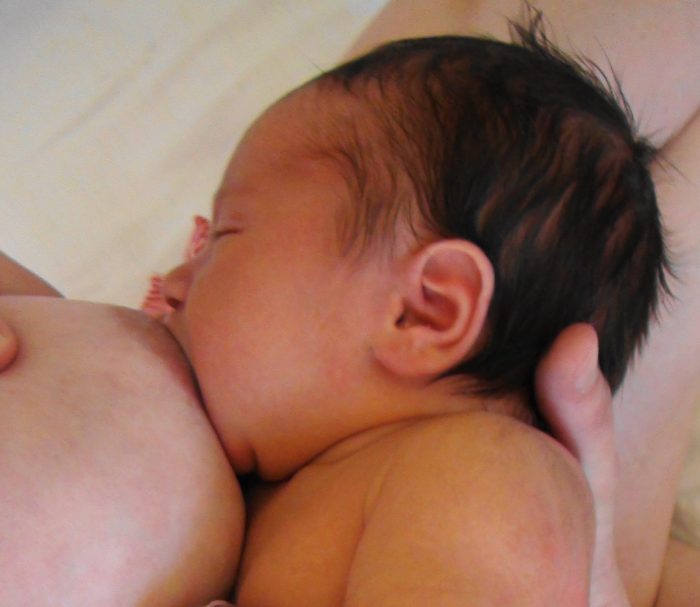

Secretory differentiation
During the latter part of pregnancy, the woman's breasts enter into the Secretory Differentiation stage. This is when the breasts make colostrum (see below), a thick, sometimes yellowish fluid. At this stage, high levels of progesterone inhibit most milk production. It is not a medical concern if a pregnant woman leaks any colostrum before her baby's birth, nor is it an indication of future milk production.
Secretory activation
At birth, prolactin levels remain high, while the delivery of the placenta results in a sudden drop in progesterone, estrogen, and HPL levels. This abrupt withdrawal of progesterone in the presence of high prolactin levels stimulates the copious milk production of Secretory Activation.
When the breast is stimulated, prolactin levels in the blood rise, peak in about 45 minutes, and return to the pre-breastfeeding state about three hours later. The release of prolactin triggers the cells in the alveoli to make milk. Prolactin also transfers to the breast milk. Some research indicates that prolactin in milk is greater at times of higher milk production, and lower when breasts are fuller, and that the highest levels tend to occur between 2 a.m. and 6 a.m.
Other hormones—notably insulin, thyroxine, and cortisol—are also involved, but their roles are not yet well understood. Although biochemical markers indicate that Secretory Activation begins about 30–40 hours after birth, mothers do not typically begin feeling increased breast fullness (the sensation of milk "coming in the breast") until 50–73 hours (2–3 days) after birth.
Colostrum is the first milk a breastfed baby receives. It contains higher amounts of white blood cells and antibodies than mature milk, and is especially high in immunoglobulin A (IgA), which coats the lining of the baby's immature intestines, and helps to prevent pathogens from invading the baby's system. Secretory IgA also helps prevent food allergies. Over the first two weeks after the birth, colostrum production slowly gives way to mature breast milk.
Autocrine control - Galactopoiesis
The hormonal endocrine control system drives milk production during pregnancy and the first few days after the birth. When the milk supply is more firmly established, autocrine (or local) control system begins.
During this stage, the more that milk is removed from the breasts, the more the breast will produce milk. Research also suggests that draining the breasts more fully also increases the rate of milk production. Thus the milk supply is strongly influenced by how often the baby feeds and how well it is able to transfer milk from the breast. Low supply can often be traced to:
- not feeding or pumping often enough
- inability of the infant to transfer milk effectively caused by, among other things:
- jaw or mouth structure deficits
- poor latching technique
- premature birth
- drowsiness in the baby, due to illness, medication or recovery from medical procedures
- rare maternal endocrine disorders
- hypoplastic breast tissue
- inadequate calorie intake or malnutrition of the mother
Milk ejection reflex

This is the mechanism by which milk is transported from the breast alveoli to the nipple. Suckling by the baby stimulates the paraventricular nuclei and supraoptic nucleus in the hypothalamus, which signals to the posterior pituitary gland to produce oxytocin. Oxytocin stimulates contraction of the myoepithelial cells surrounding the alveoli, which already hold milk. The increased pressure causes milk to flow through the duct system and be released through the nipple. This response can be conditioned e.g. to the cry of the baby.
Milk ejection is initiated in the mother's breast by the act of suckling by the baby. The milk ejection reflex (also called let-down reflex) is not always consistent, especially at first. Once a woman is conditioned to nursing, let-down can be triggered by a variety of stimuli, including the sound of any baby. Even thinking about breastfeeding can stimulate this reflex, causing unwanted leakage, or both breasts may give out milk when an infant is feeding from one breast. However, this and other problems often settle after two weeks of feeding. Stress or anxiety can cause difficulties with breastfeeding. The release of the hormone oxytocin leads to the milk ejection or let-down reflex. Oxytocin stimulates the muscles surrounding the breast to squeeze out the milk. Breastfeeding mothers describe the sensation differently. Some feel a slight tingling, others feel immense amounts of pressure or slight pain/discomfort, and still others do not feel anything different. A minority of mothers experience a dysphoric milk ejection reflex immediately before let-down, causing anxiety, anger or nausea, amongst other negative sensations, for up to a few minutes per feed.
A poor milk ejection reflex can be due to sore or cracked nipples, separation from the infant, a history of breast surgery, or tissue damage from prior breast trauma. If a mother has trouble breastfeeding, different methods of assisting the milk ejection reflex may help. These include feeding in a familiar and comfortable location, massage of the breast or back, or warming the breast with a cloth or shower.
Milk ejection reflex mechanism
This is the mechanism by which milk is transported from the breast alveoli to the nipple. Suckling by the baby innervates slowly adapting and rapidly-adapting mechanoreceptors that are densely packed around the areolar region. The electrical impulse follows the spinothalamic tract, which begins by innervation of fourth intercostal nerves. The electrical impulse then ascends the posterolateral tract for one or two vertebral levels and synapses with second-order neurons, called tract cells, in the posterior dorsal horn. The tract cells then decussate via the anterior white commissure to the anterolateral corner and ascend to the supraoptic nucleus and paraventricular nucleus in the hypothalamus, where they synapse with oxytocinergic third-order neurons. The somas of these neurons are located in the hypothalamus, but their axon and axon terminals are located in the infundibulum and pars nervosa of the posterior pituitary, respectively. The oxytocin is produced in the neuron's soma in the supraoptic and paraventricular nuclei, and is then transported down the infundibulum via the hypothalamo-neurohypophyseal tract with the help of the carrier protein, neurophysin I, to the pars nervosa of the posterior pituitary, and then stored in Herring bodies, where they are stored until the synapse between second- and third-order neurons.
Following the electrical impulse, oxytocin is released into the bloodstream. Through the bloodstream, oxytocin makes its way to myoepithelial cells, which lie between the extracellular matrix and luminal epithelial cells that also make up the alveoli in breast tissue. When oxytocin binds to the myoepithelial cells, the cells contract. The increased intra-alveolar pressure forces milk into the lactiferous sinuses, into the lactiferous ducts (a study found that lactiferous sinuses may not exist. If this is true then milk simply enters the lactiferous ducts), and then out the nipple.
Afterpains
A surge of oxytocin also causes the uterus to contract. During breastfeeding, mothers may feel these contractions as afterpains. These may range from period-like cramps to strong labour-like contractions and can be more severe with second and subsequent babies.
Lactation without pregnancy, induced lactation, relactation
Without pregnancy, induced lactation, relactation
In humans, induced lactation and relactation have been observed frequently in some cultures, and demonstrated with varying success in adoptive mothers, wet nurses, and women with lactophilia. It appears plausible that the possibility of lactation in women (or females of other species) who are not biological mothers does confer an evolutionary advantage, especially in groups with high maternal mortality and tight social bonds. The phenomenon has been also observed in most primates, in some lemurs, and in dwarf mongooses.
Lactation can be induced in humans by a combination of physical and psychological stimulation, by drugs, or by a combination of those methods. Several protocols for inducing lactation were developed by Jack Newman and Lenore Goldfarb and are commonly called the Newman-Goldfarb protocols. The "regular protocol" involves the use of birth control pills to mimic the hormone levels of pregnancy with domperidone to stimulate milk production, followed by discontinuing the birth control and the introducing use of a double electric breast pump to induce milk production. Additional protocols exist to support an accelerated timeline and to support induced lactation in menopausal parents.
Some couples may stimulate lactation outside of pregnancy for sexual purposes.
Rare accounts of male lactation (as distinct from galactorrhea) exist in historical medical and anthropological literature. Most recently a subject of transgender health care, multiple case reports have described transgender women successfully inducing lactation. Research has indicated that such breast milk is nutritionally comparable to both the milk of naturally lactating and induced lactating cisgender women.
Domperidone is a drug that can induce lactation.
Evolution
Charles Darwin recognized that mammary glands seemed to have developed specifically from cutaneous glands, and hypothesized that they evolved from glands in brood pouches of fish, where they would provide nourishment for eggs.
As all mammals lactate, lactation must have evolved before the last common ancestor of all mammals, which places it at a minimum in the Middle or Late Triassic when monotremes diverged from therians. O. T. Oftedal has argued that therapsids evolved a proto-lacteal fluid in order to keep eggs moist, an adaptation necessitated due to synapsids’ parchment shelled eggs which are more vulnerable to evaporation and dehydration than the mineralized eggs produced by some sauropsids. This protolacteal fluid became a complex, nutrient-rich milk which then allowed a decline in egg size by reducing the dependence on a large yolk in the egg. The evolution of lactation is also believed to have resulted in the more complex dentition seen in mammals, as lactation would have allowed the prolonged development of the jaw before the eruption of teeth.
Oftedal also proposed that the protolacteal fluid was initially secreted through pilosebaceous glands on mammary patches, analogous to the areola, and that hairs on this patch transported the fluid to the hatchlings as is seen in monotremes. In monotremes, they are said to have evolved from apocrine sweat glands. This would have occurred in the mammal lineages that diverged after monotremes, metatheria and eutheria. In this scenario, some genes and signaling pathways involved in lactation evolved from ancient precursors which facilitated secretions from spiny structures, which themselves evolved from odontodes.
Occurrence outside Mammalia
Recent research, as documented in the journal Science, has shed light on the behavior of certain species of caecilians. These studies reveal that some caecilians exhibit a phenomenon wherein they provide their hatchlings with a nutrient-rich substance akin to milk, delivered through a maternal vent. Among the species investigated, the oviparous nonmammalian caecilian amphibian Siphonops annulatus stood out, indicating that the practice of lactation may be more widespread among these creatures than previously thought. As detailed in a 2024 study, researchers collected 16 mothers of the Siphonops annulatus species from cacao plantations in Brazil's Atlantic Forest and filmed them with their altricial hatchlings in the lab. The mothers remained with their offspring, which suckled on a white, viscous liquid from their cloaca, experiencing rapid growth in their first week. This milk-like substance, rich in fats and carbohydrates, is produced in the mother's oviduct epithelium's hypertrophied glands, similar to mammal milk. The substance was released seemingly in response to tactile and acoustic stimulation by the babies. The researchers observed the hatchlings emitting high-pitched clicking sounds as they approached their mothers for milk, a behavior unique among amphibians. This milk-feeding behavior may contribute to the development of the hatchlings' microbiome and immune system, similar to mammalian young. The presence of milk production in caecilians that lay eggs suggests an evolutionary transition between egg-laying and live birth.
Another well known example of nourishing young with secretions of glands is the crop milk of certain birds such as columbiform birds (pigeons and doves), among others. As in mammals, this also appears to be directed by prolactin. Other birds such as flamingos and penguins utilize similar feeding techniques.
The discus fish (Symphysodon) is known for (biparentally) feeding their offspring by epidermal mucus secretion. A closer examination reveals that, as in mammals and birds, the secretion of this nourishing fluid may be controlled by prolactin. Similar behavior is seen in at least 30 species of cichlids.
Lactation is also the hallmark of adenotrophic viviparity – a breeding mechanism developed by some insects, most notably tsetse flies. The single egg of the tsetse develops into a larva inside the uterus where it is fed by a milky substance secreted by a milk gland inside the uterus. The cockroach species Diploptera punctata is also known to feed their offspring by milky secretions.
Toxeus magnus, an ant-mimicking jumping spider species of Southeast Asia, also lactates. It nurses its offspring for about 38 days, although they are able to forage on their own after 21 days. Blocking nursing immediately after birth resulted in complete mortality of the offspring, whereas blocking it 20 days after birth resulted in increased foraging and reduced survival. This form of lactation may have evolved from production of trophic eggs.
References
References
- (2009). "The origin and evolution of lactation". Journal of Biology.
- (October 2022). "Lactating Without Pregnancy".
- "Goats with Precocious Udder Syndrome". berryemporium.com.
- (2016). "Milk: the biology of lactation". Johns Hopkins University Press.
- (July 1997). "Lactation and fertility". Journal of Mammary Gland Biology and Neoplasia.
- (2003). "The Breastfeeding Answer Book". La Leche League International.
- (March 2002). "Milk prolactin, feed volume and duration between feeds in women breastfeeding their full-term infants over a 24 h period". Experimental Physiology.
- (2000). "The Breastfeeding Book". Little, Brown.
- (May 1985). "Frequency of milk expression and milk production by mothers of nonnursing premature neonates". American Journal of Diseases of Children.
- (June 1988). "Milk production by mothers of premature infants". Pediatrics.
- (March 1993). "The short-term synthesis and infant-regulated removal of milk in lactating women". Experimental Physiology.
- (March 1977). "[Slowly-adapting mechanoreceptor units of the guinea pig mammary nipple]". Fiziologicheskii Zhurnal SSSR imeni I. M. Sechenova.
- (1976). "[Properties of the mechanoreceptors of the nipple of the guinea pig mammary gland. (Rapidly adapting mechanoreceptor units)]". Fiziologicheskii Zhurnal SSSR imeni I. M. Sechenova.
- (June 2005). "Anatomy of the lactating human breast redefined with ultrasound imaging". Journal of Anatomy.
- (2010). "Breastfeeding Answers Made Simple: A Guide for Helping Mothers". Hale Publishing.
- (2005). "Oh Baby...Birth, Babies & Motherhood Uncensored". Random House NZ.
- (2007). "Pathology". Mosby Elsevier.
- (1996). "Induced Lactation". The American Surrogacy Center.
- (2003). "Prolactin, psychological stress and environment in humans: adaptation and maladaptation". Pituitary.
- (April 1981). "Relactation by mothers of sick and premature infants". Pediatrics.
- (March 1997). "Cooperative care of young in mammals". Die Naturwissenschaften.
- (June 1991). "Spontaneous lactation is an adaptive result of pseudopregnancy". Nature.
- (August 1997). "Relactation: an effective intervention to promote exclusive breastfeeding". Journal of Tropical Pediatrics.
- "The Newman Goldfarb Protocols for Induced Lactation".
- "Strange but True: Males Can Lactate".
- (December 2018). "Case Report: Induced Lactation in a Transgender Woman". Transgender Health.
- (April 2021). "Lactation Induction in a Transgender Woman Wanting to Breastfeed: Case Report". The Journal of Clinical Endocrinology and Metabolism.
- (August 2023). "Lactation Induction in a Transgender Woman: Macronutrient Analysis and Patient Perspectives". Journal of Human Lactation.
- (14 February 2018). "Transgender woman able to breastfeed in first documented case".
- (2018). "Case Report: Induced Lactation in a Transgender Woman". Transgender Health.
- (July 2002). "The mammary gland and its origin during synapsid evolution". Journal of Mammary Gland Biology and Neoplasia.
- (March 2006). "The platypus is in its place: nuclear genes and indels confirm the sister group relation of monotremes and Therians". Molecular Biology and Evolution.
- (July 2002). "The origin of lactation as a water source for parchment-shelled eggs". Journal of Mammary Gland Biology and Neoplasia.
- (6 April 2021). "Platypus: A Darwinian Cautionary Tale".
- (June 2013). "Evo-devo of the mammary gland". Journal of Mammary Gland Biology and Neoplasia.
- Quaglia, Sofia. (2024-03-07). "Bizarre, Wormlike and Oozing Milk for Their Babies". The New York Times.
- (7 Mar 2024). "Amphibian hatchlings find mother's milk". Science.
- (2024-03-08). "Milk provisioning in oviparous caecilian amphibians". Science.
- (1995). "Regulation of pigeon cropmilk secretion and parental behaviors by prolactin". Annual Review of Nutrition.
- "Bird Milk".
- (November 2010). "Biparental mucus feeding: a unique example of parental care in an Amazonian cichlid". The Journal of Experimental Biology.
- (April 2006). "Proteomics profiling of epidermal mucus secretion of a cichlid (Symphysodon aequifasciata) demonstrating parental care behavior". Proteomics.
- (May 2009). "Prolactin receptor mRNA is upregulated in discus fish (Symphysodon aequifasciata) skin during parental phase". Comparative Biochemistry and Physiology. Part B, Biochemistry & Molecular Biology.
- (August 2008). "Analysis of milk gland structure and function in Glossina morsitans: milk protein production, symbiont populations and fecundity". Journal of Insect Physiology.
- (2004). "Evolution of a novel function: nutritive milk in the viviparous cockroach, Diploptera punctata". Evolution & Development.
- (November 2018). "Prolonged milk provisioning in a jumping spider". Science.
This article was imported from Wikipedia and is available under the Creative Commons Attribution-ShareAlike 4.0 License. Content has been adapted to SurfDoc format. Original contributors can be found on the article history page.
Ask Mako anything about Lactation — get instant answers, deeper analysis, and related topics.
Research with MakoFree with your Surf account
Create a free account to save articles, ask Mako questions, and organize your research.
Sign up freeThis content may have been generated or modified by AI. CloudSurf Software LLC is not responsible for the accuracy, completeness, or reliability of AI-generated content. Always verify important information from primary sources.
Report