From Surf Wiki (app.surf) — the open knowledge base
Labaya
14th-century BCE prince and ruler in the central hill country of southern Canaan
_to_the_Egyptian_Pharaoh_Amenhotep_III_or_his_son_Akhenaten._14th_century_BCE._From_Tell_el-Amarna,_Egypt._British_Museum.jpg)
14th-century BCE prince and ruler in the central hill country of southern Canaan
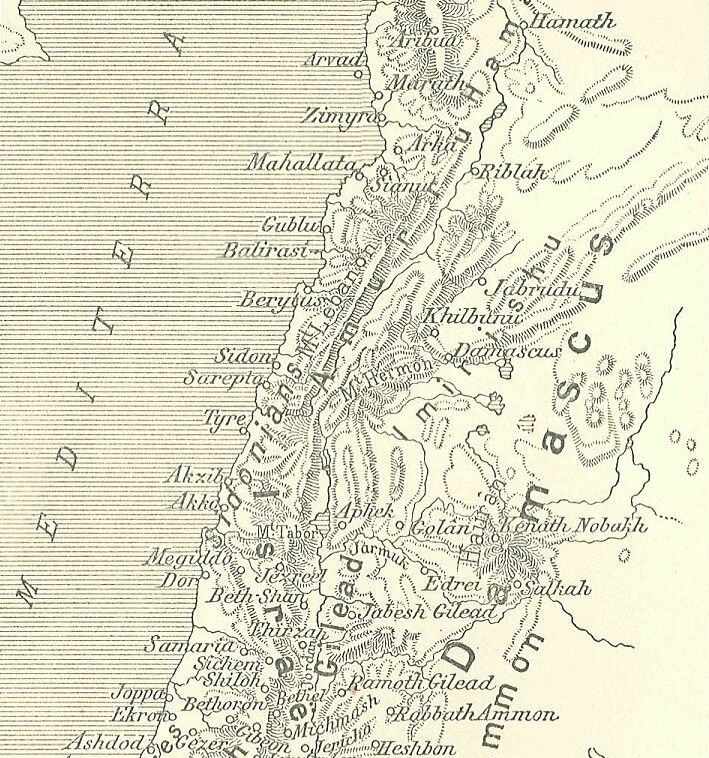
Labaya (Labayu or Lib'ayu) was a Canaanite prince and the ruler of Shechem in the central hill country of southern Canaan during the Amarna Period (c. 1350 BC). He lived contemporaneously with the pharaoh Akhenaten. Labaya is mentioned in several of the Amarna Letters (abbreviated "EA", for 'el Amarna'). He is the author of letters EA 252–54.
Labaya was active over the whole length of Samaria and slightly beyond, as he gave land to Ḫapiru in the vicinity of Šakmu (Shechem). He and his sons threatened powerful city-states such as Jerusalem and Gazru (Gezer) to the south and Magidda (Tel Megiddo) to the north.
Career
The Amarna letters give an incomplete look at Labaya's career. In the first of Labaya's letters thus far discovered (EA 252), he defends himself to the Pharaoh against complaints of other city rulers about him, for example, the complaint that he has hired mercenaries from among the Habiru. Labaya further admitted to having invaded Gezer and insulting its king Milkilu. He denied any knowledge of his son's alleged collaboration with the Habiru:
Other Canaanite rulers, such as Abdi-Heba of Jerusalem, complained of Labaya's depredations (e.g. EA 289) but note that in later years, Abdi-Heba would himself be referred to as "another Labaya" in EA 280. Labaya was accused of capturing cities that were under Egyptian protection. Biridiya, the king of Megiddo, accused him of besieging his city:
After receiving numerous complaints about Labaya's behavior, the pharaoh (probably Amenhotep III) finally ordered several Canaanite rulers to take Labaya prisoner and send him to Egypt. Biridiya, ruler of Megiddo, wrote to the pharaoh that Zurata, governor of Akko, had captured Labaya, but accepted a bribe from the latter and released him (EA 245).
Labaya was eventually killed by the citizens of Gina (Beth-Hagan, possibly modern-day Jenin). His death was reported to the Pharaoh's agent, Balu-Ur-Sag, by Labaya's two sons. The sons of Labaya continued to campaign against other Egyptian vassals in Canaan. One of Labaya's sons, Mutbaal, ruled Pella in the Trans-Jordanian part of Canaan. Biryawaza, king of Damascus, was eventually asked to take armed action against Labaya's sons (EA 250).
List of Labaya's three letters to Pharaoh
Labaya's name is referenced in fourteen el Amarna letters and his name used thirty-two times. He was the author of letters EA 252–254.
:#EA 252–title: "Sparing one's enemies" :#EA 253–title: "Neither rebel nor delinquent (1)" :#EA 254–title: *"Neither rebel nor delinquent (2)"'''
Theories
Identifications with biblical figures
Some researchers, such as Richard Abbott, note the possibility that Labaya and the biblical figure of Abimelech ben Gideon, from Judges 9, were identical.
Still others, such as David Rohl, have advocated a totally revised chronology of ancient Israelite and Egyptian history, and instead identify Labaya with Saul, and Mutbaal with Saul's son Ishbaal. Ish-baal and Mutbaal, whose names have the same meaning, "Man of Baal", moved their capital to Transjordan after the death of their fathers, whose center of power had been west of the Jordan river. Rohl further identifies Dadua, Ayab and Yishaya, three figures mentioned by Mutbaal in a later Amarna Letter, with King David, his general Joab and David's father Jesse. The Rohl chronology is not, however, widely accepted. Rohl's suggestions are rejected by other Egyptologists, such as Kenneth Kitchen, who argue that there are discrepancies between the Labaya of the Amarna texts and King Saul as he is described in the Books of Samuel.
References
Bibliography
References
- [https://books.google.ca/books?id=oxk7AAAAIAAJ&pg=PA5&dq=labaya+prince&hl=en&newbks=1&newbks_redir=0&source=gb_mobile_search&ovdme=1&sa=X&ved=2ahUKEwiaxrHk9OeRAxU4_rsIHewYLlgQ6AF6BAgKEAM#v=onepage&q=labaya%20prince&f=false Amarna Letters from Palestine, Syria, the Philistines and Phoenicia]
- [[William L. Moran]], ''The Amarna Letters'' (Baltimore: Johns Hopkins, 1992), p. 307
- Moran, pp. 332-333
- Moran, p. 321
- Moran, p. 298
- Moran, pp. 299-300
- Moran, pp. 303-304
- Moran, pp. 305-308
- Moran, p. 379. See: Commissioner ''[[Addaya]]''.
- "Abimelech, Saul, and Amarna - Abimelech and Labayu".
- [http://debate.org.uk/topics/history/rohl-1.htm Arguments identifying Labaya with Saul] {{webarchive. link. (2006-09-25 . See also EA 256, title: ''"Oaths and denials"'', in Moran, p. 309-310.)
This article was imported from Wikipedia and is available under the Creative Commons Attribution-ShareAlike 4.0 License. Content has been adapted to SurfDoc format. Original contributors can be found on the article history page.
Ask Mako anything about Labaya — get instant answers, deeper analysis, and related topics.
Research with MakoFree with your Surf account
Create a free account to save articles, ask Mako questions, and organize your research.
Sign up freeThis content may have been generated or modified by AI. CloudSurf Software LLC is not responsible for the accuracy, completeness, or reliability of AI-generated content. Always verify important information from primary sources.
Report