From Surf Wiki (app.surf) — the open knowledge base
Kuala Lumpur International Airport
Airport in Sepang, Selangor, Malaysia

Airport in Sepang, Selangor, Malaysia
| Field | Value | ||||||
|---|---|---|---|---|---|---|---|
| name | Kuala Lumpur International Airport | ||||||
| nativename | Lapangan Terbang Antarabangsa Kuala Lumpur | ||||||
| image | Kuala Lumpur International Airport Logo.svg | ||||||
| image-width | 250 | ||||||
| image2 | Bird-eye view of KLIA and Sepang F1 Circuit - panoramio.jpg | ||||||
| image2-width | 260 | ||||||
| caption2 | Aerial view of Kuala Lumpur International Airport | ||||||
| WMO | 48650 | ||||||
| IATA | KUL | ||||||
| ICAO | WMKK | ||||||
| type | Public | ||||||
| owner | Khazanah Nasional | ||||||
| operator | Malaysia Airports | ||||||
| city-served | Greater Kuala Lumpur | ||||||
| location | Sepang, Selangor, Malaysia | ||||||
| opened | |||||||
| hub | {{ubl | class=nowrap | |||||
| operating_base | {{ubl | class=nowrap | |||||
| timezone | MST | ||||||
| utc | UTC+08:00 | ||||||
| elevation-f | 70 | ||||||
| elevation-m | 21 | ||||||
| metric-elev | yes | ||||||
| coordinates | |||||||
| website | |||||||
| image_map_caption | Selangor state in Malaysia | ||||||
| mapframe | yes | ||||||
| mapframe-wikidata | yes | ||||||
| pushpin_map | Malaysia_Selangor#Malaysia#Southeast Asia#Asia | ||||||
| pushpin_label | KUL/WMKK | ||||||
| pushpin_map_caption | Location in Sepang, Selangor, Malaysia | ||||||
| r1-number | 14L/32R | ||||||
| r1-length-m | 4,019 | ||||||
| r1-surface | Asphalt | ||||||
| r2-number | 14R/32L | ||||||
| r2-length-m | 4,000 | ||||||
| r2-surface | Asphalt | ||||||
| r3-number | 15/33 | ||||||
| r3-length-m | 3,960 | ||||||
| r3-surface | Asphalt | ||||||
| metric-rwy | yes | ||||||
| stat1-header | Passengers | ||||||
| stat1-data | 57,008,869 (17.29%) | ||||||
| stat2-header | Domestic passengers | ||||||
| stat2-data | 15,173,546 (3.36%) | ||||||
| stat3-header | International passengers | ||||||
| stat3-data | 41,835,323 (22.17%) | ||||||
| stat4-header | Aircraft movements | ||||||
| stat4-data | 364,939 ( 14.4%) | ||||||
| stat5-header | Cargo (tonnes) | ||||||
| stat5-data | 794,943 ( 20.7%) | ||||||
| stat-year | 2024 | ||||||
| footnotes | Sources: MAHB | ||||||
| CAPA<ref>{{cite web | title | Kuala Lumpur International Airport handles 5.2m pax in Dec-2024, 57.1m pax in 2024 | url=https://centreforaviation.com/news/kuala-lumpur-international-airport-handles-52m-pax-in-dec-2024-571m-pax-in-2024-1300691 | website=centreforaviation.com | publisher=Centre for Asia Pacific Aviation (CAPA) | access-date=28 May 2025 | date=22 January 2025}} |
| nativename-a = | nativename-r = | image-width = 250 | image2-width = 260 | city-served = Greater Kuala Lumpur | Batik Air Malaysia | Malaysia Airlines | MASkargo | Raya Airways | World Cargo Airlines}} | AirAsia | AirAsia X}} | elevation-f = 70 | elevation-m = 21 | metric-elev = yes | mapframe-wikidata = yes | r1-number = 14L/32R | r1-length-m = 4,019 | r1-surface = Asphalt | r2-number = 14R/32L | r2-length-m = 4,000 | r2-surface = Asphalt | r3-number = 15/33 | r3-length-m = 3,960 | r3-surface = Asphalt | metric-rwy = yes | stat1-header = Passengers | stat1-data = 57,008,869 (17.29%) | stat2-header = Domestic passengers | stat2-data = 15,173,546 (3.36%) | stat3-header = International passengers | stat3-data = 41,835,323 (22.17%) | stat4-header = Aircraft movements | stat4-data = 364,939 ( 14.4%) | stat5-header = Cargo (tonnes) | stat5-data = 794,943 ( 20.7%) | stat-year = 2024 CAPA
Kuala Lumpur International Airport is the main international airport serving Kuala Lumpur, the capital of Malaysia. It is located in the Sepang District of Selangor, approximately 45 km south of downtown Kuala Lumpur and serves the city's greater conurbation.
Kuala Lumpur International Airport is the largest and busiest airport in Malaysia and is recognised as a mega hub. In 2024, it handled 57.08 million passengers, 794,943 tonnes of cargo and 819,026 aircraft movements, ranking as the 26th-busiest airport by total passenger traffic.
In 2024, KLIA is the ranked first by OAG (by ratio of connection flight frequency to destinations served) in the Global Low-Cost Megahubs index by with 11,188 possible low-cost connections across over 137 destinations.
OAG also ranked KLIA is the world's second most connected airport (by ratio of connection flight frequency to destinations served) in 2024, with 33,411 possible connections, according to the OAG Megahub Index, second to London–Heathrow and followed by Tokyo–Haneda, Amsterdam and Seoul–Incheon in the top five.
AirAsia is the dominant air carrier in Malaysia, based in KLIA and serving 14,583 low-cost connections, with a 34% share of flights, followed by Malaysia Airlines.
The airport is operated by Malaysia Airports (MAHB) Sepang Sdn Bhd and is the major hub of Malaysia Airlines, MASkargo, Batik Air Malaysia, UPS Airlines and World Cargo Airlines, and the operating base for AirAsia and AirAsia X.
History
Background
The groundbreaking ceremony for Kuala Lumpur International Airport (KLIA) took place on 1 June 1993 when the government under Mahathir Mohamad decided that the existing Kuala Lumpur airport, then known as Subang International Airport (now Sultan Abdul Aziz Shah Airport) could not handle future demand. The construction of the airport was done mainly by a few state owned construction companies as well as Ekovest Berhad – helmed by Tan Sri Datuk Lim Kang Hoo. It was created as part of the Multimedia Super Corridor, a grand development plan for Malaysia. The chief architect who designed the new airport terminal was the Japanese architect Kisho Kurokawa.
Upon KLIA's completion, Subang Airport's Terminal 1 building was demolished. Malaysia Airports agreed to redevelop the remaining Terminal 3 to create a specialist airport for turboprop and charter planes surrounded by a residential area and a business park. The IATA airport code KUL was transferred from Subang Airport, which currently handles only limited low-cost airline service, turboprop aircraft, general aviation and military aircraft.
Current site
The airport's site spans 100 km2 of former agricultural land and is one of the world's largest airport sites. An ambitious three-phase development plan anticipates KLIA to have three runways and two terminals each with two satellite terminals. Phase One involved the construction of the main terminal and one satellite terminal, giving a capacity of 25 million passengers, and two full service runways. The Phase One airport had 60 contact piers, 20 remote parking bays with 80 aircraft parking positions, four maintenance hangars and fire stations. Phase Two, designed to increase capacity to 35 million passengers per year, is largely complete. Phase Three is anticipated to increase capacity to 100 million passengers per year.
Inauguration
Kuala Lumpur International Airport was officially inaugurated by the tenth Yang di-Pertuan Agong, Tuanku Ja'afar of Negeri Sembilan, on 27 June 1998, shortly before the 1998 Commonwealth Games.
The inauguration of the airport was marked with numerous problems. The aerobridge and bay allocation systems broke down, with queues building up throughout the airport and the baggage handling breaking down. Bags were lost, and there were waits of over five to seven hours. Most of these issues were remedied eventually, though the baggage handling system was plagued with problems until it was put up for a complete replacement tender in 2007.
The airport suffered greatly reduced traffic with the general reduction in economic activity brought about by the 1997 Asian financial crisis, September 11 attacks, SARS, bird flu epidemic (Avian flu), the 2008 financial crisis, the 2009 swine flu pandemic and the COVID-19 pandemic. The airport is also largely overshadowed by the more internationally renowned Changi Airport located approximately 300 km to the southeast in Singapore, especially in regards to connecting flights by various airlines or Malaysians especially living in the southern parts of the country (e.g. Johor) preferring to travel via Changi rather than at KLIA.
The first year of opening immediately saw reduction of passenger numbers as some airlines, including All Nippon Airways (resumed on 1 September 2015), British Airways (reinstated on 28 May 2015 until 28 March 2021, and again since April 2025), Lufthansa (resumed between 28 March 2004 until 28 February 2016) discontinued their flights. Qantas moved their Sydney-Kuala Lumpur route to its low-cost subsidiary Jetstar, which continued to operate the route until 2008. Aeroflot terminated their Moscow-Kuala Lumpur via Singapore route in 2001, although there had been discussions about Aeroflot resuming the Kuala Lumpur route, no progress was made, and Northwest Airlines terminated their loss-making route from Osaka to Kuala Lumpur in 2001. KLIA's first full year of operations in 1999, in its Phase One manifestation (capacity of 25 million passengers per year), saw only 13.2 million passengers. Passenger numbers eventually increased to 21.1 million in 2004 and 47 million in 2013 — though short of the originally estimated 25 million passengers per year by 2003.
Rebranding
On 9 February 2023, transport minister Anthony Loke Siew Fook announced that the government and MAHB had agreed to rebrand KLIA and klia2 to KLIA Terminal 1 and KLIA Terminal 2 respectively. The costs associated with the rebranding will be fully borne by MAHB.
Runways
Kuala Lumpur International Airport has three parallel runways (14L/32R; 14R/32L; 15/33), all three of which are over 3800 m long and 60 m wide. The length of Runway 14L/32R is 4019 m, runway 14R/32L is 4000 m, while runway 15/33 is 3960 m.
The current three runway system is capable of handling 78 landings per hour and was expected to increase to 108 landings per hour once upgrading of the Kuala Lumpur Flight Information Region had been completed in 2019. The airport has CAT II Precision Landing ILS (runways 14L/32R and 14R/32L) to guide landing aircraft safely under all weather conditions with visibility as low as 350 metres (1,150 ft) whilst runway 15/33 has CAT I Precision Landing ILS that guide safe landings under all situations with lowest possible visibility at 900 metres (2 953 ft). These runways operate on different departure/arrival modes according to the air traffic requirements.
Operations and infrastructure
Kuala Lumpur International Airport features a number of modern design features that assist in the efficient operation of the airport. It is one of the first Asia Pacific airports to become 100% Bar Coded Boarding Pass capable. Malaysia Airlines; AirAsia; MASkargo, a cargo airline; and Malaysia Airports, the Malaysian Airports operator and manager; are headquartered on the property of KLIA. Malaysia Airlines also operates its Flight Management Building at KLIA.
Air traffic control tower


There are three air traffic control towers at Kuala Lumpur International Airport: the two main control towers (Tower East and Tower West) and the apron control tower. Tower East is the original control tower which has stood since the airport's opening. It is 130 metres tall and controls the traffic of the initial two runways. Tower West is 133.8 metres tall and is the tallest air traffic control tower in the world, followed by those at Suvarnabhumi Airport and King Abdulaziz International Airport. Each tower is shaped like an Olympic torch, and they house the air traffic control systems and radar equipment.
The 55-metre apron control tower is responsible for providing air traffic service to aircraft and vehicle movement in the northern and southern parts of the Satellite Terminal building and the cargo apron areas.
Baggage handling system

The airport's baggage handling system (BHS) features baggage common check-in at any of the 216 counters on a 24-hour basis and incorporates automatic bar-code sorting control, four level in-line baggage security screening and high speed conveyor belts.
The BHS was built by Toyo Kanetsu with lots of new mechanism such as Belt Carry Sorter, Triplanar, Hinged Diverter, Horizontal Sliding Belt Diverter, and FOD (foreign object debris) Detection System. In 2006, a contract to extend the system from the satellite building to the ERL (Express Rail Link) platform in the Main Terminal Building was awarded to Siemens. The new system from Siemens will transport baggage between the two terminals at speeds of up to 36 km per hour, compared to the previous rate of 7.2 km per hour. The new system uses a high-speed tray conveyor system in which bags are placed on individual trays for better control and tracking at high speed compared to conventional belt conveyors enables the baggage to be checked-out in KL Sentral once the operator of KLIA Express, ERL Berhad introduce the new facility.
Facilities of the baggage handling system in Terminal 1 include:
- Eight short-term car park baggage check-in counters
- Eight bus and train stations baggage check-in counters
- Three stage baggage security screening system
- Early check-in baggage storage (1,200 bags capacity)
- 17 baggage reclaim carousels together with LCCT
- 33 km total length of conveyor belts
- Part of the belts travel through a 1.1 km tunnel from the Main Terminal Building to the Satellite Building.
Meanwhile, in Terminal 2, the baggage handling system being implemented by BCS Group from Norway and upgraded by Daifuku Airport Technologies From Japan until its opening in May 2014, costing RM 60 million. The BHS in Terminal 2 is as follows:
- 128 check-ins
- Over 10km in aggregate length for over 1,200 conveyors
- Over 2km in aggregate length for 21 carousels
- CCTV system for the complete baggage system
- Two High speed tilt tray sorters
- 14 inline screening X-ray machines on the conventional baggage system plus 5 for the out of gauge lines
- 250 barcode readers
- EBS infrastructure for early bags
Several companies handle the baggage systems in KLIA. For the homebase airlines, Malaysia Airlines operates the BHS through AeroDarat Services, AirAsia uses Ground Team Red, and Malindo has their own baggage crews. There are also two more baggage handlers operate under Kuala Lumpur Airport System (KLAS) which are Pos Aviation and ProSky Services.
IATA had agreed to facilitate the usage of RFID tags between KLIA and Hong Kong International Airport after the launch of the world's smallest multiband RFID chip in Kuala Lumpur. KLIA will be the second airport to use RFID. The RFID baggage tagging trial between KLIA and Hong Kong International Airport is completed. Baggage tags are being issued at both Malaysia Airlines and Cathay Pacific check-in counters. The trial was delayed due to problems obtaining printers. Furthermore, KLIA is now awaiting reports from IATA which scheduled to be released first quarter of 2008.
In 2017, there was a mishap of baggage handling which caused 50 flights delays and affected 1500 passengers which later managed to be solved. The increasing passengers traffics and non-optimized system due to never being replaced gave a signal for MAHB to implement BHS upgrade in 2019 which predictably will cost RM 500-600 million. There are four Bursa Malaysia company with joining in force with six multinational company were competing for the tender. The project was being given to T7 Kemuncak Sdn. Bhd. with the joint venture with Siemens Logistics. The new BHS will provide a boost of extra 2500 bag positions with the new system called VarioTray, which is a high-speed conveyor system connected between the Main Terminal Building and Satellite A, will enable bags to be transferred swiftly and securely between the two buildings.
Fire and rescue

KLIA's Airport Fire and Rescue Services (AFRS) rated Category 10 (can handle emergencies involving huge jumbo jets such as Airbus A380, Antonov An-225 and Boeing 747-8) are provided to cope with aircraft accidents. This is important as KLIA itself is categorised as a National Vital Installation Priority 1, representing facilities of the highest importance to national security and the function of government.
There are three fire stations at the airport near each runway, fully equipped with fire and emergency rescue equipment. There are total of 10 Ultra Large Foam Tender, Ziegler 8-(8x8) vehicles costing RM 3.8 million each.
Air cargo
The KLIA Advance Cargo Center (ACC) covers 108 acre of land and can handle one million tonnes of cargo per annum, with the capability to expand to 3 million tonnes/year. The center is designed as an integrated transshipment hub within a Free Commercial Zone. Fueled by high economic growth in the Southeast Asian countries and China, the airport handled 677,000 tonnes of air cargo in 2006, a 5.9% growth over the 2005 fiscal year.
To handle the cargo efficiently, the ACC is equipped with the following:
- Container storage system (CSS) – over 2,200 storage positions to accommodate various ULDs with 5ETVs
- Automated storage and retrieval system (ASRS) – 12 units stacker cranes for 6,500 storage bins
- 60 units of automated electrified monorail linked to 10 units of interfloor hoists
- 28 units airside interface deck
- Two units bypass conveyor system dedicated for SLAC ULD
- Over 100 breakdown and buildup workstations
- Over 100 truck docks
- 13 units fully automated transfer vehicles
- Two units 20 tons bridge cranes
- Odd-sizes storage space (OVS)
- Computerised truck dock management system
- Over 14,000 sqm of unit loading devices storage yard
- Automated weighing scale interface with material handling system, maximum capacity 20,000kgs
- ULD and large skid X-ray machines
- 24 hours warehouse surveillance with close to 200 CCTVs
Applying added information technologies, the main operator of the center, MASkargo with joint venture with Unisys, introduced various artificial intelligence systems to handle cargo such as KLIA Community System (KLIACS), optimize load utilization, routing and inventory for air cargo, ground handlers and freight forwarders. the authority also pioneered the DagangNET System, allowing users to conduct trade declarations and apply for permits over the internet and speeding the approval process by controlling authorities. These systems will be linked the Total Airport Management System.
According to MAHB, the cargo movement of KLIA was 656,762 tonnes in 2023.
Animal hotel
The animal hotel is operated by Malaysia Airlines's cargo arm, MASkargo. The hotel operates 24 hours and manages all imports, exports and stop-over transhipments that are related to animals, and offers a pets stay-in program where owners can leave their pets to in the hotel while they are away for vacations mainly at Kuala Lumpur Animal Quarantine Station (KLAQS). At least 500 consignments of livestock are handled per day at the animal hotel.
Aircraft maintenance
There are four hangars housing facilities to provide aircraft maintenance provided by Malaysia Airlines and Kuala Lumpur Airport Service (KLAS) suitable for Maintenance, Repair and Overhaul (MRO) activities. The airport also has a hangar which is purposely built for the Airbus A380, the first in Southeast Asia. The construction of the hangar was completed in 2007. Asian Digital Engineering, the MRO arm of AirAsia has launched a new 14-line hangar that covers 35,300 sq m on an 8.2ha site that features dedicated workshops, including a composite workshop, sheet metal and machine workshop, upholstery workshop, cabin interior repair workshop and a 3D printing lab for aircraft livery.
Meteorological services
The Aeronautical Meteorological Station (AMS) is located near Runway 14R-32L which provides weather information for the aviation community in compliance with International Civil Aviation Organization standards. The AMS houses a Meteorological Data Processing System (MDPS) for weather data collection, processing, storage and analytical needs. AMS constantly make weather observations using radiosonde instrument to measure atmospheric profiles such as wind speed, wind direction, pressure, temperature and humidity at every level up to an altitude of about 30 kilometres before issuing aerodrome warnings on adverse weather for protection of aerodrome facilities and aircraft on the ground.
Terminals
| Terminal | Opened | Floor area | Handling capacity | Parking bays | Terminal 1 | ||||
|---|---|---|---|---|---|---|---|---|---|
| (Main Terminal Building 1 & Contact Pier) | Terminal 1 | ||||||||
| (Satellite Terminal A) | Terminal 2 | Bunga Raya Complex | |||||||
| (VIP terminal) | Total | ||||||||
| 27 June 1998 | 336,000 m2 | 5 million passengers per year | 20 (aerobridge) | ||||||
| 23 (remote) | |||||||||
| 27 June 1998 | 143,404 m2 | 20 million passengers per year | 26 (aerobridge) | ||||||
| 15 (remote) | |||||||||
| 1 May 2014 | 257,845 m2 | 45 million passengers per year | 68 (aerobridge) | ||||||
| 10 (remote) | |||||||||
| 27 June 1998 | |||||||||
| - | 737,249 m2 | 70 million passengers per year | 114 (aerobridge) | ||||||
| 48 (remote) |
Kuala Lumpur International Airport comprises two main terminals: the original terminal, Terminal 1, previously known simply as "KLIA"; and the newer Terminal 2 (formerly KLIA2). Terminal 1 was designed by Japanese architect Kisho Kurokawa, who also designed the Domestic Terminal (T2) at Nursultan Nazarbayev International Airport, with an emphasis of natural lighting within the airport complex. Spanning 38.4m along a grid pattern allowing for future expansions, the abstract symbolic architecture by the late Kisho Kurokawa encompasses the Islamic geometry and cutting-edge technology with the tropical rainforest in mind.
KLIA Terminal 1

.jpg)
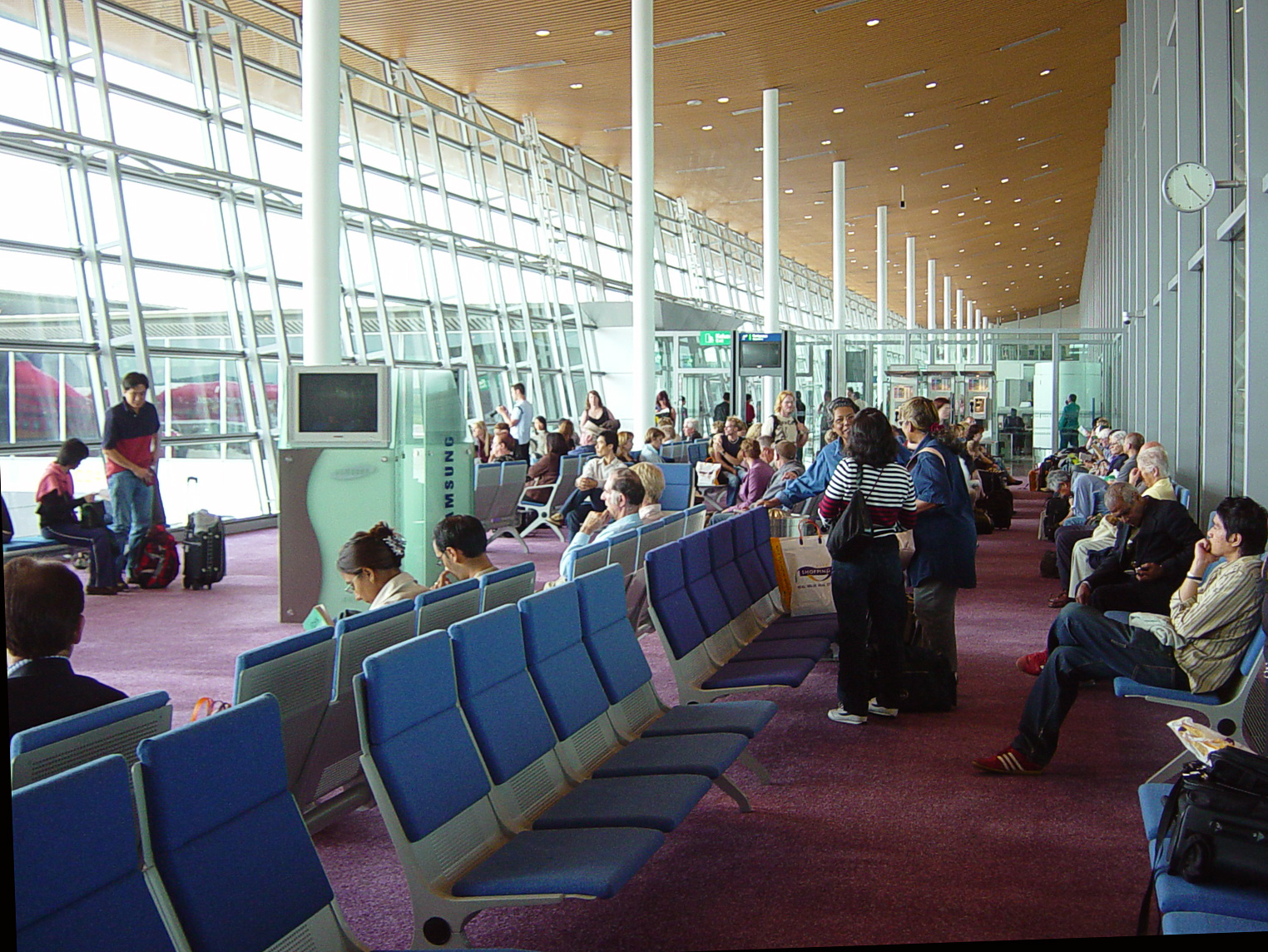
Main Terminal Building
The KLIA Main Terminal Building (MTB) now also referred to as KLIA Main is located in between the two runways. The floor area of the terminal covers 390000 m2 and the building consists of 39 square roof units, which enables future expansion of the building. There are a total of 216 check-in counters, located in 6 different islands, identified by the letters A – M (excluding I). Multi check-in services are available, designed for the use of all passengers arriving, departing or in transit. Self check in facilities are available in this airport since 2007, and KLM was the first airline to use the Common-use self-service kiosks. The contact pier is an extension of the main terminal building with gates marked with prefix A and B for domestic departures, G and H for international flights. The gate allocation is based on operational requirements, although it has been observed that Malaysia Airlines has been operating most of its operations out from the contact pier.
Satellite Terminal A

The 176000 m2 satellite building accommodates international flights departing and arriving at KLIA T1. Passengers taking flights parked at the satellite terminal are transported by the Aerotrain, that has been fully repaired since 1 July 2025 after two years of maintenance work. It is able to fit a total of 270 passengers and takes 3 minutes to travel from the Main Terminal to the Satellite Terminal. Passengers may also take the bus to the Satellite Station if they wish.
There is a wide array of duty-free shops and prestige brand boutiques in the satellite building. This includes international brands such as Burberry, Harrods, Montblanc, Salvatore Ferragamo, and Hermes. Among all international labels available within the terminal, some boutiques such as Harrods are only available in the airport. A number of restaurants and international airlines' lounges are available as well as an Airside Transit Hotel.
.jpg)
Within the terminal, wireless internet (Wi-Fi) is provided free of charge. The terminal also has prayer rooms, showers and massage service. Various lounge areas are provided, some including children's play areas and movie lounge, broadcasting movie and sport channels. The terminal also features a natural rainforest in the middle of the terminal, exhibiting the Malaysian rainforests.
Under Malaysia Airports Berhad retail optimisation plan, the retail space in satellite terminal A will be further optimised to increase its revenue derived from commercial space rental and a percentage of sale receipts to 50% by year 2010 which currently stands at 35%. Some notable improvements that will be seen after the refurbishments will be the Jungle Boardwalk which will be the first of its kind in the world and larger mezzanine floor to accommodate F&B outlets and viewing galleries.
The gates in Satellite Terminal A have the prefix C. The Satellite A terminal has 27 boarding gates altogether.
KL City Air Terminal
KL City Air Terminal, sometimes known as Kuala Lumpur City Air Terminal or KL CAT, located at KL Sentral railway station, is a virtual extension of Kuala Lumpur International Airport where city check-in services are provided. KL City Air Terminal is recognised by the International Air Transport Association (IATA) and carries the IATA designation XKL. Currently there are only two airlines providing city check-in services: Malaysia Airlines and Batik Air Malaysia.
KLIA Terminal 2

The KLIA Terminal 2 (formerly known as KLIA2) is the largest purpose-built terminal optimised for low-cost carriers, like AirAsia in response to the exponential growth of low-cost travel in the region. It was built at a cost of approximately RM4 billion to replace the previous Low Cost Carrier Terminal (LCCT). KLIA T2 began its operations on 2 May 2014, and all flight operations at LCCT were moved to KLIA T2 by 9 May 2014.

As part of its development, a third runway (Runway 15/33) and a new air traffic control tower (Tower West) were built to support its operation. KLIA T2 has an initial capacity of 45 million passengers per year. The terminal has a built-up area of 257,845 sqm with 68 departure gates, 10 remote stands, 80 aerobridges, includes a retail space of 32,000 sqm to accommodate a total of 220 retail outlets. The main terminal building of KLIA T2 is connected with its satellite piers with a skybridge, making it the first airport in Asia with such facility. KLIA T2 is certified with Leadership in Energy & Environmental Design (LEED).

Check-in counters are divided into 8 rows located in 4 islands, each row identified by the letters S – Z. Boarding gates are located in 5 piers, indicated by the letters J and K for domestic flights, and L, P and Q for international flights. Piers J, K and L are connected directly to the main terminal building, while Piers P and Q are accessible via the skybridge. Piers K and L are physically the same pier and share the same gates, but with waiting lounges on different levels (Level 1A for K and Level 2 for L). For international flights, the access door from Pier K is sealed off, while for domestic flights, the access door from Pier L is sealed off instead.
At present, inter-terminal connection is provided on the landside at Gateway@klia2 complex and there are provisions for future airside inter-terminal connection.
Gateway@klia2
Gateway@klia2 is an integrated shopping complex that is connected to the main KLIA T2 terminal building. It has a 350,000 square feet of net lettable space spanning over four levels. The transport hub at Gateway@klia2 links klia2 to the KLIA Ekspres and KLIA Transit service, with allotted pick-up and drop-off areas for coaches, taxis, rented vehicles and private transportation.
Gateway@klia2 hosts an 8-storey car park that directly adjoins KLIA T2. There are 6,000 covered parking lots at Blocks A and B and another 5,500 lots at car park D (KLIA2 parking rate). Shuttle buses are available to take the public from the car park D to the terminal. The first capsule transit hotel in Asia, the Capsule by Container Hotel, is also located at Gateway@klia2. Gateway@klia2 is managed by WCT Holdings Berhad.
Inter-terminal connectivity
Plans are in progress to create a seamless airside connection between KLIA Terminals 1 and 2 to improve the experience of passengers transferring between the two facilities. The proposal aims to eliminate the need for transit passengers to exit one terminal and re-enter the other, despite the existence of limited airside links. Supported by Malaysia Aviation Group, AirAsia and Batik Air, the initiative focuses on operational integration rather than major structural works. Measures being studied include the use of existing airside buses, which currently operate between the Main Terminal and the Satellite Terminal at KLIA Terminal 1, to transport passengers between terminals. Implementation requires coordination on baggage transfer, security screening and Immigration and Customs processes to ensure smooth movement of passengers. The expected timeline for completion is between six and nine months, subject to further operational adjustments.
Former Low Cost Carrier Terminal (LCCT){{anchor|Low Cost Carrier Terminal (LCCT)|LCCT}}
The now defunct 36000 m2 low cost carrier terminal (LCCT) was opened at Kuala Lumpur International Airport on 23 March 2006 to cater for the growing number of users of low-cost airlines, especially the passengers of Malaysia's "no-frills" airline AirAsia. The terminal was designed and built in accordance to the low cost carrier business model, with limited terminal amenities. As requested by the low-cost airlines, the terminal did not provide aerobridges, nor were there transfer facilities, rail connections, and the other facilities provided in a fully fledged terminal. LCCT was located within the Air Support Zone; it ceased operations on 9 May 2014, and all low-cost carrier flights subsequently operated out of KLIA T2.
Future expansion plans
Malaysia Airports Holdings Berhad (MAHB) has announced plans to expand the Kuala Lumpur International Airport to accommodate the increasing number of air travelers. Transport Minister, Anthony Loke Siew Fook stated that the proposal includes increasing the capacity of KLIA Terminal 1 from 30 million passengers per annum (mppa) to 59 mppa and KLIA Terminal 2 from 45 mppa to 67 mppa. The expansion plan also considers constructing a fourth runway and a new Terminal 3.
In addition to the long-term plans, short-term measures have been introduced to improve the passenger experience, such as the installation of self-check-in kiosks and the addition of 20 new immigration autogates. Furthermore, MAHB plans to build a Private Premium Terminal designed for passengers seeking premium services, offering expedited immigration and customs processes and accommodating up to 100 users at a time. This project is currently in the planning stage and is expected to begin in 2025.
MAHB also aims to establish a Hajj and Umrah Terminal with a capacity of five mppa, specifically catering to Muslim pilgrims traveling to Saudi Arabia. This terminal would enable Saudi Arabia's immigration pre-clearance procedures to be conducted at KLIA, reducing waiting times at King Abdulaziz International Airport in Jeddah. However, this development is contingent on approval from the Saudi Arabian government.
Other buildings
Malaysia Airlines has its head office in the Southern Support Zone. The head office moved there in December 2015.
The Air Asia head office is located on the airport property. AirAsia planned to move its head office to a new 613383 sqft, RM140mil facility constructed at klia2. Until the new head office opened, the airline's head office remained at LCCT. The new klia2 head office was scheduled to open in the end of 2015. It is scheduled to hold about 2,000 AirAsia and AirAsia X employees. Construction on the facility was scheduled to begin in July 2014. Malaysia Airports Holdings is leasing the land that will be occupied by the headquarters.
MASkargo has its head office at 1M, Zone C in the Advanced Cargo Centre in the KLIA Free Commercial Zone in the Southern Support Zone Malaysia Airports has its head office in the Malaysia Airports Corporate Office in the Persiaran Korporat KLIA. Malaysia Airlines operates its Flight Management Building at KLIA. It includes the head office of MAS Golden Boutiques Sdn. Bhd.
Airlines and destinations
Passenger
| 9 Air | Guangzhou
|Air Algérie|Algiers (begins 29 March 2026)
| Air Arabia | Sharjah
| Air China | Beijing–Capital, Chengdu–Tianfu
| Air India | Delhi
| Air Macau | Macau
| Air Mauritius | Mauritius
| AirAsia | Ahmedabad, Alor Setar, Amritsar, Balikpapan, Banda Aceh, Bandar Seri Begawan, Bangkok–Don Mueang, Banjarmasin, Batam (begins 13 March 2026), Bengaluru, Bintulu, Chennai, Chiang Mai, Colombo–Bandaranaike, Da Lat, Da Nang, Darwin, Denpasar, Dhaka, Guangzhou, Guilin, Hanoi, Ho Chi Minh City, Hong Kong, Hyderabad, Jakarta–Soekarno-Hatta, Jieyang, Johor Bahru, Kaohsiung, Kochi, Kolkata, Kota Bharu, Kota Kinabalu, Kozhikode, Krabi, Kuala Terengganu, Kuching, Kunming, Labuan, Labuan Bajo, Langkawi, Lombok, Lucknow, Macau, Makassar, Malé, Manila, Medan, Miri, Nanning, Nha Trang, Padang, Palembang, Pekanbaru, Penang, Perth, Phu Quoc, Phuket, Pontianak, Sandakan, Semarang, Shenzhen, Sibu, Sihanoukville, Singapore, Tawau, Thiruvananthapuram, Tiruchirappalli, Vientiane, Yogyakarta–International
| AirAsia Cambodia | Phnom Penh, Siem Reap, Sihanoukville
| AirAsia X | Almaty, Beijing–Daxing, Busan (resumes 17 June 2026), Changsha, Chengdu–Tianfu, Chongqing, Delhi, Denpasar, Hangzhou, Istanbul–Sabiha Gökçen, Karachi, Melbourne, Osaka–Kansai, Seoul–Incheon, Shanghai–Pudong, Sydney, Taipei–Taoyuan, Tashkent, Tokyo–Haneda, Xi'an
Seasonal: Jeddah, Sapporo–Chitose
| All Nippon Airways | Tokyo–Haneda, Tokyo–Narita
| Batik Air | Jakarta–Soekarno-Hatta
| Batik Air Malaysia | Alor Setar, Banda Aceh (begins 29 March 2026), Bangkok–Don Mueang, Batam, Bengaluru, Bintulu, Brisbane, Changsha, Chengdu–Tianfu, Colombo–Bandaranaike (begins 30 March 2026), Da Nang, Delhi, Denpasar, Dhaka, Dili, Dubai–International, Guangzhou, Haikou, Hanoi, Hat Yai, Hong Kong, Jakarta–Soekarno-Hatta, Jeddah, Johor Bahru, Karachi, Kathmandu, Kochi, Kota Bharu, Kota Kinabalu, Krabi, Kuching, Kunming, Lahore, Langkawi, Lombok, Makassar (begins 2 February 2026), Malé, Medan, Melbourne , Miri, Mumbai–Shivaji, Naha, Osaka–Kansai, Palembang,Pekanbaru, Penang, Perth, Phuket, Pontianak, Sandakan, Sibu, Singapore, Surabaya, Sydney, Taipei–Taoyuan, Tashkent, Tawau, Tiruchirappalli, Tokyo–Narita, Xiamen, Xining (begins 18 April 2026), Zhengzhou
Seasonal Charter: Dunhuang, Guilin, Guiyang, Harbin, Huangshan, Ordos, Sanya, Ürümqi (begins 28 August 2026)
| Biman Bangladesh Airlines | Dhaka
| British Airways | London–Heathrow
| Cambodia Airways | Phnom Penh
| Cathay Pacific | Hong Kong
| Cebu Pacific | Manila
| China Airlines | Taipei–Taoyuan
| China Eastern Airlines | Beijing–Daxing, Hangzhou, Kunming, Lanzhou, Nanjing, Shanghai–Pudong, Wuhan, Taiyuan, Xi'an
Seasonal: Hefei (begins 4 February 2026)
| China Southern Airlines | Changsha, Guangzhou, Shenzhen, Urumqi, Zhengzhou
| Chongqing Airlines | Chongqing (begins 8 April 2026)
| Citilink | Jakarta–Soekarno-Hatta
| Drukair | Paro{{cite web|title=Drukair-Royal Bhutan Airlines 611
| Emirates | Dubai–International
| Ethiopian Airlines | Addis Ababa, Singapore
| Etihad Airways | Abu Dhabi
| EVA Air | Taipei–Taoyuan
| Firefly | Cebu, Haikou, Johor Bahru, Kota Bharu, Kota Kinabalu, Krabi, Kuala Terengganu, Kuching, Sibu, Siem Reap, Singapore, Tawau
| FitsAir | Colombo–Bandaranaike
| Garuda Indonesia | Jakarta–Soekarno-Hatta
| Greater Bay Airlines | Seasonal: Hong Kong (begins 13 February 2026)
| Hainan Airlines | Haikou, Qionghai
| Himalaya Airlines | Kathmandu
| IndiGo | Bengaluru, Chennai
| Indonesia AirAsia | Denpasar, Jakarta–Soekarno-Hatta, Lombok, Medan, Surabaya
| Iran Airtour | Tehran–Imam Khomeini
| Iraqi Airways | Baghdad
| Japan Airlines | Tokyo–Narita
| Jiangxi Air | Nanchang
| Juneyao Air | Shanghai–Pudong, Wuxi (begins 20 March 2026)
| KLM | Amsterdam, Jakarta–Soekarno-Hatta
| Korean Air | Seoul–Incheon
| Loong Air | Hangzhou (resumes 13 February 2026), Xi'an
| Malaysia Airlines | Adelaide, Ahmedabad, Alor Setar, Amritsar, Auckland, Balikpapan, Bangkok–Suvarnabhumi, Beijing–Daxing, Bengaluru, Bintulu, Brisbane, Chengdu–Tianfu, Chennai, Chiang Mai, Colombo–Bandaranaike, Da Nang, Delhi, Denpasar, Dhaka, Doha, Guangzhou, Hanoi, Ho Chi Minh City, Hong Kong, Hyderabad, Jakarta–Soekarno-Hatta, Jeddah, Johor Bahru, Kathmandu, Kochi, Kolkata, Kota Bharu, Kota Kinabalu, Kuala Terengganu, Kuantan, Kuching, Labuan, Langkawi, London–Heathrow, Makassar, Malé, Manila, Medan, Medina, Melbourne, Miri, Mumbai–Shivaji, Osaka–Kansai, Paris–Charles de Gaulle, Pekanbaru, Penang, Perth, Phnom Penh, Phuket, Sandakan, Seoul–Incheon, Shanghai–Pudong, Sibu, Singapore, Surabaya, Sydney, Taipei–Taoyuan, Tawau, Thiruvananthapuram, Tokyo–Narita, Xiamen, Yangon, Yogyakarta–International
| Maldivian | Seasonal: Malé
| Myanmar Airways International | Yangon
| Nepal Airlines | Kathmandu
| Oman Air | Muscat
| Pakistan International Airlines | Islamabad
| Philippine Airlines|Manila
| Philippines AirAsia | Cebu
| Qatar Airways | Doha
| Qingdao Airlines | Qingdao
| Royal Brunei Airlines | Bandar Seri Begawan
| Saudia | Jeddah, Medina
| Scoot | Singapore
| Shandong Airlines | Jinan, Qingdao
| Shanghai Airlines | Changchun, Fuzhou, Shanghai–Pudong
| Shenzhen Airlines | Shenzhen
| Sichuan Airlines | Chengdu–Tianfu, Chongqing
| Singapore Airlines | Singapore
| Spring Airlines | Guangzhou (begins 6 February 2026), Shanghai–Pudong
| SriLankan Airlines | Colombo–Bandaranaike
| Starlux Airlines | Taipei–Taoyuan
| Super Air Jet | Banda Aceh, Padang, Pekanbaru
| Thai AirAsia | Bangkok–Don Mueang, Hat Yai
| Thai Airways International | Bangkok–Suvarnabhumi
| TransNusa | Jakarta–Soekarno-Hatta
| Turkish Airlines | Istanbul, Sydney
| Turkmenistan Airlines | Ashgabat
| US-Bangla Airlines | Dhaka
| Uzbekistan Airways | Tashkent
| VietJet Air | Da Nang, Hanoi, Ho Chi Minh City
| Vietnam Airlines | Hanoi, Ho Chi Minh City
| XiamenAir | Changsha (begins 7 February 2026), Chongqing, Fuzhou, Hangzhou, Nanjing (begins 14 March 2026), Quanzhou, Xiamen
Cargo
| Air Incheon | Haikou, Seoul–Incheon | Cargolux | Baku, Chicago–O'Hare, Dubai–Al Maktoum, Luxembourg, Singapore, Zhengzhou | China Airlines Cargo | Penang, Taipei–Taoyuan | FedEx Express | Guangzhou, Penang | Hong Kong Air Cargo | Hong Kong | Jingdong Airlines | Shenzhen | K-Mile Air | Bangkok–Suvarnabhumi, Shenzhen | Korean Air Cargo | Penang, Seoul–Incheon | MASkargo | Adelaide, Amsterdam, Bangkok–Suvarnabhumi, Bengaluru, Chennai, Chongqing, Delhi, Dhaka, Doha, Guangzhou, Hanoi, Ho Chi Minh City, Hong Kong, Jakarta–Soekarno-Hatta, Kota Kinabalu, Kuching, Labuan, Macau, Manila, Mumbai–Shivaji, Penang, Seoul–Incheon, Shanghai–Pudong, Sibu, Sydney, Taipei–Taoyuan, Tokyo–Narita | My Indo Airlines | Jakarta–Soekarno-Hatta | MY Jet Xpress Airlines | Chennai, Kota Kinabalu, Singapore | Raya Airways | Jakarta–Soekarno-Hatta | SF Airlines | Shenzhen | Teleport operated by AirAsia | Hong Kong, Kota Kinabalu, Kuching | UPS Airlines | Penang, Shenzhen | World Cargo Airlines | Kota Kinabalu, Kuching, Miri | YTO Cargo Airlines | Hangzhou, Nanning
Statistics
| Rank | Airport | Passengers | % change | |||||||
|---|---|---|---|---|---|---|---|---|---|---|
| 2022/23 | ||||||||||
| 1 | ||||||||||
| 2 | ||||||||||
| 3 | ||||||||||
| 4 | ||||||||||
| 5 | ||||||||||
| 6 | ||||||||||
| 7 | ||||||||||
| 8 | ||||||||||
| 9 | ||||||||||
| 10 | ||||||||||
| 11 | ||||||||||
| 12 | ||||||||||
| 13 | ||||||||||
| 14 | ||||||||||
| 15 | ||||||||||
| 16 | ||||||||||
| 17 | ||||||||||
| 18 | ||||||||||
| 19 | ||||||||||
| 20 | ||||||||||
| 21 | ||||||||||
| 22 | ||||||||||
| 23 | ||||||||||
| 24 | ||||||||||
| 25 | ||||||||||
| 26 | ||||||||||
| 27 | ||||||||||
| 28 | ||||||||||
| 29 | ||||||||||
| 30 | ||||||||||
| 31 | ||||||||||
| 32 | ||||||||||
| 33 | ||||||||||
| 34 | ||||||||||
| 35 | ||||||||||
| 36 | ||||||||||
| 37 | ||||||||||
| 38 | ||||||||||
| 39 | ||||||||||
| 40 | ||||||||||
| 41 | ||||||||||
| 42 | ||||||||||
| 43 | ||||||||||
| 44 | ||||||||||
| 45 | ||||||||||
| 46 | ||||||||||
| 47 | ||||||||||
| 48 | ||||||||||
| 49 | ||||||||||
| 50 |
| Rank | Airport | Passengers | % change | |||||||
|---|---|---|---|---|---|---|---|---|---|---|
| 2021/22 | ||||||||||
| 1 | ||||||||||
| 2 | ||||||||||
| 3 | ||||||||||
| 4 | ||||||||||
| 5 | ||||||||||
| 6 | ||||||||||
| 7 | ||||||||||
| 8 | ||||||||||
| 9 | ||||||||||
| 10 |
| Year | Passengers | |||||
|---|---|---|---|---|---|---|
| handled | Passenger | |||||
| % change | Cargo | |||||
| (tonnes) | Cargo | |||||
| % change | Aircraft | |||||
| movements | Aircraft | |||||
| % change | ||||||
| 1998 | 6,524,405 | 156,641 | 64,123 | |||
| 1999 | 13,172,635 | 101.9 | 417,068 | 166.3 | 116,589 | 81.8 |
| 2000 | 14,732,876 | 11.8 | 510,594 | 22.4 | 109,925 | 5.7 |
| 2001 | 14,538,831 | 1.3 | 440,864 | 13.6 | 113,590 | 3.3 |
| 2002 | 16,398,230 | 12.8 | 527,124 | 19.6 | 127,952 | 12.6 |
| 2003 | 17,454,564 | 6.4 | 586,195 | 11.2 | 139,947 | 9.4 |
| 2004 | 21,058,572 | 20.6 | 651,747 | 11.2 | 165,115 | 18.0 |
| 2005 | 23,213,926 | 10.2 | 653,654 | 0.3 | 182,537 | 10.5 |
| 2006 | 24,129,748 | 4.0 | 672,888 | 3.0 | 183,869 | 0.7 |
| 2007 | 26,453,379 | 9.6 | 644,100 | 4.3 | 193,710 | 5.3 |
| 2008 | 27,529,355 | 4.1 | 649,077 | 0.8 | 211,228 | 9.0 |
| 2009 | 29,682,093 | 7.8 | 584,559 | 10.0 | 226,751 | 7.3 |
| 2010 | 34,087,636 | 14.8 | 674,902 | 15.4 | 245,650 | 8.3 |
| 2011 | 37,704,510 | 10.6 | 669,849 | 0.7 | 269,509 | 9.7 |
| 2012 | 39,887,866 | 5.8 | 673,107 | 0.5 | 283,352 | 5.1 |
| 2013 | 47,498,157 | 19.1 | 680,982 | 1.2 | 326,678 | 15.3 |
| 2014 | 48,930,409 | 3.0 | 753,899 | 10.7 | 340,821 | 4.3 |
| 2015 | 48,938,424 | 0.0 | 726,230 | 3.7 | 354,519 | 4.0 |
| 2016 | 52,643,511 | 7.6 | 642,558 | 11.5 | 356,614 | 0.6 |
| 2017 | 58,554,627 | 11.2 | 710,186 | 10.5 | 387,234 | 8.6 |
| 2018 | 59,988,409 | 2.4 | 714,669 | 0.6 | 399,827 | 3.3 |
| 2019 | 62,336,469 | 3.9 | 687,240 | 3.8 | 407,315 | 2.1 |
| 2020 | 13,156,363 | 78.9 | 505,183 | 26.5 | 124,529 | 69.4 |
| 2021 | 4,011,836 | 69.5 | 660,039 | 30.7 | 73,673 | 40.8 |
| 2022 | 25,399,296 | 533.1 | 684,459 | 3.7 | 198,302 | 169.2 |
| 2023 | 47,224,000 | 85.9 | 660,040 | 3.6 | 319,026 | 60.9 |
| 2024 | 57,008,869 | 17.29% | 794,943 | 17.29 | 364,939 | 14.4 |
| Rank | Country | Passengers movement | % change | |||||||
|---|---|---|---|---|---|---|---|---|---|---|
| 2017 / 18 | ||||||||||
| 1 | ||||||||||
| 2 | ||||||||||
| 3 | ||||||||||
| 4 | ||||||||||
| 5 | ||||||||||
| 6 | ||||||||||
| 7 | ||||||||||
| 8 | ||||||||||
| 9 | ||||||||||
| 10 |
| Rank | Airlines | Passengers carried | % market | |||||||
|---|---|---|---|---|---|---|---|---|---|---|
| share | ||||||||||
| 1 | ||||||||||
| 2 | ||||||||||
| 3 | ||||||||||
| 4 | ||||||||||
| 5 | ||||||||||
| 6 | ||||||||||
| 7 | ||||||||||
| 8 | ||||||||||
| 9 | ||||||||||
| 10 |
| Rank | Airport | Freight | |||||
|---|---|---|---|---|---|---|---|
| (tonnes) | % change | ||||||
| 2017 / 18 | |||||||
| 1 | |||||||
| 2 | |||||||
| 3 | |||||||
| 4 | |||||||
| 5 | |||||||
| 6 | |||||||
| 7 | |||||||
| 8 | |||||||
| 9 | |||||||
| 10 |
Ground transportation
Inter-terminal transportation

Main article: Aerotrain (KLIA)
The Aerotrain is an automated people mover (APM) that connects the airside of KLIA Main Terminal Building (MTB) and the Satellite Building. In its original configuration, each 250-person capacity train can transport 3,000 passengers per hour in each direction at up to 56 km/h (35 mph). These three-car driverless trains run on elevated rail and under the taxiways. The Aerotrain operates between three and five-minute intervals between terminal, and the journey takes under two minutes. Automatic train controls manage the operation of the entire Aerotrain system, controlling the speeds, headways, stops and door openings in stations, and integrating functions that enhance the reliability and performance of the system.
The AeroTrain had been out of service for repairs and replacement work, including new rolling stock, between March 2023 and 1 July 2025.
No airside connection currently exists between the Main Terminal Building and Terminal 2; connecting passengers must clear Malaysian immigration and customs checks before taking a landside transportation option (Express Rail Link, bus or taxi).
External connections
Rail
Main article: Express Rail Link, KLIA Ekspres, KLIA Transit, Kuala Lumpur International Airport ERL station, klia2 ERL station
Kuala Lumpur International Airport is linked to the KL Sentral transportation hub in the city centre by the 57 km long Express Rail Link (ERL). There are two ERL stations at the airport: KLIA station at the Main Terminal Building and klia2 station at Gateway@klia2.
Bus
Kuala Lumpur International Airport has bus terminals in both KLIA and KLIA2 building which serves local buses, city express and intercity express buses to various destination in Kuala Lumpur, Klang Valley and also various parts of Peninsular Malaysia, as well as shuttles between KLIA and KLIA2, terminals to Long Term Car Park and terminals to Mitsui Outlet Park. KLIA bus terminal is located on Ground Floor, Block C and KLIA 2 bus terminal is located on Level 1 of the terminal. Ticketing counters are present in the terminals.
Buses to the Kuala Lumpur city mainly goes to KL Sentral railway station and Integrated Southern Terminal bus terminal (TBS), both a prominent transport hub of Kuala Lumpur, as well as various other places like Pudu Sentral, Jalan Ipoh and Jalan Pekeliling Terminal. There are also buses to parts of other Klang Valley cities like Shah Alam (Section 17 terminal), Klang (AEON Bukit Tinggi) as well as Putra Heights LRT station. Popular providers are Aerobus, Airport Coach and Jetbus.
Intercity services are available to Penang, Ipoh, Yong Peng (central Johor), Johor Bahru, Genting Highlands, Malacca and Sitiawan (Perak). Local buses are also available to Nilai (walking distance to KTM Nilai) and Banting, with SmartSelangor free shuttle available to Banting, Tanjung Sepat and Salak Tinggi.
Car
Kuala Lumpur International Airport is mainly served by tolless KLIA Expressway (Federal Route 26) which is an 11 kilometre direct road from KLIA Interchange of ELITE Expressway (E6) to both KLIA and KLIA2. The expressway also has connection to:
- KLIA Outer Ring Road (Federal 27) to KLIA mosque and Sepang International Circuit
- Labohan Dagang–Nilai Road (Federal 32) to Banting, Nilai and Salak Tinggi
The further end of the expressway leads to tolled ELITE Expressway, which connects it to the PLUS expressway networks (E1 North-South Expressway-North, E1 New Klang Valley Expressway and E2 North-South Expressway-South) which links to most of Klang Valley's major townships and further to Peninsular Malaysia's west coast states, to the extent of the border with Thailand and Singapore.
Expansion and developments
Plans

With the slight modification of the masterplan, the future Terminal 2's satellite terminal will be combined into one satellite terminal. The expansion of Terminal 2's satellite terminal will be exactly the same as Terminal 1's (the current Main Terminal) satellite terminal, where initially the satellite terminal will have four arms, and another four arms when the terminal reached its capacity. There is sufficient land and capacity to develop facilities to handle up to 97.5 million passengers a year, four runways by 2020 and two mega-terminals, each linked with satellite terminals.
On 12 December 2024, Transport Minister, Anthony Loke Siew Fook announced that plans to expand KLIA are in the pipeline to cater for the increasing flight passengers. The proposal includes increasing the capacity of T1 from 30 million passengers per annum to 59 million and T2 from 45 million to 67 million. A fourth runway and a new terminal, T3 are also in consideration.
| Phase | Year | Description |
|---|---|---|
| Phase 1 | 1998 | Initial capacity of 25 million passengers per annum |
| 2006 | Capable of handling 35 million passengers per annum with the construction of Low Cost Carrier Terminal | |
| Phase 2 | 2008 | Expansion of Low Cost Carrier Terminal to accommodate 40 million passengers per annum |
| Phase 3 | 2011 | New Low Cost Carrier Terminal will be constructed to accommodate additional 30 million (55 million) passengers per annum, Current Low Cost Carrier Terminal converted to cargo usage. |
| Not fixed | Satellite Terminal B will be constructed to handle a maximum of 75 million passengers. (One terminal accompanied by 2 satellite terminal and one low-cost carrier terminal.) | |
| Phase 4 | Not fixed | Terminal 2 and Satellite Terminal C will be constructed so that the airport can handle 97.5 million passengers. |
A380 upgrades
The operator of Kuala Lumpur International Airport, Malaysia Airports Holding Berhad, had spent about RM135 million (approx) to upgrade facilities at the KL International Airport (KLIA) in Sepang to accommodate the Airbus A380. KLIA is the only airport in Malaysia that accommodate the landing and take off of the A380. Upgrading works started on 3 April 2006, and was completed by 28 May 2007. Works include the provision of shoulders on both sides of the two existing runways of 15 meters as well as the taxiways, building additional aerobridges at the three departure halls, namely C17, C27 and C37, and enhancing the mezzanine lounges for upper deck passengers of the aircraft at the departure halls. Emirates is the only current operator of the Airbus A380 to Kuala Lumpur; its services commenced on 1 January 2012. Malaysia Airlines started its A380 services from Kuala Lumpur to London on 1 July 2012 before retiring the aircraft type at the end of 2018.

Accidents and incidents
- On 23 August 2001, a Boeing 747-368 registered HZ-AIO operating for Saudia rolled into a drainage ditch while taxiing to the gate. All six people on board survived.
- On 13 January 2007, a Boeing 737-230C operated by Grading Sari Aviation Services for RPX Airlines skidded off the side of the runway while landing at Kuching Airport. All four people on board survived. The aircraft had departed from Kuala Lumpur.
- On 8 March 2014, a Boeing 777-2H6ER operating as Malaysian Airlines Flight 370 went missing over the Indian ocean 40 minutes after take-off from Kuala Lumpur, with 239 on board.
- On 21 December 2016, a Beechcraft B200T Super King Air with the registration M41-03 operating for the Royal Malaysian Air Force crashed while landing at Butterworth Airport, killing one of the four people on board. The aircraft had departed from Kuala Lumpur.
- On 13 February 2017, Kim Jong-nam, the estranged half-brother of North Korean leader Kim Jong Un, was assassinated at KLIA2 using the nerve agent VX.
- On 8 April 2019, a bus carrying foreign workers crashed into a ditch near the MASkargo complex, killing 12 people (the driver and 11 passengers).
- On 14 April 2024, a man detonated fireworks in KLIA and attempted to shoot his wife, but instead shot her bodyguard in the abdomen.
Award and recognition
On 22 November 2024, KLIA was named Large Airport of the Year 2024 by the Centre for Aviation (CAPA) for its exceptional connectivity performance in view of the strong regional competition, commitment to the development of major infrastructure, and flexibility in servicing both full-fledged and low-cost airlines.
KLIA's Terminal 2 was voted 2024's best terminal for low-cost airlines in Southeast Asia and 7th overall in the world by Skytrax.
References
References
- [https://mahb.listedcompany.com/newsroom/MAHB_Traffic_Shanpshot_-_December_2022.pdf Traffic Snapshot] listedcompany.com December 2022
- (22 January 2025). "Kuala Lumpur International Airport handles 5.2m pax in Dec-2024, 57.1m pax in 2024". Centre for Asia Pacific Aviation (CAPA).
- "Megahubs 2024 {{!}} Most Connected Airports in the World {{!}} OAG".
- (11 October 2024). "KLIA/KLIA2".
- BERNAMA. (2024-10-10). "AirAsia Drives KLIA To Top Global LCC Megahub Status, Announces New Routes".
- "Megahubs 2024 {{!}} Most Connected Airports in the World {{!}} OAG".
- (25 March 2019). "KLIA/KLIA2".
- "Kisho Kurokawa".
- (2018). "WCT buys 60% stake in Subang Skypark". The edge markets.
- (1998). "History of KLIA".
- (1998). "Phases of KLIA".
- (1998). "First Flights of Kuala Lumpur International Airport". Department of Civil Aviation KLIA Branch.
- (15 August 2020). "NST175: Malaysian aviation through the years".
- New KL International ''[[Australian Aviation]]'' issue 141 July 1998 page 22
- (July 1998). "KLIA's opening marked with problems". Lim Kit Siang Media Release.
- (17 December 2020). "British Airways axes Kuala Lumpur, suspends Sydney and Bangkok till November". Mainly miles.
- (2 April 2025). "British Airways returns to Kuala Lumpur reconnecting Malaysia and the UK". British Airways.
- (18 December 2003). "Lufthansa to resume flights to KL next March". Travel Weekly Asia.
- (17 December 2015). "Lufthansa to discontinue Kuala Lumpur service from March 2016". vimanphotography.
- (6 August 2001). "Passengers at Kuala Lumpur Airport up despite fewer airlines". Asian Economic News.
- (1998). "Airport Traffic Report".
- Tee, Kenneth. (9 February 2023). "Anthony Loke: KLIA and KLIA2 to be rebranded to Terminals 1 and 2".
- "Loke: KLIA, KLIA2 rebranding costs do not involve govt allocation".
- For KLIA2, arrivals for can only use 32L while departures can only use 14R
- (20 February 2014). "Air Supplement Malaysia 10/2014 (appendix - a6 : WMKK AD 2.12 RUNWAY PHYSICAL CHARACTERISTICS)". CAAM.
- "ADS-B at Kuala Lumpur To Boost Landings, FIR Restructuring". Aviation International News.
- (20 February 2014). "Air Supplement Malaysia 10/2014 (appendix - a8 : WMKK AD 2.14 APPROACH AND RUNWAY LIGHTING)". CAAM.
- "eAIP Malaysia".
- "Kuala Lumpur's StB vision".
- "[http://www.malaysiaairlines.com/us/en/corporate-info/press-room/2015/3-december-2015.html Malaysia Airlines Recovery Plan Quarterly Update (1 Sept-30 Nov 15)] {{Webarchive. link. (30 July 2016 ." [[Malaysia Airlines]]. Retrieved on 5 May 2016.)
- Chan Tien Hin. "[https://www.bloomberg.com/apps/news?pid=20601080&sid=auJTd4gmrEYo&refer=asia AirAsia Has Record Drop on Loss, Analyst Downgrade]." ''[[Bloomberg L.P.]]''. 1 December 2008. Retrieved 27 September 2009.
- link. (1 January 2010." [[MASkargo]]. Retrieved 22 February 2010. "Malaysia Airlines Cargo Sdn. Bhd. 1M, Zone C, Advanced Cargo Centre KLIA Free Commercial Zone, Southern Support Zone Kuala Lumpur International Airport 64000 Sepang Selangor, Malaysia ")
- "[http://www.malaysiaairports.com.my/index.php/component/content/article/283.html Contact Information] {{webarchive. link. (9 August 2017." [[Malaysia Airports]]. Retrieved 23 May 2011. "Malaysia Airports Holdings Berhad Malaysia Airports Corporate Office, Persiaran Korporat KLIA, 64000 KLIA, Sepang, Selangor.")
- "[http://www.malaysiaairlines.com/my/en/contact.html Contact]." [[Malaysia Airlines]]. Retrieved 31 October 2012. "MAS Golden Boutiques Sdn. Bhd. 1st Floor, MAS Flight Management Building 64000 Sepang, Kuala Lumpur International Airport Selangor, Malaysia"
- (27 March 2024). "The top 10 tallest ATC towers in the world". Verdict Media Limited.
- (5 February 2019). "Tower West at klia2, tallest air traffic control tower in the world – klia2.info".
- (1 February 2017). "Jeddah's south terminal to shift to new airport by year-end".
- (23 March 2023). "QuickCheck: Is KLIA2's air traffic control tower the tallest in the world?". Star Media Group Berhad.
- (12 March 2010). "Kuala Lumpur International Airport Proposed New LCC Terminal and Associated Works at KL International Airport, Sepang, Selangor". Aeronautical Information Services, Department of Civil Aviation.
- (20 February 2014). "Air Supplement Malaysia 10/2014 (appendix - a14 : WMKK AD 2.22 FLIGHT PROCEDURES)". CAAM.
- (31 January 2019). "Baggage Handling System at klia2".
- (7 Jun 2021). "Home Four-horse race for MAHB's baggage handling system contract Edge Weekly Four-horse race for MAHB's baggage handling system contract".
- (1 January 2024). "Introduction of Japanese Technology in Airports". Council for International Development of Aviation Infrastructure - Japan Civil Aviation Bureau.
- (31 March 2006). "Siemens Clinches KLIA Contract Worth RM100 Million". Endeavor Business Media LLC..
- Siemens. [http://presszoom.com/story_116507.html Siemens equips Kuala Lumpur Airport with high-speed baggage handling system] {{Webarchive. link. (24 June 2025 . April.)
- "KLIA Baggage Handling System".
- (19 August 2013). "KLIA2 task force insists work on track".
- "KLIA2 Airport Kuala Lumpur Design, supply and install of automated baggage handling system". Daifuku Airport Technologies.
- (18 February 2018). "List of Authorised Ground Handling Service Providers". Malaysia Aviation Commission.
- "Ground Handlers". Malaysia Airports.
- "IATA to facilitate usage of RFID in KLIA". The Star.
- (August 2007). "IATA Simplifying the Business Program August 2007 Update". International Air Transportation.
- (17 March 2017). "KLIA baggage woes delay 50 flights, leaving more than 1,500 passengers affected". New Straits Times Press (M) Bhd.
- (17 March 2017). "It's business as usual at KLIA, baggage issues resolved". New Straits Times Press (M) Bhd.
- (3 May 2019). "MAHB to overhaul baggage handling systems, aerotrains MAHB to overhaul baggage handling systems, aerotrains". The Edge Communications Sdn. Bhd..
- (14 December 2022). "T7 Global-Siemens consortium wins KLIA baggage handling system contract". The Edge Communications Sdn. Bhd..
- (15 May 2022). "Airport Firefighting and Rescue Services : Appendix 2 – Aeroplane Classification by Airport Category". Civil Aviation Authority of Malaysia.
- (22 September 2022). "KLIA concludes multi-agency 'Perisai Panthera' air disaster drill".
- (1 September 2020). "Staycation KLIA Airport Fire & Rescue Service". Economy Traveller.
- "Wmkk ad 2.6 rescue and fire fighting service". AIP Malaysia.
- (15 September 2021). "MASkargo and cargo.one announce global partnership to revolutionize the airline's digital presence". Cargo One GmbH.
- "Infrastructure Management". Malaysian Investment Development Authority.
- (30 September 2009). "Air Connectivity in Archipelagic Southeast Asia: An Overview - 4.3 Demand for Air Freight Services". Asian Development Bank.
- "MHCS". MAB Kargo Sdn. Bhd..
- (16 August 2024). "MASkargo invests in Unisys' logistics optimization technology".
- (16 November 2022). "KLIA to be testing ground for new airport digital platform". FMT Media Sdn Bhd.
- (26 April 2018). "Our Operating Procedure in KLIA Animal Quarantine Station". R&D Capital Logistics (M) Sdn Bhd..
- "Essential Guide to Kuala Lumpur Animal Quarantine Station for Pet Travel to Malaysia". PetRelocation, Inc.
- (6 November 2016). "Animal Hotel beroperasi 24 jam sehari (Animal Hotel Operates 24 hours a day)". New Straits Times Press (M) Bhd.
- (20 February 2014). "WMKK AD 2.4 HANDLING SERVICES AND FACILITIES". CAAM.
- "MAS A-380 Hangar, KLIA, Kuala Lumpur, Malaysia". Zelan Berhad..
- "Tronoh to Build First A380 Hangar". Red Orbit.
- (26 September 2024). "Capital A's ADE reshapes MRO with new 14-line hangar". TMR Media Sdn Bhd.
- (31 December 2024). "Gen 3.5 Meteorological Services". CAAM.
- (15 September 2021). "Met Malaysia gearing up to predict extreme weather events". Harakahdaily By Team HD.
- "Kisho Kurokawa".
- "KLIA Introduces Integrated Self Check in Kiosks for Benefits of Passengers". Air Transport News.
- "KLIA partners with SITA to be the first fully integrated Airport in Asia".
- (2025-07-02). "Malaysia's KLIA Aerotrain resumes service on July 1". The Straits Times.
- "KLIA increase WiFi range". CAPA.
- "At KLIA: Old Malaya Kopitiam's signature Nyonya Laksa".
- "9 firms shortlisted for KLIA retail expansion project". NST.
- "KLIA layout plan, guide on getting around the Kuala Lumpur International Airport". Newsroom AirAsia.
- "Flight Check-In at KL Sentral". KLIA Ekspres.
- "klia2 receives ICAO nod, first landing".
- "klia2 overview".
- "klia2.info – Kuala Lumpur International Airport 2 (klia2)".
- "klia2 opens to public".
- (22 August 2019). "How KLIA2 became Malaysia’s most energy-efficient airport". TMR Media Sdn Bhd.
- "Pier K at the klia2 terminal, Pier for Domestic Departures and Arrivals". KLIA2.info.
- "Pier L at the klia2 terminal, Pier for Domestic Departures and Arrivals". KLIA2.info.
- "Inter-Terminal Transfer". Malaysia Airports.
- "About gateway@klia2".
- [https://parking.com.my/item/klia2-kuala-lumpur-international-airport-2/ KLIA2 parking rate]
- "Public invited to tour and experience klia2 before May 2 opening".
- "klia2 Coming Soon".
- "Plans to interlink KLIA 1, 2 in the works for passenger convenience, says Loke".
- "Welcome to Malaysia's LCCT". lcct.com.my.
- (12 December 2024). "New terminals, fourth runway being considered for KLIA expansion, Dewan Rakyat told".
- "[http://www.malaysiaairlines.com/us/en/corporate-info/press-room/2015/3-december-2015.html Malaysia Airlines Recovery Plan Quarterly Update (1 Sept-30 Nov 15)] {{Webarchive. link. (30 July 2016 ." [[Malaysia Airlines]]. Retrieved on May 5, 2016.)
- "[http://www.airasia.com/storage/bo/aaportal.model.ContentFileUpload/2af1c26b-7f000010-5074de00-7ae05427/name/AA%20Corporate%202008.pdf AirAsia Annual Report 2008]." [[AirAsia]]. 3 (5/137). Retrieved on 6 October 2009.
- Bloomberg]]''. 1 December 2008. Retrieved on 27 September 2009.
- "[http://www.thestar.com.my/News/Nation/2014/11/15/RedQuarters-set-to-become-AirAsias-global-HQ-by-2016/ RedQuarters set to become AirAsia's global HQ by 2016 ]" ([https://web.archive.org/web/20150728183142/http://www.thestar.com.my/News/Nation/2014/11/15/RedQuarters-set-to-become-AirAsias-global-HQ-by-2016/ Archive]). ''[[The Star (Malaysia). The Star]]''. November 15, 2014. Retrieved on September 2, 2015.
- "[http://www.themalaysianinsider.com/malaysia/article/airasia-denies-funding-issues-in-moving-hq-to-klia2 AirAsia denies funding issues in moving HQ to klia2]" ([https://web.archive.org/web/20140903061848/http://www.themalaysianinsider.com/malaysia/article/airasia-denies-funding-issues-in-moving-hq-to-klia2 Archive]). ''[[The Malaysian Insider]]''. 2 June 2014. Retrieved on 28 August 2014.
- link. (2014-09-03." [[ABN News]]. 4 June 2014. Retrieved on 29 August 2014.)
- Lim, Levina. "[http://www.theedgemalaysia.com/business-news/292612-airasia-delay-in-moving-hq-to-klia2-not-due-to-funding-issues.html AirAsia: Delay in moving HQ to klia2 not due to funding issues]" ([https://web.archive.org/web/20220305160223/https://www.theedgemalaysia.com/business-news/292612-airasia-delay-in-moving-hq-to-klia2-not-due-to-funding-issues.html Archive]). ''[[The Edge Financial Daily]]''. Tuesday 3 June 2014. Retrieved on 29 August 2014.
- (7 October 2019). "Air Asia RedQ".
- Rahmiasri, Masajeng. "AirAsia moves into new open-space headquarters". The Jakarta Post.
- link. (2010-01-01 ." [[MASkargo]]. Retrieved on 22 February 2010. "Malaysia Airlines Cargo Sdn. Bhd. 1M, Zone C, Advanced Cargo Centre KLIA Free Commercial Zone, Southern Support Zone Kuala Lumpur International Airport 64000 Sepang Selangor, Malaysia")
- "[http://www.malaysiaairports.com.my/index.php/component/content/article/283.html Contact Information] {{Webarchive. link. (2017-08-09 ." [[Malaysia Airports]]. Retrieved on May 23, 2011. "Malaysia Airports Holdings Berhad Malaysia Airports Corporate Office, Persiaran Korporat KLIA, 64000 KLIA, Sepang, Selangor.")
- "[http://www.malaysiaairlines.com/my/en/contact.html Contact]." [[Malaysia Airlines]]. Retrieved on 31 October 2012. "MAS Golden Boutiques Sdn. Bhd. 1st Floor, MAS Flight Management Building 64000 Sepang, Kuala Lumpur International Airport Selangor, Malaysia"
- "Flight history for 9 Air flight AQ1272".
- "Air Algerie flights from Kuala Lumpur (KUL)".
- "Air Arabia to resume flights to Kuala Lumpur in 2023".
- "国航、南航、厦航、全日空、汉莎等20家国内外航司7月国际/地区航班计划".
- "Flight history for Air India flight AI2385".
- "Flight history for Air Macau flight NX921".
- "AirAsia flights from Kuala Lumpur (KUL)".
- "AirAsia flights from Kuala Lumpur (KUL)".
- "AirAsia flights from Kuala Lumpur (KUL)".
- "Resmi! AirAsia Akan Terbangi Rute Banda Aceh–Kuala Lumpur Oktober Nanti". Instagram via @infobandaaceh.
- "Rute Banjarmasin-Kuala Lumpur Dimulai 20 Oktober 2025, Imigrasi Siapkan Personel dan Konter". banjarmasin.tribunnews.com.
- (18 January 2026). "AirAsia strengthens its position as people’s choice carrier between Malaysia and Indonesia with Kuala Lumpur–Batam Flights". [[Business Insider]].
- "AirAsia flights from Kuala Lumpur (KUL)".
- (16 March 2025). "AirAsia Direct Darwin-Kuala Lumpur Route Launched". Mirage.News.
- "AirAsia flights from Kuala Lumpur (KUL)".
- "AirAsia flights from Kuala Lumpur (KUL)".
- (15 March 2014). "Tambang Murah dan Khidmat Yang Baik Dengan AirAsia | eXplorasa". Explorasa.my.
- "AirAsia flights from Kuala Lumpur (KUL)".
- "AirAsia to fly from five more Indian cities by year-end".
- "AirAsia flights from Kuala Lumpur (KUL)".
- (12 June 2024). "AirAsia Buka Rute Kuala Lumpur-Labuan Bajo pada September 2024". travel.kompas.com.
- "AirAsia flights from Kuala Lumpur (KUL)".
- "AirAsia Feb/Mar 2023 Gradual Service Resumptions to China / Macau".
- "AirAsia flights from Kuala Lumpur (KUL)".
- "AirAsia Adds Routes to Palembang and Semarang".
- "AirAsia flights from Kuala Lumpur (KUL)".
- "AirAsia flights from Kuala Lumpur (KUL)".
- "Horeee, AirAsia buka rute internasional dari Pontianak mulai September".
- "AirAsia flights from Kuala Lumpur (KUL)".
- "AirAsia flights from Kuala Lumpur (KUL)".
- "AirAsia flights from Kuala Lumpur (KUL)".
- "AirAsia flights from Kuala Lumpur (KUL)".
- "AirAsia Cambodia flights from Kuala Lumpur (KUL)".
- "AirAsia Cambodia flights from Kuala Lumpur (KUL)".
- "AirAsia Cambodia flights from Kuala Lumpur (KUL)".
- "AirAsia X flights from Kuala Lumpur (KUL)".
- "AirAsia X flights from Kuala Lumpur (KUL)".
- (12 January 2026). "AirAsia X announces further expansion into South Korea with the resumption of direct flights to Busan". Newsroom AirAsia.
- "AirAsia X flights from Kuala Lumpur (KUL)".
- "AirAsia X resumes Kuala Lumpur to Chongqing flights". traveldailynews.asia.
- "AirAsia X Rebuilding Network After Two-Year Grounding". Informa Markets.
- "AirAsia X flights from Kuala Lumpur (KUL)".
- "AirAsia X flights from Kuala Lumpur (KUL)".
- (13 March 2025). "Airasia X expands network with new route to Karachi". Sun Media Corporation Sdn. Bhd..
- "AirAsia X flights from Kuala Lumpur (KUL)".
- "AirAsia X flights from Kuala Lumpur (KUL)".
- "AirAsia X flights from Kuala Lumpur (KUL)".
- "AirAsia X bets on medium haul market, as London relaunch pushed back".
- "AirAsia X expands Central Asia reach with new route to Tashkent, Uzbekistan".
- "AirAsia X resumes Kuala Lumpur to Xi'An, China route".
- (24 October 2024). "AirAsia X Resumes Direct Flights To Hokkaido For Malaysian Travellers - BusinessToday". Reach Publishing Sdn Bhd.
- "AirAsia X flights from Kuala Lumpur (KUL)".
- "Batik Air flights from Kuala Lumpur (KUL)".
- "Batik Air Malaysia flights from Kuala Lumpur (KUL)".
- "Banda Aceh (BTJ) Kuala Lumpur (KUL) Min, 29 Mar Langsung OD Batik Air Malaysia".
- "Batik Air Malaysia flights from Kuala Lumpur (KUL)".
- (18 July 2022). "Batik Air restores network to Mumbai, Kochi and Bangalore".
- [https://www.gayatravel.com.my/batik-air-expands-network-with-three-new-routes-to-sabah-and-sarawak/ Batik Air Expands Network with Three New Routes to Sabah and Sarawak] Gaya Travel, 10 October 2024
- "Batik Air Malaysia flights from Kuala Lumpur (KUL)".
- "Batik Air Malaysia flights from Kuala Lumpur (KUL)".
- "Batik Air Malaysia flights from Kuala Lumpur (KUL)".
- (24 November 2025). "Batik Air Malaysia schedules Colombo launch from 30 March 2026".
- (September 2025). "Batik Air fly to over 60 destinations across 20 countries, and counting!}}{{Dead link".
- "Batik Air Malaysia flights from Kuala Lumpur (KUL)".
- "Batik Air Malaysia flights from Kuala Lumpur (KUL)".
- "Batik Air Malaysia flights from Kuala Lumpur (KUL)".
- "Batik Air Malaysia flights from Kuala Lumpur (KUL)".
- "Batik Air Malaysia flights from Kuala Lumpur (KUL)".
- "Batik Air Malaysia flights from Kuala Lumpur (KUL)".
- "Batik Air Malaysia flights from Kuala Lumpur (KUL)".
- "Batik Air Malaysia flights from Kuala Lumpur (KUL)".
- "Hello Karachi!".
- "Batik Air Malaysia flights from Kuala Lumpur (KUL)".
- (22 December 2023). "BATIK AIR SETS ITS SIGHTS ON ENHANCING DOMESTIC CONNECTIVITY FROM KLIA".
- "Batik Air Malaysia flights from Kuala Lumpur (KUL)".
- "Batik Air Malaysia flights from Kuala Lumpur (KUL)".
- "Batik Air Malaysia flights from Kuala Lumpur (KUL)".
- "Batik Air Malaysia flights from Kuala Lumpur (KUL)".
- "Batik Air Malaysia flights from Kuala Lumpur (KUL)".
- (6 November 2023). "Batik Air Layani Rute Sumatera Utara ke Kuala Lumpur dan Penang". KOMPAS.com.
- "Batik Air launches year-round Melbourne A330-300 flights".
- [https://www.theborneopost.com/2016/07/02/malindo-air-resumes-suspended-kl-miri-flight-kl-sibu-next/ Malindo Air resumes suspended KL-Miri flight, KL-Sibu next] Borneo Post Online, 2 July 2016
- "Batik Air launches new service to Okinawa, Japan via Taipei".
- "Batik Air Malaysia flights from Kuala Lumpur (KUL)".
- "Batik Air Malaysia flights from Kuala Lumpur (KUL)".
- "Batik Air Malaysia flights from Kuala Lumpur (KUL)".
- "Batik Air Malaysia flights from Kuala Lumpur (KUL)".
- "Batik Air Malaysia flights from Kuala Lumpur (KUL)".
- "Batik Air Malaysia flights from Kuala Lumpur (KUL)".
- "Batik Air Malaysia flights from Kuala Lumpur (KUL)".
- Clark, Jamie. "Batik Air to Resume Sydney Services". Aviation Source.
- "Batik Air Malaysia flights from Kuala Lumpur (KUL)".
- "Batik Air Malaysia flights from Kuala Lumpur (KUL)".
- "Batik Air Malaysia flights from Kuala Lumpur (KUL)".
- "Batik Air Malaysia flights from Kuala Lumpur (KUL)".
- "Batik Air Malaysia flights from Kuala Lumpur (KUL)".
- "Airlines with flights from Kuala Lumpur to Xining".
- "Batik Air Malaysia flights from Kuala Lumpur (KUL)".
- "Batik Air Malaysia flights from Kuala Lumpur (KUL)".
- "Batik Air Malaysia flights from Kuala Lumpur (KUL)".
- "Batik Air Malaysia flights from Kuala Lumpur (KUL)".
- "Grand China Travel Launches First Charter Flight on Kuala Lumpur, Malaysia – Harbin Route".
- "Flight history for Batik Air Malaysia flight OD676".
- "Batik Air Malaysia flights from Kuala Lumpur (KUL)".
- "Flight history for Batik Air Malaysia flight OD630".
- "Direct (non-stop) flights from Urumqi to Kuala Lumpur".
- (11 October 2024). "British Airways delays Kuala Lumpur resumption to April 2025". The Economic Times.
- "Cambodia Airways flights from Kuala Lumpur (KUL)".
- (27 November 2020). "Cathay Pacific to take over Kuala Lumpur flights of Cathay Dragon".
- "Taipei, Chinese Taipei TPE".
- (4 January 2024). "Malaysia-China tourism takes off: Shanghai and China Eastern Airlines boost flights to 62 weekly | New Straits Times".
- "China Eastern Airlines flights from Kuala Lumpur (KUL)".
- "China Eastern Airlines flights from Kuala Lumpur (KUL)".
- "China Eastern Introduces Direct Lanzhou-Kuala Lumpur Route".
- "China Eastern Airlines flights from Kuala Lumpur (KUL)".
- (3 April 2024). "Central China's Wuhan to resume direct passenger flights to Kuala Lumpur". Xinhua News.
- (12 September 2025). "China Eastern Airlines Expands Global Reach With New Taiyuan-Kuala Lumpur Route". Malaysia Tourism Promotion Board (MTPB).
- (23 February 2025). "China Eastern Airlines launches Xi'an-Kuala Lumpur flights via Kunming".
- "New Batik Air route to Banda Aceh".
- "China Southern Airlines flights from Kuala Lumpur (KUL)".
- "China Southern Airlines flights from Kuala Lumpur (KUL)".
- "China Southern Airlines to open up Urumqi-Guangzhou-Kuala Lumpur route".
- "China Southern Airlines flights from Kuala Lumpur (KUL)".
- "Chongqing Airlines flights from Kuala Lumpur (KUL)".
- "Citilink flights from Kuala Lumpur (KUL)".
- (19 March 2023). "Ethiopian Airlines Fifth-Freedom Routes".
- "Taipei, Chinese Taipei TPE".
- (5 September 2025). "Malaysia Airlines, Firefly soar higher with new regional, international routes {{!}} New Straits Times". New Straits Times Press (M) Bhd.
- "Firefly flights from Kuala Lumpur (KUL)".
- "Firefly flights from Kuala Lumpur (KUL)".
- "Firefly flights from Kuala Lumpur (KUL)".
- "Firefly Moves Jet Operation to KLIA From mid-August 2025".
- "Firefly flights from Kuala Lumpur (KUL)".
- "FitsAir flights from Kuala Lumpur (KUL)".
- "Greater Bay Airlines to launch seasonal service to Kuala Lumpur for Lunar New Year".
- "Hainan Airlines flights from Kuala Lumpur (KUL)".
- "Hainan Airlines flights from Kuala Lumpur (KUL)".
- "Indigo flights from Kuala Lumpur (KUL)".
- (28 October 2025). "Direct Flights Between Tehran and Kuala Lumpur Resume".
- "Iraqi Airways flights from Kuala Lumpur (KUL)".
- (27 June 2025). "备战暑运 江西航空7~8月将新增多条航线".
- (12 June 2025). "最新!南昌新增一大波新航线,直飞新加坡、吉隆坡_腾讯新闻".
- "Juneyao Air flights from Kuala Lumpur (KUL)".
- "Newly launched! Direct flights from Wuxi! (in Mandarin)".
- "KLM flights from Kuala Lumpur (KUL)".
- "Loong Air routes from Kuala Lumpur (KUL)".
- "Loong Air flights from Kuala Lumpur (KUL)".
- "Malaysia Airlines flights from Kuala Lumpur (KUL)".
- "Malaysia Airlines flights from Kuala Lumpur (KUL)".
- "Malaysia Airlines Opens Route to Balikpapan, Flying Twice a Week".
- (22 June 2025). "Malaysia Airlines Top 10 Busiest International Routes in 2025".
- (18 April 2025). "Malaysia Airlines restarts Brisbane flights". Executive Traveller.
- (5 September 2025). "Malaysia Airlines to resume flights to Chengdu after nine years". The Edge Communications Sdn. Bhd..
- "Malaysia Airlines flights from Kuala Lumpur (KUL)".
- "Malaysia Airlines flights from Kuala Lumpur (KUL)".
- (10 May 2022). "Malaysia Airlines expands international network with new direct flight to Doha".
- "Timetable".
- "Malaysia Airlines to restart Kuala Lumpur-Kolkata direct flights from December 2". telegraphindia.
- "Malaysia Airlines Opens Makassar-Kuala Lumpur Route". sindomakassar.com.
- "Malaysia Airlines flights from Kuala Lumpur (KUL)".
- "Malaysia Airlines flights from Kuala Lumpur (KUL)".
- (16 July 2025). "Transition of Flight Operations in Phnom Penh International Airport (PNH) to Techo International Airport (KTI) Effective 9 September 2025".
- "Malaysia Airlines flights from Kuala Lumpur (KUL)".
- "Malaysia Airlines flights from Kuala Lumpur (KUL)".
- "Malaysia Airlines flights from Kuala Lumpur (KUL)".
- "Maldivian launches holiday flights to Malaysia, Thailand".
- "PIA's flight operation for Kuala Lumpur from Oct 14".
- "AirAsia Philippines Relaunches Flights Out of Cebu".
- "Qingdao Airlines flights from Kuala Lumpur (KUL)".
- "Shandong Airlines flights from Kuala Lumpur (KUL)".
- "Shandong Airlines flights from Kuala Lumpur (KUL)".
- "Changchun to Launch a New International Air Route Next Month".
- "Changchun to Launch a New International Air Route Next Month".
- "Shanghai Airlines flights from Kuala Lumpur (KUL)".
- "Sichuan Airlines flights from Kuala Lumpur (KUL)".
- "Sichuan Airlines flights from Kuala Lumpur (KUL)".
- "Spring Airlines flights from Kuala Lumpur (KUL)".
- "Spring Airlines flights from Kuala Lumpur (KUL)".
- "Taipei, Chinese Taipei TPE".
- (27 November 2020). "Starlux will expand network to Kuala Lumpur!". Starlux Airlines.
- (28 November 2020). "Taiwan's StarLux launch flights to Kuala Lumpur on Jan. 5".
- "Starting August 3, 2024, Super Air Jet will operate its inaugural flight from Sultan Iskandar Muda International Airport (BTJ) in Aceh Besar to Medan via Kualanamu International Airport (KNO) in Deli Serdang, North Sumatra and Kuala Lumpur International Airport (KUL), Malaysia". babelpos.bacakoran.co.
- (9 September 2023). "Super Air Jet Terbang dari Padang ke Kuala Lumpur per 5 Oktober 2023".
- "Bangkok, Thailand BKK".
- "Hat Yai, Thailand HDY".
- "TransNusa Buka Rute Jakarta-Kuala Lumpur Mulai 14 April".
- "Turkish Airlines flights from Kuala Lumpur (KUL)".
- "Turkmenistan Airlines flights from Kuala Lumpur (KUL)".
- (14 July 2025). "Vietjet launches new Da Nang - Kuala Lumpur route, boosting Vietnam - Malaysia connectivity". VietnamPlus, VNA..
- "Hanoi, Viet Nam HAN".
- (7 October 2024). "VietJet Air expands Asia routes".
- "Ho Chi Minh City, Viet Nam SGN".
- "Vietjet Air | Bay là thích ngay! | Website chính thức".
- "Hanoi, Viet Nam HAN".
- "Vietnam Airlines flights from Kuala Lumpur (KUL)".
- "Ho Chi Minh City, Viet Nam SGN".
- "厦航将新开长沙至曼谷、吉隆坡国际航线". [[Changsha Evening News]].
- "XiamenAir flights from Kuala Lumpur (KUL)".
- "XiamenAir flights from Kuala Lumpur (KUL)".
- "Starting March 13, Xiamen Airlines launched a new route from Nanjing to Kuala Lumpur. (in Chinese)".
- "XiamenAir flights from Kuala Lumpur (KUL)".
- "LX-VCL - Boeing 747-8R7(F) - Cargolux".
- (29 October 2024). "JD Logistics Launches Shenzhen-Kuala Lumpur Air Cargo Route to Boost Cross-border Trade".
- [https://planefinder.net/flight/MH6424 MH6424] retrieved 7 April 2025
- "Network". MASKargo.
- "MASKargo adds new intra-Asia routing in S18". Routesonline.
- "MasKargo adds new China service in Nov 2016". routesonline.
- (26 January 2018). "Menzies Macau welcomes MASkargo as a new Cargo customer". Menziesaviation.com.
- "Network". maskargo.com.
- "Raya Airways launches Kuala Lumpur-Jakarta service". centreforaviation.
- (29 August 2023). "Teleport A321F Routes". Teleport Facebook page.
- "N447UP - Boeing 757-24APF - UPS Airlines".
- (2024). "Malaysia Airports: Airports Statistics 2023". Malaysia Airports.
- "Transport Statistics Malaysia 2023". [[Ministry of Transport (Malaysia).
- (2 April 2019). "Malaysia Airports: Airports Statistics 2018". malaysiaairports.
- "Kuala Lumpur International". Kiat.net.
- (2 March 2023). "KLIA Aerotrains suspended after breakdown leaves passengers stranded". Free Malaysia Today.
- Nizam, Fuad. (15 January 2025). "KLIA aerotrain replacement project: A timeline of events". New Straits Times.
- Tee, Kenneth. (21 June 2025). "KLIA Aerotrain to resume service for travellers on July 1, Transport Ministry announces". Malay Mail.
- (21 June 2025). "Malaysia's KLIA Aerotrain set to resume service on July 1". The Straits Times.
- Yusry, Muhammad. (12 December 2024). "Transport minister says new terminals, fourth runway for KLIA on the cards".
- "MAHB upgrade KLIA to take in A380". NST.
- "First Malaysia Airlines' A380 Revealed in Full Special Livery – Very encouraging demand for seats on Malaysia Airlines A380 flights". Malaysia Airlines.
- [https://asn.flightsafety.org/asndb/323247]
- [https://asn.flightsafety.org/asndb/322025]
- "Accident Boeing 777-2H6ER 9M-MRO, Saturday 8 March 2014".
- [https://asn.flightsafety.org/asndb/319955]
- (26 February 2017). "Kim Jong-nam killing: Malaysia airport terminal declared safe". BBC News.
- (31 March 2017). "Kim Jong-nam murder: A chronology - New Straits Times".
- (13 April 2019). "Nothing wrong with factory bus in Sepang crash, say cops".
- (24 June 2024). "Nearly killed but undaunted: Bodyguard in KLIA shooting returns to work [WATCH] - New Straits Times".
- "CAPA Announces Global Aviation Awards for Excellence winners for 2024".
- "World's Best Low-Cost Airline Terminals 2024".
This article was imported from Wikipedia and is available under the Creative Commons Attribution-ShareAlike 4.0 License. Content has been adapted to SurfDoc format. Original contributors can be found on the article history page.
Ask Mako anything about Kuala Lumpur International Airport — get instant answers, deeper analysis, and related topics.
Research with MakoFree with your Surf account
Create a free account to save articles, ask Mako questions, and organize your research.
Sign up freeThis content may have been generated or modified by AI. CloudSurf Software LLC is not responsible for the accuracy, completeness, or reliability of AI-generated content. Always verify important information from primary sources.
Report