From Surf Wiki (app.surf) — the open knowledge base
Kreuzberg
District of Berlin, Germany
District of Berlin, Germany
| Field | Value |
|---|---|
| name | Kreuzberg |
| image_photo | Tempelhofer Ufer B-Kreuzberg 06-2017 img2.jpg |
| image_caption | Aerial photo |
| type | Quarter |
| City | Berlin |
| image_coa | DEU Kreuzberg (district) COA.svg |
| coordinates | |
| state | Berlin |
| borough | Friedrichshain-Kreuzberg |
| divisions | 2 zones |
| elevation | 52 |
| area | 10.4 |
| pop_ref | |
| population | |
| population_as_of | |
| postal_code | 10961, 10963, 10965, 10967, 10997, 10999, 10969 |
| licence | B |
| year | 1920 |
| plantext | Location of Kreuzberg in Friedrichshain-Kreuzberg and Berlin |
| image_plan | Berlin Friedrichshain-Kreuzberg Kreuzberg.png |
Kreuzberg () is a district of Berlin, Germany. It is part of the Friedrichshain-Kreuzberg borough located south of Mitte. During the Cold War era, it was one of the poorest areas of West Berlin, but since German reunification in 1990, it has undergone significant gentrification and is now known for its vibrant arts scene.
The borough is known for its high percentage of immigrants and descendants of immigrants, many of whom are of Turkish ancestry. This influx began in the 1960s and 1970s when West Germany invited 'Gastarbeiter' (guest workers) from various countries, including Turkey, Italy, Greece, and Yugoslavia, to address labour shortages and aid in post-war reconstruction. As of 2006, 31.6% of Kreuzberg's inhabitants did not have German citizenship. Kreuzberg is known for its diverse cultural life and experimental alternative lifestyles, making it an attractive area for many. However, some parts of the district are still characterised by higher levels of unemployment.
Geography
Layout
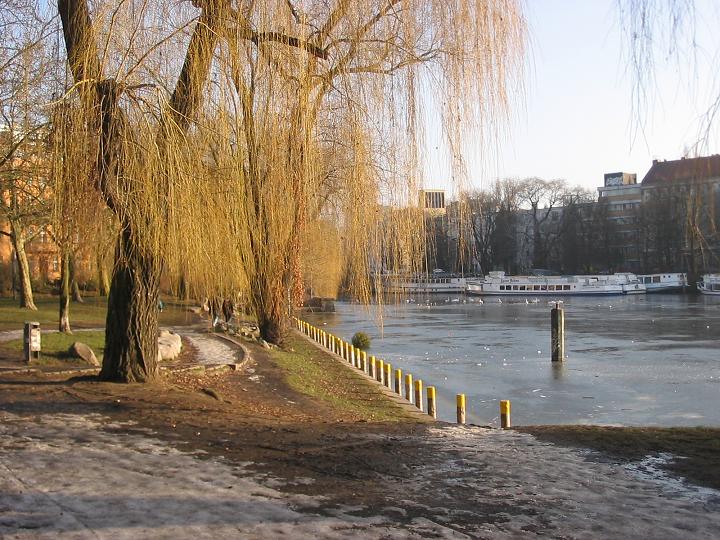
Kreuzberg is bounded by the river Spree in the east. The Landwehrkanal flows through Kreuzberg from east to west, with the Paul-Lincke-Ufer street running alongside it. Other characteristics are the old U-Bahn line of the present-day U1, Görlitzer Park in the SO36 district, and Viktoriapark on the slope of Kreuzberg hill in SW 61.
Subdivision
Kreuzberg is divided into 2 zones (Ortslagen):
- Östliches Kreuzberg (Berlin SO 36)
- Westliches Kreuzberg (Kreuzberg 61)
History
In contrast to many other areas of Berlin, which were villages before their integration into Berlin, Kreuzberg has a rather short history. It was formed on 1 October 1920 by the Greater Berlin Act, which provided for the incorporation of suburbs and the reorganisation of Berlin into twenty boroughs. The eastern Friedrichsvorstadt, the southern Friedrichstadt, the western and southern Luisenstadt, and the Tempelhofer Vorstadt were merged into the new sixth borough of Berlin, first named Hallesches Tor. On 27 September 1921, the borough assembly of Hallesches Tor decided to rename the borough after the homonymous hill. Kreuzberg, literally meaning 'cross hill', is the point of the highest elevation in the Kreuzberg locality, which is 66 m above sea level. The hill is traditionally a place for weekend trips. It received its name from the 1821 Prussian National Monument for the Liberation Wars by Karl Friedrich Schinkel within the Viktoriapark, built in commemoration of the Napoleonic Wars. Except for its northernmost part—the quarter Friedrichstadt (established at the end of the 17th century)—today's Kreuzberg was a very rural place until well into the 19th century.
This changed when, in the 1860s, industrialization caused Berlin to grow rapidly. This called for extensive housing—much of which was built exploiting the dire needs of the poor, with widespread land speculation. Many of Kreuzberg's buildings originate from that time. They were built on the streets laid out in the Hobrecht-Plan in an area that came to be known architecturally as the Wilhelmine Ring.
Far into the 20th century, Kreuzberg was the most populous of Berlin's boroughs even in absolute numbers, with more than 400,000 people, although it was and still is geographically the smallest. As a result, with more than 60,000 /km2, Kreuzberg had the highest population density in Berlin.
Kreuzberg became a district of migration during the late 19th century when Berlin began growing rapidly as an economic and cultural hub. Before World War II, it was home to a diverse population, with a large portion of the population being Ashkenazi Jews. Central to Kreuzberg Jewish life was the Fraenkelufer Synagogue, with a capacity of 2,000. This synagogue was destroyed during Kristallnacht, as were numerous Jewish businesses and property. The vast majority of Kreuzberg's Jews were deported to their deaths between 1942 and 1944 by the Nazis during The Holocaust, and their houses and businesses were seized and given to ethnic Germans. The Jewish Museum Berlin stands in Kreuzberg, and many Stolpersteine can be seen on Kreuzberg streets, commemorating the murdered Jews who lived in the area.
In addition to housing, Kreuzberg was also an industrial center of Berlin. The "export quarter" along Ritter Street consisted of many profitable small businesses, and the "press quarter" along Koch Street (Friedrichstadt) was the home of most of Germany's large newspapers, as well as the Ullstein, Scherl, and Mosse book publishers.
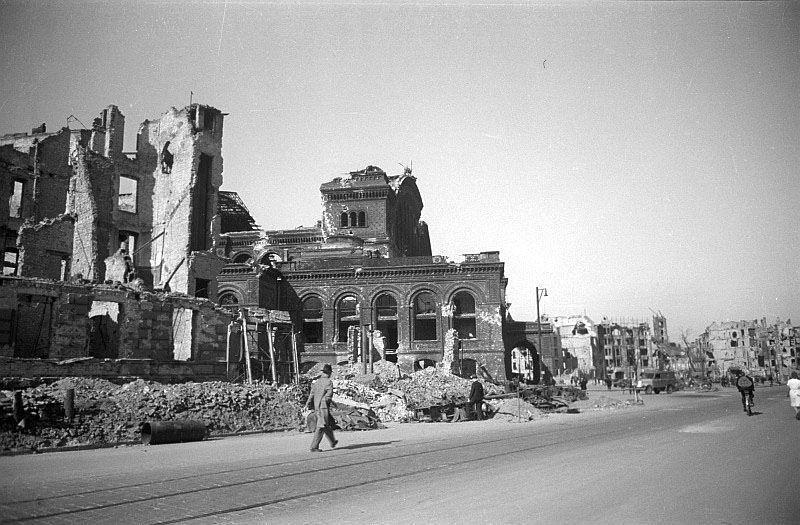
Both industrial quarters were almost entirely destroyed by air raids during World War II, with the American bombing by over a thousand aircraft on 3 February 1945. In remembrance of the old tradition, the Axel Springer press company erected its German headquarters at Kochstraße again, right next to the Berlin Wall.


In July 1945, most of the then district was assigned to the American Sector. After the Berlin Wall was built, the most important transit location to East Berlin was Checkpoint Charlie.
After World War II, Kreuzberg's housing rents were regulated by law which made investments unattractive. As a result, housing was of low quality, but cheap, which made the borough greatly attractive to immigrants. Starting in the late 1960s, increasing numbers of students, artists, and immigrants began moving to Kreuzberg. Enclosed by the Berlin Wall on three sides, the area became famous for its alternative lifestyle and its squatters, especially the SO36 part of Kreuzberg. Starting in 1987, there have been violent riots in SO36 on Labour day.
After the fall of the Berlin Wall, Kreuzberg suddenly found itself in the middle of the city again. The initially cheap rents and the high concentration of 19th-century housing made some parts of the borough more attractive as a residential area for a much wider (and richer) variety of people. Today, Kreuzberg has one of the youngest populations of all European city boroughs; statistically, its population has been completely swapped twice in the last two decades.
Berlin's 2001 administrative reform combined Kreuzberg with Friedrichshain to form the new borough of Friedrichshain-Kreuzberg. Since the two areas are linked only by a single bridge over the Spree River, the Oberbaumbrücke, The two areas not being able to agree on a common location for the future borough's city hall, the present location in Friedrichshain was decided by flipping a five-Mark coin.
Culture
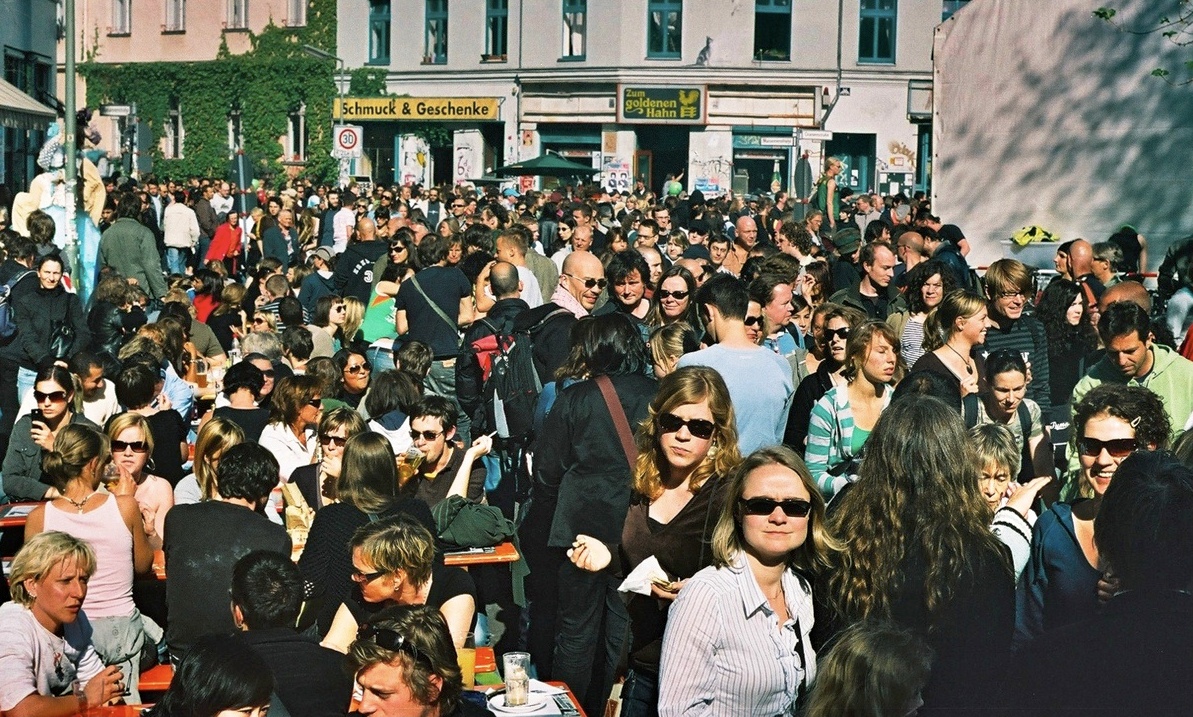
Kreuzberg has historically been home to Berlin's punk rock movement as well as other alternative subcultures in Germany. The SO36 club remains a fixture on the Berlin music scene. It was originally focused on punk music and in the 1970s was often frequented by Iggy Pop and David Bowie. In those days, the club rivalled New York's CBGB as one of the finest new-wave venues in the world.
However, in the 1980s Kreuzberg was perceived as the "eldorado of squatters". While in the 1990s Kreuzberg was perceived as "small Istanbul" and as an "immigrants' ghetto". Kreuzberg has also been a significant influence stemming from African-American and hip hop culture on Kreuzberg's youth and the area has become a centre for rap and breakdance within Berlin. Though the majority of Kreuzberg's residents are of German or Turkish descent, some identify more with (African-)American or other cultures. Hip hop was largely introduced to the youth of Kreuzberg by the children of American servicemen who were stationed nearby until the reunification of Germany. The art collective Berlin Kidz who are known for their pichação influenced graffiti, parkour, and train surfing are from the Kreuzberg area.
The Carnival of Cultures, a large annual festival, celebrates different cultures and heritages with colourful street parades and festivities including street entertainment, food, arts and craft stalls, music, and art.

Kreuzberg has long been the epicenter of LGBTQ life and arts in Berlin. Kreuzberg is home to the Schwules Museum, established in the 1980s and dedicated to preserving, exhibiting, and discovering queer history, art, and culture.
Kreuzberg in popular culture
- German musician and DJ Robin Schulz's musical composition, "Prayer in C", an adaptation of a prior song of the same name by Lilly Wood & the Prick, had most of the music video filmed in Friedrichshain-Kreuzberg.
- Turkish-German filmmaker Neco Celik, who portrays the American influence over the youth culture in Kreuzberg in his first film, Alltag, notes that "Kreuzberg is a kind of biotope where different nationalities live, but the environment determines their lives, not their nationalities".
- German musician Sven Regener's first novel, Berlin Blues, and third novel, **, are set in the district of Kreuzberg.
- Kreuzberg is one of the main locations of the cult movie Possession (1981), directed by Andrzej Żuławski, starring Isabelle Adjani and Sam Neill.
- "Kreuzberg" is a song by English indie rock band Bloc Party on the album A Weekend in the City, which also mentions the East Side Gallery.
- American musician Stephen Malkmus mentions taking a "locomotive to Kreuzberg" in his song "Black Book".
- Kreuzberg's bohemian way of life is reflected in the song "Find the Time" by English singer/songwriter Sam Duckworth's band Get Cape. Wear Cape. Fly on the album Searching for the Hows and Whys.
- Kreuzberg-based Turkish-German rapper Killa Hakan mentions Kreuzberg in most of his songs, most notably in his 2007 single "Kreuzberg City".
- The acclaimed documentary Pool of Princesses (Prinzessinnenbad) by focuses on the lives of three young girls from Kreuzberg.
- Canadian musician Shotgun Jimmie's 2011 album Transistor Sister contains a song titled "The King of Kreuzberg", wherein he sings about taking the train to Kreuzberg and "jump[ing] right into it".
- English post-punk band Killing Joke have a song on their first album titled "SO 36".
- Phoenix folk-punk band Andrew Jackson Jihad make a reference to Kreuzberg in the song "Kokopelli Face Tattoo" with the lyric "Kreuz is German for Williams." Vocalist Sean Bonnette claims this pokes fun at the young hipness of Kreuzberg, in that it is similar to a German version of Williamsburg, Brooklyn.
- Kreuzberg appears in Shadowrun Returnss Dragonfall expansion as Kreuzbasar, a small self-sufficient walled community in the anarchic "F-State" of Berlin.
- In the novel No Man's Land by Michael Califra (Hadrian, 2015), the story's narrator, an American expatriate named Richard, lives in the Kreuzberg district of West Berlin in the months prior to the fall of the Wall.
- Kreuzberg based Turkish-German rapper Massaka mentions Kreuzberg as a "ghetto" in his songs.
- In the third season's finale of the TV series The Americans, Elizabeth and Paige Jennings travel to Kreuzberg to meet Elizabeth's mother.
Economy
- Opinary, tech-media company based in Berlin-Kreuzberg
Places and buildings of interest


- Anhalter Bahnhof (station)
- Böckler Park
- Checkpoint Charlie
- Checkpoint Charlie Museum
- Engelbecken
- Peter Fechter Memorial, one of the first fatalities of the Berlin Wall
- Federal Ministry of Economic Cooperation and Development (Germany)
- Friedrichstraße
- German Museum of Technology (Berlin)
- Gleisdreieck (Berlin U-Bahn)
- Görlitzer Bahnhof (station)
- Hermannplatz (Berlin U-Bahn)
- Hotel Excelsior
- Jerusalem Church
- Jewish Museum Berlin
- Kochstrasse (Berlin U-Bahn)
- Kottbusser Tor (Berlin U-Bahn)
- Kreuzberg (Tempelhofer Berge)
- Landwehr Canal
- Luisenstadt Canal
- Martin-Gropius-Bau
- Mehringdamm (Berlin U-Bahn)
- Mehringplatz
- Moritzplatz (Berlin U-Bahn)
- National Monument for the Liberation Wars
- Niederkirchnerstraße
- Oberbaumbrücke (bridge over the Spree)
- Platz der Luftbrücke (Berlin U-Bahn)
- Prinzenstrasse (Berlin U-Bahn)
- Saint Thomas Church (Berlin)
- Schlesisches Tor (Berlin U-Bahn)
- Schönleinstraße (Berlin U-Bahn)
- SO36 quarter
- Tabor Church
- Topography of Terror
- U1 (Berlin Underground line)
- Viktoriapark
- Wilhelmstrasse
People
- Arthur Arndt (1893–1974), a decorated physician of World War I who was the father and father-in-law of the largest known group of Jews to survive hiding in Germany during The Holocaust.
- Konrad Zuse (1910–1995), built the world's first programmable computer (the Z1) in 1936 in his parent's apartment in Methfesselstraße 10
- Peter Frankenfeld (1913–1979), German comedian, radio and television personality.
- Dunja Hayali (born 1974), journalist
- Paul Alfred Kleinert (born 1960), German writer, editor and translator
- Gabor Steingart (born 1962), German journalist
- Benno Fürmann (born 1972), German actor
- Pashanim (born 2000), rapper
References
References
- {{Population Germany
- Wosnitza, Regine. (13 April 2003). "Berlin on its wild site". Time.
- "Kreuzberg".
- (30 June 2007). "Berlin's culture club". CNN.
- "Kreuzbergs Retter : Textarchiv : Berliner Zeitung Archiv".
- "Verband Berlin-Brandenburgischer Wohnungsunternehmen e.V". Web1.bbu.de.
- "Friedrichshain-Kreuzberg".
- Eva Brücker, Hasso Spode et al.: Kreuzberg (Geschichtslandschaft Berlin V), Berlin: Nicolai 1994 [https://www.amazon.de/Geschichtslandschaft-Berlin-Orte-Ereignisse-Kreuzberg/dp/3875844742%3FSubscriptionId%3D0H7E2ABGRZR51KQBN202%26tag%3Duniversitat09-21%26linkCode%3Dxm2%26camp%3D2025%26creative%3D165953%26creativeASIN%3D3875844742]
- 3-7759-0287-2.
- [http://www.muz-online.de/sights/berlinB3.html Muz-online.de] {{webarchive. link. (2 November 2005 retrieved on 21 March 2008)
- [http://www.visitberlin.de/english/sightseeing/e_si_architektur.php Visitberlin.de] {{webarchive. link. (3 April 2008 , retrieved on 21 March 2008)
- [https://web.archive.org/web/20121023084212/http://www.time.com/time/magazine/article/0,9171,901030421-443145,00.html Time.com], Regine Wosnitza "Berlin on its wild site" 13 April 2003, retrieved on 21 March 2008
- [http://www.spiegel.de/international/germany/0,1518,482795,00.html Spiegel.de] retrieved on 21 March 2008; see Brücker/Spode op.cit.
- Sontheimer, Michael. (8 December 2016). "Berliner Punk-Zentrum SO36: Bier, Schweiß, Lärm und Freiheit". Spiegel Online.
- "Home".
- (2008). "Creative Urban Milieus: Historical Perspectives on Culture, Economy, and the City". Campus University of Chicago Press.
- Brown, Timothy S. "'Keeping it Real' in a Different 'Hood: (African-) Americanization and Hip-hop in Germany". In The Vinyl Ain't Final: Hip Hop and the Globalization of Black Popular Culture, ed. by Dipannita Basu and Sidney J. Lemelle, 137-50. London; A
- [https://query.nytimes.com/gst/fullpage.html?res=9905E1D7143BF931A25757C0A9659C8B63 The Saturday Profile; A Bold New View of Turkish-German Youth], ''[[New York Times]]''
- "Biography / Berlin Kidz".
- "Karneval der Kulturen". Karneval-berlin.de.
- Lovenheim, Barbara. (2016). "Survival in the shadows: seven Jews hidden in Hitler's Berlin". Open Road Integrated Media.
This article was imported from Wikipedia and is available under the Creative Commons Attribution-ShareAlike 4.0 License. Content has been adapted to SurfDoc format. Original contributors can be found on the article history page.
Ask Mako anything about Kreuzberg — get instant answers, deeper analysis, and related topics.
Research with MakoFree with your Surf account
Create a free account to save articles, ask Mako questions, and organize your research.
Sign up freeThis content may have been generated or modified by AI. CloudSurf Software LLC is not responsible for the accuracy, completeness, or reliability of AI-generated content. Always verify important information from primary sources.
Report