From Surf Wiki (app.surf) — the open knowledge base
Krav Maga
Israeli self-defense system
Israeli self-defense system
| Field | Value |
|---|---|
| image | Kravmaga.jpg |
| imagecaption | Krav Maga course at an Israeli paratroopers school in 1955 |
| name | Krav Maga |
| native_name | |
| focus | Hybrid |
| creator | Imi Lichtenfeld |
| parenthood | Aikido, Judo, Karate, Boxing, Wrestling |
| olympic | No |
| country | Israel |
Krav Maga ( ; , ; ) is an Israeli self-defence system. Developed for the Israel Defense Forces (IDF), it is known for its focus on real-world situations.
Krav Maga was originally developed by Hungarian-born Israeli martial artist Imi Lichtenfeld. Having grown up in Bratislava during a time of antisemitic unrest, Lichtenfeld used his training as a boxer and wrestler to defend Jewish neighborhoods against attackers in the mid-to-late 1930s, becoming an experienced street fighter. After his immigration to Mandatory Palestine in the late 1940s, he began to provide lessons on combat training to Jewish paramilitary groups that would later form the IDF during the 1948 Palestine war. As an instructor, he compiled his knowledge and experience into the combat system that would later become known as Krav Maga. This system would continue to be taught long after he left the IDF.
From the outset, the original concept of Krav Maga was to take the most effective and practical techniques of other fighting styles (originally European boxing, wrestling, and street fighting) and make them rapidly teachable to conscripted soldiers. It has a philosophy emphasizing aggression and simultaneous defensive and offensive manoeuvres.{{cite news| title=All change on the buses| date=15 January 1998
Etymology
The term krav maga in Hebrew is literally translated as 'contact combat' – the three letter root of the first word is q-r-b (קרב), and the noun derived from this root means either "combat" or "battle",{{cite book |last1=Brown |first1=Francis |last2=Driver
Basic principles
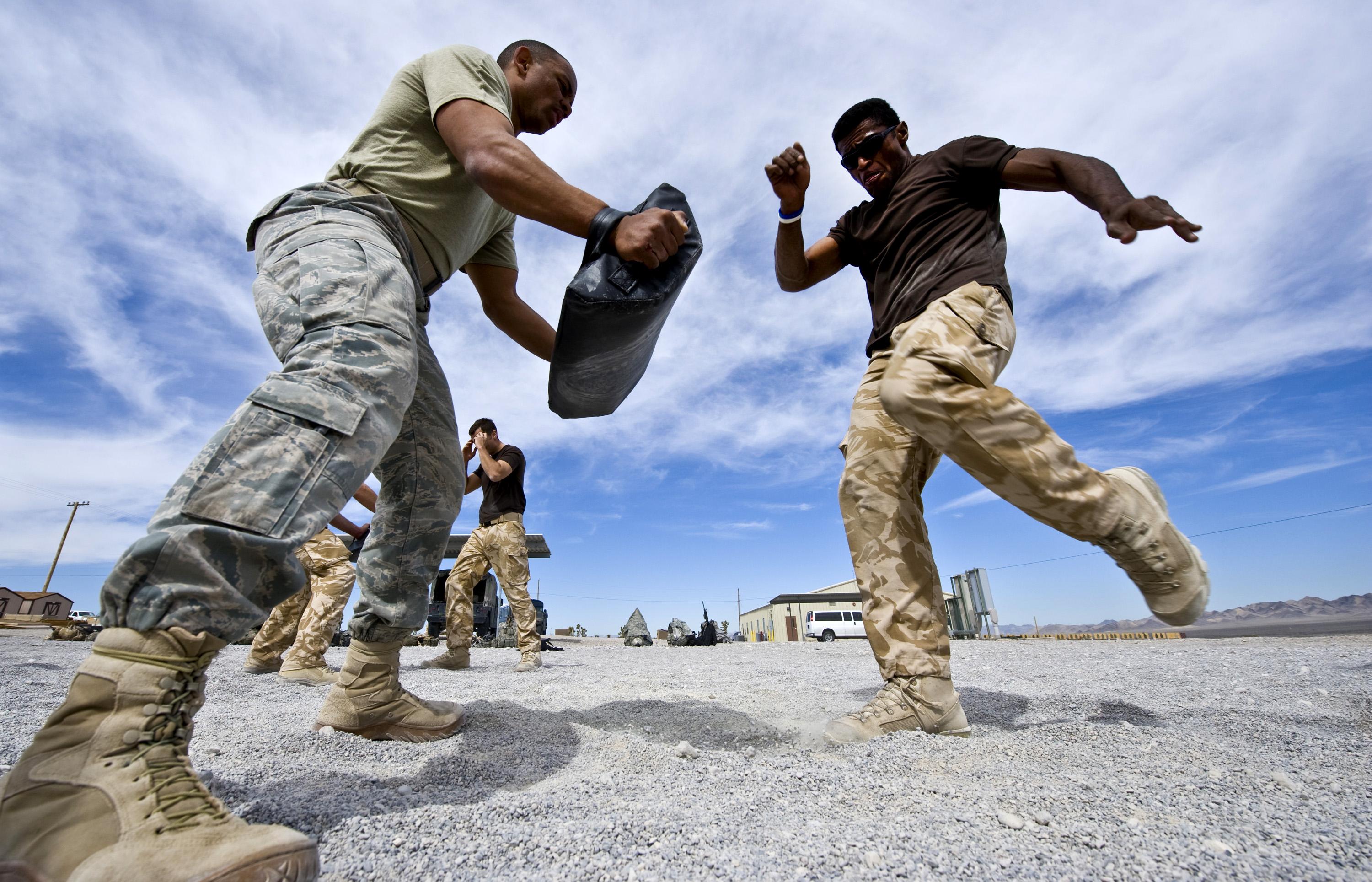
.jpg)
Like most martial arts, Krav Maga encourages students to avoid physical confrontation. If this is impossible or unsafe, it promotes finishing a fight as quickly and aggressively as possible. Attacks are aimed at the most vulnerable parts of the body, and training is not limited to techniques that avoid severe injury; some even permanently injure or kill the opponent.
Students learn to defend against all variety of attacks and are taught to counter in the quickest and most efficient way.
Ideas in Krav Maga include:
- Simultaneous defense and attack.
- Developing physical aggression (not to be confused with emotional aggression or anger), with the view that physical aggression is the most important component in a fight
- Continuing to strike the opponent until they are completely incapacitated
- Attacking preemptively or counterattacking as soon as possible
- Using any objects at hand that could be used to hit an opponent
- Targeting attacks to the body's most vulnerable points, such as the eyes, neck or throat, face, solar plexus, groin, ribs, knee, foot, fingers, liver, etc.
- Using simple and easily repeatable strikes
- Maintaining awareness of surroundings while dealing with the threat in order to look for escape routes, further attackers, or objects that could be used to strike an opponent
- Developing muscle memory for quicker fighting reaction
- Recognizing the importance of and expanding on instinctive response under stress
Training can also cover the study and development of situational awareness to develop an understanding of one's surroundings, learning to understand the psychology of a street confrontation, and identifying potential threats before an attack occurs. It may also cover physical and verbal methods to avoid violence whenever possible. It also teaches mental toughness, using controlled scenarios to strengthen mental fortitude in order for students to control the impulse and not do something rash, but instead attack only when necessary and as a last resort.
Techniques
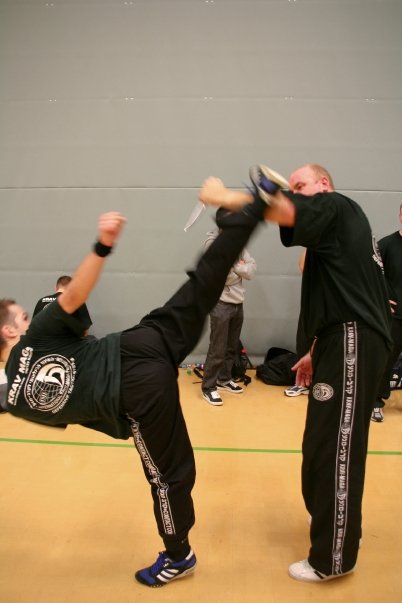
Some of the key focuses of techniques in Krav Maga are—as described above—effectiveness and instinctive response under stress. To that end, Krav Maga is an eclectic system that has not sought to replace existing effective techniques, taking what is useful from available systems, for example:
- Strikes – as per karate and boxing
- Takedowns and throws – as per judo, aikido and wrestling
- Ground work – as per judo and wrestling
- Escapes from chokes and holds – as per judo, aikido and wrestling
- Empty-hand weapon defenses – as per aikido
Since the early 21st century, a number of Krav Maga schools have introduced technical influences from other arts as well. These include Brazilian jiu-jitsu, Arnis/Kali/Escrima and Silat. This reflects Krav Maga's attitude, across a multitude of lineages, as an ever-evolving style, which continues to borrow ideas and methods from other martial arts.
History

Imre "Imi" Lichtenfeld (also known as Imi S'de-Or) was born in 1910 in Budapest, Austro-Hungary to a Jewish family and grew up in Pozsony, today's Bratislava (Slovakia). Lichtenfeld became active in a wide range of sports, including gymnastics, wrestling, and boxing. In 1928, Lichtenfeld won the Slovak Youth Wrestling Championship, and in 1929 the adult championship (light and middle weight divisions). That same year, he also won the national boxing championship and an international gymnastics championship. During the ensuing decade, Lichtenfeld's athletic activities focused mainly on wrestling, both as a contestant and a trainer.
In the mid-1930s, antisemitic riots began to threaten the Jews of Bratislava, Czechoslovakia. Lichtenfeld became the leader of a group of Jewish boxers and wrestlers who took to the streets to defend Jewish neighborhoods against the growing numbers of antisemitic Nazis. Lichtenfeld quickly discovered, however, that actual fighting was very different from competition fighting, and although boxing and wrestling were good sports, they were not always practical for the aggressive and brutal nature of street combat. It was then that he started to re-evaluate his ideas about fighting and started developing the skills and techniques that would eventually become Krav Maga. Having become a thorn in the side of the equally antisemitic local authorities, in 1940 Lichtenfeld left his home with his family and friends on the last refugee ship to escape Europe.
After making his way to Mandatory Palestine, Lichtenfeld joined the Haganah paramilitary organization. In 1944, Lichtenfeld began training fighters in his areas of expertise: physical fitness, swimming, wrestling, use of the knife, and defense against knife attacks. During this period, Lichtenfeld trained several elite units of the Haganah, including the Palmach (striking force of the Haganah and forerunner of the special units of the Israel Defense Forces) and the Palyam, as well as groups of police officers.
In 1948, when the State of Israel was founded and the IDF was formed, Lichtenfeld became Chief Instructor for Physical Fitness and Krav Maga at the IDF School of Combat Fitness. He served in the IDF for about 20 years, during which time he developed and refined his unique method for self-defense and hand-to-hand combat. Self-defense was not a new concept, since nearly all martial arts had developed some form of defensive techniques in their quest for tournament or sport dominance. However, self-defense was based strictly upon the scientific and dynamic principles of the human body. In 1965 judo training was added as part of the Krav Maga training. Until 1968 there were no grades in Krav Maga. Then a trainee's grades were determined largely by his knowledge in judo.
In 1968, Eli Avikzar, one of Lichtenfeld's principal students and first black belt, began learning aikido. In 1971, Eli left for France, where he received a black belt in aikido. Upon his return, Avikzar started working as an instructor alongside Imi to integrate more traditional martial arts into Krav Maga. Then in 1974 Imre retired and gave Eli Avikzar control over the Krav Maga training center in Netanya. Shortly after, in 1976, Avikzar joined the permanent force of IDF, as head of the Krav Maga section. The role of Krav Maga in the army advanced greatly after Eli's appointment. More courses were given, and every P.E. instructor was obliged to learn Krav Maga. Avikzar continued to develop Krav Maga within the IDF until his retirement in 1987. Up to this date, Eli had trained 80,000 male soldiers and 12,000 female soldiers.
Further pursuing excellence as a student of martial arts, Eli went to Germany in 1977 and received a black belt in aikido from the European Federation.{{cite web |access-date = 5 March 2013 |url-status = dead |archive-url = https://web.archive.org/web/20130317102746/http://krav-maga.com/training/founder |archive-date = 17 March 2013
Israel Defense Forces
The IDF offers a five-week Krav Maga instructor course. It has held an annual Krav Maga competition since May 2013.
Civilian use
Upon Imi Lichtenfeld's retirement from the IDF, he decided to open a school and teach Krav Maga to civilians.{{cite magazine | access-date=10 October 2011 | archive-date=6 November 2011 | archive-url=https://web.archive.org/web/20111106143353/http://www.people.com/people/archive/article/0,,20067113,00.html | url-status=dead The first Krav Maga course took place at the Wingate Institute, Netanya, Israel, in 1971, under his direct supervision.Krav Maga Practical Instructors Course May 2014 23 January 2014 {{cite web |access-date = 16 July 2013 |url-status = dead |archive-url = https://web.archive.org/web/20130925130107/http://kami.org.il/page.aspx?pageid=93 |archive-date = 25 September 2013
Grading system
Most of the Krav Maga organizations in Israel use Imi Lichtenfeld's colored belt grading system which is based upon the Judo ranking system. It starts with a white belt, and then yellow, orange, green, blue, brown and black belts. Black belt students can move up the ranks from 1st to 9th Dan. The time and requirements for advancing have some differences between the organizations.
Other organizations that teach Krav Maga in and outside of Israel use similar grading systems.{{cite web |access-date = 5 March 2013 |url-status = dead |archive-url = https://web.archive.org/web/20130305005709/http://krav-maga.com/training-programs/grading-system |archive-date = 5 March 2013
A patch system was developed by Eyal Yanilov in the late 1980s. The grades are divided into three main categories: Practitioner, Graduate and Expert. Each of the categories, which are often abbreviated to their initials, has five ranks. Grades P1 through to P5 are the student levels and make up the majority of the Krav Maga community. After P5 are G1–G5, and in order to achieve Graduate level the student has to demonstrate a proficiency in all of the P-level techniques before advancing.
| [[File:Krav_Maga_P0_Patch.svg | 35x35px]] | [[File:Krav_Maga_P1_Patch.svg | 35x35px]] | [[File:Krav_Maga_P2_Patch.svg | 35x35px]] | [[File:Krav_Maga_P3_Patch.svg | 35x35px]] | [[File:Krav_Maga_P4_Patch.svg | 35x35px]] | [[File:Krav_Maga_P5_Patch.svg | 35x35px]] | [[File:Krav_Maga_G1_Patch.svg | 35x35px]] | [[File:Krav_Maga_G2_Patch.svg | 35x35px]] | [[File:Krav_Maga_G3_Patch.svg | 35x35px]] | [[File:Krav_Maga_G4_Patch.svg | 35x35px]] | [[File:Krav_Maga_G5_Patch.svg | 35x35px]] | [[File:Krav_Maga_E1_Patch.svg | 35x35px]] | [[File:Krav_Maga_E2_Patch.svg | 35x35px]] | [[File:Krav_Maga_E3_Patch.svg | 35x35px]] | [[File:Krav_Maga_E4_Patch.svg | 35x35px]] | [[File:Krav_Maga_E5_Patch.svg | 35x35px]] |
|---|
Although there are some subtle differences, the various organizations teach the same core techniques and principles. Some other organizations have less formal grading ranks without belts or patches but do have levels by which students can monitor their progress.
Sparring
In some organizations, sparring is slow and light until the student reaches G2 level. This takes approximately four to six years, because rising one level in the Practitioner and Graduate categories takes at minimum half a year of consistent training. It is, however, more common to observe regular trainees grading only once a year from P3 and up.
Once in G2, students also practice simulated "real" fighting with protective gear.
In popular media
- Krav Maga was represented in the UFC by former IDF soldier Moti Horenstein. He fought Mark Coleman at UFC 10 and Mark Kerr at UFC 14, losing decisively each time. Both Coleman and Kerr were NCAA Division I wrestling champions and would go on to win their respective tournaments.
- Jennifer Lopez trained in Krav Maga for her role in Enough, and the martial art was featured in the story.
- Leonardo DiCaprio trained in Krav Maga for his role in Blood Diamond, where he played a Rhodesian-South African smuggler and mercenary.
- Jessica Chastain trained in Krav Maga for her role in The Debt, and the martial art was featured in fight scene choreography.
- Tom Cruise trained in Krav Maga for fight choreography in Jack Reacher.
- Daniel Craig trained in Krav Maga for fight choreography as James Bond in Spectre.
- Emily Blunt trained in Krav Maga for fight choreography in Edge of Tomorrow.
- Sean Penn trained in Krav Maga for fight choreography in The Gunman.
- The Grand Theft Auto IV protagonist, Niko Bellic, uses Krav Maga in physical combat.
- Krav Maga was referenced in the show How I Met Your Mother in the fourth episode of the first season.
References
References
- (25 June 2021). "About Krav Maga". sgskravmaga.com.au.
- (2001). "Martial Arts of the World: En Encyclopedia". ABC-CLIO.
- "Krav Maga Federation – Israeli Martial Arts and Self-Defense". kravmagainc.com.
- Hodsdon, Amelia. (8 February 2005). "Get your kicks with Israeli tricks". [[The Guardian]].
- (2009). "Complete Krav Maga: The Ultimate Guide to Over 200 Self-Defense and Combative Techniques". Simon and Schuster.
- "Imi Lichtenfeld".
- [https://books.google.com/books?id=SNsDAAAAMBAJ Inside Israel], Nov 2002, Vol. 40, No. 11, p. 68 [[Black Belt Magazine]], [[Active Interest Media]]
- ''[[Black Belt Magazine]]'', July 2000, Vol. 38, No. 7, p. 37 [https://books.google.com/books?id=ns8DAAAAMBAJ Krav Maga’s Top 10], Active Interest Media
- (May 27, 2013). "Elite soldiers fight it out in IDF's first-ever Krav Maga tournament". IDF Blog.
- Jim Wagner and Maj. Avi Nardia. "Inside Israel". [[Black Belt Magazine]].
- (1961). "Ben-Yehuda's Pocket English-Hebrew Hebrew-English Dictionary". Pocket books.
- "Krav Maga is the best self-defense for the streets". Krav Maga Los Angeles.
- Poulomi Banerjee. (28 January 2009). "Contact combat: Self-Defence classes to stay safe". [[The Telegraph (Calcutta).
- ''Black Belt'', July 2000, Vol. 38, No. 7, p. 37 [https://books.google.com/books?id=ns8DAAAAMBAJ Krav Maga’s Top 10], Active interest Media
- [https://books.google.com/books?id=ns8DAAAAMBAJ ''Black Belt'', July 2000, Vol. 38, No. 7], p. 35
- [https://books.google.com/books?id=ns8DAAAAMBAJ ''Black Belt'', July 2000, Vol. 38, No. 7], p. 37
- (2016). "Krav Maga Defence: How to Defend Yourself Against the 12 Most Common Unarmed Street Attacks". St. Martin's Press.
- (2009). "Krav Maga for Beginners: A Step-by-Step Guide to the World's Easiest-to-Learn, Most-Effective Fitness and Fighting Program". Ulysses Press.
- "What is Krav Maga?".
- "List of Krav Maga Techniques (Beginner & Advanced)".
- Kahn, David. (2004). "Krav Maga: An Essential Guide to the Renowned Method—for Fitness and Self-Defense". St. Martin's Publishing.
- Levine, Darren. (2022). "Complete Krav Maga: The Ultimate Guide to Over 250 Self-Defense and Combative Techniques". Ulysses Press.
- Nardia, Avi. (2008). "Kapap Combat Concepts: Martial Arts of the Israeli Special Forces". Black Belt Books.
- Kahn, David. (2021). "Krav Maga Fundamental Strategies".
- Bluestein, Jonathan. (2024). "Martial Arts Politics Explained". Amazon Digital Services LLC - Kdp.
- "Bio Imi Lichtenfeld {{!}} Fédération Européenne de Krav-maga".
- "Imi Lichtenfeld - History of the founder of Krav Maga".
- "Krav Maga".
- "THE FOUNDER OF KRAV MAGA IMRICH (IMI) SDE-OR".
- "Krav Maga Toronto {{!}} Imi Lichtenfeld, Founder of Krav Maga". Krav Maga Toronto.
- "Eli Avikzar".
- "Eli Avikzar".
- "What is K.A.M.I?".
- (11 November 2019). "The Krav Maga Expert – Mental Training to become Pure Krav Maga and Hand-to ...". Lulu.com.
- "About the Founder Eli Avikzar".
- "History of Krav-Maga".
- "Israeli Krav Maga vs. Commando Krav Maga". judo-for-self-defense.com.
- "Founder Of K.A.M.I {{!}} kami".
- (March 21, 2012). "Rare Glimpse into the Ultimate Martial Arts: Krav Maga Instructors' Course". IDF Blog – The Official Blog of the Israel Defense Forces.
- (27 May 2013). "Elite soldiers fight it out in IDF's first-ever Krav Maga tournament". [[Israeli Defense Forces]].
- "About Krav Maga".
- "Krav Maga Grading System".
- "Home Page".
- "Becoming An OIS Instructor".
- "Krav Maga for Civilians – Krav Maga Global KMG".
- "Fighting Drills G2 – Training Syllabus Sample". Maxkravmaga.com.
- (July 8, 2009). "Most Dicked Over Fighter In UFC History: Moti Horenstein".
- (May 16, 2002). "Jennifer Lopez On Getting Buff & Having 'Enough'".
- (2012-04-06). "DiCaprio, Kutcher, and Craig Use Israeli Fighting Technique Krav Maga - Algemeiner.com".
- (2011-05-25). "JESSICA CHASTAIN LEARNS KRAV MAGA & GERMAN FOR 'THE DEBT'".
- Taylor, Ella. (August 31, 2011). "'The Debt': History's Burden, And A Moral Calculus".
- Tom Cruise. "There's a bit of Krav Maga in there...WHAM! -TeamTC @philipWdd who did u learn the fighting style from, in Jack Reacher? Its pretty badass".
- Kurchak, Sarah. (2015-11-04). "How Daniel Craig Developed James Bond's Street Fighting Skills".
- Team Coco. (2014-06-05). "Emily Blunt Seeks to Understand Testicle Pain {{!}} CONAN on TBS".
- "GUNMAN - Featurette "Krav Maga" - Sean Penn (2015)".
- (2008-04-27). "Grand Theft Auto IV review".
This article was imported from Wikipedia and is available under the Creative Commons Attribution-ShareAlike 4.0 License. Content has been adapted to SurfDoc format. Original contributors can be found on the article history page.
Ask Mako anything about Krav Maga — get instant answers, deeper analysis, and related topics.
Research with MakoFree with your Surf account
Create a free account to save articles, ask Mako questions, and organize your research.
Sign up freeThis content may have been generated or modified by AI. CloudSurf Software LLC is not responsible for the accuracy, completeness, or reliability of AI-generated content. Always verify important information from primary sources.
Report