From Surf Wiki (app.surf) — the open knowledge base
Knout
Type of whip
Type of whip
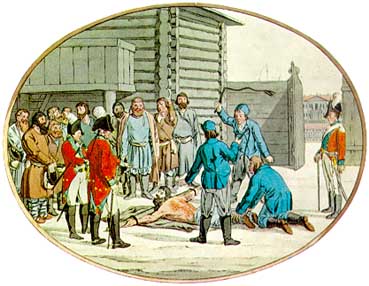
A knout (, ) is a Russian whip that consists of a rawhide thong or a rope attached to a long wooden handle. Commonly used for prodding horses or cattle, knouts were also used for flagellation as a corporal punishment in Russian history. The English word is a spelling-pronunciation of a French transliteration of the Russian word кнут (knut), which means "whip".
Etymology
The word may be derived from the Swedish knutpiska, a kind of whip with knots. The stem knut is of generic Germanic origin; compare with the German Knute, Dutch knoet (both meaning knout) and with Old Norse knutr, Anglo-Saxon cnotta and English knot.
For corporal punishment
According to Brockhaus and Efron, a typical knout used by Russian executioners consisted of a wooden handle about half arshin (35 cm) to which attached was a thick braided rawhide piece, one arshin (70 cm) long. The latter piece ended in a metal ring, to which was attached a wide rawhide belt made as long, also of one arshin length with a stiffened beak-like end.
.png)
.png)
Knouts were used in Russia for flogging as formal corporal punishment of criminals and political offenders. The victim was tied to a post or on a triangle of wood and stripped, receiving the specified number of strokes on the back. A sentence of 100 or 120 lashes was equivalent to a death sentence.
Emperor Nicholas I abolished punishment by knout in 1845, after years of deliberation, and replaced it with the pleti,
References
References
- "knot {{!}} Etymology of knot by etymonline".
- {{cite Efron. Кнут, орудие наказания
- Lagny, Germain de. (1854). "The Knout and the Russians: Or, the Muscovite Empire, the Czar, and his people". Harper&Brothers.
- a lighter whip, commonly with three tails, which was used previously for punishment as well.{{cite Efron. Плети
This article was imported from Wikipedia and is available under the Creative Commons Attribution-ShareAlike 4.0 License. Content has been adapted to SurfDoc format. Original contributors can be found on the article history page.
Ask Mako anything about Knout — get instant answers, deeper analysis, and related topics.
Research with MakoFree with your Surf account
Create a free account to save articles, ask Mako questions, and organize your research.
Sign up freeThis content may have been generated or modified by AI. CloudSurf Software LLC is not responsible for the accuracy, completeness, or reliability of AI-generated content. Always verify important information from primary sources.
Report