From Surf Wiki (app.surf) — the open knowledge base
King Yin Lei

| Field | Value |
|---|---|
| name | King Yin Lei |
| native_name | 景賢里 |
| native_language | Chinese |
| image | 景賢里1.JPG |
| coordinates | |
| location | 45 Stubbs Road, Mid-Levels, Hong Kong |
| area | Hong Kong |
| built | 1936-1937 |
| architect | A.R. Fenton-Rayen |
| architecture | Chinese classic |
| Chinese Renaissance | |
| restored | 2008-2010 |
| owner | Government of the Hong Kong Special Administrative Region |
| designation1 | HK Declared Monument |
| designation1_date | |
| designation1_number | M0085 |
Chinese Renaissance King Yin Lei () is a historic mansion in the Mid-Levels area of Hong Kong. It is within the Wan Chai District.
Development
The mansion was designed by British architect A. R. Fenton-Raven (husband of Viola, father of Wynne (Ward) and Dorothy (Balean)). Construction began in 1936 and was completed by 1937. It sits on a 50650 sqft site above Happy Valley Racecourse. The compound comprises a three-storey "red bricks and green tiles" building, a private garden festooned with penjing plants, various pavilions and terraces.
Conservation
The property was offered for sale in early 2004. Despite claims that it was likely that the new buyer would demolish the property and redevelop it, the Government of Hong Kong did not act.
The Conservancy Association of Hong Kong, a heritage advocacy group, wrote to the Secretary for Home Affairs Patrick Ho in April 2004 requesting him to consider declaring the mansion a monument under the Antiquities and Monuments Ordinance. The Association also organised a "Save King Yin Lei Campaign" in June and generated public discussion. Yow Mok Shing then announced that he would not sell the building for the moment.
The Government of Hong Kong did not act to preserve the building, arguing that it was private property and had not used its allocated land mass to the fullest. If the government was to declare it a historical building, thus forbidding the demolition and any further development on the site, it would have to pay a large amount of compensation to the owner, in the millions.
The owner wrote to the government on the preservation of the site but received no reply. Later, Secretary for Development Carrie Lam admitted it was insensitive of her department not to do so.
On 11 September 2007, dump trucks were spotted at the site. Parts of the roof were removed. All three Chinese characters on a front gate plaque were chiselled away by workers. The Conservancy Association of Hong Kong expressed disappointment that the government had not been able to preserve the estate. When the start of demolition was reported in the Hong Kong media, the government declared the site a proposed monument and ordered a work stoppage.
On 25 January 2008, the government reached a preliminary understanding with the owner on a possible preservation option for the mansion. Under the agreement, the owner surrendered King Yin Lei's entire site to the government after restoration. Subject to the necessary town planning approval, the government would grant an adjacent man-made slope site of a size similar to King Yin Lei to the owner for development, subject to the same plot ratio of 0.5 and a height restriction of three storeys.
Conservation work was undertaken from 2008 to December 2010. The roof was restored in Phase One, including about 50,000 glazed roof tiles from Guangdong Province. Phase Two involved the exterior walls and the mansion's interior. In late 2010, the restoration was considered to be "substantially completed" and management of the property was taken over by the government of Hong Kong. It is graded as a declared Monument.
Current use

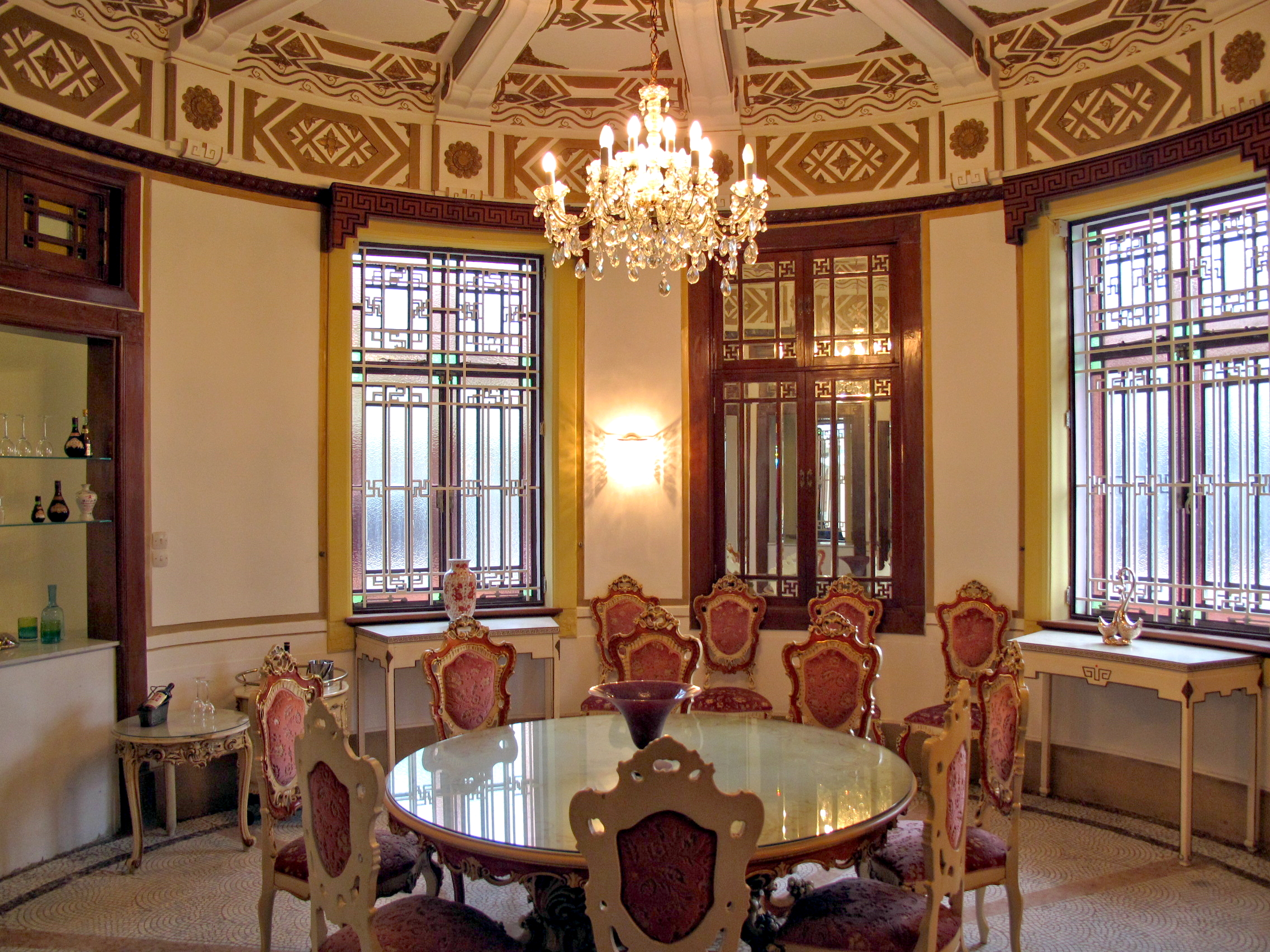
King Yin Lei remains vacant . Its high-grade status as a monument means that it cannot be altered for commercial re-use.
However, the government hosts several open houses throughout the year, during which the public can tour the monument. Tickets for timed sessions are distributed for free in advance. Visitors can view the mansion, including a few rooms that have been furnished with antiques, and the grounds.
In 2019, King Yin Lei was included in Batch VI of the Revitalising Historic Buildings Through Partnership Scheme. The Scheme seeks public participation in preserving historic buildings and putting them to good use. Proposals were due in September 2020.
In June 2022, the Tianda Institute, a think tank owned by Hong Kong businessman Fang Wenquan, was selected from 18 applicants to operate the mansion. The group plans to build a one storey annex for a tea studio at the mansion and use the villa as a learning centre to promote Chinese culture, history and environmental studies. In addition, the Tianda Group plans to build a restaurant within the mansion to serve Indian and Chinese cuisine.
In popular culture
The building has been featured in several films and TV series over the years. In Enter the Dragon,
Gallery
File:King Yin Lei 1971.jpg|Aerial view of King Yin Lei (1971) File:HK King Yin Lane view from Peak Black s Link.JPG|Aerial view of King Yin Lei (2007) File:King Yin Lei 032.JPG|Green gates to the compound, during an open house (2011) File:King Yin Lei SingChiu.jpg|Internal courtyard of the mansion, looking North, showing the three-sided veranda on the first floor and the building's swooping green rooflines File: King Yin Lei Garden.jpg|View of Hong Kong from the mansion File:King Yin Lei 160.JPG|Wrapping veranda and internal courtyard King Yin Lei Main Hall 2011.jpg|Main Hall File:King Yin Lei Bedroom shelf 2011.JPG|Bedroom with furniture (2013) File:King Yin Lei Kitchen 2011.JPG|Kitchen File:景賢里3.JPG|Pink tiled bathroom (2013) File:景賢里.JPG|King Yin Lei silhouette (2013)
References
References
- Chan, Ming K.. (2008). "China's Hong Kong Transformed: Retrospect and Prospects". City University of Hong Kong Press.
- (18 September 2008). "King Yin Lei declared a monument (with photos)". Antiquities and Monuments Office.
- McMillan, Alex Frew. (29 April 2011). "The King Yin Lei Mansion in Hong Kong Is Saved". The New York Times.
- "District Council Constitutency Boundaries - Wan Chai District". [[Electoral Affairs Commission]].
- (15 September 2007). "71 year-old Chinese styled mansion designed by a westerner". Ming Pao News.
- (20 September 2007). "Antiquities: Carrie Lam urges meeting with building owner". Information Services Department, Government of the Hong Kong Special Administrative Region.
- [[Cable TV Hong Kong. Cable TV]] news, Hong Kong – 1700 edition, 14 September 2007.
- (14 September 2007). "Antiquities: King Yin Lei declared proposed monument". Information Services Department, Government of the Hong Kong Special Administrative Region.
- (25 January 2008). "Heritage: King Yin Lei to be declared a monument". Information Services Department, Government of the Hong Kong Special Administrative Region.
- Report No. 60 of the Director of Audit, [http://www.aud.gov.hk/pdf_e/e60ch01.pdf Chapter 1: "Conservation of monuments and historic buildings"], 28 March 2013.
- (23 December 2016). "Batch III of Revitalisation Scheme". Development Bureau - Works Branch of the Government of the Hong Kong Special Administrative Region.
- Dewolf, Christopher. (27 September 2017). "Take a Peek Inside King Yin Lei, Hong Kong’s Chinese Renaissance Landmark". Zolima Ltd.
- Mirandilla, Leanne. (17 October 2017). "King Yin Lei: a mysterious Renaissance mansion". The Loop HK.
- (24 August 2018). "King Yin Lei monument to open". Information Services Department, Government of the Hong Kong Special Administrative Region.
- (12 November 2019). "Batch VI of Revitalisation Scheme – Batch VI Historic Buildings". Development Bureau, Government of Hong Kong.
- (30 July 2020). "Batch VI of Revitalisation Scheme - Application Arrangements". Development Bureau, Government of Hong Kong.
- "Historic Hong Kong mansion handed over to pro-Beijing think tank to transform into healthy living centre".
- "King Yin Lei". The Conservancy Association.
This article was imported from Wikipedia and is available under the Creative Commons Attribution-ShareAlike 4.0 License. Content has been adapted to SurfDoc format. Original contributors can be found on the article history page.
Ask Mako anything about King Yin Lei — get instant answers, deeper analysis, and related topics.
Research with MakoFree with your Surf account
Create a free account to save articles, ask Mako questions, and organize your research.
Sign up freeThis content may have been generated or modified by AI. CloudSurf Software LLC is not responsible for the accuracy, completeness, or reliability of AI-generated content. Always verify important information from primary sources.
Report