From Surf Wiki (app.surf) — the open knowledge base
Kilometre
Unit of length equal to 1,000 metres
Unit of length equal to 1,000 metres
| Field | Value |
|---|---|
| name | kilometre |
| image | 25 April Tagus bridge (10480970823).jpg |
| caption | The main span of the [25 de Abril Bridge](25-de-abril-bridge) in Lisbon, Portugal is 1.013 km. |
| symbol | km |
| standard | SI |
| quantity | length |
| units1 | SI base units |
| inunits1 | |
| units2 | imperial/US units |
| inunits2 | ≈ |
|  ≈ | |
|  ≈ | |
| units3 | nautical units |
| inunits3 | ≈ 1 km |
≈ ≈
The kilometre (SI symbol: km; or ), spelt kilometer in American and Philippine English, is a unit of length in the International System of Units (SI), equal to one thousand metres (kilo- being the SI prefix for ). It is the preferred measurement unit to express distances between geographical places on land in most of the world; notable exceptions are the United States and the United Kingdom where the statute mile is used.
Pronunciation
There are two common pronunciations for the word. 1. 1.
The first pronunciation follows a pattern in English whereby SI units are pronounced with the stress on the first syllable (as in kilogram, kilojoule and kilohertz) and the pronunciation of the actual base unit does not change irrespective of the prefix (as in centimetre, millimetre, nanometre and so on). It is generally preferred by the British Broadcasting Corporation (BBC), the Canadian Broadcasting Corporation (CBC), and the Australian Broadcasting Corporation (ABC).
Many other users, particularly in countries where SI (the metric system) is not widely used, use the second pronunciation with stress on the second syllable. The second pronunciation follows the stress pattern used for the names of measuring instruments (such as micrometer, barometer, thermometer, tachometer, and speedometer). The contrast is even more obvious in countries that use the American spelling of the word metre. This pronunciation is irregular because it makes the kilometre the only SI unit with the stress on the second syllable.
After Australia introduced the metric system in 1970, the first pronunciation was declared official by the government's Metric Conversion Board. However, the Australian prime minister at the time, Gough Whitlam, insisted that the second pronunciation was the correct one because of the Greek origins of the two parts of the word.
Equivalence to other units of length
| : { |
|---|
| ≡ |
| metres |
| - |
| ≈ |
| feet |
| - |
| ≈ |
| yards |
| - |
| ≈ |
| miles |
| - |
| ≈ |
| nautical miles |
| - |
| ≈ |
| astronomical units |
| - |
| ≈ |
| light-years |
| - |
| ≈ |
| parsecs |
| } |
History
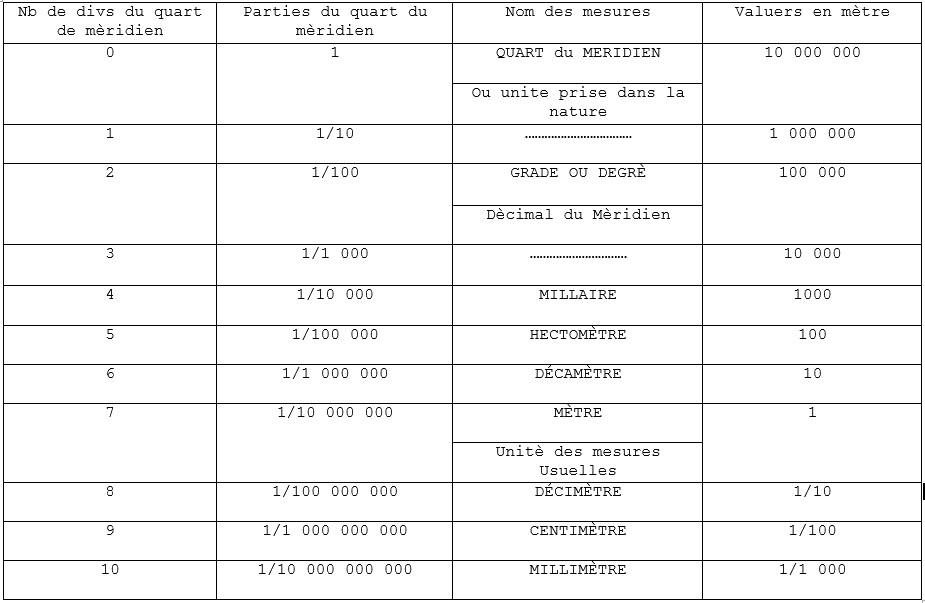
By a decree of 8 May 1790, the French National Constituent Assembly ordered the French Academy of Sciences to develop a new measurement system. In August 1793, the French National Convention decreed the metre as the sole length measurement system in the French Republic and it was based on millionth of the distance from the orbital poles (either North or South) to the Equator, this being a truly internationally based unit. The first name of the kilometre was "Millaire". Although the metre was formally defined in 1799, the myriametre ( metres) was preferred to the "kilometre" for everyday use. The term "myriamètre" appeared a number of times in the text of Develey's book Physique d'Emile: ou, Principes de la science de la nature, (published in 1802), while the term kilometre only appeared in an appendix. French maps published in 1835 had scales showing myriametres and "lieues de Poste (Postal leagues of about metres).
The Dutch, on the other hand, adopted the kilometre in 1817 but gave it the local name of the mijl. It was only in 1867 that the term "kilometer became the only official unit of measure in the Netherlands to represent metres.
Two German textbooks dated 1842 and 1848 respectively give a snapshot of the use of the kilometre across Europe: the kilometre was in use in the Netherlands and in Italy, and the myriametre was in use in France.
In 1935, the International Committee for Weights and Measures (CIPM) officially abolished the prefix "myria-" and with it the "myriametre", leaving the kilometre as the recognised unit of length for measurements of that magnitude.
The symbol km for the kilometre is in lower case and has been standardised by the BIPM. A slang term for the kilometre in the US, UK, and Canadian militaries is klick.
Notes
References
References
- Jones, Daniel. (2003). "English Pronouncing Dictionary". Cambridge University Press.
- White, Roland. (23 March 2008). "Correct pronunciation on the radio". The Times.
- "Kilometer – Definition and More from the Free Merriam-Webster Dictionary". Merriam-Webster.
- [[Charles A. Doswell III]]. "E-mail Discussions on "Peeves" Topics".
- (1802). "Physique d'Emile: ou, Principes de la science de la nature".
- (1835). "Map of the department of Hautes Pyrénées". Laguillermie et Rambos.
- Jacob de Gelder. (1824). "Allereerste Gronden der Cijferkunst". de Gebroeders van Cleef.
- (12 August 1869). "[News from] Nederland". De Locomotief. Nieuws, handels en Advertentie-blad.
- "Amtliche Maßeinheiten in Europa 1842".
- Ferdinand Malaisé. (1842). "Theoretisch-practischer Unterricht im Rechnen".
- (1848). "Lehrbuch des gesammten Rechnens für die vierte Classe der Hauptschulen in den k.k. Staaten.". Im Verlage der k.k. Schulbücher Verschleiß-Administration.
- (1997). "The Basis of Measurement – Volume 2 – Metrication and Current Practice.". Picton.
- "Kilometre".
- (2019). "The International System of Units (SI)". International Bureau of Weights and Measures (BIPM).
- "MARINE CORPS JARGON". hqmc.marines.mil.
This article was imported from Wikipedia and is available under the Creative Commons Attribution-ShareAlike 4.0 License. Content has been adapted to SurfDoc format. Original contributors can be found on the article history page.
Ask Mako anything about Kilometre — get instant answers, deeper analysis, and related topics.
Research with MakoFree with your Surf account
Create a free account to save articles, ask Mako questions, and organize your research.
Sign up freeThis content may have been generated or modified by AI. CloudSurf Software LLC is not responsible for the accuracy, completeness, or reliability of AI-generated content. Always verify important information from primary sources.
Report