From Surf Wiki (app.surf) — the open knowledge base
Kiens
| Field | Value |
|---|---|
| name | Kiens |
| official_name | Gemeinde Kiens |
| Comune di Chienes | |
| image_skyline | Kiens von Süden.jpg |
| image_caption | View of Kiens |
| image_shield | Kiens COA.svg |
| coordinates | |
| region | Trentino-Alto Adige/Südtirol |
| province | South Tyrol (BZ) |
| frazioni | Ehrenburg (Casteldarne), Getzenberg (Monghezzo), Hofern (Corti), St. Sigmund (San Sigismondo) |
| mayor | Markus Mitterhofer |
| area_total_km2 | 33.9 |
| population_total | 2726 |
| population_as_of | Nov. 2010 |
| population_demonym | German: Kiener |
| Italian: di Chienes | |
| postal_code | 39030 |
| area_code | 0474 |
| website |
Comune di Chienes Italian: di Chienes
Kiens (; ) is a comune (municipality) and a village in South Tyrol in northern Italy, located about 50 km northeast of Bolzano.
Geography
As of 30 November 2010, it had a population of 2,726 and an area of 33.9 km2.
Kiens borders the following municipalities: Pfalzen, Rodeneck, St. Lorenzen, Mühlwald, Terenten and Vintl.
Frazioni
The municipality of Kiens contains the frazioni (subdivisions, mainly villages and hamlets) Ehrenburg (Casteldarne), Getzenberg (Monghezzo), Hofern (Corti) and St. Sigmund (San Sigismondo).
History
The hamlet appears for the first time in the Freising book of traditions (Traditionsbuch) in a deed issued in the years 1005—39 as ″locus Kiehna″.
Coat-of-arms
The emblem is based on that of the family Schöneck; on gules a curved pile argent. In the right corner take place a five-pointed argent star, symbolizing the five villages in the municipality. The emblem was adopted in 1961.
Society
Linguistic distribution
According to the 2024 census, 92.61% of the population speak German, 6.11% Italian and 1.28% Ladin as first language.
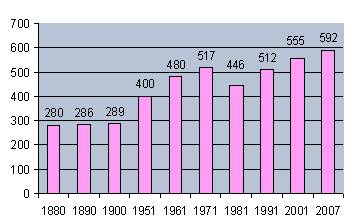
Demographic evolution
Colors= id:lightgrey value:gray(0.9) id:darkgrey value:gray(0.8) id:sfondo value:rgb(1,1,1) id:barra value:rgb(0.6,0.7,0.8)
ImageSize = width:455 height:303 PlotArea = left:50 bottom:50 top:30 right:30 DateFormat = x.y Period = from:0 till:3000 TimeAxis = orientation:vertical AlignBars = justify ScaleMajor = gridcolor:darkgrey increment:1000 start:0 ScaleMinor = gridcolor:lightgrey increment:200 start:0 BackgroundColors = canvas:sfondo
BarData= bar:1861 text:1861 bar:1871 text:1871 bar:1881 text:1881 bar:1901 text:1901 bar:1911 text:1911 bar:1921 text:1921 bar:1931 text:1931 bar:1936 text:1936 bar:1951 text:1951 bar:1961 text:1961 bar:1971 text:1971 bar:1981 text:1981 bar:1991 text:1991 bar:2001 text:2001
PlotData= color:barra width:20 align:left
bar:1861 from: 0 till:0 bar:1871 from: 0 till:0 bar:1881 from: 0 till:0 bar:1901 from: 0 till:0 bar:1911 from: 0 till:0 bar:1921 from: 0 till:1479 bar:1931 from: 0 till:1594 bar:1936 from: 0 till:1696 bar:1951 from: 0 till:1750 bar:1961 from: 0 till:1948 bar:1971 from: 0 till:2198 bar:1981 from: 0 till:2410 bar:1991 from: 0 till:2476 bar:2001 from: 0 till:2641
PlotData=
bar:1861 at:0 fontsize:XS text: ? shift:(-8,5) bar:1871 at:0 fontsize:XS text: ? shift:(-8,5) bar:1881 at:0 fontsize:XS text: ? shift:(-8,5) bar:1901 at:0 fontsize:XS text: ? shift:(-8,5) bar:1911 at:0 fontsize:XS text: ? shift:(-8,5) bar:1921 at:1479 fontsize:XS text: 1479 shift:(-8,5) bar:1931 at:1594 fontsize:XS text: 1594 shift:(-8,5) bar:1936 at:1696 fontsize:XS text: 1696 shift:(-8,5) bar:1951 at:1750 fontsize:XS text: 1750 shift:(-8,5) bar:1961 at:1948 fontsize:XS text: 1948 shift:(-8,5) bar:1971 at:2198 fontsize:XS text: 2198 shift:(-8,5) bar:1981 at:2410 fontsize:XS text: 2410 shift:(-8,5) bar:1991 at:2476 fontsize:XS text: 2476 shift:(-8,5) bar:2001 at:2641 fontsize:XS text: 2641 shift:(-8,5)
TextData= fontsize:S pos:(20,20) text:Data from ISTAT
Demographic evolution
Source:
St. Sigmund
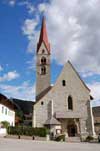
St. Sigmund is a frazione of Kiens, its origins date back to 1050, when first it was called Burin and after Peuren, in 1317.
The town is located where the valley widens into a large flat area, for that reason it enjoys excellent weather conditions throughout the year.
From an architectural point of view, the buildings in the area are based on original South Tyrolean farmsteads style. Especially is notable the parish church (1449–89), where is present the oldest and best preserved altar in Tyrol, dated around 1430. Another point of interest is the Church of Our Lady () dating back to 1621 and built in Baroque style. Behind the railway station, in the river Rienz, there are the Ilstern thermal baths (German: Bad Ilstern), which once featured facilities for cures. Also in this area is the church of St. Ulrich that dates back to 1491 and is well preserved.
References
References
- Overall demographics and other statistics: [[National Institute of Statistics (Italy). Italian National Institute of Statistics]] (ISTAT).
- (2009). "Tiroler Urkundenbuch, II. Abteilung: Die Urkunden zur Geschichte des Inn-, Eisack- und Pustertals. Vol. 1: Bis zum Jahr 1140". Universitätsverlag Wagner.
- [http://www.ngw.nl/int/ita/k/kiens.htm Heraldry of the World: Kiens]
- (December 2024). "Ergebnisse Sprachgruppenzählung 2024/Risultati Censimento linguistico 2024". Provincial Statistics Institute of the Autonomous Province of South Tyrol.
- Data from the Municipality of Kiens.
This article was imported from Wikipedia and is available under the Creative Commons Attribution-ShareAlike 4.0 License. Content has been adapted to SurfDoc format. Original contributors can be found on the article history page.
Ask Mako anything about Kiens — get instant answers, deeper analysis, and related topics.
Research with MakoFree with your Surf account
Create a free account to save articles, ask Mako questions, and organize your research.
Sign up freeThis content may have been generated or modified by AI. CloudSurf Software LLC is not responsible for the accuracy, completeness, or reliability of AI-generated content. Always verify important information from primary sources.
Report