From Surf Wiki (app.surf) — the open knowledge base
Kibbeh
Arab and Levantine dish of ground meat and bulgur
Arab and Levantine dish of ground meat and bulgur
| Field | Value |
|---|---|
| name | Kibbeh |
| image | Kibbeh3.jpg |
| image_size | 230px |
| caption | Fried *kibbeh raas* (*nabulsi kibbeh*) |
| country | Syria, Egypt, Iraq, Jordan, Armenia, Lebanon, Israel, Palestine, Turkey |
| region | Levant, Mesopotamia, Caucasus, East Mediterranean |
| course | Meze |
| served | Hot (or raw as *kibbeh nayyeh*) |
| main_ingredient | Finely ground meat, cracked wheat (bulgur), and Levantine spices |
Kibbeh (, also kubba and other spellings; ; ) is a popular dish in the Arab world and the Levant in particular, made of spiced lean ground meat and bulgur wheat. Kibbeh is considered to be a national dish of Lebanon and Syria.
In Levantine cuisine, kibbeh is made by pounding bulgur wheat together with meat into a fine paste and forming it into ovoid shapes, with toasted pine nuts and spices. It may also be layered and cooked on a tray, deep-fried, grilled, or served raw. The Syrian city of Aleppo can lay claim to at least 17 types of kibbeh. In Mesopotamian cuisine, versions with rice or farina are found.
Outside of Lebanon and Syria, versions are found in Cyprus, Egypt, Israel, Palestine, the Persian Gulf, Armenia, and Turkey, It is also found throughout Latin American countries that received substantial numbers of immigrants from the Levant during the late 19th and early 20th centuries, as well as parts of North America.
Etymology
The modern word kibbeh (كبة) is derived from the Arabic root k-b-b (ك-ب-ب).
The use of kubbeh to designate stuffed food may have also been derived from the Akkadian language kubbu. The word kubbeh itself appeared in ancient Biblical texts, meaning "tent" or "tarp". Later on the word took on a new meaning in Aramaic as kababa, which means "a covering".
The 10th century cookbook by Ibn Sayyar al-Warraq referred to meatballs as kubab (singular kubba).
History
As noted by food historian Nawal Nasrallah, the earliest mention of modern kibbeh, made with a filled shell of ground meat and grains, is in the 18th century work Taj al-'Arus min Jawahir al-Qamus. The text describes it as a disk of ground meat and rice flour made by the people of "al-Sham" (the Levant).
American Methodist missionary William McClure Thomson noted in his memoirs during his 1847 visit to Lebanon that kibbeh, then made by crushing wheat in mortar and pestle, was very popular. He described it as "the national dish of the Arabs", despite its association with the Levant. Swedish Orientalist described 8 types of kibbeh in his 1844 dictionary, and also mentioned a proverb about its social importance: "[...], without our koubbé, we would all have died". |trans-title=A French-Arabic guide for travelers and Franks in Syria and Egypt: with a physical and geographical map of Syria and a geometric plan of ancient and modern Jerusalem, as a supplement to travels in the Orient |access-date=24 Jan 2026
The 1885 Beirut cookbook Ustadh al-Tabbakhin by author provided 15 kibbeh recipes, including recipes for kibbeh labaniyyeh, kiyyeh bil siniyyeh, kibbeh mashwiyyeh, among others. The Comparative Encyclopedia of Aleppo by Syrian author Khayr al-Din al-Asadi (completed in 1971, published posthumously in 1981) described 58 different kinds of kibbeh.
Variations
Levant
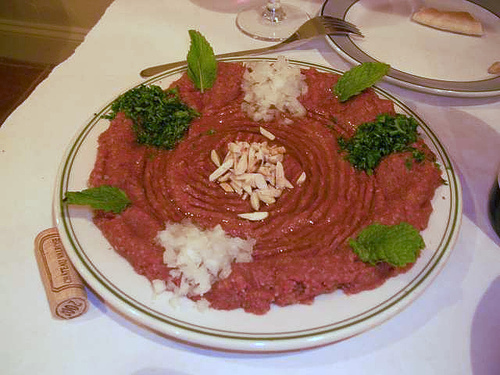
Kibbeh nayyeh is a raw dish made from a mixture of bulgur, very finely minced lamb or beef similar to steak tartare, and Levantine spices, served on a platter, frequently as part of a meze in Lebanon and Syria, garnished with mint leaves and olive oil, and served with green onions or scallions, green hot peppers, and pita or markouk bread. Because kibbeh nayyeh is raw, it requires high-quality meat to prepare and has been seen as a traditional way to honor guests.

Kibbeh labaniyeh () is a variant of kibbeh cooked in a yoghurt sauce and served over rice. It is popular in Lebanon and Syria. kibbeh mishwiyyeh () is kibbeh that is grilled rather than fried.
Kibbeh bil siniyeh () is a variation of kibbeh in which the meat stuffing is sandwiched between two layers of kibbeh dough and then baked; it is popular in Lebanon and Syria.

Lebanon
In Lebanon, meatless versions of kibbeh exist, and are sometimes called "poor man's kibbe". The stuffing is made with onions, walnuts, and wheat. Kibbet samak, made using fish, is popular among Sunni Muslims in North Lebanon.
Potato kibbeh is a variation of kibbeh in which potato is mixed with the bulgur. It is often assembled in three layers: a potato layer, followed by the meat filling, then another potato layer on top. Author Claudia Roden describes it as an "oriental shepherd's pie." It is especially popular in Lebanon.
Syria
The city of Aleppo, Syria, is known for its many varieties of kibbe. These include kibbeh prepared with sumac (kibbe sumāqiyye), yogurt (kibbe labaniyye), quince (kibbe safarjaliyye), lemon juice (kibbe ḥāmḍa), pomegranate sauce (kibbeh rummaniyeh), cherry sauce, and other varieties, such as "disk" kibbeh (kibbe arāṣ), "plate" kibbeh (kibbe biṣfīḥa or kibbe bṣēniyye) and raw kibbeh (kibbeh nayyeh). Kibbeh sajiyeh () is kibbeh shaped into a thin disk with a meat filling that is traditionally dipped in a yogurt sauce.
A Syrian soup known as kubbi kishk consists of kubbi ("torpedoes" or "footballs") in a yogurt (kishk) and butter broth with stewed cabbage leaves. Another soup, known as kibbeh hamda, consists of chicken stock with vegetables (usually leeks, celery, turnips and courgettes), lemon juice and garlic, with small kibbeh made with ground rice as dumplings. In the Syrian Jewish diaspora this dish is popular both for Pesach and as the pre-fast meal on the day before Yom Kippur.
Iraq

Kubba Mosul from Iraq is flat and round like a disc, named after the city of Mosul. Kubbat shorba is an Iraqi and Kurdish version prepared as a stew, commonly made with turnips and chard in a tomato-based stew. It is often served with arak and various salads.
Among Kurdish Jews, there is a kubba soup flavored with aromatic thyme leaves during winter.
Turkey
In Turkey, kibbeh is called içli köfte.
Several variants of içli köfte are protected as geographical indications by the Turkish Patent and Trademark Office:
- The Adana variety of içli köfte. It is a grilled, skewer-cooked form of içli köfte.
- Malatya içli köftesi is a bulgur meatball that is boiled rather than fried.
- Polat içli köftesi is a boiled bulgur meatball with beef and onion filling.
Egypt
In Egypt, kibbeh is referred to as kobeba (). Seafood variations of kobeba exist, such as shrimp kobeba, popular in Port Said.
Latin America
Brazil
In the Brazilian state of Acre, a variation of quibe called quibe de arroz (rice kibbeh) is made with a rice flour breading. It was created by Arab immigrants to Brazil who had no access to wheat in the remote Amazon region of Brazil.
Colombia
On Colombia's Caribbean coast, most local variations of the dish use ground beef instead of lamb, but the original recipe, or one with a mixture of beef and lamb, can be found served by the large Lebanese and Syrian population of the area. The dish has acquired almost vernacular presence and is frequently served in social occasions at both Arab and non-Arab households. When served as an adopted local dish, it is offered often as a starter along with other regional specialties, including empanadas, deditos and carimañolas.
Dominican Republic
The Dominican version was brought to the Dominican Republic by Lebanese immigrants.
Mexico
Some regional Syrian and Lebanese dishes combine kibbeh with elements taken from Latin American cuisine; for example, it is typical of Syrian Mexicans to eat traditional kibbeh with salsa verde.
Culture
Kibbeh is considered by many to be a difficult dish to prepare, and as such, the quality of kibbeh is considered to be a benchmark for the skill of a cook in Iraq and the Levant.
References
ku:Kutilk
References
- (2011-09-13). "Top 10 National Dishes -- National Geographic".
- George, Maria. ''Mediterranean Cuisine: Flavors for a Healthier You'', Christian Faith Publishing, Inc. 2019, Page 301
- (17 November 2010). "Encyclopedia of Jewish Food". HMH.
- Perry, Charles. (2014). "The Oxford Companion to Food". Oxford University Press.
- (2000). "Arab Detroit: From Margin to Mainstream". Wayne State University Press.
- (4 October 2018). "Feast: Food of the Islamic World". Bloomsbury Publishing.
- Perry, Charles PerryCharles. (2006). "kibbeh". Oxford University Press.
- Khalaf, Hala. (2018-08-09). "A guide to kibbeh".
- Annia Ciezadlo. (2012). "Day of Honey: A Memoir of Food, Love, and War". Simon and Schuster.
- Edelstein, Sari. (2010). "Food, Cuisine, and Cultural Competency for Culinary, Hospitality, and Nutrition Professionals". Jones & Bartlett Publishers.
- (6 October 2020). "Meatballs: The Ultimate Cookbook". Simon and Schuster.
- "Kibbe at the Crossroads: A Lebanese Kitchen Story".
- "تعريف و شرح و معنى كبة بالعربي في معاجم اللغة العربية معجم المعاني الجامع1".
- (1927). "Supplément aux dictionnaires arabes, par R. Dozy. T. 1, 2. 2e édition. Tome 2,Edition 2".
- hersh. (2023-09-19). "Kubbeh, Kibbeh and Kebabs: What's In A Name?".
- (2013). "Delights from the Garden of Eden: A Cookbook and History of the Iraqi Cuisine". Equinox Pub..
- "Chapter 8 - Sidon - William M. Thomson (#103253) - Bible Truth Library".
- (8 December 2021). "Making Levantine Cuisine: Modern Foodways of the Eastern Mediterranean". University of Texas Press.
- (5 December 2024). "Recipe Corner: Lebanese & Syrian Meat and Bulgur Balls in Yoghurt (Kibbeh Labaniyya)". The Armenian Mirror-Spectator.
- (1 January 2024). "Kibbeh labaniyeh: Lebanese meatballs to start a new year". BBC.
- (26 March 2025). "Eid al-Fitr conjures up my fondest childhood memories". [[NJ.com]].
- (19 August 2013). "Aleppo's Kitchen: For rarely found Syrian specialties". Los Angeles Times.
- (17 Dec 2020). "Kibbeh Bil Sanieh".
- (3 April 2023). "أطباق رمضان بما تيسّر...". Sawt Beirut.
- (10 Oct 2015). "تعرّف إلى كبّة "أبو آمنة" أو "كبّة الفقير" في عكار". Annahar.
- (3 Jul 2022). "كبّة البطاطا... ابتكار لا يّقاوم". [[An-Nahar]].
- (10 Apr 2019). "المطبخ اللبناني.. أكلات شهية "تغذي" ترتيبه عالميًا". [[Anadolu Agency]].
- (5 Jan 2010). "NPR web: Food Lovers Discover The Joys Of Aleppo".
- "طريقة عمل السماقية الفلسطينية والحلبية بخطوات بسيطة". E7kky.
- (5 May 2021). ""وجبات حلب العريقة" على موائد المحتاجين". The New Arab.
- (22 March 2018). "A New Book of Middle Eastern Food: The Essential Guide to Middle Eastern Cooking. As Heard on BBC Radio 4". Penguin Books Limited.
- (25 Nov 2018). "تعرف على أنواع الكبة الحلبية". [[Asharq Al-Awsat]].
- (11 July 2014). "زهرة الخليج - الشيف محمد أورفه لي يستذكر رمضان وأكلاته في حلب".
- (27 Jul 2015). "كبة صاجية على الطريقة السورية". Al-Wasat.
- Roden, Claudia. (March 1974). "A Book of Middle Eastern Food". [[Random House]] - Vintage Books.
- Poopa Dweck. (2011). "Aromas of Aleppo". Harper Collins.
- (27 May 2024). "كبة حلب العراقية.. هناك أسباب وراء تسميتها". [[Ultrasawt]].
- "An Iraqi-Kurdish-Israeli Dumpling Soup Makes Its Way To America".
- [https://www.ynet.co.il/articles/0,7340,L-3507657,00.html אדוני רוצה עוד קובה? הצצה למטבח הכורדי]
- (June 12, 2021). "Mangal ateşi Adana'nın tescilli içli köftesine lezzet kattı". Anadolu Agency.
- "Coğrafi İşaret Platformu".
- (25 June 2019). "Ağız sulandıran lezzet 'mangalda içli köfte' yoğun ilgi görüyor - Güncel Haberler Son Dakika". CNN TÜRK.
- (25 Jun 2019). "Mangalda içli köfte ilgi görüyor {{!}} Aktüel Haberleri". Yeni Şafak.
- (14 September 2021). "Tescilli Malatya İçli Köftesi Türkiye'nin dört bir yanına ulaştırılacak". TRT Haber.
- "Malatya İçli Köftesi".
- "Polat İçli Köftesi / Polat Köftesi".
- (19 Jan 2023). "Polat İçli Köftesi Tescil Edildi". malatyagazetecilercemiyeti.
- (14 June 2018). "Beef and cracked wheat slice (kobeba)". [[SBS Food]].
- ""كبيبة الجمبري".. أسرار أشهر الأكلات البورسعيدية- صور". [[Masrawy]].
- (9 July 2021). "طريقة عمل كبيبة الجمبري.. أشهى الأكلات البورسعيدية". El-Wattan News.
- (2022-07-19). "Lebanese Brazilian Food: Fried Kibbeh". [[Texas de Brazil]].
- Menezes, Gabrielli. (2021-06-14). "Culinária do Acre esbanja identidade e orgulho em cada prato; conheça". [[Universo Online.
- Hourani, Albert. ''The Lebanese and the World A Century of Emigration'', University of Virginia, 1992, Page 365
- Cepeda, María Elena. "Musical imagiNation : U.S.-Colombian identity and the Latin music boom".
- (28 October 2013). "Food and Drink in American History: A "Full Course" Encyclopedia [3 Volumes]". Bloomsbury Publishing USA.
- (7 February 2019). "Taste, Politics, and Identities in Mexican Food". Bloomsbury Publishing.
- (20 Jan 2023). "This Soup Is Yotam Ottolenghi’s Comfort Food". The New York Times Magazine.
This article was imported from Wikipedia and is available under the Creative Commons Attribution-ShareAlike 4.0 License. Content has been adapted to SurfDoc format. Original contributors can be found on the article history page.
Ask Mako anything about Kibbeh — get instant answers, deeper analysis, and related topics.
Research with MakoFree with your Surf account
Create a free account to save articles, ask Mako questions, and organize your research.
Sign up freeThis content may have been generated or modified by AI. CloudSurf Software LLC is not responsible for the accuracy, completeness, or reliability of AI-generated content. Always verify important information from primary sources.
Report