From Surf Wiki (app.surf) — the open knowledge base
Khartoum
Capital of Sudan
Capital of Sudan
| Field | Value |
|---|---|
| official_name | Khartoum |
| native_name | الخرطوم |
| native_name_lang | ar |
| nickname | "Triangular Capital" |
| settlement_type | Capital city |
| image_skyline | {{multiple image |
| border | infobox |
| perrow | 1/2/2 |
| total_width | 300 |
| align | center |
| image1 | ©Nile-Project -Sari Omer 0025.jpg |
| caption1 | Night view of Khartoum and of the White Nile |
| image2 | Khartoum Mosque.jpg |
| caption2 | Khartoum Mosque |
| image3 | University of Khartoum 001.JPG |
| caption3 | University of Khartoum |
| image4 | Elmek Nimir Bridge.jpg |
| caption4 | El Mek Nimr Bridge |
| image_seal | Khartoum locality.png |
| map_caption | Khartoum's location in Sudan |
| pushpin_map | Sudan#Africa |
| pushpin_label_position | bottom |
| pushpin_relief | yes |
| pushpin_map_caption | Location in Sudan and Africa |
| subdivision_type | Country |
| subdivision_name | Sudan |
| subdivision_type1 | State |
| subdivision_name1 | Khartoum |
| leader_title | Mayor |
| area_footnotes | |
| area_total_km2 | 322.7 |
| area_urban_footnotes | |
| area_urban_km2 | 1031 |
| elevation_footnotes | |
| elevation_m | 381 |
| population_density_km2 | auto |
| population_footnotes | |
| population_as_of | 2025 est. |
| population_total | 1,974,647 |
| population_rank | 1st |
| population_urban | 7,155,000 (est. 2023) |
| population_density_urban_km2 | auto |
| population_demonyms | Khartoumese, Khartoumian (the latter more properly designates a Mesolithic archaeological stratum) |
| timezone | CAT |
| utc_offset | +02:00 |
| coordinates | |
| coordinates_footnotes |
Khartoum, also spelled Khartum, is the capital city of Sudan as well as Khartoum State. With an estimated population of 7.1 million people, Greater Khartoum is the largest urban area in Sudan.
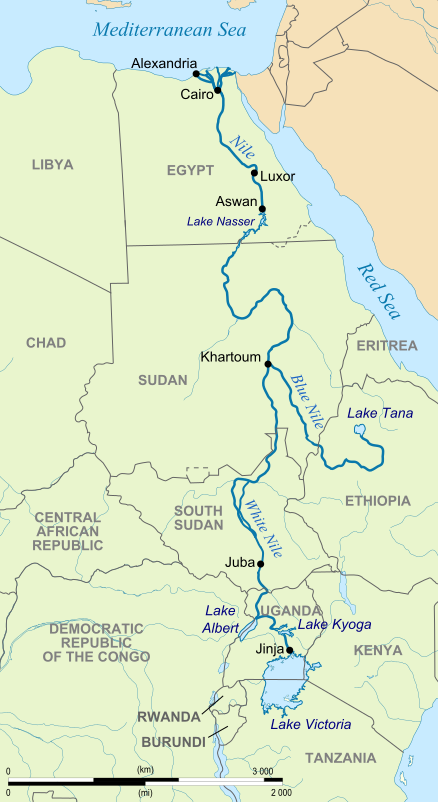
Khartoum is located at the confluence of the White Nile – flowing north from Lake Victoria – and the Blue Nile, flowing west from Lake Tana in Ethiopia. Divided by these two parts of the Nile, the Khartoum metropolitan area is a tripartite metropolis consisting of Khartoum proper and linked by bridges to Khartoum North (الخرطوم بحري ar) and Omdurman (أم درمان ar) to the west. The place where the two Niles meet is known as al-Mogran or al-Muqran (المقرن; English: "The Confluence").
Khartoum was founded in 1821 by Muhammad Ali Pasha, north of the ancient city of Soba. In 1882 the British Empire took control of the Egyptian government, leaving the administration of Sudan in the hands of the Egyptians. At the outbreak of the Mahdist War, the British attempted to evacuate Anglo-Egyptian garrisons from Sudan but the Siege of Khartoum in 1884 resulted in the capture of the city by Mahdist forces and a massacre of the defending Anglo-Egyptian garrison. In 1898 it was reoccupied by British forces and was the seat of Anglo-Egyptian Sudan's government until 1956.
In 1956, the city was designated as the capital of an independent Sudan. Three hostages were killed during the attack on the Saudi Embassy in Khartoum in 1973.
In 2008, the Justice and Equality Movement engaged in combat in the city with the Sudanese Armed Forces as part of the War in Darfur. The Khartoum massacre occurred in 2019 during the Sudanese Revolution. Between 2023 and 2025, the city saw extensive combat during the civil war involving the armed forces and the Rapid Support Forces (RSF), affecting Khartoum International Airport and other critical sites. In 2025, the Sudanese armed forces recaptured Khartoum from the RSF, leaving widespread destruction.
Khartoum is an economic and trade center in North Africa, with rail lines from Port Sudan and El-Obeid. It is served by Khartoum International Airport with the New Khartoum International Airport under construction. Several national and cultural institutions are in Khartoum and its metropolitan area, including the National Museum of Sudan, the Khalifa House Museum, the University of Khartoum, and the Sudan University of Science and Technology.
Etymology
The origin of the word Khartoum is uncertain. Some Scholars posit that the name derives from the Dinka words khar-tuom (Dinka-Bor dialect) or khier-tuom (as is the pronunciation in various Dinka dialects), translating to "place where rivers meet". This is supported by historical accounts which place the Dinka homeland in central Sudan (around present-day Khartoum) as recently as the 13th-17th centuries A.D.
One folk etymology is that it is derived from Arabic ar (خرطوم or ), probably referring to the narrow strip of land extending between the Blue and White Niles.
Captain J.A. Grant, who reached Khartoum in 1863 with Captain Speke's expedition, thought the name was most probably from the Arabic ar (قرطم , i.e., Carthamus tinctorius), which was cultivated extensively in Egypt for its oil to be used as fuel. Some scholars speculate that the word derives from the Nubian word nub, meaning "the abode of Atum", Atum being the Nubian and Egyptian god of creation. Other Beja scholars suggest Khartoum is derived from the Beja word hartoom, "meeting". Sociologist Vincent J. Donovan notes that in the Nilotic Maa language of the Maasai people, khartoum means "we have acquired" and that the geographical location of Khartoum is where Maasai oral tradition claims that the ancestors of the Maasai first acquired cattle.
History
19th century
In 1821, Khartoum was established 15 mi north of the ancient city of Soba, by Isma'il Kamil Pasha, the third son of Egypt's ruler, Muhammad Ali Pasha, who had just incorporated Sudan into his realm. Originally, Khartoum served as an outpost for the Egyptian Army. Egypt shifted the seat of the colonial government from Wad Madani to Khartoum in 1823, which became a permanent settlement and underwent rapid development in the next decades. With its elevation to capital status, Khartoum quickly grew into a regional center of trade, serving as a rest area on the caravan route from Ethiopia to Egypt, but also becoming a major focal point for the slave trade.
A significant change took place in 1854, when most of the city was destroyed by heavy rains and floods. It was rebuilt with houses made out of mud and stones, replacing those made out of thatch and straw. Khartoum also became the seat of several European consulates and the Apostolic Vicariate of Central Africa. European pressure and influence forced Egypt to close the city's public slave market in 1854, although slaves continued to be sold and trafficked in large numbers, specifically from the Blue Nile region and the Nuba Mountains, as well as down the White Nile (the Dinka and Shilluk territories). According to the British explorer Samuel Baker, who visited Khartoum in 1862, slavery was the industry "that kept Khartoum going as a bustling town".
On 13 March 1884, troops loyal to the Mahdi Muhammad Ahmad began the siege of Khartoum against the Egyptian garrison led by the British General Charles George Gordon. Despite being fortified by trenches and a wall connecting the Blue and White Niles, the city was conquered by the Mahdists on 26 January 1885 and the entire garrison was annihilated. Many of the inhabitants were massacred or enslaved and the survivors were deported to the newly established Omdurman, while Khartoum was largely destroyed and abandoned.
With the reconquest of Sudan by Anglo-Egyptian forces in 1898, Khartoum was established as the capital of Anglo-Egyptian Sudan. Herbert Kitchener became Governor-General of the Sudan in September 1898, and began a programme of reconstruction, Khartoum was rebuilt according to a street plan in the shape of the Union Jack. Khartoum Bahri was established as a garrison comprising a dockyard and a railhead to Egypt, while Omdurman, remained the most populous part and largely kept its old shape. Kitchener ordered the mosques of Khartoum rebuilt and guaranteed freedom of religion to all citizens. He also prevented Christian missionaries from trying to proselytize the local Muslims.Britannica, Khartoum , britannica.com, USA, accessed on 30 June 2019
20th century
_b_617.jpg)
The city rapidly grew and developed under British administration. Under Reginald Wingate (1899–1916), the Governor-General's Palace in Khartoum was rebuilt using red bricks, with sandstone used for the corners. The buildings in Khartoum proper were modeled after Victorian architecture, with a distinct Middle Eastern influence as well as Mediterranean-style windows and balconies. The Gordon Memorial College (now the University of Khartoum) was opened in 1903, and a new railway to Port Sudan was completed in 1919. These developments prompted large migration from rural areas, resulting in an increase in the city's population. By 1930, Khartoum was estimated to have a population of over 50,000. Khartoum continued to grow after it was declared the capital of the newly independent Republic of Sudan in 1956. Within the following years, the Municipal Stadium, the Khartoum American School and the Bank of Sudan would be established. This large scale development would spurred rural to urban migration, by 1964 Khartoum's population had ballooned to 185,000. In the 1973 census Khartoum would have a population of 334,000 inhabitants.
In 1973, the city was the site of a hostage crisis in which members of Black September held 10 hostages at the Saudi Arabian embassy, five of them diplomats. The US ambassador, the US deputy ambassador, and the Belgian chargé d'affaires were murdered. The remaining hostages were released. A 1973 United States Department of State document, declassified in 2006, concluded: "The Khartoum operation was planned and carried out with the full knowledge and personal approval of Yasser Arafat."
In 1977, the first oil pipeline between Khartoum and Port Sudan was completed. The Organization of African Unity summit of 18–22 July 1978 was held in Khartoum, during which Sudan was awarded the OAU presidency.

Throughout the 1970s and 1980s, Khartoum was the destination of hundreds of thousands of refugees fleeing conflicts in neighboring nations such as Chad, Eritrea, Ethiopia and Uganda. Many Eritrean and Ethiopian refugees assimilated into society, while others settled in large slums on the city's outskirts. Since the mid-1980s, large numbers of refugees from South Sudan and Darfur – fleeing the violence of the Second Sudanese Civil War and Darfur conflict – have settled around Khartoum.
In 1991, Osama bin Laden purchased a house in the affluent al-Riyadh neighborhood of the city and another in Soba. He lived there until 1996, when he was banished from the country. Following the 1998 U.S. embassy bombings, the United States accused bin Laden's al-Qaeda group and, on 20 August, launched cruise missile attacks on the al-Shifa pharmaceutical factory in Khartoum North. The factory's destruction created diplomatic tension between the U.S. and Sudan. The factory ruins are now a tourist attraction.
In November 1991, the government of President Omar al-Bashir sought to remove half the population from the city. The residents, deemed squatters, were mostly southern Sudanese whom the government feared could be potential rebel sympathizers. Around 425,000 people were placed in five "Peace Camps" in the desert an hour's drive from Khartoum. The camps were watched over by heavily armed security guards, many relief agencies were banned from assisting, and "the nearest food was at a market four miles away, a vast journey in the desert heat". Many residents were reduced to having only burlap sacks as housing. The intentional displacement was part of a large urban renewal plan backed by the housing minister, Sharaf Bannaga.

21st century
The sudden death of SPLA head and vice-president of Sudan John Garang in late July 2005, was followed by three days of violent riots in the capital. Order was finally restored after southern Sudanese politicians and tribal leaders sent strong messages to the rioters. The death toll was at least 24, as youths from southern Sudan attacked northern Sudanese and clashed with security forces.
The African Union summit of 16–24 January 2006 was held in Khartoum; as was the Arab League summit of 28–29 March 2006, during which they elected Sudan the Arab League presidency.
On 10 May 2008, the Darfur rebel group Justice and Equality Movement attacked the city with the goal of toppling Omar al-Bashir's government. The Sudanese government held off the assault.
On 23 October 2012, an explosion at the Yarmouk munitions factory killed two people and injured another person. The Sudanese government claimed that the explosion was the result of an Israeli airstrike.
On 3 June 2019, Khartoum was the site of the Khartoum massacre, where over 100 dissidents were murdered (the government said 61 were killed), hundreds more injured and 70 women raped by Rapid Support Forces (RSF) soldiers in order to forcefully disperse the peaceful protests calling for a civilian government.
On 1 July 2020, activists demanded that al-Zibar Basha street in Khartoum be renamed. Al-Zubayr Rahma Mansur was a slave trader and the al-Zibar Basha street leads to the military base where the 2019 Khartoum massacre took place.
On 26 October 2021, the city was locked down following a military coup that left at least 7 dead, triggering protests and calls for a general strike. Prime minister Abdalla Hamdok was arrested during the coup, and held along with other cabinet members in an unknown location.
On 15 April 2023, fighting between the Sudanese Armed Forces and the RSF broke out across Sudan, including in Khartoum. Fighting was reported at the presidential palace, the RSF's headquarters, Khartoum International Airport and Merowe Airport, which the RSF claimed to have captured. The Sudanese Armed Forces regained full control of Khartoum on 26 March 2025.
Geography
Location
Khartoum is located at the confluence of the Blue Nile and the White Nile.
Khartoum is relatively flat, at elevation 385 m, as the Nile flows northeast past Omdurman to Shendi, at elevation 364 m about 163 km away.
Climate
Khartoum features a hot desert climate (Köppen climate classification BWh) with a dry season occurring during winter, typical of the Saharo-Sahelian zone, which marks the progressive passage between the Sahara Desert's vast arid areas and the Sahel's vast semi-arid areas. The climate is extremely dry for most of the year, with about eight months when average rainfall is lower than 5 mm. The very long dry season is itself divided into a warm, very dry season between November and February, as well as a very hot, dry season between March and May. During this part of the year, hot, dry continental trade winds from deserts, such as the harmattan, sweep over the region; the weather is stable and very dry.
The very irregular, very brief, rainy season lasts about 1 month as the maximum rainfall is recorded in August, with about 48 mm. The rainy season is characterized by a seasonal reverse of wind regimes, when the Intertropical Convergence Zone goes northerly. Average annual rainfall is very low, with only 121.3 mm of precipitation. Khartoum records on average six days with 10 mm or more and 19 days with 1 mm or more of rainfall. The highest temperatures occur during two periods in the year: the first at the late dry season, when average high temperatures consistently exceed 40 C from April to June, and the second at the early dry season, when average high temperatures exceed 39 C in September and October. Temperatures cool off somewhat during the night, with Khartoum's lowest average low temperature of the year, in January, just above 15 C. Khartoum is one of the hottest major cities on Earth, with annual mean temperatures hovering around 30 C. The city also has very warm winters. In no month does the average monthly high temperature fall below 30 C. This is something not seen in other major cities with hot desert climates, such as Riyadh, Baghdad and Phoenix. |Jan record high C = 42.7 |Feb record high C = 42.5 |Mar record high C = 45.6 |Apr record high C = 46.5 |May record high C = 47.5 |Jun record high C = 46.5 |Jul record high C = 44.7 |Aug record high C = 44.0 |Sep record high C = 45.3 |Oct record high C = 43.5 |Nov record high C = 41.5 |Dec record high C = 39.5 |year record high C = 47.5 |Jan record low C = 7.5 |Feb record low C = 8.4 |Mar record low C = 12.5 |Apr record low C = 16.0 |May record low C = 18.5 |Jun record low C = 20.2 |Jul record low C = 17.8 |Aug record low C = 18.0 |Sep record low C = 17.7 |Oct record low C = 17.5 |Nov record low C = 14.5 |Dec record low C = 10.4 |year record low C = 7.5
Demographics
| Year | Population | City | Metropolitan area |
|---|---|---|---|
| 1859 | 30,000 | n.a. | |
| 1907 | 69,349 | n.a. | |
| 1956 | 93,100 | 245,800 | |
| 1973 | 333,906 | 748,300 | |
| 1983 | 476,218 | 1,340,646 | |
| 1993 | 947,483 | 2,919,773 | |
| 2008 Census Preliminary | 3,639,598 | 5,274,321 |
Almost 250,000 Syrians lived in Khartoum as of 2019, representing 5% of the total population of the city. Most are young men who have fled war in Syria. Sudan was the only country in the world to accept travelers carrying a Syrian passport who lacked a visa.
Economy
After the signing of the historic Comprehensive Peace Agreement between the Government of Sudan and the Sudan People's Liberation Movement (SPLA), the Government of Sudan began a massive development project. In 2007, the biggest projects in Khartoum were the Al-Mogran Development Project, two five-star hotels, a new airport, El Mek Nimr Bridge (finished in October 2007) and the Tuti Bridge that links Khartoum to Tuti Island.
In the 21st century, Khartoum developed based on Sudan's oil wealth (although the independence of South Sudan in 2011 affected the economy of Sudan negatively). The center of the city has tree-lined streets. Khartoum has the highest concentration of economic activity in the country. This has changed as major economic developments take place in other parts of the country, like oil exploration in the south, the Giad Industrial Complex in Al Jazirah state and White Nile Sugar Project in Central Sudan, and the Merowe Dam in the North.
Among the city's industries are printing, glass manufacturing, food processing, and textiles. Petroleum products are now produced in the far north of Khartoum state, providing fuel and jobs for the city. One of Sudan's largest refineries is located in northern Khartoum.
Retailing

The Souq al Arabi is Khartoum's largest open air market. The souq is spread over several blocks in the center of Khartoum proper just south of the Great Mosque (Mesjid al-Kabir) and the minibus station. It is divided into separate sections, including one focused entirely on gold.
Al Qasr Street and Al Jamhoriyah Street are considered the most famous high streets in Khartoum State.
Afra Mall is located in the southern suburb of Arkeweet. The Afra Mall has a supermarket, retail outlets, coffee shops, a bowling alley, movie theaters, and a children's playground.
In 2011, Sudan opened the Hotel Section and part of the food court of the new, Corinthia Hotel Tower. The Mall/Shopping section is still under construction.
Education
Main article: Education in Khartoum

Khartoum is the main location for most of Sudan's top educational bodies. There are four main levels of education:
- Kindergarten and day-care. It begins in the age of 3–4, consisting of 1-2 grades, (depending on the parents).
- Elementary school. The first grade pupils enter at the age of 6–7. It consists of 8 grades, after which, at 13–14 years old, students are ready to take the certificate exams and enter high school.
- Upper second school and high school. In these three the school methods add some main academic subjects such as chemistry, biology, physics, and geography. There are three grades in this level. The students' ages are about 14–15 to 17–18.
- Higher education. There are several universities and colleges in Khartoum, including the University of Khartoum and Sudan University of Science and Technology.
Transportation
Khartoum is home to the largest airport in Sudan, Khartoum International Airport. It is the main hub for Sudan Airways, Sudan's main carrier. A new airport was planned for the southern outskirts of the city, but with Khartoum's rapid growth and consequent urban sprawl, the airport is still located in the heart of the city.
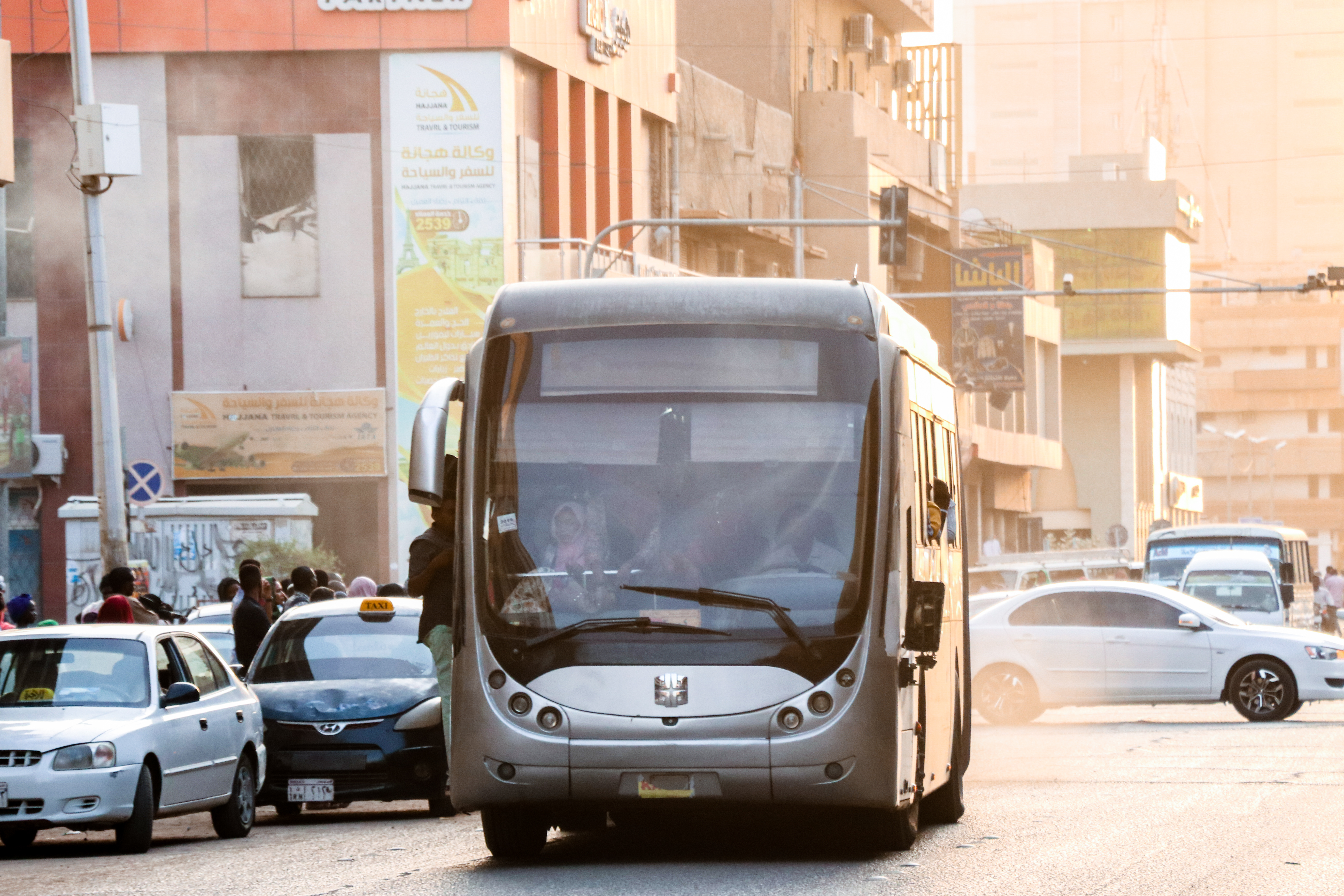
Khartoum's transportation is limited to the vehicular road system, with buses and personal vehicles comprising the main types of vehicles. As with many cities in the continent, parts of Khartoum are connected through privately owned buses.
Khartoum has a number of bridges across both tributaries of the Nile. The Mac Nimir Bridge, the Blue Nile Road & Railway Bridge, the Cooper Bridge (also known as the Armed Forces Bridge), and the Elmansheya Bridge span the Blue Nile, connecting Khartoum to Khartoum North. The Omdurman Bridge, the Victory Bridge, and the Al-Dabbasin Bridge span the White Nile, connecting Khartoum to Omdurman. The Tuti Bridge connects Tuti Island with Khartoum. Prior to the construction of the Tuti Bridge in 2008, residents of Tuti Island relied on water taxis to cross the Blue Nile into Khartoum.
Khartoum has rail lines from Wadi Halfa, Port Sudan on the Red Sea, and El Obeid. All are operated by Sudan Railways.
Architecture
The architecture of Khartoum reflects the city's history since the early 1820s and is marked by both native Sudanese, Turkish, British and modern buildings. In general, the architecture of Sudan reflects a wide diversity in its shapes, materials, and use.
Since independence, the people of Sudan have introduced new infrastructure and technology, which has led to new and innovative building concepts, ideas and construction techniques.
Culture
.jpg)
Museums
The largest museum in Sudan is the National Museum of Sudan. Founded in 1971, it contains works from different epochs of Sudanese history. Among the exhibits are two Egyptian temples of Buhen and Semna, originally built by Pharaoh Hatshepsut and Pharaoh Tuthmosis III, respectively, but relocated to Khartoum upon the flooding of Lake Nasser.
The Republican Palace Museum, opened in 2000, is located in the former Anglican All Saints' cathedral on Sharia al-Jama'a, next to the historical Presidential Palace.
The Ethnographic Museum is located on Sharia al-Jama'a, close to the Mac Nimir Bridge.
Botanical gardens
Khartoum is home to one of the oldest botanical gardens in Africa, National Botanical Garden in the Mogran district of the city.[[File:Jami el kebir,Khartum.jpg|thumb|Great Mosque]]
Clubs
Khartoum is home to several clubs, including the Blue Nile Sailing Club, social clubs such as the German Club, the Greek Club, the Coptic Club, the Syrian Club and the International Club, as well as football clubs Al Khartoum SC and Al Ahli Khartoum.
Places of worship
The places of worship in Khartoum primarily consist of Muslim mosques.Britannica, Sudan , britannica.com, USA, accessed on 7 July 2019 There are also Christian churches and temples: Coptic Orthodox Church, St. Matthew's Cathedral, Khartoum, Roman Catholic Archdiocese of Khartoum (Catholic Church), Sudan Interior Church (Baptist World Alliance), the Greek Orthodox Church of the Annunciation and Presbyterian Church in Sudan (World Communion of Reformed Churches).
In popular culture
Literature
Khartoum's unique history and cultural significance have inspired literary works that explore its past, present, and future. For example, in "Reading Khartoum", the city is depicted as a space shaped by movement, political instability, and socio-cultural changes, resulting in underlying layers of meanings and ambiguity. Arabic-written poetry also offers a personalized glimpse of the city, reflecting its distinct cultural appearance and setting it apart from other Arab and African cities.
Movies
- Song of Khartoum (1955)
- Khartoum (1966 film) (1966)
- Khartoum Offside (2019)
Notable people
- Sara Berkai, Eritrean and British social enterprise founder and STEM educator, born in Khartoum
References
Notes
Bibliography
References
- (2015). "Khartoum, Sudan - Population Trends and Demographics".
- (August 2023). "Demographia World Urban Areas". Demographia.
- (2 October 2015). "Where is Khartoum, The Sudan?".
- (2025). "Sudan Cities by Population 2025".
- "Khartoum".
- "Khartoum".
- (2021-10-01). "Khartoum - ACRC".
- (2021-10-01). "Khartoum - ACRC".
- "Khartoum {{!}} Location, Facts, & History".
- Leiro, Roberto. (2023-04-15). "Sudan's RSF Clashes with Army in Khartoum Airport".
- (1 April 2025). "BBC team reaches Khartoum and finds overwhelming destruction". BBC News.
- Room, Adrian. (2006). "Placenames of the World". McFarland.
- Beswick, Stephanie. (2013). "Sudan's Blood Memory: The Legacy of War, Ethnicity, and Slavery in Early South Sudan". University Rochester Press.
- (1935). "The Story of Khartoum". University of Khartoum.
- "Beja scholars and the creativity of powerlessness". University of Michigan Library.
- Shukri, Hasan. (August 1966). "Khartoum and Tuti 'Shreen Munz Qarnan". Khartoum.
- (1978). "Christianity Rediscovered: An Epistle from the Masai". Orbis Books.
- (2008). "Encyclopaedia Aethiopica: Volume 3: He-N".
- Roman Adrian Cybriwsky, ''Capital Cities around the World: An Encyclopedia of Geography, History, and Culture'', ABC-CLIO, USA, 2013, p. 139
- (2008). "Encyclopaedia Aethiopica: Volume 3: He-N".
- Jok, Madut Jok. (2001). "War and Slavery in Sudan". University of Pennsylvania Press.
- Hammond, Peter. (2005). "Slavery, Terrorism & Islam". Christian Liberty Books.
- (2003). "Encyclopaedia Aethiopica: D-Ha".
- (2008). "Encyclopaedia Aethiopica: Volume 3: He-N".
- "Historical dictionary of the Sudan".
- "Historical dictionary of the Sudan".
- "The Seizure of the Saudi Arabian Embassy in Khartoum".
- (1995). "Minerals Yearbook". Bureau of Mines.
- Harris, Gordon. (1994). "The Organization of African Unity". Transaction Publishers.
- Cybriwsky, Roman Adrian. (2013). "Capital Cities around the World: An Encyclopedia of Geography, History, and Culture". ABC-CLIO.
- Peterson, Scott. (2000). "Me against my brother : at war in Somalia, Sudan, and Rwanda : a journalist reports from the battlefields of Africa". Routledge.
- (1992-03-31). "Khartoum Squatters Forcibly Displaced". The Christian Science Monitor.
- Miller, Judith. (1992-03-09). "Sudan Is Undeterred in Drive to Expel Squatters". The New York Times.
- (1 August 2005). "World {{pipe}} Africa {{pipe}} Riots after Sudan VP Garang dies". BBC News.
- Staff. "Decisions & Declarations of the Assembly; African Union".
- Hiro, Dilip. (2013). "A Comprehensive Dictionary of the Middle East". Olive Branch Press.
- (10 May 2008). "Curfew in capital as Sudanese army clash near Khartoum with Darfur rebels". Sudan Tribune.
- (10 May 2008). "Sudanese rebels 'reach Khartoum'". BBC News.
- (10 May 2008). "PHOTOS: Sudan capital after today's attack from Darfur JEM". Sudan Tribune.
- (25 October 2012). "Khartoum fire blamed on Israeli bombing". Al Jazeera.
- (2019-07-13). "Sudanese protesters demand justice following mass killings". The Guardian.
- (2020-07-01). "'Decolonise and rename' streets of Uganda and Sudan, activists urge". The Guardian.
- "Sudan's capital locked down after coup triggers deadly unrest". The Irish Times.
- (26 March 2025). "Sudan army chief Abdel Fattah al-Burhan tours recaptured presidential palace in Khartoum".
- (2021-07-28). "The Khartoum-Omdurman conurbation: a growing megacity at the confluence of the Blue and White Nile Rivers". Journal of Maps.
- (2018). "Khartoum Elevation (385m)".
- (2018). "Shendi Elevation (364m)".
- Peel, M. C.. (2007). "Updated world map of the Köppen-Geiger climate classification". Hydrology and Earth System Sciences.
- "World Weather Information Service – Khartoum". World Meteorological Organization.
- "Khartoum Climate Normals 1961–1990". [[National Oceanic and Atmospheric Administration]].
- "Klimatafel von Khartoum / Sudan". Deutscher Wetterdienst.
- [[Theophilus Waldmeier. Waldmeier, Theophilus]] (1886) ''Ten Years in Abyssinia, and Sixteen Years in Syria, being the Autobiography of Theophilus Waldmeier.'' S.W. Partridge & Co, London. p.7
- {{cite EB1911
- (13 November 2019). "The New Lost Boys of Sudan".
- (5 September 2005). "Sudan and UNDP launch Millennium Goals project". [[Sudan Tribune]].
- Winter, Joseph. (24 April 2007). "Khartoum booms as Darfur burns". BBC.
- (2014-09-03). "Country Analysis Brief: Sudan and South Sudan".
- (2016-06-07). "Sudan Shopping and Districts (Sudan, SD, North-East Africa)". TravelSmart Ltd..
- "University of Khartoum".
- "Sudan University of Science and Technology".
- Bannaga, Sharaf Eldin Ibrahim. (April 11, 2018). "Revitalization of Greater Khartoum Urban Transportation System". Future Cities and Environment.
- (November 17, 2019). "Public transport crisis bothers citizens in Sudan's capital".
- "Archnet".
- Shumba, Ano. (2015-10-28). "Sudan National Museum; Bio".
- (2017). "The Rescue of Nubian Monuments and Sites".
- (2016). "Palace Museum".
- (2017). "Designs for the Cathedral Church of All Saints, Khartoum...".
- "Museums in Sudan".
- Jibreel, T. J. O.. (2010). "Two Ichneumonid Parasitoid Wasps Affecting Ficus sycamorus (L.) Fruits in Khartoum State (Thesis)". University of Khartoum department of Zoology.
- Uloth, Tony. (2011-01-18). "The Blue Nile Sailing Club".
- (2009-02-09). "Reuters.com". Africa.reuters.com.
- (2014-12-17). "Former Ghana coach Kwesi Appiah takes over at SC Khartoum". BBC Sport.
- (May 2017). "Al Ahli Khartoum".
- "::مساجد السودان::".
- Wanni, Nada Hussein. (2005). "Reading Khartoum". Politique Africaine.
- "Technology and Maths geniuses".
This article was imported from Wikipedia and is available under the Creative Commons Attribution-ShareAlike 4.0 License. Content has been adapted to SurfDoc format. Original contributors can be found on the article history page.
Ask Mako anything about Khartoum — get instant answers, deeper analysis, and related topics.
Research with MakoFree with your Surf account
Create a free account to save articles, ask Mako questions, and organize your research.
Sign up freeThis content may have been generated or modified by AI. CloudSurf Software LLC is not responsible for the accuracy, completeness, or reliability of AI-generated content. Always verify important information from primary sources.
Report