From Surf Wiki (app.surf) — the open knowledge base
Ketyl
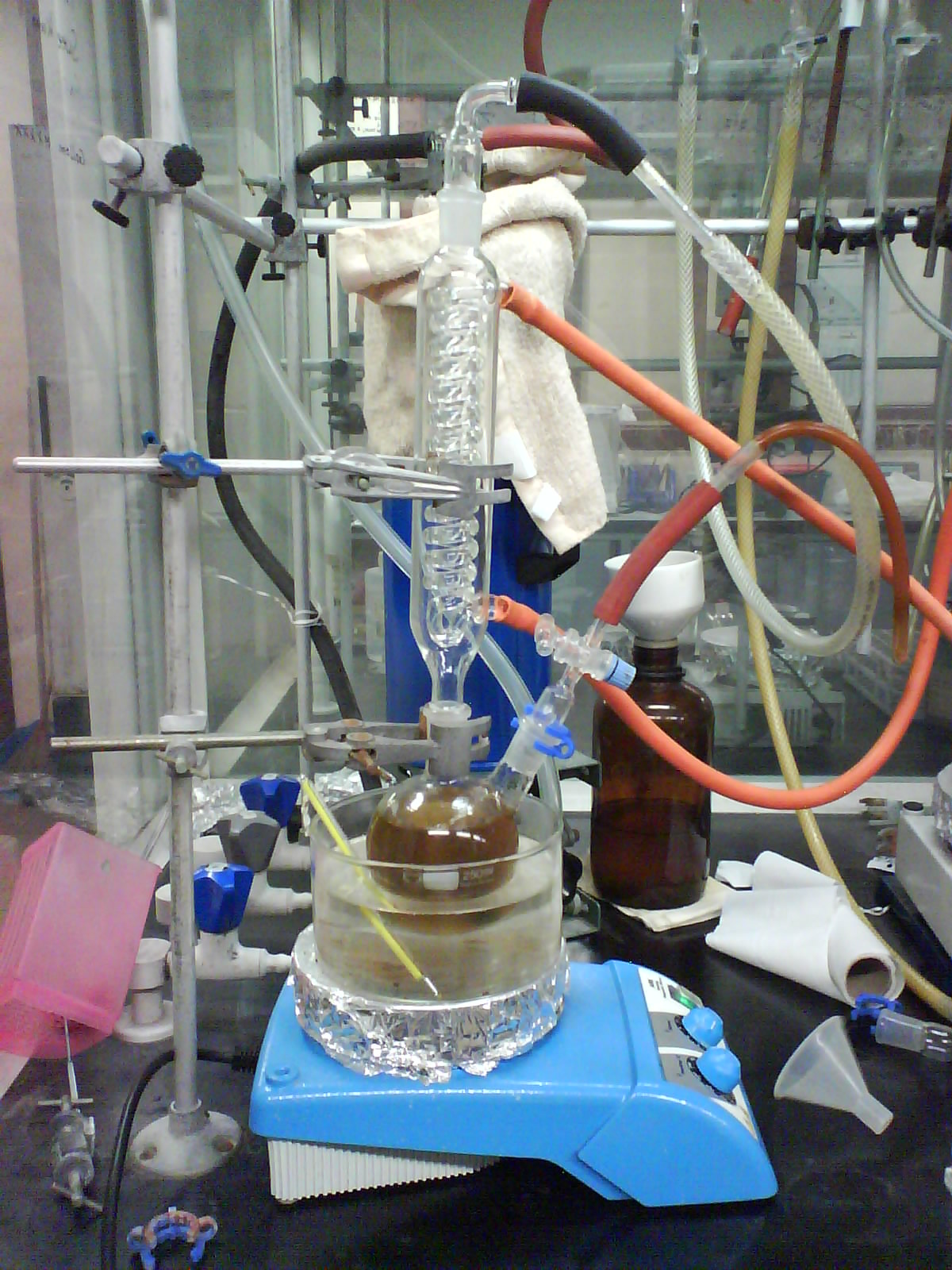

A ketyl group in organic chemistry is an anion radical that contains a group R2C−O•. It is the product of the 1-electron reduction of a ketone.
Another mesomeric structure has the radical position on carbon and the negative charge on oxygen.
:[[File:Ketyl structure.svg|200px|A ketyl]]
Ketyls can be formed as radical anions by one-electron reduction of carbonyls with alkali metals. Sodium and potassium metal reduce benzophenone in THF solution to the soluble ketyl radical. Ketyls are also invoked as intermediates in the pinacol coupling reaction.
Reactions
Water
The ketyl radicals derived from the reaction of sodium and benzophenone is a common laboratory desiccant. Ketyls react quickly with water, peroxides, and with oxygen. Thus, the deep purple coloration qualitatively indicates dry, peroxide-free, and oxygen-free conditions. The method for drying is still popular in many laboratories due to its ability to produce such pure solvent quickly. An alternative option for chemists interested only in water-free solvent is the use of molecular sieves. This is a much safer method than using an alkali metal still, produces solvent as dry as sodium-ketyl (though not as dry as potassium, or potassium-sodium alloy) but takes longer.
Oxygen
Sodium benzophenone ketyl reacts with oxygen to give sodium benzoate and sodium phenoxide.
As a reducing agent
Potassium-benzophenone ketyl is used as a reductant for the preparation of organoiron compounds.
Further reduction
When excess alkali metal is present, benzophenone ketyl may be reduced to the ketone dianion, resulting in a color transformation from deep blue to purple: :
References
References
- "ketyls".
- Williams, D. B. G., Lawton, M., "Drying of Organic Solvents: Quantitative Evaluation of the Efficiency of Several Desiccants", The Journal of Organic Chemistry 2010, vol. 75, 8351. {{doi. 10.1021/jo101589h
- (1981). "Convenient preparation and isolation of pure potassium cyclopentadienyldicarbonylferrate, K[(''η''5-C5H5)Fe(CO)2]". Inorg. Chem..
- (March 28, 1996). "Chemical Redox Agents for Organometallic Chemistry". Chemical Reviews.
This article was imported from Wikipedia and is available under the Creative Commons Attribution-ShareAlike 4.0 License. Content has been adapted to SurfDoc format. Original contributors can be found on the article history page.
Ask Mako anything about Ketyl — get instant answers, deeper analysis, and related topics.
Research with MakoFree with your Surf account
Create a free account to save articles, ask Mako questions, and organize your research.
Sign up freeThis content may have been generated or modified by AI. CloudSurf Software LLC is not responsible for the accuracy, completeness, or reliability of AI-generated content. Always verify important information from primary sources.
Report