From Surf Wiki (app.surf) — the open knowledge base
Ketanji Brown Jackson
US Supreme Court justice since 2022
.jpg)
US Supreme Court justice since 2022
| Field | Value |
|---|---|
| name | Ketanji Brown Jackson |
| image | Justice Jackson Official Portrait.jpg |
| alt | Official portrait of Associate Justice of the Supreme Court Ketanji Brown Jackson |
| caption | Official portrait, 2024 |
| office | Associate Justice of the Supreme Court of the United States |
| nominator | Joe Biden |
| term_start | June 30, 2022 |
| predecessor | Stephen Breyer |
| office1 | Judge of the United States Court of Appeals for the District of Columbia Circuit |
| nominator1 | Joe Biden |
| term_start1 | June 17, 2021 |
| term_end1 | June 29, 2022 |
| predecessor1 | Merrick Garland |
| successor1 | Florence Y. Pan |
| office2 | Judge of the United States District Court for the District of Columbia |
| nominator2 | Barack Obama |
| term_start2 | March 26, 2013 |
| term_end2 | June 17, 2021 |
| predecessor2 | Henry H. Kennedy Jr. |
| successor2 | Florence Y. Pan |
| office3 | Vice Chair of the United States Sentencing Commission |
| president3 | Barack Obama |
| term_start3 | February 12, 2010 |
| term_end3 | December 2014 |
| predecessor3 | Rubén Castillo |
| successor3 | L. Felipe Restrepo |
| birth_name | Ketanji Onyika Brown |
| birth_date | |
| birth_place | Washington, D.C., U.S. |
| spouse | |
| children | 2 |
| relatives | Calvin Ross (uncle) |
| education | Harvard University (BA, JD) |
| signature | Ketanji Brown Jackson signature.svg |
| signature_alt | Cursive signature in ink |
| module |
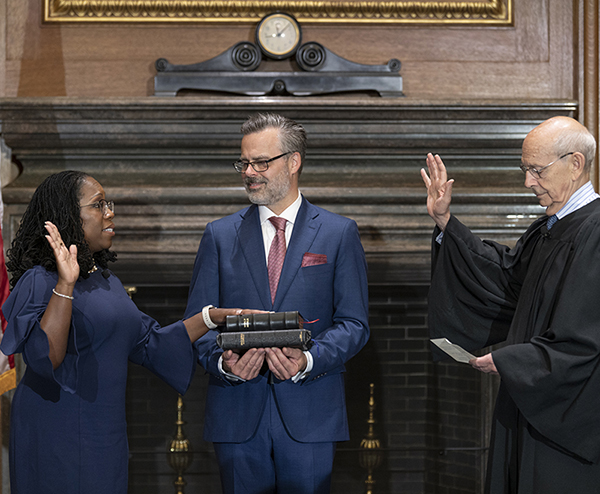
Ketanji Onyika Brown Jackson (née Brown; ; born September 14, 1970) is an American lawyer and jurist who is an associate justice of the Supreme Court of the United States. Jackson was nominated to the Supreme Court by President Joe Biden on February 25, 2022, and confirmed by the U.S. Senate and sworn into office that same year. She is the first black woman, the first former federal public defender, and the sixth woman to serve on the United States Supreme Court.
Jackson was born in Washington, D.C., and raised in Miami, Florida. She received her undergraduate and legal education at Harvard University, where she served as an editor of the Harvard Law Review, and clerked for Justice Stephen Breyer, whose seat she later assumed on the Supreme Court. From 2010 to 2014, Jackson was the vice chairwoman of the United States Sentencing Commission. In 2013, she was appointed by President Barack Obama to serve as a district judge for the United States District Court for the District of Columbia. President Joe Biden elevated her to the United States Court of Appeals for the District of Columbia Circuit in 2021, where she served until 2022. Jackson served as a Harvard Board of Overseers member from 2016 to 2022.
Alongside justices Elena Kagan and Sonia Sotomayor, Jackson is considered part of the Court's liberal wing.
Early life and education
Jackson was born on September 14, 1970, in Washington, D.C., to parents who were both teachers and had been educated at historically black colleges and universities. Her father, Johnny Brown, graduated from the University of Miami School of Law and became chief attorney for the Miami-Dade County School Board. Her mother, Ellery, was the school principal at the New World School of the Arts in Miami. One of her uncles, Calvin Ross, served as the police chief of the Miami Police Department.
Jackson grew up in Miami and attended Miami Palmetto Senior High School. She distinguished herself as a champion debater, winning the national oratory title at the National Catholic Forensic League championships in New Orleans during her senior year. She has recalled her experience with high school debate as one "that I can say without hesitation was the one activity that best prepared me for future success in law and in life." In 1988, Jackson graduated from Palmetto as senior class president. In her high school yearbook, she was quoted as saying that she wanted "to go into law and eventually have a judicial appointment".
After high school, Jackson matriculated at Harvard University to study government, having applied despite her guidance counselor's advice to set her sights lower. She took classes in drama and performed improv comedy, forming a diverse friend group. As a member of the Black Students Association, she led protests against a student who displayed a Confederate flag from his dormitory window and protested the lack of full-time professors in the Afro-American Studies Department. While a freshman, Jackson enrolled in Michael Sandel's course Justice, which she has called a major influence during her undergraduate years. She graduated from Harvard in 1992 with a Bachelor of Arts, magna cum laude. Her senior thesis was titled "The Hand of Oppression: Plea Bargaining Processes and the Coercion of Criminal Defendants".
From 1992 to 1993, Jackson worked as a staff reporter and researcher for Time magazine. She then attended Harvard Law School, where she was a supervising editor of the Harvard Law Review, graduating in 1996 with a Juris Doctor, cum laude.
Early career
After law school, Jackson was a law clerk to Judge Patti B. Saris of the U.S. District Court for the District of Massachusetts from 1996 to 1997 and to Judge Bruce M. Selya of the U.S. Court of Appeals for the First Circuit from 1997 to 1998. She spent a year in private practice at the Washington, D.C., law firm of Miller Cassidy Larroca & Lewin (now part of Baker Botts), then clerked for Supreme Court Justice Stephen Breyer from 1999 to 2000.
Jackson returned to private legal practice at the law firm of Goodwin Procter from 2000 to 2002, then under Kenneth Feinberg at the law firm now called Feinberg & Rozen LLP from 2002 to 2003. From 2003 to 2005, she was an assistant special counsel to the United States Sentencing Commission. From 2005 to 2007, Jackson was an assistant federal public defender in Washington, D.C., where she handled cases before the United States Court of Appeals for the District of Columbia Circuit. A review by The Washington Post of cases Jackson handled during her time as a public defender showed that "she won uncommon victories against the government that shortened or erased lengthy prison terms". From 2007 to 2010, Jackson was an appellate specialist in private practice at the law firm of Morrison & Foerster.
U.S. Sentencing Commission (2010–2014)
On July 23, 2009, President Obama nominated Jackson as vice chair of the United States Sentencing Commission. The Senate Judiciary Committee favorably reported her nomination by voice vote on November 5, 2009. The Senate confirmed her nomination by voice vote on February 11, 2010. She succeeded Michael E. Horowitz, who had served from 2003 until 2009. Jackson served on the Sentencing Commission until 2014. During her time on the commission, it retroactively amended the sentencing guidelines to reduce the guideline range for crack cocaine offenses, and enacted the "drugs minus two" amendment, which implemented a two offense-level reduction for drug crimes.
District Court (2013–2021)
On September 20, 2012, Obama nominated Jackson to serve as a United States district judge for the District of Columbia to the seat vacated by retiring judge Henry H. Kennedy Jr. Republican U.S. Representative Paul Ryan, a relative by marriage, introduced Jackson at her December 2012 confirmation hearing and said, "Our politics may differ, but my praise for Ketanji's intellect, for her character, for her integrity, it is unequivocal." She was confirmed by the Senate by voice vote on March 22, received her commission on March 26, and was sworn in by Justice Breyer in May. Her service as a district judge ended on June 17, 2021, when she was elevated to the court of appeals.
During her time on the district court, Jackson wrote multiple decisions adverse to the positions of the Trump administration. In her opinion ordering Trump's former White House counsel Don McGahn to comply with a legislative subpoena, she wrote that "presidents are not kings". Jackson handled a number of challenges to executive agency actions that raised questions of administrative law. She also issued rulings in several cases that gained particular political attention.
Bloomberg Law reported in spring 2021 that conservative activists were pointing to certain decisions by Jackson that had been reversed on appeal as a "potential blemish on her record". In 2019, Jackson ruled that provisions in three Trump executive orders conflicted with federal employee rights to collective bargaining. Her decision was reversed unanimously by the D.C. Circuit. The D.C. Circuit also reversed another 2019 decision, involving a challenge to a Department of Homeland Security decision to expand the agency's definition of which non-citizens can be deported. Alliance for Justice President Nan Aron defended Jackson's record, saying she "has written nearly 600 opinions and been reversed less than twelve times".
Selected rulings
.jpeg)
In American Meat Institute v. U.S. Department of Agriculture (2013), Jackson rejected the meat packing industry's request for a preliminary injunction to block a United States Department of Agriculture rule requiring them to identify animals' country of origin. Jackson found that the rule likely did not violate the First Amendment.
In Depomed v. Department of Health and Human Services (2014), Jackson ruled that the Food and Drug Administration (FDA) had violated the Administrative Procedure Act when it failed to grant pharmaceutical company Depomed market exclusivity for its orphan drug Gralise. She concluded that the Orphan Drug Act required the FDA to grant Gralise exclusivity.
In Pierce v. District of Columbia (2015), Jackson ruled that the D.C. Department of Corrections violated the rights of a deaf inmate under the Americans with Disabilities Act because jail officials failed to provide the inmate with reasonable accommodations, or to assess his need for reasonable accommodations, during his detention in 2012. She held that "the District's willful blindness regarding" Pierce's need for accommodation and its half-hearted attempt to provide Pierce with a random assortment of auxiliary aids—and only after he specifically requested them—fell far short of what the law requires."
In April and June 2018, Jackson presided over two cases challenging the Department of Health and Human Services' decision to terminate grants for teen pregnancy prevention programs two years early. She ruled that the decision to terminate the grants early without explanation was arbitrary and capricious.
In American Federation of Government Employees, AFL-CIO v. Trump (2018), Jackson invalidated provisions of three executive orders that would have limited the time federal employee labor union officials could spend with union members, the issues that unions could bargain over in negotiations, and the rights of disciplined workers to appeal disciplinary actions. She ruled that the executive orders violated the right of federal employees to collectively bargain, as guaranteed by the Federal Service Labor-Management Relations Statute. The D.C. Circuit vacated this ruling on jurisdictional grounds in 2019.
In 2018, Jackson dismissed 40 wrongful death and product liability lawsuits stemming from the disappearance of Malaysia Airlines Flight 370, which had been combined into a single multidistrict litigation. She held that under the doctrine of forum non conveniens, the suits should be brought in Malaysia, not the U.S. The D.C. Circuit affirmed this ruling in 2020.
In 2019, in Center for Biological Diversity v. McAleenan, Jackson held that Congress had, through the Illegal Immigration Reform and Immigrant Responsibility Act, stripped federal courts of jurisdiction to hear non-constitutional challenges to the United States Secretary of Homeland Security's decision to waive certain environmental requirements to facilitate construction of a border wall on the United States and Mexico border.
In 2019, Jackson issued a preliminary injunction in Make The Road New York v. McAleenan, blocking a Trump administration rule that would have expanded expedited removal ("fast-track" deportations) without immigration court hearings for undocumented immigrants. She found that the U.S. Department of Homeland Security had violated the Administrative Procedure Act (APA) because its decision was arbitrary and capricious and the agency did not seek public comment before issuing the rule. In a 2–1 ruling in 2020, the D.C. Circuit reversed the entry of the preliminary injunction, ruling that the IIRIRA (by committing the matter to the executive branch's "sole and unreviewable discretion") precluded APA review of the decision.
In 2019, Jackson issued a ruling in Committee on the Judiciary of the U.S. House of Representatives v. McGahn, in which the House Committee on the Judiciary sued former White House Counsel Don McGahn to compel him to comply with the subpoena to appear at an impeachment inquiry hearing on issues of alleged obstruction of justice by the Trump administration. McGahn declined to comply with the subpoena after President Donald Trump, relying on a legal theory of executive testimonial immunity, ordered McGahn not to testify. In a lengthy opinion, Jackson ruled in favor of the House Committee and held that senior-level presidential aides "who have been subpoenaed for testimony by an authorized committee of Congress must appear for testimony in response to that subpoena" even if the president orders them not to do so. Jackson rejected the administration's assertion of executive testimonial immunity by holding that "with respect to senior-level presidential aides, absolute immunity from compelled congressional process simply does not exist". According to her, that conclusion was "inescapable precisely because compulsory appearance by dint of a subpoena is a legal construct, not a political one, and per the Constitution, no one is above the law." Jackson's use of the phrase "presidents are not kings" gained popular attention in subsequent media reporting on the ruling. Noting that she took four months to resolve the case, including writing a 120-page opinion, The Washington Post wrote: "That slow pace contributed to helping Mr. Trump run out the clock on the congressional oversight effort before the 2020 election." and the D.C. Circuit affirmed part of Jackson's decision in August 2020. While the case remained pending, on June 4, 2021, McGahn testified behind closed doors under an agreement reached with the Biden administration.
U.S. Court of Appeals (2021–2022)

On April 28, 2021, a hearing on her nomination was held before the Senate Judiciary Committee. During her confirmation hearing, Jackson was questioned about several of her rulings against the Trump administration. On May 20, Jackson's nomination was reported out of committee by a 13–9 vote. On June 8, Majority Leader Chuck Schumer filed cloture on her nomination. On June 10, the Senate invoked cloture on her nomination by a 52–46 vote. On June 14, her nomination was confirmed by a 53–44 vote. Republican senators Susan Collins, Lindsey Graham, and Lisa Murkowski joined all 50 Democrats in voting to confirm Jackson. She received her judicial commission on June 17, 2021. Her service as a circuit judge ended on June 29, 2022, the day before she was sworn in as an Associate Justice of the United States Supreme Court.
During her time on the Circuit Court Jackson authored two majority opinions, American Federation of Government Employees v. FLRA and Wye Oak Technology, Inc. v. Republic of Iraq. In American Federation of Government Employees, her first written opinion for the court of appeals, Jackson, writing for a unanimous panel, wrote that a 2020 FLRA law change that moved to allow for collective bargaining negotiations with unions only when the negotiated working condition changes constituted a "substantial impact", stood in violation with U.S. Code 5 § 706. In her opinion, Jackson rejected arguments that the previously established de minimis standard warranted replacement, objecting to claims that the standard was "unpredictable" in its application or inconsistent with federal labor law. In addition, she argued that the replacement standard failed to be affirmatively more successful when compared to the existing de minimis standard, as no comparative analysis between the two had occurred, and that the existing could therefore not be justifiably replaced.
In Wye Oak Technology, Inc. v. Republic of Iraq Jackson wrote for a unanimous panel regarding the Foreign Sovereign Immunities Act's commercial activity exemptions. In her opinion, Jackson addressed prior litigation by Wye Oak Technology which had determined that, under the second of the Act's three exemption clauses, U.S. courts were permitted to exercise jurisdiction over Iraq to facilitate the payment of their invoices. The clause Wye Oak used in litigation provided for the exemption so long as "an act is performed in the United States in connection with the foreign state’s outside-U.S. commercial activity". Jackson determined that this clause was applicable only when an act is performed by a foreign state within the U.S., vacating the prior verdict permitting for the exemption, as all acts performed within the U.S. were attributable to Wye Oak and not Iraq. Jackson subsequently remanded the case for consideration to the District Court for the District of Columbia to determine whether additional commercial activity exemptions such as the "direct effect" clause were applicable in its stead.
Nomination to the Supreme Court
Main article: Ketanji Brown Jackson Supreme Court nomination
In early 2016, Obama administration officials vetted Jackson as a potential nominee to the Supreme Court of the United States to fill the vacancy left by the death of Justice Antonin Scalia. Jackson was one of five candidates interviewed as a potential nominee.
In early 2022, news outlets speculated that Biden would nominate Jackson to the U.S. Supreme Court to fill the seat vacated by Justice Breyer. Biden pledged during the 2020 United States presidential election campaign to appoint a black woman to the court should a vacancy occur. Jackson's appointment to the D.C. Circuit, considered the second-most influential federal court, was viewed as preparation for a potential promotion to the Supreme Court.
Jackson's potential nomination to the Supreme Court was supported by civil rights and liberal advocacy organizations. Her potential nomination was opposed by Republican Party leaders and senators. The Washington Post wrote that Jackson's experience as a public defender "has endeared her to the more liberal base of the Democratic Party". While her supporters have touted her history as a public defender as an asset, during her 2021 confirmation hearing, Republicans tried to cast it as a liability.
On February 25, 2022, Biden announced that Jackson was his nominee to be an associate justice of the Supreme Court. Her nomination was sent to the Senate on February 28. Her confirmation hearing before the Senate Judiciary Committee was held on March 21. After the Judiciary Committee deadlocked on her nomination by an 11–11 vote, the Senate discharged the committee from further consideration of her nomination by a 53–47 vote. The next day, the Senate proceeded to the consideration of her nomination by a 53–47 vote, and Majority Leader Chuck Schumer then filed cloture on her nomination. On April 7, the Senate invoked cloture on her nomination by a 53–47 vote. Later that day, she was confirmed by the same margin. Republicans Mitt Romney, Lisa Murkowski, and Susan Collins joined all Democrats in confirming Jackson to the Supreme Court. She received her judicial commission as an associate justice on April 8. She was sworn in and became an associate justice at noon on June 30, 2022, when Breyer's retirement went into effect.
U.S. Supreme Court (2022–present)
The Supreme Court released its final merit opinions on the morning of June 30, 2022. At noon, Breyer officially retired and Jackson was sworn in, becoming the first Black woman and the first former federal public defender to serve on the Supreme Court. On September 28, 2022, Jackson was assigned as the circuit justice for the First Circuit.
On July 21, Jackson voted on her first Supreme Court case, joining the dissent in a 5–4 decision refusing to block a district court ruling that prevented the Biden administration from setting new enforcement priorities for immigrants entering the U.S. or living in the country illegally. She participated in her first oral argument as an associate justice on October 3, in Sackett v. Environmental Protection Agency. On November 7 she wrote her first opinion, a two-page dissent from a denial of review in the case of a death row inmate in Chinn v. Shoop; the opinion was joined by Justice Sotomayor.
Two contributors to SCOTUSBlog noted that, since joining the Court at the beginning of the 2022 term, Jackson was the most active participant in oral arguments, speaking an average of 1,350 words per argument, while the eight other justices each spoke on average fewer than 1,000. On February 28, 2023, Jackson authored her first majority opinion for a unanimous court in Delaware v. Pennsylvania, which involved how unclaimed money from MoneyGrams are distributed among individual states.
In 2025, Justice Amy Coney Barrett criticized Jackson's dissent in Trump v. CASA, writing, "Justice Jackson decries an imperial Executive while embracing an imperial Judiciary." On July 8, 2025, in AFGE v. Trump, the Supreme Court issued an emergency order on Trump's federal workforce reorganization, ruling in Trump's favor 8–1, with Jackson the lone dissenter. It was an appeal of a lower court ruling in the Northern District of California. Jackson argued that Trump's reorganization of the U.S. government was an illegal restructuring of the federal bureaucracy. Justice Sonia Sotomayor said the case was not about the merits of the reorganization plans themselves and pointed out that the case could proceed and other aspects challenged.
Labor disputes
On June 1, 2023, Jackson wrote the sole dissenting opinion in Glacier Northwest, Inc. v. Teamsters, concerning the power of employers to sue labor unions regarding the destruction of employer property following a strike. In her opinion, she argued that further deference to the National Labor Relations Board was justified given the precedent of cases such as San Diego Building Trades Council v. Garmon that stipulate that the NLRA preempts state law when the two conflict. Jackson further contended that the majority opinion failed "Congress's intent with respect to the Board's primary role in adjudicating labor disputes", with its deference to state actions risking "erosion of the right to strike". In her conclusion, she emphasized these points, writing: "Workers are not indentured servants, bound to continue laboring until any planned work stoppage would be as painless as possible for their master. They are employees whose collective and peaceful decision to withhold their labor is protected by the NLRA even if economic injury results".
On June 13, 2024, Jackson wrote an opinion, concurring in part and dissenting in part, in Starbucks Corporation v. McKinney. In it, she agreed that the case should be reheard in the lower courts using the four criteria tests of Winter v. Natural Resources Defense Council, but argued that the majority failed to follow the NLRA's directives of court deference to NLRB authority in labor disputes. Arguing that the court was failing to issue proper deference to the NLRB, Jackson wrote, "I am loath to bless this aggrandizement of judicial power where Congress has so plainly limited the discretion of the courts, and where it so clearly intends for the expert agency it has created to make the primary determinations".
Affirmative action
Jackson dissented from the Supreme Court's ruling in Students for Fair Admissions v. University of North Carolina, the companion case to Students for Fair Admissions v. President and Fellows of Harvard College, which limited the use of racial preferences in university admissions. In her dissent, Jackson emphasized the relationship between Black Americans and the U.S. government, writing, "Our country has never been colorblind", and associating affirmative action as a corrective marker in reconciliation. In doing so, she expressed opposition to the majority's usage of the Equal Protection Clause, writing, "To impose this result in that Clause’s name when it requires no such thing, and to thereby obstruct our collective progress toward the full realization of the Clause’s promise, is truly a tragedy for us all".
Judicial philosophy

Jackson has said she does not have a particular judicial philosophy, but rather has a perspective on legal analysis or a "judicial methodology". Though she has not embraced the label, Jackson has expressed that she sees value in originalism, saying the "Constitution is fixed in its meaning", and has explicitly criticized living constitutionalism.
In January 2022, The New York Times reported that Jackson had "not yet written a body of appeals court opinions expressing a legal philosophy" because she had joined the U.S. Court of Appeals for the D.C. Circuit in the summer of 2021. However, The Times said, Jackson's earlier rulings "comported with those of a liberal-leaning judge", including her opinions blocking various Trump administration actions. Additionally, a review of over 500 of her judicial opinions indicated that she would likely be as liberal as Breyer, the justice she replaced.
According to Sahil Kapur, writing for NBC News, "Jackson fits well with the Democratic Party and the progressive movement's agenda" due to her relative youth, background as a public defender, and history of labor-friendly rulings.
Politico reported that "Jackson is popular with liberal legal activists looking to replace Breyer with a justice willing to engage in ideological combat with the court's conservatives."
Personal life
In 1996, Jackson married surgeon Patrick Graves Jackson, whom she met at Harvard College. He is a descendant of Continental Congress delegate Jonathan Jackson and is related to U.S. Supreme Court justice Oliver Wendell Holmes Jr. The couple have two daughters. Jackson is a non-denominational Protestant. In a 2017 speech, she said, "I am fairly certain that if you traced my family lineage back past my grandparents—who were raised in Georgia, by the way—you would find that my ancestors were slaves on both sides." Jackson's paternal ancestry can be traced to Houston County, Georgia, while her maternal ancestry can be traced to Calhoun County, Georgia. Through her marriage, Jackson is related to former speaker of the House Paul Ryan.
In 1989, while Jackson was an undergraduate at Harvard, her uncle Thomas Brown Jr. was sentenced to life in prison for a nonviolent cocaine conviction after federal agents found 14 kilograms of cocaine wrapped in duct tape. Years later, Jackson persuaded a law firm to take his case pro bono, and President Barack Obama eventually commuted his sentence.
_(cropped).jpg)
Jackson appeared in the Broadway production of & Juliet one night in December 2024. After receiving the invitation to portray herself in a brief cameo, she called it a "lifelong dream of hers". She took acting classes as an undergraduate at Harvard, and said that prepared her for her role on Broadway. The role was written for her.
Affiliations
Jackson is a member of the Judicial Conference Committee on Defender Services and the Council of the American Law Institute. She previously served as a member of the Harvard Board of Overseers and on the Georgetown Day School Board of Trustees and the U.S. Supreme Court Fellows Commission.
From 2010 to 2011, she served on the advisory board of Montrose Christian School, a Baptist school. Jackson has served as a judge in several mock trials with the Shakespeare Theatre Company and for the Historical Society of the District of Columbia's Mock Court Program. In 2018, she presided over a mock trial hosted by Drexel University's Thomas R. Kline School of Law "to determine if Vice President Aaron Burr was guilty of murdering" Alexander Hamilton.
In 2017, Jackson presented at the University of Georgia School of Law's 35th Edith House Lecture. In 2018, she was a panelist at the National Constitution Center's town hall on Alexander Hamilton's legacy. In 2020, Jackson gave the Martin Luther King Jr. Day lecture at the University of Michigan Law School and was honored at the University of Chicago Law School's third annual Judge James B. Parsons Legacy Dinner, hosted by the school's Black Law Students Association. In 2022, she received the Academy of Achievement's Golden Plate Award, presented by Awards Council members Justice Amy Coney Barrett and retired justice Anthony Kennedy.
Selected works
- Lovely One (2024).
Notes
References
Additional sources
References
- (April 7, 2022). "Jackson confirmed as first Black female high court justice".
- (April 7, 2022). "Senate confirms Jackson as first Black woman on U.S. Supreme Court". Reuters.
- "The Current Court: Justice Ketanji Brown Jackson".
- Marimow, Ann E.. (April 30, 2021). "Biden's court pick Ketanji Brown Jackson has navigated a path few Black women have". The Washington Post.
- (March 21, 2022). "Read Ketanji Brown Jackson's opening statement for her Supreme Court hearings". [[Politico]].
- Leibowitz, Aaron. (January 26, 2022). "Supreme Court prospect Brown Jackson was 'star in the making' at Miami's Palmetto High". [[Miami Herald]].
- (January 30, 2022). "For Ketanji Brown Jackson, View of Criminal Justice Was Shaped by Family". The New York Times.
- (October 7, 2009). "Capitol Hill Hearing - Nominations". Federal News Service.
- Berke, Jeremy. (February 17, 2016). "Influential Supreme Court expert is floating a new candidate to fill Scalia's seat".
- "Questionnaire for judicial nominees". [[United States Senate Committee on the Judiciary]].
- (February 25, 2022). "Who is Ketanji Brown Jackson? 5 things to know about Biden's Supreme Court pick". WFTV.
- D'Oench, Peter. (June 30, 2022). "Miami Palmetto Senior High grad Ketanji Brown Jackson sworn in as Supreme Court justice".
- Mazzei, Patricia. (2022-02-26). "How a High School Debate Team Shaped Ketanji Brown Jackson". [[The New York Times]].
- (25 February 2022). "How Ketanji Brown Jackson found a path between confrontation and compromise". [[The Washington Post]].
- (January 27, 2022). "US Supreme Court: The women in the running to replace Stephen Breyer".
- Green, Erica L.. (2022-03-20). "At Harvard, a Confederate Flag Spurred Ketanji Brown Jackson to Act". [[The New York Times]].
- Chadwick, John. "New Supreme Court Justice Cited Research by Rutgers Professor in her Harvard Honors Thesis". [[Rutgers University]].
- (April 7, 2022). "Ketanji Brown Jackson: Legal career timeline".
- Reed, Rachel. (February 25, 2022). "President Biden nominates Ketanji Brown Jackson '96 for Supreme Court". [[Harvard University]].
- "Ketanji Brown Jackson". Morrison & Foerster LLP.
- Fitzpatrick, Edward. (February 25, 2022). "Supreme Court nominee Judge Ketanji Brown Jackson reminds others of Ruth Bader Ginsburg".
- {{FJC Bio|nid=1394151|inline=yes}}
- Carlisle, Madeleine. (2022-04-07). "Ketanji Brown Jackson Confirmed to the Supreme Court, Becoming the First Black Woman Justice in U.S. History".
- (July 23, 2009). "President Obama Nominates Ketanji Brown Jackson to US Sentencing Commission". [[White House]].
- (March 30, 2021). "Supreme Court Path Set for Potential First Black Female Nominee". Bloomberg L.P..
- Weiss Cassens, Debra. (March 30, 2021). "Biden's first judicial picks include DC Circuit nominee Judge Ketanji Brown Jackson, said to be SCOTUS contender". ABA Journal.
- (11 February 2022). "Potential pick Ketanji Brown Jackson would make history as first federal public defender on Supreme Court". The Washington Post.
- (2009-07-23). "President Obama Nominates Ketanji Brown Jackson to U.S. Sentencing Commission".
- (February 16, 2010). "Ketanji Brown Jackson to Serve as Vice Chair". [[United States Sentencing Commission]].
- (February 11, 2010). "PN802 – Ketanji Brown Jackson – United States Sentencing Commission".
- (October 28, 2013). "Former Commissioner Information".
- (March 29, 2021). "Biden's first slate of judicial nominees aims to quickly boost diversity in federal courts". The Washington Post.
- Schwarzapfel, Beth. (July 23, 2015). "Federal Prisons Could Release 1,000 Times More Drug Offenders Than Obama Did".
- (September 20, 2012). "President Obama Nominates Two to the United States District Courts". [[White House]].
- (January 3, 2013). "President Obama Re-nominates Thirty-Three to Federal Judgeships". [[White House]].
- Valencia, Milton J.. (February 25, 2022). "Who is Ketanji Brown Jackson, Biden's pick for US Supreme Court?". [[The Boston Globe]].
- Marimow, Ann. (June 14, 2021). "Senate confirms D.C. Circuit nominee Ketanji Brown Jackson to replace Merrick Garland". [[The Washington Post]].
- Savage, Charlie. (January 26, 2022). "Judge Ketanji Brown Jackson is among the leading candidates to succeed Justice Breyer.". The New York Times.
- Alder, Madison. (April 28, 2021). "Circuit Pick Jackson's Reversals a Likely Target for GOP". news.bloomberglaw.com.
- Abbott, Charles. (September 11, 2013). "New U.S. meat label rule survives challenge by meat packers". [[Reuters]].
- ''American Meat Institute v. U.S. Dept. of Agriculture'', 968 F.Supp.2d 38 (D.D.C. 2013).
- Kearn, Rebekah. (September 12, 2014). "Orphan Drugmaker Wins Exclusivity".
- Zapotosky, Matt. (September 12, 2015). "Judge rules D.C. Corrections must pay damages in case of deaf inmate". [[The Washington Post]].
- Hansler, Jennifer. (June 4, 2018). "HHS loses another court battle over teen pregnancy prevention grant funding". CNN.
- (March 19, 2019). "The real reason the Trump administration is constantly losing in court". [[The Washington Post]].
- Vazquez, Maegan. (August 25, 2018). "Judge strikes down sections of Trump exec orders for federal workers in victory for unions". [[CNN]].
- ''American Federation of Government Employees, AFL-CIO v. Trump'', 318 F.Supp.3d 370 (D.D.C. 2018), ''vacated'', 929 F.3d 748 (D.C. Cir. 2019).
- "Lawsuit challenging President Trump civil service executive orders (2018)".
- ''In re Air Crash Over Southern Indian Ocean on March 8, 2014'', 352 F.Supp.3d 19 (D.D.C. 2018), ''aff'd'', 946 F.3d 607 (D.C. Cir. 2020).
- Stempel, Jonathan. (November 23, 2018). "U.S. judge dismisses litigation over missing Malaysia Airlines flight". [[Reuters]].
- (December 12, 2018). "Judge Dismisses US Lawsuits Filed Over Malaysia Airlines Disappearance". [[Yahoo! Finance]].
- Shepardson, David. (January 10, 2020). "U.S. appeals court upholds dismissal of lawsuits over missing Malaysia Air flight". Reuters.
- Grzincic, Barbara. (September 6, 2019). "Trump administration can waive enviro laws for border wall". Reuters.
- Hsu, Spencer S.. (September 28, 2019). "Judge bars Trump fast-track deportation policy, saying threat to legal migrants was not assessed". [[The Washington Post]].
- Gerstein, Josh. (September 28, 2019). "Judge blocks Trump plan to expand fast-track deportations". [[Politico]].
- (September 27, 2019). "Make the Road New York v. McAleenan".
- (November 25, 2019). "Committee on the Judiciary of the U.S. House of Representatives v. McGahn, No. 19-cv-2379 (KBJ), Slip Op. at 116".
- (November 25, 2019). "Committee on the Judiciary of the U.S. House of Representatives v. McGahn, No. 19-cv-2379 (KBJ), Slip Op. at 115".
- Thomsen, Jacqueline. (November 25, 2019). "'No One Is Above the Law': Judge Says Donald McGahn Must Comply With House Subpoena for His Testimony". Law.com.
- (November 25, 2019). "Don McGahn must testify about time as White House lawyer, judge rules".
- Durkee, Alison. (November 25, 2019). "'Presidents Are Not Kings': Federal Judge Destroys Trump's 'Absolute Immunity' Defense Against Impeachment".
- Yaeger, Lynn. (December 1, 2019). "The Week in Washington: 'Presidents Are Not Kings!'".
- (November 26, 2019). "Judge tells Trump he's not a king – the President is not so sure". [[CNN]].
- Reilly, Ryan J.. (November 25, 2019). "'Presidents Are Not Kings': Judge Orders Trump Lawyer McGahn To Testify Before Congress".
- "Appeals court rejects key argument against McGahn subpoena". Politico.
- (June 4, 2021). "McGahn testifies about Trump's efforts to obstruct the Russia inquiry". [[The New York Times]].
- (March 30, 2021). "President Biden Announces Intent to Nominate 11 Judicial Candidates".
- (April 19, 2021). "Nominations Sent to the Senate".
- (April 28, 2021). "Nominations {{pipe}} United States Senate Committee on the Judiciary".
- Marimow, Ann. (April 28, 2021). "Biden judicial pick Ketanji Brown Jackson defends her independence in Senate hearing". The Washington Post.
- (May 20, 2021). "Results of Executive Business Meeting". Senate Judiciary Committee.
- (June 10, 2021). "On the Cloture Motion (Motion to Invoke Cloture: Ketanji Brown Jackson to be U.S. Circuit Judge for the District of Columbia Circuit)".
- (June 14, 2021). "On the Nomination (Confirmation: Ketanji Brown Jackson, of the District of Columbia, to be U.S. Circuit Judge for the District of Columbia Circuit)". United States Senate.
- "U.S. Court of Appeals – D.C. Circuit – Ketanji Brown Jackson".
- "Opinions - U.S. Court of Appeals for the D.C. Circuit".
- (February 2022). "Supreme Court Hopeful Tosses Labor Policy in Debut Ruling (3)".
- "American Federation of Government Employees v. Federal Labor Relations Authority, No. 20-1396 (D.C. Cir. 2022)".
- Joseph Stern, Mark. (February 25, 2022). "What We Learned From Ketanji Brown Jackson's First Appeals Court Opinion".
- (February 25, 2022). "Notable Opinions by High Court Nominee Ketanji Brown Jackson".
- Braun, Julie. (October 18, 2022). "Ketanji Brown Jackson: Legal Philosophy of a Rookie Supreme Court Justice".
- (March 14, 2022). "The Nomination of Judge Ketanji Brown Jackson to the Supreme Court".
- Adler, Jonathan. (February 4, 2022). "Judge Ketanji Brown Jackson's Second Circuit Court Opinion".
- (June 27, 2024). "Report on the Nomination of Judge Ketanji Brown Jackson as an Associate Justice of the Supreme Court of the United States".
- Hunt, Hyland. (February 6, 2022). "D.C. Circuit Review – Reviewed: Two Opinions by Judge Jackson".
- Atkinson, Khorri. (February 4, 2022). "DC Circ. Overturns $89M Contract Breach Ruling Against Iraq".
- Tillman, Zoe. (February 26, 2016). "Source: D.C. Judge Ketanji Brown Jackson Vetted for Scalia Seat".
- (March 7, 2016). "Here are judges the White House is considering for the Supreme Court". [[The Washington Post]].
- Gresko, Jessica. (March 9, 2016). "Possible Supreme Court pick would make history in many ways". Associated Press.
- Edwards, Julia. (March 10, 2016). "White House interviewing five potential U.S. Supreme Court nominees: source". Reuters.
- Kapur, Sahil. (May 6, 2020). "Biden pledged to put a Black woman on the Supreme Court. Here's what he might have to do.".
- Ross, Janell. (January 31, 2019). "Ketanji Brown Jackson: A decisive force applying rules to any and all".
- Williams, Pete. (January 26, 2022). "Justice Stephen Breyer to retire from Supreme Court, paving way for Biden appointment".
- Hulse, Carl. (February 25, 2022). "On Capitol Hill, Democrats celebrate Judge Jackson while Republicans pledge a respectful review.". The New York Times.
- (February 25, 2022). "What senators are saying: Tracking reactions to Jackson's nomination".
- Gualtieri, Allison Elyse. (February 25, 2022). "Senators weigh in on nomination of Ketanji Brown Jackson to the Supreme Court".
- (January 27, 2022). "A guide to the Black female judges who are contenders to replace Justice Breyer". The Washington Post.
- (February 25, 2022). "President Biden Nominates Judge Ketanji Brown Jackson to Serve as Associate Justice of the U.S. Supreme Court". [[White House Office]].
- (February 28, 2022). "Press Release: Nominations Sent to the Senate". The White House.
- (March 21, 2022). "Day one of Supreme court hearing for Ketanji Brown Jackson".
- Kapur, Shail. (April 4, 2022). "3 Republicans endorse Jackson in vote to advance her Supreme Court nomination".
- (April 5, 2022). "U.S. Supreme Court nominee Jackson secures more Republican backers, clears hurdle". Reuters.
- (2022-04-05). "On the Motion to Proceed (Motion to Proceed to Executive Session to Consider Executive Calendar No. 860)".
- (April 7, 2022). "PN1783 – Ketanji Brown Jackson – Supreme Court of the United States".
- (2022-04-07). "On the Cloture Motion (Motion to Invoke Cloture: Ketanji Brown Jackson to be an Associate Justice of the Supreme Court of the United States)".
- McArdle, Elaine. (Summer 2022). "'One Generation ... from Segregation to the Supreme Court': Ketanji Brown Jackson '96 becomes the first Black woman to serve on the Court". [[Harvard Law School]].
- (April 7, 2022). "Senate". [[United States Government Publishing Office.
- Baker, Sam. (April 7, 2022). "Ketanji Brown Jackson confirmed as first Black female Supreme Court justice".
- "On the Nomination (Confirmation: Ketanji Brown Jackson, of the District of Columbia, to be an Associate Justice of the Supreme Court of the United States)".
- de Vogue, Ariane. (June 30, 2022). "Ketanji Brown Jackson to join a Supreme Court in turmoil".
- (June 30, 2022). "WATCH LIVE: Judge Ketanji Brown Jackson sworn in as first Black woman on Supreme Court".
- (2022-04-07). "Jackson won't be sworn in until Justice Stephen Breyer retires".
- Booker, Brakkton. (April 7, 2022). "What Justice Ketanji Brown Jackson means for the country".
- (28 September 2022). "Jackson, as circuit justice for 1st Circuit, will review emergency appeals from most of New England". SCOTUSblog.
- Williams, Pete. (July 21, 2022). "Supreme Court won't allow Biden administration to impose new border enforcement priorities for now".
- "Monthly Argument - Supreme Court of the United States".
- "(ORDER LIST: 598 U.S.)".
- (December 30, 2022). "The new hot bench: With Jackson leading the way, the justices are speaking more during oral arguments".
- (28 February 2023). "Justice Jackson writes 1st Supreme Court majority opinion".
- Lee, Ella. (June 27, 2025). "Barrett, Jackson spar in birthright citizenship case opinions". The Hill.
- Howe, Amy. [https://www.scotusblog.com/2025/07/supreme-court-allows-trump-administration-to-implement-plans-to-significantly-reduce-the-federal-workforce/ Supreme Court allows Trump administration to implement plans to significantly reduce the federal workforce], ''[[SCOTUSblog]]'', July 8, 2025.
- (June 1, 2023). "Glacier Northwest, Inc. v. International Brotherhood of Teamsters, 598 U.S. ___ (2023)".
- Schonfeld, Zach. (June 1, 2023). "Ketanji Brown Jackson issues solo dissent in ruling against Teamsters strike".
- Olson, Walter. (June 1, 2023). "Glacier Northwest v. Teamsters: The Supreme Court Gets Concrete".
- Block, Sharon. (2023-06-02). "Supreme Court rules against union over strike liability". SCOTUSblog.
- Ivanova, Irina. (June 2, 2023). "Supreme Court ruling deals another blow to organized labor".
- Jamieson, Dave. (June 13, 2024). "Supreme Court Rules In Starbucks' Favor In Labor Case".
- (June 13, 2024). "Supreme Court, in Starbucks Ruling, Curbs Labor Regulator's Authority".
- Mann, Ronald. (June 13, 2024). "Justices side with Starbucks in union organizing dispute".
- Savage, David. (June 13, 2024). "Supreme Court rules for Starbucks, limits power of judges to protect fired union organizers". [[LA Times]].
- (June 13, 2024). "Why Was Ketanji Brown Jackson Made to Stand Alone for the Rights of Starbucks Workers?".
- Brown Jackson, Ketanji. (June 29, 2023). ""A Tragedy for Us All": Justice Ketanji Brown Jackson's Dissent".
- Lithwick, Dahlia. (June 29, 2023). "Ketanji Brown Jackson Exposed the Supreme Court's "Colorblind" Lie".
- Liptak, Adam. (June 29, 2023). "Supreme Court Rejects Affirmative Action Programs at Harvard and U.N.C.".
- Wang, Amy. (June 29, 2023). "Jackson's dissent decries affirmative action decision as 'tragedy for us all'".
- Howe, Amy. (June 29, 2023). "Supreme Court strikes down affirmative action programs in college admissions".
- (1 April 2022). "Justice Ketanji Brown Jackson—what can we expect?".
- (22 March 2022). "By Turns Cautious and Confident, Judge Jackson Takes the Stage".
- (10 May 2022). "The Misguided Criticism of Judge Ketanji Brown Jackson's Judicial Philosophy".
- (February 25, 2022). "Judge Jackson's Rulings: Detailed, Methodical and Leaning Left".
- Kapur, Sahil. (January 26, 2022). "Who is Ketanji Brown Jackson? A likely Biden short-lister for Supreme Court". NBC News.
- Gerstein, Josh. (February 25, 2022). "Ketanji Brown Jackson is the first Black woman selected for the nation's top court". Politico.
- (February 26, 2022). "A Historic Nomination: Judge Kentanji Brown Jackson, First Black Woman Nominated to the Supreme Court". [[Mountain Views News]].
- (June 19, 2020). "The First Marshal of Massachusetts: Jonathan Jackson". U.S. Department of Justice, Marshals Service.
- (1905). "Men of Mark In America". Men of Mark Publishing Company.
- (March 22, 2022). "These are the members of Ketanji Brown Jackson's family". CNN.
- "See Photos of How Ketanji Brown Jackson's Family Supported Her During Confirmation Hearings".
- Goldstein, Tom. (February 16, 2016). "Continued thoughts on the next nominee (and impressions of Judge Ketanji Brown Jackson)". [[SCOTUSblog]].
- Fritze, John. (March 6, 2022). "Supreme Court: Ketanji Brown Jackson would add second Protestant voice". [[USA Today]].
- Totenberg, Nina. (2022-02-25). "Ketanji Brown Jackson, Biden's Supreme Court nominee, has blazed trails all her life". NPR.
- Platoff, Emma. (July 9, 2022). "Beside the nation's first Black woman Supreme Court justice is her husband, a 'quintessential Boston Brahmin'".
- "The Ancestry of Ketanji Brown Jackson".
- (February 25, 2022). "How Paul Ryan is related to Ketanji Brown Jackson". The Washington Post.
- (January 30, 2022). "Possible Supreme Court nominee, former defender, saw impact of harsh drug sentence firsthand". Washington Post.
- Prater, Nia. (February 25, 2022). "Meet Ketanji Brown Jackson". [[New York (magazine).
- (16 December 2024). "Justice Ketanji Brown Jackson, a longtime theater lover, makes her Broadway debut". NPR.
- (16 December 2024). "Backstage with Supreme Court Justice Ketanji Brown Jackson as she made her Broadway debut - CBS News". www.cbsnews.com.
- (17 December 2024). "Ketanji Brown Jackson is the first Supreme Court justice on Broadway: 'We have dreams'". Los Angeles Times.
- "U.S. Court of Appeals – D.C. Circuit – Ketanji Brown Jackson".
- "Board of Trustees – Georgetown Day School".
- "The Commission – Supreme Court of the United States".
- "[https://www.judiciary.senate.gov/imo/media/doc/Brown%20Jackson%20Responses1.pdf Responses to questions for the record] {{Webarchive. link. (January 21, 2022" (PDF). [[United States Senate Committee on the Judiciary]]. Retrieved January 28, 2022.)
- (June 28, 2019). "U.S. Supreme Court Justice Ruth Bader Ginsburg Oversees Unanimous Jury Decision About Ancient Greek Crime".
- Treanor, Tim. (December 13, 2017). "Olivia versus Sebastian: outcome of Twelfth Night Mock Trial".
- Hamm, Andrew. (December 13, 2016). "Friar Laurence free to go in case of Juliet and her Romeo".
- Stein, Shira. (December 15, 2017). "As a high school student during the Vietnam War, she wore her protest on her sleeve". The Washington Post.
- (November 16, 2018). "Unprecedented 'Trial' of Aaron Burr and Scholarly Discussion Highlight Alexander Hamilton's Legacies in Law and Culture".
- Jackson, Ketanji. (March 2, 2017). "Reflections on My Journey as a Mother and a Judge". Edith House Lectures.
- "Hamilton: The Man, the Musical, and the Law".
- Billiter, Laura. (January 29, 2020). "The Hon. Ketanji Brown Jackson's MLK Day Lecture Honors Black Women Leaders in the Civil Rights Movement".
- (February 24, 2020). "BLSA Honors Judge Ketanji Brown Jackson at Third Annual Parsons Dinner".
- "Golden Plate Awardees of the American Academy of Achievement". [[American Academy of Achievement]].
- "2022 Summit". [[American Academy of Achievement]].
This article was imported from Wikipedia and is available under the Creative Commons Attribution-ShareAlike 4.0 License. Content has been adapted to SurfDoc format. Original contributors can be found on the article history page.
Ask Mako anything about Ketanji Brown Jackson — get instant answers, deeper analysis, and related topics.
Research with MakoFree with your Surf account
Create a free account to save articles, ask Mako questions, and organize your research.
Sign up freeThis content may have been generated or modified by AI. CloudSurf Software LLC is not responsible for the accuracy, completeness, or reliability of AI-generated content. Always verify important information from primary sources.
Report