From Surf Wiki (app.surf) — the open knowledge base
Kentish ragstone
Hard grey limestone in Kent, England

Hard grey limestone in Kent, England
Kentish ragstone is a hard grey limestone in Kent, England, drawn from the geological sequence known as the Hythe Beds of the Lower Greensand. For millennia it has been quarried for use both locally and further afield.
Geology
Ragstone occurs in a geological formation known in the Hythe Beds of the Lower Greensand, a layer of limestones running from Kent into Surrey which was laid down in the Cretaceous period. It outcrops in various places, notably at the cliffs of Hythe, Kent (whence it gets its name) and along the Greensand Ridge above the Weald of Kent.{{Citation |access-date=14 July 2011 |access-date=1 August 2017 |archive-url=https://web.archive.org/web/20170802000501/http://www.gallagher-group.co.uk/hermitagequarry/hermitage_quarry.html |archive-date=2 August 2017 |url-status=dead |access-date=19 July 2011 |archive-url=https://web.archive.org/web/20120327213944/http://www.lambsstone.com/nav/catalog.htm?cat=stone&code=wkr |archive-date=27 March 2012 |url-status=dead
History
With hard rock for building being in short supply in south-east England, it was inevitable that the only significant source of hard limestone – Kentish ragstone – would be used in building from an early period. Since Roman times, ragstone has been used in roughly squared blocks for building walls. The stone was almost certainly quarried at the Tovil quarry near Maidstone, and then transported by boat along the River Medway to London. A Roman ship discovered at Blackfriars had a cargo of Kentish ragstone, probably from Maidstone, on board. Examples of Roman uses include the Roman walled cemetery at Boughton and the old Roman wall near Tower Hill underground station.{{Citation |access-date = 19 July 2011 |archive-url = https://web.archive.org/web/20111002105259/http://www.maidstone.gov.uk/pdf/Maidstone%20Centre%20CAA%20Approved%20Doc%20PDF.pdf |archive-date = 2011-10-02 |url-status = dead
|access-date = 17 July 2011 |archive-url = https://web.archive.org/web/20110515060028/http://extraordinarybookofdoors.com/Stone.aspx |archive-date = 2011-05-15 |url-status = dead |access-date = 14 July 2011 |archive-url = https://web.archive.org/web/20110425203431/http://www.gallagher-group.co.uk/case_studies/aggregate/hermitagequarry/kentish_ragstone.html |archive-date = 2011-04-25 |url-status = dead |archive-url=https://web.archive.org/web/20120203202052/http://www.bbc.co.uk/history/domesday/dblock/GB-576000-150000/page/14 |url-status=dead |archive-date=3 February 2012 |access-date=14 July 2011 Ragstone acquired its name from the quarrymen who so named it because it would break along ragged edges. Because the rock is bedded between layers of hassock, the phrase ‘rag and hassock’ arose. In 1834 a fossil Iguanodon from a ragstone quarry (Bensted’s Quarry, later renamed Iguanodon Quarry) was recorded by the famous palaeontologist Gideon Mantell.{{Citation |access-date = 14 July 2011 |archive-url = https://web.archive.org/web/20120327212546/http://www.bearstedwoodlandtrust.org/land/geology |archive-date = 2012-03-27 |url-status = dead By the 1940s over a dozen Kentish quarries were producing ragstone for roads and for buildings.
Modern uses of Kentish ragstone

A new housing development in Maidstone, built using Kentish Ragstone]]
Only two ragstone quarries are operational in Kent, Hermitage Quarry in Barming and Blaise Farm near King's Hill. Hermitage Quarry continues to meet the traditional demand for building stone for use in modern buildings. Modern demand is busy and diverse, however, with about 60 different products being required for use in the ready mix concrete, road building and engineering industries. Block stone is used for the construction of walls and repairs to historical buildings. Larger stone is used for the construction of seawalls and barriers against coastal erosion.
Ragstone is important for repairing historic buildings to ensure that the repairs blend in with the original building. The Hermitage Quarry is the only supplier of Kentish Ragstone building stone in Kent. Blaise Farm is excavated mainly for aggregate, and is not regarded as being a realistic source of building stone. If ragstone cannot be obtained locally, historic buildings such as Rochester Castle, the Archbishop's Palace in Maidstone or the city walls at Canterbury will have to be repaired with stone imported from abroad or elsewhere in the UK, making it difficult to blend in repairs with a traditional Kentish ragstone appearance.{{Citation |access-date=20 July 2011 |archive-date=27 March 2012 |archive-url=https://web.archive.org/web/20120327230539/http://kent-consult.limehouse.co.uk/portal/mwcs/issues?pointId=ID-1373178-QUESTION-14&do=view |url-status=dead

Mines and quarries
Allington Quarry
Main article: Allington Quarry
Allington Quarry is a Site of Special Scientific Interest (SSSI) as the result of interesting geological features uncovered as a result of quarrying. Once sand and ragstone quarrying had ceased, the quarry became the site of the Allington Quarry Waste Management Facility.{{Citation |access-date=19 July 2011
Allington was an attractive site for ragstone quarrying on account of its geology and close proximity to the River Medway which allowed quarried stone to be easily transported by boat to London. There is evidence of quarrying in the area since 1174 with the construction of Allington Castle in 1174 and the Allington quarry had certainly existed since the 1790s. In the region of 20 million tonnes of stone were extracted from the quarry for use in local buildings, roads and railways, most recently to build the Channel Tunnel Rail Link. .{{Citation |access-date=19 July 2011
In 2001 owners Hanson Aggregates decided to close the site and relocate to the quarry at Blaise Farm, near Offham, which was estimated to have reserves of 35 million tonnes. Among the last pieces of stone extracted from the quarry were some given to Langley Park School for Boys in Beckenham, Kent, for the construction of stone seating circles at the school.
Bensted's (or Iguanodon) Quarry (TQ 747558)
|archive-url=https://archive.today/20111001113904/http://www.bbc.co.uk/history/programmes/peoplesmuseum/week2_10.shtml |url-status=dead |archive-date=1 October 2011 |access-date=19 July 2011
The quarry closed in 1872 and the quarry faces are no longer visible, having been built over in the 1970s. The Iguanodon is today depicted in Maidstone's Coat-of-Arms.{{Citation |access-date = 14 July 2011
Blaise Farm Quarry (TQ 662562)
Following the departure of Hanson from Allington, the Blaise Farm Quarry opened in 2001. Hanson withdrew in 2005 and the quarry was taken over by Gallagher Aggregates Limited. Although the site is 116 hectares with permission for quarrying 57 million tonnes of ragstone over 62 years, the quality of the ragstone is considered to be of a lesser quality than that found in Gallagher's Hermitage Quarry and is only used to meet low-level demand for low grade aggregate.{{Citation |access-date = 14 July 2011 |access-date = 14 July 2011 As part of a requirement to restore areas after extraction, the quarry is infilled with hassock. Part of the site comprises a composting facility of about 6.74 hectares on the floor of the disused quarry.{{Citation |access-date = 14 July 2011
Borough Green Quarry
|access-date = 14 July 2011 |archive-url = https://web.archive.org/web/20110829002331/http://www.boroughgreen.org/about_history.html |archive-date = 2011-08-29 |url-status = dead Quarrying began at Basted Quarry, moved north through Isles Quarry East, crossed Thong Lan and travelled south as Isles Quarry West, landfilled in the 50s with mixed waste. Quarrying continued south across Mill Lane to become Stangate Quarry. Once the ragstone had been exhausted, the quarry—then known as the ARC (Amalgamated Roadstone Corporation) Stangate Landfill Site—became a landfill site for London waste.{{Citation |access-date=20 July 2011 |access-date=20 July 2011
Boughton Monchelsea Quarries
Boughton Monchelsea was an agricultural settlement with several ragstone quarries which had been worked since Roman times, making use of the river Medway to keep London supplied with building stone. Maidstone architect, John Whichcord, regarded them as “the best ragstone quarries in Kent”.{{Citation |access-date=14 July 2011 |archive-date=28 September 2011 |archive-url=https://web.archive.org/web/20110928183212/http://www.boughton-monchelsea-pc.org.uk/index.php?option=com_content&view=article&id=54&Itemid=85 |url-status=dead |access-date = 20 July 2011 |archive-url = https://web.archive.org/web/20111002105428/http://www.maidstone.gov.uk/pdf/Boughton%20Monchelsea%20Quarries%20CAA%20Main%20text%20PDF%20APPROVED.pdf |archive-date = 2011-10-02 |url-status = dead
The area is also remembered for the so-called "Battle of Boughton Quarry". In October 1830, following crop failures and political unrest, a mob of 500-600 men gathered in the quarries with the intention of marching on Maidstone. They were met by a small military force led by five magistrates and the mayor of Maidstone. The magistrates demanded their dispersal and the ringleaders were seized. When the cavalry appeared, the crowd quickly disappeared. Disturbances continued for the next two years with sporadic incidents of arson and machine breaking.
Ditton Court Quarry
The quarry is also a prime location for geological research and provides opportunities for field studies in a variety of disciplines: sedimentology, stratigraphy, palaeontology, geography, and industrial archaeology. Several features make this a unique location for the study of rock formations. Visitors can examine the extensively exposed rock faces, primarily Kentish Ragstone and Hassock facies, and study changes in vertical and lateral facies. The facies are glauconitic with some horizons of silicification. Shell debris (ammonites, belemnites, nautiloids, bivalves, etc.) and bioturbation are also present. The quarry could be important for future research via gamma ray profiling of the rock beds in relation to changes in sea level and climate.{{Citation |access-date=26 June 2011
Hay's Depot Yard (TQ 726574)
This disused quarry is now the site of the Quarry Wood shopping centre and industrial estate in Aylesford. An old quarry face on the eastern side of the estate is visible and shows the characteristic alternate layers of ragstone and Hassock. It is an important geological site because it allows for lateral variation in the rag and hassock facies to be studied.{{Citation |access-date = 14 July 2011
Hermitage Quarry, Barming & Ditton
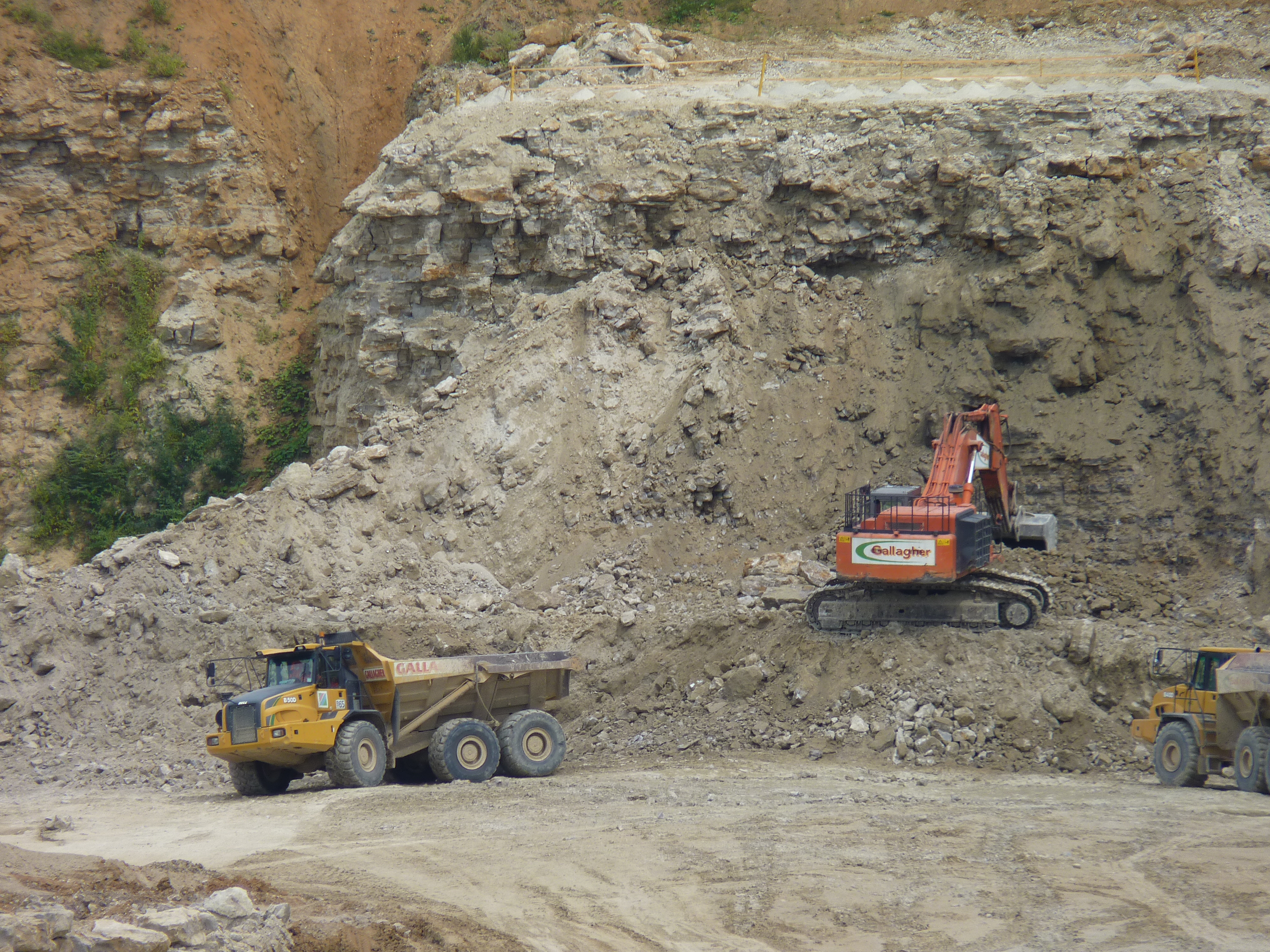
In 2011 Gallagher Aggregates applied to extend the Hermitage Quarry into Oaken Wood in the parish of Ditton. Planning committee chairman Richard King said that "local residents and environmental groups have argued that the loss of irreplaceable ancient woodland and impact on the local wildlife site is unacceptable. On balance, however, members felt the job prospects and the economic need for ragstone to support construction in the county in future, and benefits of the project, outweighed these objections."{{Citation |access-date=25 June 2011
Hosey Common, Westerham (TQ 454532)
The barred entrance to the disused mines can be found in woods in a shallow valley near the village. Dating from the 17th century, they produced stone for buildings such as Westerham Church. At least four different faces were worked although evidence of other workings is concealed by roof falls. The stone was transported on sledges with a gauge of 14.5ins. Parts of the mine have been backfilled because, it is believed, at times when the price of stone dropped only the best quality stone was excavated, with the poor quality material being stacked in the mine for convenience.{{Citation |access-date = 20 July 2011 |archive-url = https://web.archive.org/web/20111008031947/http://www.visitwesterham.org.uk/pdf/HoseyCaves-2.pdf |archive-date = 2011-10-08 |url-status = dead |access-date=20 July 2011 |archive-date=28 September 2011 |archive-url=https://web.archive.org/web/20110928194014/http://www.kurg.org.uk/sites/limestone.htm |url-status=dead
Laker House Quarry face, Canning Street, Maidstone (TQ 761569)
This is one of two ragstone outcrops that can be found in Maidstone town, and is valuable as an educational site for the earth sciences. At five to seven metres high the vertical face reveals alternating layers of well-cemented, glauconitic shelly limestone (ragstone) and softer weathering, glauconitic calcareous sand (hassock). Silicification and bioturbation are apparent.{{Citation |access-date = 14 July 2011
Loose Quarry, Quarry Wood (TQ 763518)
Work at the quarry ceased in the 1940s and the site is currently owned by Loose Scouts Group. Ragstone from the quarry was used for local buildings and also in the construction of the Loose Viaduct in 1830 by Thomas Telford. The quarry is within the 'Boughton Group' of the ragstone. Although abandoned, there is still some evidence of quarry working, such as a central over-burden roadway, overburden and spoil dumps. The rock face is a good example of ragstone and hassock layering together with others less common features resulting from cambering{{Citation |access-date=21 July 2011 |access-date = 14 July 2011
Offham Quarry

This quarry originated as a source of supply of aggregate to the road-building and construction industries, and has been used as a landfill site since the early 1980s. It is located south-west of the village and access is gained along the Teston Road. Like Borough Green (Stangate) Quarry, this site was once operated by ARC with trucks bringing domestic, commercial, industrial and inert waste from London to infill the excavated quarry floor.{{Citation |access-date=21 July 2011
West Farleigh Quarry (TQ 721520)
This disused and partly overgrown quarry is in 26 hectares of ancient mixed woodland located near West Farleigh. It provides an important site for the study of cambering (slope movement). Ragstone and hassock layers are well exposed, and the rocks are the same as those in which the fossil remains of an Iguanodon fossil were discovered at Bensted's Quarry, Maidstone. Today it is part of a Nature Reserve.{{Citation |access-date = 14 July 2011 |access-date = 21 July 2011 |archive-url = https://web.archive.org/web/20111001000028/http://www.kentwildlifetrust.org.uk/reserves/maidstone-low-weald-area/quarry-wood/ |archive-date = 2011-10-01 |url-status = dead
References
References
- [http://www.english-nature.org.uk/citation/citation_photo/1002844.pdf Allington Quarry]
- (1839). "Topography of Maidstone and its environs, and directory.of Maidstone".
- "Isles History".
- ''Ditton Quarry Nature Reserve'', Ditton Gazette, Spring 2009.
- "A report by Head of Planning Applications Group to Planning Applications Committee on 10 May 2011.". Kent County Council.
- Graham, Mary. (2013-07-13). "Government approves application to extend Hermitage Quarry in Maidstone". Kentonline.co.uk.
This article was imported from Wikipedia and is available under the Creative Commons Attribution-ShareAlike 4.0 License. Content has been adapted to SurfDoc format. Original contributors can be found on the article history page.
Ask Mako anything about Kentish ragstone — get instant answers, deeper analysis, and related topics.
Research with MakoFree with your Surf account
Create a free account to save articles, ask Mako questions, and organize your research.
Sign up freeThis content may have been generated or modified by AI. CloudSurf Software LLC is not responsible for the accuracy, completeness, or reliability of AI-generated content. Always verify important information from primary sources.
Report