From Surf Wiki (app.surf) — the open knowledge base
Karplus equation
Correlation used in NMR spectroscopy
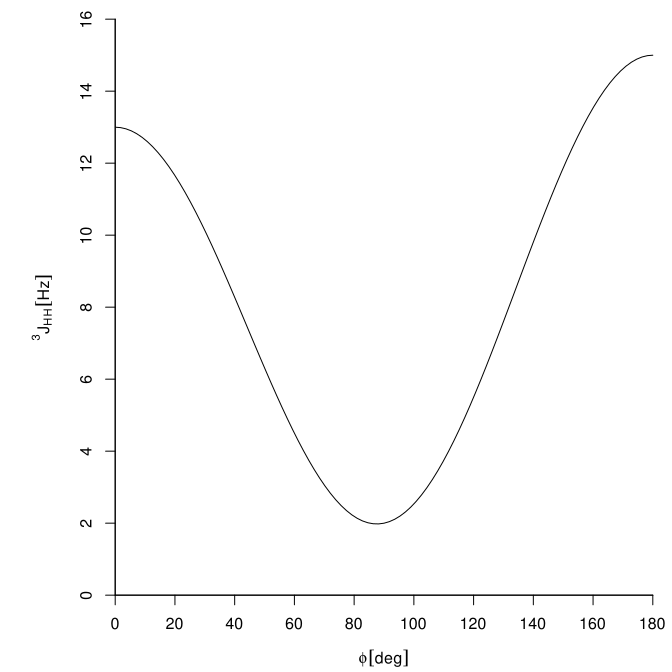
Correlation used in NMR spectroscopy
The Karplus equation, named after Martin Karplus, describes the correlation between 3J-coupling constants and dihedral torsion angles in nuclear magnetic resonance spectroscopy: :J(\phi) = A \cos,2\phi + B \cos,\phi + C
where J is the 3J coupling constant, \phi is the dihedral angle, and A, B, and C are empirically derived parameters whose values depend on the atoms and substituents involved. The relationship may be expressed in a variety of equivalent ways e.g. involving cos 2φ rather than cos2 φ —these lead to different numerical values of A, B, and C but do not change the nature of the relationship.
The relationship is used for 3JH,H coupling constants. The superscript "3" indicates that a 1H atom is coupled to another 1H atom three bonds away, via H-C-C-H bonds. (Such H atoms bonded to neighbouring carbon atoms are termed vicinal). The magnitude of these couplings are generally smallest when the torsion angle is close to 90° and largest at angles of 0 and 180°.
This relationship between local geometry and coupling constant is of great value throughout nuclear magnetic resonance spectroscopy and is particularly valuable for determining backbone torsion angles in protein NMR studies.
References
References
- Minch, M. J.. (1994). "Orientational Dependence of Vicinal Proton-Proton NMR Coupling Constants: The Karplus Relationship". [[Concepts in Magnetic Resonance]].
- Dalton, Louisa. (2003-12-22). "Karplus Equation". [[Chemical & Engineering News]].
- Karplus, Martin. (1959). "Contact Electron-Spin Coupling of Nuclear Magnetic Moments". [[J. Chem. Phys.]].
- Karplus, Martin. (1963). "Vicinal Proton Coupling in Nuclear Magnetic Resonance". [[J. Am. Chem. Soc.]].
This article was imported from Wikipedia and is available under the Creative Commons Attribution-ShareAlike 4.0 License. Content has been adapted to SurfDoc format. Original contributors can be found on the article history page.
Ask Mako anything about Karplus equation — get instant answers, deeper analysis, and related topics.
Research with MakoFree with your Surf account
Create a free account to save articles, ask Mako questions, and organize your research.
Sign up freeThis content may have been generated or modified by AI. CloudSurf Software LLC is not responsible for the accuracy, completeness, or reliability of AI-generated content. Always verify important information from primary sources.
Report