From Surf Wiki (app.surf) — the open knowledge base
Jupiter
Fifth planet from the Sun

Fifth planet from the Sun
| Field | Value | |||
|---|---|---|---|---|
| name | Jupiter | |||
| symbol | [[File:Jupiter symbol (bold).svg | 24px | class=skin-invert | ♃]] |
| image | Jupiter_OPAL_2024.png | |||
| image_alt | A full disk image of Jupiter taken by NASA's Hubble Space Telescope | |||
| caption | Jupiter in true colour, taken by the Hubble Space Telescope in January 2024Jupiter's atmosphere and its appearance constantly change, and hence its current appearance today may not resemble what it was when this image was taken. Depicted in this image, however, are a few features that remain consistent, such as the famous Great Red Spot, featured prominently in the lower right of the image, and the planet's recognisable banded appearance. | |||
| background | Wheat | |||
| named_after | Jupiter | |||
| orbit_ref | ||||
| epoch | J2000 | |||
| semimajor | 778.479 e6km | |||
| aphelion | 816.363 e6km | |||
| perihelion | 740.595 e6km | |||
| time_periastron | January 21, 2023 | |||
| eccentricity | ||||
| inclination | {{plainlist | |||
| * 1.303° to ecliptic<ref name | "VSOP87"/ | |||
| * 6.09° to Sun's equator<ref name | "VSOP87"/ | |||
| * 0.32° to invariable plane<ref name | Souami_Souchay_2012/ | |||
| asc_node | 100.464° | |||
| arg_peri | 273.867° | |||
| mean_anomaly | 20.020° | |||
| period | {{plainlist | |||
| * {{val | 11.862 | u | yr}} | |
| * {{val | fmt | commas | 4332.59 | u=days}} |
| * {{val | fmt | commas | 10476.8 | u=Jovian solar days}} |
| synodic_period | ||||
| avg_speed | ||||
| satellites | 97 () | |||
| physical_ref | ||||
| flattening | ||||
| equatorial_radius | Refers to the level of 1 bar atmospheric pressure{{plainlist | |||
| * {{val | 11.209 | u | × of Earth's}} | |
| * {{val | 0.10276 | u | × of Sun's}} | |
| polar_radius | ||||
| mean_radius | ||||
| surface_area | ||||
| volume | ||||
| mass | {{plainlist | |||
| * {{val | 317.8 | u | × of Earth's}} | |
| * {{val | 0.00095 | u | × of Sun's}} | |
| density | Based on the volume within the level of 1 bar atmospheric pressure | |||
| surface_grav | 24.79 m/s2 | |||
| moment_of_inertia_factor | ||||
| escape_velocity | ||||
| rotation | (9 h 55 m 33 s) | |||
| sidereal_day | 9.9250 hours (9 h 55 m 30 s) | |||
| rot_velocity | ||||
| axial_tilt | 3.13° (to orbit) | |||
| right_asc_north_pole | 268.057°; | |||
| declination | 64.495° | |||
| albedo | ||||
| magnitude | −2.94 to −1.66 | |||
| abs_magnitude | −9.4 | |||
| angular_size | 29.8" to 50.1" | |||
| pronounced | ||||
| adjectives | Jovian () | |||
| single_temperature | 88 K (blackbody temperature) | |||
| temp_name1 | 1 bar | |||
| mean_temp_1 | 165 K | |||
| temp_name2 | 0.1 bar | |||
| min_temp_2 | 78 K | |||
| mean_temp_2 | 128 K | |||
| atmosphere | yes | |||
| atmosphere_ref | ||||
| surface_pressure | 200-600 kPa | |||
| (opaque cloud deck) | ||||
| scale_height | 27 km | |||
| atmosphere_composition | {{Unbulleted indent list | |||
| {{val | 89 | 2.0 | u | %}} hydrogen |
| {{val | 10 | 2.0 | u | %}} helium |
| {{val | 0.3 | 0.1 | u | %}} methane |
| {{val | 0.026 | 0.004 | u | %}} ammonia |
| {{val | 0.0028 | 0.001 | u | %}} hydrogen deuteride |
| {{val | 0.0006 | 0.0002 | u | %}} ethane |
| {{val | 0.0004 | 0.0004 | u | %}} water |
the planet
-
1.303° to ecliptic
-
6.09° to Sun's equator
-
0.32° to invariable plane
(opaque cloud deck) | hydrogen | helium | methane | ammonia | hydrogen deuteride | ethane | water
Jupiter is the fifth planet from the Sun, and the largest in the Solar System. It is a gas giant with a mass nearly 2.5 times that of all the other planets in the Solar System combined and slightly less than one-thousandth the mass of the Sun. Its diameter is 11 times that of Earth and a tenth that of the Sun. Jupiter orbits the Sun at a distance of 778.479 Gm, with an orbital period of . It is the third-brightest natural object in the Earth's night sky, after the Moon and Venus, and has been observed since prehistoric times. Its name derives from that of Jupiter, the chief deity of ancient Roman religion.
Jupiter was the first of the Sun's planets to form, and its inward migration during the primordial phase of the Solar System affected much of the formation history of the other planets. Jupiter's atmosphere consists of 76% hydrogen and 24% helium by mass, with a denser interior. It contains traces of the elements carbon, oxygen, sulfur, neon, and compounds such as ammonia, water vapour, phosphine, hydrogen sulfide, and hydrocarbons. Jupiter's helium abundance is 80% of the Sun's, similar to Saturn's composition.
The outer atmosphere is divided into a series of latitudinal bands, with turbulence and storms along their interacting boundaries; the most obvious result of this is the Great Red Spot, a giant storm that has been recorded since 1831. Because of its rapid rotation rate, one turn in ten hours, Jupiter is an oblate spheroid; it has a slight but noticeable 6.5% bulge around the equator compared to its poles. Its internal structure is believed to consist of an outer mantle of fluid metallic hydrogen and a diffuse inner core of denser material. The ongoing contraction of Jupiter's interior generates more heat than the planet receives from the Sun. Jupiter's magnetic field is the strongest and second-largest contiguous structure in the Solar System, generated by eddy currents within the fluid, metallic hydrogen core. The solar wind interacts with the magnetosphere, extending it outward and affecting Jupiter's orbit.
At least 97 moons orbit the planet; the four largest moons—Io, Europa, Ganymede, and Callisto—orbit within the magnetosphere and are visible with common binoculars. Ganymede, the largest of the four, is larger than the planet Mercury. Jupiter is surrounded by a faint system of planetary rings. The rings of Jupiter consist mainly of dust and have three main segments: an inner torus of particles known as the halo, a relatively bright main ring, and an outer gossamer ring. The rings have a reddish colour in visible and near-infrared light. The age of the ring system is unknown, possibly dating back to Jupiter's formation. Since 1973, Jupiter has been visited by nine robotic probes: seven flybys and two dedicated orbiters (with two more en route). Jupiter-like exoplanets have also been found in other planetary systems.
Name and symbol
In both the ancient Greek and Roman civilizations, Jupiter was named after the chief god of the divine pantheon: Zeus to the Greeks and Jupiter to the Romans. The International Astronomical Union formally adopted the name Jupiter for the planet in 1976 and has since named its newly discovered satellites for the god's lovers, favourites, and descendants. The planetary symbol for Jupiter, [[File:Jupiter symbol (fixed width).svg|16px|♃|class=skin-invert]], descends from a Greek zeta with a horizontal stroke, , as an abbreviation for Zeus.
In Latin, Iovis is the genitive case of Iuppiter, i.e. Jupiter. It is associated with the etymology of Zeus ('sky father'). The English equivalent, Jove, is known to have come into use as a poetic name for the planet around the 14th century.
Jovian is the adjectival form of Jupiter. The older adjectival form jovial, employed by astrologers in the Middle Ages, has come to mean 'happy' or 'merry', moods ascribed to Jupiter's influence in astrology.
The original Greek deity Zeus supplies the root zeno-, which is used to form some Jupiter-related words, such as zenography.
Formation and migration
Main article: Grand tack hypothesis
Jupiter is believed to be the oldest planet in the Solar System, having formed just one million years after the Sun and roughly 50 million years before Earth. Current models of Solar System formation suggest that Jupiter formed at or beyond the snow line: a distance from the early Sun where the temperature was sufficiently cold for volatiles such as water to condense into solids. First forming a solid core, the planet then accumulated its gaseous atmosphere. Therefore, the planet must have formed before the solar nebula was fully dispersed. During its formation, Jupiter's mass gradually increased until it had 20 times the mass of the Earth, approximately half of which was made up of silicates, ices and other heavy-element constituents.
According to the "grand tack hypothesis", Jupiter began to form at a distance of roughly 3.5 AU from the Sun. As the young planet accreted mass, its interaction with the gas disk orbiting the Sun and the orbital resonances from Saturn caused it to migrate inwards. This upset the orbits of several super-Earths orbiting closer to the Sun, causing them to collide destructively. This changed the direction of migration, causing them to migrate away from the Sun and out of the inner system to their current locations. All of this happened over a period of 3–6million years, with the final migration of Jupiter occurring over several hundred thousand years.{{cite journal |archive-url=https://web.archive.org/web/20170314171306/http://news.nationalgeographic.com/2015/03/150324-jupiter-super-earth-collisions-planets-astronomy-sky-watching/ |archive-date=March 14, 2017 |access-date=April 18, 2021
There are several unresolved issues with the grand tack hypothesis. The resulting formation timescales of terrestrial planets appear to be inconsistent with the measured elemental composition. Jupiter would likely have settled into an orbit much closer to the Sun if it had migrated through the solar nebula. Some competing models of Solar System formation predict the formation of Jupiter with orbital properties that are close to those of the present-day planet. Other models predict Jupiter forming at distances much further out, such as 18 AU.
According to the Nice model, the infall of proto-Kuiper belt objects over the first 600 million years of Solar System history caused Jupiter and Saturn to migrate from their initial positions into a 1:2 resonance, which caused Saturn to shift into a higher orbit, disrupting the orbits of Uranus and Neptune, depleting the Kuiper belt, and triggering the Late Heavy Bombardment.
According to the Jumping-Jupiter scenario, Jupiter's migration through the early Solar System could have led to the ejection of a fifth gas giant. This hypothesis suggests that during its orbital migration, Jupiter's gravitational influence disrupted the orbits of other gas giants, potentially casting one planet out of the Solar System entirely. The dynamics of such an event would have dramatically altered the formation and configuration of the Solar System, leaving behind only the four gas giants humans observe today.
Based on Jupiter's composition, researchers have made the case for an initial formation outside the molecular nitrogen (N2) snow line, which is estimated at 20 - from the Sun, and possibly even outside the argon snow line, which may be as far as 40 AU. Having formed at one of these extreme distances, Jupiter would then have, over a roughly 700,000-year period, migrated inwards to its current location, during an epoch approximately 2–3 million years after the planet began to form. In this model, Saturn, Uranus, and Neptune would have formed even further out than Jupiter, and Saturn would also have migrated inwards.
Physical characteristics
Jupiter is a gas giant, meaning its chemical composition is primarily hydrogen and helium. These materials are classified as gasses in planetary geology, a term that does not denote the state of matter. It is the largest planet in the Solar System, with a diameter of 142984 km at its equator, giving it a volume 1,321 times that of the Earth. Its average density, 1.326 g/cm3, is lower than those of the four terrestrial planets.
Composition
The atmosphere of Jupiter is approximately 76% hydrogen and 24% helium by mass. By volume, the upper atmosphere is about 90% hydrogen and 10% helium, with the lower proportion owing to the individual helium atoms being more massive than the molecules of hydrogen formed in this part of the atmosphere.{{cite journal| title=NOTE: New Constraints on the Composition of Jupiter from Galileo Measurements and Interior Models | last1=Guillot | first1=Tristan | last2=Gautier | first2=Daniel | last3=Hubbard | first3=William B. |journal=Icarus | volume=130 | issue=2 | pages=534–539 | date=December 1997 | doi=10.1006/icar.1997.5812 | arxiv=astro-ph/9707210 | bibcode=1997Icar..130..534G
The atmospheric proportions of hydrogen and helium are close to the theoretical composition of the primordial solar nebula. Neon in the upper atmosphere consists of 20 parts per million by mass, which is about a tenth as abundant as in the Sun. Jupiter's helium abundance is about 80% that of the Sun due to the precipitation of these elements as helium-rich droplets, a process that happens deep in the planet's interior.
Based on spectroscopy, Saturn is thought to be similar in composition to Jupiter, but the other giant planets Uranus and Neptune have relatively less hydrogen and helium and relatively more of the next most common elements, including oxygen, carbon, nitrogen, and sulfur. These planets are known as ice giants because during their formation, these elements are thought to have been incorporated into them as ice; however, they probably contain very little ice.
Size and mass
Main article: Jupiter mass
Jupiter is about eleven times wider than the Earth (); while its mass is 318 times that of Earth which is 2.5 times the mass of all the other planets in the Solar System combined. It is so massive that its barycentre with the Sun lies above the Sun's surface at 1.068 solar radii from the Sun's centre. Jupiter's radius is about one tenth the radius of the Sun (), and its mass is one thousandth the mass of the Sun, meaning the densities of the two bodies are similar. A "Jupiter mass" ( or ) is used as a unit to describe masses of other objects, particularly extrasolar planets and brown dwarfs. For example, the extrasolar planet HD 209458 b has a mass of , while the brown dwarf Gliese 229 b has a mass of .
Jupiter radiates more heat than it receives through solar radiation, due to the Kelvin–Helmholtz mechanism within its contracting interior.{{cite book | access-date=April 23, 2022 | archive-date=June 19, 2024 | archive-url=https://web.archive.org/web/20240619015914/https://books.google.com/books?id=p8wCsJweUb0C&pg=PA62#v=onepage&q&f=false | url-status=live
Theoretical models indicate that if Jupiter had over 40% more mass, the interior would be so compressed that its volume would decrease despite the increasing amount of matter. For smaller changes in its mass, the radius would not change appreciably. As a result, Jupiter is thought to have about as large a diameter as a planet of its composition and evolutionary history can achieve. The process of further shrinkage with increasing mass would continue until appreciable stellar ignition was achieved.{{cite journal
Internal structure
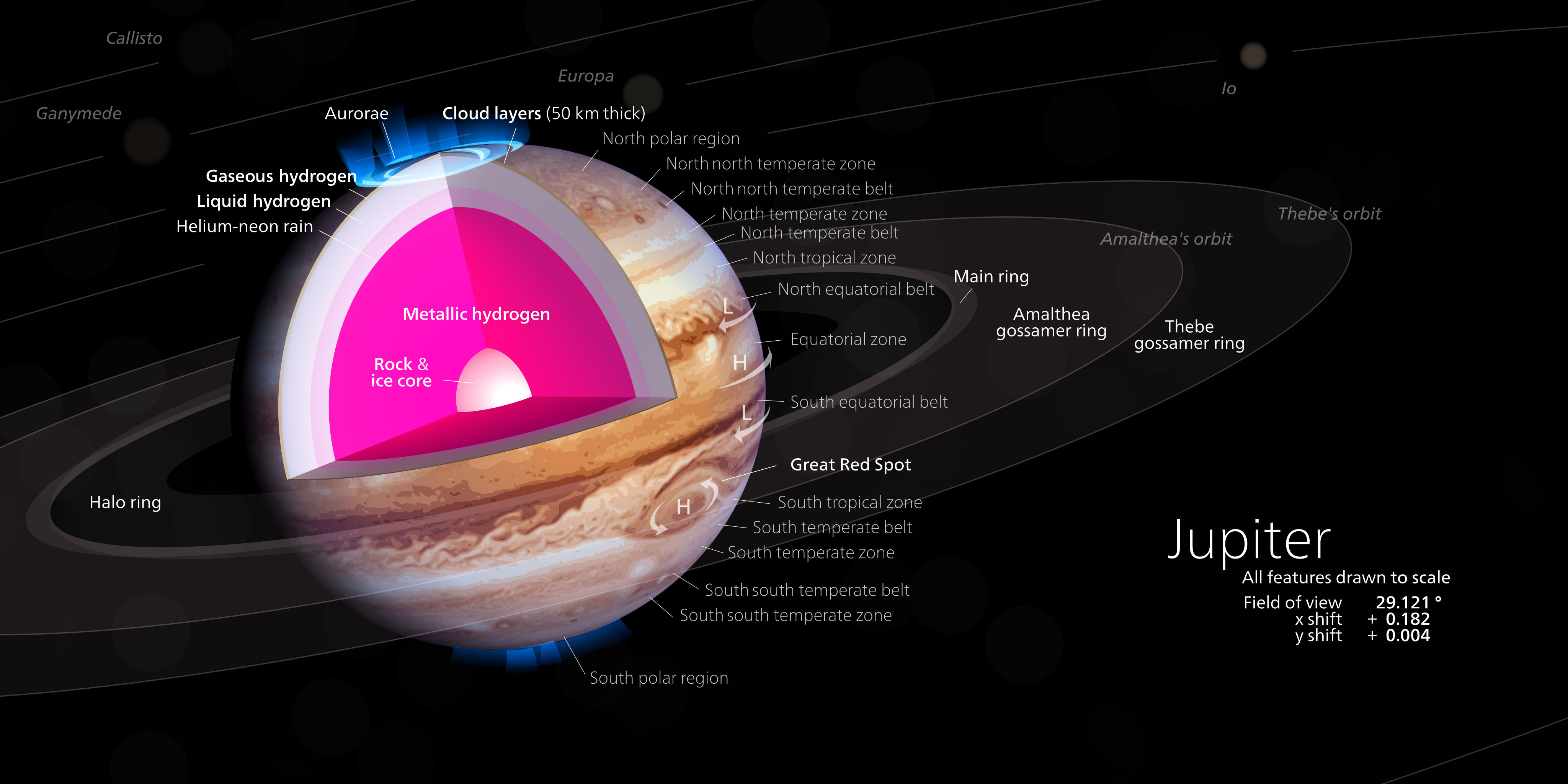
Before the early 21st century, most scientists proposed one of two scenarios for the formation of Jupiter. If the planet accreted first as a solid body, it would consist of a dense core, a surrounding layer of fluid metallic hydrogen (with some helium) extending outward to about 80% of the radius of the planet, and an outer atmosphere consisting primarily of molecular hydrogen. Alternatively, if the planet collapsed directly from the gaseous protoplanetary disk, it was expected to completely lack a core, consisting instead of a denser and denser fluid (predominantly molecular and metallic hydrogen) all the way to the centre. Data from the Juno mission showed that Jupiter has a diffuse core that mixes into its mantle, extending for 30–50% of the planet's radius, and comprising heavy elements with a combined mass 7–25 times the Earth. This mixing process could have arisen during formation, while the planet accreted solids and gases from the surrounding nebula. Alternatively, it could have been caused by an impact from a planet of about ten Earth masses a few million years after Jupiter's formation, which would have disrupted an originally compact Jovian core.
Outside the layer of metallic hydrogen lies a transparent interior atmosphere of hydrogen. At this depth, the pressure and temperature are above molecular hydrogen's critical pressure of 1.3 MPa and critical temperature of 33 K. In this state, there are no distinct liquid and gas phases—hydrogen is said to be in a supercritical fluid state. The hydrogen and helium gas extending downward from the cloud layer gradually transitions to a liquid in deeper layers, possibly resembling something akin to an ocean of liquid hydrogen and other supercritical fluids. Physically, the gas gradually becomes hotter and denser as depth increases.
Rain-like droplets of helium and neon precipitate downward through the lower atmosphere, depleting the abundance of these elements in the upper atmosphere. Calculations suggest that helium drops separate from metallic hydrogen at a radius of 60000 km (11000 km below the cloud tops) and merge again at 50000 km (22000 km beneath the clouds).{{cite journal
The temperature and pressure inside Jupiter increase steadily inward as the heat of planetary formation can only escape by convection. At a surface depth where the atmospheric pressure level is about one standard Earth atmosphere (about 1 bar), the temperature is around 165 K. The region where supercritical hydrogen changes gradually from a molecular fluid to a metallic fluid spans pressure ranges of 500000 - with temperatures of 5000 -, respectively. The temperature of Jupiter's diluted core is estimated to be 20000 K with a pressure of around 40 e6bar.
Atmosphere
Main article: Atmosphere of Jupiter
The atmosphere of Jupiter is primarily composed of molecular hydrogen and helium, with a smaller amount of other compounds such as water, methane, hydrogen sulfide, and ammonia. Jupiter's atmosphere extends to a depth of approximately 3000 km below the cloud layers.
Cloud layers
Jupiter is perpetually covered with clouds of ammonia crystals, which may contain ammonium hydrosulfide as well. The clouds are located in the tropopause layer of the atmosphere, forming bands at different latitudes, known as tropical regions. These are subdivided into lighter-hued zones and darker belts. The interactions of these conflicting circulation patterns cause storms and turbulence. Wind speeds of 100 m/s are common in zonal jet streams.{{cite book | editor1-first=Fran | editor1-last=Bagenal | editor2-first=Timothy E. | editor2-last=Dowling | editor3-first=William B. | editor3-last=McKinnon | publication-place=Cambridge, UK | access-date=March 8, 2022 }} The zones have been observed to vary in width, colour and intensity from year to year, but they have remained stable enough for scientists to name them.
The cloud layer is about 50 km deep and consists of at least two decks of ammonia clouds: a thin, clearer region on top and a thicker, lower deck. There may be a thin layer of water clouds underlying the ammonia clouds, as suggested by flashes of lightning detected in the atmosphere of Jupiter. These electrical discharges can be up to a thousand times as powerful as lightning on Earth. The water clouds are assumed to generate thunderstorms in the same way as terrestrial thunderstorms, driven by the heat rising from the interior. The Juno mission revealed the presence of "shallow lightning" which originates from ammonia-water clouds relatively high in the atmosphere. These discharges carry "mushballs" of water-ammonia slushes covered in ice, which fall deep into the atmosphere.{{cite journal
The orange and brown colours in the clouds of Jupiter are caused by upwelling compounds that change colour when they are exposed to ultraviolet light from the Sun. The exact makeup remains uncertain, but the substances are thought to be made up of phosphorus, sulfur or possibly hydrocarbons. These colourful compounds, known as chromophores, mix with the warmer clouds of the lower deck. The light-coloured zones are formed when rising convection cells form crystallising ammonia that hides the chromophores from view.
Jupiter has a low axial tilt, thus ensuring that the poles always receive less solar radiation than the planet's equatorial region. Convection within the interior of the planet transports energy to the poles, balancing out temperatures at the cloud layer.
Great Red Spot and other vortices
A well-known feature of Jupiter is the Great Red Spot, a persistent anticyclonic storm located 22° south of the equator. It was first observed in 1831, and possibly as early as 1665. Images by the Hubble Space Telescope have shown two more "red spots" adjacent to the Great Red Spot. The storm is visible through Earth-based telescopes with an aperture of 12 cm or larger. The storm rotates counterclockwise, with a period of about six days. The maximum altitude of this storm is about 8 km above the surrounding cloud tops. The Spot's composition and the source of its red colour remain uncertain, although photodissociated ammonia reacting with acetylene is a likely explanation.
The Great Red Spot is larger than the Earth. Mathematical models suggest that the storm is stable and will be a permanent feature of the planet. However, it has significantly decreased in size since its discovery. Initial observations in the late 1800s showed it to be approximately 25500 mi across. , the storm was measured at approximately 10250 by, and was decreasing in length by about 580 mi per year. In October 2021, a Juno flyby mission measured the depth of the Great Red Spot, putting it at around 300 -.
Juno missions found several cyclone groups at Jupiter's poles. The northern group contains nine cyclones, with a large one in the centre and eight others around it, while its southern counterpart also consists of a centre vortex but is surrounded by five large storms and a single smaller one for a total of seven storms.
In 2000, an atmospheric feature formed in the southern hemisphere that is similar in appearance to the Great Red Spot, but smaller. This was created when smaller, white oval-shaped storms merged to form a single feature—these three smaller white ovals were formed in 1939–1940. The merged feature was named Oval BA. It has since increased in intensity and changed from white to red, earning it the nickname "Little Red Spot".
In April 2017, a "Great Cold Spot" was discovered in Jupiter's thermosphere at its north pole. This feature is 24000 km across, 12000 km wide, and 200 C-change cooler than surrounding material. While this spot changes form and intensity over the short term, it has maintained its general position in the atmosphere for more than 15 years. It may be a giant vortex similar to the Great Red Spot, and appears to be quasi-stable like the vortices in Earth's thermosphere. This feature may be formed by interactions between charged particles generated from Io and the strong magnetic field of Jupiter, resulting in a redistribution of heat flow.
Magnetosphere
Main article: Magnetosphere of Jupiter
Jupiter's magnetic field is the strongest of any planet in the Solar System, with a dipole moment of 4.170 G that is tilted at an angle of 10.31° to the pole of rotation. The surface magnetic field strength varies from 2 G up to 20 G. This field is thought to be generated by eddy currents—swirling movements of conducting materials—within the fluid, metallic hydrogen core. At about 75 Jupiter radii from the planet, the interaction of the magnetosphere with the solar wind generates a bow shock. Surrounding Jupiter's magnetosphere is a magnetopause, located at the inner edge of a magnetosheath—a region between it and the bow shock. The solar wind interacts with these regions, elongating the magnetosphere on Jupiter's lee side and extending it outward until it nearly reaches the orbit of Saturn. The four largest moons of Jupiter all orbit within the magnetosphere, which protects them from solar wind.
The volcanoes on the moon Io emit large amounts of sulfur dioxide, forming a gas torus along its orbit. The gas is ionized in Jupiter's magnetosphere, producing sulfur and oxygen ions. They, together with hydrogen ions originating from the atmosphere of Jupiter, form a plasma sheet in Jupiter's equatorial plane. The plasma in the sheet co-rotates with the planet, causing deformation of the dipole magnetic field into that of a magnetodisk. Electrons within the plasma sheet generate a strong radio signature, with short, superimposed bursts in the range of 0.6–30 MHz that are detectable from Earth with consumer-grade shortwave radio receivers. As Io moves through this torus, the interaction generates Alfvén waves that carry ionized matter into the polar regions of Jupiter. As a result, radio waves are generated through a cyclotron maser mechanism, and the energy is transmitted out along a cone-shaped surface. When Earth intersects this cone, the radio emissions from Jupiter can exceed the radio output of the Sun.
Planetary rings
Main article: Rings of Jupiter
]] Jupiter has a faint planetary ring system composed of three main segments: an inner torus of particles known as the halo, a relatively bright main ring, and an outer gossamer ring. These rings appear to be made of dust, whereas Saturn's rings are made of ice. The main ring is most likely made out of material ejected from the satellites Adrastea and Metis, which is drawn into Jupiter because of the planet's strong gravitational influence. New material is added by additional impacts. In a similar way, the moons Thebe and Amalthea are believed to produce the two distinct components of the dusty gossamer ring. There is evidence of a fourth ring that may consist of collisional debris from Amalthea that is strung along the same moon's orbit.
Orbit and rotation

Jupiter is the only planet whose barycentre with the Sun lies outside the volume of the Sun, though by 7% of the Sun's radius. The average distance between Jupiter and the Sun is 778 e6km and it completes an orbit every 11.86 years. This is approximately two-fifths the orbital period of Saturn, forming a near orbital resonance. The orbital plane of Jupiter is inclined 1.30° compared to Earth. Because the eccentricity of its orbit is 0.049, Jupiter is slightly over 75 million km nearer the Sun at perihelion than aphelion, which means that its orbit is nearly circular. This low eccentricity is at odds with exoplanet discoveries, which have revealed Jupiter-sized planets with very high eccentricities. Models suggest this may be due to there being two giant planets in the Solar System, as the presence of a third or more giant planets tends to induce larger eccentricities.
The axial tilt of Jupiter is 3.13°, which is relatively small, so its seasons are insignificant compared to those of Earth and Mars.
Jupiter's rotation is the fastest of all the Solar System's planets, completing a rotation on its axis in slightly less than ten hours; this creates an equatorial bulge easily seen through an amateur telescope. Because Jupiter is not a solid body, its upper atmosphere undergoes differential rotation. The rotation of Jupiter's polar atmosphere is about five minutes longer than that of the equatorial atmosphere. The planet is an oblate spheroid, meaning that the diameter across its equator is longer than the diameter measured between its poles. On Jupiter, the equatorial diameter is 9276 km longer than the polar diameter.
Three systems are used as frames of reference for tracking planetary rotation, particularly when graphing the motion of atmospheric features. System I applies to latitudes from 7° N to 7° S; its period is the planet's shortest, at 9h 50 m 30.0s. System II applies at latitudes north and south of these; its period is 9h 55 m 40.6s. System III was defined by radio astronomers and corresponds to the rotation of the planet's magnetosphere; its period is Jupiter's official rotation.
Observation

Jupiter is usually the fourth-brightest object in the sky (after the Sun, the Moon, and Venus), although at opposition Mars can appear brighter than Jupiter. Depending on Jupiter's position with respect to the Earth, it can vary in visual magnitude from as bright as −2.94 at opposition down to −1.66 during conjunction with the Sun. The mean apparent magnitude is −2.20 with a standard deviation of 0.33. The angular diameter of Jupiter likewise varies from 50.1 to 30.5 arc seconds. Favourable oppositions occur when Jupiter is passing through the perihelion of its orbit, bringing it closer to Earth. Near opposition, Jupiter will appear to go into retrograde motion for a period of about 121 days, moving backward through an angle of 9.9° before returning to prograde movement.{{cite book | access-date=March 19, 2023 | archive-date=March 26, 2023 | archive-url=https://web.archive.org/web/20230326164802/https://books.google.com/books?id=GnrAVhVZ3wMC&pg=PA140 | url-status=live
Because the orbit of Jupiter is outside that of Earth, the phase angle of Jupiter as viewed from Earth is always less than 11.5°; thus, Jupiter always appears nearly fully illuminated when viewed through Earth-based telescopes. It was during spacecraft missions to Jupiter that crescent views of the planet were obtained.{{cite book | chapter-url=https://history.nasa.gov/SP-349/ch8.htm | access-date=February 17, 2007 | archive-date=December 25, 2017 | archive-url=https://web.archive.org/web/20171225230634/https://history.nasa.gov/SP-349/sp349.htm | url-status=live
History
Pre-telescopic research
Observations of Jupiter are attested with the Babylonian astronomers during the 7th–8th centuries BC. The ancient Chinese knew Jupiter as the ' star' (zh 歲星) and established their cycle of twelve earthly branches based on the approximate number of years it takes Jupiter to revolve around the Sun; the Chinese language still uses its name (歲; simplified as 岁) when referring to years of age. By the 4th century BC, these observations had developed into the Chinese zodiac, and each year became associated with a Tai Sui star and god controlling the region of the heavens opposite Jupiter's position in the night sky. These beliefs survive in some Taoist and folk religious practices and in the East Asian zodiac's twelve animals. The Chinese historian Xi Zezong has claimed that Gan De, an ancient Chinese astronomer, reported a small star "in alliance" with the planet, which may indicate a sighting of one of Jupiter's moons with the unaided eye. If true, this would predate Galileo's discovery by nearly two millennia.
A 2016 paper reports that trapezoidal rule was used by Babylonians before 50 BC for integrating the velocity of Jupiter along the ecliptic. In his 2nd century work the Almagest, the Hellenistic astronomer Claudius Ptolemaeus constructed a geocentric planetary model based on deferents and epicycles to explain Jupiter's motion relative to Earth, giving its orbital period around Earth as 4332.38 days, or 11.86 years.
Ground-based telescope research
In 1610, Italian polymath Galileo Galilei discovered the four largest moons of Jupiter (now known as the Galilean moons) using a telescope. This is thought to be the first telescopic observation of moons other than Earth's. Just one day after Galileo, Simon Marius independently discovered moons around Jupiter, though he did not publish his discovery in a book until 1614. It was Marius's names for the major moons, however, that stuck: Io, Europa, Ganymede, and Callisto. The discovery was a major point in favour of the heliocentric theory of the motions of the planets by Nicolaus Copernicus; Galileo's outspoken support of the Copernican theory led to him being tried and condemned by the Inquisition.
In the autumn of 1639, the Neapolitan optician Francesco Fontana tested a 22-palm telescope of his own making and discovered the characteristic bands of the planet's atmosphere.
During the 1660s, Giovanni Cassini used a new telescope to discover spots in Jupiter's atmosphere, observe that the planet appeared oblate, and estimate its rotation period. In 1692, Cassini noticed that the atmosphere undergoes a differential rotation.{{cite journal
The Great Red Spot may have been observed as early as 1664 by Robert Hooke and in 1665 by Cassini, although this is disputed. The pharmacist Heinrich Schwabe produced the earliest known drawing to show details of the Great Red Spot in 1831. The Red Spot was reportedly lost from sight on several occasions between 1665 and 1708 before becoming quite conspicuous in 1878.{{cite book | access-date=March 19, 2023 | archive-date=March 26, 2023 | archive-url=https://web.archive.org/web/20230326164803/https://books.google.com/books?id=SO48AAAAIAAJ&pg=PA188 | url-status=live
Both Giovanni Borelli and Cassini made careful tables of the motions of Jupiter's moons, which allowed predictions of when the moons would pass before or behind the planet. By the 1670s, Cassini observed that when Jupiter was on the opposite side of the Sun from Earth, these events would occur about 17 minutes later than expected. Ole Rømer deduced that light does not travel instantaneously (a conclusion that Cassini had earlier rejected), and this timing discrepancy was used to estimate the speed of light.{{cite journal
In 1892, E. E. Barnard observed a fifth satellite of Jupiter with the 36 in refractor at Lick Observatory in California. This moon was later named Amalthea. It was the last planetary moon to be discovered directly by a visual observer through a telescope. An additional eight satellites were discovered before the flyby of the Voyager 1 probe in 1979.
In 1932, Rupert Wildt identified absorption bands of ammonia and methane in the spectra of Jupiter. Three long-lived anticyclonic features called "white ovals" were observed in 1938. For several decades, they remained as separate features in the atmosphere that approach each other but never merge. Finally, two of the ovals merged in 1998, then absorbed the third in 2000, becoming Oval BA.
Radiotelescope research
In 1955, Bernard Burke and Kenneth Franklin discovered that Jupiter emits bursts of radio waves at a frequency of 22.2 MHz. The period of these bursts matched the rotation of the planet, and they used this information to determine a more precise value for Jupiter's rotation rate. Radio bursts from Jupiter were found to come in two forms: long bursts (or L-bursts) lasting up to several seconds, and short bursts (or S-bursts) lasting less than a hundredth of a second.
Scientists have discovered three forms of radio signals transmitted from Jupiter:
- Decametric radio bursts (with a wavelength of tens of metres) vary with the rotation of Jupiter, and are influenced by the interaction of Io with Jupiter's magnetic field.
- Decimetric radio emission (with wavelengths measured in centimetres) was first observed by Frank Drake and Hein Hvatum in 1959. The origin of this signal is a torus-shaped belt around Jupiter's equator, which generates cyclotron radiation from electrons that are accelerated in Jupiter's magnetic field.
- Thermal radiation is produced by heat in the atmosphere of Jupiter.
Exploration
Main article: Exploration of Jupiter
Jupiter has been visited by automated spacecraft since 1973, when the space probe Pioneer 10 passed close enough to Jupiter to send back revelations about its properties and phenomena. Missions to Jupiter are accomplished at a cost in energy, which is described by the net change in velocity of the spacecraft, or delta-v. Entering a Hohmann transfer orbit from Earth to Jupiter from low Earth orbit requires a delta-v of 6.3 km/s, which is comparable to the 9.7 km/s delta-v needed to reach low Earth orbit.{{cite web | archive-url=https://web.archive.org/web/20060715015836/http://www.pma.caltech.edu/~chirata/deltav.html | archive-date=July 15, 2006 }} Gravity assists through planetary flybys can be used to reduce the energy required to reach Jupiter.
Flyby missions
| Spacecraft | Closest | |
|---|---|---|
| approach | Distance (km) | |
| *Pioneer 10* | December 3, 1973 | 130,000 |
| *Pioneer 11* | December 4, 1974 | 34,000 |
| *Voyager 1* | March 5, 1979 | 349,000 |
| *Voyager 2* | July 9, 1979 | 570,000 |
| *Ulysses* | February 8, 1992 | 408,894 |
| February 4, 2004 | 120,000,000 | |
| *Cassini* | December 30, 2000 | 10,000,000 |
| *New Horizons* | February 28, 2007 | 2,304,535 |
Beginning in 1973, several spacecraft performed planetary flyby manoeuvres that brought them within the observation range of Jupiter. The Pioneer missions obtained the first close-up images of Jupiter's atmosphere and several of its moons. They discovered that the radiation fields near the planet were much stronger than expected, but both spacecraft managed to survive in that environment. The trajectories of these spacecraft were used to refine the mass estimates of the Jovian system. Radio occultations by the planet resulted in better measurements of Jupiter's diameter and the amount of polar flattening.
Six years later, the Voyager missions vastly improved the understanding of the Galilean moons and discovered Jupiter's rings. They also confirmed that the Great Red Spot was anticyclonic. Comparison of images showed that the Spot had changed hues since the Pioneer missions, turning from orange to dark brown. A torus of ionized atoms was discovered along Io's orbital path, which were found to come from erupting volcanoes on the moon's surface. As the spacecraft passed behind the planet, it observed flashes of lightning in the night side atmosphere.
The next mission to encounter Jupiter was the Ulysses solar probe. In February 1992, it performed a flyby manoeuvre to attain a polar orbit around the Sun. During this pass, the spacecraft studied Jupiter's magnetosphere, although it had no cameras to photograph the planet. The spacecraft passed by Jupiter six years later, this time at a much greater distance.
In 2000, the Cassini probe flew by Jupiter on its way to Saturn, and provided higher-resolution images.
The New Horizons probe flew by Jupiter in 2007 for a gravity assist en route to Pluto. The probe's cameras measured plasma output from volcanoes on Io and studied all four Galilean moons in detail.
''Galileo'' mission
Main article: Galileo (spacecraft)

The first spacecraft to orbit Jupiter was the Galileo mission, which reached the planet on December 7, 1995. It remained in orbit for over seven years, conducting multiple flybys of all the Galilean moons and Amalthea. The spacecraft also witnessed the impact of Comet Shoemaker–Levy 9 when it collided with Jupiter in 1994. Some of the goals for the mission were thwarted due to a malfunction in Galileos high-gain antenna.
A 340-kilogram titanium atmospheric probe was released from the spacecraft in July 1995, entering Jupiter's atmosphere on December 7. It parachuted through 150 km of the atmosphere at a speed of about 2575 kph and collected data for 57.6 minutes until the spacecraft was destroyed. The Galileo orbiter itself experienced a more rapid version of the same fate when it was deliberately steered into the planet on September 21, 2003. NASA destroyed the spacecraft to avoid any possibility of the spacecraft crashing into and possibly contaminating the moon Europa, which may harbour life.
Data from this mission revealed that hydrogen composes up to 90% of Jupiter's atmosphere. The recorded temperature was more than 300 C, and the wind speed measured more than 644 km/h (400 mph) before the probes vaporized.
''Juno'' mission
Main article: Juno (spacecraft)

NASA's Juno mission arrived at Jupiter on July 4, 2016, with the goal of studying the planet in detail from a polar orbit. The spacecraft was originally intended to orbit Jupiter thirty-seven times over a period of twenty months.{{cite web | access-date=April 27, 2022 | archive-date=May 12, 2022 | archive-url=https://web.archive.org/web/20220512174710/https://www.planetary.org/space-missions/juno | url-status=live
Juno completed 12 orbits before the end of its budgeted mission plan, ending in July 2018. In June of that year, NASA extended the mission operations plan to July 2021, and in January of that year the mission was extended to September 2025 with four lunar flybys: one of Ganymede, one of Europa, and two of Io. When Juno reaches the end of the mission, it will perform a controlled deorbit and disintegrate into Jupiter's atmosphere to avoid the risk of colliding and contaminating Jupiter's moons.
Cancelled missions and future plans
There is an interest in missions to study Jupiter's larger icy moons, which may have subsurface liquid oceans. Funding difficulties have delayed progress, causing NASA's JIMO (Jupiter Icy Moons Orbiter) to be cancelled in 2005. A subsequent proposal was developed for a joint NASA/ESA mission called EJSM/Laplace, with a provisional launch date around 2020. EJSM/Laplace would have consisted of the NASA-led Jupiter Europa Orbiter and the ESA-led Jupiter Ganymede Orbiter. However, the ESA formally ended the partnership in April 2011, citing budget issues at NASA and the consequences on the mission timetable. Instead, ESA planned to go ahead with a European-only mission to compete in its L1 Cosmic Vision selection. These plans have been realized as the European Space Agency's Jupiter Icy Moon Explorer (JUICE), launched on April 14, 2023, followed by NASA's Europa Clipper mission, launched on October 14, 2024.
Other proposed missions include the Chinese National Space Administration's Tianwen-4 mission which aims to launch an orbiter to the Jovian system and possibly Callisto around 2035,{{cite news | access-date=April 27, 2020 | archive-date=April 27, 2021 | archive-url=https://web.archive.org/web/20210427053454/https://www.planetary.org/articles/jupiter-mission-callisto-landing | url-status=live | access-date=April 27, 2020 | archive-date=May 15, 2021 | archive-url=https://archive.today/20210515103459/https://spacenews.com/china-to-launch-a-pair-of-spacecraft-towards-the-edge-of-the-solar-system/ | url-status=live | access-date=April 27, 2020 | archive-date=July 25, 2021 | archive-url=https://web.archive.org/web/20210725054502/https://www.scientificamerican.com/article/proposed-interstellar-mission-reaches-for-the-stars-one-generation-at-a-time1/ | url-status=live
Moons
Main article: Moons of Jupiter
Jupiter has 97 known natural satellites, and it is likely that this number will go up due to increasing telescopic observations. Of these, only 16 are larger than 10 km in diameter. The four largest moons, known as the Galilean moons, are Ganymede, Callisto, Io, and Europa (in order of decreasing size), and are visible from Earth with binoculars on a clear night.
Galilean moons
Main article: Galilean moons
The moons discovered by Galileo—Io, Europa, Ganymede, and Callisto—are among the largest in the Solar System. The orbits of Io, Europa, and Ganymede form a pattern known as a Laplace resonance; for every four orbits that Io makes around Jupiter, Europa makes exactly two orbits and Ganymede makes exactly one. This resonance causes the gravitational effects of the three large moons to distort their orbits into elliptical shapes, because each moon receives an extra tug from its neighbours at the same point in every orbit it makes. The tidal force from Jupiter, on the other hand, works to circularize their orbits.
The eccentricity of their orbits causes regular flexing of the three moons' shapes, with Jupiter's gravity stretching them out as they approach it and allowing them to spring back to more spherical shapes as they swing away. The friction created by this tidal flexing generates heat in the interior of the moons. This is seen most dramatically in the volcanic activity of Io (which is subject to the strongest tidal forces), and to a lesser degree in the geological youth of Europa's surface, which indicates recent resurfacing of the moon's exterior.
| Name | IPA | Diameter | Mass | Orbital radius | Orbital period | km | *D*☾ | kg | *M*☾ | km | *a*☾ | days | *T*☾ | Io | Europa | Ganymede | Callisto |
|---|---|---|---|---|---|---|---|---|---|---|---|---|---|---|---|---|---|
| 3,643 | 1.05 | 8.9×10²² | 1.20 | 421,700 | 1.10 | 1.77 | 0.07 | ||||||||||
| 3,122 | 0.90 | 4.8×10²² | 0.65 | 671,034 | 1.75 | 3.55 | 0.13 | ||||||||||
| 5,262 | 1.50 | 14.8×10²² | 2.00 | 1,070,412 | 2.80 | 7.15 | 0.26 | ||||||||||
| 4,821 | 1.40 | 10.8×10²² | 1.50 | 1,882,709 | 4.90 | 16.69 | 0.61 |
|- | [[File:The Galilean satellites (the four largest moons of Jupiter).tif|frameless|561px|center|The Galilean satellites in false colour. From left to right, in order of increasing distance from Jupiter: [[Io (moon)|Io]], [[Europa (moon)|Europa]], [[Ganymede (moon)|Ganymede]], [[Callisto (moon)|Callisto]].]] |- |}
Classification
Jupiter's moons were classified into four groups of four, based on their similar orbital elements. This picture has been complicated by the discovery of numerous small outer moons since 1999. Jupiter's moons are divided into several different groups, although there are two known moons which are not part of any group (Themisto and Valetudo).
The eight innermost regular moons, which have nearly circular orbits near the plane of Jupiter's equator, are thought to have formed alongside Jupiter, while the remainder are irregular moons and are thought to be captured asteroids or fragments of captured asteroids. The irregular moons within each group may have a common origin, perhaps as a larger moon or captured body that broke up.
| Regular moons | Irregular moons | |||||||
|---|---|---|---|---|---|---|---|---|
| Inner group | date=August 23, 2013 | title=Planetary Satellite Mean Orbital Parameters | url=http://ssd.jpl.nasa.gov/?sat_elem | access-date=February 1, 2016 | publisher=JPL, NASA | archive-date=November 3, 2013 | archive-url=https://web.archive.org/web/20131103134221/http://ssd.jpl.nasa.gov/?sat_elem | url-status=live }}, and references therein. |
| Galilean moons | These four moons, discovered by Galileo Galilei and by Simon Marius in parallel, orbit between 400,000 and 2 million km, and are some of the largest moons in the Solar System. | |||||||
| Himalia group | A tightly clustered group of prograde-orbiting moons with orbits around 11–12 million km from Jupiter | |||||||
| Carpo group | A sparsely populated group of small moons with highly inclined prograde orbits around 16–17 million km from Jupiter | |||||||
| Ananke group | This group of retrograde-orbiting moons has rather indistinct borders, averaging 21.3 million km from Jupiter with an average inclination of 149 degrees. | |||||||
| Carme group | A tightly clustered group of retrograde-orbiting moons that averages 23.4 million km from Jupiter with an average inclination of 165 degrees | |||||||
| Pasiphae group | A dispersed and vaguely distinct retrograde group that covers all the outermost moons |
Interaction with the Solar System
As the most massive of the eight planets, the gravitational influence of Jupiter has helped shape the Solar System. With the exception of Mercury, the orbits of the system's planets lie closer to Jupiter's orbital plane than the Sun's equatorial plane. The Kirkwood gaps in the asteroid belt are mostly caused by Jupiter, and the planet may have been responsible for the Late Heavy Bombardment in the inner Solar System's history.
In addition to its moons, Jupiter's gravitational field controls numerous asteroids that have settled around the Lagrangian points that precede and follow the planet in its orbit around the Sun. These are known as the Trojan asteroids, and are divided into Greek and Trojan "camps" to honour the Iliad. The first of these, 588 Achilles, was discovered by Max Wolf in 1906; since then more than two thousand have been discovered. The largest is 624 Hektor.
The Jupiter family is defined as comets that have a semi-major axis smaller than Jupiter's; most short-period comets belong to this group. Members of the Jupiter family are thought to form in the Kuiper belt outside the orbit of Neptune. During close encounters with Jupiter, they are perturbed into orbits with a smaller period, which then becomes circularized by regular gravitational interactions with the Sun and Jupiter.
Impacts
Main article: Impact events on Jupiter
Jupiter has been called the Solar System's vacuum cleaner because of its immense gravity well and location near the inner Solar System. There are more impacts on Jupiter, such as comets, than on any other planet in the Solar System. For example, Jupiter experiences about 200 times more asteroid and comet impacts than Earth. Scientists used to believe that Jupiter partially shielded the inner system from cometary bombardment. However, computer simulations in 2008 suggest that Jupiter does not cause a net decrease in the number of comets that pass through the inner Solar System, as its gravity perturbs their orbits inward roughly as often as it accretes or ejects them. This topic remains controversial among scientists, as some think it draws comets towards Earth from the Kuiper belt, while others believe that Jupiter protects Earth from the Oort cloud.
In July 1994, the Comet Shoemaker–Levy 9 comet collided with Jupiter. The impacts were closely observed by observatories around the world, including the Hubble Space Telescope and Galileo spacecraft. The event was widely covered by the media.
Surveys of early astronomical records and drawings produced eight examples of potential impact observations between 1664 and 1839. However, a 1997 review determined that these observations had little or no possibility of being the results of impacts. Further investigation by this team revealed a dark surface feature discovered by astronomer Giovanni Cassini in 1690 may have been an impact scar.
In culture
The existence of the planet Jupiter has been known since ancient times. It is visible to the naked eye in the night sky and can be seen in the daytime when the Sun is low. To the Babylonians, this planet represented their god Marduk, chief of their pantheon from the Hammurabi period. They used Jupiter's roughly 12-year orbit along the ecliptic to define the constellations of their zodiac.
The mythical Greek name for this planet is Zeus (Ζεύς), also referred to as Dias (Δίας), the planetary name of which is retained in modern Greek. The ancient Greeks knew the planet as Phaethon (), meaning "shining one" or "blazing star". The Greek myths of Zeus from the Homeric period showed particular similarities to certain Near-Eastern gods, including the Semitic El and Baal, the Sumerian Enlil, and the Babylonian god Marduk. The association between the planet and the Greek deity Zeus was drawn from Near Eastern influences and was fully established by the fourth century BC, as documented in the Epinomis of Plato and his contemporaries.
The god Jupiter is the Roman counterpart of Zeus, and he is the principal god of Roman mythology. The Romans originally called Jupiter the "star of Jupiter" (Iuppiter Stella), as they believed it to be sacred to its namesake god. This name comes from the Proto-Indo-European vocative compound *Dyēu-pəter (nominative: *Dyēus-pətēr, meaning "Father Sky-God", or "Father Day-God"). As the supreme god of the Roman pantheon, Jupiter was the god of thunder, lightning, and storms, and was called the god of light and sky.
In Vedic astrology, Hindu astrologers named the planet after Brihaspati, the religious teacher of the gods, and called it "Guru", which means the "Teacher". In Central Asian Turkic myths, Jupiter is called Erendiz or Erentüz, from eren (of uncertain meaning) and yultuz ("star"). The Turks calculated the period of the orbit of Jupiter as 11 years and 300 days. They believed that some social and natural events connected to Erentüz's movements in the sky. The Chinese, Japanese, Koreans, and Vietnamese called it the "wood star" (), based on the Chinese Five Elements. In China, it became known as the "year star" (), as Chinese astronomers noted that it jumped one zodiac constellation each year (with corrections). In some ancient Chinese writings, the years were, in principle, named in correlation with the Jovian zodiac signs.
Notes
References
References
- (2024). "Jupiter OPAL 2024". NASA.
- "HORIZONS Planet-center Batch call for January 2023 Perihelion". NASA/JPL.
- Seligman, Courtney. "Rotation Period and Day Length".
- (2015). "Planetary Sciences". Cambridge University Press.
- NASA/JPL [https://ssd.jpl.nasa.gov/?planet_phys_par Planets and Pluto: Physical Characteristics] Last updated 2020-May-29
- (February 27, 2009). "Astrodynamic Constants". JPL Solar System Dynamics.
- (June 2, 2011). "NASA: Solar System Exploration: Planets: Jupiter: Facts & Figures". solarsystem.nasa.gov.
- Ni, D.. (2018). "Empirical models of Jupiter's interior from Juno data". Astronomy & Astrophysics.
- (2018). "Report of the IAU Working Group on Cartographic Coordinates and Rotational Elements: 2015". Celestial Mechanics and Dynamical Astronomy.
- "Encyclopedia - the brightest bodies".
- (1989). "Jupiter". Clarendon.
- (September 2015). "Jupiter's Deep Cloud Structure Revealed Using Keck Observations of Spectrally Resolved Line Shapes". The Astrophysical Journal.
- Alexander, Rachel. (2015). "Myths, Symbols and Legends of Solar System Bodies". Springer.
- "Naming of Astronomical Objects". International Astronomical Union.
- Jones, Alexander. (1999). "Astronomical papyri from Oxyrhynchus". American Philosophical Society.
- Maunder, A. S. D.. (August 1934). "The origin of the symbols of the planets". The Observatory.
- Harper, Douglas. "Jove". Online Etymology Dictionary.
- "Jovial". Dictionary.com.
- (June 2017). "Age of Jupiter inferred from the distinct genetics and formation times of meteorites". Proceedings of the National Academy of Sciences.
- (December 2019). "Jupiter formed as a pebble pile around the N2 ice line". Astronomy & Astrophysics.
- (2011). "A low mass for Mars from Jupiter's early gas-driven migration". [[Nature (journal).
- (March 2020). "Capture and migration of Jupiter and Saturn in mean motion resonance in a gaseous protoplanetary disc". Monthly Notices of the Royal Astronomical Society.
- Batygin, Konstantin. (2015). "Jupiter's decisive role in the inner Solar System's early evolution". Proceedings of the National Academy of Sciences.
- (2019). "Constraints on terrestrial planet formation timescales and equilibration processes in the Grand Tack scenario from Hf-W isotopic evolution". Earth and Planetary Science Letters.
- (2012). "Outward Migration of Jupiter and Saturn in Evolved Gaseous Disks". The Astrophysical Journal.
- (2021). "Growth of Jupiter: Formation in disks of gas and solids and evolution to the present epoch". Icarus.
- (March 2019). "Consequences of planetary migration on the minor bodies of the early solar system". Astronomy & Astrophysics.
- (March 22, 2019). "Jupiter's Unknown Journey Revealed". Lund University.
- (2008). "Origin of the structure of the Kuiper belt during a dynamical instability in the orbits of Uranus and Neptune". [[Icarus (journal).
- (2016). "Evidence for a Distant Giant Planet in the Solar System". The Astronomical Journal.
- (2019). "Jupiter's Composition Suggests its Core Assembled Exterior to the N_{2} Snowline". The Astronomical Journal.
- (2020). "Erratum: "Jupiter's Composition Suggests Its Core Assembled Exterior to the N2 Snowline"". The Astronomical Journal.
- (January 7, 2020). "Regents Exams and Answers: Earth Science—Physical Setting 2020". Barrons Educational Series.
- Swarbrick, James. (2013). "Encyclopedia of Pharmaceutical Technology". CRC Press.
- (2000). "Allen's Astrophysical Quantities". Springer.
- (October 18, 2010). "A Concise Handbook of Mathematics, Physics, and Engineering Sciences". CRC Press.
- (2006). "Jupiter: The Planet, Satellites and Magnetosphere". Cambridge University Press.
- (1985). "Infrared Polar Brightening on Jupiter III. Spectrometry from the Voyager 1 IRIS Experiment". Icarus.
- (2021). "Zonal Features in the Behavior of Weak Molecular Absorption Bands on Jupiter". Solar System Research.
- (1981). "The helium abundance of Jupiter from Voyager". Journal of Geophysical Research.
- (September 10, 2004). "Jupiter's Atmospheric Composition from the Cassini Thermal Infrared Spectroscopy Experiment". Science.
- (December 2017). "Solar Nebula Supermarket". nasa.gov.
- (1996). "The Galileo Probe Mass Spectrometer: Composition of Jupiter's Atmosphere". Science.
- (1998). "Helium in Jupiter's atmosphere: Results from the Galileo probe Helium Interferometer Experiment". Journal of Geophysical Research.
- Stevenson, David J.. (May 2020). "Jupiter's Interior as Revealed by Juno". Annual Review of Earth and Planetary Sciences.
- (June 1, 2005). "Outer Planets: The Ice Giants". Lunar & Planetary Institute.
- Hofstadter, Mark. (2011). "The Atmospheres of the Ice Giants, Uranus and Neptune". [[National Research Council (United States).
- MacDougal, Douglas W.. (2012). "Newton's Gravity". Springer New York.
- Burgess, Eric. (1982). "By Jupiter: Odysseys to a Giant". Columbia University Press.
- Shu, Frank H.. (1982). "The physical universe: an introduction to astronomy". University Science Books.
- (2005). "Meteorites, comets, and planets". Elsevier.
- Schneider, Jean. (2009). "The Extrasolar Planets Encyclopedia: Interactive Catalogue".
- (August 2022). "3D Selection of 167 Substellar Companions to Nearby Stars". [[The Astrophysical Journal Supplement Series]].
- Irwin, Patrick G. J.. (2009). "Giant Planets of Our Solar System: Atmospheres, Composition, and Structure". Springer.
- (2004). "Jupiter: The Planet, Satellites and Magnetosphere". [[Cambridge University Press]].
- Bodenheimer, P.. (1974). "Calculations of the early evolution of Jupiter". Icarus.
- (May 20, 2025). "Jupiter Was Formerly Twice Its Current Size and Had a Much Stronger Magnetic Field".
- (2007). "Mass-Radius Relationships for Solid Exoplanets". The Astrophysical Journal.
- (2014). "How the Universe Works 3". Discovery Channel.
- (July 2001). "The theory of brown dwarfs and extrasolar giant planets". Reviews of Modern Physics.
- Smoluchowski, R.. (1971). "Metallic interiors and magnetic fields of Jupiter and Saturn". The Astrophysical Journal.
- (2017). "Comparing Jupiter interior structure models to Juno gravity measurements and the role of a dilute core". Geophysical Research Letters.
- Shang-Fei Liu. (August 15, 2019). "The Formation of Jupiter's Diluted Core by a Giant Impact". Nature.
- Chang, Kenneth. (July 5, 2016). "NASA's Juno Spacecraft Enters Jupiter's Orbit". [[The New York Times]].
- (2022). "Mixing of Condensable Constituents with H-He during the Formation and Evolution of Jupiter". The Planetary Science Journal.
- Guillot, T.. (2019). "Signs that Jupiter was mixed by a giant impact". Nature.
- (March 2014). "Dynamic transition of supercritical hydrogen: Defining the boundary between interior and atmosphere in gas giants". Physical Review E.
- Coulter, Dauna. "A Freaky Fluid inside Jupiter?".
- "NASA System Exploration Jupiter".
- Guillot, T.. (1999). "A comparison of the interiors of Jupiter and Saturn". Planetary and Space Science.
- Lang, Kenneth R.. (2003). "Jupiter: a giant primitive planet". NASA.
- Lodders, Katharina. (2004). "Jupiter Formed with More Tar than Ice". The Astrophysical Journal.
- Kramer, Miriam. (October 9, 2013). "Diamond Rain May Fill Skies of Jupiter and Saturn". [[Space.com]].
- Kaplan, Sarah. (August 25, 2017). "It rains solid diamonds on Uranus and Neptune". [[The Washington Post]].
- (2004). "Jupiter. The planet, satellites and magnetosphere". Cambridge University Press.
- (March 2018). "Coloring Jupiter's clouds: Radiolysis of ammonium hydrosulfide (NH4SH)". Icarus.
- (February 2021). "Lightning Generation in Moist Convective Clouds and Constraints on the Water Abundance in Jupiter". Journal of Geophysical Research: Planets.
- (February 25, 2006). "Surprising Jupiter: Busy Galileo spacecraft showed jovian system is full of surprises". NASA.
- Kerr, Richard A.. (2000). "Deep, Moist Heat Drives Jovian Weather". Science.
- (2020). "Small lightning flashes from shallow electrical storms on Jupiter". Nature.
- (October 27, 2020). "Juno Data Indicates 'Sprites' or 'Elves' Frolic in Jupiter's Atmosphere".
- (2006). "A Spectroscopic Search for Jupiter's Chromophores". American Astronomical Society.
- (2004). "Jupiter". World Book @ NASA.
- Chang, Kenneth. (December 13, 2017). "The Great Red Spot Descends Deep into Jupiter". [[The New York Times]].
- Denning, William F.. (1899). "Jupiter, early history of the great red spot on". [[Monthly Notices of the Royal Astronomical Society]].
- Kyrala, A.. (1982). "An explanation of the persistence of the Great Red Spot of Jupiter". Moon and the Planets.
- (1665–1666). "Philosophical Transactions of the Royal Society". Project Gutenberg.
- (May 22, 2008). "New Red Spot Appears on Jupiter". [[NASA]].
- (July 17, 2008). "Three Red Spots Mix It Up on Jupiter". [[NASA]].
- Covington, Michael A.. (2002). "Celestial Objects for Modern Telescopes". Cambridge University Press.
- "The Great Red Spot". University of Tennessee.
- (1979). "Jupiter, the Giant of the Solar System". NASA.
- (July 2017). "A possibly universal red chromophore for modeling colour variations on Jupiter". Icarus.
- White, Greg. (November 25, 2015). "Is Jupiter's Great Red Spot nearing its twilight?". Space.news.
- (February 25, 1988). "Laboratory simulation of Jupiter's Great Red Spot". Nature.
- (March 2015). "Dramatic Change in Jupiter's Great Red Spot".
- Grush, Loren. (October 28, 2021). "NASA's ''Juno'' spacecraft finds just how deep Jupiter's Great Red Spot goes".
- (March 2018). "Clusters of cyclones encircling Jupiter's poles". Nature.
- Starr, Michelle. (December 13, 2017). "NASA Just Watched a Mass of Cyclones on Jupiter Evolve Into a Mesmerising Hexagon".
- Steigerwald, Bill. (October 14, 2006). "Jupiter's Little Red Spot Growing Stronger". NASA.
- (September 2011). "Vertical structure of Jupiter's Oval BA before and after it reddened: What changed?". Icarus.
- (April 10, 2017). "The Great Cold Spot in Jupiter's upper atmosphere". Geophysical Research Letters.
- (May 26, 2017). "A New Model of Jupiter's Magnetic Field From Juno's First Nine Orbits". Geophysical Research Letters.
- Brainerd, Jim. (November 22, 2004). "Jupiter's Magnetosphere". The Astrophysics Spectator.
- (March 1, 2017). "Receivers for Radio JOVE".
- (February 20, 2004). "Radio Storms on Jupiter".
- (1987). "Jupiter's ring system: New results on structure and particle properties". Icarus.
- (1999). "The Formation of Jupiter's Faint Rings". Science.
- (2004). "The Galileo Star Scanner Observations at Amalthea". Icarus.
- (1999). "Optical and Infrared Spectroscopy of Circumstellar Matter". Astronomical Society of the Pacific.
- (December 16, 2012). "Newton's Gravity: An Introductory Guide to the Mechanics of the Universe". Springer New York.
- (February 2001). "Modeling the 5:2 Mean-Motion Resonance in the Jupiter–Saturn Planetary System". Icarus.
- (October 30, 2019). "Simulations explain giant exoplanets with eccentric, close-in orbits". ScienceDaily.
- "Interplanetary Seasons". Science@NASA.
- Ridpath, Ian. (1998). "Norton's Star Atlas". Prentice Hall.
- Hide, R.. (January 1981). "On the rotation of Jupiter". Geophysical Journal.
- (2001). "The rotation period of Jupiter". Geophysical Research Letters.
- (July 20, 1995). "The giant planet Jupiter". Cambridge University Press.
- Chaple, Glenn F.. (2009). "Outer Planets". ABC-CLIO.
- Sachs, A.. (May 2, 1974). "Babylonian Observational Astronomy". [[Philosophical Transactions of the Royal Society of London]].
- Dubs, Homer H.. (1958). "The Beginnings of Chinese Astronomy". Journal of the American Oriental Society.
- (2015). "A Guide to Hubble Space Telescope Objects: Their Selection, Location, and Significance". Springer International Publishing.
- Seargent, David A. J.. (September 24, 2010). "Weird Astronomy: Tales of Unusual, Bizarre, and Other Hard to Explain Observations".
- Xi, Z. Z.. (1981). "The Discovery of Jupiter's Satellite Made by Gan-De 2000 Years Before Galileo". Acta Astrophysica Sinica.
- Dong, Paul. (2002). "China's Major Mysteries: Paranormal Phenomena and the Unexplained in the People's Republic". China Books.
- (29 January 2016). "Ancient Babylonian astronomers calculated Jupiter's position from the area under a time-velocity graph". Science.
- Pedersen, Olaf. (1974). "A Survey of the Almagest". Odense University Press.
- Pasachoff, Jay M.. (2015). "Simon Marius's Mundus Iovialis: 400th Anniversary in Galileo's Shadow". Journal for the History of Astronomy.
- Westfall, Richard S.. "Galilei, Galileo". Rice University.
- (2009). "On an Unpublished Letter of Francesco Fontana to the Grand-Duke of Tuscany Ferdinand II de' Medici". Galilæana: Journal of Galilean Studies.
- (April 2003). "Giovanni Domenico Cassini". University of St. Andrews.
- Murdin, Paul. (2000). "Encyclopedia of Astronomy and Astrophysics". Institute of Physics Publishing.
- (August 1974). "Pioneer Odyssey". NASA History Office.
- Brown, Kevin. (2004). "Roemer's Hypothesis". MathPages.
- Tenn, Joe. (March 10, 2006). "Edward Emerson Barnard". Sonoma State University.
- (October 1, 2001). "Amalthea Fact Sheet". NASA/JPL.
- Dunham, Theodore Jr.. (1933). "Note on the Spectra of Jupiter and Saturn". Publications of the Astronomical Society of the Pacific.
- (2003). "The dynamics of jovian white ovals from formation to merger". Icarus.
- Weintraub, Rachel A.. (September 26, 2005). "How One Night in a Field Changed Astronomy". NASA.
- Garcia, Leonard N. "The Jovian Decametric Radio Emission". NASA.
- (1996). "Jupiter's Synchrotron Radiation: Observed Variations Before, During and After the Impacts of Comet SL9". NASA.
- (March 26, 2007). "The Pioneer Missions". NASA.
- (March 7, 2003). "NASA Glenn Pioneer Launch History". NASA – Glenn Research Center.
- (2003). "Spacecraft systems engineering". John Wiley and Sons.
- Wong, Al. (May 28, 1998). "Galileo FAQ: Navigation". NASA.
- Lasher, Lawrence. (August 1, 2006). "Pioneer Project Home Page". NASA Space Projects Division.
- (January 14, 2003). "Jupiter". NASA/JPL.
- (2004). "Space OPS 2004 Conference". American Institute of Aeronautics and Astronautics.
- (2004). "The Cassini–Huygens flyby of Jupiter". Icarus.
- (October 9, 2007). "Pluto-Bound New Horizons Sees Changes in Jupiter System". NASA.
- (May 1, 2007). "Pluto-Bound New Horizons Provides New Look at Jupiter System". NASA.
- McConnell, Shannon. (April 14, 2003). "Galileo: Journey to Jupiter". NASA/JPL.
- Magalhães, Julio. (December 10, 1996). "Galileo Probe Mission Events". NASA Space Projects Division.
- Goodeill, Anthony. (March 31, 2008). "New Frontiers – Missions – Juno". NASA.
- Jet Propulsion Laboratory. (June 17, 2016). "NASA's Juno spacecraft to risk Jupiter's fireworks for science".
- Firth, Niall. (September 5, 2016). "NASA's Juno probe snaps first images of Jupiter's north pole". New Scientist.
- Clark, Stephen. (February 21, 2017). "NASA's Juno spacecraft to remain in current orbit around Jupiter". Spaceflight Now.
- (June 6, 2018). "NASA Re-plans Juno's Jupiter Mission". NASA/JPL.
- Talbert, Tricia. (January 8, 2021). "NASA Extends Exploration for Two Planetary Science Missions".
- Dickinson, David. (February 21, 2017). "Juno Will Stay in Current Orbit Around Jupiter". Sky & Telescope.
- Sori, Mike. (April 10, 2023). "Jupiter's moons hide giant subsurface oceans – two missions are sending spacecraft to see if these moons could support life".
- Berger, Brian. (February 7, 2005). "White House scales back space plans". MSNBC.
- "Laplace: A mission to Europa & Jupiter system". European Space Agency.
- (April 19, 2011). "New approach for L-class mission candidates". European Space Agency.
- (April 14, 2023). "European Space Agency: Blast off for Jupiter icy moons mission". BBC News.
- Foust, Jeff. (July 10, 2020). "Cost growth prompts changes to Europa Clipper instruments". Space News.
- (April 30, 2025). "Planetary Satellite Discovery Circumstances". NASA.
- Greenfieldboyce, Nell. (February 9, 2023). "Here's why Jupiter's tally of moons keeps going up and up".
- Sheppard, Scott S.. "Moons of Jupiter". Carnegie Institution for Science.
- (2015). "A Stargazing Program for Beginners". Springer International Publishing.
- (2002). "Numerical simulations of the orbits of the Galilean satellites". Icarus.
- (March 3, 2011). "The Cambridge Guide to the Solar System". Cambridge University Press.
- (2006). "Encyclopedia of the Solar System". Elsevier Science.
- (October 1981). "Derivation of the collision probability between orbiting objects: the lifetimes of jupiter's outer moons". Icarus.
- (2013). "Moons of the Solar System". SPBRA.
- (2004). "Jupiter: The Planet, Satellites and Magnetosphere". Cambridge University Press.
- (2003). "Orbital and Collisional Evolution of the Irregular Satellites". The Astronomical Journal.
- (August 23, 2013). "Planetary Satellite Mean Orbital Parameters". [[JPL]], [[NASA]].
- (1999). "The Galilean Satellites". Science.
- (May 2003). "An abundant population of small irregular satellites around Jupiter". Nature.
- (July 2003). "Collisional Origin of Families of Irregular Satellites". The Astronomical Journal.
- Ferraz-Mello, S.. (1994). "Kirkwood Gaps and Resonant Groups". Kluwer Academic Publishers.
- Kerr, Richard A.. (2004). "Did Jupiter and Saturn Team Up to Pummel the Inner Solar System?". Science.
- "List Of Jupiter Trojans". IAU Minor Planet Center.
- (October 2000). "Trojan Asteroid 624 Hektor: Constraints on Surface Composition". Bulletin of the American Astronomical Society.
- (1990). "Planetary perturbations and the origins of short-period comets". Astrophysical Journal, Part 1.
- (September 10, 2010). "Caught in the act: Fireballs light up Jupiter". ScienceDaily.
- (1998). "Collisional Probability of Periodic Comets with the Terrestrial Planets: An Invalid Case of Analytic Formulation". Astronomical Journal.
- (2008). "Jupiter – friend or foe? I: the asteroids.". International Journal of Astrobiology.
- Overbye, Dennis. (July 25, 2009). "Jupiter: Our Cosmic Protector?". [[The New York Times]].
- (December 9, 2017). "In Depth {{!}} P/Shoemaker-Levy 9".
- Howell, Elizabeth. (January 24, 2018). "Shoemaker-Levy 9: Comet's Impact Left Its Mark on Jupiter".
- information@eso.org. "The Big Comet Crash of 1994 – Intensive Observational Campaign at ESO".
- "Top 20 Comet Shoemaker-Levy Images".
- (December 30, 2004). "Hubble Observations Shed New Light on Jupiter Collision".
- "NASA TV Coverage on Comet Shoemaker-Levy".
- (February 1997). "Discovery of a Possible Impact SPOT on Jupiter Recorded in 1690". Publications of the Astronomical Society of Japan.
- (June 16, 2005). "Stargazers prepare for daylight view of Jupiter". [[ABC News (Australia).
- Waerden, B. L.. (1974). "Science Awakening II". Springer.
- Rogers, J. H.. (1998). "Origins of the ancient constellations: I. The Mesopotamian traditions". Journal of the British Astronomical Association.
- (April 25, 2010). "Greek Names of the Planets".
- Cicero, Marcus Tullius. (1888). "Cicero's Tusculan Disputations; also, Treatises on The Nature of the Gods, and on The Commonwealth". Harper & Brothers.
- Cicero, Marcus Tullus. (1967). "De Natura Deorum". Cambridge University Press.
- Zolotnikova, O.. (2019). "Mythologies in contact: Syro-Phoenician traits in Homeric Zeus". The Scientific Heritage.
- Tarnas, R.. (2009). "The planets". Archai: The Journal of Archetypal Cosmology.
- Harper, Douglas. (November 2001). "Jupiter". Online Etymology Dictionary.
- Vytautas Tumėnas. (2016). "The Common Attributes Between The Baltic Thunder God Perkunas And His Antique Equivalents Jupiter And Zeus". Mediterranean Archaeology and Archaeometry.
- "Guru". Indian Divinity.com.
- (July 2022). "Astrolatry in the Brahmaputra Valley: Reflecting upon the Navagraha Sculptural Depiction". Heritage: Journal of Multidisciplinary Studies in Archaeology.
- "Türk Astrolojisi-2". [[NTV (Turkey).
- De Groot, Jan Jakob Maria. (1912). "Religion in China: universism. a key to the study of Taoism and Confucianism". G.P. Putnam's Sons.
- Crump, Thomas. (1992). "The Japanese numbers game: the use and understanding of numbers in modern Japan". Routledge.
- Hulbert, Homer Bezaleel. (1909). "The passing of Korea". Doubleday, Page & Company.
- Williams, David R.. (December 23, 2021). "Jupiter Fact Sheet". [[NASA]].
- (February 1994). "Numerical expressions for precession formulae and mean elements for the Moon and planets". Astronomy and Astrophysics.
- (2018). "Computing Apparent Planetary Magnitudes for The Astronomical Almanac". Astronomy and Computing.
- (2017). "Comprehensive wide-band magnitudes and albedos for the planets, with applications to exo-planets and Planet Nine". Icarus.
- (February 2003). "Composition and origin of the atmosphere of Jupiter—an update, and implications for the extrasolar giant planets". Planetary and Space Science.
This article was imported from Wikipedia and is available under the Creative Commons Attribution-ShareAlike 4.0 License. Content has been adapted to SurfDoc format. Original contributors can be found on the article history page.
Ask Mako anything about Jupiter — get instant answers, deeper analysis, and related topics.
Research with MakoFree with your Surf account
Create a free account to save articles, ask Mako questions, and organize your research.
Sign up freeThis content may have been generated or modified by AI. CloudSurf Software LLC is not responsible for the accuracy, completeness, or reliability of AI-generated content. Always verify important information from primary sources.
Report