From Surf Wiki (app.surf) — the open knowledge base
Jowzjan Province
Province of Afghanistan
Province of Afghanistan
| Field | Value |
|---|---|
| name | Jowzjan |
| official_name | Jowzan Province |
| native_name | |
| native_name_lang | prs |
| settlement_type | Province |
| image_skyline | Power plant outside of Sheberghan.jpg |
| image_caption | Landscape of Jowzjan |
| image_map | Jowzjan in Afghanistan.svg |
| map_caption | Map of Afghanistan with Jowzjan highlighted |
| coordinates | |
| subdivision_type | Country |
| subdivision_name | Afghanistan |
| seat_type | Capital |
| seat | Sheberghan |
| leader_party | Taliban |
| leader_title | Governor |
| leader_name | Gul Haidar Shafiq |
| leader_title1 | Deputy Governor |
| leader_name1 | Maulvi Gul Mohammad |
| unit_pref | Metric |
| area_total_km2 | 11798.3 |
| population_total | 613,481 |
| population_as_of | 2021 |
| population_footnotes | |
| population_density_km2 | auto |
| timezone1 | Afghanistan Time |
| utc_offset1 | +04:30 |
| postal_code_type | Postal code |
| postal_code | 19xx |
| iso_code | AF-JOW |
| blank_name_sec1 | Main languages |
| blank_info_sec1 | Dari |
| Pashto | |
| Turkmen | |
| Uzbek | |
| website |
Pashto Turkmen Uzbek Jowzjan (Pashto, Dari: جوزجان), also known as Jawzjan or Jozjan, and historically known as Gowzgan or Guzgan, is one of the 34 provinces of Afghanistan, located in the north of the country bordering neighboring Turkmenistan. The province is divided into 11 districts and contains hundreds of villages. It has a population of about 613,481 residents, which is a multi-ethnic society. Sheberghan is the capital of Jowzjan province.
Etymology
It is thought that the name is an Arabicized version of the Persian word gowzgān (گوزگان), "(Land of) Walnuts". As the Arabic language lacks the /g/ sound, in which it tends to be replaced with the /d͡ʒ/ sound.
History
The province is named after the early medieval region and principality of Juzjan. In the earlier section of the 7th Century, the region of Jowzan was counted as part of Tokharistan. According to legal documents that date to the late 7th and early 8th centuries, the area was under the rule of a local family that used the country Gozgan as the dynastic name. Several are named, including Zhulad Gozgan, and Skag Gozgan, presumably one of his successors. The Kingdom of Rob, in which numerous documents in Bactrian language were found, was located to the southeast of the Kingdom of Guzgan. Between the early 16th century and mid-18th century, the area was ruled by the Khanate of Bukhara. It was conquered by Ahmad Shah Durrani and became part of the Durrani Empire in or about 1750, which formed to the modern state of Afghanistan.
Recent history
Following a series of changing allegiances and falling out with Uzbek warlord Abdul Malik Pahlawan in 1997, the Taliban withdrew from the area, but in 1998 a contingent of 8,000 Taliban fighters pressed through neighboring Faryab, seizing Abdul Rashid Dostum's headquarters in Sheberghan.
A Swedish-led Provincial Reconstruction Team (PRT), which was based in Mazar-e-Sharif since about 2005 and responsible for four provinces including Jowzjan, established an office and some troops in the province. Security situation in the province has rapidly deteriorated in 2009 and 2010. A new Turkish PRT was also established in the province in the summer of 2010, providing security to the area which also covered Sar-e Pol. The Afghan National Security Forces (ANFS) began expanding in the last decade and gradually took over security from the International Security Assistance Force (ISAF). The Afghanistan-Turkmenistan border is maintained by the Afghan Border Force while law and order for the rest of the province is provided by the Afghan National Police.
Although it was regarded as a relatively secured place compared to some other provinces of Afghanistan, there was an increasing number of incidents particularly in Darzab, Qosh Tepa and Fayzabad districts. The Mazar-e-Sharif-Sheberghan highway (called Aqyol) had turned into a dangerous traveling route because of militants carrying out attacks, mainly against government forces.
In April 2012, construction of a mega power network with power pylons carrying 500 megawatts of electricity from neighboring Turkmenistan started in the province; the project is supported by Turkmenistan and Turkey. Initial work on the $390 million project had already been completed. Turkmenistan began installing power pylons over a distance of 374 kilometres on its soil toward the Afghanistan border. The network supplies electricity to many areas in Jowzjan, Balkh, Sar-e Pol, Faryab and Kabul provinces.
Geography
Jowzjan is situated in the northern part of Afghanistan, bordering Turkmenistan in the north, Balkh province in the east, Sar-e Pol province in the south and Faryab province in the west. Jowzjan province covers an area of 10,326 km2. More than one quarter of the province is mountainous or semi mountainous terrain (29.4%), while more than two thirds of the area is made up of flat land (68.9%). It is one of the provinces known to contain petroleum and natural gas. Mining and agriculture are the main industries.
Administrative divisions

| District | Capital | Population | Area | Pop. | |
|---|---|---|---|---|---|
| density | Ethnicity | ||||
| and notes | |||||
| Aqcha | 87,265 | 611 | 143 | Predominantly Uzbek, few Pashtun. | |
| Darzab | 55,635 | 489 | 114 | Predominantly Uzbek, few Pashtun. | |
| Fayzabad | 47,032 | 824 | 57 | 50% Uzbek, 20% Turkmen, 20% Tajik, 10% Pashtun. | |
| Khamyab | 15,811 | 912 | 17 | Predominantly Turkmen. | |
| Khaniqa | 26,306 | 341 | 77 | Predominantly Uzbek, few Pashtuns. Used to belong to Aqcha District. | |
| Khwaja Du Koh | 30,424 | 2,042 | 15 | Mixed Uzbeks, Afsharid Turkmen and Tajik. | |
| Mardyan | 43,577 | 657 | 66 | Predominantly Pashtun, few Turkmen. | |
| Mingajik | 48,493 | 907 | 53 | Mixed Uzbek and Pashtun. | |
| Qarqin | 28,243 | 981 | 29 | Predominantly Turkmen. | |
| Qosh Tepa | 26,572 | 883 | 30 | Mixed Uzbek and Pashtun. Used to belong to Darzab District. | |
| Sheberghan | Sheberghan | 192,724 | 1,951 | 99 | Majority Uzbek and Farsiwan, minority Pashtun and Hazara. |
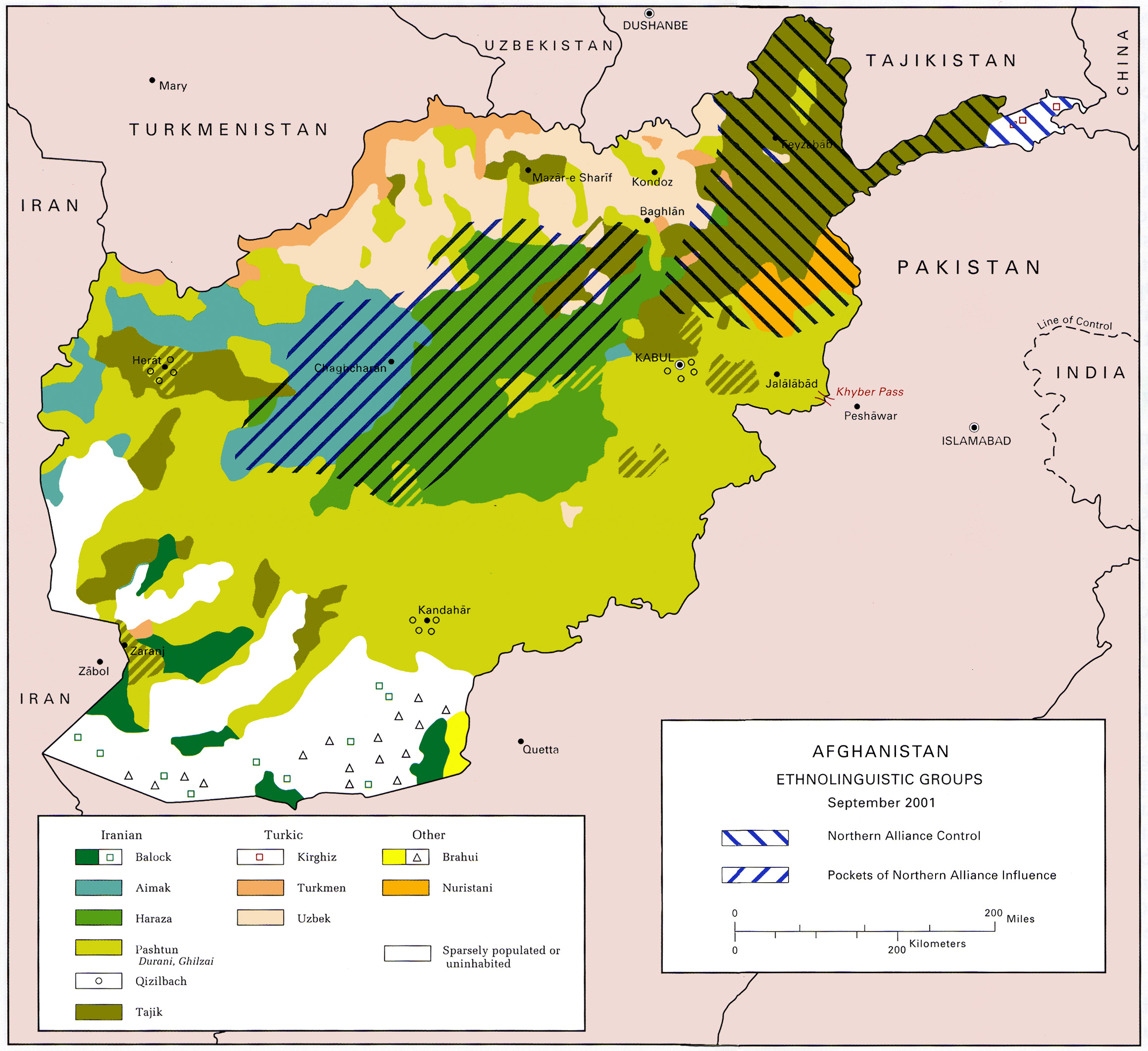
| **Jowzjan** | **602,082** | **11,292** | **53** | 50.8% Uzbeks, 19.3% Pashtuns, 14.4% Tajiks 10.5% Turkmens (1.7% Afsharids), 4.8% Hazaras. |
Demographics
Population
2022 estimates suggest that Jowzjan has a population of around 613,481 residents.
Ethnicity, languages and religions
The population belongs to the nation's various ethnic groups with the majority being ethnic Turkmen and Uzbeks. Approximately 39.5% of the population speaks Uzbek, 28.7% speaks Turkmen, 17.2% speak Pashto, 12.1% speaks Dari and 2.5% speaks other languages. Around 14.1% of the population lived below the national poverty line.
| Ethnicity | Uzbek | Turkmen | Pashtun | Tajik/ |
|---|---|---|---|---|
| Farsiwan | Hazara | Others | *Sources* | Period |
| 2004–2021 |
|---|
| (Islamic Republic) |
| 40 – 50% |
| 2020 EU |
| 2018 UN |
| 2015 CSSF |
| 2015 CP |
| 2011 USA |
| 2011 PRT |
| **Legend:** |
|---|
Education
The overall literacy rate (6+ years of age) fell from 31% in 2005 to 16% in 2011. The overall net enrolment rate (6–13 years of age) increased from 40% in 2005 to 46% in 2011. The primary school numbers in the province as of 2011 accounts for 116 (2011). https://knoema.com/atlas/Afghanistan/Jowzjan
Health
The percentage of households with clean drinking water increased from 24% in 2005 to 44% in 2011. The percentage of births attended to by a skilled birth attendant increased from 9% in 2005 to 21% in 2011.
Notable people
- Zhulād of Gōzgān, ruler of the mid 7th century, in the region of Guzgan, then part of Tokharistan
- Ibrahim ibn Ya'qub al-Juzajani, 9th century Muslim scholar, student of ibn Hanbal
- Abu 'Ubayd al-Juzjani, from the 11th century, the famous pupil of Avicenna, was from this region, hence his name
- Minhaj-i Siraj Juzjani (born 1193), thirteenth-century chronicler of India
- Abdul Rashid Dostum, Vice President of Afghanistan, is from Hodja Dukhu village of this province
- Qari Hekmat, leader of Islamic State of Iraq and the Levant in Darzab District.
- Abdul Salam Hanafi, Acting Second Deputy Prime Minister of Afghanistan.
Notes
References
References
- (4 May 2023). "Governors, security chiefs appointed in major reshuffle". Pajhwok Afghan News.
- کاکړ, جاويد هميم. (March 4, 2022). "په یو شمیر وزارتونو، قول اردو ګانو او ولایتونو کې نوې ټاکنې وشوې".
- (April 2021). "Estimated Population of Afghanistan 2021-22". National Statistic and Information Authority (NSIA).
- Everett-Heath, John. (2019-10-24). "The Concise Oxford Dictionary of World Place Names". Oxford University Press.
- Larry P. Goodson. (2001). "Afghanistan's endless war: state failure, regional politics, and the rise of the Taliban". University of Washington Press.
- "Power Network in Jawzjan | Wadsam".
- "Jowzjan Province - Powerpoint Overview". The University of Montana.
- (August 2012). "Decoding the New Taliban: Insights from the Afghan Field". Hurst.
- (2020). "Country Guidance: Afghanistan. Common analysis and guidance note". [[European Union Agency for Asylum]].
- Ramizpoor. (2018). "Afghan People's Dialogue on Peace: Local Road Maps for Peace – Kabul and Surrounding Provinces". [[United Nations Assistance Mission in Afghanistan]].
- (2024-02-25). "State of Families CSSF Report: Jowzjan, Afghanistan".
- "Kabul Province - Afghanistan National Drug Use Survey".
- (January 2011). "U.S. Army Afghanistan Smart Book, Third Edition".
- (February 2011). "Afghanistan Provincial Reconstruction Team".
- [https://documents1.worldbank.org/curated/en/221411481792470877/pdf/SFG2759-EA-P159291-Box396338B-PUBLIC-Disclosed-12-13-2016.pdf World Bank Group]
- "Pages - Jowzjan".
This article was imported from Wikipedia and is available under the Creative Commons Attribution-ShareAlike 4.0 License. Content has been adapted to SurfDoc format. Original contributors can be found on the article history page.
Ask Mako anything about Jowzjan Province — get instant answers, deeper analysis, and related topics.
Research with MakoFree with your Surf account
Create a free account to save articles, ask Mako questions, and organize your research.
Sign up freeThis content may have been generated or modified by AI. CloudSurf Software LLC is not responsible for the accuracy, completeness, or reliability of AI-generated content. Always verify important information from primary sources.
Report