From Surf Wiki (app.surf) — the open knowledge base
John II, Count of Nevers
French noble (1415–1491)
French noble (1415–1491)
| Field | Value |
|---|---|
| name | John II of Nevers |
| title | Count of Nevers, Rethel and Eu |
| image | SOAOTO - Jean de Bourgogne (1415-1491).jpg |
| caption | John II, Count of Nevers |
| noble family | Valois-Burgundy-Nevers |
| father | Philip II, Count of Nevers |
| mother | Bonne of Artois |
| spouse | Jacqueline d'Ailly |
| Pauline de Brosse | |
| Marie d'Albret | |
| birth_date | before 20 October 1415 |
| birth_place | Clamecy, Nievre |
| death_date | |
| death_place | Nevers |
Pauline de Brosse Marie d'Albret
John II, Count of Nevers (fr. Jean de Nevers , 1415–1491), known as John of Clamecy prior to acquiring titles, was a French nobleman and the last male member of the House of Valois-Burgundy. He was initially Count of Étampes from 1442 to 1465, and later became Count of Nevers and Rethel from 1464, and also Count of Eu from 1472. Since John had no male heirs, his counties of Nevers and Eu were inherited by his grandson Engelbert of Cleves, son of John's older daughter Elizabeth of Nevers (d. 1483), while the County of Rethel was inherited by John's younger daughter Charlotte (d. 1500).
Life
John was the son of Philip II, Count of Nevers and Bonne of Artois, daughter of Philip of Artois, Count of Eu. His father was the youngest son of Philip the Bold, Duke of Burgundy. As the younger son, John became Count of Étampes in 1442. John's elder brother, Charles I, Count of Nevers and Rethel, had no legitimate children, and so on his death in 1464 his titles passed to John. In 1472, his uncle Charles of Artois, Count of Eu, died, and having no legitimate children, his title also passed to John.
John fought in the army of his stepfather Philip the Good and was active in Picardy (1434), Calais (1436), Luxembourg (1443), and Flanders (1453). But he clashed with Philip's successor, Charles the Bold, and he defected to King Louis XI of France. He fought alongside Louis XI in the War of the Public Weal and became Lieutenant General of Normandy.
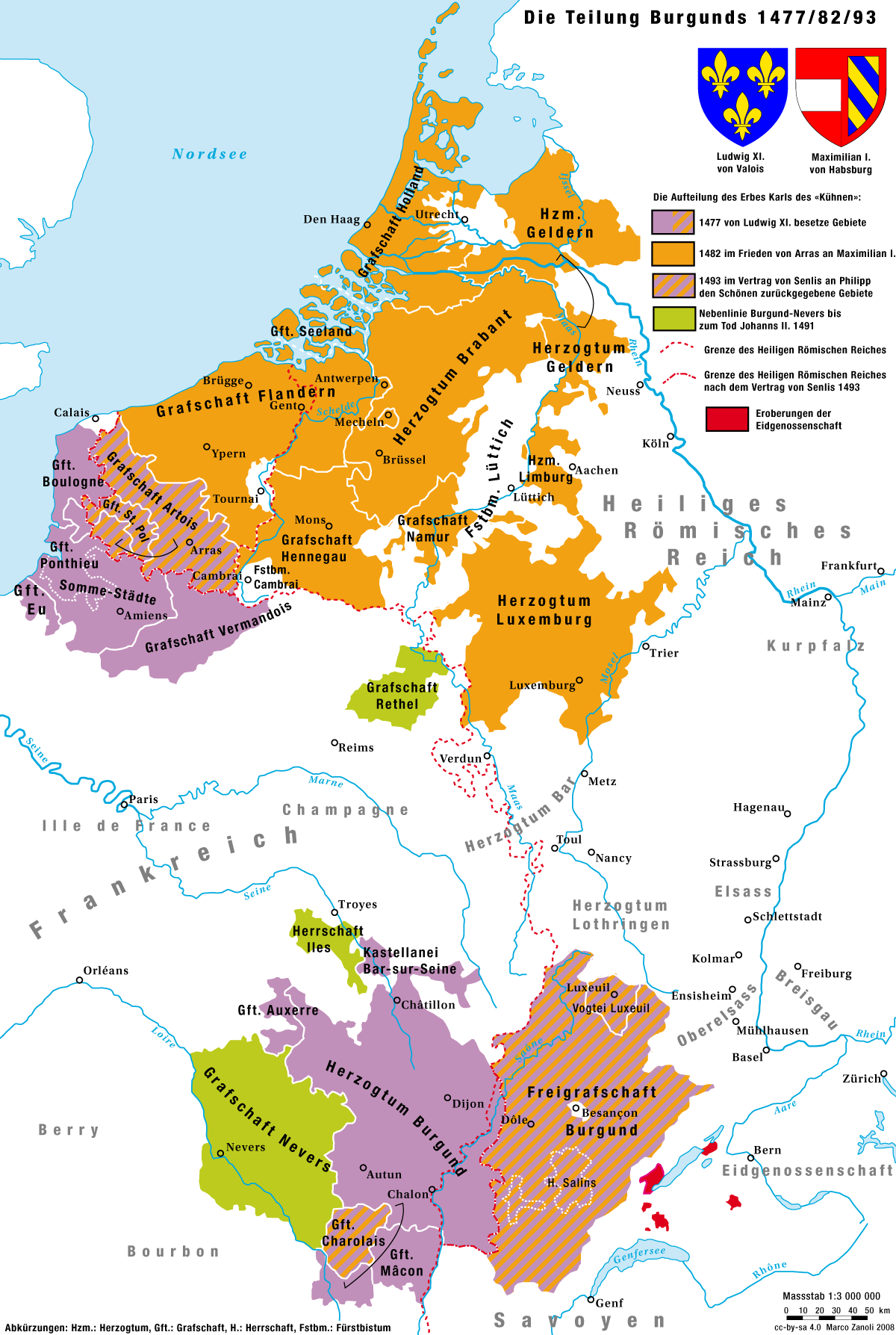
Being the closest male cousin of duke Charles of Burgundy, who died in 1477 without male heirs, John was excluded as a potential heir by the French king Louis XI, who seized the Duchy of Burgundy as a reverted royal fief, while the exclusion of John was based on the royal charter of 1364, that was restricting the Burgundian succession to direct male descendants, thus eliminating potential heirs from collateral branches.
Family
John was first married on 24 November 1435 in Amiens, to Jacqueline d'Ailly, Dame d'Ingelmunster (died 1470), they had two children:
- Elizabeth (c. 1439 – 21 June 1483), who married John I, Duke of Cleves.
- Philip (1446–1452).
Upon Jacqueline's death in 1470 he married secondly on 30 August 1471, in , to Pauline de Brosse (-1479), daughter of Jean II de Brosse. They had one child:
- Charlotte (c. 1472 – 23 August 1500), Countess of Rethel (1491-1500), who married John d'Albret and had a daughter, Marie d'Albret, Countess of Rethel.
John's final marriage was on 11 March 1480, in the château de Châlus-Chabrol (Limousin), to Marie d'Albret (-1521).
Ancestors
Notes
References
Sources
References
- Patrick Van Kerrebrouck, ''Nouvelle histoire généalogique de l'auguste maison de France'', vol. 3: ''Les Valois'', Villeneuve d'Ascq, 1990, p. 406, note 2.
This article was imported from Wikipedia and is available under the Creative Commons Attribution-ShareAlike 4.0 License. Content has been adapted to SurfDoc format. Original contributors can be found on the article history page.
Ask Mako anything about John II, Count of Nevers — get instant answers, deeper analysis, and related topics.
Research with MakoFree with your Surf account
Create a free account to save articles, ask Mako questions, and organize your research.
Sign up freeThis content may have been generated or modified by AI. CloudSurf Software LLC is not responsible for the accuracy, completeness, or reliability of AI-generated content. Always verify important information from primary sources.
Report