From Surf Wiki (app.surf) — the open knowledge base
Johannes Kepler ATV
2011 European resupply spaceflight to the ISS
2011 European resupply spaceflight to the ISS
| Field | Value |
|---|---|
| name | *Johannes Kepler* ATV |
| image | View of ATV-2 - cropped and rotated.jpg |
| image_caption | *Johannes Kepler* in orbit, prior to its rendezvous with the ISS |
| insignia | Johannes Kepler ATV.png |
| mission_type | ISS resupply |
| operator | European Space Agency |
| mission_duration | |
| spacecraft_type | Automated Transfer Vehicle |
| manufacturer | EADS Astrium |
| Thales Alenia Space | |
| launch_mass | 20050 kg |
| launch_date | UTC |
| launch_rocket | Ariane 5ES |
| launch_site | Guiana, ELA-3 |
| launch_contractor | Arianespace |
| disposal_type | Deorbited |
| decay_date | UTC |
| orbit_reference | Geocentric |
| orbit_regime | Low Earth |
| orbit_inclination | 51.6° |
| apsis | gee |
| docking | {{Infobox spaceflight/Dock |
| docking_target | ISS |
| docking_type | dock |
| docking_port | Zvezda Aft |
| docking_date | 24 February 2011, 15:59:19 UTC |
| undocking_date | 20 June 2011, 15:46 UTC |
| time_docked | |
| cargo_mass | 7084 kg |
| cargo_mass_press | 1600 kg |
| cargo_mass_fuel | 5384 kg |
| cargo_mass_gas | 100 kg |
| programme | Automated Transfer Vehicle |
| previous_mission | ATV-1 |
| next_mission | ATV-3 |
Thales Alenia Space The Johannes Kepler ATV, or Automated Transfer Vehicle 2 (ATV-2), was an uncrewed cargo spacecraft built to resupply the International Space Station (ISS). It was launched on February 16, 2011 by the European Space Agency (ESA). and had a total mass of over 20000 kg, making it, at the time, the heaviest payload launched by the ESA. The second of five Automated Transfer Vehicle spacecraft, it was named after the 17th-century German astronomer Johannes Kepler.
The ATV carried around five tons more cargo than Russia's Progress-M resupply spacecraft, and about 1.5 tons more than the Japanese HTV. The ATV used 4500 kg of fuel to boost the ISS's altitude from 350 to 400 km.
Many of the supplies aboard the ATV were used for the Space Shuttle mission STS-133 and the ISS Expedition 26. Johannes Kepler performed a destructive re-entry as intended on 21 June 2011, with its remains impacting the Pacific Ocean.
Spacecraft
Johannes Kepler consisted of two sections: the Propulsion Module, with four main engines and 28 smaller maneuvering thrusters, and the Integrated Cargo Carrier, which attached directly to the ISS and could hold up to eight standard payload racks. The four solar wings of the spacecraft provided up to 4,800 watts of electrical power to its rechargeable batteries.
The ATV's rendezvous and docking system mounted a telegoniometer, which functioned as a radar system, and two videometers, which fired laser pulses at cube-shaped reflectors on the ISS' Zvezda service module for range detection. The nose of the spacecraft contained rendezvous sensors and Russian docking equipment.
Specifications
| Deployed solar array width | 22.3 m |
|---|
Mission payload
| Cargo | Mass | Total |
|---|---|---|
| ISS reboost/attitude control propellants | 4534 kg | |
| ISS refuel propellant | 850 kg | |
| Oxygen gas | 100 kg | |
| Water | 0 kg | |
| Dry cargo (food, clothes, equipment) | 1600 kg | |
| 7084 kg |
: Source:
GeoFlow II
Johannes Kepler delivered the GeoFlow II hydrodynamics experiment container to the ISS. This experiment was designed to observe liquid movements in microgravity, and compare them with computer simulations, thus helping scientists to understand convection currents within the Earth's mantle.
Mission summary
Launch
On 16 February 2011 UTC, Johannes Kepler was launched on an Ariane 5ES rocket from the Guiana Space Centre in Kourou, French Guiana. The launch was conducted by Arianespace on behalf of the ESA.
The first launch attempt, on 15 February 2011, was halted four minutes before lift-off, due to an erroneous signal from one of the rocket's fuel tanks.
Docking

Docking with the ISS was completed on 24 February 2011 at 15:59 UTC, after a 15-minute delay. The spacecraft traveled over eight days to catch up with the space station, and arrived at the aft port of the station's Zvezda service module. During the rendezvous operations, ATV-2 traveled a total of 2.5 million miles. The docking occurred as ATV-2 and the ISS flew over the coast of Liberia in western Africa. Hooks and latches engaged a few minutes later to firmly attach ATV-2 to the ISS.
The Johannes Kepler mission marked the first time European astronauts were on board the International Space Station during an ATV mission, with Italian astronaut Paolo Nespoli welcoming the ATV's arrival. ESA astronaut Roberto Vittori was also aboard the ISS at the same time as the ATV, having arrived on Space Shuttle Endeavour on the STS-134 mission in May 2011.
ISS altitude Increase
.jpg)
Johannes Kepler was used to boost the ISS's standard altitude from about 350 kilometers (220 statute miles) to 400 km (248 miles). The higher altitude has lower atmospheric drag, which reduces the propellant needed annually to maintain the station's altitude from 6,800 kg (15,000 lb) to roughly 3,630 kg (8,000 lb), depending on atmospheric conditions. The ATV used about 4,500 kg (9,900 lb) of rocket fuel to accomplish this change, with the reboost occurring incrementally over several months.
End of mission and deorbit
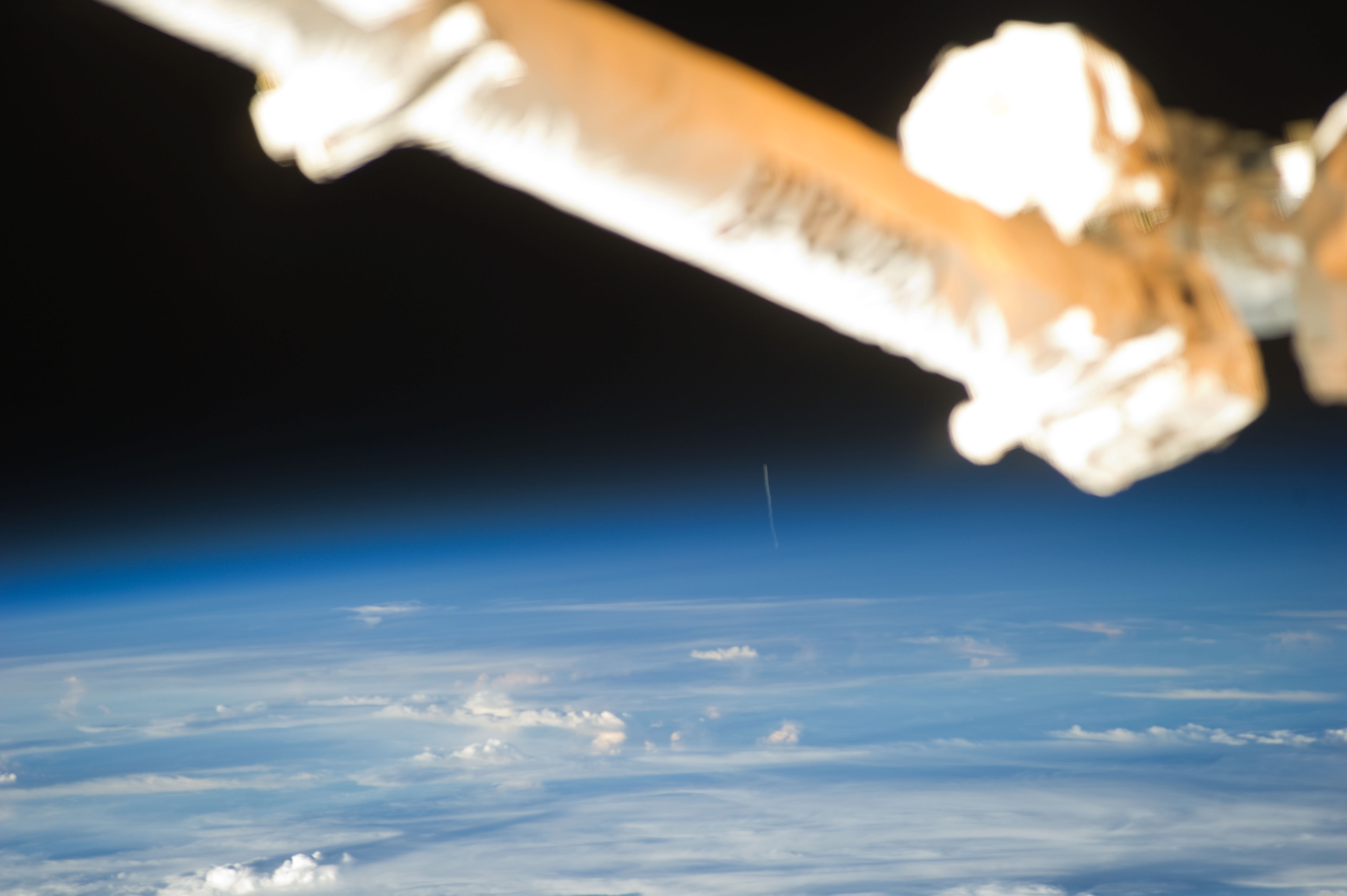
On 20 June 2011, Johannes Kepler undocked from the ISS. At 18:30 UTC (20:30 CEST) that same day, while preparing to deorbit, the ATV was forced to conduct a debris-avoidance maneuver, using some of its remaining fuel to move into a safe orbit after NASA warned of a potential collision with orbital debris. On 21 June 2011, the ATV deorbited, burning up in the atmosphere as planned over the South Pacific Ocean at around 22:44 CET.
ATV missions
References
References
- [http://www.nasa.gov/multimedia/nasatv/ NASA Live TV broadcast]. 24 February 2011. Retrieved 12 January 2013.
- [http://blogs.esa.int/atv/2011/04/15/atv-undocking-set-for-20-june/ ESA ATV blog]. Retrieved 11 June 2011.
- ''Johannes Kepler'' carried propellant, air and dry cargo weighing over {{convert. 7000. kg,[http://www.nasa.gov/mission_pages/station/structure/iss_manifest.html NASA's Consolidated Launch Schedule] {{Webarchive. link. (2009-03-07 . Retrieved 22 March 2012.)
- Chris Gebhardt. (15 February 2011). "Ariane 5 launches ATV-2 for journey to the ISS". [[NASASpaceflight.com]].
- (3 February 2011). "Europe's ATV space ferry ready for launch". [[ESA]].
- (19 February 2009). "Second ATV named after Johannes Kepler". ESA.
- ESA. (January 2011). "INFORMATION KIT ATV Johannes Kepler". ESA.
- (29 March 2011). "Unique Aerospace Invention Ready For Debut". Space Travel.com.
- "NASA.gov: ''JK ATV Mission Cargo''".
- "Project Geoflow II flies into space aboard Ariane 5". ASTRIUM.
- [http://www.esa.int/esaCP/SEMLWSOT1KG_index_0.html "Europe’s ATV Johannes Kepler supply ship on its way to Space Station"]. ESA Portal. 16 February 2011. Retrieved 6 December 2011.
- Atkinson, Nancy. (15 February 2011). "ATV 'Johannes Kepler' Launch to Space Station Delayed to Wednesday". [[Universe Today]].
- Stephen Clark. (24 February 2011). "Europe's automated cargo ship docks with space station". Spaceflight Now.
- (11 August 2009). "NASA Assigns Crew for STS-134 Shuttle Mission, Change to STS-132". NASA.
- [http://www.nasa.gov/mission_pages/station/expeditions/expedition26/iss_altitude.html "Higher Altitude Improves Station's Fuel Economy"] {{Webarchive. link. (2015-05-15 . NASA. 14 February 2011. Retrieved 4 November 2013.)
- Moskowitz, Clara. (20 June 2011). "Huge Robot Cargo Ship Departs Space Station".
- [http://blogs.esa.int/atv/ ESA ATV blog]. Retrieved 21 June 2011.
- [http://blogs.esa.int/atv/2011/06/21/end-of-mission/ ESA ATV blog]. Retrieved 21 June 2011.
This article was imported from Wikipedia and is available under the Creative Commons Attribution-ShareAlike 4.0 License. Content has been adapted to SurfDoc format. Original contributors can be found on the article history page.
Ask Mako anything about Johannes Kepler ATV — get instant answers, deeper analysis, and related topics.
Research with MakoFree with your Surf account
Create a free account to save articles, ask Mako questions, and organize your research.
Sign up freeThis content may have been generated or modified by AI. CloudSurf Software LLC is not responsible for the accuracy, completeness, or reliability of AI-generated content. Always verify important information from primary sources.
Report