From Surf Wiki (app.surf) — the open knowledge base
Jin Midi
Xiongnu-Chinese politician (134–86 BCE)
.jpg)
Xiongnu-Chinese politician (134–86 BCE)
Jin Midi (134 BC – 29 September 86 BC, , courtesy name Wengshu (翁叔), formally Marquess Jing of Du (秺敬侯)), was a Xiongnu Xiutu prince and a general of the Western Han dynasty. He was referred to as a non-Han "barbarian", either with the term Hu or Yidi. He was originally from the Xiutu Kingdom in central Gansu and served as co-regent early in the reign of the Emperor Zhao of Han. He was given the family name "Jin" ("Gold") by Emperor Wu of Han because he worshipped the golden statue of the Xiongnu which Huo Qubing captured in his military campaigns.
Background
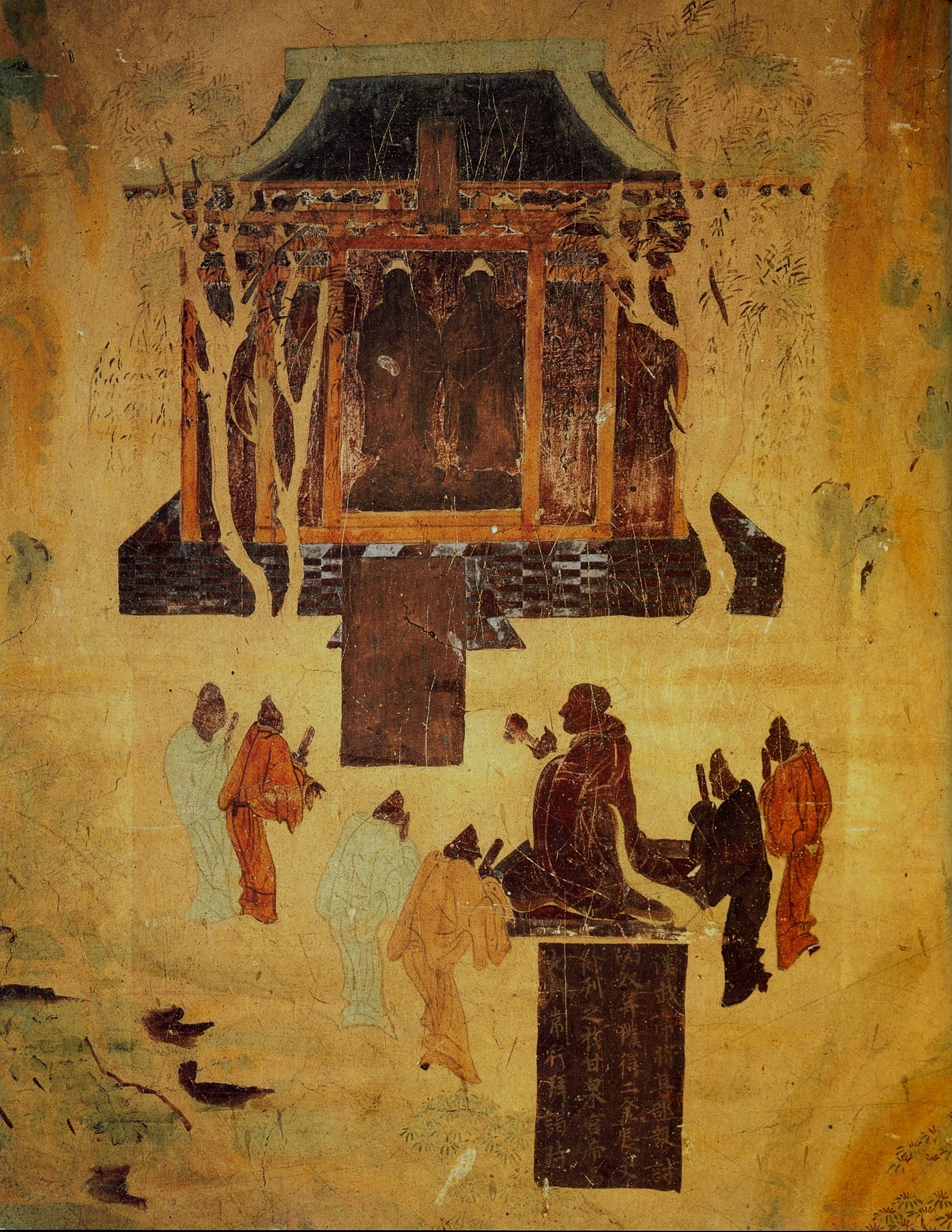
Jin Midi was born in 134 BC to a royal Xiongnu family. He was the heir of the Xiongnu's Prince of Xiutu, one of the major princes under the supreme ruler of the Xiongnu, the Junchen Chanyu. After Junchen's death in 126 BC, his brother Yizhixie succeeded him. During this time, the Prince of Xiutu and another major prince, the Prince of Hunye, were responsible for defending Xiongnu's southwestern border with Han dynasty in modern central and western Gansu.
In 121 BC, Emperor Wu of Han sent his general Huo Qubing to attack the Xiongnu, dealing a great defeat to the Xiongnu. In the campaign, Huo killed the Princes of Zhelan and Luhu, as well as 8,900 Xiongnu soldiers, while capturing the Prince of Hunye's son, chief assistant, and a number of officials, as well as golden statues that the Prince of Xiutu had forged to use to worship heaven. Yizhixie Chanyu was greatly displeased, and was considering summoning the Princes of Hunye and Xiutu to execute them. The princes, in fear, plotted to defect to Han. When Emperor Wu sent Huo to accept their surrender, the Prince of Xiutu changed his mind and tried to back out of defecting. The Prince of Hunye killed him and surrendered to Han, along with the region that he controlled.
Because the Prince of Xiutu was killed, Midi, as well as his mother the princess, as well as his brother Lun, were confiscated to serve as imperial servants. Midi was assigned to the imperial stables.
During Emperor Wu's reign
During an imperial feast, Emperor Wu ordered that horses be brought to him for him to examine. Midi, and a large number of fellow stable attendants, brought the horses, and as a number of Emperor Wu's beautiful concubines were in attendance, the attendants were struck by their beauty and were looking at them, but Midi did not dare to. Emperor Wu saw Midi and was impressed by his propriety, tall stature, and how healthy and strong the horses under Midi's care were. That same day, he awarded Midi robes and made him the director of the imperial stables, and thereafter became increasingly close to Midi. According to the Hanshu, the reaction of the court was not without some resentment:
As he remembered that the Prince of Xiutu had used golden statues to worship heaven, Emperor Wu gave Midi the surname Jin, meaning "gold". When Jin Midi's mother died, Emperor Wu had her portrait drawn and displayed at his later favorite palace, the Sweet Spring Palace, entitling the portrait, "The Princess of Xiutu" (i.e., not regarding her as a servant any more, but by her former status as princess). Two of Jin Midi's sons became close attendants to Emperor Wu and were favored by Emperor Wu. After one of the sons was grown, on one occasion, he was flirting with Emperor Wu's ladies in waiting when Jin Midi saw them. In anger at his son's inappropriate behavior, killed him, and then reported to Emperor Wu. Emperor Wu was greatly saddened but became even more impressed with Jin Midi.

In 88 BC, the imperial official Ma Heluo was anxious over the fact that the clan of his friend Jiang Chong had been slaughtered by Emperor Wu. Jiang had falsely accused Emperor Wu's crown prince Liu Ju of treason in 91 BC, causing Liu Ju to rise in rebellion in fear, killing Jiang. Liu Ju was killed, but in the aftermath, Emperor Wu, discovering that Jiang's accusations were false, had Jiang's clan killed. He thus conspired with his brothers to assassinate Emperor Wu. The assassination attempt was thwarted by Jin, as when he saw Ma about to enter Emperor Wu's bedchambers with a knife, he fought and wrestled Ma down until other imperial guards could arrive.
In 87 BC, Emperor Wu was seriously ill, and made his youngest son Liu Fuling crown prince. He summoned his close associates to his bedchambers to designate one of them, Huo Qubing's younger brother Huo Guang, as regent. Huo initially declined, arguing that Jin was more capable, but Jin pointed out that he was ethnically Xiongnu and that the other officials and the Xiongnu might think of him lightly. Emperor Wu thus designated Huo as the primary regent, but also designated Jin and Shangguan Jie secondary regents. He soon died, and Liu Fuling took the throne as Emperor Zhao. (In his will, Emperor Wu, citing the suppression of Ma's plot, created Jin, as well as Huo and Shangguan, marquesses, but Jin, citing Emperor Zhao's young age, declined.)
During Emperor Zhao's reign
In late 86 BC, Jin Midi became seriously ill. Huo Guang, after discussing with Emperor Zhao, had Emperor Zhao approve a creation of Midi as the Marquess of Du on his death bed. Midi died the next day and was buried near Emperor Wu's tomb. His family continued to serve as imperial servants until the end of the Western Han dynasty, with seven generations in total.
Mausoleum
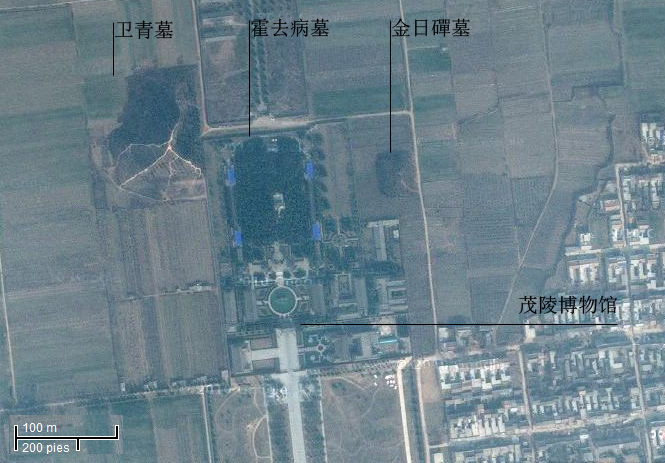
Upon his death, Jin Midi was buried in a Mausoleum located at , next to the Mausoleum of Huo Qubing and not far from the Mausoleum of Han Wudi in Maoling.
References
Sources
- 金日磾
- 武威本土历史人物——金日磾
- Book of Han, vol. 68.
- Zizhi Tongjian, vols. 19, 20, 21, 22, 23.
- Han Ji, vols. 13, 15, 16 https://web.archive.org/web/20051126192727/http://ef.cdpa.nsysu.edu.tw/ccw/02/whr.htm.
- 祭天金人
- 休屠王
References
- (2001). "Origins of Daoist Iconography". Ars Orientalis.
- ''bing'zi'' day of the 9th month of the 1st year of the ''Shi'yuan'' era, per vol.23 of ''Zizhi Tongjian''
- 现代汉语词典]](第7版). (September 2016). [[Commercial Press]]. zh-hans. 䃅(磾) {{Transliteration. zh. dī {{lang. zh-hans. 用于人名,金日{{Transliteration. zh. (mì){{lang. zh-hans. 䃅,汉代人。
- (23 April 2020). "Rome, China, and the Barbarians: Ethnographic Traditions and the Transformation of Empires". Cambridge University Press.
- (23 April 2020). "Rome, China, and the Barbarians: Ethnographic Traditions and the Transformation of Empires". Cambridge University Press.
- (1937). "The "Golden Man" of Former Han Times". T'oung Pao.
- "《漢書》(前漢書):霍光金日磾傳第三十八 數位經典".
- Anthony J. Barbieri-Low; Artisans in Early Imperial China, p.168, "Jin Midi was an ethnic Xiongnu who had once been the heir apparent of the Xiuchu King of the Xiongnu."
- Tang Yongtong (汤用彤 1893-1964) proposed earlier that it was the Turco-Mongol god of Heaven, the Tengri. Ding Fubao (丁福保 1874-1952)that it was the Persian god Ahura Mazda, and Chu Chae Hyeok (주채혁/朱载赫) that it was the god El of the ancient [[Canaanite religion]].
- (2011). "Forging the Imperial Nation: Imperialism, Nationalism, and Ethnic Boundaries in China's Longue Durée". University of Michigan (Thesis).
- (2011). "Two Notes on the Xiongnu Ancestry of the Authors of "Han-shu"". Central Asiatic Journal.
- (2008). "Ban Gu's history of early China". Cambria press.
- "古代同志导读:汉武帝-金日磾".
This article was imported from Wikipedia and is available under the Creative Commons Attribution-ShareAlike 4.0 License. Content has been adapted to SurfDoc format. Original contributors can be found on the article history page.
Ask Mako anything about Jin Midi — get instant answers, deeper analysis, and related topics.
Research with MakoFree with your Surf account
Create a free account to save articles, ask Mako questions, and organize your research.
Sign up freeThis content may have been generated or modified by AI. CloudSurf Software LLC is not responsible for the accuracy, completeness, or reliability of AI-generated content. Always verify important information from primary sources.
Report