From Surf Wiki (app.surf) — the open knowledge base
Jean-Baptiste de La Salle
French priest and Catholic saint (1651–1719)

French priest and Catholic saint (1651–1719)
| Field | Value | |
|---|---|---|
| honorific_prefix | Saint | |
| name | Jean-Baptiste de La Salle | |
| image | Jean baptiste de la Salle.jpg | |
| titles | Priest, Religious, Founder, and Confessor | |
| birth_date | ||
| birth_place | Reims, Champagne, | |
| Kingdom of France | ||
| death_date | ||
| death_place | Rouen, Normandy | |
| Kingdom of France | ||
| feast_day | Church: 7 April | |
| 15 May (General Roman Calendar 1904-1969, and Lasallian institutions) | ||
| beatified_date | 19 February 1888 | |
| beatified_place | Saint Peter's Basilica | |
| beatified_by | Pope Leo XIII | |
| canonized_date | 24 May 1900 | |
| canonized_place | Saint Peter's Basilica | canonized_by=Pope Leo XIII |
| major_shrine | Sanctuary of John Baptist de La Salle, Casa Generalizia, Rome, Italy | |
| attributes | Book, Christian Brothers' habit | |
| patronage | Teachers of Youth, (15 May 1950, Pius XII) | |
| Institute of the Brothers of the Christian Schools | ||
| Lasallian Educational Institutions | ||
| Educators | ||
| School principals | ||
| Teachers | ||
| venerated_in | Catholic Church | |
| honorific_suffix | FSC |
Kingdom of France Kingdom of France 15 May (General Roman Calendar 1904-1969, and Lasallian institutions) Institute of the Brothers of the Christian Schools Lasallian Educational Institutions Educators School principals Teachers
Jean-Baptiste de La Salle (; English: John Baptist de La Salle ; 30 April 1651 – 7 April 1719) was a French priest, educational reformer, and founder of the Institute of the Brothers of the Christian Schools. He is a saint of the Catholic Church and the patron saint for teachers of youth.
La Salle dedicated much of his life to the education of poor children in France; in doing so, he started many lasting educational practices.
Background
La Salle was born to a wealthy family in Reims, France, on 30 April 1651. He was the eldest child of Louis de La Salle and Nicolle Moet de Brouillet. Nicolle's family was a noble one and operated a successful winery business; she was a relative of Claude Moët, founder of Moët & Chandon.
La Salle was tonsured at age eleven on 11 March 1662, He was named canon of Reims Cathedral when he was sixteen, and at seventeen received minor orders. He was sent to the College des Bons Enfants, where he pursued higher studies and on 10 July 1669 he took the degree of Master of Arts. When De La Salle had completed his classical, literary, and philosophical courses, he was sent to Paris to enter the Seminary of Saint-Sulpice on 18 October 1670. His mother died on 19 July 1671 and his father on 9 April 1672. This circumstance obliged him to leave Saint-Sulpice on 19 April 1672. He was now twenty-one, the head of the family, and as such had the responsibility of educating his four brothers and two sisters. In 1672 he received the minor order of subdeacon, was ordained a deacon in 1676, and then finally completed his theological studies and was ordained to the priesthood at the age of 26 on 9 April 1678. Two years later he received a doctorate in theology.
Sisters of the Child Jesus
The Sisters of the Child Jesus were a new religious congregation whose work was the care of the sick and education of poor girls. The young priest helped them become established and then served as their chaplain and confessor. It was through his work with the Sisters that in 1679 he met the schoolmaster Adrian Nyel. With De La Salle's help, a school was soon opened. Shortly thereafter, a wealthy woman in Reims told Nyel that she also would endow a school, but only if La Salle would help. What began as an effort to help Adrian Nyel establish a school for the poor in La Salle's home town gradually became his life's work.
Institute of the Brothers of the Christian Schools
_15.jpg)
At that time, most children had little hope for social and economic advancement. Moved by the plight of the poor who seemed so "far from salvation" either in this world or the next, he determined to put his own talents and advanced education at the service of the children "often left to themselves and badly brought up".
La Salle knew that the teachers in Reims were struggling, lacking leadership, purpose, and training, and he found himself taking increasingly deliberate steps to help this small group of men with their work. First, in 1680, he invited them to take their meals in his home, as much to teach them table manners as to inspire and instruct them in their work. This crossing of social boundaries was one that his relatives found difficult to bear. In 1681, De La Salle decided that he would take a further step and so he brought the teachers into his own home to live with him. De La Salle's relatives were deeply disturbed; his social peers were scandalized. A year later, when his family home was lost at auction because of a family lawsuit, De La Salle rented a house into which he and the handful of teachers moved.
La Salle decided to resign his canonry to devote his full attention to the establishment of schools and training of teachers. The priesthood primarily required him to focus on the sacraments and he needed to give full devotion to education, even in his free time to connect with students.{{Cite web|title=Founders Week: Day 3 Prayers and Reflections
La Salle thereby began a new religious institute, the first one with no priests whatsoever among its members: the Institute of the Brothers of the Christian Schools, also known as De La Salle Brothers in Europe, Australasia, and Asia, and the Christian Brothers in the United States. One decision led to another, and La Salle found himself doing something he had never anticipated. La Salle wrote:
La Salle's enterprise met with opposition from ecclesiastical authorities who resisted the creation of a new form of religious life, a community of consecrated laymen to conduct free schools "together and by association". The educational establishment resented his innovative methods.
In 1685 La Salle founded what is generally considered the first normal school, a school whose purpose is to train teachers, in Reims.
Worn out by austerity and exhausting labour, La Salle died at Saint Yon, near Rouen, on Good Friday 1719.
Veneration
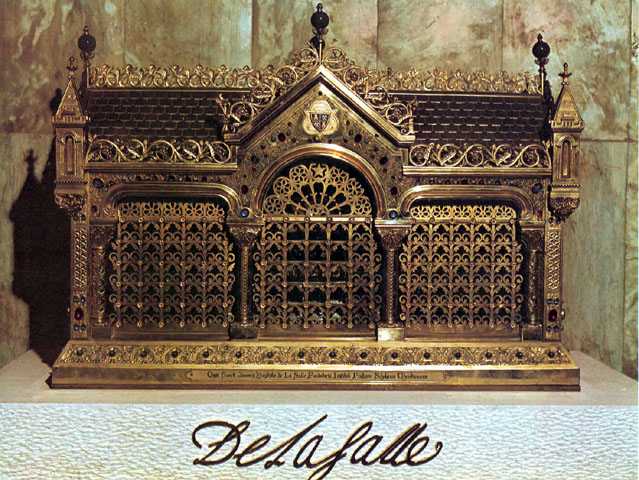
Pope Leo XIII canonized La Salle on 24 May 1900 and Pope Pius X inserted his feast in the General Roman Calendar in 1904 for celebration on 15 May. Because of his life and inspirational writings, Pope Pius XII proclaimed him Patron Saint of All Teachers of Youth on 15 May 1950. In the 1969 revision of the Church calendar, Pope Paul VI moved his feast day to 7 April, the day of his death or "birth to heaven", his dies natalis.
Legacy
La Salle was a pioneer in programs for training lay teachers. He was one of the first to teach in native French and not Latin.
The Lasallian schools form a 300-year-old network following La Salle's principles. Many schools are named after La Salle, and several streets, often near a Lasallian School, are named after him.
In 2021 the International Lasallian Mission website stated that the Lasallian order consists of about 3,000 Brothers, who help in running over 1,100 education centers in over 80 countries with more than a million students, together with at least 90,000 teachers and lay associates.
Asteroid 3002 Delasalle was discovered in 1982 and was named after De La Salle.
References
References
- Van Grieken, G. (1995). ''To Touch Hearts - Pedagogical Spirituality and St. John Baptist de La Salle'' (Doctoral dissertation). [[Boston College]], [[Chestnut Hill, Massachusetts]].
- "In the Footsteps of De La Salle".
- (2020). "CATHOLIC ENCYCLOPEDIA".
- [https://www.lasalle.org/en/who-are-we/st-john-baptist-de-la-salle/ "St. John Baptist de La Salle", La Salle.org]
- "La Salle, Ireland, Great Britain, and Malta : The Key Events in the Life of St. John Baptist de La Salle".
- {{Catholic. Graham. Matthias
- "Adrien Nyel Project".
- Wanner, R., ''Claude Fleury (1640-1723) as an Educational Historiographer'' 1975 "No survey of French education in the seventeenth century would be complete without reference to the educational work of Jean-Baptiste de La Salle."
- [http://delasalle.org/resources/resources-signs-of-faith/sof_fall00/f00life.htm "John Baptist de La Salle: His Life and Times", ''Signs of Faith'', Winter 2000, De La Salle Institute] {{webarchive. link. (17 July 2012)
- [http://www.ewtn.com/library/MARY/LASALLE.htm "St. John Baptist de La Salle", ''Lives of Saints'', John J. Crawley & Co., Inc.]
- (2016). "Saint Jean-Baptiste de La Salle".
- ""Discover the Priesthood", Diocese of Jefferson City, Missouri".
- [https://nominis.cef.fr/contenus/saint/931/Saint-Jean-Baptiste-de-La-Salle.html "Saint Jean-Baptiste de La Salle", nominis.cef]
- Of his writings on education, Matthew Arnold remarked: "Later works on the same subject have little improved the precepts, while they entirely lack the unction." His educational innovations include Sunday courses for working young men, one of the first institutions in France for the care of delinquents, technical schools, and secondary schools for modern languages, arts, and sciences. La Salle University says that his writings influenced educational practice, school management, and teacher preparation for more than 300 years.[https://web.archive.org/web/20180614220736/https://www.lasalle.edu/missionoffice/index.php?page=history&group=history "History", La Salle University]
- "De La Salle Educational Mission: Institutions and Activities". lasalle.org.
- "The life and legacy of Saint La Salle".
- "The International Lasallian Mission".
- "(3002) Delasalle = 1942 FG = 1959 LB = 1963 SC1 = 1965 AY = 1979 HU5 = 1980 TG11 = 1980 VB1 = 1982 BR3 = 1982 DM4 = 1982 FB3 = 2001 YG140". International Astronomical Union.
This article was imported from Wikipedia and is available under the Creative Commons Attribution-ShareAlike 4.0 License. Content has been adapted to SurfDoc format. Original contributors can be found on the article history page.
Ask Mako anything about Jean-Baptiste de La Salle — get instant answers, deeper analysis, and related topics.
Research with MakoFree with your Surf account
Create a free account to save articles, ask Mako questions, and organize your research.
Sign up freeThis content may have been generated or modified by AI. CloudSurf Software LLC is not responsible for the accuracy, completeness, or reliability of AI-generated content. Always verify important information from primary sources.
Report