From Surf Wiki (app.surf) — the open knowledge base
Jan Siberechts
Flemish painter

Flemish painter
Jan Siberechts (1627–1703) was a Flemish landscape painter who, after a successful career in Antwerp, emigrated in the latter part of his life to England. In his early works, he developed a personal style of landscape painting, with an emphasis on the Flemish countryside and country life. His later landscapes painted in England retained their Flemish character by representing a universal theme. Siberechts also painted hunting scenes for his English patrons. The topographical views he created in England stand at the beginning of the English landscape tradition.
Life
Jan Siberechts was born in Antwerp, the son of a sculptor with the same name. He trained in Antwerp with his father and became a master in the local Guild of Saint Luke by 1648. He developed a personal style of painting landscapes, which impressed George Villiers, 2nd Duke of Buckingham when he visited Antwerp in 1670. The Duke invited the artist to England.
Siberechts arrived in England around 1672 and spent the first three years in England painting decorations in the Duke's newly built Cliveden House at Taplow, Buckinghamshire, England. From the second part of the 1670s and in the 1680s, he travelled widely in England, completing numerous commissions for aristocratic clients. Whilst in London he was commissioned to paint the Belsize Estate of goldsmith banker John Coggs in 1696, which now hangs in the Tate Gallery London.
He died in London.
John Wootton was one of his pupils.
Work
About 100 of his works have been preserved. His early works were indebted to Dutch Italianate landscape painters such as Nicolaes Berchem and Karel Dujardin. Siberechts must have become acquainted with their work in Antwerp as these artists were mainly active in Rome and Siberechts possibly did not visit Italy himself although such a visit in the late 1640s, early 1650s cannot be excluded.
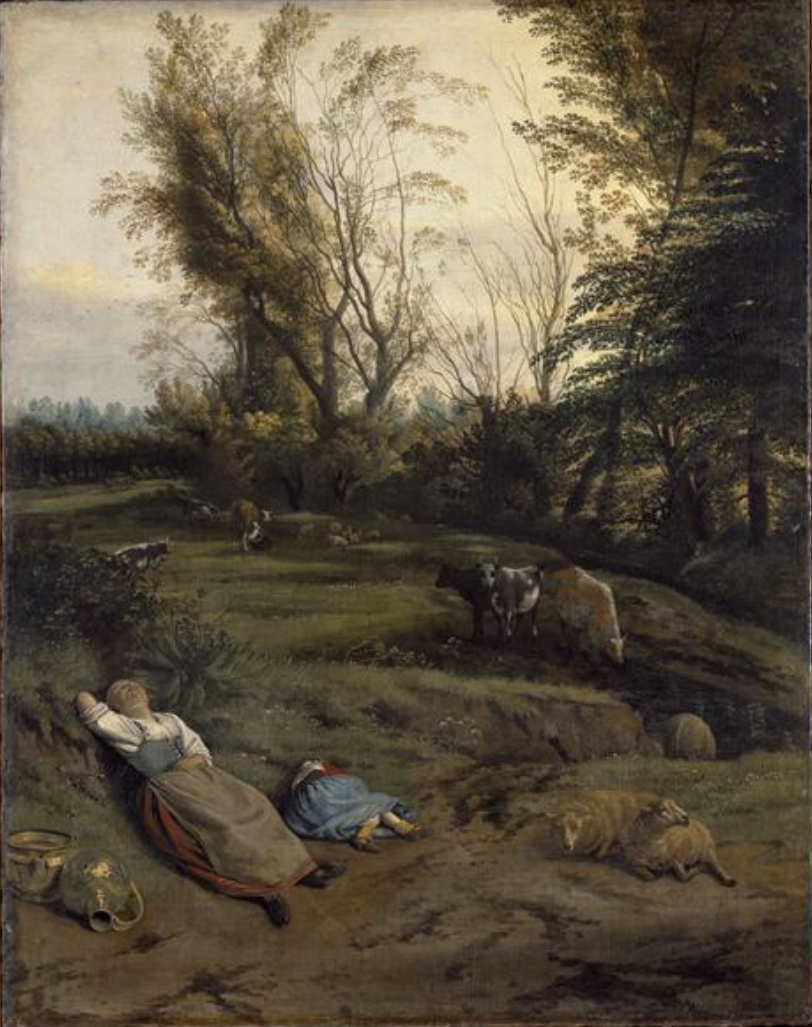
In the 1660s, he developed a very personal style of landscape painting, with an emphasis on the Flemish countryside and country life. He introduced into the foreground of his landscapes figures of robust country girls, dressed in bright red, blue, and yellow. These countrywomen are shown traveling in carts, on foot, and on the backs of mules and in the act of carrying objects, bundles, or baskets, or crossing flooded roads or fords. The volumetric modeling and the manner in which they are set against brightly lit areas of the countryside make the figures stand out from the picture. The artist used the figures to play with the visual effects produced by the figures in the water.

His later landscapes, painted in England in the 1670s and 1680s, retained their Flemish character by representing a universal theme. This stands in contrast to Dutch landscape paintings of the period, which typically concentrated on a single aspect of a landscape. Siberechts' landscapes depicted powerful trees and soft light on distant hills, while the figures became less important than the landscape itself. The foreground was kept relatively dark in order to draw attention to the broad, brightly lit vista in the background.
Siberechts also painted hunting scenes for his English patrons. These are the earliest country house portraits in England. He used a fairly standardised composition for these hunting scenes: the hunting scene with the huntsmen and horsemen in the foreground and a naturalistic view of the stately home as the backdrop, placed in a misty and atmospheric landscape. He adopted a bird's-eye view that allowed a maximum amount of detail to be depicted.
These country house portraits had an important influence on English landscape painting, and Siberechts can be regarded as the 'father of British landscape'. These landscapes also have an important historical and topographical interest. Siberechts stood at the beginning of a long tradition of Flemish painters who made topographical paintings of the estates of the British nobility. These artists include Peter Tillemans, Pieter Andreas Rijsbrack, and Hendrik Frans de Cort.
Gallery
File:A View from Richmond Hill.png|A View from Richmond Hill, 1677 File:Jan Siberechts (1627-c.1703) - View of a House and its Estate in Belsize, Middlesex - T06996 - Tate.jpg|View of a House and its Estate in Belsize, Middlesex, 1696
References
References
- [http://www.museothyssen.org/en/thyssen/ficha_obra/106 Jan Siberechts, The Ford] at the [[Thyssen-Bornemisza Museum]]
- Ingo F. Walther, ''Masterpieces of Western Art: A History of Art in 900 Individual Studies from the Gothic to the Present Day, Part 1,'' Taschen, 2002, p. 328
- Hans Devisscher. "Siberechts, Jan." Grove Art Online. Oxford Art Online. Oxford University Press. Web. 20 February 2022
- fr
- Helen Jacobsen, ''Luxury and Power: The Material World of the Stuart Diplomat, 1660-1714'', Oxford University Press, 2012, pp. 82–83
- He lived in London, where one of his daughters was a lace-maker for the Queen. His younger daughter, Frances, married the Flemish émigré sculptor [[Artus Quellinus III]] (known in England as 'Arnold Quellinus') and, after being widowed, [[John Nost]], another Flemish émigré sculptor.[http://www.tate.org.uk/art/artists/jan-siberechts-493 Jan Siberechts 1627–c.1700] at Tate Britain
- Patrick O'Brien, ''Urban Achievement in Early Modern Europe: Golden Ages in Antwerp, Amsterdam and London'', Cambridge University Press, 12 Apr 2001, p. 219
- [https://www.tate.org.uk/art/artworks/siberechts-view-of-a-house-and-its-estate-in-belsize-middlesex-t06996 Jan Siberechts, ''View of a House and its Estate in Belsize, Middlesex''] at the Tate Gallery
- [https://rkd.nl/explore/artists/72397 Jan Siberechts] at the [[Netherlands Institute for Art History]] {{in lang. nl
- [[Cornelis de Bie]], [[Het Gulden Cabinet]], 1660, p. 373
This article was imported from Wikipedia and is available under the Creative Commons Attribution-ShareAlike 4.0 License. Content has been adapted to SurfDoc format. Original contributors can be found on the article history page.
Ask Mako anything about Jan Siberechts — get instant answers, deeper analysis, and related topics.
Research with MakoFree with your Surf account
Create a free account to save articles, ask Mako questions, and organize your research.
Sign up freeThis content may have been generated or modified by AI. CloudSurf Software LLC is not responsible for the accuracy, completeness, or reliability of AI-generated content. Always verify important information from primary sources.
Report