From Surf Wiki (app.surf) — the open knowledge base
Jajce
| Field | Value |
|---|---|
| name | Jajce |
| native_name | Јајце |
| image_seal | Jajce coat of arms.gif |
| seal_size | 75px |
| image_skyline | Jajce (kolaž).jpg |
| imagesize | 255px |
| image_caption | Clockwise from top: The Pliva Waterfall, Panoramic view of eastern Maršala Tita area from Jajce Fortress, Jajce Fortress and ancient area, Meadow Gate and Omer Bey's native house and the view of Šejh Mustafe area. |
| settlement_type | Town and municipality |
| subdivision_type | Country |
| subdivision_name | |
| subdivision_type2 | Entity |
| subdivision_name2 | Federation of Bosnia and Herzegovina |
| subdivision_type3 | Canton |
| subdivision_name3 | Central Bosnia |
| timezone | CET |
| utc_offset | +1 |
| timezone_DST | CEST |
| utc_offset_DST | +2 |
| image_map | BiH municipality location Jajce.svg |
| leader_name | Edin Hozan (SDA) |
| leader_title | Municipal mayor |
| population_total | 27258 |
| population_urban | 7172 |
| population_as_of | 2013 |
| area_total_km2 | 342.46 |
| population_density_km2 | auto |
| coordinates | |
| area_code | +387 30 |
| website | |
| map_caption | Location of Jajce within Bosnia and Herzegovina |
| total_type | Municipality |
Jajce (Јајце) is a town and municipality in the Central Bosnia Canton of the Federation of Bosnia and Herzegovina, an entity of Bosnia and Herzegovina. According to the 2013 census, the town has a population of 7,172 inhabitants, with 27,258 inhabitants in the municipality, It is situated in the region of Bosanska Krajina, on the crossroads between Banja Luka, Mrkonjić Grad, and Donji Vakuf, and on the confluence of the rivers Pliva and Vrbas.
History
Ancient times
Main article: Jajce Mithraeum
Jajce Mithraeum is a temple dedicated to the God of the Sun, Mithra. The god was worshiped and the cult spread to other parts of the Roman Empire throughout the Mediterranean basin by slaves and merchants from the Orient, and by Roman soldiers who came into contact with the followers of the cult in the East. The temple is dated to the 2nd century AD and was renovated sometime during the 4th century AD. This particular Mithraeum is renowned as one of the best preserved in Europe. It was discovered accidentally during the construction of a private house. The temple is protected by glass walls so that visitors can see inside even without entering the facility. However, for entry and a closer look, visitors need to give notice of their visit in advance by contacting the Ethnological Museum of Jajce.
The Jajce Mithraeum has been declared a National Monument of Bosnia and Herzegovina.
Bosnian Kingdom
Main article: Walled city of Jajce, Catacombs of Jajce
Jajce was first built in the 14th century and served as the capital of the independent Kingdom of Bosnia during its time. The first references to the name of Jajce in written sources is from the year 1396, but the fortress already existed before this. The town has gates as fortifications, as well as a castle with walls which lead to the various gates around the town. About 10–20 kilometres from Jajce lies the Komotin Castle and town area which is older but smaller than Jajce. It is believed the town of Jajce was established after Komotin was struck by the Black Death.
Banate of Jajce
Jajce was the final residence of the last Bosnian king Stjepan Tomašević where he received the royal crown from Pope Pius II as "by grace of God, the King of Serbs, Bosnia, Littoral, Hum, Dalmatia, Croats, etc.". The king was slain in the town after the Ottoman conquests.
The Ottomans besieged the town and executed Tomašević in 1463, but held it only for six months. What was left of the Kingdom of Bosnia was annexed by the Kingdom of Hungary, who looked to seize the opportunity to hinder the Ottoman expansion in the Balkans. With the Bosnian King's death, an opportunity arose for the Hungarian King Matthias Corvinus to try and capture Bosnia before the Ottomans, which consequentially lead to the Siege of Jajce and suppression of the Ottoman forces' advancement. This derailed Ottoman plans for nearly half a century.
Later in the year 1463, king Matthias Corvinus established the .
Before her death in 1478 Queen Catherine restored the Saint Mary's Church in Jajce, nowadays the oldest church in the town.
Skenderbeg Mihajlović besieged Jajce again in 1501, which, although the siege was unsuccessful, marked the approaching demise of the town and the Hungarian rule in Bosnia. Mihajlović was repelled by Ivaniš Korvin, who was assisted by the Zrinski, Frankopan, Karlović and Cubor families.in 1520 Petar Keglević became the Ban of Jajce.
Jajce inscriptions
In 1866, a Glagolitic inscription was discovered on the road from Jajce to Brod with the text "ⰂⰀ ⰂⰓⰋⰮⰅ ⰖⰈⰮⰑⰆⰐⰑⰃ ⰍⰐⰅⰈⰀ ⰗⰅⰓⰅⰐⰜⰀ ⰁⰅⰓⰋⰔⰀⰎⰋⰛⰀ", "In the time of knez Ferenac Berisalić", referring to who, on his mother's side, was related to the Berislavić family of Grabarje, who was Ban of Jajce on multiple occasions around the turn of the 16th century. Its discovery was first published in 1885 by or possibly earlier, but was little known except to historians of that family such as Josip Koprivčević, because Jajce was so far away from where most Glagolitic inscriptions were made. It has appeared in several lists of Glagolitic inscriptions complied by , but the inscription itself is thought to have been lost. According to Stjepan Damjanović, another Glagolitic inscription was discovered in Jajce in 1996.
Ottoman period
In 1527, Jajce fell to the Ottomans. Under the Ottomans, the town lost its strategic importance, as the border moved further north.
There are several churches and mosques built at different times during different reigns, making Jajce a rather diverse town in this aspect.
Austria-Hungary period
Jajce was ruled together with the rest of Bosnia and Herzegovina under the administration of Austria-Hungary from 1878 to 1918. The Franciscan monastery of Saint Luke was completed in 1885.
World War II
From 1929–1941, Jajce was part of the Vrbas Banovina of the Kingdom of Yugoslavia. During the Second World War, Jajce gained importance as centre of a large swath of free territory, and on 29 November 1943 it hosted the second convention of the Anti-Fascist Council of National Liberation of Yugoslavia (AVNOJ). There, in the Sokol building built in 1934 by Momir Korunović, representatives from throughout Yugoslavia decided to establish a federal Yugoslavia, one that would have equality between its ethnic groups, and established that Bosnia and Herzegovina would be one of its constitutive republics. The post-war economy of Jajce in socialist times was based on industry and tourism.
Bosnian War
Main article: Bosnian War, Operation Vrbas '92, Operation Mistral 2
At the beginning of the Bosnian War, Jajce was inhabited by people from all ethnic groups, and was situated at a junction between areas of the Bosnian Serb majority to the north, Bosniak majority areas to the southeast and Bosnian Croat majority areas to the southwest.
At the end of April and the beginning of May 1992, almost all ethnic Serbs fled or were expelled to the territory under Republika Srpska control. In the summer of 1992, the Army of Republika Srpska (VRS) started heavy bombardment of the town. Jajce was defended by Croat (HVO) and Bosniak (ARBiH) forces with two separate command lines, but fell to Serb forces on 29 October. Retreating forces were joined by a column of 30,000 to 40,000 civilian refugees, stretching 10 mi towards Travnik, under VRS sniping and shelling. Shrader defined it as "the largest and most wretched single exodus" of the Bosnian War.
Bosniak refugees resettled in Central Bosnia, while Croats moved either to Croatia or closer to the Croatian border due to rising tensions. By November 1992 the pre-war population of Jajce had shrunk from 45,000 to just several thousand.
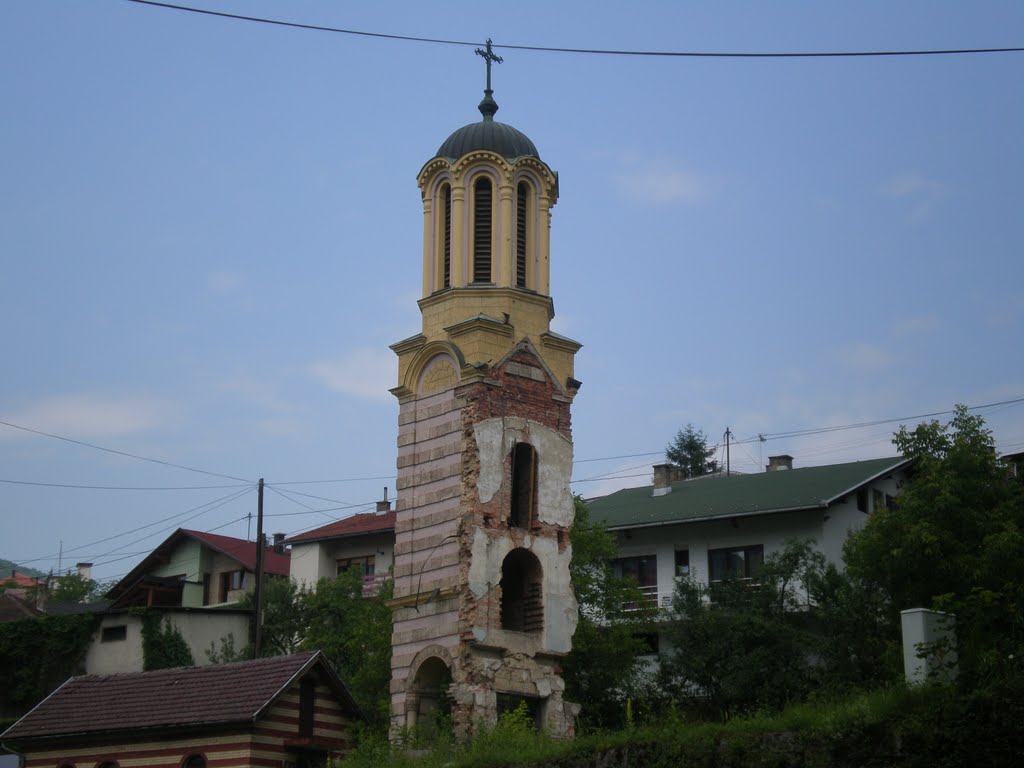
In the following weeks, all mosques and Catholic churches in Jajce were demolished. It is presumed that the Orthodox church was demolished on 10–11 October by members of the so-called "Krajina Brigade" within the Army of BiH. The VRS converted the town's Franciscan monastery into a prison and its archives, museum collections and artworks were looted; the monastery church was completely destroyed. By 1992, all religious buildings in Jajce had been destroyed, except for two mosques whose perilous positioning on a hilltop had made them unsuitable for demolition.
Jajce was re-captured together with Bosanski Petrovac in mid-September 1995 during Operation Mistral 2 by the Croatian Defence Council (HVO), after VRS forces had evacuated the Serb population. Jajce became part of the Federation of Bosnia and Herzegovina according to the Dayton Agreement. Returning Bosniaks were at first blocked by a mob of Croats in early August 1996, which according to US diplomat Robert Gelbard was personally led by convicted Bosnian Croat war criminal Dario Kordić. Bosniak refugees were able to return peacefully only a few weeks after, being accompanied by many more. Dario Kordić surrendered and was flown to the Hague following political pressure on Zagreb, particularly by the United States.
A significant number of Serb refugees settled in Brčko while the rest settled in Mrkonjić Grad, Šipovo, and Banja Luka.
Economy and tourism

National Monument and UNESCO Tentative List
The economy of the Jajce municipality is nowadays weak. UNESCO, with a Swedish organisation Kulturarv utan gränser (), initiated a project of the renovation of the historical core of the town. The main project of the company was to renovate old traditional houses which symbolize the panoramic view of the town with the waterfall. As of 2006, most of the houses were rebuilt.
The old Jajce walled city core, including the waterfall, and other individual sites outside the walled city perimeter, such as the Jajce Mithraeum, is designated as The Natural and Architectural Ensemble of Jajce and proposed for the inscription into the UNESCO's World Heritage Site list. The bid for the inscription is currently placed on the UNESCO Tentative list.
Tourism
Jajce was a popular tourist destination in Yugoslav times, mostly due to the historical importance of the AVNOJ session. Tourism has restarted, and its numbers (20-55,000 tourists in 2012–2013) are relevant in relation to the municipality's population (25,000). Tourists from across the former Yugoslavia still make up most of the visitors to Jajce, but Middle Eastern tourists have also increased since the early 2000s. Organised school trips also make up a significant portion of tourists. Spring and autumn are the main tourist seasons.
The town is famous for its beautiful 22 m high waterfall where the Pliva River meets the river Vrbas. It was damaged during the Bosnian War by high waters and severe flooding, as the area of the Jajce-1 Hydroelectric Power Station was at the battlefront and out of service; the sudden rise in water levels and discharge created a tidal wave which damaged the travertine body of the waterfall.
Jajce is situated in the mountains; there is beautiful countryside near the town, rivers such as the Vrbas and Pliva, and lakes such as Pliva lake, which is also a popular destination for the local people and tourists. Not far from Jajce there are mountains that are almost 2,000 metres high, such as Vlašić near the town of Travnik. Travelling through the mountain roads to the town may not be pleasant for some visitors, because the roads are in poor condition, but the scenery is picturesque.
Demographics
In 1931 the municipality of Jajce was part of the much bigger Jajce County (together with today's municipalities of Jezero, Dobretići and Šipovo).
266 Serbs from Jajce are documented to have been murdered at the Jasenovac concentration camp during World War II.
Population
| Settlement | 1931 | 1948 | 1953 | 1961 | 1971 | 1981 | 1991 | 2013 |
|---|---|---|---|---|---|---|---|---|
| Total | 48,510 | 34,488 | 35,002 | 41,197 | 45,007 | |||
| 1 | Bare | 225 | ||||||
| 2 | Barevo | 1,616 | ||||||
| 3 | Biokovina | 512 | ||||||
| 4 | Bistrica | 1,236 | ||||||
| 5 | Bravnice | 868 | ||||||
| 6 | Bučići | 457 | ||||||
| 7 | Bulići | 1,400 | ||||||
| 8 | Carevo Polje | 1,875 | ||||||
| 9 | Divičani | 1,257 | ||||||
| 10 | Donji Bešpelj | 834 | ||||||
| 11 | Doribaba | 651 | ||||||
| 12 | Gornji Bešpelj | 783 | ||||||
| 13 | Ipota | 372 | ||||||
| 14 | **Jajce** | 6,853 | 9,127 | 11,918 | 13,579 | |||
| 15 | Kasumi | 319 | ||||||
| 16 | Klimenta | 411 | ||||||
| 17 | Kruščica | 913 | ||||||
| 18 | Kuprešani | 1,106 | ||||||
| 19 | Lendići | 703 | ||||||
| 20 | Lupnica | 1,064 | ||||||
| 21 | Mile | 1,270 | ||||||
| 22 | Peratovci | 372 | ||||||
| 23 | Podmilačje | 674 | ||||||
| 24 | Prudi | 614 | ||||||
| 25 | Pšenik | 411 | ||||||
| 26 | Rika | 901 | ||||||
| 27 | Seoci | 423 | ||||||
| 28 | Šibenica | 925 | ||||||
| 29 | Smionica | 470 | ||||||
| 30 | Vinac | 1,341 | ||||||
| 31 | Vlasinje | 1,133 | ||||||
| 32 | Vrbica | 652 | ||||||
| 33 | Vukičevci | 475 |
Ethnic composition
| 2013 | 1991 | 1981 | 1971 |
|---|---|---|---|
| Total | 7,172 (100,0%) | 13,579 (100,0%) | 11,918 (100,0%) |
| Croats | 3,273 (45,64%) | 1,899 (13,98%) | 1,991 (16,71%) |
| Bosniaks | 3,267 (45,55%) | 5,277 (38,86%) | 4,068 (34,13%) |
| Others | 435 (6,065%) | 389 (2,865%) | 80 (0,671%) |
| Serbs | 197 (2,747%) | 3,797 (27,96%) | 3,046 (25,56%) |
| Yugoslavs | 2,217 (16,33%) | 2,632 (22,08%) | |
| Montenegrins | 58 (0,487%) | ||
| Albanians | 22 (0,185%) | ||
| Macedonians | 8 (0,067%) | ||
| Slovenes | 6 (0,050%) | ||
| Hungarians | 6 (0,050%) | ||
| Roma | 1 (0,008%) |
| 2013 | 1991 | 1981 | 1971 | 1961 | 1931 |
|---|---|---|---|---|---|
| Total | 30,758 (100,0%) | 45,007 (100,0%) | 41,197 (100,0%) | 35,002 (100,0%) | 34,488 (100,0%) |
| Bosniaks | 13,269 (48,68%) | 17,380 (38,62%) | 15,145 (36,76%) | 14,001 (40,00%) | 7,545 (21,88%) |
| Croats | 12,555 (46,06%) | 15,811 (35,13%) | 14,418 (35,00%) | 12,376 (35,36%) | 13,733 (39,82%) |
| Others | 933 (3,423%) | 657 (1,460%) | 375 (0,910%) | 192 (0,549%) | 198 (0,57%) |
| Serbs | 501 (1,838%) | 8,663 (19,25%) | 7,954 (19,31%) | 8,132 (23,23%) | 8,670 (25,14%) |
| Yugoslavs | 2,496 (5,546%) | 3,177 (7,712%) | 208 (0,594%) | 4,342 (12,59%) | |
| Montenegrins | 72 (0,175%) | 47 (0,134%) | |||
| Albanians | 32 (0,078%) | 15 (0,043%) | |||
| Macedonians | 10 (0,024%) | 3 (0,009%) | |||
| Slovenes | 7 (0,017%) | 18 (0,051%) | |||
| Hungarians | 6 (0,015%) | 4 (0,011%) | |||
| Roma | 1 (0,002%) | 6 (0,017%) |
Climate
| Jan record high C = 16.6 | Feb record high C = 21.4 | Mar record high C = 26.6 | Apr record high C = 29.4 | May record high C = 33.4 | Jun record high C = 34.6 | Jul record high C = 37.6 | Aug record high C = 37.0 | Sep record high C = 37.0 | Oct record high C = 29.4 | Nov record high C = 23.2 | Dec record high C = 19.8 |year record high C = 37.6 | Jan record low C = -25.4 | Feb record low C = -18.6 | Mar record low C = -15.2 | Apr record low C = -4.4 | May record low C = -1.5 | Jun record low C = 1.2 | Jul record low C = 5.4 | Aug record low C = 4.8 | Sep record low C = -2.0 | Oct record low C = -5.8 | Nov record low C = -14.8 | Dec record low C = -18.8 |year record low C = -25.4 | archive-url = https://web.archive.org/web/20180507015809/http://atlasklime.fhmzbih.gov.ba/en/data-access/reference-period/7 | archive-date = 7 May 2018 | access-date = 6 May 2018}}
Settlements
- Bare
- Barevo
- Bavar
- Biokovina
- Bistrica
- Borci
- Božikovac
- Bravnice
- Brvanci
- Bučići
- Bulići
- Carevo Polje
- Cvitović
- Čerkazovići
- Ćusine
- Divičani
- Dogani
- Donji Bešpelj
- Doribaba
- Drenov Do
- Dubrave
- Đumezlije
- Gornji Bešpelj
- Grabanta
- Grdovo
- Ipota
- Jajce
- Jezero
- Kamenice
- Karići
- Kasumi
- Klimenta
- Kokići
- Kovačevac
- Krezluk
- Kruščica
- Kuprešani
- Lendići
- Lučina
- Lupnica
- Ljoljići
- Magarovci
- Mile
- Peratovci
- Perućica
- Podlipci
- Podmilačje
- Prisoje
- Prudi
- Pšenik
- Rika
- Selište
- Seoci
- Smionica
- Stare Kuće
- Šerići
- Šibenica
- Vinac
- Vrbica
- Vukićevci
- Zastinje
- Zdaljevac
- Žaovine
Notable people
- Pero Šimleša (1910–1988), pedagogue from Ljuša
- Dubravko Lovrenović, medievalist and author
- Mato Jajalo (born 1988), footballer
- Marin Leovac (born 1988), footballer
- Irfan Škiljan (born 1973), computer scientist, author of the IrfanView program
- Mara Jelica (born 1974), chess player
Twin towns – sister cities
Jajce is twinned with:
- TUR Alaçatı (Çeşme), Turkey
- SWE Hallsberg, Sweden
- CZE Kutná Hora, Czech Republic
- AUT Ottensheim, Austria
- ITA Piacenza, Italy
- HUN Szekszárd, Hungary
- BIH Tomislavgrad, Bosnia and Herzegovina
- CRO Virovitica, Croatia
- BIH Zenica, Bosnia and Herzegovina
Notes
References
Bibliography
References
- "Naseljena Mjesta 1991/2013". [[Statistical Office of Bosnia and Herzegovina]].
- (12 January 2003). "The historic (antique religious) monument of the Mithraeum in Jajce". Commission to preserve national monuments.
- Amer Sulejmanagić, Vol. 54 No. 65, 2012. Coins of Hrvoje Vukčić Hrvatinić, https://hrcak.srce.hr/190275 #page=57
- (2023). "A Concise History of Serbia". [[Cambridge University Press]].
- {{cite encyclopedia. (2013–2015). Leksikografski zavod Miroslav Krleža. link
- JOSIPA ADŽIĆ, History department, KEGLEVIĆI BUŽIMSKI U 16. STOLJEĆU, 2018 https://repozitorij.unipu.hr/islandora/object/unipu:2759/preview{{Dead link. (August 2025)
- {{harvnb. Mesić. 1869
- {{harvnb. Magdić. 1884
- {{harvnb. Koprivčević. 1943
- {{harvnb. Karbić. 2006
- {{harvnb. Žubrinić. 1995a; {{harvnb. Žubrinić. 1995b; {{harvnb. Žubrinić. 2001; {{harvnb. Žubrinić. 2017; not mentioned in {{harvnb. Damjanović. 2004
- Pinson, Mark. (1996). "The Muslims of Bosnia-Herzegovina, the Historic Development from Middle Ages to the Dissolution of Yugoslavia". [[President and Fellows of Harvard College]].
- "Spomenik Database {{!}} 2nd AVNOJ Museum at Jajce".
- Shrader, Charles R.. (2003). "The Muslim-Croat Civil War in Central Bosnia: A Military History, 1992–1994". [[Texas A&M University Press]].
- (2011). "Bosnia Remade: Ethnic Cleansing and Its Reversal". Oxford University Press.
- Walesek, Helen. (2013). "Bosnia and the Destruction of Cultural Heritage". [[Ashgate Publishing]].
- [[Richard Holbrooke]], ''To end a war'', Random House 1998, p. 158
- [[Richard Holbrooke]], ''To end a war'', Random House 1998, p. 350
- (3 June 1998). "A Tale of Two Cities: Return of Displaced Persons to Jajce and Travnik". International Crisis Group.
- "The natural and architectural ensemble of Jajce – UNESCO World Heritage Centre". UNESCO World Heritage Centre.
- "UNESCO World Heritage Centre – Tentative Lists: Bosnia and Herzegovina". UNESCO World Heritage Centre.
- [https://books.google.com/books?id=N5LpCgAAQBAJ The wider benefits of investment in cultural heritage: Case studies in Bosnia and Herzegovina and Serbia]. [[Council of Europe]], 2015
- [http://www.visitjajce.com/en/index.php/homepage/offers/first-offer/192-jajce-tourism-service-package Visit Jajce]{{dead link. (November 2017)
- "BiH Tourism".
- "Bradt Guide".
- (September 2024). "Victims search: Place of Origin Contains Jajce". [[Jasenovac Research Institute]].
- "Godišnje izdanje Informativnog biltena Općine Jajce za 2018. godinu". Jajce.
This article was imported from Wikipedia and is available under the Creative Commons Attribution-ShareAlike 4.0 License. Content has been adapted to SurfDoc format. Original contributors can be found on the article history page.
Ask Mako anything about Jajce — get instant answers, deeper analysis, and related topics.
Research with MakoFree with your Surf account
Create a free account to save articles, ask Mako questions, and organize your research.
Sign up freeThis content may have been generated or modified by AI. CloudSurf Software LLC is not responsible for the accuracy, completeness, or reliability of AI-generated content. Always verify important information from primary sources.
Report