From Surf Wiki (app.surf) — the open knowledge base
Israeli settlement
Israeli communities built on land occupied in the 1967 Six-Day War
Israeli communities built on land occupied in the 1967 Six-Day War
Israeli settlements, also called Israeli colonies, are the civilian communities built by Israel throughout the Israeli-occupied territories. They are populated by Israeli citizens, almost exclusively of Jewish identity or ethnicity, and have been constructed on lands that Israel has militarily occupied since the Six-Day War in 1967. The international community considers Israeli settlements to be illegal under international law, but Israel disputes this.{{Cite book| title = International Law and the Arab-Israel Conflict: Extracts from "Israel and Palestine Assault on the Law of Nations" by Professor Julius Stone | edition = 2nd | author-link = Julius Stone | editor-last = Lacey | editor-first = Ian
As of April 2025, Israeli settlements exist in the West Bank (including East Jerusalem), which is claimed by the Palestine Liberation Organization (PLO) as the sovereign territory of the State of Palestine, and in the Golan Heights, which is internationally recognized as a part of the sovereign territory of Syria.{{efn|In 2019, the United States became the only state to recognize the Golan Heights as Israeli sovereign territory, while the rest of the international community continues to consider the territory Syrian held under Israeli military occupation.
As of January 2023, there are 144 Israeli settlements in the West Bank, including 12 in East Jerusalem; the Israeli government administers the West Bank as the Judea and Samaria Area, which does not include East Jerusalem. In addition to the settlements, the West Bank is also hosting at least 196 Israeli outposts, which are settlements that have not been authorized by the Israeli government. In total, over 450,000 Israeli settlers reside in the West Bank, excluding East Jerusalem, with an additional 220,000 Israeli settlers residing in East Jerusalem. Additionally, over 25,000 Israeli settlers live in Syria's Golan Heights. Between 1967 and 1982, there were 18 settlements established in the Israeli-occupied Sinai Peninsula of Egypt, though these were dismantled by Israel after the Egypt–Israel peace treaty of 1979. Additionally, as part of the Israeli disengagement from the Gaza Strip in 2005, Israel dismantled all 21 settlements in the Gaza Strip and four settlements in the West Bank.
Per the Fourth Geneva Convention, the transfer by an occupying power of its civilian population into the territory it is occupying constitutes a war crime, although Israel disputes that this statute applies to the West Bank. On 20 December 2019, the International Criminal Court announced the opening of an investigation of war crimes in the Palestinian territories. The presence and ongoing expansion of existing settlements by Israel and the construction of outposts is frequently criticized as an obstacle to peace by the PLO, and by a number of third parties, such as the Organization of Islamic Cooperation, the United Nations (UN), Russia, the United Kingdom, France, and the European Union. The UN has repeatedly upheld the view that Israel's construction of settlements in the occupied territories constitutes a violation of the Fourth Geneva Convention.*
-
- Civilian and military presence as strategies of territorial control: The Arab-Israel conflict, David Newman, Political Geography Quarterly Volume 8, Issue 3, July 1989, Pages 215–227 For decades, the United States also designated Israeli settlements as illegal, but the first Trump administration reversed this long-standing policy in November 2019, declaring that "the establishment of Israeli civilian settlements in the West Bank is not per se inconsistent with international law"; this new policy, in turn, was reversed to the original by the Biden administration in February 2024, once again classifying Israeli settlement expansion as "inconsistent with international law" and matching the official positions of the other three members of the Middle East Quartet.
Name and characterization
Certain observers and Palestinians occasionally use the term "Israeli colonies" as a substitute for the term "settlements". Settlements range in character from farming communities and frontier villages to urban suburbs and neighborhoods. The four largest settlements, Modi'in Illit, Ma'ale Adumim, Beitar Illit and Ariel, have achieved city status. Ariel has 18,000 residents, while the rest have around 37,000 to 55,500 each.
Housing costs and state subventions
Settlement has an economic dimension, much of it driven by the significantly lower costs of housing for Israeli citizens living in Israeli settlements compared to the cost of housing and living in Israel proper. Government spending per citizen in the settlements is double that spent per Israeli citizen in Tel Aviv and Jerusalem, while government spending for settlers in isolated Israeli settlements is three times the Israeli national average. Most of the spending goes to the security of the Israeli citizens living there.
Number of settlements and inhabitants
Main article: :List of Israeli settlements As of January 2023, there are 144 Israeli settlements in the West Bank, including 12 in East Jerusalem. In addition, there are at least 196 Israeli illegal outposts (not sanctioned by the Israeli government) in the West Bank. In total, over 500,000 Israeli settlers live in the West Bank excluding East Jerusalem, with an additional 220,000 Jewish settlers residing in East Jerusalem.
Additionally, over 20,000 Israeli citizens live in settlements in the Golan Heights.
History
Occupied territories
Following the 1967 Six-Day War, Israel occupied a number of territories. It took over the remainder of the Palestinian Mandate territories of the West Bank including East Jerusalem, from Jordan which had controlled the territories since the 1948 Arab-Israeli war, and the Gaza Strip from Egypt, which had held Gaza under occupation since 1949. From Egypt, it also captured the Sinai Peninsula and from Syria it captured most of the Golan Heights, which since 1981 has been administered under the Golan Heights Law.
Settlement policy
As early as September 1967, Israeli settlement policy was progressively encouraged by the Labor government of Levi Eshkol. The basis for Israeli settlement in the West Bank became the Allon Plan, named after its inventor Yigal Allon. It implied Israeli annexation of major parts of the Israeli-occupied territories, especially East Jerusalem, Gush Etzion and the Jordan Valley. The settlement policy of the government of Yitzhak Rabin was also derived from the Allon Plan.
The first settlement was Kfar Etzion, in the southern West Bank, although that location was outside the Allon Plan. Many settlements began as Nahal settlements. They were established as military outposts and later expanded and populated with civilian inhabitants. According to a secret document dating to 1970, obtained by Haaretz, the settlement of Kiryat Arba was established by confiscating land by military order and falsely representing the project as being strictly for military use while in reality, Kiryat Arba was planned for settler use. The method of confiscating land by military order for establishing civilian settlements was an open secret in Israel throughout the 1970s, but publication of the information was suppressed by the military censor.
In the 1970s, Israel's methods for seizing Palestinian land to establish settlements included requisitioning for ostensibly military purposes and spraying of land with poison.
The Likud government of Menahem Begin, from 1977, was more supportive to settlement in other parts of the West Bank, by organizations like Gush Emunim and the Jewish Agency/World Zionist Organization, and intensified the settlement activities. In a government statement, Likud declared that the entire historic Land of Israel is the inalienable heritage of the Jewish people and that no part of the West Bank should be handed over to foreign rule. Ariel Sharon declared in the same year (1977) that there was a plan to settle 2 million Jews in the West Bank by 2000. The government abrogated the prohibition from purchasing occupied land by Israelis; the "Drobles Plan", a plan for large-scale settlement in the West Bank meant to prevent a Palestinian state under the pretext of security became the framework for its policy.Division for Palestinian Rights/CEIRPP, SUPR Bulletin No. 9-10 (letters of 19 September 1979 and 18 October 1979). Original UNGA/UNSC publication of the "Drobles Plan" in pdf: Letter dated 18 October 1979 from the Chairman of the Committee on the Exercise of the Inalienable Rights of the Palestinian People addressed to the Secretary-General , see ANNEX (doc.nrs. A/34/605 and S/13582 d.d. 22-10-1979).Citations from the Drobles Plan (October 1978): http://documents-dds-ny.un.org/doc/UNDOC/GEN/N79/268/98/pdf/N7926898.pdf?OpenElement
"Settlement throughout the entire Land of Israel is for security and by right. A strip of settlements at strategic sites enhances both internal and external security alike, as well as making concrete and realizing our right to Eretz Israel."
"The disposition of the settlements must be carried out not only around the settlements of the minorities, but also in between them." Note: "minorities" refers to the Arab population in Israel and the [Palestinian territories. The West Bank had some 98% Arabs in 1978.]
"New settlements will be established only on State-owned land, and not on private Arab-owned land which is duly registered. We should ensure that there is no need for the expropriation of private plots from the members of the minorities."
"As is known, it is the task of the land settlement department to initiate, plan and implement the settlement enterprise according to the decisions of the Government and of the joint Government-World Zionist Organization Committee for Settlement."
"This will enable us to bring about the dispersion … to the presently empty areas of J&S."
The "Drobles Plan" from the World Zionist Organization, dated October 1978 and named "Master Plan for the Development of Settlements in Judea and Samaria, 1979–1983", was written by the Jewish Agency director and former Knesset member Matityahu Drobles. In January 1981, the government adopted a follow-up plan from Drobles, dated September 1980 and named "The current state of the settlements in Judea and Samaria", with more details about settlement strategy and policy.Citations from the Matityahu Drobles follow-up plan (September 1980): https://unispal.un.org/UNISPAL.NSF/0/3E5D731750EEB69E8525696600663AD0
THE SETTLEMENT STRATEGY IN JUDEA AND SAMARIA
"In light of the current negotiations on the future of Judea and Samaria, it will now become necessary for us to conduct a race against time. During this period, everything will be mainly determined by the facts we establish in these territories and less by any other considerations. This is therefore the best time for launching an extensive and comprehensive settlement momentum, particularly on the Judea and Samaria hilltops which are not easily passable by nature and which preside over the Jordan Valley on the cast and over the Coastal Plain on the west."
"It is therefore significant to stress today, mainly by means of actions, that the autonomy does not and will not apply to the territories but only to the Arab population thereof. This should mainly find expression by establishing facts on the ground. Therefore, the state-owned lands and the uncultivated barren lands in Judea and Samaria ought to be seized right away, with the purpose of settling the areas between and around the centers occupied by the minorities so as to reduce to the minimum the danger of an additional Arab state being established in these territories. Being cut off by Jewish settlements the minority population will find it difficult to form a territorial and political continuity."
"There mustn't be even the shadow of a doubt about our intention to keep the territories of Judea and Samaria for good. Otherwise, the minority population may get into a state of growing disquiet which will eventually result in recurrent efforts to establish an additional Arab state in these territories. The best and most effective way of removing every shadow of a doubt about our intention to hold on to Judea and Samaria forever is by speeding up the settlement momentum in these territories."
SETTLEMENT POLICY IN JUDEA AND SAMARIA
"Thus, it is necessary to establish additional settlements near every existing settlement in Judea and Samaria, so as to create settlement clusters in homogenous settlement regions ..."
"Over the next 5 years it is necessary to establish 12–15 rural and urban settlements per annum in Judea and Samaria, so that in five years from now the number of settlements will grow by 60–75 and the Jewish population thereof will amount to between 120,000 and 150,000 people."
Since 1967, government-funded settlement projects in the West Bank are implemented by the "Settlement Division" of the World Zionist Organization. Though formally a non-governmental organization, it is funded by the Israeli government and leases lands from the Civil Administration to settle in the West Bank. It is authorized to create settlements in the West Bank on lands licensed to it by the Civil Administration. Traditionally, the Settlement Division has been under the responsibility of the Agriculture Ministry. Since the Oslo Accords, it was always housed within the Prime Minister's Office (PMO). In 2007, it was moved back to the Agriculture Ministry. In 2009, the Netanyahu Government decided to subject all settlement activities to additional approval of the Prime Minister and the Defense Minister. In 2011, Netanyahu sought to move the Settlement Division again under the direct control of (his own) PMO, and to curtail Defense Minister Ehud Barak's authority.
At the presentation of the Oslo II Accord on 5 October 1995 in the Knesset, PM Yitzhak Rabin expounded the Israeli settlement policy in connection with the permanent solution to the conflict. Israel wanted "a Palestinian entity, less than a state, which will be a home to most of the Palestinian residents living in the Gaza Strip and the West Bank". It wanted to keep settlements beyond the Green Line including Ma'ale Adumim and Givat Ze'ev in East Jerusalem. Blocs of settlements should be established in the West Bank. Rabin promised not to return to the 4 June 1967 lines.
In June 1997, the Likud government of Benjamin Netanyahu presented its "Allon Plus Plan". This plan holds the retention of some 60% of the West Bank, including the "Greater Jerusalem" area with the settlements Gush Etzion and Ma'aleh Adumim, other large concentrations of settlements in the West Bank, the entire Jordan Valley, a "security area", and a network of Israeli-only bypass roads.
In the Road map for peace of 2002, which was never implemented, the establishment of a Palestinian state was acknowledged. Outposts would be dismantled. However, many new outposts appeared instead, few were removed. Israel's settlement policy remained unchanged. Settlements in East Jerusalem and remaining West Bank were expanded.
While according to official Israeli policy no new settlements were built, at least some hundred unauthorized outposts were established since 2002 with state funding in the 60% of the West Bank that was not under Palestinian administrative control and the population growth of settlers did not diminish.
In 2005, all 21 settlements in the Gaza Strip and four in the northern West Bank were forcibly evacuated as part of Israeli disengagement from the Gaza Strip, known to some in Israel as "the Expulsion". Nevertheless, the total settler population continued to rise.
After the failure of the Roadmap, several new plans emerged to settle in major parts of the West Bank. In 2011, Haaretz revealed the Civil Administration's "Blue Line"-plan, written in January 2011, which aims to increase Israeli "state-ownership" of West Bank land ("state lands") and settlement in strategic areas like the Jordan Valley and the northern Dead Sea area. In March 2012, it was revealed that the Civil Administration over the years covertly allotted 10% of the West Bank for further settlement. Provisional names for future new settlements or settlement expansions were already assigned. The plan includes many Palestinian built-up sites in the Areas A and B.
Settlements in the Gaza Strip
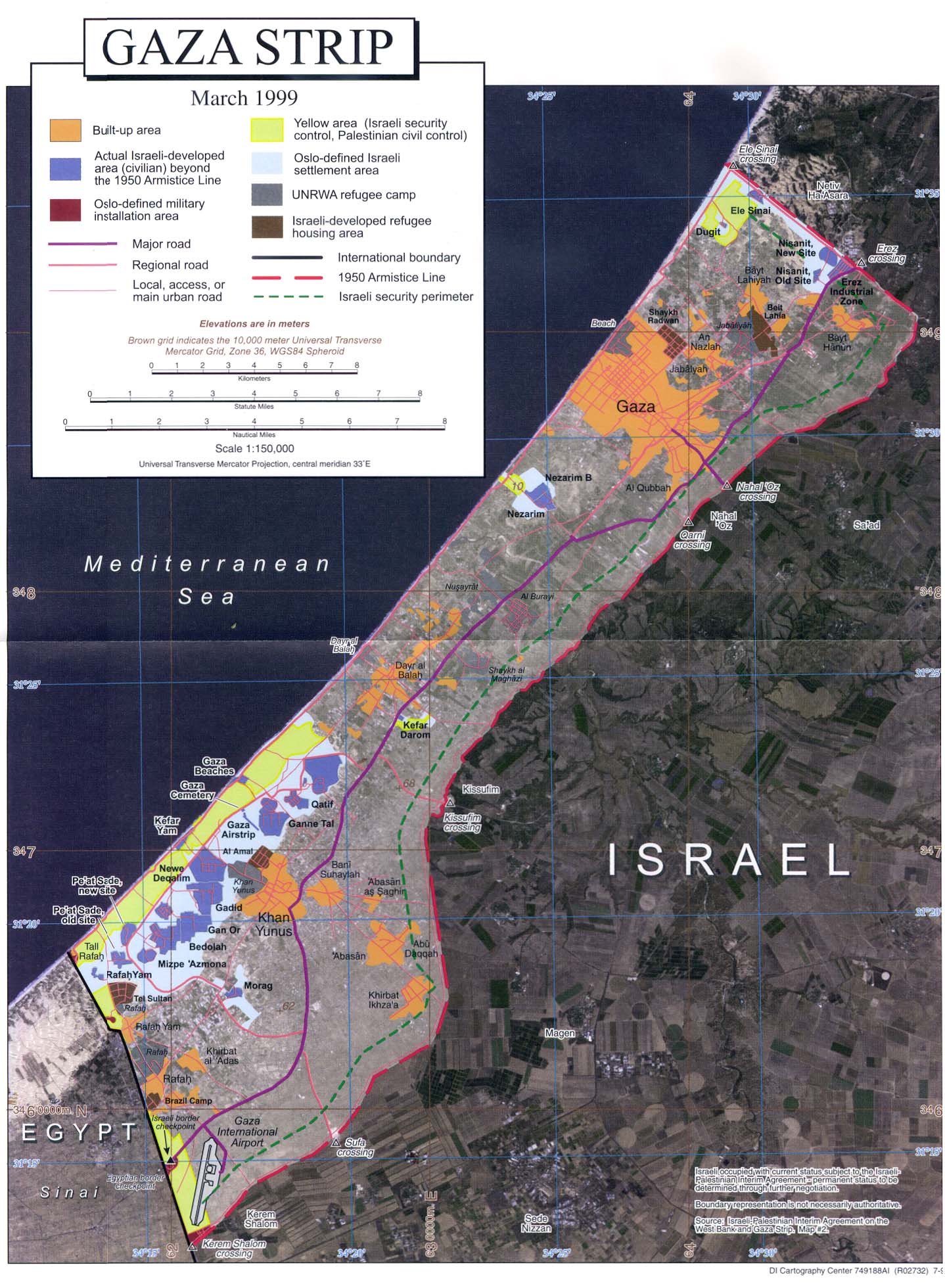
Land in the Gaza Strip available to its Palestinian inhabitants has historically been limited as a result of Israeli land confiscation and the establishment of settlements. Settlement growth in the Gaza Strip before 1977 was limited, as the Israeli labor party's policy of containment preferred the establishment of a collection of settlements along the border of the Strip. At this point, 6 settlements in the Strip existed, Kfar Darom, Netzarim, Morag, Eretz, Katif, and Netzer Hazani. With the Likud party's revisionist Zionist policies entering with Begin's government, the scale of settlement expansion increased, although the basic policies relating to the settlements did not change. By 1978, 13 settlements had been built as part of a buffer zone along Gaza's southern border in Rafah.
The discussions at Camp David that year surrounding the idea of potential future Palestinian autonomy would trigger an increase in settlement expansion in the Gaza Strip, following the Israeli policy of establishing "facts on the ground". Political economist Sara Roy described this as a policy intended to make the establishment of an independent Palestinian state more difficult. The locations and size of these new settlements would contribute to geographically isolating Palestinian communities from each other.
In the seven years between 1978 and 1985, 11,500 acres of land were confiscated by the Israeli government for the establishment of settlements. By 1991, the settler population in Gaza would reach 3,500 and 4,000 by 1993, or less than 1% of Gaza's population. The land available for use by the Jewish settler community exceeded 25% of the total land in Gaza. The ratio of dunams to people was 23 for Jewish settlers, and 0.27 for Palestinians. Comparing the available built-up area available to each of the two groups in 1993, the ratio is 115 people per square mile for Jewish settlers and over 9,000 people per square mile for Palestinians. Sara Roy estimates the increase in Palestinian population density in Gaza due to Israeli policies alone to be an increase of almost 2,000 people per square mile in 1993.
All the settlements were surrounded by electric fences or barbed wire.
While the settlements maintained an isolated economic system, they affected the Gazan economy via land confiscation, the disproportionate consumption of local resources such as water, by overwhelmingly denying work opportunities and through the large disparities in funding (both private and governmental) for economic development.
Geography and municipal status
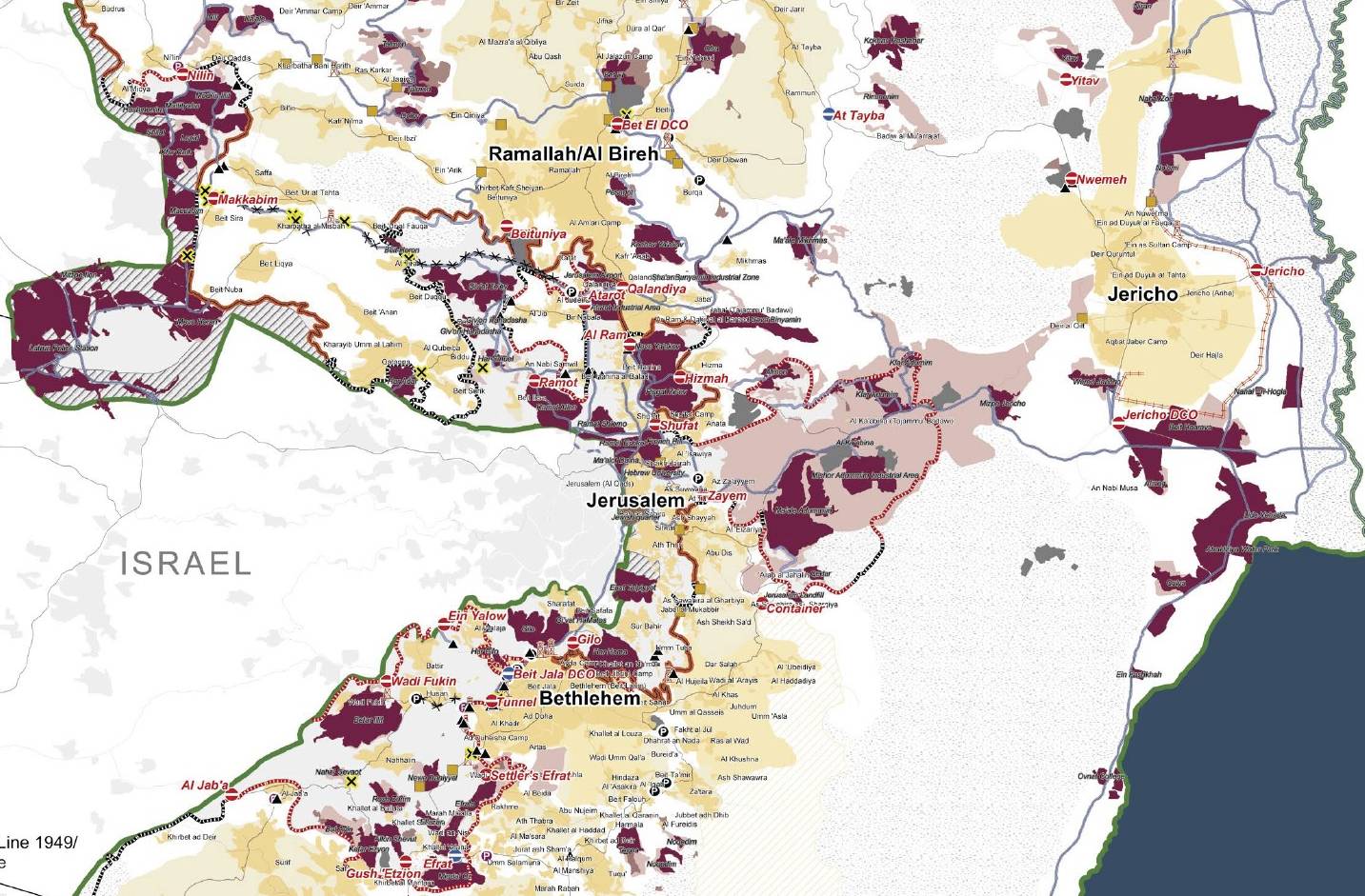
| Lower L of center: Etzion bloc | Lower center: Judean Desert | Lower right: Dead Sea |
|---|
]]
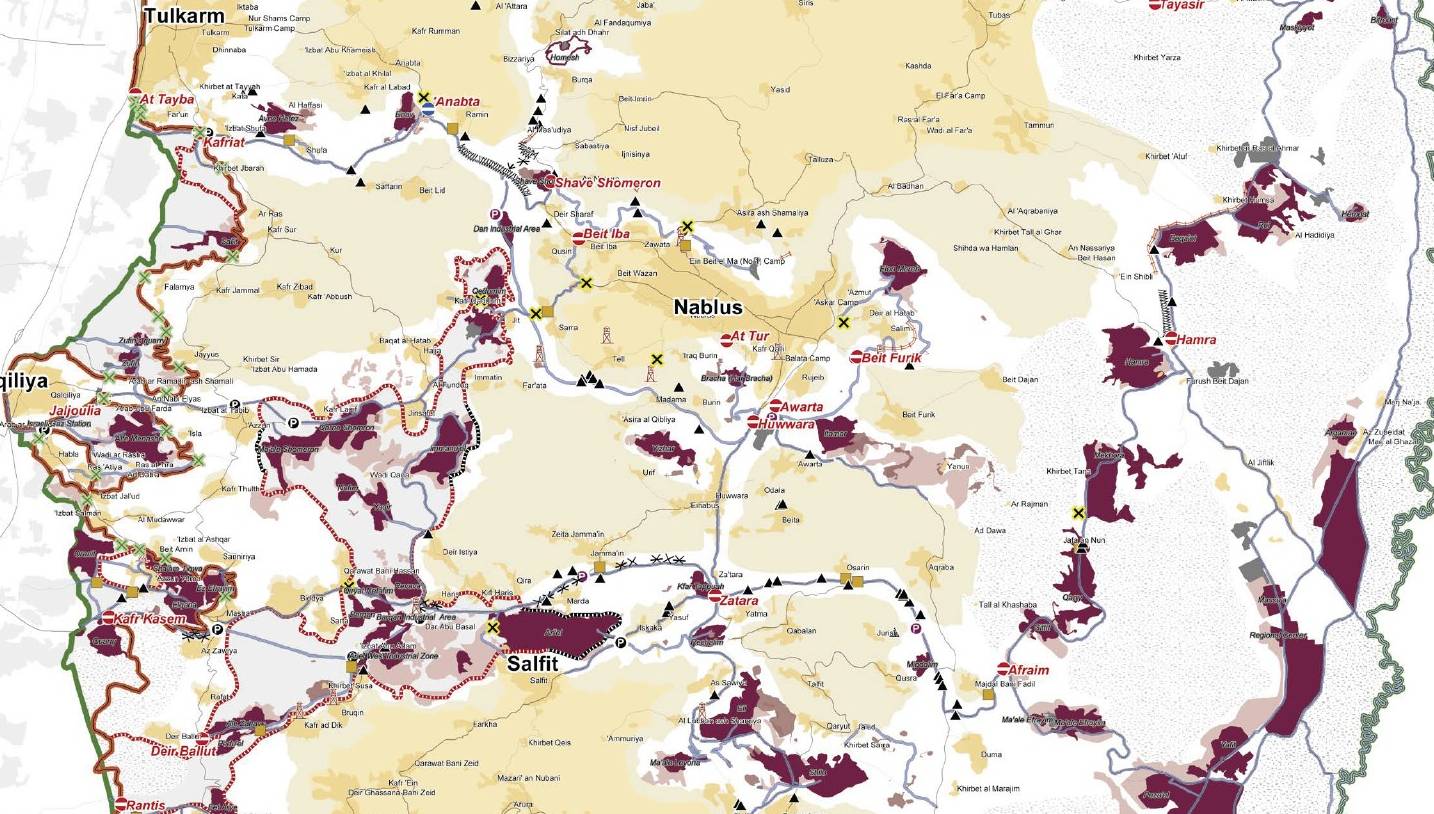
| Lower L: W. Samaria bloc to Ariel | Lower middle: E. Trans-Samaria Hwy outside barrier |
|---|
Some settlements are self-contained cities with a stable population in the tens of thousands, infrastructure, and all other features of permanence. Examples are Beitar Illit (a city of close to 45,000 residents), Ma'ale Adumim, Modi'in Illit, and Ariel (almost 20,000 residents). Some are towns with a local council status with populations of 2,000–20,0000, such as Alfei Menashe, Eli, Elkana, Efrat and Kiryat Arba. There are also clusters of villages governed by a local elected committee and regional councils that are responsible for municipal services. Examples are Kfar Adumim, Neve Daniel, Kfar Tapuach and Ateret. Kibbutzim and moshavim in the territories include Argaman, Gilgal, Na'aran and Yitav. Jewish neighborhoods have been built on the outskirts of Arab neighborhoods, for example in Hebron. In Jerusalem, there are urban neighborhoods where Jews and Arabs live together: the Muslim Quarter, Silwan, Abu Tor, Sheikh Jarrah and Shimon HaTzadik.
Under the Oslo Accords, the West Bank was divided into three separate parts designated as Area A, Area B and Area C. Leaving aside the position of East Jerusalem, all of the settlements are in Area C which comprises about 60% of the West Bank.
Types of settlement
- Cities/towns: Ariel, Betar Illit, Modi'in Illit and Ma'ale Adumim.
- Urban suburbs, such as Har Gilo.
- Block settlements, such as Gush Etzion and settlements in the Nablus area.
- Frontier villages, such as those along the Jordan River.
- Outposts, small settlements, some authorized and some unauthorized, often on hilltops. The Sasson Report, commissioned by Ariel Sharon's administration, found that several government ministries had cooperated to establish illegal outposts, spending millions of dollars on infrastructure.
Resettlement of former Jewish communities
Some settlements were established on sites where Jewish communities had existed during the British Mandate of Palestine or even since the First Aliyah or ancient times.
- Golan Heights – Bnei Yehuda, founded in 1890, abandoned because of Arab attacks in 1920, rebuilt near the original site in 1972.
- Jerusalem – Jewish presence alongside other peoples since biblical times, various surrounding communities and neighborhoods, including Kfar Shiloah, also known as Silwan—settled by Yemenite Jews in 1884, Jewish residents evacuated in 1938, a few Jewish families move into reclaimed homes in 2004. Other communities: Shimon HaTzadik, Neve Yaakov and Atarot which in post-1967 was rebuilt as an industrial zone.
- Gush Etzion – four communities, established between 1927 and 1947, destroyed 1948, reestablished beginning 1967.
- Hebron – Jewish presence since biblical times, forced out in the wake of the 1929 Hebron massacre, some families returned in 1931 but were evacuated by the British, a few buildings resettled since 1967.
- Dead Sea, northern area – Kalia and Beit HaArava – the former was built in 1934 as a kibbutz for potash mining. The latter was built in 1943 as an agricultural community. Both were abandoned in 1948, and subsequently destroyed by Jordanian forces, and resettled after the Six-Day War.
- Gaza City had a Jewish community for many centuries that was evacuated following riots in 1929. After the Six-Day War, Jewish communities were not built in Gaza City, but in Gush Katif in the southwestern part of the Gaza Strip, f.e. Kfar Darom – established in 1946, evacuated in 1948 after an Egyptian attack, resettled in 1970, evacuated in 2005 as part of the withdrawal from the Gaza Strip.
Demographics
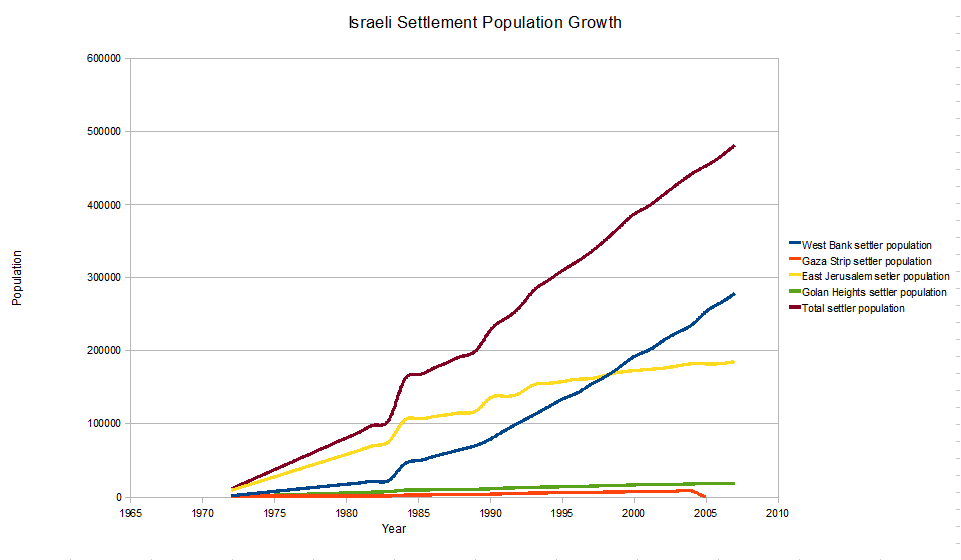
At the end of 2010, 534,224 Jewish Israelis lived in the West Bank, including East Jerusalem. 314,132 of them lived in the 121 authorised settlements and 102 unauthorised settlement outposts on the West Bank, 198,629 were living in East Jerusalem, and almost 20,000 lived in settlements in the Golan Heights.
By 2011, the number of Jewish settlers in the West Bank excluding East Jerusalem had increased to 328,423 people.
In June 2014, the number of Israeli settlers in the West Bank excluding East Jerusalem had increased to 382,031 people, with over 20,000 Israeli settlers in the Golan Heights.
In January 2015, the Israeli Interior Ministry gave figures of 389,250 Israeli citizens living in the West Bank outside East Jerusalem.
By the end of 2016, the West Bank Jewish population had risen to 420,899, excluding East Jerusalem, where there were more than 200,000 Jews.
In 2019, the number of Israeli settlers in the West Bank excluding East Jerusalem had risen to 441,600 individuals, and the number of Israeli settlers in the Golan Heights had risen to 25,261.
In 2020, the number of Israeli settlers in the West Bank excluding East Jerusalem had reportedly risen to 451,700 individuals, with an additional 220,000 Jews living in East Jerusalem.
Based on various sources, population dispersal can be estimated as follows:
| Settler population | 1948 | 1972 | 1977 | 1980 | 1983 | 1993 | 2004 | 2007 | 2010 | 2014 | 2018 | 2019 | 2020 | 2022 | Total | 2,810 | 10,531 | 99,795 | 269,200 | 423,913 | 467,478 | 512,769 | 645,800 | 671,700 | 733,000 | |||||||||||
|---|---|---|---|---|---|---|---|---|---|---|---|---|---|---|---|---|---|---|---|---|---|---|---|---|---|---|---|---|---|---|---|---|---|---|---|---|
| West Bank (excluding Jerusalem) | 480 (see Gush Etzion) | 1,182 | 3,200 | |||||||||||||||||||||||||||||||||
| 17,400 | 22,800 | 111,600 | 234,500 | 276,500 | 314,100 | 400,000 | url=https://fmep.org/resource/settlement-report-october-11-2019/ | title=Settlement Report: October 11, 2019 | publisher=Foundation for Middle East Peace | date=11 October 2019 | access-date=9 December 2019 | archive-date=14 December 2019 | archive-url=https://web.archive.org/web/20191214192236/https://fmep.org/resource/settlement-report-october-11-2019/ | url-status=live}} | url=https://www.jpost.com/arab-israeli-conflict/growth-rate-of-settlements-plummets-to-all-time-low-678817 | title=Growth rate of settlements plummets to all-time low | publisher=Jerusalem Post | date=5 September 2021 | access-date=30 October 2021 | archive-date=22 April 2023 | archive-url=https://web.archive.org/web/20230422172930/https://www.jpost.com//arab-israeli-conflict/growth-rate-of-settlements-plummets-to-all-time-low-678817 | url-status=live}} | 451,700 | 503,000 | ||||||||||||
| Gaza Strip 2 | 30 (see Kfar Darom) | 700 1 | – | 900 | 4,800 | 7,826 | 0 | |||||||||||||||||||||||||||||
| East Jerusalem | 2,300 (see Jewish Quarter, Atarot, Neve Yaakov) | 8,649 | – | 76,095 | 152,800 | 181,587 | 189,708 | 198,629 | – | 218,000 | – | url=https://www.un.org/unispal/wp-content/uploads/2021/03/EUSETTLERPT_120321.pdf | title=Six-Month Report on Israeli settlements in the occupied West Bank, including East Jerusalem Reporting period January–July 2020 | publisher=Jerusalem Post | date=8 March 2021 | access-date=31 October 2021 | archive-date=31 October 2021 | archive-url=https://web.archive.org/web/20211031114950/https://www.un.org/unispal/wp-content/uploads/2021/03/EUSETTLERPT_120321.pdf | url-status=live}} | 230,000 | ||||||||||||||||
| Golan Heights | 0 | 77 | – | 6,800 | 12,600 | 17,265 | 18,692 | 19,797 | 21,000 | – | 25,261 | – |
: 1 including Sinai : 2 Janet Abu-Lughod mentions 500 settlers in Gaza in 1978 (excluding Sinai), and 1,000 in 1980
In addition to internal migration, in large though declining numbers, the settlements absorb annually about 1000 new immigrants from outside Israel. The American Kulanu organization works with such right-wing Israeli settler groups as Amishav and Shavei Israel to settle "lost" Jews of color in such areas where local Palestinians are being displaced. In the 1990s, the annual settler population growth was more than three times the annual population growth in Israel. Population growth has continued in the 2000s. According to the BBC, the settlements in the West Bank have been growing at a rate of 5–6% since 2001. In 2016, there were sixty thousand American Israelis living in settlements in the West Bank.
The establishment of settlements in the Palestinian territories is linked to the displacement of the Palestinian populations as evidenced by a 1979 Security Council Commission which established a link between Israeli settlements and the displacement of the local population. The commission also found that those who remained were under consistent pressure to leave to make room for further settlers who were being encouraged into the area. In conclusion the commission stated that settlement in the Palestinian territories was causing "profound and irreversible changes of a geographic and demographic nature".
Administration and local government
West Bank
Main article: Judea and Samaria Area
The Israeli settlements in the West Bank fall under the administrative district of Judea and Samaria Area. Since December 2007, approval by both the Israeli Prime Minister and Israeli Defense Minister of all settlement activities (including planning) in the West Bank is required. Authority for planning and construction is held by the Israel Defense Forces Civil Administration.
The area consists of four cities, thirteen local councils and six regional councils.
- Cities: Ariel, Betar Illit, Maale Adumim, Modi'in Illit;
- Local councils: Alfei Menashe, Beit Aryeh-Ofarim, Beit El, Efrat, Elkana, Giv'at Ze'ev, Har Adar, Immanuel, Karnei Shomron, Kedumim, Kiryat Arba, Ma'ale Efraim, Oranit;
- Regional councils: Gush Etzion (Ezion Bloc), Har Hebron (Mount Hebron), Matte Binyamin (Staff of Benjamin, named after the ancient Israelite tribe that dwelled in the area), Megilot (Scrolls, named after the Dead Sea scrolls, which were discovered in the area), Shomron Regional Council (Samaria), Biq'at HaYarden (Jordan valley). The Yesha Council (, Moatzat Yesha, a Hebrew acronym for Judea, Samaria and Gaza) is the umbrella organization of municipal councils in the West Bank.
The actual buildings of the Israeli settlements cover only one percent of the West Bank, but their jurisdiction and their regional councils extend to about 42 percent of the West Bank, according to the Israeli NGO B'Tselem. Yesha Council chairman Dani Dayan disputes the figures and claims that the settlements only control 9.2 percent of the West Bank.
Between 2001 and 2007 more than 10,000 Israeli settlement units were built, while 91 permits were issued for Palestinian construction, and 1,663 Palestinian structures were demolished in Area C.
West Bank Palestinians have their cases tried in Israel's military courts while Jewish Israeli settlers living in the same occupied territory are tried in civil courts. The arrangement has been described as "de facto segregation" by the UN Committee on the Elimination of Racial Discrimination. A bill to formally extend Israeli law to the Israeli settlements in the West Bank was rejected in 2012. The basic military laws governing the West Bank are influenced by what is called the "pipelining" of Israeli legislation. As a result of "enclave law", large portions of Israeli civil law are applied to Israeli settlements and Israeli residents in the occupied territories.
On 31 August 2014, Israel announced it was appropriating 400 hectares of land in the West Bank to eventually house 1,000 Israel families. The appropriation was described as the largest in more than 30 years. According to reports on Israel Radio, the development is a response to the 2014 kidnapping and murder of Israeli teenagers.
In March 2024 and during the Gaza war, it was announced that Israel was planning on building more than 3,300 new homes in the Kedar and Ma'ale Adumim settlement in the West Bank. The settlement expansion was announced by Israeli Finance Minister Bezalel Smotrich after three Palestinians opened fire near the Ma'ale Adumim settlement, killing one and wounding five, and drew criticism from the US due to increasing tensions. During the Israel-Hamas war, the lines between settlers and the military were described as having become "indistinguishable".
East Jerusalem
East Jerusalem is defined in the Jerusalem Law of 1980 as part of Israel and its capital, Jerusalem. As such it is administered as part of the city and its district, the Jerusalem District. Pre-1967 residents of East Jerusalem and their descendants have residency status in the city but many have refused Israeli citizenship. Thus, the Israeli government maintains an administrative distinction between Israeli citizens and non-citizens in East Jerusalem, but the Jerusalem municipality does not.
Golan Heights
The Golan Heights is administered under Israeli civil law as the Golan sub-district, a part of the Northern District. Israel makes no legal or administrative distinction between pre-1967 communities in the Golan Heights (mainly Druze) and the post-1967 settlements.
Sinai Peninsula
After the capture of the Sinai Peninsula from Egypt in the 1967 Six-Day War, settlements were established along the Gulf of Aqaba and in northeast Sinai, just below the Gaza Strip. Israel had plans to expand the settlement of Yamit into a city with a population of 200,000, though the actual population of Yamit did not exceed 3,000. The Sinai Peninsula was returned to Egypt in stages beginning in 1979 as part of the Egypt–Israel peace treaty. As required by the treaty, in 1982 Israel evacuated the Israeli civilian population from the 18 Sinai settlements in Sinai. In some instances evacuations were done forcefully, such as the evacuation of Yamit. All the settlements were then dismantled.
Gaza Strip
Before Israel's unilateral disengagement plan in which the Israeli settlements were evacuated, there were 21 settlements in the Gaza Strip under the administration of the Hof Aza Regional Council. The land was allocated in such a way that each Israeli settler disposed of 400 times the land available to the Palestinian refugees, and 20 times the volume of water allowed to the peasant farmers of the Strip.
Legal status
Main article: International law and Israeli settlements
The International Court of Justice delivered a landmark advisory opinion in July 2024 that Israel's occupation of West Bank, East Jerusalem and the Gaza Strip was illegal, that Israel had "an obligation to cease immediately all new settlement activities and to evacuate all settlers" from the West Bank and East Jerusalem, and that Israel should "make reparation for the damage caused to all" the people of such lands.
The consensus view in the international community is that the existence of Israeli settlements in the West Bank including East Jerusalem and the Golan Heights is in violation of international law. The Fourth Geneva Convention includes statements such as "the Occupying Power shall not deport or transfer parts of its own civilian population into the territory it occupies". On 20 December 2019, International Criminal Court chief prosecutor Fatou Bensouda announced an International Criminal Court investigation in Palestine into alleged war crimes committed during the Israeli–Palestinian conflict. At present, the view of the international community, as reflected in numerous UN resolutions, regards the building and existence of Israeli settlements in the West Bank, East Jerusalem and the Golan Heights as a violation of international law.{{cite book|editor=Emma Playfair |title=International Law and the Administration of Occupied Territories|publisher=Oxford University Press|year=1992|location=USA|page=396|isbn=978-0-19-825297-9
The position of successive Israeli governments is that all authorized settlements are entirely legal and consistent with international law. In practice, Israel does not accept that the Fourth Geneva Convention applies de jure, but has stated that on humanitarian issues it will govern itself de facto by its provisions, without specifying which these are. The scholar and jurist Eugene Rostow has disputed the illegality of authorized settlements.
Under Israeli law, West Bank settlements must meet specific criteria to be legal. In 2009, there were approximately 100 small communities that did not meet these criteria and are referred to as illegal outposts.
In 2014 twelve EU countries warned businesses against involving themselves in the settlements. According to the warnings, economic activities relating to the settlements involve legal and economic risks stemming from the fact that the settlements are built on occupied land not recognized as Israel's.
Illegality arguments
The consensus of the international community – the vast majority of states, the overwhelming majority of legal experts, the International Court of Justice and the UN – is that settlements are in violation of international law.*
- Civilian and military presence as strategies of territorial control: The Arab-Israel conflict, David Newman, Political Geography Quarterly Volume 8, Issue 3, July 1989, Pages 215–227 After the Six-Day War, in 1967, Theodor Meron, legal counsel to the Israeli Foreign Ministry stated in a legal opinion to the Prime Minister,
"My conclusion is that civilian settlement in the administered territories contravenes the explicit provisions of the Fourth Geneva Convention."
This legal opinion was sent to Prime Minister Levi Eshkol. However, it was not made public at the time. The Labor cabinet allowed settlements despite the warning. This paved the way for future settlement growth. In 2007, Meron stated that "I believe that I would have given the same opinion today."
In 1978, the Legal Adviser of the Department of State of the United States reached the same conclusion.
The International Court of Justice, in its advisory opinion, has since ruled that Israel is in breach of international law by establishing settlements in Occupied Palestinian Territory, including East Jerusalem. The Court maintains that Israel cannot rely on its right of self-defense or necessity to impose a regime that violates international law. The Court also ruled that Israel violates basic human rights by impeding liberty of movement and the inhabitants' right to work, health, education and an adequate standard of living.
International intergovernmental organizations such as the Conference of the High Contracting Parties to the Fourth Geneva Convention, major organs of the United Nations, the European Union, and Canada, also regard the settlements as a violation of international law. The Committee on the Elimination of Racial Discrimination wrote that "The status of the settlements was clearly inconsistent with Article 3 of the Convention, which, as noted in the Committee's General Recommendation XIX, prohibited all forms of racial segregation in all countries. There is a consensus among publicists that the prohibition of racial discrimination, irrespective of territories, is an imperative norm of international law." Amnesty International, and Human Rights Watch have also characterized the settlements as a violation of international law.
In late January 2013 a report drafted by three justices, presided over by Christine Chanet, and issued by the United Nations Human Rights Council declared that Jewish settlements constituted a creeping annexation based on multiple violations of the Geneva Conventions and international law, and stated that if Palestine ratified the Rome Accord, Israel could be tried for "gross violations of human rights law and serious violations of international humanitarian law." A spokesman for Israel's Foreign Ministry declared the report 'unfortunate' and accused the UN's Human Rights Council of a "systematically one-sided and biased approach towards Israel."
The Supreme Court of Israel, with a variety of different justices sitting, has repeatedly stated that Israel's presence in the West Bank is subject to international law.
Legality arguments
Four prominent jurists cited the concept of the "sovereignty vacuum" in the immediate aftermath of the Six-Day War to describe the legal status of the West Bank and Gaza: Yehuda Zvi Blum in 1968, Elihu Lauterpacht in 1968, Julius Stone in 1969 and 1981, and Stephen M. Schwebel in 1970. Eugene V. Rostow also argued in 1979 that the occupied territories' legal status was undetermined.
- Stephen M. Schwebel made three distinctions specific to the Israeli situation to claim that the territories were seized in self-defense and that Israel has more title to them than the previous holders.
- Julius Stone also wrote that "Israel's presence in all these areas pending negotiation of new borders is entirely lawful, since Israel entered them lawfully in self-defense." He argued that it would be an "irony bordering on the absurd" to read Article 49(6) as meaning that the State of Israel was obliged to ensure (by force if necessary) that areas with a millennial association with Jewish life shall be forever "judenrein". Professor Ben Saul took exception to this view, arguing that Article 49(6) can be read to include voluntary or assisted transfers, as indeed it was in the advisory opinion of the International Court of Justice which had expressed this interpretation in the Israeli Wall Advisory Opinion (2003).
Israel maintains that a temporary use of land and buildings for various purposes is permissible under a plea of military necessity and that the settlements fulfilled security needs. Israel argues that its settlement policy is consistent with international law, including the Fourth Geneva Convention, while recognising that some settlements have been constructed illegally on private land. The Israeli Supreme Court has ruled that the power of the Civil Administration and the Military Commander in the occupied territories is limited by the entrenched customary rules of public international law as codified in the Hague Regulations.*Helmreich, Jeffrey. Diplomatic and Legal Aspects of the Settlement Issue , Jerusalem Issue Brief, Jerusalem Center for Public Affairs, Vol. 2, No. 16, 19 January 2003.
- Disputed territories – Forgotten facts about the West Bank and Gaza strip , Israeli Ministry of Foreign Affairs, 1 February 2003. Retrieved 29 January 2008. In 1998 the Israeli Minister of Foreign Affairs produced "The International Criminal Court Background Paper". It concludesInternational law has long recognised that there are crimes of such severity they should be considered "international crimes." Such crimes have been established in treaties such as the Genocide Convention and the Geneva Conventions... The following are Israel's primary issues of concern [i.e. with the rules of the ICC]: The inclusion of settlement activity as a "war crime" is a cynical attempt to abuse the Court for political ends. The implication that the transfer of civilian population to occupied territories can be classified as a crime equal in gravity to attacks on civilian population centres or mass murder is preposterous and has no basis in international law.
A UN conference was held in Rome in 1998, where Israel was one of seven countries to vote against the Rome Statute to establish the International Criminal Court. Israel was opposed to a provision that included as a war crime the transfer of civilian populations into territory the government occupies. Israel has signed the statute, but not ratified the treaty.
Land ownership
A 1996 amendment to an Israeli military order states that land privately owned can not be part of a settlement unless the land in question has been confiscated for military purposes. In 2006 Peace Now acquired a report, which it claims was leaked from the Israeli Government's Civil Administration, indicating that up to 40 percent of the land Israel plans to retain in the West Bank is privately owned by Palestinians. Peace Now called this a violation of Israeli law. Peace Now published a comprehensive report about settlements on private lands. In the wake of a legal battle, Peace Now lowered the figure to 32 percent, which the Civil Administration also denied. The Washington Post reported that "The 38-page report offers what appears to be a comprehensive argument against the Israeli government's contention that it avoids building on private land, drawing on the state's own data to make the case."
In February 2008, the Civil Administration stated that the land on which more than a third of West Bank settlements was built had been expropriated by the IDF for "security purposes." The unauthorized seizure of private Palestinian land was defined by the Civil Administration itself as 'theft.' According to B'Tselem, more than 42 percent of the West Bank are under control of the Israeli settlements, 21 percent of which was seized from private Palestinian owners, much of it in violation of the 1979 Israeli Supreme Court decision.
In 1979, the government decided to extend settlements or build new ones only on "state lands".
A secret database, drafted by a retired senior officer, Baruch Spiegel, on orders from former defense minister Shaul Mofaz, found that some settlements deemed legal by Israel were illegal outposts, and that large portions of Ofra, Elon Moreh and Beit El were built on private Palestinian land. The "Spiegel report" was revealed by Haaretz in 2009. Many settlements are largely built on private lands, without approval of the Israeli Government. According to Israel, the bulk of the land was vacant, was leased from the state, or bought fairly from Palestinian landowners.
Invoking the Absentees' Property Laws to transfer, sell or lease property in East Jerusalem owned by Palestinians who live elsewhere without compensation has been criticized both inside and outside of Israel. Opponents of the settlements claim that "vacant" land belonged to Arabs who fled or collectively to an entire village, a practice that developed under Ottoman rule. B'Tselem charged that Israel is using the absence of modern legal documents for the communal land as a legal basis for expropriating it. These "abandoned lands" are sometimes laundered through a series of fraudulent sales.
According to Amira Hass, one of the techniques used by Israel to expropriate Palestinian land is to place desired areas under a "military firing zone" classification, and then issue orders for the evacuation of Palestinians from the villages in that range while allowing contiguous Jewish settlements to remain unaffected.
Effects on Palestinian human rights

Amnesty International argues that Israel's settlement policy is discriminatory and a violation of Palestinian human rights. B'Tselem claims that Israeli travel restrictions impact on Palestinian freedom of movement and Palestinian human rights have been violated in Hebron due to the presence of the settlers within the city. According to B'Tselem, over fifty percent of West Bank land expropriated from Palestinians has been used to establish settlements and create reserves of land for their future expansion. The seized lands mainly benefit the settlements and Palestinians cannot use them. The roads built by Israel in the West Bank to serve the settlements are closed to Palestinian vehicles' and act as a barrier often between villages and the lands on which they subsist.
Human Rights Watch and other human rights observer volunteer regularly file reports on "settler violence", referring to stoning and shooting incidents involving Israeli settlers. Israel's withdrawal from Gaza and Hebron have led to violent settler protests and disputes over land and resources. Meron Benvenisti described the settlement enterprise as a "commercial real estate project that conscripts Zionist rhetoric for profit."
The construction of the Israeli West Bank barrier has been criticized as an infringement on Palestinian human and land rights. The United Nations Office for the Coordination of Humanitarian Affairs estimated that 10% of the West Bank would fall on the Israeli side of the barrier.
In July 2012, the UN Human Rights Council decided to set up a probe into Jewish settlements. The report of the independent international fact-finding mission which investigated the "implications of the Israeli settlements on the civil, political, economic, social and cultural rights of the Palestinian people throughout the Occupied Palestinian Territory" was published in February 2013.
In February 2020, the Office of the United Nations High Commissioner for Human Rights published a list of 112 companies linked to activities related to Israeli settlements in the occupied West Bank.
Economy
Goods produced in Israeli settlements are able to stay competitive on the global market, in part because of massive state subsidies they receive from the Israeli government. Farmers and producers are given state assistance, while companies that set up in the territories receive tax breaks and direct government subsidies. An Israeli government fund has also been established to help companies pay customs penalties. Israel has built 16 industrial zones, containing roughly 1000 industrial plants, in the West Bank and East Jerusalem on acreage that consumes large parts of the territory planned for a future Palestinian state. According to Jodi Rudoren these installations both entrench the occupation and provide work for Palestinians, even those opposed to it. The 16 parks are located at Shaked, Beka'ot, Baran, Karnei Shomron, Emmanuel, Barkan, Ariel, Shilo, Halamish, Ma'ale Efraim, Sha'ar Binyamin, Atarot, Mishor Adumim, Gush Etzion, Kiryat Arba and Metarim (2001). In spite of this, the West Bank settlements have failed to develop a self-sustaining local economy. About 60% of the settler workforce commutes to Israel for work. The settlements rely primarily on the labor of their residents in Israel proper rather than local manufacturing, agriculture, or research and development. Of the industrial parks in the settlements, there are only two significant ones, at Ma'ale Adumim and Barkan, with most of the workers there being Palestinian. Only a few hundred settler households cultivate agricultural land, and rely primarily on Palestinian labor in doing so.
Settlement has an economic dimension, much of it driven by the significantly lower costs of housing for Israeli citizens living in Israeli settlements compared to the cost of housing and living in Israel proper. Government spending per citizen in the settlements is double that spent per Israeli citizen in Tel Aviv and Jerusalem, while government spending for settlers in isolated Israeli settlements is three times the Israeli national average. Most of the spending goes to the security of the Israeli citizens living there.
Export to EU
According to Israeli government estimates, $230 million worth of settler goods including fruit, vegetables, cosmetics, textiles and toys are exported to the EU each year, accounting for approximately 2% of all Israeli exports to Europe. A 2013 report of Profundo revealed that at least 38 Dutch companies imported settlement products.
European Union law requires a distinction to be made between goods originating in Israel and those from the occupied territories. The former benefit from preferential custom treatment according to the EU-Israel Association Agreement (2000); the latter do not, having been explicitly excluded from the agreement. In practice, however, settler goods often avoid mandatory customs through being labelled as originating in Israel, while European customs authorities commonly fail to complete obligatory postal code checks of products to ensure they have not originated in the occupied territories.
In 2009, the United Kingdom's Department for the Environment, Food and Rural Affairs issued new guidelines concerning labelling of goods imported from the West Bank. The new guidelines require labelling to clarify whether West Bank products originate from settlements or from the Palestinian economy. Israel's foreign ministry said that the UK was "catering to the demands of those whose ultimate goal is the boycott of Israeli products"; but this was denied by the UK government, who said that the aim of the new regulations was to allow consumers to choose for themselves what produce they buy. Denmark has similar legislation requiring food products from settlements in the occupied territories to be accurately labelled.
On 12 November 2019 the Court of Justice of the European Union in a ruling covering all territory Israel captured in the 1967 war decided that labels on foodstuffs must not imply that goods produced in occupied territory came from Israel itself and must "prevent consumers from being misled as to the fact that the State of Israel is present in the territories concerned as an occupying power and not as a sovereign entity". In its ruling, the court said that failing to inform EU consumers they were potentially buying goods produced in settlements denies them access to "ethical considerations and considerations relating to the observance of international law".
In January 2019 the Dáil Éireann (Ireland's lower house) voted in favour, by 78 to 45, of the Control of Economic Activity (Occupied Territories) Bill. This piece of legislation prohibits the purchasing of any good and/or service from the Golan Heights, East Jerusalem or West Bank settlements. The Bill made no further progress until 2024 when the then government sought legal advice from the Attorney General in response to the International Court of Justice's advisory opinion on Israel's occupation of the Palestinian territories. Following the Attorney General's advice the Tánaiste and Minister for Foreign Affairs, Micheál Martin confirmed on 22 October 2024 that the Bill would be "reviewed and amendments prepared in order to bring in into line with the Constitution and EU Law". On 31 October 2024, it was reported that a technical blockage of the Bill would be removed to allow it to proceed to committee stage, however the Bill was not passed before the Dáil was suspended sine die on the 7 November 2024 marking the end of the 33rd Dáil.
A petition under the European Citizens' Initiative, submitted in September 2021, was accepted on 20 February 2022. The petition seeks the adoption of legislation to ban trade with unlawful settlements. The petition requires a million signatures from across the EU and has received support from civil society groups including Human Rights Watch.
Palestinian economy and resources
A Palestinian report argued in 2011 that settlements have a detrimental effect on the Palestinian economy, equivalent to about 85% of the nominal gross domestic product of Palestine, and that the "occupation enterprise" allows the state of Israel and commercial firms to profit from Palestinian natural resources and tourist potential. A 2013 report published by the World Bank analysed the impact that the limited access to Area C lands and resources had on the Palestinian economy. While settlements represent a single axis of control, it is the largest with 68% of the Area C lands reserved for the settlements. The report goes on to calculate that access to the lands and resources of Area C, including the territory in and around settlements, would increase the Palestinian GDP by some $3.5 billion (or 35%) per year.
The Israeli Supreme Court has ruled that Israeli companies are entitled to exploit the West Bank's natural resources for economic gain, and that international law must be "adapted" to the "reality on the ground" of long-term occupation.
Palestinian labour
Due to the availability of jobs offering twice the prevailing salary of the West Bank (), as well as high unemployment, tens of thousands of Palestinians work in Israeli settlements. According to the Manufacturers Association of Israel, some 22,000 Palestinians were employed in construction, agriculture, manufacturing and service industries. An Al-Quds University study in 2011 found that 82% of Palestinian workers said they would prefer to not work in Israeli settlements if they had alternative employment in the West Bank.
Palestinians have been highly involved in the construction of settlements in the West Bank. In 2013, the Palestinian Central Bureau of Statistics released their survey showing that the number of Palestinian workers who are employed by the Jewish settlements increased from 16,000 to 20,000 in the first quarter. The survey also found that Palestinians who work in Israel and the settlements are paid more than twice their salary compared to what they receive from Palestinian employers.
In 2008, Kav LaOved charged that Palestinians who work in Israeli settlements are not granted basic protections of Israeli labor law. Instead, they are employed under Jordanian labor law, which does not require minimum wage, payment for overtime and other social rights. In 2007, the Supreme Court of Israel ruled that Israeli labor law does apply to Palestinians working in West Bank settlements and applying different rules in the same work place constituted discrimination. The ruling allowed Palestinian workers to file lawsuits in Israeli courts. In 2008, the average sum claimed by such lawsuits stood at 100,000 shekels.
According to the Palestinian Center for Policy and Survey Research, 63% of Palestinians opposed PA plans to prosecute Palestinians who work in the settlements. However, 72% of Palestinians support a boycott of the products they sell. Although the Palestinian Authority has criminalized working in the settlements, the director-general at the Palestinian Ministry of Labor, Samer Salameh, described the situation in February 2014 as being "caught between two fires". He said "We strongly discourage work in the settlements, since the entire enterprise is illegal and illegitimate...but given the high unemployment rate and the lack of alternatives, we do not enforce the law that criminalizes work in the settlements."
Violence
Israeli settler violence
Main article: Israeli settler violence}}{{Further, Hilltop Youth
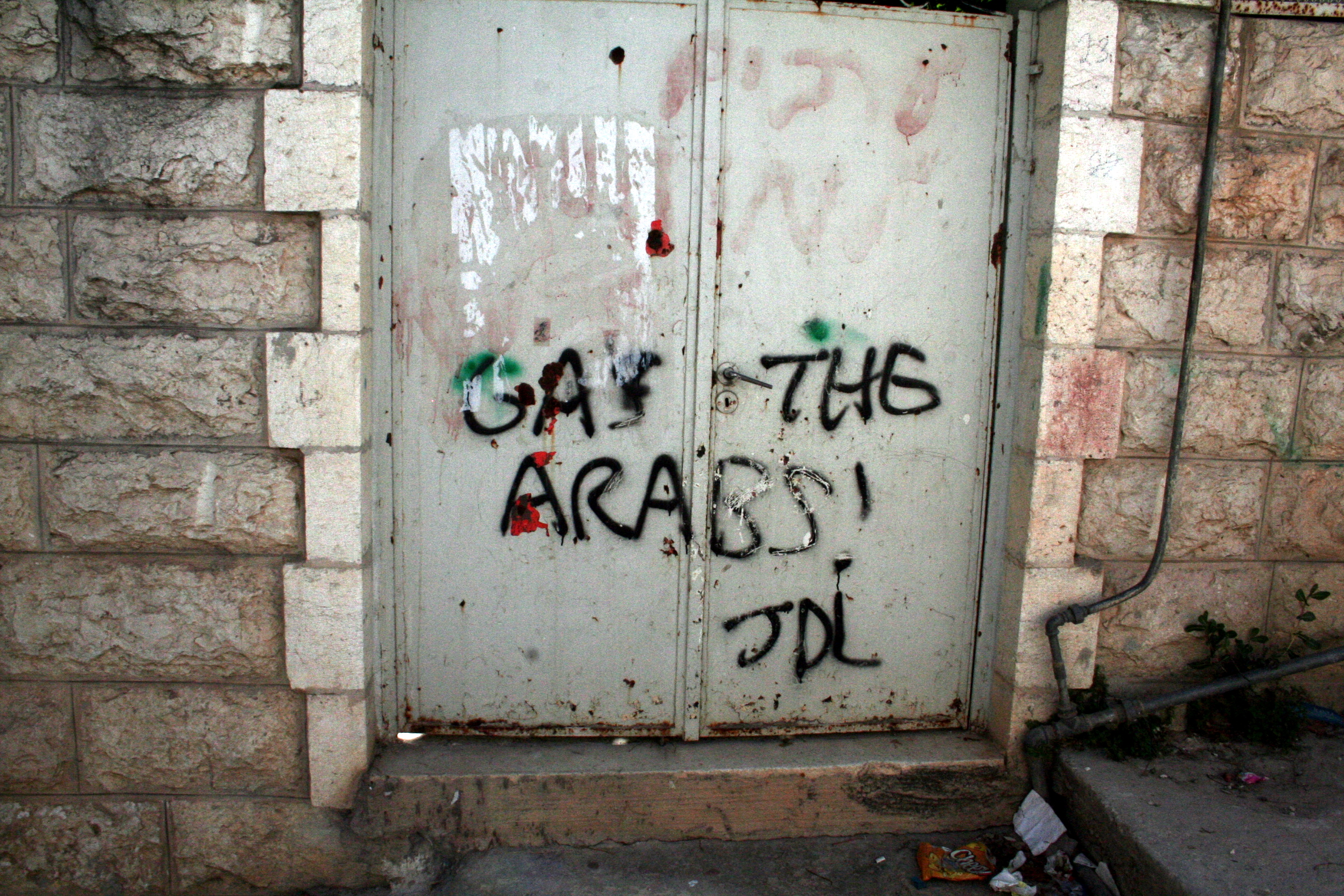
Gush Emunim Underground was a militant organization that operated in 1979–1984. The organization planned attacks on Palestinian officials and the Dome of the Rock. In 1994, Baruch Goldstein of Hebron, a member of Kach carried out the Cave of the Patriarchs massacre, killing 29 Muslim worshipers and injuring 125. The attack was widely condemned by the Israeli government and Jewish community. The Palestinian leadership has accused Israel of "encouraging and enabling" settler violence in a bid to provoke Palestinian riots and violence in retaliation. Violence perpetrated by Israeli settlers against Palestinians constitutes terrorism according to the U.S. Department of State, and former IDF Head of Central Command Avi Mizrahi stated that such violence constitutes "terror."
In mid-2008, a UN report recorded 222 acts of Israeli settler violence against Palestinians and IDF troops compared with 291 in 2007. This trend reportedly increased in 2009. Maj-Gen Shamni said that the number had risen from a few dozen individuals to hundreds, and called it "a very grave phenomenon." In 2008–2009, the defense establishment adopted a harder line against the extremists. This group responded with a tactic dubbed "price tagging", vandalizing Palestinian property whenever police or soldiers were sent in to dismantle outposts. From January through to September 2013, 276 attacks by settlers against Palestinians were recorded.
Leading religious figures in the West Bank have harshly criticized these tactics. Rabbi Menachem Froman of Tekoa said that "Targeting Palestinians and their property is a shocking thing, ... It's an act of hurting humanity. ... This builds a wall of fire between Jews and Arabs." The Yesha Council and Hanan Porat also condemned such actions. Other rabbis have been accused of inciting violence against non-Jews. In response to settler violence, the Israeli government said that it would increase law enforcement and cut off aid to illegal outposts. Some settlers are thought to lash out at Palestinians because they are "easy victims." The United Nations accused Israel of failing to intervene and arrest settlers suspected of violence. In 2008, Haaretz wrote that "Israeli society has become accustomed to seeing lawbreaking settlers receive special treatment and no other group could similarly attack Israeli law enforcement agencies without being severely punished."
In September 2011, settlers vandalized a mosque and an army base. They slashed tires and cut cables of 12 army vehicles and sprayed graffiti. In November 2011, the United Nations Office for Coordination of Human Affairs (OCHA) in the Palestinian territories published a report on settler violence that showed a significant rise compared to 2009 and 2010. The report covered physical violence and property damage such as uprooted olive trees, damaged tractors and slaughtered sheep. The report states that 90% of complaints filed by Palestinians have been closed without charge.
According to EU reports, Israel has created an "atmosphere of impunity" for Jewish attackers, which is seen as tantamount to tacit approval by the state. In the West Bank, Jews and Palestinians live under two different legal regimes and it is difficult for Palestinians to lodge complaints, which must be filed in Hebrew in Israeli settlements.
The 27 ministers of foreign affairs of the European Union published a report in May 2012 strongly denouncing policies of the State of Israel in the West Bank and denouncing "continuous settler violence and deliberate provocations against Palestinian civilians." The report by all EU ministers called "on the government of Israel to bring the perpetrators to justice and to comply with its obligations under international law."
In July 2014, a day after the burial of three murdered Israeli teens, Khdeir, a 16-year-old Palestinian, was forced into a car by 3 Israeli settlers on an East Jerusalem street. His family immediately reported the fact to Israeli Police who located his charred body a few hours later at Givat Shaul in the Jerusalem Forest. Preliminary results from the autopsy suggested that he was beaten and burnt while still alive. The murder suspects explained the attack as a response to the June abduction and murder of three Israeli teens. The murders contributed to a breakout of hostilities in the 2014 Israel–Gaza conflict. In July 2015, a similar incident occurred where Israeli settlers made an arson attack on two Palestinian houses, one of which was empty; however, the other was occupied, resulting in the burning to death of a Palestinian infant; the four other members of his family were evacuated to the hospital suffering serious injuries. These two incidents received condemnation from the United States, European Union and the IDF. The European Union criticized Israel for "failing to protect the Palestinian population".
Germany denounced Israel's proposal to construct over 750 housing units in the West Bank in December 2025, stating that "this construction contravenes international law and UN Security Council resolutions."
Olive trees
While the economy of the Palestinian territories has shown signs of growth, the International Committee of the Red Cross reported that Palestinian olive farming has suffered. According to the ICRC, 10,000 olive trees were cut down or burned by settlers in 2007–2010. Foreign ministry spokesman Yigal Palmor said the report ignored official PA data showing that the economic situation of Palestinians had improved substantially, citing Mahmoud Abbas's comment to The Washington Post in May 2009, where he said "in the West Bank, we have a good reality, the people are living a normal life."
Haaretz blamed the violence during the olive harvest on a handful of extremists. In 2010, trees belonging to both Jews and Arabs were cut down, poisoned or torched. In the first two weeks of the harvest, 500 trees owned by Palestinians and 100 trees owned by Jews had been vandalized. In October 2013, 100 trees were cut down.
Violent attacks on olive trees seem to be facilitated by the apparently systematic refusal of the Israeli authorities to allow Palestinians to visit their own groves, sometimes for years, especially in cases where the groves are deemed to be too close to settlements.
Palestinian violence against settlers
Israeli civilians living in settlements have been targeted by violence from armed Palestinian groups. These groups, according to Human Rights Watch, assert that settlers are "legitimate targets" that have "forfeited their civilian status by residing in settlements that are illegal under international humanitarian law." Both Human Rights Watch and B'tselem rejected this argument on the basis that the legal status of the settlements has no effect on the civilian status of their residents. Human Rights Watch said the "prohibition against intentional attacks against civilians is absolute." B'tselem said "The settlers constitute a distinctly civilian population, which is entitled to all the protections granted civilians by international law. The Israeli security forces' use of land in the settlements or the membership of some settlers in the Israeli security forces does not affect the status of the other residents living among them, and certainly does not make them proper targets of attack."
Fatal attacks on settlers have included firing of rockets and mortars and drive-by shootings, also targeting infants and children. Violent incidents include the murder of Shalhevet Pass, a ten-month-old baby shot by a Palestinian sniper in Hebron, and the murder of two teenagers by unknown perpetrators on 8 May 2001, whose bodies were hidden in a cave near Tekoa, a crime that Israeli authorities suggest may have been committed by Palestinian terrorists. In the Bat Ayin axe attack, children in Bat Ayin were attacked by a Palestinian wielding an axe and a knife. A 13-year-old boy was killed and another was seriously wounded. Rabbi Meir Hai, a father of seven, was killed in a drive-by shooting. In August 2011, five members of one family were killed in their beds. The victims were the father Ehud (Udi) Fogel, the mother Ruth Fogel, and three of their six children—Yoav, 11, Elad, 4, and Hadas, the youngest, a three-month-old infant. According to David Ha'ivri, and as reported by multiple sources, the infant was decapitated.
Pro-Palestinian activist violence
.jpg)
Pro-Palestinian activists who hold regular protests near the settlements have been accused of stone-throwing, physical assault and provocation. In 2008, Avshalom Peled, head of the Israel Police's Hebron district, called "left-wing" activity in the city dangerous and provocative, and accused activists of antagonizing the settlers in the hope of getting a reaction.
Environmental issues
Municipal Environmental Associations of Judea and Samaria, an environmental awareness group, was established by the settlers to address sewage treatment problems and cooperate with the Palestinian Authority on environmental issues. Settlers and Palestinians share the mountain aquifer as a water source, and both generate sewage and industrial effluents that endanger the aquifer. Friends of the Earth Middle East claimed that sewage treatment was inadequate in both sectors. Sewage from Palestinian sources was estimated at 46 million cubic meters a year, and sources from settler sources at 15 million cubic meters a year. A 2004 study found that sewage was not sufficiently treated in many settlements, while sewage from Palestinian villages and cities flowed into unlined cesspits, streams and the open environment with no treatment at all.
In a 2007 study, the Israel Nature and Parks Authority and Israeli Ministry of Environmental Protection, found that Palestinian towns and cities produced 56 million cubic meters of sewage per year, 94 percent discharged without adequate treatment, while Israeli sources produced 17.5 million cubic meters per year, 31.5 percent without adequate treatment.
According to Palestinian environmentalists, the settlers operate industrial and manufacturing plants that can create pollution as many do not conform to Israeli standards. In 2005, an old quarry between Kedumim and Nablus was slated for conversion into an industrial waste dump. Pollution experts warned that the dump would threaten Palestinian water sources.
Impact on Palestinian demographics
The Consortium for Applied Research on International Migration (CARIM) has reported in their 2011 migration profile for Palestine that the reasons for individuals to leave the country are similar to those of other countries in the region and they attribute less importance to the specific political situation of the occupied Palestinian territory.Anna Di Bartolomeo, Thibaut Jaulin, Delphine Perrin "CARIM Migration Report Palestine" , CARIM – Consortium for Applied Research on International Migration, 2011, p. 5 Human Rights Watch in 2010 reported that Israeli settlement policies have had the effect of "forcing residents to leave their communities".
In 2008, Condoleezza Rice suggested sending Palestinian refugees to South America, which might reduce pressure on Israel to withdraw from the settlements. Sushil P. Seth speculates that Israelis might feel that increasing settlements will force many Palestinians to flee to other countries and that the remainder will be forced to live under Israeli terms. Speaking anonymously with regard to Israeli policies in the South Hebron Hills, a UN expert said that the Israeli crackdown on alternative energy infrastructures like solar panels is part of a deliberate strategy in Area C.
"From December 2010 to April 2011, we saw a systematic targeting of the water infrastructure in Hebron, Bethlehem and the Jordan valley. Now, in the last couple of months, they are targeting electricity. Two villages in the area have had their electrical poles demolished. There is this systematic effort by the civil administration targeting all Palestinian infrastructure in Hebron. They are hoping that by making it miserable enough, they [the Palestinians] will pick up and leave."
Approximately 1,500 people in 16 communities are dependent on energy produced by these installations duct business are threatened with work stoppage orders from the Israeli administration on their installation of alternative power infrastructure, and demolition orders expected to follow will darken the homes of 500 people.
Educational institutions
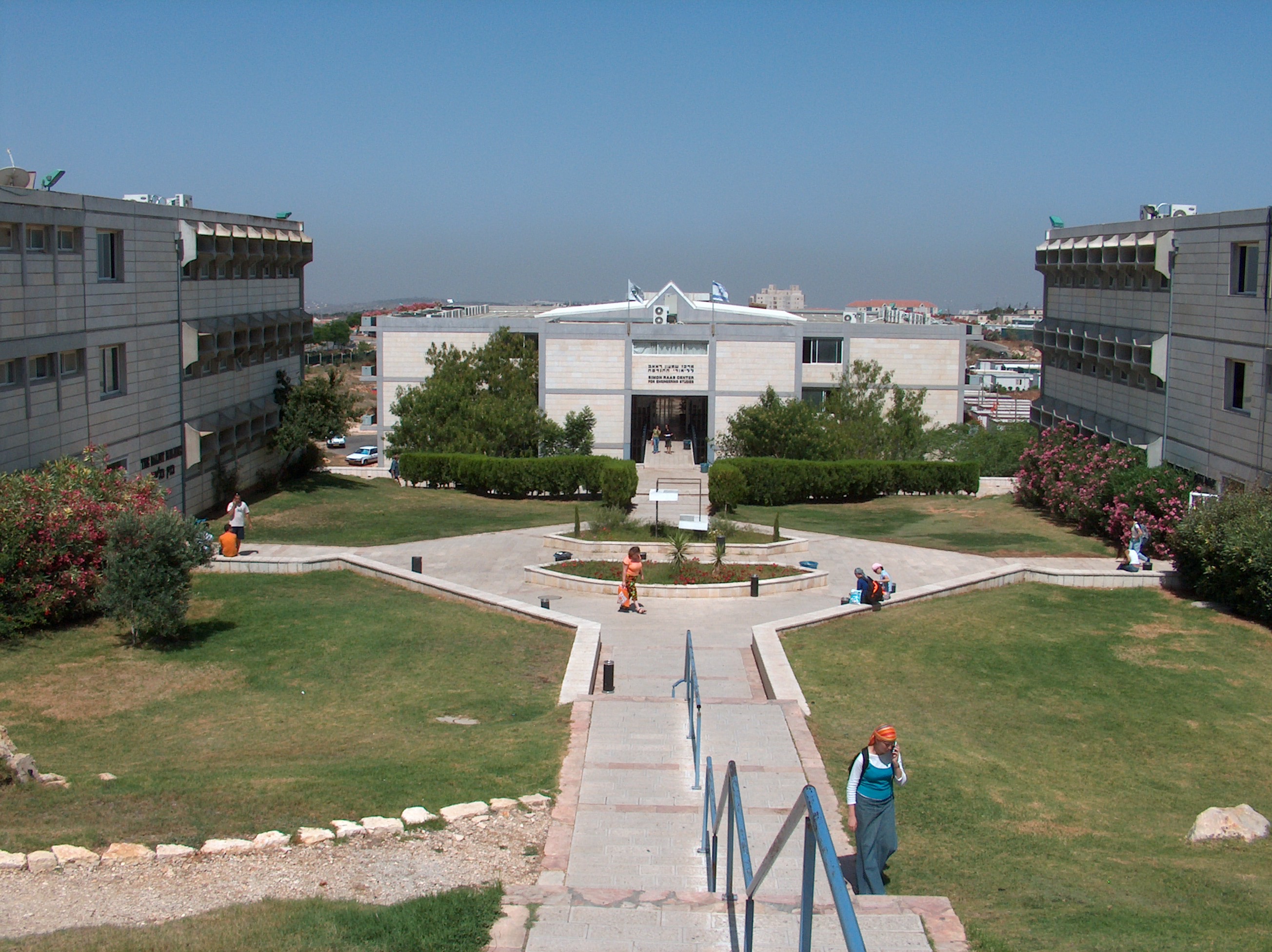
Ariel University, formerly the College of Judea and Samaria, is the major Israeli institution of higher education in the West Bank. With close to 13,000 students, it is Israel's largest public college. The college was accredited in 1994 and awards bachelor's degrees in arts, sciences, technology, architecture and physical therapy. On 17 July 2012, the Council for Higher Education in Judea and Samaria voted to grant the institution full university status.
Teacher training colleges include Herzog College in Alon Shvut and Orot Israel College in Elkana. Ohalo College is located in Katzrin, in the Golan Heights.
In March 2012, The Shomron Regional Council was awarded the Israeli Ministry of Education's first prize National Education Award in recognizing its excellence in investing substantial resources in the educational system. The Shomron Regional Council achieved the highest marks in all parameters (9.28 / 10). Gershon Mesika, the head of the regional council, declared that the award was a certificate of honour of its educators and the settlement youth who proved their quality and excellence.
Strategic significance

In 1983 an Israeli government plan entitled "Master Plan and Development Plan for Settlement in Samaria and Judea" envisaged placing a "maximally large Jewish population" in priority areas to accomplish incorporation of the West Bank in the Israeli "national system". According to Ariel Sharon, strategic settlement locations would work to preclude the formation of a Palestinian state.
Palestinians argue that the policy of settlements constitutes an effort to preempt or sabotage a peace treaty that includes Palestinian sovereignty, and claim that the presence of settlements harm the ability to have a viable and contiguous state. This was also the view of the Israeli Vice Prime Minister Haim Ramon in 2008, saying "the pressure to enlarge Ofra and other settlements does not stem from a housing shortage, but rather is an attempt to undermine any chance of reaching an agreement with the Palestinians ..."
The Israel Foreign Ministry asserts that some settlements are legitimate, as they took shape when there was no operative diplomatic arrangement, and thus they did not violate any agreement. Based on this, they assert that:
- Prior to the signing of the Egypt–Israel peace treaty, the eruption of the First Intifada, down to the signing of the Israel–Jordan peace treaty in 1994, Israeli governments on the left and right argued that the settlements were of strategic and tactical importance. The location of the settlements was primarily chosen based on the threat of an attack by the bordering hostile countries of Jordan, Syria, and Egypt and possible routes of advance into Israeli population areas. These settlements were seen as contributing to the security of Israel at a time when peace treaties had not been signed.
Dismantling of settlements
An early evacuation took place in 1982 as part of the Egypt–Israel peace treaty, when Israel was required to evacuate its settlers from the 18 Sinai settlements. Arab parties to the conflict had demanded the dismantlement of the settlements as a condition for peace with Israel. The evacuation was carried out with force in some instances, for example in Yamit. The settlements were demolished, as it was feared that settlers might try to return to their homes after the evacuation.
Israel's unilateral disengagement from the Gaza Strip took place in 2005. It involved the evacuation of settlements in the Gaza Strip and part of the West Bank, including all 21 settlements in Gaza and four in the West Bank, while retaining control over Gaza's borders, coastline, and airspace. Most of these settlements had existed since the early 1980s, some were over 30 years old; the total population involved was more than 8,000.“Palestine: The Forgotten Reality,” Le Monde Diplomatique, December 2005, online at https://www.globalpolicy.org/security-council/index-of-countries-on-the-security-council-agenda/israel-palestine-and-the-occupied-territories/38326 .
htl. There was significant opposition to the plan among parts of the Israeli public, and especially those living in the territories. George W. Bush said that a permanent peace deal would have to reflect "demographic realities" in the West Bank regarding Israel's settlements.
The Israeli human rights group GISHA maintains that despite the disengagement, Israel continues to occupy Gaza because it maintains its control over the area. For example, Israel maintains control over Gaza's airspace and waters, its borders (specifically, passage of goods and people to and from Gaza), the population registry, its telecommunications networks, and the collection of customs and tax on imports. GISHA also reports that Israel continues to control Gaza's infrastructure through its control over the supply of resources such as electricity. In addition, under the disengagement plan, Israel can prevent the PA from reopening its airport or seaport.
Within the former settlements, almost all buildings were demolished by Israel, with the exception of certain government and religious structures, which were completely emptied. Under an international arrangement, greenhouses were left to assist the Palestinian economy although half had been demolished by the settlers two months prior to the disengagement. The reduction in greenhouse space and increased restrictions on exports reduced the viability of the project. After the redeployment of Israeli troops to the Gaza border, 30% of the greenhouses suffered various degrees of damage due to Palestinian looters stealing, for example, hoses and irrigation equipment. Following the withdrawal, many of the former synagogues were torched and destroyed by Palestinians.
Some believe that settlements need not necessarily be dismantled and evacuated, even if Israel withdraws from the territory where they stand, as they can remain under Palestinian rule. These ideas have been expressed both by left-wing Israelis, and by Palestinians who advocate the two-state solution, and by extreme Israeli right-wingers and settlers who object to any dismantling and claim links to the land that are stronger than the political boundaries of the state of Israel.
I don't think "pro-two state solution Palestinians" as well as right wingers & settlers are entertaining any overlapping concepts, like Jewish settlers living under a state of Palestine government --
The Israeli government has often threatened to dismantle outposts. Some have actually been dismantled, occasionally with use of force; this led to settler violence.
Palestinian statehood bid of 2011
American refusal to declare the settlements illegal was said to be the determining factor in the 2011 attempt to declare Palestinian statehood at the United Nations, the so-called Palestine 194 initiative.
Israel announced additional settlements in response to the Palestinian diplomatic initiative and Germany responded by moving to stop deliveries to Israel of submarines capable of carrying nuclear weapons.
Finally in 2012, several European states switched to either abstain or vote for statehood in response to continued settlement construction. Israel approved further settlements in response to the vote, which brought further worldwide condemnation.
Impact on peace process
Main article: Israeli–Palestinian peace process
The settlements have been a source of tension between Israel and the U.S. Jimmy Carter regarded the settlements as illegal and tactically unwise. Ronald Reagan stated that they were legal but an obstacle to negotiations. In 1991, the U.S. delayed a subsidized loan to pressure Israel on the subject of settlement-building in the Jerusalem-Bethlehem corridor. In 2005, U.S. declared support for "the retention by Israel of major Israeli population centers as an outcome of negotiations," reflecting the statement by George W. Bush that a permanent peace treaty would have to reflect "demographic realities" in the West Bank. In June 2009, Barack Obama said that the United States "does not accept the legitimacy of continued Israeli settlements."
Palestinians claim that Israel has undermined the Oslo accords and peace process by continuing to expand the settlements. Settlements in the Sinai Peninsula were evacuated and razed in the wake of the peace agreement with Egypt. The 27 ministers of foreign affairs of the European Union published a report in May 2012 strongly denouncing policies of the State of Israel in the West Bank and finding that Israeli settlements in the West Bank are illegal and "threaten to make a two-state solution impossible." In the framework of the Oslo I Accord of 1993 between the Israeli government and the Palestine Liberation Organization (PLO), a modus vivendi was reached whereby both parties agreed to postpone a final solution on the destination of the settlements to the permanent status negotiations (Article V.3). Israel claims that settlements thereby were not prohibited, since there is no explicit interim provision prohibiting continued settlement construction, the agreement does register an undertaking by both sides, namely that "Neither side shall initiate or take any step that will change the status of the West Bank and the Gaza Strip pending the outcome of the permanent status negotiations" (Article XXX1 (7)), which has been interpreted as, not forbidding settlements, but imposing severe restrictions on new settlement building after that date. Melanie Jacques argued in this context that even 'agreements between Israel and the Palestinians which would allow settlements in the OPT, or simply tolerate them pending a settlement of the conflict, violate the Fourth Geneva Convention.'
Final status proposals have called for retaining long-established communities along the Green Line and transferring the same amount of land in Israel to the Palestinian state. The Clinton administration proposed that Israel keep some settlements in the West Bank, especially those in large blocs near the pre-1967 borders of Israel, with the Palestinians receiving concessions of land in other parts of the country. Both Clinton and Tony Blair pointed out the need for territorial and diplomatic compromise based on the validity of some of the claims of both sides.
As Minister of Defense, Ehud Barak approved a plan requiring security commitments in exchange for withdrawal from the West Bank. Barak also expressed readiness to cede parts of East Jerusalem and put the holy sites in the city under a "special regime."
On 14 June 2009, Israeli Prime Minister Benjamin Netanyahu, as an answer to U.S. President Barack Obama's speech in Cairo, delivered a speech setting out his principles for a Palestinian-Israeli peace, among others, he alleged "... we have no intention of building new settlements or of expropriating additional land for existing settlements." In March 2010, the Netanyahu government announced plans for building 1,600 housing units in Ramat Shlomo across the Green Line in East Jerusalem during U.S. Vice President Joe Biden's visit to Israel causing a diplomatic row.
On 6 September 2010, Jordanian King Abdullah II and Syrian President Bashar al-Assad said that Israel would need to withdraw from all of the lands occupied in 1967 in order to achieve peace with the Palestinians.
Bradley Burston has said that a negotiated or unilateral withdraw from most of the settlements in the West Bank is gaining traction in Israel.
In November 2010, the United States offered to "fight against efforts to delegitimize Israel" and provide extra arms to Israel in exchange for a continuation of the settlement freeze and a final peace agreement, but failed to come to an agreement with the Israelis on the exact terms.
In December 2010, the United States criticised efforts by the Palestinian Authority to impose borders for the two states through the United Nations rather than through direct negotiations between the two sides. In February 2011, it vetoed a draft resolution to condemn all Jewish settlements established in the occupied Palestinian territory since 1967 as illegal. The resolution, which was supported by all other Security Council members and co-sponsored by nearly 120 nations, would have demanded that "Israel, as the occupying power, immediately and completely ceases all settlement activities in the occupied Palestinian territory, including East Jerusalem and that it fully respect its legal obligations in this regard." The U.S. representative said that while it agreed that the settlements were illegal, the resolution would harm chances for negotiations. Israel's deputy Foreign Minister, Daniel Ayalon, said that the "UN serves as a rubber stamp for the Arab countries and, as such, the General Assembly has an automatic majority," and that the vote "proved that the United States is the only country capable of advancing the peace process and the only righteous one speaking the truth: that direct talks between Israel and the Palestinians are required." Palestinian negotiators, however, have refused to resume direct talks until Israel ceases all settlement activity.
In November 2009, Israeli Prime Minister Netanyahu issued a 10-month settlement freeze in the West Bank in an attempt to restart negotiations with the Palestinians. The freeze did not apply to building in Jerusalem in areas across the green line, housing already under construction and existing construction described as "essential for normal life in the settlements" such as synagogues, schools, kindergartens and public buildings. The Palestinians refused to negotiate without a complete halt to construction. In the face of pressure from the United States and most world powers supporting the demand by the Palestinian Authority that Israel desist from settlement project in 2010, Israel's ambassador to the UN Meron Reuben said Israel would only stop settlement construction after a peace agreement is concluded, and expressed concern were Arab countries to press for UN recognition of a Palestinian state before such an accord. He cited Israel's dismantlement of settlements in both the Sinai which took place after a peace agreement, and its unilateral dismantlement of settlements in the Gaza Strip. He presumed that settlements would stop being built were Palestinians to establish a state in a given area.
Proposals for land swap
The Clinton Parameters, a 2000 peace proposal by then U.S. President Bill Clinton, included a plan on which the Palestinian State was to include 94–96% of the West Bank, and around 80% of the settlers were to be under Israeli sovereignty, and in exchange for that, Israel will concede some territory (so called 'Territory Exchange' or 'Land Swap') within the Green Line (1967 borders). The swap would consist of 1–3% of Israeli territory, such that the final borders of the West Bank part of the Palestinian state would include 97% of the land of the original borders.
In 2010, Palestinian Authority President Mahmoud Abbas said that the Palestinians and Israel have agreed on the principle of a land swap. The issue of the ratio of land Israel would give to the Palestinians in exchange for keeping settlement blocs is an issue of dispute, with the Palestinians demanding that the ratio be 1:1, and Israel insisting that other factors be considered as well.
Under any peace deal with the Palestinians, Israel intends to keep the major settlement blocs close to its borders, which contain over 80% of the settlers. Prime Ministers Yitzhak Rabin, Ariel Sharon, and Benjamin Netanyahu have all stated Israel's intent to keep such blocs under any peace agreement. U.S. President George W. Bush acknowledged that such areas should be annexed to Israel in a 2004 letter to Prime Minister Sharon.
The European Union position is that any annexation of settlements should be done as part of mutually agreed land swaps, which would see the Palestinians controlling territory equivalent to the territory captured in 1967. The EU says that it will not recognise any changes to the 1967 borders without an agreement between the parties.
Israeli Foreign Minister Avigdor Lieberman has proposed a plan which would see settlement blocs annexed to Israel in exchange for heavily Arab areas inside Israel as part of a population exchange.
According to Mitchell G. Bard: "Ultimately, Israel may decide to unilaterally disengage from the West Bank and determine which settlements it will incorporate within the borders it delineates. Israel would prefer, however, to negotiate a peace treaty with the Palestinians that would specify which Jewish communities will remain intact within the mutually agreed border of Israel, and which will need to be evacuated. Israel will undoubtedly insist that some or all of the "consensus" blocs become part of Israel".
Proposal of dual citizenship
A number of proposals for the granting of Palestinian citizenship or residential permits to Jewish settlers in return for the removal of Israeli military installations from the West Bank have been fielded by such individuals as Arafat, Ibrahim Sarsur and Ahmed Qurei. In contrast, Mahmoud Abbas said in July 2013 that "In a final resolution, we would not see the presence of a single Israeli—civilian or soldier—on our lands."
Israeli Minister Moshe Ya'alon said in April 2010 that "just as Arabs live in Israel, so, too, should Jews be able to live in Palestine." ... "If we are talking about coexistence and peace, why the [Palestinian] insistence that the territory they receive be ethnically cleansed of Jews?".
The idea has been expressed by both advocates of the two-state solution and supporters of the settlers and conservative or fundamentalist currents in Israeli Judaism that, while objecting to any withdrawal, claim stronger links to the land than to the State of Israel.
Settlement expansion
Pre Resolution 2334
On 19 June 2011, Haaretz reported that the Israeli cabinet voted to revoke Defense Minister Ehud Barak's authority to veto new settlement construction in the West Bank, by transferring this authority from the Agriculture Ministry, headed by Barak ally Orit Noked, to the Prime Minister's office.
In 2009, newly elected Prime Minister Benjamin Netanyahu said: "I have no intention of building new settlements in the West Bank... But like all the governments there have been until now, I will have to meet the needs of natural growth in the population. I will not be able to choke the settlements." On 15 October 2009, he said the settlement row with the United States had been resolved.
In April 2012, four illegal outposts were retroactively legalized by the Israeli government. In June 2012, the Netanyahu government announced a plan to build 851 homes in five settlements: 300 units in Beit El and 551 units in other settlements.
Amid peace negotiations that showed little signs of progress, Israel issued on 3 November 2013, tenders for 1,700 new homes for Jewish settlers. The plots were offered in nine settlements in areas Israel says it intends to keep in any peace deal with the Palestinians. On 12 November, Peace Now revealed that the Construction and Housing Ministry had issued tenders for 24,000 more settler homes in the West Bank, including 4,000 in East Jerusalem. 2,500 units were planned in Ma'aleh Adumim, some 9,000 in the Gush Etzion Region, and circa 12,000 in the Binyamin Region, including 1,200 homes in the E1 area in addition to 3,000 homes in previously frozen E1 projects. Circa 15,000 homes of the 24,000 plan would be east of the West Bank Barrier and create the first new settlement blocs for two decades, and the first blocs ever outside the Barrier, far inside the West Bank.
As stated before, the Israeli government (as of 2015) has a program of residential subsidies in which Israeli settlers receive about double that given to Israelis in Tel Aviv and Jerusalem. As well, settlers in isolated areas receive three times the Israeli national average. From the beginning of 2009 to the end of 2013, the Israeli settlement population as a whole increased by a rate of over 4% per year. A New York Times article in 2015 stated that said building had been "at the heart of mounting European criticism of Israel."
Resolution 2334 and quarterly reports
United Nations Security Council Resolution 2334 "Requests the Secretary-General to report to the Council every three months on the implementation of the provisions of the present resolution;" In the first of these reports, delivered verbally at a security council meeting on 24 March 2017, United Nations Special Coordinator for the Middle East Peace Process, Nickolay Mladenov, noted that Resolution 2334 called on Israel to take steps to cease all settlement activity in the Occupied Palestinian Territory, that "no such steps have been taken during the reporting period" and that instead, there had been a marked increase in statements, announcements and decisions related to construction and expansion.
Regularization and outpost method
The 2017 Settlement Regularization in "Judea and Samaria" Law permits backdated legalization of outposts constructed on private Palestinian land. Following a petition challenging its legality, on June 9, 2020, Israel's Supreme Court struck down the law that had retroactively legalized about 4,000 settler homes built on privately owned Palestinian land. The Israeli Attorney General has stated that existing laws already allow legalization of Israeli constructions on private Palestinian land in the West Bank. The Israeli Attorney General, Avichai Mandelblit, has updated the High Court on his official approval of the use of a legal tactic permitting the de facto legalization of roughly 2,000 illegally built Israeli homes throughout the West Bank. The legal mechanism is known as "market regulation" and relies on the notion that wildcat Israeli homes built on private Palestinian land were done so in good faith.
In a report of 22 July 2019, PeaceNow notes that after a gap of 6 years when there were no new outposts, establishment of new outposts recommenced in 2012, with 32 of the current 126 outposts set up to date. 2 outposts were subject to eviction, 15 were legalized and at least 35 are in process of legalization.
Updates and related matters
The Israeli government announced in 2019 that it has made monetary grants available for the construction of hotels in Area C of the West Bank.
According to Peace Now, approvals for building in Israeli settlements in East Jerusalem expanded by 60% between 2017, when Donald Trump became US president, and 2019.
On 9 July 2021, Michael Lynk, U.N. special rapporteur on human rights in the occupied Palestinian territory, addressing a session of the UN Human Rights Council in Geneva, said "I conclude that the Israeli settlements do amount to a war crime," and "I submit to you that this finding compels the international community...to make it clear to Israel that its illegal occupation, and its defiance of international law and international opinion, can and will no longer be cost-free." Israel, which does not recognize Lynk's mandate, boycotted the session.
A new Israeli government, formed on 13 June 2021, declared a "status quo" in the settlements policy. According to Peace Now, as of 28 October this has not been the case. On October 24, 2021, tenders were published for 1,355 housing units plus another 83 in Givat HaMatos and on 27 October 2021, approval was given for 3,000 housing units including in settlements deep inside the West Bank. These developments were condemned by the U.S. as well as by the United Kingdom, Russia and 12 European countries. while UN experts, Michael Lynk, Special Rapporteur on the situation of human rights in the Palestinian Territory occupied since 1967 and Mr. Balakrishnan Rajagopal (United States of America), UN Special Rapporteur on adequate housing said that settlement expansion should be treated as a "presumptive war crime".
In February 2023, the new Israeli government under Benjamin Netanyahu approved the legalization of nine illegal settler outposts in the West Bank. Finance Minister Bezalel Smotrich took charge of most of the Civil Administration, obtaining broad authority over civilian issues in the West Bank. In March 2023, Netanyahu's government repealed a 2005 law whereby four Israeli settlements, Homesh, Sa-Nur, Ganim and Kadim, were dismantled as part of the Israeli disengagement from Gaza. In June 2023, Israel shortened the procedure of approving settlement construction and gave Finance Minister Smotrich the authority to approve one of the stages, changing the system operating for the last 27 years. In its first six months, construction of 13,000 housing units in settlements, almost triple the amount advanced in the whole of 2022.
In December 2025, the security cabinet of Israel sanctioned the establishment of 19 settlements in the occupied West Bank. Palestinian authorities assert that this initiative "intensifies years of land appropriation and demographic manipulation." According to Ynet, the United States is currently working on executing the plan.
Notes
| i. | Statistics for the West Bank ("Judea and Samaria") from the Statistical Abstract of Israel 2013 No. 64. |
|---|
References
- {{Cite book | author2-link = Michael Sfard | access-date = 15 October 2018 | archive-date = 3 March 2023 | archive-url = https://web.archive.org/web/20230303182234/https://books.google.com/books?id=Is5TDwAAQBAJ&pg=PA52 | url-status = live
References
- Matar, Ibrahim. (1981). "Israeli Settlements in the West Bank and Gaza Strip". Journal of Palestine Studies.
- (2011). "Palestinian landscape and the Israeli–Palestinian conflict". International Journal of Environmental Studies.
- Thawaba, Salem. (2019). "Building and planning regulations under Israeli colonial power: a critical study from Palestine". Planning Perspectives.
- (2019). "Israel, Palestine and the Politics of Race: Exploring Identity and Power in a Global Context". Bloomsbury Publishing.
- (2015). "Settlers in Contested Lands: Territorial Disputes and Ethnic Conflicts". Stanford University Press.
- Dumper, M.. (2014). "Jerusalem Unbound: Geography, History, and the Future of the Holy City". Columbia University Press.
- (7 December 2014). "Leave or let live? Arabs move in to Jewish settlements". Reuters.
- Rivlin, P.. (2010). "The Israeli Economy from the Foundation of the State through the 21st Century". Cambridge University Press.
- (1990). "Prolonged Military Occupation: The Israeli-Occupied Territories Since 1967". The American Journal of International Law.
- (2005). "The Italian Yearbook of International Law". Martinus Nijhoff Publishers.
- (2006). "Israel: The security barrier—between international law, constitutional law, and domestic judicial review". International Journal of Constitutional Law.
- (1997). "Human rights, self-determination and political change in the occupied Palestinian territories". Martinus Nijhoff Publishers.
- (30 January 2019). "Chapter 3: Israeli Settlements and International Law".
- Aji, Albert. (2019-03-26). "Trump acceptance of Israeli control of Golan sparks protests". Associated Press.
- (2019-03-26). "Trump's Golan move unites Gulf States and Iran in condemnation".
- [[Anthony Cordesman]], Jennifer Moravitz, [https://books.google.com/books?id=-dRUGqwLSE4C&pg=PA433 ''The Israeli–Palestinian War: Escalating to Nowhere''], Greenwood Publishing Group, Center for Strategic and International Studies, 2005 p. 432: 'Between 1993 and 1999, settlers established 42 "unofficial" settlements, only four of which were subsequently dismantled. More than a dozen new settlements were established between the 1998 Wye Accord [sic: it's the Wye River '''Memorandum''', but Oslo '''Accords'''] and the outbreak of war, although former Prime Minister Netanyahu supposedly promised Clinton that he would halt expansion.'
- [[Zeev Maoz]] [https://books.google.com/books?id=bWEV__6BYPgC&pg=PA472 ''Defending the Holy Land: A Critical Analysis of Israel's Security & Foreign Policy''], University of Michigan Press, 2006 p. 472: 'As can be seen from the table, in 1993 there were about 110,000 settlers in the occupied territories. In 2001 there were 195,000 (Note that the number of settlers increased by 18 percent during the [[Al Aqsa Intifada]]). This was an increase of 73 percent'
- [[Marwan Bishara]], [https://books.google.com/books?id=TiW3wW5dqPIC&pg=PA133 ''Palestine/Israel: Peace or Apartheid''] Zed Books, 2003 p. 133: 'The settlement expansion has continued unabated...and accelerated after the launch of the peace process.' p. 133.
- Baylis Thomas, [https://books.google.com/books?id=R2nKI4UcRr4C&pg=PA137 ''The Dark Side of Zionism: Israel's Quest for Security Through Dominance''] Lexington Books, 3011 p. 137: "Six years after the agreement there were more Israeli settlements, less freedom of movement, and worse economic conditions." Settlement building and roads for Jewish settlers proceeded at a frenetic pace under Barak – the classic Zionist maneuver of creating of facts on the ground to preclude a Palestinian state.' p. 137.
- Barahona, Ana. (2013). "Bearing Witness: Eight weeks in Palestine". Metete.
- (9 July 2004). "Summary of the Advisory Opinion of 9 July 2004". International Court of Justice.
- "fco.gov.uk".
- (3 May 2015). "Archived copy".
- "Jerusalem".
- "Settlements above the Law: BBC Eye investigates extremist settlers in the West Bank and speaks to the Palestinian families who have been forcibly expelled from their homes".
- (5 September 2021). "Growth rate of settlements plummets to all-time low".
- "Population".
- Gershom Gorenberg. (2007). "The Accidental Empire: Israel and the Birth of the Settlements, 1967–1977". Macmillan.
- Robert Cryer, Hakan Friman, Darryl Robinson, Elizabeth Wilmshurst, [https://books.google.com/books?id=q_agr0x5SOsC&pg=PA308 ''An Introduction to International Criminal Law and Procedure,''] [[Cambridge University Press]] 2010 p.308
- Ghislain Poissonnier, Eric David, [https://journals.openedition.org/revdh/7613 'Israeli Settlements in the West Bank, a War Crime?,'] {{Webarchive. link. (3 June 2023 Revue des droits de l'homme, 2020.)
- [https://www.amnesty.org/download/Documents/MDE1594902019ENGLISH.PDF 'Status of Settlements Under International Law,'] {{Webarchive. link. (25 August 2020 [[Amnesty International]] pp.8,29f.)
- Stone, Julius. (2004). "International Law and the Arab-Israel Conflict: Extracts from "Israel and Palestine Assault on the Law of Nations" by Professor Julius Stone". Jirlac Publications.
- Byron, Christine. (2013). "War Crimes and Crimes Against Humanity in the Rome Statute of the International Criminal Court". [[Cambridge University Press]].
- (20 May 2011). "Palestinians condemn settlements plan". [[The Financial Times]].
- [https://unispal.un.org/UNISPAL.NSF/0/F2A10EBCC878329685257BB0005CBC12 "OIC Secretary General hails EU decision on Israeli settlements"] {{Webarchive. link. (2 April 2015. [[United Nations Information System on the Question of Palestine]] – OIC Statement to UN. Accessed 14 March 2015.)
- (8 November 2009). "Israeli settlement plan denounced". BBC.
- "Israeli settlements – DW – 07/21/2009".
- "Russia's stance on Israeli settlements in West Bank remains unchanged — ministry".
- (4 November 2009). "Britain: Israeli settlements are 'illegal' and 'obstacle' to peace". [[Haaretz]].
- (21 March 2014). "France condemns Israel over settlement building decision". [[Business Standard]].
- (15 March 2010). "EU's Ashton SAYS Israeli settlement plans hurt peace moves". Reuters.
- "UN Security Council Resolution 465".
- (2019-11-18). "Jewish settlements no longer illegal – US".
- (18 November 2019). "Secretary of State Mike Pompeo announces reversal of Obama-era stance on Israeli settlements".
- (23 February 2024). "Blinken says any expansion of West Bank settlements would be inconsistent with international law | CNN Politics".
- (23 February 2024). "Blinken reverses Trump-era policy on Israeli settlements in occupied West Bank".
- Matar, Ibrahim. (1981). "Israeli Settlements in the West Bank and Gaza Strip". Journal of Palestine Studies.
- (2011). "Palestinian landscape and the Israeli–Palestinian conflict". International Journal of Environmental Studies.
- Thawaba, Salem. (2019). "Building and planning regulations under Israeli colonial power: a critical study from Palestine". Planning Perspectives.
- (2019). "Israel, Palestine and the Politics of Race: Exploring Identity and Power in a Global Context". Bloomsbury Publishing.
- link. (7 January 2015 [[Ma'an News Agency]] 7 January 2015.)
- link. (8 March 2021 ''[[The New York Times]]'', 12 March 2015: 'the government spent about $950 supporting each West Bank resident in 2014, more than double its investment in people living in Tel Aviv or Jerusalem; in isolated settlements, it was $1,483 per capita.')
- (2 February 2023). "Jewish settler population in the West Bank surpasses half a million". Los Angeles Times.
- (18 May 2023). "Far-right Israeli Minister Lays Groundwork for Doubling West Bank Settler Population". Haaretz.
- (October 2014). "Israel okays 2,610 homes for Jews and Arabs in E. Jerusalem".
- Sherwood, Harriet. (26 July 2012). "Population of Jewish settlements in West Bank up 15,000 in a year". The Guardian.
- "Report on Israeli Settlement in the Occupied Territories". Foundation for Middle East Peace.
- [https://www.hrw.org/en/node/95059/section/5 ''Separate and Unequal''] {{Webarchive. link. (14 December 2014 , Chapter IV. Human Rights Watch, 19 December 2010)
- Akiva Eldar, [https://www.haaretz.com/hasen/spages/988828.html "A matter of a few dozen meters"] {{Webarchive. link. (22 November 2008 . ''Haaretz'', 1 June 2008)
- Ian S. Lustick, [http://www.sas.upenn.edu/penncip/lustick/lustick13.html ''For the land and the Lord: Jewish fundamentalism in Israel''] {{Webarchive. link. (22 July 2021 , chapter 3, par. ''Early Activities of Gush Emunim''. 1988, the Council on Foreign Relations)
- Knesset Website, [https://www.knesset.gov.il/lexicon/eng/gush_em_eng.htm Gush Emunim] {{Webarchive. link. (27 September 2020 . Retrieved 27-02-2013)
- Donald Macintyre, [https://web.archive.org/web/20080611213726/http://www.independent.co.uk/news/world/middle-east/secret-memo-shows-israel-knew-six-day-war-was-illegal-450410.html "Secret memo shows Israel knew Six Day War was illegal"]. ''Independent'', 26 May 2007. (on web.archive)
- Berger, Yotam. (2016-07-28). "Secret 1970 document confirms first West Bank settlements built on a lie".
- Yotam Berger. (7 September 2016). "Israel Used Military Censor to Conceal First Settlements From Public, Document Reveals". Haaretz.
- Aderet, Ofer. (23 June 2023). "Israel Poisoned Palestinian Land to Build West Bank Settlement in 1970s, Documents Reveal".
- link. (3 December 2013 , chapter III. "The magnitude of settlements". 1 July 1984. [https://unispal.un.org/UNISPAL.NSF/0/B795B2D7FE86DA4885256B5A00666D70 ''Part I''] {{webarchive). link. (9 March 2012)
- Ian S. Lustick, [http://www.sas.upenn.edu/penncip/lustick/lustick13.html ''For the land and the Lord: Jewish fundamentalism in Israel''] {{Webarchive. link. (22 July 2021 , chapter 3, par. "Gush Emunim and the Likud". 1988, the Council on Foreign Relations)
- Israel Ministry of Foreign Affairs, [http://www.mfa.gov.il/MFA/Foreign%20Relations/Israels%20Foreign%20Relations%20since%201947/1977-1979/23%20Government%20statement%20on%20recognition%20of%20three%20se 23. "Government statement on recognition of three settlements"] {{Webarchive. link. (25 September 2020 . 26 July 1977)
- Robin Bidwell, [https://books.google.com/books?id=KKrCgxsRBkEC&pg=PA442 ''Dictionary Of Modern Arab History''], Routledge, 2012 p. 442
- UNGA/UNSC, [https://unispal.un.org/UNISPAL.NSF/0/3E5D731750EEB69E8525696600663AD0 ''Letter dated 19 June 1981 from the Acting Chairman of the Committee on the Exercise of the Inalienable Rights of the Palestinian People to the Secretary-General''] {{Webarchive. link. (3 December 2013 (A/36/341 and S/14566 d.d.19-06-1981).
) - [https://www.jpost.com/Diplomacy-and-Politics/Cabinet-seeks-to-limit-Baraks-say-on-settlements "Cabinet seeks to limit Barak's say on settlements"] {{Webarchive. link. (25 February 2021 . Tovah Lazaroff and Herb Keinon, ''Jerusalem Post'', 20 June 2011)
- Presentation of the Oslo II Accord in the Knesset by Rabin: MFA, [http://www.mfa.gov.il/mfa/mfa-archive/1995/pages/pm%20rabin%20in%20knesset-%20ratification%20of%20interim%20agree.aspx ''Prime Minister Yitzhak Rabin: Ratification of the Israel–Palestinian Interim Agreement—The Knesset October 5, 1995''] {{Webarchive. link. (27 November 2020 .)
- [https://unispal.un.org/UNISPAL.NSF/0/3DF99D9DCCB3B21F85257C62004B782F ''The origins and evolution of the Palestine problem''] {{webarchive. link. (21 April 2014 , Part V (1989–2000), chap. III, E. CEIRPP, 2014.)
- [http://www.fmep.org/reports/archive/vol.-7/no.-4/PDF "Netanyahu Presents His 'Allon-Plus' Final Status Map"]{{dead link. (July 2018)
- Akiva Eldar, [https://www.haaretz.com/print-edition/news/idf-civil-administration-pushing-for-land-takeover-in-west-bank-1.374564 "IDF Civil Administration pushing for land takeover in West Bank"] {{Webarchive. link. (24 September 2015 ''Haaretz'', 22 July 2011)
- Akiva Eldar, [https://www.haaretz.com/news/diplomacy-defense/israel-defense-ministry-plan-earmarks-10-percent-of-west-bank-for-settlement-expansion-1.421589 "Israel Defense Ministry plan earmarks 10 percent of West Bank for settlement expansion"] {{Webarchive. link. (25 August 2015 . ''Haaretz'', 30 March 2012.)
- Sara M. Roy. (2016). "The Gaza Strip". Institute for Palestine Studies USA, Incorporated.
- Geoffrey Aronson, “Gaza Settlement—Building a Dream World,” Report on Israeli Settlement in the Occupied Territories 3, no.5 (September 1993): 4-5.
- Erlanger, Steve. (9 March 2005). "Israeli Report Condemns Support for Settlement Outposts". The New York Times.
- Fischbach, Michael R.. (2008). "Jewish Property Claims against Arab Countries". Columbia University Press, New York.
- Gilbert, Martin. (1996). "The Routledge Atlas of the Arab-Israeli Conflict". Routledge London.
- (23 March 2010). "Silwan settlers plan Passover festival in bid to curry favor with public". Haaretz.
- (1 January 1995). "Symbolism and Landscape: The Etzion Bloc in the Judean Mountains". Middle Eastern Studies.
- (18 February 2003). "The hostility of Hebron". BBC News.
- Gilbert, p.45 ("The Arab Invasion of the State of Israel")
- Gilbert, p.2 ("The Jews of Palestine 636 A.D. to 1880), p.3 ("1880 – 1914") and p.17 ("Riots in Palestine 1921 – 1947")
- Fischbach, p.87
- (18 August 2005). "Seventeen Gaza Settlements Evacuated". Fox News.
- "Israeli Settler Population 1972–2006". Foundation for Middle East Peace.
- "Population by year in West Bank settlements". [[B'Tselem]].
- "Comprehensive Settlement Population 1972–2010". Foundation for Middle East Peace.
- staff, T. O. I.. "Israel okays 2,610 homes for Jews and Arabs in E. Jerusalem".
- Balofsky, Ahuva. (5 January 2015). "Jewish Population in Judea, Samaria Growing Significantly – Israel News".
- (26 March 2017). "Settler leader: Population growth is end of 2-state solution".
- (16 May 2014). "Housing minister sees 50% more settlers in West Bank by 2019". Haaretz.
- (9 October 2018}} {{cite web). "Oops, Something is wrong".
- "מכון ירושלים לחקר ישראל".
- (8 December 2007 }}: {{cite web). "Foundation for Middle East Peace -- Settler Population 1972-2005, Graph".
- "Palestine-Israel Journal: Settlements: A Geographic and Demographic Barrier to Peace".
- [http://www.btselem.org/download/201007_by_hook_and_by_crook_eng.pdf ''By Hook and by Crook''] {{Webarchive. link. (17 April 2014 , pp. 9–10. B'Tselem)
- "Residents in occupied Golan Heights fear creeping Israeli presence". middleeasteye.net.
- "S/14268 Report of the Security Council Commission Established Under Resolution 446 (1979)". United Nations.
- link. (7 April 2014 . Maan, 14 November 2010)
- "Comprehensive Settlement Population 1972–2008—FMEP". Fmep.org.
- (11 October 2019). "Settlement Report: October 11, 2019". Foundation for Middle East Peace.
- (5 September 2021). "Growth rate of settlements plummets to all-time low". Jerusalem Post.
- Parker, Claire. (2023-03-01). "Jewish settler population in West Bank passes half a million". Washington Post.
- (8 March 2021). "Six-Month Report on Israeli settlements in the occupied West Bank, including East Jerusalem Reporting period January–July 2020". Jerusalem Post.
- (15 May 2023). "2022 Report on Israeli settlements in the occupied West Bank, including East Jerusalem". EU.
- (15 February 2023). "What are Israeli settlements and outposts?".
- [http://www.palestine-studies.org/files/Special%20Focus/Israeli%20Settlers/Israeli%20Settlements%20in%20Occupied%20Arab%20Lands%20Conquest%20to%20Colony.pdf ''Israeli Settlements in Occupied Arab Lands: Conquest to Colony'']{{dead link. (November 2017)
- 978-1-478-01230-6 p.6: '[[Nadia Abu El-Haj]] writes about how the American liberal multicultural Jewish organization Kulanu has partnered with right-wing Israeli groups like Amishav and Shavei Israel to settle "lost" Jews of color in the illegal settlements that have continued to displace Palestinians in recent decades. As Abu El-Haj explains, "Nonwhite Jews become the site for discussions of Jewish racism, which is viewed as an entirely internal Jewish problem. The question of Palestine, the realities of a colonial present, and its very violent forms of racism in a state structured around the distinction between Jew and non-Jew, subject and citizen, and movement and enclosure are displaced".
- [http://www.fmep.org/settlement_info/settlement-info-and-tables/stats-data/sources-of-population-growth-total-israeli-population-and-settler-population-1991-2003 Sources of Population Growth: Total Israeli Population and Settler Population, 1991–2003] {{webarchive. link. (26 August 2013 , Foundation for Middle East Peace.)
- [http://www.fmep.org/settlement_info/settlement-info-and-tables/stats-data/population-growth-east-and-west-of-the-barrier Settler Population Growth East and West of the Barrier, 2000–2007] {{Webarchive. link. (18 August 2009 , Foundation for Middle East Peace.)
- (25 November 2009). "Palestinians shun Israeli settlement restriction plan". BBC.
- Tobin, Andrew. (2 November 2016). "Home > Jewish Times World Series ignites old passions among West Bank's American Jews". The Times of Israel.
- Mélanie Jacques. (20 September 2012). "Armed Conflict and Displacement: The Protection of Refugees and Displaced Persons Under International Humanitarian Law". Cambridge University Press.
- Entous, Adam. (31 December 2007). "Olmert curbs WBank building, expansion and planning". Reuters.
- [[CBS News]], 2010 Jul 6, [http://www.cbsnews.com/stories/2010/07/06/world/main6650897.shtml "Group: Israel Controls 42% of West Bank: Settlements Occupy Land Seized from Palestinians in Defiance of 1979 Court Ban, Israeli Human Rights Group Says"] {{Webarchive. link. (4 November 2013)
- Phoebe Greenwood, [https://www.theguardian.com/global-development/2012/mar/14/palestinians-prepare-to-lose-solar-panels 'Palestinians prepare to lose the solar panels that provide a lifeline,'] {{Webarchive. link. (9 August 2020 at [[The Guardian]], 14 March 2012.)
- [https://www.amnestyusa.org/sites/default/files/emails/W1506EACHN1.html Detained, interrogated, beaten: Demand protection for Palestinian children (Amnesty USA, June 2015)] {{Webarchive. link. (22 December 2015 "While Palestinian children and adults face Israeli military courts, Jewish Israeli settlers benefit from Israeli civil law. Israel gives Jewish settlers a different system of justice – even though they are living illegally in the very same occupied Palestinian territories.")
- [http://www2.ohchr.org/english/bodies/cerd/docs/CERD.C.ISR.CO.14-16.pdf Concluding observations of the Committee on the Elimination of Racial Discrimination (Israel) (9 March 2012)] {{Webarchive. link. (18 July 2014 (paragraph 24))
- Jonathan Lis. (13 May 2012). "In about-face, Israeli ministers block bill to annex West Bank settlements". Haaretz.
- (31 August 2014). "Israel launches massive new West Bank settlement plans". Israel Herald.
- Frankel, Julia. (2024-02-23). "Israel plans to build 3,300 new settlement homes. It says it's a response to a Palestinian attack".
- "How extremist settlers in the West Bank became the law".
- ''The Arab–Israeli Dilemma (Contemporary Issues in the Middle East)'', Syracuse University Press; 3rd edition (August, 1985 {{ISBN. 978-0-8156-2340-3
- "Kintera.org—The Giving Communities".
- [[Jean-Pierre Filiu]], [https://books.google.com/books?id=vPhzBAAAQBAJ&pg=PA196 ''Gaza: A History''], Oxford University Press, 2014 p. 196.
- (19 July 2024). "Palestinians Hail ICJ Ruling, Condemnation In Israel". [[Barron's]].
- (19 July 2024). "UN top court says Israeli occupation of Palestinian territories is illegal". [[BBC News]].
- (19 July 2024). "Israel's Palestinian Territories Occupation Unlawful: UN Court". [[BNN Bloomberg]].
- [https://www.theguardian.com/world/2013/jan/31/israel-must-withdraw-settlers-icc Israel must withdraw all settlers or face ICC, says UN report (The Guardian, 31 January 2013)] {{Webarchive. link. (1 August 2020 "Israel (...) was in violation of article 49 of the fourth Geneva convention, which forbids the transfer of civilian populations to occupied territory (...) The UNHRC report broadly restated international consensus on the illegality of Israeli settlements")
- (9 December 2009). "Jewish settlers in West Bank building curb protest". BBC.
- [http://www.icrc.org/ihl.nsf/WebART/380-600056 GC4 Part III : Status and treatment of protected persons #Section III : Occupied territories] {{Webarchive. link. (16 April 2016 "the Occupying Power shall not deport or transfer parts of its own civilian population into the territory it occupies" International Committee of the Red Cross.)
- (23 December 2019). "The Hague vs. Israel: Everything you need to know about the ICC Palestine probe". [[Times of Israel]].
- Cecilia Albin. (2001). "Justice and Fairness in International Negotiation". Cambridge University Press.
- Mark Gibney. (1999). "Judicial Protection of Human Rights: Myth or Reality?". Praeger/Greenwood.
- (3 October 2013). "Point 12 icrc.org".
- "paragraphs 95–101 and 120".
- Gregory S. Mahler. (2004). "Politics and government in Israel: the maturation of a modern state". Rowman & Littlefield.
- Gerson, Allan. ''Israel, the West Bank, and International law'', Routledge, 28 September 1978, {{ISBN. 978-0-7146-3091-5, p. 82.
- Roberts, Adam, "Decline of Illusions: The Status of the Israeli-Occupied Territories over 21 Years" in ''International Affairs'' (Royal Institute of International Affairs 1944–), Vol. 64, No. 3. (Summer, 1988), pp. 345–359., p. 350
- [[Eugene V. Rostow. Rostow, Eugene V.]], [[The New Republic]] 23 April 1990 ''The Historical Approach to the Issue of the Legality of Jewish Settlement Activity''
- Peace Now, [[Hagit Ofran]] and Dror Etkes, [http://peacenow.org.il/eng/sites/default/files/Jurisdiction2007.pdf ''"And Thou Shalt Spread ..." Construction and development of settlements beyond the official limits of jurisdiction''] {{Webarchive. link. (13 January 2013 ; pp. 3–5. June 2007)
- [http://www.fmep.org/documents/opinion_OLA_DOS4-21-78.html fmep.org] {{Webarchive. link. (27 September 2007 . Retrieved 13 May 2007.)
- "7".
- Sallon, Hélène. (28 June 2014). "La France durcit sa position face à la colonisation israélienne". Le Monde.fr.
- (4 July 2014). "EU states promote settler boycott amid Israel crisis".
- 978-0-190-62534-4, p. 179.
- [[Gershom Gorenberg. Gorenberg, Gershom]]. "The Accidental Empire". New York: Times Books, Henry Holt and Company, 2006. p. 99.
- "Secret memo shows Israel knew Six Day War was illegal".
- "Letter of the State Department Legal Advisor, Mr. Herbert J. Hansell, Concerning the Legality of Israeli Settlements in the Occupied Territories", cited in ''[http://www.unhcr.org/refworld/topic,4565c22541,459bab0b2,3b00f4404,0.html Progress report—The human rights dimensions of population transfer including the implantation of settler] {{Webarchive. link. (15 October 2012 '' prepared by Mr. Awn Shawhat Al-Khasawneh.)
- "The Carter Administration View: "Settlements are Inconsistent with International Law"".
- "Cour internationale de Justice – International Court of Justice".
- Conference of High Contracting Parties to the Fourth Geneva Convention: Declaration, GENEVA, 5 December 2001 [https://unispal.un.org/UNISPAL.NSF/0/8FC4F064B9BE5BAD85256C1400722951] {{Webarchive. link. (11 December 2014)
- See UN General Assembly resolution 39/146, 14 December 1984; UN Security Council Resolution 446, 22 March 1979; and International Court of Justice Advisory Opinion, 9 July 2004, Legal Consequences of the Construction of a Wall in the Occupied Palestinian Territory, para 120
- "Canadian Policy on Key Issues in the Israeli–Palestinian Conflict". [[Department of Foreign Affairs and International Trade]].
- See CERD/C/SR.1250, 9 March 1998
- Nick Cumming-Bruce, [https://www.nytimes.com/2013/02/01/world/middleeast/un-panel-says-israeli-settlement-policy-violates-law.html?hp 'U.N. Panel Says Israeli Settlement Policy Violates Law,'] {{Webarchive. link. (13 March 2017 at ''[[The New York Times]]'', 31 January 2013)
- Tomer Zarchin, [https://www.haaretz.com/news/diplomacy-defense/legal-expert-if-israel-isn-t-occupying-west-bank-it-must-give-up-land-held-by-idf-1.449909 If Israel is not occupying the West Bank it must give up land held by the IDF] {{Webarchive. link. (9 July 2012 at [[Haaretz]], 9 July 2012: 'For 45 years, different compositions of the High Court of Justice stated again and again that international law applies to the West Bank, which is clearly opposed to Levy's findings.')
- Howard Grief, ''The Legal Foundation and Borders of Israel Under International Law,'' Mazo Publishers, p. 662. cf. p. 191.
- ''The Missing Reversioner: Reflections on the Status of Judea and Samaria,'' in Israel Law Review,3 1968 pp. 279–301.
- ''Jerusalem and the Holy Places,'' Anglo-Israel Association, London 1968.
- Julius Stone,''No Peace-No War in the Middle East,'' Maitland Publications, Sydney 1969.
- Julius Stone, ''Israel and Palestine:Assault on the Law of Nations,'' Johns Hopkins University Press, Baltimore, 1981.
- Stephen M. Schwebel, ''What Weight to Conquest'', in [[American Journal of International Law]], vol.64, 1970 pp. 344–347.
- ''Palestinian Self-Determination: Possible Futures for the Unallocated Territories of the Palestine Mandate,'' Yale Studies in World Public Order, 147 (1978–1979) vol.5 1978 pp. 147–172.
- Stephen M. Schwebel. (1994). "Justice in International Law: Selected Writings (What Weight to Conquest?)". Cambridge University Press.
- Julius Stone. (1982). "Israel and Palestine: Assault on the Law of Nations". Dashing.
- [http://www.commentarymagazine.com/article/the-illegal-settlements-myth/ Illegal-Settlements Myth] {{Webarchive. link. (27 January 2012 , ''[[Commentary (magazine)). Commentary]]'' magazine
- Ben Saul, Director, Sydney Centre for International Law, Faculty of Law, The University of Sydney, [https://ssrn.com/abstract=1485056## ''Julius Stone and the Question of Palestine in International Law'' p. 11. Retrieved 23 December 2011]
- Kretzmer, David ''The occupation of justice: the Supreme Court of Israel and the Occupied Territories,'' SUNY Press, 2002, {{ISBN. 978-0-7914-5337-7, {{ISBN. 978-0-7914-5337-7, page 83
- Harel, Amos. (24 October 2006). "Settlements grow on Arab land, despite promises made to U.S.". Haaretz.
- Kretzmer, David. (2002). "The occupation of justice: the Supreme Court of Israel and the Occupied Territories". SUNY Press.
- Kretzmer, David. (27 October 2008). "Israel Chapter for Book Entitled 'The Role of Domestic Courts in Treaty Enforcement: A Comparative Study'".
- "30 July 1998, Israeli Minister of Foreign Affairs produced "The International Criminal Court Background Paper" Retrieved 13 May 2007".
- "The International Criminal Court (CBC News (Canada), 9 July 2004)".
- "Israel and the International Criminal Court (Office of the Legal Adviser to the Ministry of Foreign Affairs (Israel), June 2002)".
- Erlanger, Steven. (21 November 2006). "Israeli Map Says West Bank Posts Sit on Arab Land". The New York Times.
- (21 November 2006). "Settlements 'violate Israeli law'". BBC News.
- Peace Now, [http://peacenow.org.il/eng/content/settlement-are-built-private-palestinian-land ''Breaking the Law in the West Bank – One Violation Leads to Another: Israeli Settlement Building on Private Palestinian Property''] {{Webarchive. link. (4 March 2016 . October 2006)
- "Reports".
- שרגאי, נדב. (14 March 2007). "דו"ח: 32% מההתנחלויות – על שטח פלשתיני פרטי".
- Wilson, Scott. "West Bank Settlements Often Use Private Palestinian Land, Study Says". The Washington Post.
- "Haaretz – Israel News – Haaretz.com".
- "Court case reveals how settlers illegally grab West Bank lands". Haaretz.
- (17 April 2009 }}. ''Haaretz'', 30 January 2009
''Haaretz'', Uri Blau, [https://www.haaretz.com/secret-israeli-database-reveals-full-extent-of-illegal-settlement-1.266936 "Secret Israeli database reveals full extent of illegal settlement"] {{Webarchive). "Israeli Defense Ministry Comprehensive Settler Database — FMEP". - (1 February 2005). "Jerusalem land seizures 'illegal'". BBC News.
- (7 April 2013). "Israeli court orders settlers to return land to Palestinian owners". Haaretz.
- [[Amira Hass]], [https://www.haaretz.com/news/features/a-proper-zionist-live-fire-zone.premium-1.459329 'A proper Zionist live fire zone,'] {{Webarchive. link. (21 August 2012 ''[[Haaretz]]'', 20 August 2012)
- link. (13 February 2006 Amnesty International, 2005)
- Barahona, Ana. (2013). "Bearing Witness: Eight Weeks in Palestine". Metete.
- "Restrictions on Movement".
- "Report".
- Barahona, Ana. (2013). "Bearing Witness: Eight Weeks in Palestine". Metete.
- "Land Expropriation and Taking Control of the Land".
- "Forbidden Roads". B'Tselem.
- Barahona, Ana. (2013). "Bearing Witness: Eight Weeks in Palestine". Metete.
- Barahona, Ana. (2013). "Bearing Witness: Eight Weeks in Palestine". Metete.
- Barahona, Ana. (2013). "Bearing Witness: Eight Weeks in Palestine". Metete.
- "Who lost? The people of Israel". Haaretz.
- "Guide to the West Bank barrier". BBC News.
- (15 September 2005). "Q&A: What is the West Bank barrier?". BBC News.
- [http://www.ohchr.org/Documents/HRBodies/HRCouncil/RegularSession/Session19/FFM/FFMSettlements.pdf Human rights situation in Palestine and other occupied Arab territories] {{Webarchive. link. (10 June 2019 (PDF; 538 kB). Report of the independent international fact-finding mission to investigate the implications of the Israeli settlements on the civil, political, economic, social and cultural rights of the Palestinian people throughout the Occupied Palestinian Territory, including East Jerusalem, February 2013)
- "UN lists 112 businesses linked to Israeli settlements". BBC.
- "UN lists firms linked to illegal Israeli settlements in West Bank". Al Jazeera.
- Palestinian officials estimate that settlers sell goods worth some $500 million to the Palestinian market.[http://www.alertnet.org/thenews/newsdesk/LDE64Q136.htm Q&A-Palestinians boycott Israeli settler goods], Reuters, 27 May 2010
- link. (9 March 2014 ''New York Times'', 10 February 2014.)
- (17 November 2015). "The Settlement Enterprise Has Failed". Haaretz.
- Sydow, Christoph. (2012-10-30). "Activists Seek Ban on Trade with Israeli Settlers". Spiegel.
- Profundo, [http://www.profundo.nl/files/download/Cord-ICCO-IKV0413.pdf ''Dutch economic links with the occupation''] {{Webarchive. link. (21 June 2013 . 20 April 2013. [http://www.profundo.nl/page/show/themes#mensenrechten Available on] {{Webarchive). link. (21 June 2013)
- (10 December 2009). "UK issues new guidance on labelling of food from illegal West Bank settlements". The Guardian.
- (12 November 2019). "Foodstuffs originating in the territories occupied by the State of Israel must bear the indication of their territory of origin, accompanied, where those foodstuffs come from an Israeli settlement within that territory, by the indication of that provenance".
- (12 November 2019). "EU court rules goods from Israeli settlements must be labeled". Reuters.
- "Control of Economic Activity (Occupied Territories) Bill 2018".
- (15 October 2024). "Plan to progress Occupied Territories Bill could go to Cabinet as early as next week, says O'Gorman".
- (22 October 2024). "Statement by Tánaiste Micheál Martin on the Occupied Territories Bill".
- "Citizen-led petition calls on Europe to ban trade with Israeli settlements".
- (21 February 2022). "Petition seeks EU ban on Israeli settler products".
- (12 May 2021). "Court Takes up Bid for Boycott over Israel's Occupation of Palestine".
- (21 February 2022). "Europe: Ban Trade with Illegal Settlements".
- "Initiative detail | European Citizens' Initiative".
- Harriet Sherwood. (29 September 2011). "Israeli occupation hitting Palestinian economy, claims report". The Guardian.
- World Bank. (2 October 2013). "West Bank and Gaza:Area C and the Future of the Palestinian Economy". Poverty Reduction and Economic Management Department.
- Harriet Sherwood. (3 January 2011). "Israeli companies can profit from West Bank resources, court rules". The Guardian.
- Jihan Abdalla. (18 February 2014). "A Palestinian contradiction: working in Israeli settlements". Al-Monitor.
- Harriet Sherwood, [https://www.theguardian.com/world/2010/jun/29/palestinian-boycott-israeli-settlement-goods Palestinian boycott of Israeli settlement goods starts to bite] {{Webarchive. link. (1 December 2016 , [[The Guardian]], 29 June 2010)
- (15 August 2013). "20,000 Palestinians working in settlements, survey finds".
- "Palestinian workers in Israeli West Bank settlements – 2008". [[Kav LaOved]].
- (13 August 2012). "Palestinians oppose settlement labor ban".
- Harkinson, Josh. (11 March 2015). "Why are US taxpayers subsidizing right-wing Israeli settlers?".
- Matar, Haggai. (10 May 2014). "How I got involved in a 14-year-old girl's murder case".
- Kershner, Isabel. (25 September 2008). "Radical Settlers Take on Israel". The New York Times.
- Kraft, Dina. (8 October 2008). "Radical settlers using violence against Jews".
- "Erekat: Settler violence reflects Israeli policy".
- "U.S. State Department defines settler violence as terrorism". Haaretz.
- (2 October 2008). "'Hundreds join' settler violence".
- [https://www.haaretz.com/print-edition/news/top-idf-officer-warns-settlers-radical-fringe-growing-1.5787 Top IDF officer warns: Settlers' radical fringe growing] {{Webarchive. link. (24 September 2015 Haaretz 20 October 2009)
- Hider, James. (15 October 2009). "West Bank settlers use 'price tag' tactic to punish Palestinians". The Times.
- [[Amira Hass]], [https://www.haaretz.com/news/diplomacy-defense/.premium-1.549558 'Gambling on Blair's Palestinian casino,'] {{Webarchive. link. (1 October 2013 at [[Haaretz]] 1 October 2013. The statistics included 527 residential demolitions and 862 Palestinians uprooted from their homes.)
- (1995-06-20). "Rabbi slams Jewish 'hooligans' – Israel News, Ynetnews". Ynetnews.com.
- Israel – Rabbi Harshly Condemns Violence by Jewish Hooligans Against Arabs, 2 June 2009
- "Login".
- [https://www.nytimes.com/2008/11/03/world/middleeast/03mideast.html "Israel Acts to Cut Off Funds to Illegal Settlements"] {{Webarchive. link. (5 January 2018 article by [[Isabel Kershner]] in ''[[The New York Times]]'' 2 November 2008.)
- Gee, Robert W.. (25 August 2008). "Settlers Increase Attacks on Palestinians in West Bank".
- "ISRAELI SETTLER VIOLENCE AND THE EVACUATION OF OUTPOSTS (UN OCHAOPT, November 2009)".
- (27 October 2008). "Defeat settler terror". [[Haaretz]].
- [https://www.haaretz.com/news/diplomacy-defense/israeli-settlers-vandalize-idf-base-in-first-price-tag-act-against-army-1.383068 Israeli settlers vandalize IDF base in first 'price tag' act against army] {{Webarchive. link. (8 September 2011 , Haaretz)
- United Nations, November 2011, [http://www.ochaopt.org/documents/ocha_opt_settler_violence_FactSheet_October_2011_english.pdf] {{Webarchive. link. (24 November 2011. Retrieved 8 November 2011)
- (14 March 2012). "EU report notes huge increase in Jewish settler attacks".
- "EU: Israel's policies in the West Bank endanger two-state solution". Haaretz.
- Kershner, Isabel. (6 July 2014). "Suspects Arrested in Death of Palestinian Youth, Israeli Police Say". [[The New York Times]].
- (5 July 2014). "Official: Autopsy shows Palestinian youth burnt alive". [[Ma'an News Agency]].
- (2 July 2014). "Palestinian teen abducted, killed in suspected revenge attack". [[Ma'an News Agency]].
- (2 July 2014). "Arab teen killed in capital; revenge attack suspected". The Times of Israel.
- Assaf Sharon, [http://www.nybooks.com/articles/archives/2014/sep/25/failure-gaza "Failure in Gaza"] {{Webarchive. link. (19 September 2015 , ''[[New York Review of Books]]'', 25 September 2014, pp. 20–24.)
- Hoff, Mallory. (3 July 2014). "Family of slain Palestinian teen lives in Sacramento". KCRA Television Sacramento.
- (8 July 2014). "Israel and Hamas Trade Attacks as Tension Rises". The New York Times.
- Heruti, Tali. (2015-07-31). "Palestinian Infant Burned to Death in West Bank Arson Attack; IDF Blames 'Jewish Terror' – Israel". Haaretz.
- Heruti, Tali. (2015-07-31). "EU, U.S. State Department Condemn 'Vicious' West Bank Arson Attack – Diplomacy and Defense". Haaretz.
- "A Cause for Serious Concern'".
- [http://news.bbc.co.uk/2/hi/middle_east/8519921.stm Israel makes life very hard for Palestinians, says ICRC] {{Webarchive. link. (20 February 2010 (BBC, 17 February 2010))
- (29 October 2006). "29 October 06: B'Tselem Urges the Security Forces to Prepare for the Olive Harvest". [[B'Tselem]].
- "Palestinians: Settlers attacked our olive trees". Haaretz.
- [https://www.haaretz.com/print-edition/news/current-olive-harvest-most-violent-in-years-defense-document-reveals-1.319892 Current olive harvest most violent in years, defense document reveals] ''Haaretz'' 19 October 2010.
- "Israeli settlers accused of destroying Palestinian olive trees". Al Jazeera.
- Barahona, Ana. (2013). "Bearing Witness: Eight Weeks in Palestine". Metete.
- Human Rights Watch. (2002). "Erased in a moment: Suicide Bombing Attacks Against Israeli Civilians".
- "Attacks on Israeli Civilians by Palestinians". B'Tselem.
- Sontag, Deborah. (2 April 2001). "Israeli Baby's Funeral Becomes Focus of Settler Militancy". [[The New York Times]].
- Dudkevitch, Margot. (5 May 2001). "Casualties of war". The Jerusalem Post.
- [http://www.ynet.co.il/Ext/Comp/ArticleLayout/CdaArticlePrintPreview/1,2506,L-3696287,00.html Teen killed in West Bank terror attack] {{Webarchive. link. (23 September 2018 , Ynet News, 4 February 2009)
- (November 2017)
- Ethan Bronner, [https://www.nytimes.com/2009/12/27/world/middleeast/27mideast.html Israeli Military Kills 6 Palestinians] {{Webarchive. link. (14 June 2018 , ''New York Times'', 26 December 2009)
- (2 May 2012). "Rallies held around country in response to Itamar attacks". The Jerusalem Post.
- "Fogel Family Murderers Arrested". World Jewish Daily.
- Bagshawe, Louise. (24 March 2011). "A family slaughtered in Israel – doesn't the BBC care?". The Daily Telegraph.
- [http://www.ynetnews.com/articles/0,7340,L-3474845,00.html 3 Palestinians, left-wing activist suspected of uprooting trees at outpost] {{Webarchive. link. (23 August 2012 , ynetnews)
- [http://www.israelnationalnews.com/News/News.aspx/123467 Arabs, Left-Wing Extremists Uproot Jewish Vineyard] {{Webarchive. link. (3 October 2009 , arutz sheva)
- [http://www.ynet.co.il/articles/0,7340,L-3834882,00.html stone throwing Naalin protest] {{Webarchive. link. (20 October 2012 , ynet)
- Weiss, Efrat. (16 June 2008). "Police: Leftists in Hebron more dangerous than right-wing counterparts". Ynetnews.
- Winder, Rob. (6 July 2005). "Pollution politics in the West Bank". BBC.
- Rinat}} {{dead link, Zafrir. (10 June 2005). "Settlement sewage kills off 200 olive trees grown by Palestinians". Haaretz.
- Friends of the Earth Middle East, {{usurped
- link. (4 March 2021 , Israel Ministry of Environmental Protection 23 September 2008)
- Ratner, David. (4 April 2005). "Israel to dump 10,000 tons of garbage a month in the West Bank". [[Haaretz]].
- [https://www.hrw.org/en/news/2010/12/18/israelwest-bank-separate-and-unequal "Israel/West Bank: Separate and Unequal."] {{Webarchive. link. (10 June 2015 ''[[Human Rights Watch]]'', 19 December 2010.)
- Barahona, Ana. (2013). "Bearing Witness: Eight Weeks in Palestine". Metete.
- Carroll, Rory. [https://www.theguardian.com/world/2011/jan/24/condoleezza-rice-palestinian-refugees-south-america "Condoleezza Rice: send Palestinian refugees to South America."] ''[[The Guardian]]'', 24 January 2011.
- Daily Times]]'', 24 December 2010. {{Webarchive. link. (28 January 2012)
- Akiva Eldarf, [https://www.haaretz.com/print-edition/features/israel-demolishes-west-bank-villages-as-jewish-outposts-remains-untouched-1.413875 'Israel demolishes West Bank villages as Jewish outposts remains untouched'] {{Webarchive. link. (26 March 2012 , ''[[Haaretz]]'', 21 February 2012:'Children will revert to straining their eyes as they do their homework in the light of oil lamps, and the women will go back to churning butter and cheeses with blistered hands. ... During the first six months of 2011, the UN Coordinator of Humanitarian Affairs recorded 342 demolitions of Palestinian structures in the area. That is almost five times the number razed during the same period in 2010. The report noted that for Palestinian villages in Area C, the Civil Administration did not manage to plan sufficiently, but all Jewish communities in the West Bank did receive detailed plans.')
- Phoebe Greenwood, [https://www.theguardian.com/global-development/2012/mar/14/palestinians-prepare-to-lose-solar-panels 'Palestinians prepare to lose the solar panels that provide a lifeline'] {{Webarchive. link. (9 August 2020 Wednesday, 14 March 2012: 'According to UN research, as the result of these policies, 10 of 13 Palestinian communities living in [[Area C (West Bank)). Area C]] surveyed by the [[Office for the Coordination of Humanitarian Affairs]] in 2011 had already left their land as a result of Israeli policies.'
- link. (21 July 2011 , [[Council for Higher Education in Israel]])
- "Ariel gets university status, despite opposition". The Jerusalem Post.
- Curricula at these institutions are overseen by the Council for Higher Education in Judea and Samaria (CHE-JS).Tamara Traubmann, [https://www.haaretz.com/hasen/spages/772722.html Education council angry over decision to upgrade Ariel College status] {{Webarchive. link. (4 June 2009 ''Haaretz'', 10 October 2006)
- (22 February 2012). "Shomron Regional Council Receives National Education Award". Israel National News.
- link. Ma'ariv. (21 February 2012)
- Bowen, Stephen. (28 October 1997). "Human Rights, Self-Determination and Political Change in the Occupied Palestinian Territories". Martinus Nijhoff Publishers.
- (7 January 2010). "Imposing Middle East Peace".
- (21 March 2005). "Israel confirms settlement growth". BBC News.
- (12 August 2005). "Gaza diary: Hakeem Abu Samra". BBC News.
- Akiva Eldar, [https://www.haaretz.com/print-edition/news/vice-pm-ofra-settlement-homes-built-on-private-palestinian-land-1.243558 "Vice PM: Ofra settlement homes built on private Palestinian land"] {{Webarchive. link. (21 November 2010 . ''Haaretz'', 8 April 2008)
- [http://www.mfa.gov.il/MFA/Peace+Process/Guide+to+the+Peace+Process/Israeli+Settlements+and+International+Law.htm Israeli Settlements and International Law] {{Webarchive. link. (17 January 2013 , Israel Foreign Ministry website, 4 May 2001. Retrieved 11 July 2007.)
- [http://www.jcpa.org/jl/vp470.htm "Occupied Territories" to "Disputed Territories"] {{Webarchive. link. (9 July 2011 by [[Dore Gold]], Jerusalem Center for Public Affairs, 16 January 2002. Retrieved 29 September 2005.)
- [http://www.jcpa.org/brief/brief2-16.htm Diplomatic and Legal Aspects of the Settlement Issue] {{Webarchive. link. (14 June 2006 , Jeffrey Helmreich, Institute for Contemporary Affairs, jcpa.org. Retrieved 11 July 2007.)
- Kessler, Glenn. (5 January 2006). "Bush at Risk of Losing Closest Mideast Ally". The Washington Post.
- (12 April 2005). "Israel 'to keep some settlements'". BBC News.
- Dore Gold. "What Happened to Secure Borders for Israel? The U.S., Israel, and the Strategic Jordan Valley". Jerusalem Center for Public Affairs.
- Dromi, Shai M.. (2014). "Uneasy Settlements: Reparation Politics and the Meanings of Money in the Israeli Withdrawal from Gaza". Sociological Inquiry.
- (25 March 2005). "US will accept Israel settlements". BBC News.
- Sara M. Roy. (2016). "The Gaza Strip". Institute for Palestine Studies USA, Incorporated.
- Erlanger, S. (2005). Israeli Settlers Demolish Greenhouses and Gaza Jobs. N.Y. Times. Retrieved from https://www.nytimes.com/2005/07/15/world/middleeast/israeli-settlers-demolish-greenhouses-and-gaza-jobs.html {{Webarchive. link. (21 November 2023)
- "'All the Dreams We Had Are Now Gone'". Haaretz.
- [https://www.nbcnews.com/id/wbna9331863 Looters strip Gaza greenhouses], NBC News, [[Associated Press]], 13 September 2005.
- Freeman, Simon. (12 September 2005). "Synagogues burn in Gaza". The Times.
- "A Cup of Tea in Old Jerusalem".
- "Interview: Israeli settler Avi Farhan".
- [https://www.haaretz.com/news/diplomacy-defense/pa-official-u-s-mideast-peace-offer-convinced-palestinians-to-seek-statehood-at-un-1.385011 "PA official: U.S. Mideast peace offer convinced Palestinians to seek statehood at UN."] {{Webarchive. link. (18 September 2011 ''Haaretz'', 17 September 2011.)
- [http://www.spiegel.de/international/germany/0,1518,794991,00.html "Germany Threatens To Halt Submarine Sale to Israel."] {{Webarchive. link. (3 January 2012 ''Der Spiegel'', 31 October 2011.)
- "Ahead of the UNGA vote // 'Germany abstaining at UN because Israel wouldn't budge on settlements'". Haaretz.
- (3 December 2012). "Israel says will stick with settlement plan despite condemnation". Reuters.
- [[Eugene Rostow. Rostow, Eugene]]. {{usurped
- [http://news.bbc.co.uk/1/hi/world/middle_east/4382343.stm 'US will accept Israel settlements'] {{Webarchive. link. (12 March 2007 , BBC News Online, 25 March 2005.)
- [http://news.bbc.co.uk/1/hi/world/middle_east/4445839.stm 'UN Condemns Israeli settlements'] {{Webarchive. link. (22 August 2006 , BBC News Online, 14 April 2005.)
- [https://huffingtonpost.com/2009/06/04/obama-speech-in-cairo-vid_n_211215.html 'Obama Speech In Cairo: VIDEO, Full Text'] {{Webarchive. link. (16 March 2019 , ''The Huffington Post'', 4 June 2009.)
- Mélanie Jacques, ''Armed Conflict and Displacement: The Protection of Refugees and Displaced Persons Under International Humanitarian Law'', Cambridge University Press 2012 pp. 96–97.
- [http://www.hanania.com/aaview/CD08-16-05DennisRoosBook.htm Review of Dennis Ross book] {{Webarchive. link. (27 September 2007 , by Ray Hanania, hanania.com, 16 August 2004. Retrieved 11 July 2007.)
- [https://www.jewishvirtuallibrary.org/jsource/Peace/clintplan.html Remarks by Pres. Clinton] {{Webarchive. link. (26 November 2015 , 7 January 2001. (Full transcript available at: [http://edition.cnn.com/2001/WORLD/meast/01/08/clinton.transcript/index.html cnn transcript] {{Webarchive). link. (6 December 2007 ))
- link. (27 September 2007 , 17 April 2004, incl. comments on compromising on settlements, UK Foreign office. Retrieved 12 July 2007.)
- (22 November 2009). "US may give Israel arms in exchange for concessions". The Jerusalem Post.
- [https://www.haaretz.com/news/diplomacy-defense/barak-israel-ready-to-cede-parts-of-jerusalem-in-peace-deal-1.311450 Barak: Israel ready to cede parts of Jerusalem in peace deal] {{Webarchive. link. (1 September 2010 , ''Haaretz'')
- [http://middleeast.about.com/od/documents/a/netanyahu-peace-proposal_3.htm "Full Text: Netanyahu's Proposal for Palestinian-Israeli Peace (June 2009)"] {{Webarchive. link. (12 January 2011 A Demilitarized Palestinian State With Limited Sovereignty by Pierre Tristam, About.com Guide.)
- (17 March 2010). "Brazil President in West Bank: I dream of a free Palestine". Haaretz.
- "Jordan and Syria call for Israeli withdrawal from all Arab lands". Haaretz.
- Burston, Bradley [https://www.haaretz.com/blogs/a-special-place-in-hell/special-place-in-hell-breaking-israel-to-fix-it-rightists-rethink-holding-the-west-bank-1.314809?localLinksEnabled=false Special Place in Hell / Breaking Israel to fix it – rightists rethink holding the West Bank] ''Haaretz'', 20 September 2010
- Ravid, Barak. [https://www.haaretz.com/news/diplomacy-defense/u-s-we-ll-oppose-delegitimization-of-israel-in-exchange-for-settlement-freeze-1.324496?localLinksEnabled=false "U.S.: We'll oppose delegitimization of Israel in exchange for settlement freeze."] ''[[Haaretz]]'', 13 November 2010
- (27 March 2008). "US asks Israel for 90-day settlement building moratorium". The Jerusalem Post.
- link. (30 January 2012 ''[[Haaretz]]'', 24 December 2010.)
- (18 February 2011). "U.S. vetoes U.N. draft condemning Israeli settlements". Reuters.
- (18 February 2011). "Palestinian envoy: U.S. veto at UN 'encourages Israeli intransigence' on settlements". Haaretz.
- (18 February 2011). "United States vetoes Security Council resolution on Israeli settlements". UN News Centre.
- (20 February 2011). "Deputy FM: Anti-settlement vote proves UN is a 'rubber stamp' for Arab nations". Haaretz.
- Heruti, Tali. (2009-11-25). "Netanyahu Declares 10-month Settlement Freeze 'To Restart Peace Talks'". Haaretz.
- Keinon, Herb. (2011-09-26). "'We won't renew settlement freeze to lure Palestinian Authority to talks'". The Jerusalem Post.
- [http://www.ynetnews.com/articles/0,7340,L-3970766,00.html 'Israel's UN envoy says only peace can halt settlements,'] {{Webarchive. link. (2 April 2015 AFP/[[Ynet]], 17 October 2010.)
- [http://www.peacelobby.org/clinton_parameters.htm Clinton Parameters] {{Webarchive. link. (17 January 2015 , The Jewish Peace Lobby website, full text (English))
- Abu Toameh, Khaled. "Abbas: Land swap principle reached". The Jerusalem Post.
- "The "Consensus" Settlements".
- "The European Union: Challenges for Israeli Diplomacy". Jewish Center for Public Affairs.
- "Let them stay in Palestine". Haaretz.
- "Arafat may allow Jewish settlers to stay in West Bank".
- (January 2026). "Haaretz – Israel News – Haaretz.com".
- "PA: Settlers can become Palestinian citizens". Haaretz.
- (2013-07-30). "Abbas: 'Not a single Israeli' in future Palestinian state". [[The Jerusalem Post]].
- Herb Keinon, [https://www.jpost.com/Israel/No-need-to-remove-any-settlements 'No need to remove any settlements'] {{Webarchive. link. (12 April 2019 ''Jerusalem Post'', 16 April 2010)
- Heruti, Tali. (2011-06-19). "Cabinet Votes to Curtail Barak's Power to Veto West Bank Settlement Construction". Haaretz.
- [https://news.yahoo.com/s/ap/20090126/ap_on_re_mi_ea/ml_israel_palestinians Netanyahu would let West Bank settlements expand] {{Webarchive. link. (5 February 2009 . By Mark Levie. [[Yahoo! News]]. Published 26 January 2009.)
- "Netanyahu: Israel and U.S. have resolved settlements row".
- Peace Now, 1 August 2012 [http://peacenow.org.il/eng/Nofei-Nehemia ''The Government Secretly Approved another Outpost: Nofei Nehemia''] {{Webarchive. link. (11 October 2013)
- Peace Now, 11 June 2012, [http://peacenow.org.il/eng/851newhomes ''The Compensation Package for the Settlers: 851 Units to Undermine the Two States Solution''] {{Webarchive. link. (12 October 2013)
- (7 June 2012). "Israel to build more West Bank homes". Al Jazeera.
- [http://forward.com/articles/186796/israel-approves-construction-of--new-settlemen/ Israel Approves Construction of 1,700 New Settlement Homes] {{Webarchive. link. (5 November 2013 . Reuters, 3 November 2013)
- [http://forward.com/articles/187496/israel-plans--new-homes-for-jewish-settlers/#ixzz2kSmksaEr Israel Plans 24,000 New Homes for Jewish Settlers] {{Webarchive. link. (3 December 2013 . Reuters, 12 November 2013)
- [https://www.jpost.com/Diplomacy-and-Politics/Netanyahu-halts-E1-housing-tenders-amid-plans-for-24000-new-units-in-West-Bank-east-Jlem-331505 Netanyahu instructs housing minister to 'reconsider' plans for 24,000 units beyond Green Line] {{Webarchive. link. (23 November 2013 . ''Jerusalem Post'', 13 November 2013)
- [https://www.jpost.com/Diplomacy-and-Politics/Potential-West-Bank-housing-plans-would-create-first-settlement-blocs-outside-barrier-route-331695 Potential settlement plans would create first blocs outside barrier route] {{Webarchive. link. (23 November 2013 . Tovah Lazaroff, ''Jerusalem Post'', 14 November 2013)
- (2016-12-16). "Resolution 2334 (2016) Adopted by the Security Council at its 7853rd meeting, on 23 December 2016".
- Noura Erakat. (2019). "Justice for Some: Law and the Question of Palestine". Stanford University Press.
- (2017-03-24). "Israel Markedly Increased Settlement Construction, Decisions in Last Three Months, Middle East Special Coordinator Tells Security Council".
- (2017-03-24). "Security Council Seventy-second year 7908th meeting Friday, 24 March 2017, 3 p.m. New York".
- Seada Hussein Adem. (2019). "Palestine and the International Criminal Court". Springer.
- (June 9, 2020). "Israel's Supreme Court strikes down law legalising settlements on private Palestinian land". Reuters.
- (2018-10-22). "Situation of human rights in the Palestinian territories occupied since 1967 Note by the Secretary-General".
- (2018-12-18). "AG urges court to strike Regulation Law, points to new ways to legalize outposts".
- (2019-07-22). "Return of the Outpost Method 32 new unauthorized settlements under the Netanyahu government".
- (2019-09-20). "Resource: Tracking Israel's support for illegal outposts".
- (2019-07-22). "At Least 16 Israeli Unauthorized West Bank Outposts Established Since 2017".
- Tovah Lazaroff. (30 April 2019). "ISRAEL TO OFFER GRANTS TO BUILD HOTELS IN WEST BANK SETTLEMENTS".
- (2019-09-12). "New data shows Israeli settlement surge in east Jerusalem".
- (9 July 2021). "Israeli settlements amount to war crime – U.N. rights expert".
- "Israeli settlements amount to war crime, UN rights official says". Haaretz.
- "OHCHR | Occupied Palestinian Territory: Israeli settlements should be classified as war crimes, says UN expert".
- (28 October 2021). "A Government of Change (for the worse)".
- "U.S. Gives Harshest Public Rebuke Yet on Israeli Settlement Plans". Haaretz.
- (28 October 2021). "Russia, UK, top EU nations issue rebuke on settlement plans".
- Heaney, Christopher. "Statement by EU Spokesperson on Further Settlement Expansion (Non-UN Document)".
- (4 November 2021). "Israel settlement expansion should be treated as 'presumptive war crime': UN experts". The New Arab.
- "OHCHR | UN experts say Israeli settlement expansion 'tramples' on human rights law".
- (27 February 2023). "U.S. Announced Israeli Settlement Freeze, Netanyahu Rushed to Deny It". Haaretz.
- Sharon, Jeremy. (23 February 2023). "Smotrich handed sweeping powers over West Bank, control over settlement planning". The Times of Israel.
- McGreal, Chris. (24 February 2023). "Former US ambassador accuses Israel of 'creeping annexation' of the West Bank". The Guardian.
- "U.S. Denounces 'Provocative' Settlement Law, Slams Smotrich's 'Dangerous' Comments on Palestinians". Haaretz.
- (21 June 2023). "Israeli government takes major step toward West Bank annexation". [[Le Monde]].
- Sharon, Jeremy. (18 June 2023). "Netanyahu hands Smotrich full authority to expand existing settlements".
- "Israel approves 19 new West Bank settlements in major annexation push".
This article was imported from Wikipedia and is available under the Creative Commons Attribution-ShareAlike 4.0 License. Content has been adapted to SurfDoc format. Original contributors can be found on the article history page.
Ask Mako anything about Israeli settlement — get instant answers, deeper analysis, and related topics.
Research with MakoFree with your Surf account
Create a free account to save articles, ask Mako questions, and organize your research.
Sign up freeThis content may have been generated or modified by AI. CloudSurf Software LLC is not responsible for the accuracy, completeness, or reliability of AI-generated content. Always verify important information from primary sources.
Report