From Surf Wiki (app.surf) — the open knowledge base
Isotopes of americium
none
none
Americium (95Am) is an artificial element, and thus a standard atomic weight cannot be given. Like all artificial elements, it has no known stable isotopes. The first isotope to be synthesized was 241Am in 1944. The artificial element decays by ejecting alpha particles. Americium has an atomic number of 95 (the number of protons in the nucleus of the americium atom). Despite being an order of magnitude longer lived than , the former is harder to obtain than the latter as more of it is present in spent nuclear fuel.
Eighteen radioisotopes of americium, ranging from 229Am to 247Am with the exception of 231Am, have been characterized; another isotope, 223Am, has also been reported but is unconfirmed. The most stable isotopes are 243Am with a half-life of 7,350 years and 241Am with a half-life of 432.6 years. All of the remaining radioactive isotopes have half-lives that are less than seven days, the majority of which are shorter than two hours. This element also has fourteen meta states, with the most stable being 242m1Am (half-life 141 years). This isomer is unusual in that its half-life is far longer than that of the ground state of the same isotope.
List of isotopes
Americium-224 |-id=Americium-223 | 223Am{{refn|group=n|The discovery of this isotope is uncertain due to disagreements between theoretical predictions and reported experimental data.{{cite journal |title=New short-lived isotope 223Np and the absence of the Z = 92 subshell closure near N = 126 | 223.04584(32)# | | α | 219Np | 9/2–# |-id=Americium-229 | 229Am | 229.04528(11) | | α | 225Np | 5/2–# |-id=Americium-230 | β+ (
| 230Pu |
|---|
| β+, SF (30%) |
| (various) |
| -id=Americium-232 |
| β+ (97%) |
| 232Pu |
| - |
| α? (3%) |
| 228Np |
| - |
| β+, SF (0.069%) |
| (various) |
| -id=Americium-233 |
| β+? (95.5%) |
| 233Pu |
| - |
| α (4.5%) |
| 229Np |
| -id=Americium-234 |
| β+ (99.95%) |
| 234Pu |
| - |
| α (0.039%) |
| 230Np |
| - |
| β+, SF (0.0066%) |
| (various) |
| -id=Americium-235 |
| β+ (99.60%) |
| 235Pu |
| - |
| α (0.40%) |
| 231Np |
| -id=Americium-236 |
| β+ |
| 236Pu |
| - |
| α (4×10⁻³%) |
| 232Np |
| -id=Americium-236m |
| | β+ | 236Pu | (1−) |-id=Americium-237 | β+ (99.975%)
| 237Pu |
|---|
| α (0.025%) |
| 233Np |
| -id=Americium-238 |
| β+ |
| 238Pu |
| - |
| α (1.0×10⁻⁴%) |
| 234Np |
| -id=Americium-238m |
| | SF | (various) | |-id=Americium-239 | EC (99.990%)
| 239Pu |
|---|
| α (0.010%) |
| 235Np |
| -id=Americium-239m |
| | SF | (various) | (7/2+) |-id=Americium-240 | β+
| 240Pu |
|---|
| α (1.9×10⁻⁴%) |
| 236Np |
| -id=Americium-240m |
| | SF | (various) | |- | α
| 237Np |
|---|
| SF (3.6×10⁻¹⁰%) |
| (various) |
| -id=Americium-241m |
| | SF | (various) | |-id=Americium-242 | β− (82.7%)
| 242Cm |
|---|
| EC (17.3%) |
| 242Pu |
| - |
| IT (99.55%) |
| 242Am |
| - |
| α (0.45%) |
| 238Np |
| - |
| SF (−9%) |
| (various) |
| -id=Americium-242m2 |
| SF |
| (various) |
| - |
| IT |
| 242Am |
| - |
| α |
| 239Np |
| - |
| SF (3.7×10⁻⁹%) |
| (various) |
| -id=Americium-243m |
| | SF | (various) | |-id=Americium-244 | 244Am | 244.0642829(16) | | β− | 244Cm | (6−) |-id=Americium-244m1 | β− (99.96%)
| 244Cm |
|---|
| EC (0.0364%) |
| 244Pu |
| -id=Americium-244m2 |
| | SF | (various) | |-id=Americium-244m3 | ~ | SF | (various) | |-id=Americium-245 | 245Am | 245.0664528(20) | | β− | 245Cm | 5/2+ |-id=Americium-245m | | SF | (various) | |-id=Americium-246 | 246Am | 246.069774(19)# | | β− | 246Cm | 7− |-id=Americium-246m1 | | β− | 246Cm | 2(−) |-id=Americium-246m2 | | SF | (various) | |-id=Americium-247 | 247Am | 247.07209(11)# | | β− | 247Cm | 5/2#
Actinides vs fission products
Americium-241
Main article: Americium-241
Americium-241 (alpha emitter, half-life 432.6 years) is the most common isotope of americium in nuclear waste. It is the isotope used in normal ionization smoke detectors, which work as an ionization chamber. It is a potential fuel for long-lifetime radioisotope thermoelectric generators, with a half-life longer than that of the standard plutonium-238 (87.7 years) or the alternative strontium-90 (28.91 years). Its decay heat is 0.114 W/g; its rate of spontaneous fission 1.2/g/s.
The alpha decay of Am is accompanied by a significant emission of gamma rays. Its presence in plutonium is determined by the original concentration of Pu (which decays to it) and the sample age. Older samples of plutonium containing plutonium-241 build up Am, and chemical separation of americium from such plutonium (e.g. during reworking of plutonium pits) may be required.
Americium-242m1
Americium-242m

Americium-242m (half-life 141 years) is one of the rare cases, like Ag, Ho, Ta, Re, Ir, Bi, Po and others, where a higher-energy nuclear isomer is more stable than its ground state. While that ground state, Am, decays with half-life 16.02 hours by beta emission or electron capture, in a typical example of spin-forbiddenness the isomer does not decay by those modes, but falls to the ground state very slowly (99.55% of decays) or emits an alpha particle (0.45%, partial half-life 31 ky).
Am is fissile with a low critical mass, comparable to that of Pu. It has a very high fission cross section, and is quickly destroyed if it is produced in a nuclear reactor. It has been investigated whether this isotope could be used for a novel type of nuclear rocket.
Americium-243
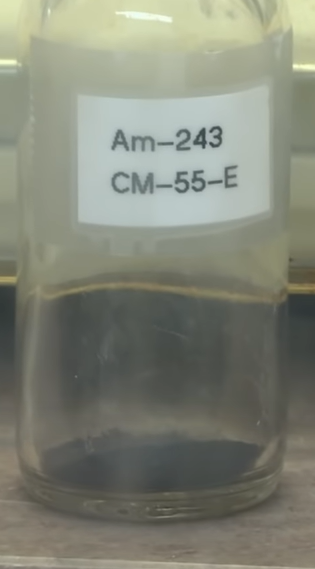
Americium-243, an alpha emitter, has a half-life of 7350 years, the longest of all americium isotopes. It is formed in the nuclear fuel cycle mainly by neutron capture on plutonium-242 followed by beta decay. Production increases exponentially with increasing burnup as a total of 5 neutron captures on U are required. If MOX-fuel is used, particularly MOX-fuel high in and , more americium overall and more will be produced.
It decays by either emitting an alpha particle (decay energy 5.439 MeV) to become Np, which then quickly goes to Pu, or, very rarely, spontaneous fission. The fission rate is about 60% that of americium-241 or about 0.7/g/s.
As for the other americium isotopes, and more generally for all alpha emitters, Am is carcinogenic in case of internal contamination after being inhaled or ingested. Am also presents a risk of external irradiation associated with the gamma ray emitted by its short-lived decay product Np. The external irradiation risk for the other two americium isotopes (Am and Am) is less than 10% of that for americium-243.
References
Sources
Isotope masses from:
Half-life, spin, and isomer data selected from the following sources.
- IAEA - Nuclear Data Section. Live Chart of Nuclides. Vienna International Centre.
References
- [http://www.ead.anl.gov/pub/doc/Americium.pdf "Americium"] {{webarchive. link. (2012-07-30 . Argonne National Laboratory, EVS. Retrieved 25 December 2009.)
- (April 2004). "Neutron and Gamma Ray Source Evaluation of LWR High Burn-up UO2 and MOX Spent Fuels". Journal of Nuclear Science and Technology.
- "Critical Mass Calculations for {{sup".
- (December 28, 2000). "Extremely Efficient Nuclear Fuel Could Take Man To Mars In Just Two Weeks". Ben-Gurion University Of The Negev.
- (2000). "Ultra-thin 242mAm fuel elements in nuclear reactors". Nuclear Instruments and Methods in Physics Research A.
- [http://www.ornl.gov/sci/isotopes/r_am243.html "Americium-243"] {{webarchive. link. (2011-02-25 . Oak Ridge National Laboratory. Retrieved 25 December 2009.)
- {{NNDC
- Calculated from Nubase data.
This article was imported from Wikipedia and is available under the Creative Commons Attribution-ShareAlike 4.0 License. Content has been adapted to SurfDoc format. Original contributors can be found on the article history page.
Ask Mako anything about Isotopes of americium — get instant answers, deeper analysis, and related topics.
Research with MakoFree with your Surf account
Create a free account to save articles, ask Mako questions, and organize your research.
Sign up freeThis content may have been generated or modified by AI. CloudSurf Software LLC is not responsible for the accuracy, completeness, or reliability of AI-generated content. Always verify important information from primary sources.
Report