From Surf Wiki (app.surf) — the open knowledge base
Isophorone
Alpha-beta unsaturated cyclic ketone

Alpha-beta unsaturated cyclic ketone
α-isophorone
1,1,3-Trimethyl-3-cyclohexene-5-one Isoforone Isoacetophorone IP 2330 mg/kg (rat, oral) 2690 mg/kg (mouse, oral) 1840 ppm (rat, 4 hr)
Isophorone is an α,β-unsaturated cyclic ketone. It is a colorless liquid with a characteristic peppermint-like odor, although commercial samples can appear yellowish. Used as a solvent and as a precursor to polymers, it is produced on a large scale industrially.
Structure and reactivity
Isophorone undergoes reactions characteristic of an α,β-unsaturated ketone. Hydrogenation gives the cyclohexanone derivative. Epoxidation with basic hydrogen peroxide affords the oxide.
Isophorone is degraded by attack of hydroxyl radicals.
Photodimerization
When exposed to sunlight in aqueous solutions, isophorone undergoes 2+2 photocycloaddition to give three isomeric photodimers (Figure). These "diketomers" are cis-syn-cis, head to tail (HT), cys-anti-cys (HT), and head-head (HH). The formation of HH photodimers is favored over HT photodimers with increasing polarity of the medium.
Natural occurrence
Isophorone occurs naturally in cranberries.
Synthesis
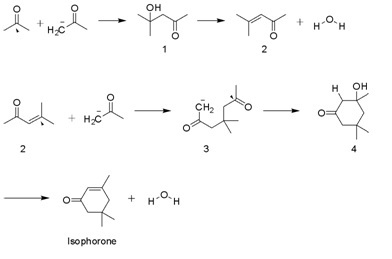
Isophorone is produced on a multi-thousand ton scale by the aldol condensation of acetone using KOH. Diacetone alcohol, mesityl oxide, and 3-hydroxy-3,5,5-trimethylcyclohexan-1-one are intermediates. A side product is beta-isophorone, where the C=C group is not conjugated with the ketone.
Applications
The partly hydrogenated derivative trimethylcyclohexanone is used in production of polycarbonates. It condenses with phenol to give an analogue of bisphenol A. Polycarbonates produced by phosgenation of these two diols produces a polymer with improved thermal stability. Trimethyladipic acid and 2,2,4-trimethylhexamethylenediamine are produced from trimethylcyclohexanone and trimethylcyclohexanol. They are used to make specialty polyamides. Hydrocyanation gives the nitrile followed by reductive amination gives isophorone diamine. This diamine is used to produce isophorone diisocyanate which has certain niche applications.
Full hydrogenation gives 3,3,5-Trimethylcyclohexanol, a precursor to both sunscreens and chemical weapons.
Safety
The value of isophorone in rats and rabbits by oral exposure is around 2.00 g/kg. The safety aspects of isophorone have been subject to several studies.
History
The use of isophorone as a solvent resulted from the search for ways to dispose of or recycle acetone, which is a waste product of phenol synthesis by the Hock method.
References
References
- ''[[Merck Index]]'', 13th Edition, '''5215'''.
- {{PGCH. 0355
- {{IDLH. 78591. Isophorone
- {{cite encyclopedia. Hardo Siegel. (2005). Wiley-VCH
- Richard L. Wasson. (1957). "Isophorone Oxide". Org. Synth..
- "TOXNET".
- (1998-01-28). "Supramolecularity and Photodimerization of Isophorone: FTIR and Molecular Mechanics Studies". The Journal of Physical Chemistry A.
- "Isophorone".
- {{cite encyclopedia. Volker Serini. Wiley-VCH. (2000)
- "Toxicity Effects".
- W. Morton Grant, Joel S. Schuman M.D. (11 February 2016). "Toxicology of the Eye: Effects on the Eyes and Visual System from Chemicals, Drugs, Metals and Minerals, Plants, Toxins, and Venoms; Also, Systemic Side Effects from Eye". Med (2-Volume Set) 4th Edition, Page 863.
- [http://www.degussa-history.com/geschichte/en/inventions/isophorone/ Isophorone history at Degussa]
This article was imported from Wikipedia and is available under the Creative Commons Attribution-ShareAlike 4.0 License. Content has been adapted to SurfDoc format. Original contributors can be found on the article history page.
Ask Mako anything about Isophorone — get instant answers, deeper analysis, and related topics.
Research with MakoFree with your Surf account
Create a free account to save articles, ask Mako questions, and organize your research.
Sign up freeThis content may have been generated or modified by AI. CloudSurf Software LLC is not responsible for the accuracy, completeness, or reliability of AI-generated content. Always verify important information from primary sources.
Report