From Surf Wiki (app.surf) — the open knowledge base
Ismail al-Jazari
Muslim engineer and artist (1136–1206)
Muslim engineer and artist (1136–1206)
| Field | Value |
|---|---|
| era | Islamic Golden Age |
| name | Ismail al-Jazari |
| title | **al-Jazari** |
| religion | Islam |
| birth_date | 1136 CE |
| birth_place | Jazira, Artuqid Dynasty |
| death_date | 1206 CE |
Badīʿ az-Zaman Abu l-ʿIzz ibn Ismāʿīl ibn ar-Razāz al-Jazarī (1136–1206, , ) was a polymath: a scholar, inventor, mechanical engineer, artisan and artist from the Artuqid Dynasty of Jazira in Mesopotamia. He is best known for writing The Book of Knowledge of Ingenious Mechanical Devices (, also known as Automata) in 1206, where he described 50 mechanical devices, along with instructions on how to construct them. One of his more famous inventions is the elephant clock. He has been described as the "father of robotics" and modern day engineering.
Biography
Al-Jazari was part of a tradition of artisans and was thus more a practical engineer than an inventor who appears to have been "more interested in the craftsmanship necessary to construct the devices than in the technology which lay behind them" and his machines were usually "assembled by trial and error rather than by theoretical calculation". His Book of Knowledge of Ingenious Mechanical Devices appears to have been quite popular as it appears in a large number of manuscript copies, and as he explains repeatedly, he only describes devices he has built himself. According to Mayr, the book's style resembles that of a modern "do-it-yourself" book.
Some of his devices were inspired by earlier devices, such as one of his monumental water clocks, which was based on that of a Pseudo-Archimedes. He also cites the influence of the Banū Mūsā brothers for his fountains, al-Saghani for the design of a candle clock, and Hibatullah ibn al-Husayn (d. 1139) for musical automata. Al-Jazari goes on to describe the improvements he made to the work of his predecessors, and describes a number of devices, techniques and components that are original innovations which do not appear in the works by his precessors.
1206 edition (Ahmet III 3472)
The Artuqid ruler Nasr al-Din Mahmud (r. 1201–1222) is known to have commissioned the first edition of Al-Jāmi' fī ṣinā'at al-ḥiyal of Ibn al-Razzaz al-Jazari, in April 1206 at the Artuqid court. This manuscript is known as Ahmet III 3472, now in the Topkapı Sarayı Library. The miniatures are thought to reflect various aspects of the Artuqid court at the time. Ibn al-Razzaz al-Jazari was employed at the Artuqid court during the last quarter of the 12th century, and this is the earliest known manuscript of his opus.
File:Mechanical boat (court scene), probably Amid, modern-day Diyarbakır, Turkey, 1206 (Ms. Ahmet III 3472).jpg|Court scene. Amid, modern-day Diyarbakır, Turkey, 1206 (Ms. Ahmet III 3472). File:Mechanical male servant, probably Amid, modern-day Diyarbakır, Turkey, 1206 (Ms. Ahmet III 3472, fol. 121v).jpg|Mechanical Turkic servant. Amid, modern-day Diyarbakır, Turkey, 1206 (Ms. Ahmet III 3472). File:Mechanical female servant, probably Amid, modern-day Diyarbakır, Turkey, 1206 (Ms. Ahmet III 3472).jpg|Female servant. Amid, modern-day Diyarbakır, Turkey, 1206 (Ms. Ahmet III 3472). File:Mechanical Slave, probably Amid, modern-day Diyarbakır, Turkey, 1206 (Ms. Ahmet III 3472, fol. 121v).jpg|Mechanical Turkic servant. Amid, modern-day Diyarbakır, Turkey, 1206 (Ms. Ahmet III 3472).
Mechanisms and methods
The most significant aspect of al-Jazari's machines are the mechanisms, components, ideas, methods, and design features which they employ.
Camshaft
A camshaft, a shaft to which cams are attached, was described in 1206 by al-Jazari, who employed them in his automata, water clocks (such as the candle clock) and water-raising machines.
Crankshaft and crank-slider mechanism
The eccentrically mounted handle of the rotary quern-stone in fifth century BCE Spain that spread across the Roman Empire constitutes a crank. The earliest evidence of a crank and connecting rod mechanism dates to the 3rd century AD Hierapolis sawmill in the Roman Empire. The crank also appears in the mid-9th century in several of the hydraulic devices described by the Banū Mūsā brothers in their Book of Ingenious Devices.
In 1206, al-Jazari invented an early crankshaft, The crankshaft described by al-Jazari
He used the crankshaft with a connecting rod in two of his water-raising machines: the crank-driven saqiya chain pump and the double-action reciprocating piston suction pump. His water pump also employed the first known crank-slider mechanism.
Design and construction methods
English technology historian Donald Hill writes:
Escapement mechanism in a rotating wheel
Al-Jazari invented a method for controlling the speed of rotation of a wheel using an escapement mechanism.
Mechanical controls
According to Donald Hill, al-Jazari described several early mechanical controls, including "a large metal door, a combination lock and a lock with four bolts".
Conical valve and segmental gear
A segmental gear is "a piece for receiving or communicating reciprocating motion from or to a cogwheel, consisting of a sector of a circular gear, or ring, having cogs on the periphery, or face." Lynn Townsend White wrote:
Water-raising machines
Al-Jazari invented five machines for raising water, as well as watermills and water wheels with cams on their axle used to operate automata, in the 12th and 13th centuries, and described them in 1206. It was in these water-raising machines that he introduced his most important ideas and components.
Saqiya chain pumps
The first known use of a crankshaft in a chain pump was in one of al-Jazari's saqiya machines. The concept of minimizing intermittent working is also first implied in one of al-Jazari's saqiya chain pumps, which was for the purpose of maximising the efficiency of the saqiya chain pump. Al-Jazari also constructed a water-raising saqiya chain pump which was run by hydropower rather than manual labour, though the Chinese were also using hydropower for chain pumps prior to him. Saqiya machines like the ones he described have been supplying water in Damascus since the 13th century up until modern times, and were in everyday use throughout the medieval Islamic world. Interestingly, the depiction of the chain in al-Jazari's pump appears to be in the form of a Möbius strip, from long before the Möbius strip was first identified as an object of study in mathematics.{{cite journal
Double-action suction pump with valves and reciprocating piston motion
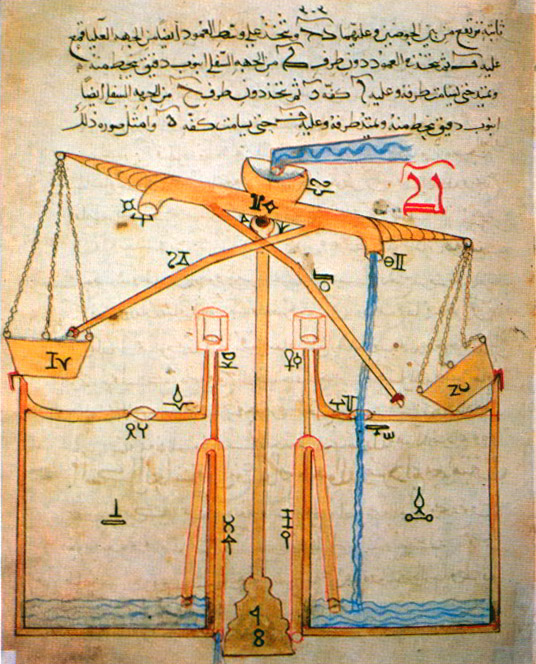
Al-Jazari described suction pipes, suction pump, double-action pump, and made early uses of valves and a crankshaft-connecting rod mechanism, when he developed a twin-cylinder reciprocating piston suction pump. This pump is driven by a water wheel, which drives, through a system of gears, an oscillating slot-rod to which the rods of two pistons are attached. The pistons work in horizontally opposed cylinders, each provided with valve-operated suction and delivery pipes. The delivery pipes are joined above the centre of the machine to form a single outlet into the irrigation system. This water-raising machine had a direct significance for the development of modern engineering. This pump is remarkable for three reasons:
- The first known use of a true suction pipe (which sucks fluids into a partial vacuum) in a pump.
- The first application of the double-acting principle.
- The conversion of rotary to reciprocating motion via the crank-connecting rod mechanism.
Al-Jazari's suction piston pump could lift 13.6 metres of water, with the help of delivery pipes. It was not, however, any more efficient than the noria commonly used by the Muslim world at the time.
Al-Jazari cited the Byzantine siphon used for discharging Greek fire as an inspiration for his pump. According to Donald Hill, al-Jazari's pump can be considered "a direct ancestor of the steam engine combination". According to Joseph Needham, al-Jazari's slot-rod force pump is one of "the two machines of the Middle Ages which lie most directly in the line of ancestry of the steam-engine and the locomotive" along with Wang Zhen's blowing engine a century later.
Single-bucket and four-bucket water lifting machines
Al-Jazari described single-bucket and four-bucket water lifting machines. The single-bucket version employs differentials, semi-circular gear units, bucket elevators, and gearboxes, while the four-bucket version adds a mechanical timer.
Water supply system
Al-Jazari developed the earliest water supply system to be driven by gears and hydropower, which was built in 13th century Damascus to supply water to its mosques and Bimaristan hospitals. The system had water from a lake turn a scoop-wheel and a system of gears which transported jars of water up to a water channel that led to mosques and hospitals in the city.
Automata
Al-Jazari built automated moving peacocks driven by hydropower. He also created automatic doors as part of one of his elaborate water clocks,
Mark E. Rosheim summarizes the advances in robotics made by Muslim engineers, especially al-Jazari, as follows:
Drink-serving waitress
One of al-Jazari's humanoid automata was a waitress that could serve water, tea or drinks. The drink was stored in a tank with a reservoir from where the drink drips into a bucket and, after seven minutes, into a cup, after which the waitress appears out of an automatic door serving the drink.
Hand-washing automaton with flush mechanism
Al-Jazari invented a hand washing automaton incorporating a flush mechanism now used in modern flush toilets. This device is another example of humanoid automata. It consisted of a human figure, made from jointed copper, holding a pitcher resembling a peacock in its right hand. The pitcher was made from brass and held within it a chamber, divided into two parts by a metal plate. This mechanism aided the pouring of the water from the spout so that it was smooth and would not splutter. The reservoir in which the water was held was situated within the right-hand side of the human figure. An axle was fitted into the right elbow of the human figure so as to allow the liquid to pour from the reservoir through the spout of the pitcher. The left arm of the figure had a fixed weight which would raise and lower the arm which would hold a towel, comb and mirror.
This automaton was designed to aid the king whilst he performed his ritual ablutions. A servant of the king would carry the figure and place it next to a basin that could hold liquid. The servant then turned a knob on the back of the figure which opened a valve resulting in the pouring of water from the right hand of the figure into the basin. When the reservoir was nearly empty and most of the water had been poured, a mechanism was prompted and the left hand of the figure, holding the towel, comb and mirror, was extended out in the direction of the king so that he could dry himself and tend to his beard.
Peacock fountain with automated servants
Water and its usages holds particular importance in Islam; both as being an integral part of the pre-prayer washing processes wudu and ghusl, and a key feature in Islamic gardens – four fountains featuring in the Paradise Garden; the Islamic final resting place referenced in the Quran. Additionally, with Mesopotamia being a naturally drought-ridden place, machines relating to water held a significant function; in both a divine and practical sense.
An entire section of The Book of Knowledge of Ingenious Mechanical Devices was devoted to fountain mechanisms, titled: On the construction in pools of fountains which change their shape, and of machines for the perpetual flute.
Al-Jazari's "peacock fountain" was a more sophisticated hand washing device featuring humanoid automata as servants which offer soap and towels. Mark E. Rosheim describes it as follows:
The basin of the "peacock fountain" formed the basin for performing wudu, and it would have been operated by a servant, who would have pulled the plug and positioned the peacock's beak; allowing the mechanism to release the water into the basin in front of the user.
However, whilst water moving objects such as the peacock fountain had ritualistic usage, there is suggestion that water-moving hydraulics were put to profane use. Ayhan Aytes suggests that:Many of the devices also had additional functions that contradicted divine omnipotence. The most profane purpose of several of his hydraulic and pnuematic automata was to get guests at parties drunk as quickly as possible.
Musical robot band
Al-Jazari's work described fountains and musical automata, in which the flow of water alternated from one large tank to another at hourly or half-hourly intervals. This operation was achieved through his innovative use of hydraulic switching.
Al-Jazari created a musical automaton, which was a boat with four automatic musicians that floated on a lake to entertain guests at royal drinking parties. Professor Noel Sharkey has argued that it is quite likely that it was an early programmable automata and has produced a possible reconstruction of the mechanism; it has a programmable drum machine with pegs (cams) that bump into little levers that operated the percussion. The drummer could be made to play different rhythms and different drum patterns if the pegs were moved around.
The water-clock of the drummers

The water-clock of the drummers, which differs from the Musical robot band in that it lacks a flute-playing doll and instead has two trumpeters, consists of seven wood-jointed male figures, including the aforementioned trumpeters as well as two dolls playing cymbals and the rest playing other percussive instruments. The mechanism in this specific automaton serves as a clock by producing a musical output once every hour, illustrating Al-Jazari's ability to create multi-faceted automata that functioned on a practical and entertainment level. The motion of the automaton is initiated at daybreak by another male doll, who stands at the edge of the frieze element of the design, moving across until he reaches a specific point at which a carved falcon leans forward dropping a ball from its beak onto a cymbal. All mechanical aspects of the automaton are then driven by water and a series of pistons and cables. Each hour water drains out of the main cistern to cause another bucket to tip over driving a water wheel that is connected to the musicians. The automaton is described to 'perform a with a clamorous sound which is heard from afar' and could play several different tunes. Like many other automatons by Al-Jazari, this was created to entertain guests at the royal palace.
Clocks
Al-Jazari constructed a variety of water clocks and candle clocks. These included a portable water-powered scribe clock, which was a meter high and half a meter wide, reconstructed successfully at the Science Museum in 1976 Al-Jazari also invented monumental water-powered astronomical clocks which displayed moving models of the Sun, Moon, and stars.
Candle clocks
According to Donald Hill, al-Jazari constructed the most sophisticated candle clocks known to date. Hill described one of al-Jazari's candle clocks as follows:
Al-Jazari's candle clock also included a dial to display the time and, for the first time, employed a bayonet fitting, a fastening mechanism still used in modern times.
Elephant clock
Main article: Elephant clock
The elephant clock described by al-Jazari in 1206 is notable for several innovations. It was the first clock in which an automaton reacted after certain intervals of time (in this case, a humanoid robot striking the cymbal and a mechanical robotic bird chirping) and the first water clock to accurately record the passage of the temporal hours to match the uneven length of days throughout the year.
Castle clock
Al-Jazari's largest astronomical clock was the "castle clock", which was a complex device that was about 11 ft high, and had multiple functions besides timekeeping. It included a display of the zodiac and the solar and lunar orbits, and an innovative feature of the device was a pointer in the shape of the crescent moon which travelled across the top of a gateway, moved by a hidden cart, and caused automatic doors to open, each revealing a mannequin, every hour.
Another feature of the device was five automata musicians who automatically play music when moved by levers operated by a hidden camshaft attached to a water wheel.
Al-Jazari invented water clocks that were driven by both water and weights. These included geared clocks and a portable water-powered scribe clock, which was a meter high and half a meter wide. The scribe with his pen was synonymous to the hour hand of a modern clock. Al-Jazari's famous water-powered scribe clock was reconstructed successfully at the Science Museum, London in 1976.
Miniature paintings
Alongside his accomplishments as an inventor and engineer, al-Jazari was also an accomplished artist. In The Book of Knowledge of Ingenious Mechanical Devices, he gave instructions of his inventions and illustrated them using miniature paintings, a medieval style of Islamic art.
Image:Al-Jazari - A Candle Clock.jpg|One of al-Jazari's candle clocks. Image:Al-Jazari - A Musical Toy.jpg|The musical robot band designed by al-Jazari. Image:Al-Jazari - A Table Device.jpg|A table device automaton designed by al-Jazari. Image:Al-Jazari - The Basin.jpg|The hand-washing automaton with a flush mechanism designed by al-Jazari. Image:Al-Jazari Automata 1205.jpg|Al-Jazari's hydropowered saqiya chain pump device. File:Al-Djazari automate verseur de vin.jpg|An illustration of a device invented by al-Jazari. File:A blood measuring device by Al-Jazari.jpg|A sketch of a device designed by al-Jazari. From the manuscript of Kitabal Al-Hial in Aga Khan Museum, Toronto.
Notes
References
- Claus-Peter Haase, Modest Variations—Theoretical Tradition and Practical Innovation in the Mechanical Arts from Antiquity to the Arab Middle Ages, in:
- Ulrich Alertz, The Horologium of Hārūn al-Rashīd Presented to Charlemagne – An Attempt to Identify and Reconstruct the Clock Using the Instructions Given by al-Jazarī, in:
- George Saliba, Blurred Edges—At the Intersection of Science, Culture, and Art, in:
- Amnon Shiloah, The Paradigmatic-Individualistic Approach of Arab Musical Creativeness, in:
- Eilhard Wiedemann, On Musical Automata, in:
References
- al-Jazari, ''The Book of Knowledge of Ingenious Mechanical Devices: Kitáb fí ma'rifat al-hiyal al-handasiyya'', transl. & anno. [[Donald Hill. Donald R. Hill]]. (1973), [[Springer Science+Business Media]].
- (2022). "The Sea in the Middle The Mediterranean World, 650–1650". University of California Press.
- (30 July 2020). "Ismail al-Jazari, the Muslim inventor whom some call the 'Father of Robotics'". National Geographic Society.
- (1983). "Islamic Scientific Thought and Muslim Achievements in Science: Papers Presented". Ministry of Science and Technology, National Hijra Centenary Committee, and Organization of Islamic Conference.
- Dr. Norman Smith. (1974-04-04). "The Arabian legacy". [[Reed Business Information]].
- (1998). "Encyclopedia of Arabic Literature". Taylor & Francis.
- (2010). "Distinguished Figures in Mechanism and Machine Science - Part 2". [[Springer Science+Business Media.
- [[Donald Hill]], "Mechanical Engineering in the Medieval Near East", ''[[Scientific American]]'', May 1991, pp. 64-9 ([[cf.]] [[Donald Hill]], [http://home.swipnet.se/islam/articles/HistoryofSciences.htm Mechanical Engineering] {{webarchive. link. (25 December 2007 ))
- (2010). "Engineering and Technology". [[Cengage.
- Banū Mūsā. (1979). "The Book of Ingenious Devices/Kitáb al-Ḥiyal: Kitáb al-Hiyal". [[D. Reidel.
- Mehmet Aga-Oglu. (November 1931). "On a Manuscript by Al-Jazari". Parnassus.
- (2017). "Ancient Engineers' Inventions: Precursors of the Present". [[Springer International Publishing]].
- (2020). "A History of Mechanical Engineering". [[Springer Nature]].
- (2013). "Building Tomorrow's Leaders Today: On Becoming a Polymath Leader". Routledge.
- (2008). "A Biographical Dictionary of People in Engineering". [[Purdue University Press]].
- Donald R. Hill, in ''Dictionary of scientific biography'', 15, suppl. I, p. 254.
- Tibbetts, G. R.. (1975). "Donald R. Hill (tr.): ''The book of knowledge of ingenious mechanical devices (Kitāb fῑ ma'rifat al-ḥiyal alhandasiyya), by Ibn al-Razzāz al-Jazarῑ''. xxv, 285 pp. Dordrecht, Boston: D. Reidel Publishing Co., [C1974]. Guilders 240.". University of London.
- Otto Mayr. (1970). "The Origins of Feedback Control". [[MIT Press]].
- Ahmad Y. al-Hassan. "al-Jazari And the History of the Water Clock". History of Science and Technology in Islam.
- (19 December 2022). "Automated Slaves, Ambivalent Images, and Noneffective Machines in al-Jazari's Compendium of the Mechanical Arts, 1206.". Inquiries into Art.
- (1 January 1985). "Evidence for a School of Painting at the Artuqid Court". Oxford Studies in Islamic Art.
- Georges Ifrah (2001). ''The Universal History of Computing: From the Abacus to the Quatum Computer'', p. 171, Trans. E.F. Harding, John Wiley & Sons, Inc. (See [http://www.banffcentre.ca/bnmi/programs/archives/2005/refresh/docs/conferences/Gunalan_Nadarajan.pdf] {{Webarchive. link. (8 October 2006))
- Tullia Ritti, Klaus Grewe, Paul Kessener: "A Relief of a Water-powered Stone Saw Mill on a Sarcophagus at Hierapolis and its Implications", Journal of Roman Archaeology, Vol. 20 (2007), pp. 138–163 (159)
- (1990). "The Cambridge History of Arabic Literature". [[Cambridge University Press]].
- Sally Ganchy, Sarah Gancher. (2009). "Islam and Science, Medicine, and Technology". The Rosen Publishing Group.
- transforms continuous [[Rotary engine. rotary motion]] into a linear [[Reciprocating engine
- [[Ahmad Y. al-Hassan]], [http://www.history-science-technology.com/Notes/Notes%203.htm The Crank-Connecting Rod System in a Continuously Rotating Machine] {{webarchive. link. (12 March 2013)
- (1990). "The Cambridge History of Arabic Literature". Cambridge University Press.
- [[Donald Hill]], "Engineering", in Roshdi Rashed, ed., ''[[Encyclopedia of the History of Arabic Science]]'', Vol. 2, pp. 751–795 [792]. [[Routledge]], London and New York.
- [http://www.thefreedictionary.com/Segment+gear Segment gear], [[TheFreeDictionary.com]]
- [[Ahmad Y. al-Hassan]], [http://www.history-science-technology.com/Articles/articles%206.htm al-Jazari and the History of the Water Clock] {{webarchive. link. (26 February 2008)
- [[Donald Hill]], "Engineering", in Roshdi Rashed, ed., ''[[Encyclopedia of the History of Arabic Science]]'', Vol. 2, pp. 751–795 [776]. [[Routledge]], London and New York.
- [[Ahmad Y. al-Hassan]]. "The Origin of the Suction Pump: al-Jazari 1206 A.D.".
- Needham, Joseph. (1965). "Science and Civilisation in China, Volume 4: Physics and Physical Technology (Part II: Mechanical Technology)". [[Cambridge University Press]].
- Howard R. Turner (1997), ''Science in Medieval Islam: An Illustrated Introduction'', p. 81, [[University of Texas Press]], {{ISBN. 0-292-78149-0
- [http://www.britannica.com/eb/topic-301961/al-Jazari al-Jazari (Islamic artist)], ''[[Encyclopædia Britannica]]''.
- Rosheim, Mark E.. (1994). "Robot Evolution: The Development of Anthrobotics". Wiley-IEEE.
- (24 July 2008). "Ancient Discoveries, Episode 12: Machines of the East". [[History (U.S. TV channel).
- Ibn al-Razzaz al-Jazari. (1974-01-01). "The Book Of Knowledge Of Ingenious Mechanical Devices".
- (2018-07-03). "Fountains and water: the development of the hydraulic technology of display in Islamic gardens 700–1700 CE". Studies in the History of Gardens & Designed Landscapes.
- Rosheim, Mark E.. (1994). "Robot Evolution: The Development of Anthrobotics". Wiley-IEEE.
- גולן, אבי. (2019-07-30). "The basin of the Peacock and the magic of automata".
- "Zentrum für Kunst und Medientechnologie Karlsruhe (ZKM)".
- Professor Noel Sharkey, [https://web.archive.org/web/20070629182810/http://www.shef.ac.uk/marcoms/eview/articles58/robot.html A 13th Century Programmable Robot (Archive)], [[University of Sheffield]].
- The Book of Knowledge of Ingenious Mechanical Devices by Ibn al-Razzaz al-Jazari Translated by Donald R. Hill, 01-01-1974
- "2. Prehistory of Musical Robots, Michael Krzyzaniak, Arizona State University, School of Arts, Media and Engineering".
- [https://michaelkrzyzaniak.com/Research/PrehistoryMusicalRobots.pdf 2.Prehistory of Musical Robots, Michael Krzyzaniak, Arizona State University, School of Arts, Media and Engineering]
- [[Donald Hill]] (1996), ''A History of Engineering in Classical and Medieval Times'', [[Routledge]], p. 224
- Ibn al-Razzaz Al-Jazari (ed. 1974) ''The Book of Knowledge of Ingenious Mechanical Devices'', Translated and annotated by [[Donald Hill]], Dordrecht / D. Reidel, part II.
- (28 July 2008). "Ancient Discoveries, Episode 12: Machines of the East". [[History (U.S. TV channel).
- (1986). "Islamic Technology: An Illustrated History". [[Cambridge University Press]].
- "Ancient Discoveries, Episode 11: Ancient Robots". [[History (U.S. TV channel).
This article was imported from Wikipedia and is available under the Creative Commons Attribution-ShareAlike 4.0 License. Content has been adapted to SurfDoc format. Original contributors can be found on the article history page.
Ask Mako anything about Ismail al-Jazari — get instant answers, deeper analysis, and related topics.
Research with MakoFree with your Surf account
Create a free account to save articles, ask Mako questions, and organize your research.
Sign up freeThis content may have been generated or modified by AI. CloudSurf Software LLC is not responsible for the accuracy, completeness, or reliability of AI-generated content. Always verify important information from primary sources.
Report