From Surf Wiki (app.surf) — the open knowledge base
Ipomoea alba
Species of plant
Species of plant
Ipomoea alba, known in English as ** white tropical morning glory**, moonflower or moonvine, is a species of night-blooming morning glory, native to tropical and subtropical regions of North and South America, from Argentina to northern Mexico, Arizona, Florida and the West Indies. Though formerly classified as genus Calonyction, species aculeatum, it is now properly assigned to genus Ipomoea, subgenus Quamoclit, section Calonyction.
Description
Ipomoea alba is a perennial, herbaceous liana growing to a height of 5–30 m tall with twining stems. The leaves are entire or three-lobed, 5–15 cm long, with a stem 5–20 cm long. The flowers are fragrant, white or pink, and large, 8–14 cm diameter. The flowers open quickly in the evening and last through the night, remaining open until touched by the morning dew. On overcast days, the blossoms may remain open for longer. The flowers also tend to remain open longer during cool temperatures, which may also cause the segments to snag or tear as they open.
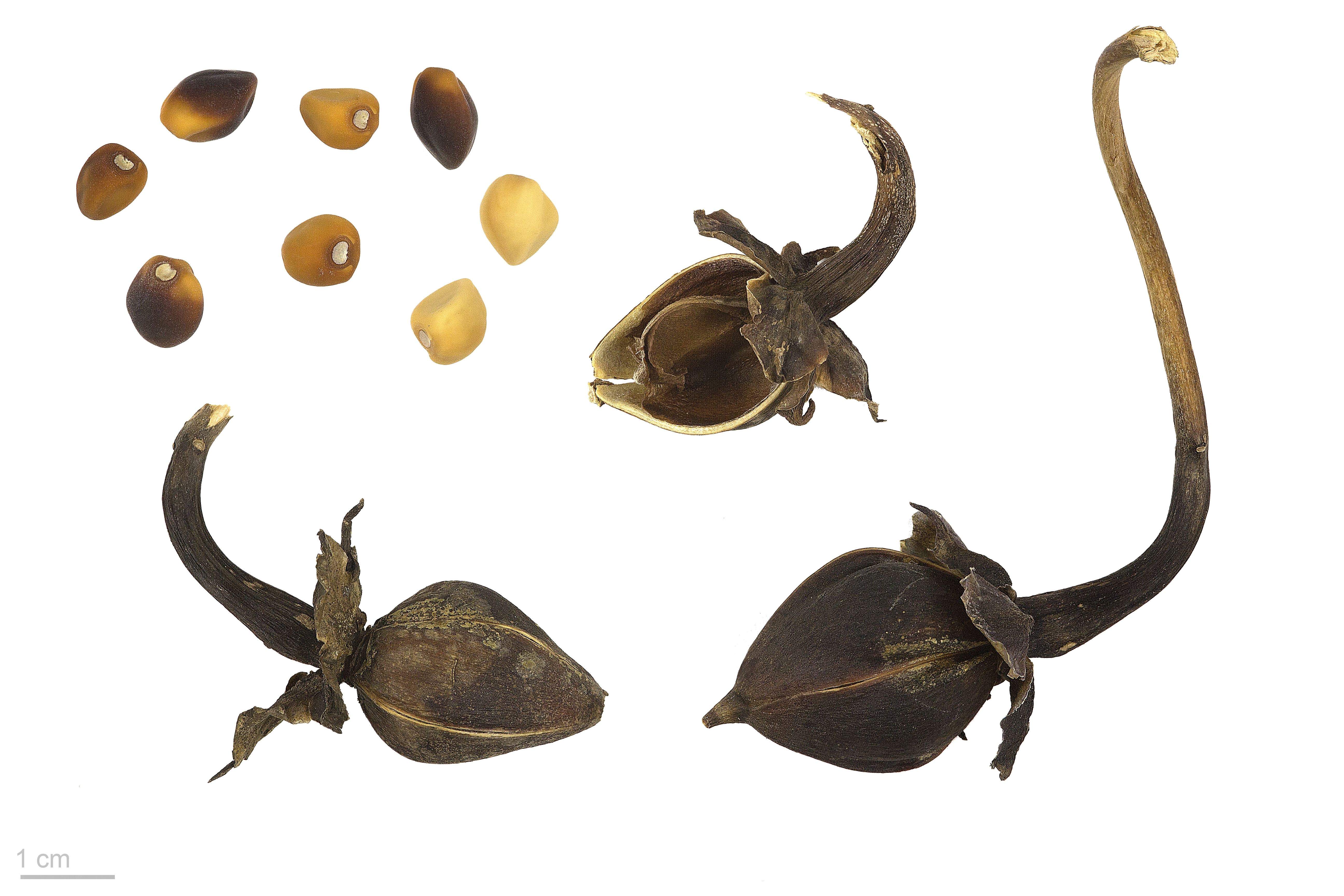
The seeds are yellowish light brown to nearly black in color and nearly round, 10–12 mm long and 8–9 mm wide. The seeds are quite buoyant. In an experiment they floated in water for a year and a half.
The leaves, flowers, and seeds are toxic to humans, cats, dogs, and livestock.
Names
Ipomoea alba is known by a variety of common names. Many of them allude to its night-blooming white flowers, including "moonflower",{{cite web |title=Ipomoea alba |url=https://www.missouribotanicalgarden.org/PlantFinder/PlantFinderDetails.aspx?kempercode=c801 |website=Plant Finder |publisher=Missouri Botanical Garden |access-date=26 May 2024 |language=en|url-status=live |archive-url= https://web.archive.org/web/20251024012800/https://www.missouribotanicalgarden.org/PlantFinder/PlantFinderDetails.aspx?kempercode=c801 |archive-date=October 24, 2025 }} "moonvine", "white moonflower", and "tropical white morning glory". Though "moonflower" is most often used with Ipomoea alba specifically, it is used for other plants, including those formerly placed in Calonyction and now in genus Ipomoea, Ipomoea muricata, Datura candida, Brugmansia suaveolens, and Selenicereus wittii. The similar "moon-flower" was used in the 1800s as a name for Anemonoides altaica, Leucanthemum vulgare, and Rabelera holostea.
Historical use
The Mesoamerican civilizations used the Ipomoea alba morning glory to convert the latex from the Castilla elastica tree to produce bouncing rubber balls. The sulfur in this morning glory served to cross-link the rubber, a process predating Charles Goodyear's discovery of vulcanization by at least 3,000 years.
Cultivation
The species is widely cultivated as an ornamental plant for its flowers. In areas too cold for winter survival, it can be grown as an annual plant. Since it is of tropical origin, it flowers best under a summer short-day photoperiod. Though it can be successfully flowered in the north, its flowering is impaired by excessively long summer days. Thus, at higher latitudes it often does not set buds and bloom until early autumn, when daylight length is once again near 12 hours.
Propagation is usually by seed. The seed resembles a small, brownish nut, and should be nicked with a file and then soaked overnight before planting.
In some areas, the plant is an invasive species which can cause problems in agricultural settings.
References
References
- Canteiro, C.. (2021). "''Ipomoea alba''".
- (2024). "''Ipomoea alba''".
- "Ipomoea alba (Moonflower, Moonvine, Tropical White Morning Glory) {{!}} North Carolina Extension Gardener Plant Toolbox".
- And Bly {{PLANTS
- (2000). "Flora of Puerto Rico and Adjacent Islands: A Systematic Synopsis". Ed. de la Universidad.
- {{GRIN
- (2004). "Some Like It Hot: plants that thrive in hot and humid weather". Wyrick & Co..
- (1976). "World Guide to Tropical Drift Seeds and Fruits". Quadrangle / New York Times Book Co..
- "Ipomoea alba (Moonflower, Moonvine, Tropical White Morning Glory)". North Carolina State University.
- (1950). "The Columbia Encyclopedia (In One Volume)". Columbia University.
- (2007). "Roadside Weed Management". U.S. Dept. of Transportation, Federal Highway Administration.
- (2012). "CRC World Dictionary of Medicinal and Poisonous Plants". CRC Press.
- (1988). "The Beautiful Plants of Kenya". Westlands Sundries.
- (2016). "The Cabaret of Plants: Forty Thousand Years of Plant Life and the Human Imagination". W. W. Norton & Company.
- (1886). "A Dictionary of English Plant-names". Trübner & Co..
- "Rubber processed in ancient Mesoamerica, MIT researchers find". MIT News.
This article was imported from Wikipedia and is available under the Creative Commons Attribution-ShareAlike 4.0 License. Content has been adapted to SurfDoc format. Original contributors can be found on the article history page.
Ask Mako anything about Ipomoea alba — get instant answers, deeper analysis, and related topics.
Research with MakoFree with your Surf account
Create a free account to save articles, ask Mako questions, and organize your research.
Sign up freeThis content may have been generated or modified by AI. CloudSurf Software LLC is not responsible for the accuracy, completeness, or reliability of AI-generated content. Always verify important information from primary sources.
Report