From Surf Wiki (app.surf) — the open knowledge base
International Standard Payload Rack
Steel container used in the International Space Station
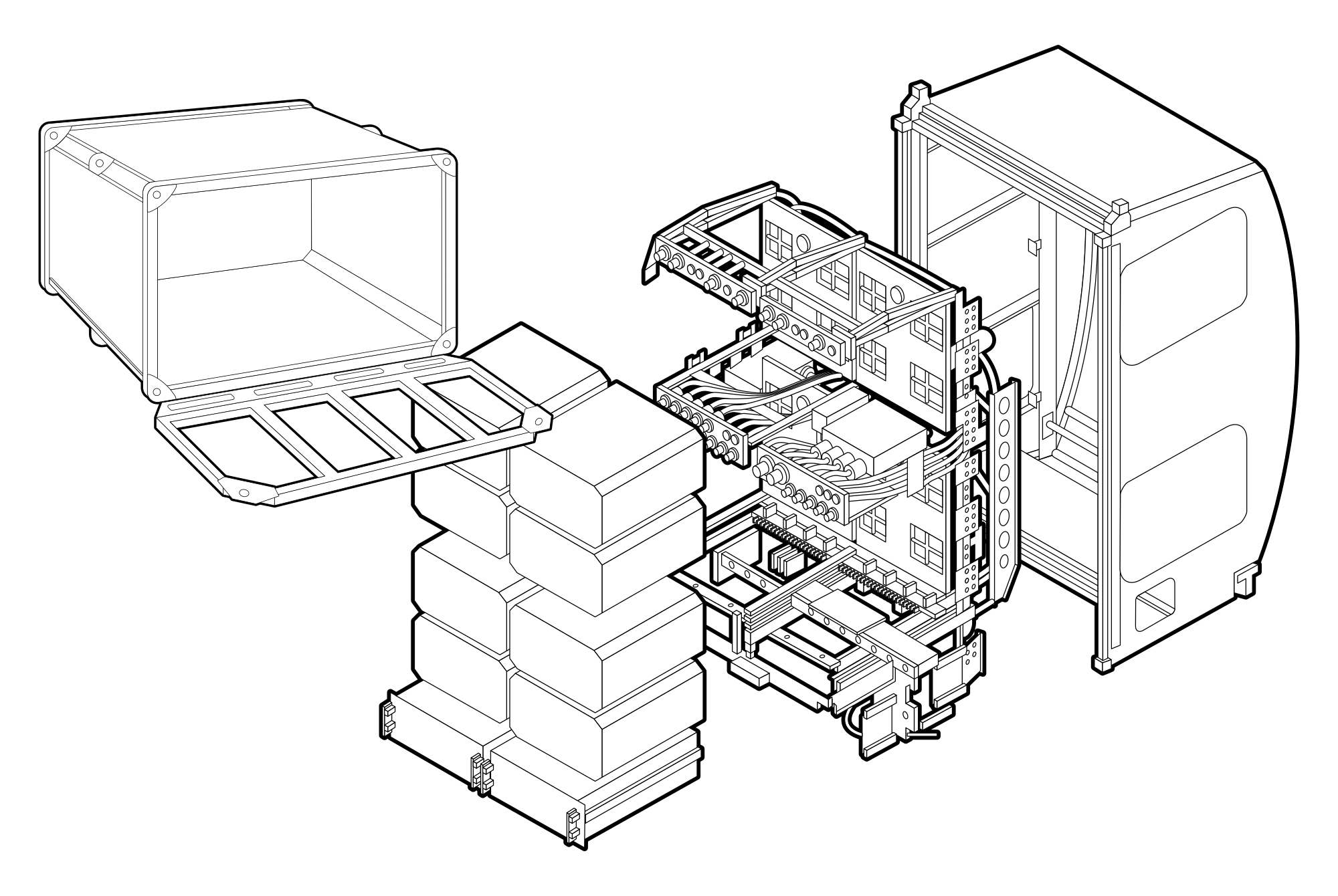
Steel container used in the International Space Station

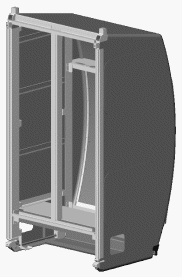
The International Standard Payload Rack (ISPR) is a steel framework container that is designed and been adopted by the International Space Station (ISS) program to support efficient integration and interchangeability of space payload hardware, such as machines and experiments. A typical rack contains 37 ISPR slots for science payloads, which are interchangeable to accommodate different components or payloads.
Capabilities
Each ISPR provides 1.571 m3 of internal volume being about 2 m high, 1.05 m wide, and 85.9 cm deep. The rack weighs 104 kg (230 lb) and can accommodate an additional 700 kg of payload equipment. The rack has internal mounting provisions to allow attachment of secondary structure. The ISPRs will be outfitted with a thin center post to accommodate sub-rack-sized payloads, such as the 483 mm (19-inch rack) Spacelab Standard Interface Rack (SIR) Drawer or the Space Shuttle Middeck Locker. Utility pass-through ports are located on each side to allow cables to be run between Racks. Module attachment points are provided at the top of the rack and via pivot points at the bottom. The pivot points support installation and maintenance. Tracks on the exterior front posts allow mounting of payload equipment and laptop computers. Additional adapters on the ISPRs are provided for ground handling.
Compatibility
The International Standard Payload Rack is the size of a side-by-side refrigerator, and is too big to fit through the Russian probe and drogue docking system, APAS, or NDS docking systems, and therefore cannot be transferred directly from a Progress, ATV, or the interior of the Space Shuttle to the ISS. In the past ISPRs were delivered in Multi-Purpose Logistics Modules, which were carried in the Space Shuttle cargo bay and berthed to CBM ports. Cygnus spacecraft hatches are too narrow to fit ISPRs with their 37 in wide openings and Cargo Dragon 1 spacecraft have no capability to either launch or return ISPRs because of the design of the pressurized section of the Cargo Dragon 1 spacecraft which can only transport cargo bags and smaller racks. Cargo Dragon 2 spacecraft have 31 in wide hatch openings and can not fit the 41.3 in wide ISPRs. ISPRs can only be delivered using the Japanese H-II Transfer Vehicle.
Other ISPR systems
Japan has developed an ISPR with interfaces and capabilities nearly identical to NASA's.
References
References
- (October 2025). "International Space Station User Guide". National Aeronautics and Space Administration.
- "HTV-3 arrives to make large delivery of supplies and research cargo to ISS {{!}} NASASpaceFlight.com".
- Harding, Pete. (2010-10-20). "ISS Prepares for Busy Upcoming Year of Logistics Operations". Nasaspaceflight.
This article was imported from Wikipedia and is available under the Creative Commons Attribution-ShareAlike 4.0 License. Content has been adapted to SurfDoc format. Original contributors can be found on the article history page.
Ask Mako anything about International Standard Payload Rack — get instant answers, deeper analysis, and related topics.
Research with MakoFree with your Surf account
Create a free account to save articles, ask Mako questions, and organize your research.
Sign up freeThis content may have been generated or modified by AI. CloudSurf Software LLC is not responsible for the accuracy, completeness, or reliability of AI-generated content. Always verify important information from primary sources.
Report