From Surf Wiki (app.surf) — the open knowledge base
International Nuclear and Radiological Event Scale
Scale to enable communication of safety information in nuclear accidents
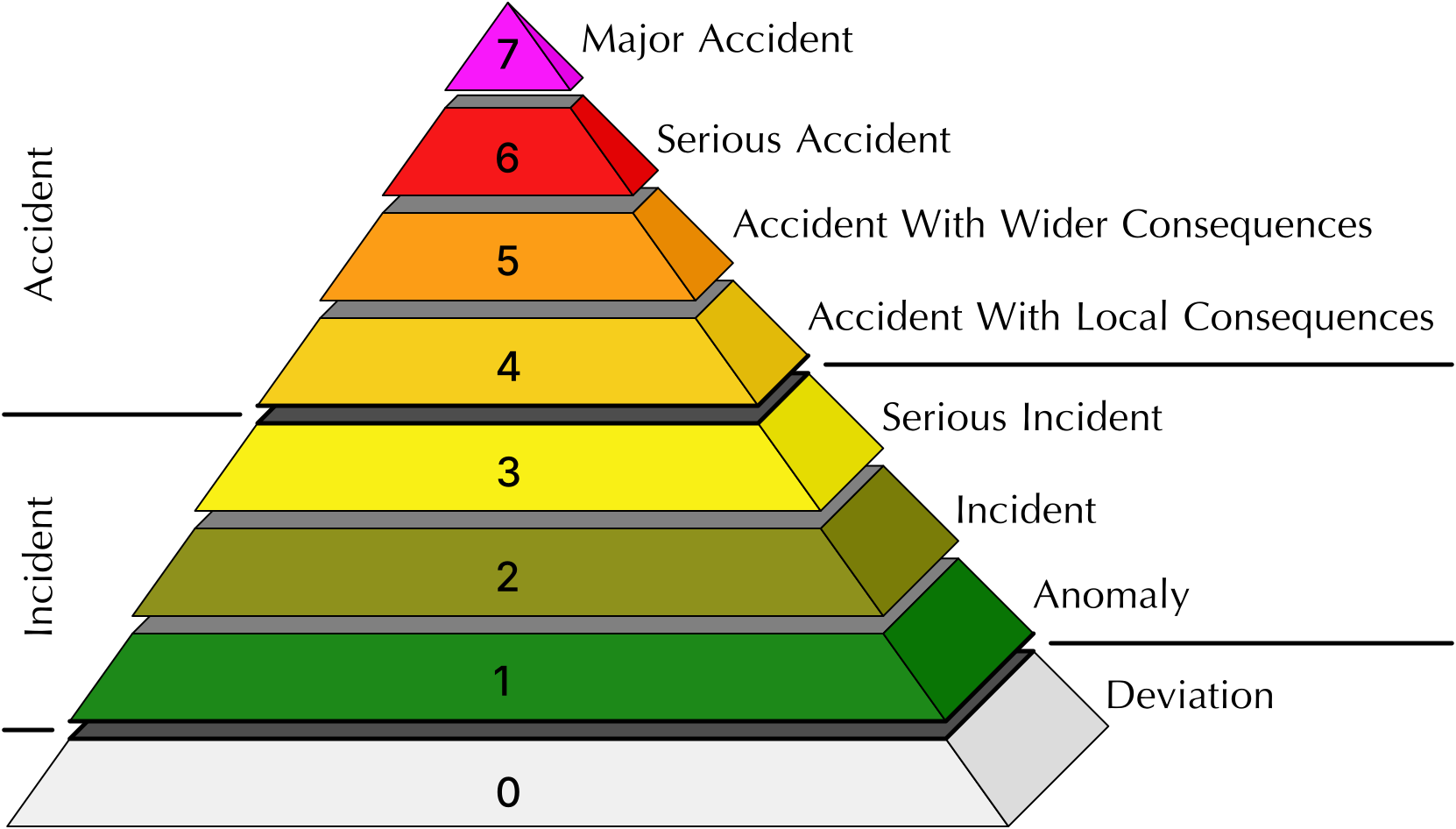
Scale to enable communication of safety information in nuclear accidents
The International Nuclear and Radiological Event Scale (INES) was introduced in 1990 by the International Atomic Energy Agency (IAEA) in order to enable prompt communication of safety and significant information in case of nuclear accidents.
The scale is intended to be logarithmic, similar to the moment magnitude scale that is used to describe the comparative magnitude of earthquakes. Each increasing level represents an accident approximately ten times as severe as the previous level. Compared to earthquakes, where the event intensity can be quantitatively evaluated, the level of severity of a human-made disaster, such as a nuclear accident, is more subject to interpretation. Because of this subjectivity, the INES level of an incident is assigned well after the occurrence. The scale is therefore intended to assist in disaster-aid deployment.
Details
A number of criteria and indicators are defined to assure coherent reporting of nuclear events by different official authorities. There are seven nonzero levels on the INES scale: three incident-levels and four accident-levels. There is also a level 0.
The level on the scale is determined by the highest of three scores: off-site effects, on-site effects, and defense in depth degradation.
| Level | Classification | Description | Examples |
|---|---|---|---|
| Major accident | Impact on people and environment: | There have been two Level 7 accidents: | Fukushima nuclear disaster, a series of events beginning on 11 March 2011. Major damage to the backup power and containment systems caused by the 2011 Tōhoku earthquake and tsunami resulted in overheating and leaking from some of the Fukushima I nuclear plant's reactors. A temporary exclusion zone of 20 km was established around the plant.}} |
| Serious accident | Impact on people and environment: | There has been one Level 6 accident: | |
| Accident with wider consequences | Impact on people and environment: | Several deaths from radiation.}} | Release of large quantities of radioactive material within an installation with a high probability of significant public exposure. This could arise from a major criticality accident or fire.}} |
| Accident with local consequences | Impact on people and environment: | At least one death from radiation.}} | Release of significant quantities of radioactive material within an installation with a high probability of significant public exposure.}} |
| Serious incident | Impact on people and environment: | Non-lethal deterministic health effect (e.g., burns) from radiation.}} | Severe contamination in an area not expected by design, with a low probability of significant public exposure.}} |
| Incident | Impact on people and environment: | Exposure of a worker in excess of the statutory annual limits.}} | Significant contamination within the facility into an area not expected by design.}} |
| Anomaly | Impact on defence-in-depth: | Minor problems with safety components with significant defence-in-depth remaining. | Low activity lost or stolen radioactive source, device, or transport package.}} |
| Deviation | No safety significance. | {{bulleted list | 13 February 2006: Fire in Nuclear Waste Volume Reduction Facilities of the Japanese Atomic Energy Agency (JAEA) in Tokaimura. |
Out of scale
There are also events of no safety relevance, characterized as "out of scale". :Examples: :* 5 March 1999: San Onofre, United States: Discovery of suspicious item, originally thought to be a bomb, in a nuclear power plant. :* 29 September 1999: H.B. Robinson, United States: A tornado sighting within the protected area of the nuclear power plant. :* 17 November 2002, Natural Uranium Oxide Fuel Plant at the Nuclear Fuel Complex in Hyderabad, India: A chemical explosion at a fuel fabrication facility.
Criticism
Deficiencies in the existing INES have emerged through comparisons between the 1986 Chernobyl disaster, which had severe and widespread consequences to humans and the environment, and the 2011 Fukushima nuclear disaster, which caused one fatality and comparatively small (10%) release of radiological material into the environment. The Fukushima Daiichi nuclear accident was originally rated as INES 5, but then upgraded to INES 7 (the highest level) when the events of units 1, 2 and 3 were combined into a single event and the combined release of radiological material was the determining factor for the INES rating.
One study found that the INES scale of the IAEA is highly inconsistent, and the scores provided by the IAEA incomplete, with many events not having an INES rating. Further, the actual accident damage values do not reflect the INES scores. A quantifiable, continuous scale might be preferable to the INES.
Three arguments have been made: First, the scale is essentially a discrete qualitative ranking, not defined beyond event level 7. Second, it was designed as a public relations tool, not an objective scientific scale. Third, its most serious shortcoming is that it conflates magnitude and intensity. An alternative nuclear accident magnitude scale (NAMS) was proposed by British nuclear safety expert David Smythe to address these issues.
Alternatives
Nuclear Accident Magnitude Scale
The Nuclear Accident Magnitude Scale (NAMS) is an alternative to INES, proposed by David Smythe in 2011 as a response to the Fukushima Daiichi nuclear disaster. There were some concerns that INES was used in a confusing manner, and NAMS was intended to address the perceived INES shortcomings.
As Smythe pointed out, the INES scale ends at 7; a more severe accident than Fukushima in 2011 or Chernobyl in 1986 would also be measured as INES category 7. In addition, it is discontinuous, not allowing a fine-grained comparison of nuclear incidents and accidents. But the most pressing item identified by Smythe is that INES conflates magnitude with intensity; a distinction long made by seismologists to compare earthquakes. In that subject area, magnitude describes the physical energy released by an earthquake, while the intensity focuses on the effects of the earthquake. By analogy, a nuclear incident with a high magnitude (e.g. a core meltdown) may not result in an intense radioactive contamination, as the incident at the Swiss research reactor in Lucens shows – yet it resides in INES category 4, together with the Windscale fire of 1957, which caused significant contamination outside of its facility.
Definition
The definition of the NAMS scale is:
: NAMS = log10(20 × R)
with R being the radioactivity being released in terabecquerels, calculated as the equivalent dose of iodine-131. Furthermore, only the atmospheric release affecting the area outside the nuclear facility is considered for calculating the NAMS, giving a NAMS score of 0 to all incidents which do not affect the outside. The factor of 20 assures that both the INES and the NAMS scales reside in a similar range, aiding a comparison between accidents. An atmospheric release of any radioactivity will only occur in the INES categories 4 to 7, while NAMS does not have such a limitation.
The NAMS scale still does not take into account the radioactive contamination of liquids such as an ocean, sea, river or groundwater pollution in proximity to any nuclear power plant.
The estimation of magnitude seems to be related to the problematic definition of a radiological equivalence between different types of involved isotopes and the variety of paths by which activity might eventually be ingested, e.g. eating fish or through the food chain.
Smythe lists these incidents: Chernobyl, former USSR 1986 (M = 8.0), Three Mile Island, USA (M = 7.9), Fukushima-Daiichi, Japan 2011 (M = 7.5), Kyshtym, former USSR 1957 (M = 7.3).
Notes
References
References
- (6 October 2008). "Event scale revised for further clarity". World-nuclear-news.org.
- Parfitt, Tom. (26 April 2006). "Opinion remains divided over Chernobyl's true toll". The Lancet.
- Ahlstrom, Dick. (2 April 2016). "Chernobyl anniversary: The disputed casualty figures". The Irish Times.
- Mycio, Mary. (26 April 2013). "How Many People Have Really Been Killed by Chernobyl? Why estimates differ by tens of thousands of deaths". Slate.
- Ritchie, Hannah. (24 July 2017). "What was the death toll from Chernobyl and Fukushima?". Our World in Data.
- Highfield, Roger. (21 April 2011). "How many died because of the Chernobyl disaster? We don't really know (Article updated May 7, 2019)". New Scientist.
- (12 April 2011). "Japan: Nuclear crisis raised to Chernobyl level". BBC News.
- (13 April 2011). "Japan's government downgrades its outlook for growth". BBC News.
- (12 April 2011). "Japan upgrades nuclear crisis to same level as Chernobyl".
- "Kyshtym disaster {{!}} Causes, Concealment, Revelation, & Facts".
- (7 October 2013). "The world's worst nuclear power disasters". Power Technology.
- ''Canadian Nuclear Society'' (1989) [http://media.cns-snc.ca/history/nrx.html The NRX Incident by Peter Jedicke] {{Webarchive. link. (21 May 2015)
- ''The Canadian Nuclear FAQ'' [https://www.nuclearfaq.ca/cnf_sectionD.htm#x What are the details of the accident at Chalk River's NRX reactor in 1952?]
- Richard Black. (18 March 2011). "Fukushima – disaster or distraction?". BBC.
- (18 March 2011). "Fukushima – disaster or distraction?". BBC News.
- (8 October 2007). "The unacceptable toll of Britain's nuclear disaster". The Irish Times.
- (9 October 2007). "Windscale fire: 'We were too busy to panic'". The Telegraph.
- Spiegelberg-Planer, Rejane. "A Matter of Degree". IAEA.
- (2006). "Classification of events with an off-site radiological impact at the Sellafield site between 1950 and 2000, using the International Nuclear Event Scale". IOP.
- (2009). "Ядерная губа Андреева".
- "The death of officer Kalinin S. V. from radiation overdose at Andreev Bay".
- Brian, Cowell. "Loss of Off Site Power: An Operator's Perspective, EDF Energy, Nuclear Generation".
- [http://www-ns.iaea.org/downloads/coordination/snr-reg-meeting-2007/SRM2007-Fukushima3.pdf Information on Japanese criticality accidents],
- "Statement of civil incidents meeting the Ministerial Reportable Criteria (MRC) reported to ONR – Q1 2017".
- "Sellafield Ltd incident reports and notices".
- [https://www.theguardian.com/environment/2008/jul/10/nuclearpower.pollution River use banned after French uranium leak]. ''The Guardian'' (10 July 2008).
- (AFP). "AFP: Incident "significatif" à la centrale nucléaire de Gravelines, dans le Nord".
- (ASN) – 5 April 2012. "ASN has decided to lift its emergency crisis organisation and has temporarily classified the event at the level 1". ASN.
- "Incident Reports".
- "Statement of civil incidents meeting the Ministerial Reportable Criteria (MRC) reported to ONR – Q1 2018".
- "Statement of civil incidents meeting the Ministerial Reportable Criteria (MRC) reported to ONR – Q2 2018".
- "Sellafield Ltd incident reports and notices".
- https://www.jaea.go.jp/02/press2005/p06021301/index.html {{in lang. ja
- http://200.0.198.11/comunicados/18_12_2006.pdf{{dead link. (November 2017). es
- [http://ursjv.arhiv-spletisc.gov.si/en/info/news/5400/index.html News. Slovenian Nuclear Safety Administration]
- "More information on the plant disturbance at Olkiluoto 2".
- (November 2017)
- [https://www.climatesceptics.org/event/641 Discovery of suspicious item in plant. Nuclear power U.S.A.]. Climatesceptics.org. Retrieved on 22 August 2013.
- (25 April 2001). "NRC: SECY-01-0071 – Expanded NRC Participation in the Use of the International Nuclear Event Scale". US Nuclear Regulatory Commission.
- (25 April 2001). "SECY-01-0071-Attachment 5 – INES Reports, 1995–2000". US Nuclear Regulatory Commission.
- [https://www.climatesceptics.org/event/660 Tornado sighting within protected area. Nuclear power in Europe]. Climatesceptics.org. Retrieved on 22 August 2013.
- [http://www.aerb.gov.in/t/annrpt/2002/chapter8.pdf] {{webarchive. link. (21 July 2011)
- Geoff Brumfiel. (26 April 2011). "Nuclear agency faces reform calls". Nature.
- Spencer Wheatley, [[Benjamin Sovacool]], and Didier Sornette [https://arxiv.org/abs/1504.02380 Of Disasters and Dragon Kings: A Statistical Analysis of Nuclear Power Incidents & Accidents], ''Physics Society'', 7 April 2015.
- David Smythe. (12 December 2011). "An objective nuclear accident magnitude scale for quantification of severe and catastrophic events". Physics Today.
- (12 December 2011). "An objective nuclear accident magnitude scale for quantification of severe and catastrophic events". Physics Today.
- "David Smythe - - Nuclear accidents".
This article was imported from Wikipedia and is available under the Creative Commons Attribution-ShareAlike 4.0 License. Content has been adapted to SurfDoc format. Original contributors can be found on the article history page.
Ask Mako anything about International Nuclear and Radiological Event Scale — get instant answers, deeper analysis, and related topics.
Research with MakoFree with your Surf account
Create a free account to save articles, ask Mako questions, and organize your research.
Sign up freeThis content may have been generated or modified by AI. CloudSurf Software LLC is not responsible for the accuracy, completeness, or reliability of AI-generated content. Always verify important information from primary sources.
Report