From Surf Wiki (app.surf) — the open knowledge base
International Maritime Organization
Specialized agency of the United Nations
Specialized agency of the United Nations
| Field | Value |
|---|---|
| image | International Maritime Organization Logo (2025).png |
| image_size | 220px |
| name | International Maritime Organization |
| type | United Nations specialized agency |
| abbreviation | IMO, OMI |
| leader_title | Head |
| leader_name | Secretary-General |
| Arsenio Dominguez | |
| status | Active |
| formation | |
| headquarters | London, United Kingdom |
| website | |
| parent_organization | United Nations Economic and Social Council |
| footnotes |
Arsenio Dominguez The International Maritime Organization (IMO; ; ) is a specialized agency of the United Nations regulating maritime transport. It was established following agreement at a UN conference held in Geneva in 1948, but this did not come into force for ten years, and the new body, then called the Inter-governmental Maritime Consultative Organization, first assembled on 6 January 1959. Headquartered in London, United Kingdom, the IMO has 176 Member States and three Associate Members as of 2025.
The IMO's purpose is to develop and maintain a comprehensive regulatory framework for shipping and its remit includes maritime safety, environmental concerns, and legal matters. IMO is governed by an assembly of members which meets every two years. Its finance and organization is administered by a council of 40 members elected from the assembly. The work of IMO is conducted through five committees supported by technical subcommittees. Other UN organizations may observe the proceedings of the IMO. Observer status is granted to qualified NGOs.
IMO is supported by a permanent secretariat of employees who are representative of the organization's members. The secretariat is composed of a Secretary-General elected by the assembly, and various divisions such as those for marine safety, environmental protection and a conference section.
History
In February–March 1948 the United Nations Maritime Conference in Geneva institutionalized the regulation of the safety of shipping into an international framework. Hitherto such international conventions had been initiated piecemeal, notably the Safety of Life at Sea Convention (SOLAS), adopted in 1914 following the Titanic disaster. The conference resolved "that an international organization to be known as the Intergovernmental Maritime Consultative Organization shall be established"; however many countries did not trust the convention, so ratification was slow and it took until March 1958 until it came into force.
The Inter-Governmental Maritime Consultative Organization (IMCO; now using the hyphen) held its first Assembly in London in January 1959.
When IMCO began its operations in 1959 certain other pre-existing conventions were brought under its aegis, most notably the International Convention for the Prevention of Pollution of the Sea by Oil (OILPOL) from 1954. Under the guidance of IMCO, the convention was amended in 1962, 1969, and 1971.

As oil trade and industry developed, many people in the industry saw a need for further improvements in regards to pollution prevention. This became increasingly apparent in 1967, when the tanker Torrey Canyon ran aground entering the English Channel and spilled record-breaking 120,000 tons of crude oil. This incident prompted a series of new conventions.
IMO held an emergency session of its council to deal with the need to readdress regulations pertaining to maritime pollution. In 1969, the IMO Assembly decided to host an international gathering in 1973 dedicated to this issue. The goal was to develop an international agreement for controlling general environmental contamination by ships when out at sea. During the next few years IMO brought to the forefront a series of measures designed to prevent large ship accidents and to minimize their effects. It also detailed how to deal with the environmental threat caused by routine ship duties such as the cleaning of oil cargo tanks or the disposal of engine room wastes. By tonnage, the aforementioned was a bigger problem than accidental pollution. The most significant development to come out of this conference was the International Convention for the Prevention of Pollution from Ships, 1973 (MARPOL). It covers not only accidental and operational oil pollution but also different types of pollution by chemicals, goods in packaged form, sewage, garbage and air pollution. The original MARPOL was signed on 17 February 1973, but did not come into force due to lack of ratifications. The current convention is a combination of 1973 Convention and the 1978 Protocol. It entered into force on 2 October 1983. As of December 2025, 162 states, representing 98.89 per cent of the world's shipping tonnage, are signatories to the MARPOL convention.
As well as updates to MARPOL and SOLAS, the IMO facilitated several updated international maritime conventions, including the International Convention on Load Lines in 1966 (replacing an earlier 1930 Convention), the International Regulations for Preventing Collisions at Sea in 1972 (also replacing an earlier set of rules) and the STCW Convention in 1978. In 1975, the assembly of the IMO decided that future conventions of the International Convention for the Safety of Life at Sea (SOLAS) and other IMO instruments should use SI units.{{cite journal |access-date = 4 September 2012 |archive-date = 28 August 2013 |archive-url = https://web.archive.org/web/20130828012541/http://www.imo.org/blast/blastDataHelper.asp?data_id=24097&filename=351(IX).pdf |url-status = dead
In November 1975, the IMCO Assembly, as a part of comprehensive review of the Convention, decided to rename it as the International Maritime Organization (IMO); after ratifications, this happened in May 1982. Throughout its existence, the IMO has continued to produce new and updated conventions across a wide range of maritime issues covering not only safety of life and marine pollution but also encompassing safe navigation, search and rescue, wreck removal, tonnage measurement, liability and compensation, ship recycling, the training and certification of seafarers, and piracy. More recently SOLAS has been amended to bring an increased focus on maritime security through the International Ship and Port Facility Security (ISPS) Code. The IMO has also increased its focus on smoke emissions from ships. In 1983, the IMO established the World Maritime University in Malmö, Sweden and also facilitated the adoption of the IGC Code. In 1991, the IMO facilitated the adoption of the International Grain Code.
In December 2002, new amendments to the 1974 SOLAS Convention were enacted by the IMO. These gave rise to the International Ship and Port Facility Security (ISPS) Code, which went into effect on 1 July 2004. The concept of the code is to provide layered and redundant defences against smuggling, terrorism, piracy, stowaways, etc. The ISPS Code required most ships and port facilities engaged in international trade to establish and maintain strict security procedures as specified in ship and port specific Ship Security Plans and Port Facility Security Plans.
On 1 January 2017, the IMO introduced a new mandatory International Code for Ships Operating in Polar Waters (Polar Code), covering shipping operations in the polar regions of Earth.
In 2025, the IMO updated its logo to all six official UN languages (Arabic, Chinese, English, French, Russian, Spanish).
Headquarters
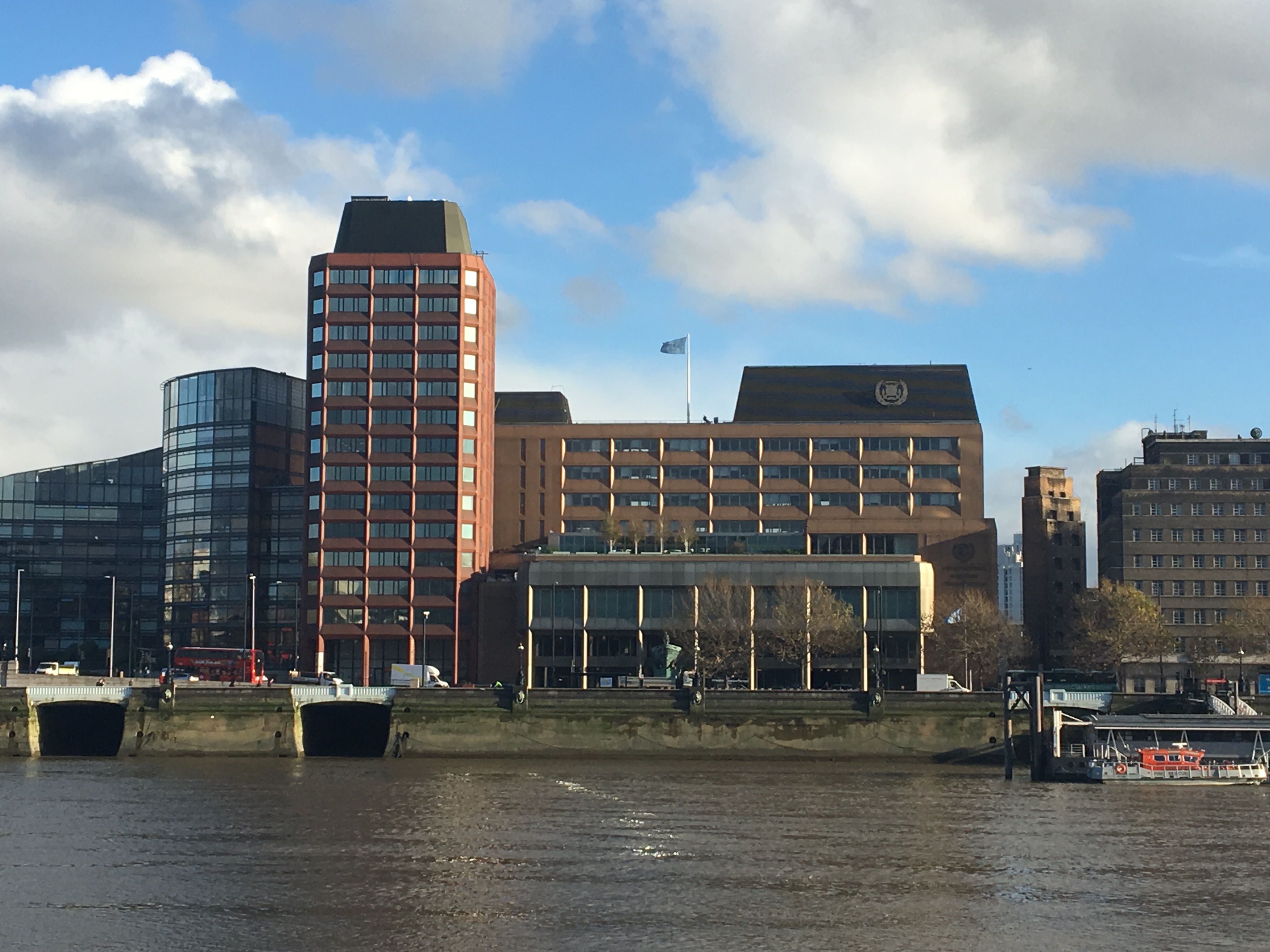
The IMO headquarters is a large purpose-built building facing the River Thames on the Albert Embankment, in Lambeth, London. The organization moved into its new headquarters in late 1982, with the building being officially opened by Queen Elizabeth II on 17 May 1983. The front of the building is dominated by a seven-metre high, ten-tonne bronze sculpture of the bow of a ship, with a lone seafarer maintaining a look-out.
Structure
The IMO consists of an Assembly, a Council and five main Committees. The organization is led by a Secretary-General. A number of Sub-Committees support the work of the main technical committees.
Governance of IMO


The governing body of the International Maritime Organization is the Assembly which meets every two years. In between Assembly sessions a Council, consisting of 40 Member States elected by the Assembly, acts as the governing body. The technical work of the International Maritime Organization is carried out by a series of Committees. The Secretariat consists of some 300 international civil servants headed by a Secretary-General.
The Secretary-General Arsenio Dominguez took office for a four year term on 1 January 2024, having been elected in July 2023. The previous Secretary-General was Kitack Lim from South Korea elected for a four-year term at the 114th session of the IMO Council in June 2015 and at the 29th session of the IMO's Assembly in November 2015. His mandate started on 1 January 2016. At the 31st session of the Assembly in 2019 he was re-appointed for a second term, ending on 31 December 2023.
| Name | Country | Term | |
|---|---|---|---|
| Ove Nielsen | DEN Denmark | 1959–1961† | |
| William Graham | UK United Kingdom | 1961–1963 | |
| Jean Roullier | FRA France | 1964-1967 | |
| Colin Goad | UK United Kingdom | 1968-1973 | |
| Chandrika Prasad Srivastava | IND India | 1974-1989 | |
| William A. O'Neil | CAN Canada | 1990-2003 | |
| Efthymios Mitropoulos | GRE Greece | 2004-2011 | |
| Koji Sekimizu | JPN Japan | 2012-2015 | |
| Kitack Lim | KOR South Korea | 2016–2023 | |
| Arsenio Dominguez | PAN Panama | 2024–present |
Technical committees

The technical work of the International Maritime Organization is carried out by five principal Committees:
- The Maritime Safety Committee (MSC)
- The Marine Environment Protection Committee (MEPC)
- The Legal Committee
- The Technical Cooperation Committee, for capacity building
- The Facilitation Committee, to simplify the documentation and formalities required in international shipping. The Committees meet once or twice a year attended by Member States and NGOs.
Maritime Safety Committee
It is regulated in the Article 28(a) of the Convention on the IMO:
(a) The Maritime Safety Committee shall consider any matter within the scope of the Organization concerned with aids to navigation, construction and equipment of vessels, manning from a safety standpoint, rules for the prevention of collisions, handling of dangerous cargoes, maritime safety procedures and requirements, hydrographic information, log-books and navigational records, marine casualty investigation, salvage and rescue, and any other matters directly affecting maritime safety.
(b) The Maritime Safety Committee shall provide machinery for performing any duties assigned to it by this Convention, the Assembly or the Council, or any duty within the scope of this Article which may be assigned to it by or under any other international instrument and accepted by the Organization.
(c) Having regard to the provisions of Article 25, the Maritime Safety Committee, upon request by the Assembly or the Council or, if it deems such action useful in the interests of its own work, shall maintain such close relationship with other bodies as may further the purposes of the Organization}}

The Maritime Safety Committee is the most senior of these and is the main Technical Committee; it oversees the work of its nine sub-committees and initiates new topics. One broad topic it deals with is the effect of the human element on casualties; this work has been put to all of the sub-committees, but meanwhile, the Maritime Safety Committee has developed a code for the management of ships which will ensure that agreed operational procedures are in place and followed by the ship and shore-side staff.
Sub-committees
The MSC and MEPC are assisted in their work by a number of sub-committees which are open to all Member States. The committees are:
- Sub-Committee on Human Element, Training and Watchkeeping (HTW)
- Sub-Committee on Implementation of IMO Instruments (III)
- Sub-Committee on Navigation, Communications and Search and Rescue (NCSR)
- Sub-Committee on Pollution Prevention and Response (PPR)
- Sub-Committee on Ship Design and Construction (SDC)
- Sub-Committee on Ship Systems and Equipment (SSE)
- Sub-Committee on Carriage of Cargoes and Containers (CCC).
The names of the IMO sub-committees were changed in 2013. Prior to 2013 there were nine Sub-Committees as follows:
- Bulk Liquids and Gases (BLG)
- Carriage of Dangerous Goods, Solid Cargoes and Containers(DSC)
- Fire Protection (FP)
- Radio-communications and Search and Rescue (COMSAR)
- Safety of Navigation (NAV)
- Ship Design and Equipment (DE)
- Stability and Load Lines and Fishing Vessels Safety (SLF)
- Standards of Training and Watchkeeping (STW)
- Flag State Implementation (FSI)
Membership
_Headquarters_-_13.jpg)
To join the IMO, a state ratifies a multilateral Convention on the International Maritime Organization. As of 2025, there are 176 member states of the IMO, which includes 175 of the UN member states plus the Cook Islands. The first state to ratify the convention was Canada in October 1948, but it took until March 1958 when Egypt and Japan brought the number of parties to 21, required by the Convention.
These are the current members with the year they joined:
- Albania (1993)
- Algeria (1963)
- Angola (1977)
- Antigua and Barbuda (1986)
- Argentina (1953)
- Armenia (2018)
- Australia (1952)
- Austria (1975)
- Azerbaijan (1995)
- Bahamas (1976)
- Bahrain (1976)
- Bangladesh (1976)
- Barbados (1970)
- Belarus (2016)
- Belgium (1951)
- Belize (1990)
- Benin (1980)
- Bolivia (1987)
- Bosnia and Herzegovina (1993)
- Botswana (2021)
- Brazil (1963)
- Brunei Darussalam (1984)
- Bulgaria (1960)
- Cabo Verde (1976)
- Cambodia (1961)
- Cameroon (1961)
- Canada (1948)
- Chile (1972)
- China (1973)
- Colombia (1974)
- Comoros (2001)
- Congo (1975)
- Cook Islands (2008)
- Costa Rica (1981)
- Côte d'Ivoire (1960)
- Croatia (1960/1992)
- Cuba (1966)
- Cyprus (1973)
- Czechia (1963/1993)
- Democratic People's Republic of Korea (1986)
- Democratic Republic of the Congo (1973)
- Denmark (1959)
- Djibouti (1979)
- Dominica (1979)
- Dominican Republic (1953)
- Ecuador (1956)
- Egypt (1958)
- El Salvador (1981)
- Equatorial Guinea (1972)
- Eritrea (1993)
- Estonia (1992)
- Ethiopia (1975)
- Fiji (1983)
- Finland (1959)
- France (1952)
- Gabon (1976)
- Gambia (1979)
- Georgia (1993)
- Germany (1959)
- Ghana (1959)
- Greece (1958)
- Grenada (1998)
- Guatemala (1983)
- Guinea (1975)
- Guinea-Bissau (1977)
- Guyana (1980)
- Haiti (1953)
- Honduras (1954)
- Hungary (1970)
- Iceland (1960)
- India (1959)
- Indonesia (1961)
- Iran (1958)
- Iraq (1973)
- Ireland (1951)
- Israel (1952)
- Italy (1957)
- Jamaica (1976)
- Japan (1958)
- Jordan (1973)
- Kazakhstan (1994)
- Kenya (1973)
- Kiribati (2003)
- Kuwait (1960)
- Kyrgyzstan (2024)
- Latvia (1993)
- Lebanon (1966)
- Liberia (1959)
- Libya (1970)
- Lithuania (1995)
- Luxembourg (1991)
- Madagascar (1961)
- Malawi (1989)
- Malaysia (1971)
- Maldives (1967)
- Malta (1966)
- Marshall Islands (1998)
- Mauritania (1961)
- Mauritius (1978)
- Mexico (1954)
- Monaco (1989)
- Mongolia (1996)
- Montenegro (1960/2006)
- Morocco (1962)
- Mozambique (1979)
- Myanmar (1951)
- Namibia (1994)
- Nauru (2018)
- Nepal (1979)
- Netherlands (1949)
- New Zealand (1960)
- Nicaragua (1982)
- Nigeria (1962)
- North Macedonia (1960/1993)
- Norway (1958)
- Oman (1974)
- Pakistan (1958)
- Palau (2011)
- Panama (1958)
- Papua New Guinea (1976)
- Paraguay (1993)
- Peru (1968)
- Philippines (1964)
- Poland (1960)
- Portugal (1976)
- Qatar (1977)
- Republic of Korea (1962)
- Republic of Moldova (2001)
- Romania (1965)
- Russian Federation (1958)
- Saint Kitts and Nevis (2001)
- Saint Lucia (1980)
- Saint Vincent and the Grenadines (1981)
- Samoa (1996)
- San Marino (2002)
- São Tomé and Príncipe (1990)
- Saudi Arabia (1969)
- Senegal (1960)
- Serbia (1960/2000)
- Seychelles (1978)
- Sierra Leone (1973)
- Singapore (1966)
- Slovakia (1963/1993)
- Slovenia (1993)
- Solomon Islands (1988)
- Somalia (1978)
- South Africa (1995)
- Spain (1962)
- Sri Lanka (1972)
- Sudan (1974)
- Suriname (1976)
- Sweden (1959)
- Switzerland (1955)
- Syria (1963)
- Tanzania (1974)
- Thailand (1973)
- Timor-Leste (2005)
- Togo (1983)
- Tonga (2000)
- Trinidad and Tobago (1965)
- Tunisia (1963)
- Turkey (1958)
- Turkmenistan (1993)
- Tuvalu (2004)
- Uganda (2009)
- Ukraine (1994)
- United Arab Emirates (1980)
- United Kingdom (1949)
- United States of America (1950)
- Uruguay (1968)
- Vanuatu (1986)
- Venezuela (1975)
- Viet Nam (1984)
- Yemen (1979)
- Zambia (2014)
- Zimbabwe (2005)
The three associate members are the Faroe Islands (2002), Hong Kong (1967) and Macau (1990).
In 1961, the territories of Sabah and Sarawak, which had been included through the participation of United Kingdom, became joint associate members; in 1963 they became part of Malaysia.
The most recent new members are Armenia (landlocked, January 2018), Nauru (May 2018), Botswana (landlocked, October 2021) and, on 27 February 2024, landlocked Kyrgyzstan became the 176th Member State of the organization.
Most UN member states that are not members of IMO are landlocked countries. These include Afghanistan, Andorra, Bhutan, Burkina Faso, Burundi, Central African Republic, Chad, Eswatini, Laos, Lesotho, Liechtenstein, Mali, Niger, Rwanda, South Sudan, Tajikistan and Uzbekistan. The Federated States of Micronesia, an island-nation in the Pacific Ocean, is also a non-member. Taiwan, as Republic of China, was a member of the IMCO from 1958 until UN changed its recognition to People's Republic of China in 1971; its later attempts to join IMO were blocked, although it has a major shipping industry.
Legal instruments
IMO is the source of approximately 60 legal instruments that guide the regulatory development of its member states to improve safety at sea, facilitate trade among seafaring states and protect the maritime environment. The most well known is the International Convention for the Safety of Life at Sea (SOLAS), as well as International Convention for the Prevention of Pollution from Ships (MARPOL). Others include the International Oil Pollution Compensation Funds (IOPC). It also functions as a depository of yet to be ratified treaties, such as the International Convention on Liability and Compensation for Damage in Connection with the Carriage of Hazardous and Noxious Substances by Sea, 1996 (HNS Convention) and Nairobi International Convention of Removal of Wrecks (2007).
IMO regularly enacts regulations, which are broadly enforced by national and local maritime authorities in member countries, such as the International Regulations for Preventing Collisions at Sea (COLREG). The IMO has also enacted a Port state control (PSC) authority, allowing domestic maritime authorities such as coast guards to inspect foreign-flag ships calling at ports of the many port states. Memoranda of Understanding (protocols) were signed by some countries unifying Port State Control procedures among the signatories.
Conventions, Codes and Regulations:
- MARPOL Convention
- Marpol Annex I
- SOLAS Convention
- IMDG Code
- ISM Code
- ISPS Code
- Polar Code
- IGF Code
- IGC Code
- IBC Code
- TDC Code
- International Code on Intact Stability
- INF Code
- International Grain Code
- IMSBC Code
- STCW Convention
- International Code of Signalsmandatory for carriage on ships and used for communications between all ships, including merchant vessels and naval vessels
- International Ballast Water Management Convention (BWM Convention)
- International Convention on Civil Liability for Oil Pollution Damage (CLC Convention)
- International Convention on Maritime Search and Rescue (SAR Convention)
- International Convention on Oil Pollution Preparedness, Response and Co-operation (OPRC)
- HNS Convention
- International Regulations for Preventing Collisions at Sea (COLREG)
- International Convention on Load Lines (CLL)
- International Convention on the Establishment of an International Fund for Compensation for Oil Pollution Damage (FUND92)
- Convention for the Suppression of Unlawful Acts against the Safety of Maritime Navigation (SUA Convention)
- International Convention on the Control of Harmful Anti-fouling Systems on Ships (AFS Convention)
- Athens Convention (PAL)
- Nairobi International Convention on the Removal of Wrecks
- Convention on Facilitation of International Maritime Traffic
- The Casualty Investigation Codeenacted through Resolution MSC.255(84), of 16 May 2008. The full title is Code of the International Standards and Recommended Practices for a Safety Investigation into a maritime casualty or incident.
Current priorities
Recent initiatives at the IMO have included amendments to SOLAS, which among other things, included upgraded fire protection standards on passenger ships, the International Convention on Standards of Training, Certification and Watchkeeping for Seamen (STCW) which establishes basic requirements on training, certification and watchkeeping for seafarers and to the Convention on the Prevention of Maritime Pollution (MARPOL 73/78), which required double hulls on all tankers.
Environmental issues
GHG emissions
The IMO has a role in tackling international climate change. The First Intersessional Meeting of IMO's Working Group on Greenhouse Gas Emissions from Ships took place in Oslo, Norway (June 2008), tasked with developing the technical basis for the reduction mechanisms that may form part of a future IMO regime to control greenhouse gas emissions from international shipping, and a draft of the actual reduction mechanisms themselves, for further consideration by IMO's Marine Environment Protection Committee (MEPC). The IMO participated in the 2015 United Nations Climate Change Conference in Paris seeking to establish itself as the "appropriate international body to address greenhouse gas emissions from ships engaged in international trade". Nonetheless, there has been widespread criticism of the IMO's relative inaction since the conclusion of the Paris conference, with the initial data-gathering step of a three-stage process to reduce maritime greenhouse emissions expected to last until 2020. In 2018, the Initial IMO Strategy on the reduction of GHG emissions from ships was adopted.
In April 2025, the IMO's Marine Environment Protection Committee (MEPC) approved net-zero regulations for the global shipping industry to reach net-zero GHG emissions in the shipping industry by or around 2050. The changes would require that from 2028, shipowners would be required to use cleaner fuels or face a carbon pricing mechanism. However, in October 2025, at a 2nd extraordinary session, adoption of the amendments to MARPOL Annex VI to bring the regulations into force were delayed to a future session.
Ballast water management
The IMO has also taken action to mitigate the global effects of ballast water and sediment discharge, through the 2004 Ballast Water Management Convention, which entered into force in September 2017.
Biofouling
In April 2025, at the IMO MEPC 83 meeting, the IMO agreed to develop a legally binding framework for controlling and managing ships’ biofouling to reduce the accumulation of marine organisms on the hulls of ships and thereby reduce the transfer of invasive aquatic species. Controlling ship's biofouling also improves the environmental efficiency of ships by reducing drag resistance.
Maritime safety
_Maritime_Safety_Committee_(MSC_108)_on_15_May_2024_-_4.jpg)
The IMO's e-Navigation system has harmonized marine navigation systems with supporting shore services, as available to seamen and shore-side traffic services called. An e-Navigation strategy was ratified in 2005, and an implementation plan was developed through three IMO sub-committees. The plan was completed by 2014 and implemented in November of that year.
On 1 January 2011, ECDIS (Electronic Chart Display Information Systems) were made mandatory for new ships and for existing ships subject to a phased update process which was completed on 1 July 2018.
In December 2023, the IMO adopted a resolution targeting "Shadow fleet" ("dark fleet") tankers that form a risk by undertaking illegal and unsafe activities at sea. Primarily working for Iran and Russia to breach international sanctions, the tankers, many of which are elderly and unreliable, often undertake mid ocean transfers in an attempt to evade sanctions. The resolution calls upon flag states to "adhere to measures which lawfully prohibit or regulate" the transfer of cargoes at sea, known as ship-to-ship transfers.
In June 2025, the IMO adopted amendments to SOLAS Regulation V/23 on improving pilot ladder safety, including associated new Performance Standards for pilot transfer arrangements (to take effect 1 January 2028).
Fishing safety
The IMO Cape Town Agreement is an international International Maritime Organization legal instrument established in 2012, that sets out minimum safety requirements for fishing vessels of 24 metres in length and over or equivalent in gross tons. As of 2022, the Agreement is not yet in force but the IMO is encouraging more member States to ratify the Agreement.
References
- "Introduction to IMO". International Maritime Organization.
- (2017). "Understanding UK Shipping". [[Witherby Publishing Group]].
- Hoffman, Michael L.. (4 March 1948). "Ship Organization Nears Final Form; U.N. Maritime Body Expected to Have 3 Principal Organs – Panama in Opposition". [[The New York Times]].
- (14 May 2023). "History of IMO".
- "Convention on the International Maritime Organization".
- (7 January 1959). "World Shipping Nations Set Up Consultative Body In London". The Times.
- Arora, Sumit. (2023-09-27). "World Maritime Day 2023: Date, Theme, History and Significance".
- (March 2012). "MARPOL73-78: Brief history – list of amendments to date and where to find them". IMO.
- (2025-12-09). "Status of IMO Treaties". IMO.
- One [[nautical mile]] is approximately one [[minute of arc]] of [[latitude]] along any [[meridian arc]], and defined since 1929 as precisely 1852 meters (about 1.151 [[statute miles]]).
- (2017-01-01). "International Code for Ships Operating in Polar Waters (Polar Code)".
- (2025-12-04). "WhatsNewNews".
- "IMO History: 30 years". International Maritime Organization.
- "IMO Building History". International Maritime Organization.
- "IMO History in Pictures". International Maritime Organization.
- (1 January 2012). "Structure". IMO.
- (28 July 2007). "The International Maritime Organization". Marine.gov.uk.
- "Mr Arsenio Dominguez (Panama) elected as IMO Secretary-General". International Maritime Organization.
- [http://www.imo.org/MediaCentre/SecretaryGeneral/Pages/Default.aspx Personal Page of the Secretary-General] {{Webarchive. link. (19 May 2015 , accessed: 9 July 2020)
- [http://www.imo.org/MediaCentre/PressBriefings/Pages/Positional-changes-at-IMO-Secretariat.aspx Press-Briefing "Positional changes at IMO Secretariat"] {{Webarchive. link. (12 May 2015 , accessed: 30 January 2012)
- acting, following Nielsen's death
- (2021). "Regulatory Primer for Mates & Masters: Questions and Answers Covering Current and New Regulations". [[Witherby Publishing Group]].
- "Structure of IMO". International Maritime Organization.
- "Membership". International Maritime Organization.
- "United Kingdom of Great Britain and Northern Ireland and Federation of Malaya, North Boreno, Sarawak and Singapore Agreement relating to Malaysia (with annexes including the Constitutions of the States of Sabah, Sarawak and Singapore, the Malaysia Immigration Bill and the Agreement the Governments of the Federation of Malaya and Singapore on common market and financial arrangements). Signed at London on 9 July 1963".
- (13 November 1961). "Convention on the Inter-Governmental Maritime Consultative Organization Done at Geneva on 6 March 1948". United Nations.
- "Member States". International Maritime Organization.
- "WhatsnewNews". International Maritime Organization.
- "IMO Welcomes 175th Member States". Hellenic Shipping News.
- "IMO welcomes 176th Member State". International Maritime Organization.
- "UNTC".
- "About us". International Oil Compensation Funds.
- "Nairobi International Convention on Removal of Wrecks".
- (2015). "21st Century Seamanship". [[Witherby Publishing Group]].
- (2015). "21st Century Seamanship". [[Witherby Publishing Group]].
- (2015). "21st Century Seamanship". [[Witherby Publishing Group]].
- (2015). "21st Century Seamanship". [[Witherby Publishing Group]].
- (2015). "21st Century Seamanship". [[Witherby Publishing Group]].
- (2021). "Regulatory Primer for Mates & Masters: Questions and Answers Covering Current and New Regulations". [[Witherby Publishing Group]].
- (2015). "21st Century Seamanship". [[Witherby Publishing Group]].
- (2015). "21st century seamanship". [[Witherby Publishing Group]].
- (2015). "21st Century Seamanship". [[Witherby Publishing Group]].
- Roach, J. Ashley. (2012-06-22). "Excessive Maritime Claims". Martinus Nijhoff Publishers.
- (2021). "Regulatory Primer for Mates & Masters: Questions and Answers Covering Current and New Regulations". [[Witherby Publishing Group]].
- (2015). "21st Century Seamanship". [[Witherby Publishing Group]].
- (2015). "21st Century Seamanship". [[Witherby Publishing Group]].
- (2021). "Regulatory Primer for Mates & Masters: Questions and Answers Covering Current and New Regulations". [[Witherby Publishing Group]].
- (2015). "21st Century Seamanship". [[Witherby Publishing Group]].
- (2015). "21st Century Seamanship". [[Witherby Publishing Group]].
- (2015). "21st Century Seamanship". [[Witherby Publishing Group]].
- (2015). "21st Century Seamanship". [[Witherby Publishing Group]].
- (2021). "Regulatory Primer for Mates & Masters: Questions and Answers Covering Current and New Regulations". [[Witherby Publishing Group]].
- "RESOLUTION MSC.255(84)".
- (April 2017)
- (2015). "IMO at COP21 statement". IMO.
- "Offshore Carbon: Why a Climate Deal for Shipping is Sinking (Climate Home)".
- (25 December 2020). "Research Handbook on Climate Change, Oceans and Coasts". Edward Elgar Publishing.
- (2025-04-07). "Here's what to know about nations considering the 1st global tax on emissions for shipping".
- Stallard, Esme. (2025-04-11). "Global breakthrough agreement to tackle shipping emissions".
- Stallard, Esme. (2025-10-17). "Landmark global shipping deal abandoned under US threats".
- (2025-10-17). "IMO decides to postpone adoption of Net-Zero Framework".
- Atack, Patrick Rhys. (2025-10-20). "Industry reaction as IMO's Net Zero Framework adoption pushed back another year".
- "Ballast water management - the control of harmful invasive species". International Maritime Organization.
- (2025-04-16). "Improve environmental performance with a ship-specific biofouling management plan".
- (16 May 2013). "[Navigation Strategy]".
- (2011-01-01). "Electronic Nautical Charts (ENC) and Electronic Chart Display and Information Systems (ECDIS)".
- (2011-01-26). "New Electronic Navigation Charts and ECDIS Systems Requirements".
- Bockmann, Michelle Wiese. (6 December 2023). "IMO assembly adopts 'dark fleet' resolution to tackle 'illegal operations'".
- (2025-09-08). "UK Club: Overview of upcoming standards on pilot transfers".
- "2012 Cape Town Agreement to enhance fishing safety". International Maritime Organization.
This article was imported from Wikipedia and is available under the Creative Commons Attribution-ShareAlike 4.0 License. Content has been adapted to SurfDoc format. Original contributors can be found on the article history page.
Ask Mako anything about International Maritime Organization — get instant answers, deeper analysis, and related topics.
Research with MakoFree with your Surf account
Create a free account to save articles, ask Mako questions, and organize your research.
Sign up freeThis content may have been generated or modified by AI. CloudSurf Software LLC is not responsible for the accuracy, completeness, or reliability of AI-generated content. Always verify important information from primary sources.
Report