From Surf Wiki (app.surf) — the open knowledge base
International Criminal Court
Intergovernmental organisation and tribunal

Intergovernmental organisation and tribunal
| Field | Value | ||
|---|---|---|---|
| conventional_long_name | International Criminal Court | ||
| name | {{collapsible list | ||
| titlestyle | background:transparent;text-align:center;line-height:normal;font-size:84%; | ||
| title | *(in other official languages)* | ||
| {{Infobox | subbox | yes | bodystyle=font-size:77%;font-weight:normal; |
| rowclass1 | mergedrow | label1=French: | data1=Cour pénale internationale |
| rowclass2 | mergedrow | label2=Arabic: | data2=المحكمة الجنائية الدولية |
| rowclass3 | mergedrow | label3=Chinese: | data3=国际刑事法院 |
| rowclass4 | mergedrow | label4=Russian: | data4=Международный уголовный суд |
| rowclass5 | mergedrow | label5=Spanish: | data5=Corte Penal Internacional |
| symbol_type | Official logo | ||
| image_symbol | International Criminal Court logo.svgclass=skin-invert | ||
| symbol_width | 100px | ||
| image_map | International Criminal Court – State Parties.svg | ||
| image_map_size | 320px | ||
| map_caption | |||
| membership_type | Member states | ||
| membership | 125 (Oct 2024) | ||
| admin_center_type | Seat | ||
| admin_center | The Hague, Netherlands | ||
| languages_type | Working languages | ||
| languages | |||
| languages2_type | Official languages | ||
| languages2 | |||
| leader_title1 | President | ||
| leader_name1 | Tomoko Akane | ||
| leader_title2 | First Vice-President | ||
| leader_name2 | Rosario Salvatore Aitala | ||
| leader_title3 | Second Vice-President | ||
| leader_name3 | Reine Alapini-Gansou | ||
| leader_title4 | Prosecutor | ||
| leader_name4 | Karim Ahmad Khan | ||
| leader_title5 | Registrar | ||
| leader_name5 | Osvaldo Zavala Giler | ||
| established_event1 | Rome Statute adopted | ||
| established_date1 | 17 July 1998 | ||
| established_event2 | Entered into force | ||
| established_date2 | 1 July 2002 | ||
| official_website | [www.icc-cpi.int](https://www.icc-cpi.int/) |
| {{Infobox |subbox=yes |bodystyle=font-size:77%;font-weight:normal;
The International Criminal Court (ICC) is an intergovernmental organisation and international tribunal seated in The Hague, Netherlands. Established in 2002 under the multilateral Rome Statute, the ICC is the first and only permanent international court with jurisdiction to prosecute individuals for the international crimes of genocide, crimes against humanity, war crimes, and the crime of aggression. The ICC is intended to complement, not replace, national judicial systems; it can exercise its jurisdiction only when national courts are unwilling or unable to prosecute criminals. It is distinct from the International Court of Justice, an organ of the United Nations that hears disputes between states.
The ICC can generally exercise jurisdiction in cases where the accused is a national of a state party, the alleged crime took place on the territory of a state party, or a situation is referred to the Court by the United Nations Security Council. As of October 2024, there are 125 states parties to the Rome Statute, which are represented in the court's governing body, the Assembly of States Parties. Countries that are not party to the Rome Statute and do not recognise the court's jurisdiction include China, India, Russia, and the United States.
The Office of the Prosecutor has opened investigations into over a dozen situations and conducted numerous preliminary examinations. The Court issued its first arrest warrants in 2005, and issued its first judgment in 2012. Indicted individuals have included heads of state and other senior officials. In recent years, notable cases include arrest warrants issued for Russian president Vladimir Putin, in connection with the invasion of Ukraine and Israeli prime minister Benjamin Netanyahu and defence minister Yoav Gallant, along with several Hamas leaders, in connection with the Gaza war.
Since its establishment, the ICC has faced significant criticism. Opponents, including major powers that have not joined the court, question its legitimacy, citing concerns over national sovereignty and alleging susceptibility to political influence. The court has also been accused of bias and of disproportionately targeting African leaders. Others have questioned the court's effectiveness, pointing to its reliance on state cooperation for arrests, its relatively small number of convictions, and the high cost of its proceedings.
History
Background
The establishment of an international tribunal to judge political leaders accused of international crimes was first proposed during the Paris Peace Conference in 1919 following the First World War by the Commission of Responsibilities. The issue was addressed again at a conference held in Geneva under the auspices of the League of Nations in 1937, which resulted in the conclusion of the first convention stipulating the establishment of a permanent international court to try acts of international terrorism. The convention was signed by 13 states, but none ratified it, so the convention never entered into force.
Following the Second World War, the allied powers established two ad hoc tribunals to prosecute Axis leaders accused of war crimes. The International Military Tribunal, which sat in Nuremberg and is often referred to as the "Nuremberg Trials", prosecuted German leaders, including for Nazi perpetration of The Holocaust, while the International Military Tribunal for the Far East in Tokyo prosecuted Japanese leaders for war crimes and crimes against humanity. In 1948 the United Nations General Assembly first recognised the need for a permanent international court to deal with atrocities of the kind prosecuted after World War II. At the request of the General Assembly, the International Law Commission (ILC) drafted two statutes by the early 1950s, but these were shelved during the Cold War, which made the establishment of an international criminal court politically unrealistic.
Benjamin B. Ferencz, an investigator of Nazi war crimes after World War II and the Chief Prosecutor for the United States Army at the Einsatzgruppen trial, became a vocal advocate of the establishment of international rule of law and of an international criminal court. In his book Defining International Aggression: The Search for World Peace (1975), he advocated for the establishment of such a court. Another leading proponent was Robert Kurt Woetzel, a German-born professor of international law, who co-edited Toward a Feasible International Criminal Court in 1970 and created the Foundation for the Establishment of an International Criminal Court in 1971.
Formal proposal and establishment
In June 1989, A. N. R. Robinson, who would later become Prime Minister of Trinidad and Tobago, revived the idea of a permanent international criminal court by proposing the creation of a tribunal to address the illegal drug trade. In response, the General Assembly tasked the ILC with once again drafting a statute for a permanent court.
While work began on the draft, the UN Security Council established two ad hoc tribunals in the early 1990s: the International Criminal Tribunal for the former Yugoslavia, created in 1993 in response to large-scale atrocities committed by armed forces during the Yugoslav Wars, and the International Criminal Tribunal for Rwanda, created in 1994 following the Rwandan genocide. The creation of these tribunals further highlighted to many the need for a permanent international criminal court.
In 1994, the ILC presented its final draft statute for the International Criminal Court to the General Assembly and recommended that a conference be convened to negotiate a treaty that would serve as the Court's statute. To consider major substantive issues in the draft statute, the General Assembly established the Ad Hoc Committee on the Establishment of an International Criminal Court, which met twice in 1995. After considering the Committee's report, the General Assembly created the Preparatory Committee on the Establishment of the ICC to prepare a consolidated draft text. From 1996 to 1998, six sessions of the Preparatory Committee were held at the United Nations headquarters in New York City, during which NGOs provided input and attended meetings under the umbrella organisation of the Coalition for the International Criminal Court (CICC). In January 1998, the Bureau and coordinators of the Preparatory Committee convened for an inter-sessional meeting in Zutphen in the Netherlands to technically consolidate and restructure the draft articles into a draft.
Finally, the General Assembly convened a conference in Rome in June 1998, with the aim of finalising the treaty to serve as the Court's statute. On 17 July 1998, the Rome Statute of the International Criminal Court was adopted by a vote of 120 to seven, with 21 countries abstaining. The seven countries that voted against the treaty were China, Iraq, Israel, Libya, Qatar, the U.S., and Yemen.
Israel's opposition to the treaty stemmed from the inclusion in the list of war crimes "the action of transferring population into occupied territory", a provision added during the Rome Conference at the insistence of Arab countries with the specific intention of targeting Israeli citizens.[[File:Assembly of States Parties to the Rome statute of the ICC.jpg|left|thumb|355x355px|The third Assembly of States Parties to the Rome Statute of the International Criminal Court is held in The Hague, the Netherlands in the Fall 2004.]]The UN General Assembly voted on 9 December 1999 and again on 12 December 2000 to endorse the ICC. Following 60 ratifications, the Rome Statute entered into force on 1 July 2002 and the International Criminal Court was formally established. The first bench of 18 judges was elected by the Assembly of States Parties in February 2003. They were sworn in at the inaugural session of the Court on 11 March 2003.
The Court issued its first arrest warrants on 8 July 2005, and the first pre-trial hearings were held in 2006.
The Court issued its first judgment in 2012 when it found Congolese rebel leader Thomas Lubanga Dyilo guilty of war crimes related to using child soldiers.
In 2010, the states parties of the Rome Statute held the first Review Conference of the Rome Statute of the International Criminal Court in Kampala, Uganda. The Review Conference led to the adoption of two resolutions that amended the crimes under the jurisdiction of the Court. Resolution 5 amended Article 8 on war crimes, criminalising the use of certain kinds of weapons in non-international conflicts whose use was already forbidden in international conflicts. Resolution 6, pursuant to Article 5(2) of the Statute, provided the definition and a procedure for jurisdiction over the crime of aggression.
Operation
The ICC began operations on 1 July 2002, upon the entry into force of the Rome Statute, a multilateral treaty that serves as the court's charter and governing document. States which become party to the Rome Statute become members of the ICC, serving on the Assembly of States Parties, which administers the court. As of January 2025, there are 125 ICC member states, 29 states have signed but not ratified the Rome Statute (including four who have withdrawn their signature) and 41 states have neither signed nor become parties to the Rome Statute.
Intended to serve as the "court of last resort", the ICC complements existing national judicial systems and may exercise its jurisdiction only when national courts are unwilling or unable to prosecute criminals. It lacks universal territorial jurisdiction and may only investigate and prosecute crimes committed within member states, crimes committed by nationals of member states, or crimes in situations referred to the Court by the UN Security Council.
The ICC held its first hearing in 2006, concerning war crimes charges against Thomas Lubanga Dyilo, a Congolese warlord accused of recruiting child soldiers; his subsequent conviction in 2012 was the first in the court's history. The Office of the Prosecutor has opened twelve official investigations and is conducting an additional nine preliminary examinations.
Establishing the court's jurisdiction
The process to establish the court's jurisdiction may be "triggered" by any one of three possible sources: (1) a state party, (2) the Security Council or (3) a prosecutor. It is then up to the prosecutor acting proprio motu to initiate an investigation under the requirements of Article 15 of the Rome Statute. The procedure is slightly different when referred by a state party or the Security Council, in which cases the prosecutor does not need authorisation of the Pre-Trial Chamber to initiate the investigation. Where there is a reasonable basis to proceed, it is mandatory for the prosecutor to initiate an investigation. The factors listed in Article 53 considered for reasonable basis include whether the case would be admissible, and whether there are substantial reasons to believe that an investigation would not serve the interests of justice (the latter stipulates balancing against the gravity of the crime and the interests of the victims).
Structure
The ICC is governed by the Assembly of States Parties, which is made up of the states that are party to the Rome Statute. The Assembly elects officials of the Court, approves its budget, and adopts amendments to the Rome Statute. The Court itself has four organs: the Presidency, the Judicial Divisions, the Office of the Prosecutor, and the Registry.
State parties
Main article: States parties to the Rome Statute
Assembly
The Court's management oversight and legislative body, the Assembly of States Parties, consists of one representative from each state party. Each state party has one vote and "every effort" has to be made to reach decisions by consensus. If consensus cannot be reached, decisions are made by vote. The Assembly is presided over by a president and two vice-presidents, who are elected by the members to three-year terms.
The Assembly meets in full session once a year, alternating between New York and The Hague, and may also hold special sessions where circumstances require. Sessions are open to observer states and non-governmental organisations.
The Assembly elects the judges and prosecutors, decides the Court's budget, adopts important texts (such as the Rules of Procedure and Evidence), and provides management oversight to the other organs of the Court. Article 46 of the Rome Statute allows the Assembly to remove from office a judge or prosecutor who "is found to have committed serious misconduct or a serious breach of his or her duties" or "is unable to exercise the functions required by this Statute".
The states parties cannot interfere with the judicial functions of the Court. Disputes concerning individual cases are settled by the Judicial Divisions.
Organs
The ICC has four principal organs: the Presidency, the Judicial Divisions, the Office of the Prosecutor and the Registry.
- The President is the most senior judge chosen by the eighteen judges in the Judicial Division.
- The Judicial Division is composed of eighteen judges and hears cases before the Court.
- The Office of the Prosecutor is headed by the Prosecutor, who investigates crimes and initiates criminal proceedings before the Judicial Division.
- The Registry is headed by the Registrar and is charged with managing all the administrative functions of the ICC, including the headquarters, detention unit, and public defence office.
The ICC employs over 900 personnel from roughly 100 countries and conducts proceedings in English and French.
Presidency
Main article: Presidency of the International Criminal Court
The Presidency is responsible for the proper administration of the Court (apart from the Office of the Prosecutor). It comprises the President and the First and Second Vice-Presidents—three judges of the Court who are elected to the Presidency by their fellow judges for a maximum of two three-year terms.
Song Sang-hyun was the President of the ICC from 2009 to 2015. As of March 2024, the President is Tomoko Akane from Japan, who took office on 11 March 2024, succeeding Piotr Hofmański. Her first term will expire in 2027.
Judicial Division
Main article: Judges of the International Criminal Court
The Judicial Divisions consist of the 18 judges of the Court, organised into three chambers—the Pre-Trial Chamber, Trial Chamber and Appeals Chamber — which carry out the judicial functions of the Court. Judges are elected to the Court by the Assembly of States Parties. They serve nine-year terms and are not generally eligible for re-election. All judges must be nationals of states parties to the Rome Statute, and no two judges may be nationals of the same state. They must be "persons of high moral character, impartiality and integrity who possess the qualifications required in their respective States for appointment to the highest judicial offices".
The Prosecutor or any person being investigated or prosecuted may request the disqualification of a judge from "any case in which his or her impartiality might reasonably be doubted on any ground". Any request for the disqualification of a judge from a particular case is decided by an absolute majority of the other judges. Judges may be removed from office if "found to have committed serious misconduct or a serious breach of his or her duties" or is unable to exercise his or her functions. The removal of a judge requires both a two-thirds majority of the other judges and a two-thirds majority of the states parties.
Office of the Prosecutor
Main article: Prosecutor of the International Criminal Court
The Office of the Prosecutor (OTP) is responsible for conducting investigations and prosecutions. It is headed by the Prosecutor of the International Criminal Court, who is assisted by one or more Deputy Prosecutors. The Rome Statute provides that the Office of the Prosecutor shall act independently; as such, no member of the Office may seek or act on instructions from any external source, such as states, international organisations, non-governmental organisations or individuals.
The Prosecutor may open an investigation under three circumstances:
- when a situation is referred by a state party;
- when a situation is referred by the United Nations Security Council, acting to address a threat to international peace and security; or
- when the Pre-Trial Chamber authorises the prosecutor to open an investigation on the basis of information received from other sources, such as individuals or non-governmental organisations.
Any person being investigated or prosecuted may request the disqualification of a prosecutor from any case "in which their impartiality might reasonably be doubted on any ground". Requests for the disqualification of prosecutors are decided by the Appeals Chamber. A prosecutor may be removed from office by an absolute majority of the states parties through a finding "to have committed serious misconduct or a serious breach of his or her duties" or is unable to exercise his or her functions.
Lead prosecutor Luis Moreno Ocampo of Argentina, in office from 2003 to 2012, was succeeded in the role by Fatou Bensouda of Gambia, who served from 16 June 2012 to 16 June 2021. (She was elected to the nine-year term on 12 December 2011.)
On 12 February 2021, British barrister Karim Khan was selected in a secret ballot against three other candidates to serve as lead prosecutor as of 16 June 2021. As a British barrister, Khan had headed the United Nations' special investigative team when it looked into Islamic State crimes in Iraq. At the ICC, he had been lead defence counsel on cases from Kenya, Sudan and Libya.
Policy papers
The Office of the Prosecutor occasionally publishes policy papers that put forth the considerations given to topics the office focuses on, and often the criteria for case selection. While a policy paper does not give the Court jurisdiction over a new category of crimes, it promises what the Office of Prosecutor will consider when selecting cases in the upcoming term of service. OTP's policy papers are subject to revision.
The following papers have been published since the start of the ICC:
- 1 September 2007: Policy Paper on the Interest of Justice
- 12 April 2010: Policy Paper on Victims' Participation
- 1 November 2013: Policy Paper on Preliminary Examinations
- 20 June 2014: Policy Paper on Sexual and Gender-Based Crimes
- 15 September 2016: Policy paper on case selection and prioritisation
- 15 November 2016: Policy on Children
The paper published in September 2016 announced that the ICC will focus on environmental crimes when selecting cases. The Office will give particular consideration to prosecuting Rome Statute crimes that are committed by means of, or that result in, "inter alia, the destruction of the environment, the illegal exploitation of natural resources or the illegal dispossession of land". This has been interpreted as a major shift in environmental law
Registry
The Registry is responsible for the non-judicial aspects of the administration and servicing of the Court. This includes, among other things, The Registry is headed by the Registrar, who is elected by the judges to a five-year term.
| Registrar | Term | Reference |
|---|---|---|
| Bruno Cathala | 2003–2008 | |
| Silvana Arbia | 2008–2013 | |
| Herman von Hebel | 2013–2018 | |
| Peter Lewis | 2018–2023 | |
| Osvaldo Zavala Giler | 2023–present |
{{Anchor|Subject-matter jurisdiction}}Crimes for which individuals can be prosecuted
The Court's subject-matter jurisdiction means the crimes for which individuals can be prosecuted. Individuals can only be prosecuted for crimes that are listed in the Statute. The primary crimes are listed in article 5 of the Statute and defined in later articles: genocide (defined in article 6), crimes against humanity (defined in article 7), war crimes (defined in article 8), and crimes of aggression (defined in article 8 bis) (since 2018). In addition, article 70 defines offences against the administration of justice, which is a fifth category of crime for which individuals can be prosecuted.
Genocide
Article 6 defines the crime of genocide as "acts committed with intent to destroy, in whole or in part, a national, ethnical, racial or religious group." There are five such acts which constitute crimes of genocide under Article 6:
- Killing members of a group
- Causing serious bodily or mental harm to members of the group
- Deliberately inflicting on the group conditions of life calculated to bring about its physical destruction
- Imposing measures intended to prevent births within the group
- Forcibly transferring children of the group to another group The definition of these crimes is identical to those contained within the Convention on the Prevention and Punishment of the Crime of Genocide of 1948.
Crimes against humanity
Article 7 defines crimes against humanity as acts "committed as part of a widespread or systematic attack directed against any civilian population, with knowledge of the attack". The article lists 16 such individual crimes:
- Murder
- Extermination
- Enslavement
- Deportation or forcible transfer of population
- Imprisonment or other severe deprivation of physical liberty
- Torture
- Rape
- Sexual slavery
- Enforced prostitution
- Forced pregnancy
- Enforced sterilisation
- Sexual violence
- Persecution
- Enforced disappearance of persons
- Apartheid
- Other inhumane acts
War crimes
Article 8 defines war crimes depending on whether an armed conflict is either international (which generally means it is fought between states) or non-international (which generally means that it is fought between non-state actors, such as rebel groups, or between a state and such non-state actors). The most serious crimes constitute either grave breaches of the Geneva Conventions of 1949 and its Protocols. In total there are 74 war crimes listed in article 8.
Eleven crimes constitute grave breaches of the Geneva Conventions and apply only to international armed conflicts:
- Wilful killing
- Torture
- Inhumane treatment
- Biological experiments
- Wilfully causing great suffering
- Destruction and appropriation of property
- Compelling service in hostile forces
- Denying a fair trial
- Unlawful deportation and transfer
- Unlawful confinement
- Taking hostages
Seven crimes constitute serious violations of Article 3 common to the Geneva Conventions and apply only to non-international armed conflicts:
- Murder
- Mutilation
- Cruel treatment
- Torture
- Outrages upon personal dignity
- Taking hostages
- Sentencing or execution without due process
Another 56 crimes are defined by Article 8: 35 apply to international armed conflicts and 21 to non-international armed conflicts. Such crimes include attacking civilians or civilian objects, attacking peacekeepers, causing excessive incidental death or damage, transferring populations into occupied territories, treacherously killing or wounding, denying quarter, pillaging, employing poison, using expanding bullets, rape and other forms of sexual violence, and conscripting or using child soldiers.
Crimes of aggression
Article 8 bis defines crimes of aggression. The Statute originally provided that the Court could not exercise its jurisdiction over the crime of aggression until such time as the states parties agreed on a definition of the crime and set out the conditions under which it could be prosecuted. Such an amendment was adopted at the first review conference of the ICC in Kampala, Uganda, in June 2010. This amendment specified that the ICC would not be allowed to exercise jurisdiction of the crime of aggression until two further conditions had been satisfied: (1) the amendment has entered into force for 30 states parties and (2) on or after 1 January 2017, the Assembly of States Parties has voted in favour of allowing the Court to exercise jurisdiction. On 26 June 2016 the first condition was satisfied and the state parties voted in favour of allowing the Court to exercise jurisdiction on 14 December 2017. The Court's jurisdiction to prosecute crimes of aggression was accordingly activated on 17 July 2018.
The Statute, as amended, defines the crime of aggression as "the planning, preparation, initiation or execution, by a person in a position effectively to exercise control over or to direct the political or military action of a State, of an act of aggression which, by its character, gravity and scale, constitutes a manifest violation of the Charter of the United Nations." The Statute defines an "act of aggression" as "the use of armed force by a State against the sovereignty, territorial integrity or political independence of another State, or in any other manner inconsistent with the Charter of the United Nations." The article also contains a list of seven acts of aggression, which are identical to those in United Nations General Assembly Resolution 3314 of 1974 and include the following acts when committed by one state against another state:
- Invasion or attack by armed forces against territory
- Military occupation of territory
- Annexation of territory
- Bombardment against territory
- Use of any weapons against territory
- Blockade of ports or coasts
- Attack on the land, sea, or air forces or marine and air fleets
- The use of armed forces which are within the territory of another state by agreement, but in contravention of the conditions of the agreement
- Allowing territory to be used by another state to perpetrate an act of aggression against a third state
- Sending armed bands, groups, irregulars, or mercenaries to carry out acts of armed force
Offences against the administration of justice
Article 70 criminalises certain intentional acts which interfere with investigations and proceedings before the Court, including giving false testimony, presenting false evidence, corruptly influencing a witness or official of the Court, retaliating against an official of the Court, and soliciting or accepting bribes as an official of the Court.
{{Anchor|Territorial or personal jurisdiction}}Jurisdiction and admissibility ==
The Rome Statute requires that several criteria exist in a particular case before an individual can be prosecuted by the Court. The Statute contains three jurisdictional requirements and three admissibility requirements. All criteria must be met for a case to proceed. The three jurisdictional requirements are (1) subject-matter jurisdiction (what acts constitute crimes), (2) territorial or personal jurisdiction (where the crimes were committed or who committed them), and (3) temporal jurisdiction (when the crimes were committed).
For an individual to be prosecuted by the Court either territorial jurisdiction or personal jurisdiction must exist. Therefore, an individual can only be prosecuted if he or she has either (1) committed a crime within the territorial jurisdiction of the Court or (2) committed a crime while being a national of a state that is within the territorial jurisdiction of the Court.
Territorial jurisdiction
The territorial jurisdiction of the Court includes the territory, registered vessels, and registered aircraft of states which have either (1) become party to the Rome Statute or (2) accepted the Court's jurisdiction by filing a declaration with the Court.
In situations that are referred to the Court by the United Nations Security Council, the territorial jurisdiction is defined by the Security Council, which may be more expansive than the Court's normal territorial jurisdiction. For example, if the Security Council refers a situation that took place in the territory of a state that has both not become party to the Rome Statute and not lodged a declaration with the Court, the Court will still be able to prosecute crimes that occurred within that state.
Personal jurisdiction
The personal jurisdiction of the Court extends to all natural persons who commit crimes, regardless of where they are located or where the crimes were committed, as long as those individuals are nationals of either (1) states that are party to the Rome Statute or (2) states that have accepted the Court's jurisdiction by filing a declaration with the Court. As with territorial jurisdiction, the personal jurisdiction can be expanded by the Security Council if it refers a situation to the Court.
Temporal jurisdiction requirements
Temporal jurisdiction Temporal jurisdiction is the time period over which the Court can exercise its powers. No statute of limitations applies to any of the crimes defined in the Statute. This is not completely retroactive. Individuals can only be prosecuted for crimes that took place on or after 1 July 2002, which is the date that the Rome Statute entered into force. If a state became party to the Statute, and therefore a member of the Court, after 1 July 2002, then the Court cannot exercise jurisdiction prior to the membership date for certain cases. For example, if the Statute entered into force for a state on 1 January 2003, the Court could only exercise temporal jurisdiction over crimes that took place in that state or were committed by a national of that state on or after 1 January 2003.
{{Anchor|Admissibility}}Admissibility requirements
To initiate an investigation, the Prosecutor must (1) have a "reasonable basis to believe that a crime within the jurisdiction of the Court has been or is being committed", (2) the investigation would be consistent with the principle of complementarity, and (3) the investigation serves the interests of justice.
The principle of complementarity means the Court will only prosecute an individual if states are unwilling or unable to prosecute. Therefore, if legitimate national investigations or proceedings into crimes have taken place or are ongoing, the Court will not initiate proceedings. This principle applies regardless of the outcome of national proceedings. Even if an investigation is closed without any criminal charges being filed or if an accused person is acquitted by a national court, the Court will not prosecute an individual for the crime in question so long as it is satisfied that the national proceedings were legitimate. The application of the complementarity principle has recently come under theoretical scrutiny.
The Court will only initiate proceedings if a crime is of "sufficient gravity to justify further action by the Court".
The Prosecutor will initiate an investigation unless there are "substantial reasons to believe that an investigation would not serve the interests of justice" when "[t]aking into account the gravity of the crime and the interests of victims". Furthermore, even if an investigation has been initiated and there are substantial facts to warrant a prosecution and no other admissibility issues, the Prosecutor must determine whether a prosecution would serve the interests of justice "taking into account all the circumstances, including the gravity of the crime, the interests of victims and the age or infirmity of the alleged perpetrator, and his or her role in the alleged crime".
Individual criminal responsibility
The Court has jurisdiction over natural persons. A person who commits a crime within the jurisdiction of the Court is individually responsible and liable for punishment in accordance with the Rome Statute. In accordance with the Rome Statute, a person shall be criminally responsible and liable for punishment for a crime within the jurisdiction of the Court if that person: Commits such a crime, whether as an individual, jointly with another or through another person, regardless of whether that other person is criminally responsible; Orders, solicits or induces the commission of such a crime which in fact occurs or is attempted; For the purpose of facilitating the commission of such a crime, aids, abets or otherwise assists in its commission or its attempted commission, including providing the means for its commission; In any other way contributes to the commission or attempted commission of such a crime by a group of persons acting with a common purpose. In respect of the crime of genocide, directly and publicly incites others to commit genocide; Attempts to commit such a crime by taking action that commences its execution by means of a substantial step, but the crime does not occur because of circumstances independent of the person's intentions
Procedure
Trial
Trials are conducted under a hybrid common law and civil law judicial system, but it has been argued the procedural orientation and character of the court is still evolving. A majority of the three judges present, as triers of fact in a bench trial, may reach a decision, which must include a full and reasoned statement. Trials are supposed to be public, but proceedings are often closed, and such exceptions to a public trial have not been enumerated in detail. In camera proceedings are allowed for protection of witnesses or defendants as well as for confidential or sensitive evidence. Hearsay and other indirect evidence is not generally prohibited, but it has been argued the court is guided by hearsay exceptions which are prominent in common law systems. There is no subpoena or other means to compel witnesses to come before the court, although the court has some power to compel testimony of those who chose to come before it, such as fines.
Rights of the accused
The Rome Statute provides that all persons are presumed innocent until proven guilty beyond reasonable doubt, and establishes certain rights of the accused and persons during investigations. These include the right to be fully informed of the charges against them; the right to have a lawyer appointed, free of charge; the right to a speedy trial; and the right to examine the witnesses against them.
To ensure "equality of arms" between defence and prosecution teams, the ICC has established an independent Office of Public Counsel for the Defence (OPCD) to provide logistical support, advice and information to defendants and their counsel. The OPCD also helps to safeguard the rights of the accused during the initial stages of an investigation. Thomas Lubanga's defence team said they were given a smaller budget than the Prosecutor and that evidence and witness statements were slow to arrive.
Victim participation
One of the great innovations of the Statute of the International Criminal Court and its Rules of Procedure and Evidence is the series of rights granted to victims. For the first time in the history of international criminal justice, victims have the possibility under the Statute to present their views and observations before the Court.
Participation before the Court may occur at various stages of proceedings and may take different forms, although it will be up to the judges to give directions as to the timing and manner of participation.
Participation in the Court's proceedings will in most cases take place through a legal representative and will be conducted "in a manner which is not prejudicial or inconsistent with the rights of the accused and a fair and impartial trial".
The victim-based provisions within the Rome Statute provide victims with the opportunity to have their voices heard and to obtain, where appropriate, some form of reparation for their suffering. It is the aim of this attempted balance between retributive and restorative justice that, it is hoped, will enable the ICC to not only bring criminals to justice but also help the victims themselves obtain some form of justice. Justice for victims before the ICC comprises both procedural and substantive justice, by allowing them to participate and present their views and interests, so that they can help to shape truth, justice and reparations outcomes of the Court.
Article 43(6) establishes a Victims and Witnesses Unit to provide "protective measures and security arrangements, counselling and other appropriate assistance for witnesses, victims who appear before the Court, and others who are at risk on account of testimony given by such witnesses." Article 68 sets out procedures for the "Protection of the victims and witnesses and their participation in the proceedings." The Court has also established an Office of Public Counsel for Victims, to provide support and assistance to victims and their legal representatives.
Reparations
Victims before the International Criminal Court can also claim reparations under Article 75 of the Rome Statute. Reparations can only be claimed when a defendant is convicted and at the discretion of the Court's judges. So far the Court has ordered reparations against Thomas Lubanga. Reparations can include compensation, restitution and rehabilitation, but other forms of reparations may be appropriate for individual, collective or community victims. Article 79 of the Rome Statute establishes a Trust Fund to provide assistance before a reparation order to victims in a situation or to support reparations to victims and their families if the convicted person has no money.
Cooperation by states not party to Rome Statute
One of the principles of international law is that a treaty does not create either obligations or rights for third states without their consent, and this is also enshrined in the 1969 Vienna Convention on the Law of Treaties. The cooperation of the non-party states with the ICC is envisioned by the Rome Statute of the International Criminal Court to be of a voluntary nature. States not acceded to the Rome Statute might still be subject to an obligation to cooperate with the ICC in certain cases. When a case is referred to the ICC by the UN Security Council all UN member states are obliged to cooperate, since its decisions are binding for all of them. Also, there is an obligation to respect and ensure respect for international humanitarian law, which stems from the Geneva Conventions and Additional Protocol I, which reflects the absolute nature of international humanitarian law.
In relation to cooperation in investigation and evidence gathering, it is implied from the Rome Statute that the consent of a non-party state is a prerequisite for the Prosecutor to conduct an investigation within its territory, and it seems that it is even more necessary for him to observe any reasonable conditions raised by that state, since such restrictions exist for states party to the Statute. Taking into account the experience of the International Criminal Tribunal for the former Yugoslavia (which worked with the principle of primacy, instead of complementarity) in relation to cooperation, some scholars have expressed their pessimism as to the possibility of the ICC obtaining the cooperation of non-party states. As for the actions that the ICC can take toward non-party states that do not cooperate, the Rome Statute stipulates that the Court may inform the Assembly of States Parties or Security Council, when the matter was referred by it, when a non-party state refuses to cooperate after it has entered into an ad hoc arrangement or an agreement with the Court.
Amnesty and national reconciliation processes
It is unclear to what extent the ICC is compatible with reconciliation processes that grant amnesty to human rights abusers as part of agreements to end conflict. Article 16 of the Rome Statute allows the Security Council to prevent the Court from investigating or prosecuting a case, and Article 53 allows the Prosecutor the discretion not to initiate an investigation if he or she believes that "an investigation would not serve the interests of justice". Former ICC president Philippe Kirsch has said that "some limited amnesties may be compatible" with a country's obligations genuinely to investigate or prosecute under the Statute.
It is sometimes argued that amnesties are necessary to allow the peaceful transfer of power from abusive regimes. By denying states the right to offer amnesty to human rights abusers, the International Criminal Court may make it more difficult to negotiate an end to conflict and a transition to democracy. For example, the outstanding arrest warrants for four leaders of the Lord's Resistance Army are regarded by some as an obstacle to ending the insurgency in Uganda. Czech politician Marek Benda argues that "the ICC as a deterrent will in our view only mean the worst dictators will try to retain power at all costs". The United Nations and the International Committee of the Red Cross maintain that granting amnesty to those accused of war crimes and other serious crimes is a violation of international law.
Facilities
Headquarters
The official seat of the Court is in The Hague, Netherlands, but its proceedings may take place anywhere.
The Court moved into its first permanent premises in The Hague, located at Oude Waalsdorperweg 10, on 14 December 2015. Part of The Hague's International Zone, which also contains the Peace Palace, Europol, Eurojust, ICTY, OPCW and The Hague World Forum, the court facilities are situated on the site of the Alexanderkazerne, a former military barracks, adjacent to the dune landscape on the northern edge of the city. The ICC's detention centre is a short distance away.
The land and financing for the construction were provided by the Netherlands.{{cite web |archive-url=https://archive.today/20120802005354/http://www.icc-cpi.int/nr/exeres/c0bf504b-5ca8-4b1a-bb69-15c62a15ef8f.htm |archive-date=2 August 2012 |access-date=19 February 2012
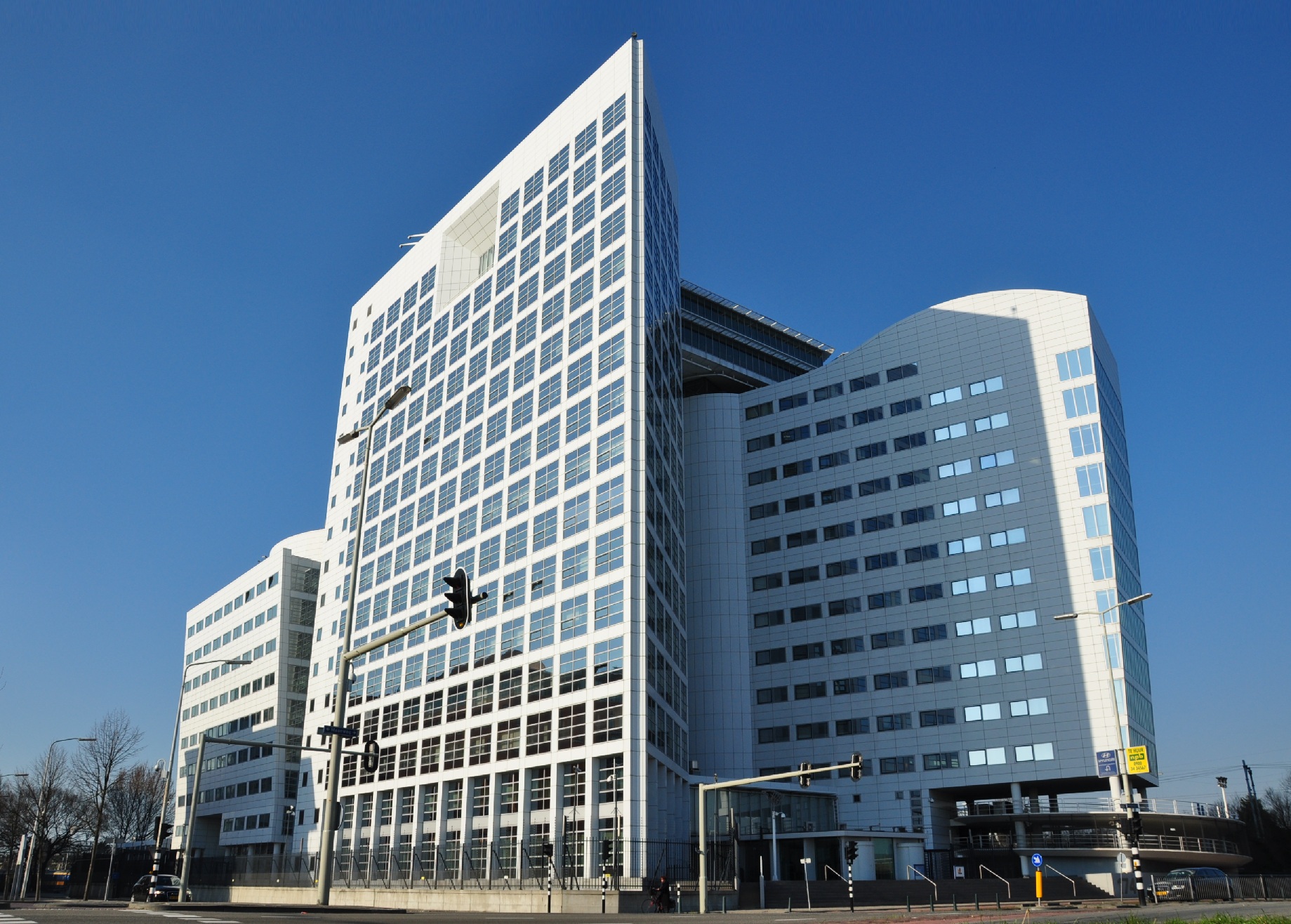
The barracks were demolished from November 2011 to August 2012. In October 2012 the tendering procedure for the general contractor was completed and the combination Visser & Smit Bouw and Boele & van Eesteren ("Courtys") was selected.
The building has a compact footprint and consists of six connected building volumes with a garden motif. The tallest volume with a green façade, placed in the middle of the design, is the Court Tower, which accommodates three courtrooms. The rest of the building's volumes accommodate the offices of the different organs of the ICC.
From 2002 to late 2015, the ICC was housed in interim premises in The Hague provided by the Netherlands. Formerly belonging to KPN, the provisional headquarters were located at Maanweg 174 in the east-central portion of the city.
Detention centre
Main article: People detained by the International Criminal Court#Detention centre
The ICC's detention centre accommodates both those convicted by the court and serving sentences as well as those suspects detained pending the outcome of their trial. It comprises twelve cells on the premises of the Scheveningen branch of the Hague Penitentiary Institution, The Hague, close to the ICC's headquarters in the Alexanderkazerne. Suspects held by the former International Criminal Tribunal for the former Yugoslavia were held in the same prison and shared some facilities, like the fitness room, but had no contact with suspects held by the ICC.
Other offices
The ICC maintains a liaison office in New York and field offices in places where it conducts its activities.
Digital infrastructure
The ICC used Microsoft digital infrastructure, including email, Microsoft Office, file storage and "software for evidence analysis" through to 2025. During 2025, following Trump sanctions against the ICC, the ICC Prosecutor and some other ICC staff switched from Microsoft email to Proton Mail.
In late October 2025, the ICC stated that it would switch from Microsoft Office to OpenDesk, a free and open-source productivity software suite managed by the German (ZenDiS).
Funding
| No. | Country | Contributions (€) | Percent (%) | 1 | 2 | 3 | 4 | 5 | 6 | 7 | 8 | 9 | 10 | Others | Total |
|---|---|---|---|---|---|---|---|---|---|---|---|---|---|---|---|
| Japan | 25,105,436 | 13.4 | |||||||||||||
| Germany | 21,480,416 | 11.5 | |||||||||||||
| France | 15,972,647 | 8.5 | |||||||||||||
| United Kingdom | 15,378,334 | 8.2 | |||||||||||||
| Italy | 11,209,416 | 5.6 | |||||||||||||
| Republic of Korea | 9,278,240 | 5.0 | |||||||||||||
| Canada | 9,237,533 | 4.9 | |||||||||||||
| Spain | 7,501,080 | 4.0 | |||||||||||||
| Brazil | 7,492,611 | 4.0 | |||||||||||||
| Australia | 7,420,157 | 4.0 | |||||||||||||
| 57,008,314 | 30.5 | ||||||||||||||
| 187,084,184 | 100.0 |
The ICC is financed by contributions from the states parties. The amount payable by each state party is determined using the same method as the United Nations:{{cite web |title=Resolution ICC-ASP/6/Res.4 |work=Part III – Resolutions and recommendations adopted by the Assembly of States Parties |format=PDF, 323 KB |publisher=International Criminal Court |date=14 December 2007 |url=http://www.icc-cpi.int/library/asp/ICC-ASP-6-20_Vol.I_Part_III_English.pdf |archive-url= https://web.archive.org/web/20080409070948/http://www.icc-cpi.int/library/asp/ICC-ASP-6-20_Vol.I_Part_III_English.pdf |archive-date=9 April 2008 |access-date=30 October 2011 |quote=Programme budget for 2008, the Working Capital Fund for 2008, scale of assessments for the apportionment of expenses of the International Criminal Court and financing appropriations for the year 2008}} each state's contribution is based on the country's capacity to pay, which reflects factors such as national income and population. The maximum amount a single country can pay in any year is limited to 22% of the Court's budget; Japan paid this amount in 2008.
The Court spent €80.5 million in 2007. The Assembly of States Parties approved a budget of €90.4 million for 2008, €101.2 million for 2009,Programme budget for 2009, the Working Capital Fund for 2009, scale of assessments for the apportionment of expenses of the International Criminal Court, financing appropriations for the year 2009 and the Contingency Fund
and €141.6 million for 2017. , the ICC's staff consisted of 800 persons from approximately 100 states.
Trial history
The Court's Pre-Trial Chambers have
The indicted individuals include Ugandan rebel leader Joseph Kony, former President Omar al-Bashir of Sudan, President Uhuru Kenyatta of Kenya, Libyan head of state Muammar Gaddafi, President Laurent Gbagbo of Ivory Coast and former Vice President Jean-Pierre Bemba of the Democratic Republic of the Congo.
In 2015, several Congolese individuals were tried by the ICC. Thomas Lubanga was convicted and sentenced to 14 years improsonment, Germain Katanga to 12 years, and Mathieu Ngudjolo Chui was acquitted.
The judgment of Jean-Pierre Bemba was rendered in March 2016. Bemba was convicted on two counts of crimes against humanity and three counts of war crimes. This marked the first time the ICC convicted someone of sexual violence as they added rape to his conviction. Bemba's convictions were overturned by the Court's Appeal Chamber in June 2018. The Court refused to compensate Bemba for losses suffered by him during his 10 years of imprisonment. It has been argued that this decision raises important questions about the court's present powers.
Ntaganda (DR Congo) was convicted to 30 years for crimes against humanity. The Bemba et al. OAJ case and the Laurent Gbagbo-Blé Goudé trial in the Côte d'Ivoire situation ended in acquittals. The Banda trial in the situation of Darfur, Sudan, was scheduled to begin in 2014 but the start date was vacated.
Charges against Malian Ahmad al-Faqi al-Mahdi have been confirmed and he was sentenced to nine years in prison. On 25 November 2021, his sentence was commuted to 7 years in prison, and he was released on 18 September 2022. Ugandan Dominic Ongwen has been convicted to a prison sentence of 25 years.
On 6 July 2020, two Uyghur activist groups filed a complaint with the ICC calling for it to investigate PRC officials for crimes against Uyghurs, including allegations of genocide. In December 2020, ICC prosecutors rejected the complaint, stating that the ICC did not have jurisdictional basis to proceed.
On 31 October 2023, the Israeli families of over 34 victims of the 2023 Hamas-led attack on Israel, filed an Article 15 communication with the ICC prosecutor's office urging an investigation into the killings and abductions, and the ICC confirmed the receipt of the filing. Reporters Without Borders also lodged a complaint regarding the deaths of eight Palestinian journalists in the Gaza Strip during Israel's bombardment, as well as an Israeli journalist killed during a surprise attack by Hamas in southern Israel.
On 17 March 2023, ICC judges issued arrest warrants for Russian president Vladimir Putin and the Presidential Commissioner for Children's Rights in Russia Maria Lvova-Belova for child abductions in the 2022 Russian invasion of Ukraine. Russia denounced the arrest warrants as "outrageous". Putin became the first head of state of a U.N. Security Council Permanent Member to be the subject of an ICC arrest warrant. Although Russia withdrew its signature from the Rome Statute in 2016, and is thus not a participant in the ICC nor under its jurisdiction, Putin can be charged for actions against Ukraine, which is not a party but has accepted jurisdiction of the court since 2014. Should Putin travel to a state party, he can be arrested by local authorities. Later in 2023, Russia's Ministry of Internal Affairs retaliated by placing several ICC officials on its wanted list. Later in December 2025, the Moscow City Court sentenced a prosecutor and eight judges of the ICC in absentia to prison terms of up to 15 years each. In March 2024, the ICC issued two more arrest warrants, for Sergey Kobylash, the commander of the Long-Range Aviation of the Russian Aerospace Forces, and Viktor Sokolov, the commander of the Black Sea Fleet over their role in war crimes in Ukraine.
On 20 May 2024, the ICC's chief prosecutor Karim Khan announced his intention to seek arrest warrants for Israeli prime minister Benjamin Netanyahu, Israeli defence minister Yoav Gallant, leader of Hamas Yahya Sinwar, leader of the Al Qassem Brigades Mohammed Deif, and Hamas political leader Ismail Haniyeh in connection to war crimes committed in the Israel-Hamas war. On November 21, warrants were formally issued for Netanyahu, Gallant and Deif. Warrants for Haniyeh and Sinwar were withdrawn following confirmation of their deaths in July and October respectively.
On 23 January 2025, the ICC's chief prosecutor Karim Khan announced requests for arrest warrants against Taliban leader Haibatullah Akhundzada and the chief justice of Afghanistan Abdul Hakim Haqqani, for crimes against humanity of the oppression and persecution of Afghan women and girls, who have been deprived of the freedom of movement, the rights to control their bodies, to education, and to a private and family life. Alleged resistance and opposition are brutally suppressed with murder, imprisonment, torture, rape, and other forms of sexual violence, since 2021. On 8 July 2025, the ICC's Pre-Trial Chamber II issued the requested arrest warrants.
Investigations and preliminary examinations
Main article: International Criminal Court investigations

Green: Official investigations (Uganda, DR Congo, Central African Republic I + II, Darfur (Sudan), Kenya, Libya, Côte d'Ivoire, Mali, Georgia, Burundi, Afghanistan, Palestine, Venezuela I, Bangladesh/Myanmar, Philippines, Ukraine)
Orange: Authorisation to open investigation requested (none at present)
Light red: Ongoing preliminary examinations (Nigeria, Guinea, Venezuela II)
Dark red: Closed preliminary examinations that have not resulted in an investigation (Colombia, Iraq, Honduras, South Korea, Comoros (registered vessels), Gabon, Bolivia)]]
By 2025, the Office of the Prosecutor has
Key:
| Situation | Referred by | Referred on | Preliminary examination on | Investigation on | Current status | Ref(s). |
|---|---|---|---|---|---|---|
| Investigation (phase 1) | ||||||
| — | — | Investigation (phase 1) | ||||
| Uganda | Uganda | Investigation (phase 2) | ||||
| Colombia | — | — | — | Preliminary examination closed on | ||
| Central African Republic I | Central African Republic | Investigation (phase 2) | ||||
| Darfur, Sudan | United Nations Security Council | Investigation (phase 1) | ||||
| Iraq/United Kingdom | — | — | — | Preliminary examination closed on | ||
| Venezuela | — | — | — | Preliminary examination closed on | ||
| Afghanistan | — | — | Investigation (phase 1) | |||
| Kenya | — | — | Investigation (phase 2) | |||
| Georgia | — | — | Investigation (phase 2) | |||
| Palestine | — | — | — | Preliminary examination closed on | ||
| Guinea | — | — | — | Preliminary examination closed on | ||
| Honduras | — | — | — | Preliminary examination closed on | ||
| Nigeria | — | — | — | Preliminary examination (phase 3) | ||
| — | — | — | Preliminary examination closed on | |||
| Libya | United Nations Security Council | Investigation (phase 1) | ||||
| Mali | Mali | Investigation (phase 1) | ||||
| Registered vessels | Comoros | — | Preliminary examination closed on | |||
| Central African Republic II | Central African Republic | Investigation (phase 2) | ||||
| Ukraine | Albania *et al.* | Investigation (phase 1) | ||||
| Palestine | Palestine | Investigation (phase 1) | ||||
| Burundi | — | — | Investigation (phase 1) | |||
| Gabon | Gabon | — | Preliminary examination closed on | |||
| Philippines | — | — | Investigation (phase 1) | |||
| Venezuela I | Argentina *et al.* | Investigation (phase 1) | ||||
| Bangladesh/Myanmar | — | — | Investigation (phase 1) | |||
| Venezuela II | Venezuela | — | Preliminary examination (phase 2) | |||
| Bolivia | Bolivia | — | Preliminary examination closed on | |||
| — | Preliminary examination closed on | |||||
| Lithuania/Belarus | Lithuania | — | Preliminary examination (phase 1) | |||
| **Notes** |
| Total | 73 | 31 | 3 | 1 | 3 | 9 | 2 | 14 | 11 |
|---|
Notes
| El Hishri | Abd-Al-Rahman |
|---|
Relationships
United Nations
Unlike the International Court of Justice, the ICC is legally independent from the United Nations. The Rome Statute grants certain powers to the United Nations Security Council, which limit its functional independence. Article 13 allows the Security Council to refer to the Court situations that would not otherwise fall under the Court's jurisdiction (as it did in relation to the situations in Darfur and Libya, which the Court could not otherwise have prosecuted as neither Sudan nor Libya are state parties). Article 16 allows the Security Council to require the Court to defer from investigating a case for a period of twelve months. Such a deferral may be renewed indefinitely by the Security Council. This sort of an arrangement gives the ICC some of the advantages inhering in the organs of the United Nations such as using the enforcement powers of the Security Council, but it also creates a risk of being tainted with the political controversies of the Security Council.
The Court cooperates with the UN in many different areas, including the exchange of information and logistical support. The Court reports to the UN each year on its activities, and some meetings of the Assembly of States Parties are held at UN facilities. The relationship between the Court and the UN is governed by a "Relationship Agreement between the International Criminal Court and the United Nations".
Nongovernmental organisations
During the 1970s and 1980s, international human rights and humanitarian Nongovernmental Organisations (or NGOs) began to proliferate at exponential rates. Concurrently, the quest to find a way to punish international crimes shifted from being the exclusive responsibility of legal experts to being shared with international human rights activism.
NGOs helped birth the ICC through advocacy and championing for the prosecution of perpetrators of crimes against humanity. NGOs closely monitor the organisation's declarations and actions, ensuring that the work that is being executed on behalf of the ICC is fulfilling its objectives and responsibilities to civil society. According to Benjamin Schiff, "From the Statute Conference onward, the relationship between the ICC and the NGOs has probably been closer, more consistent, and more vital to the Court than have analogous relations between NGOs and any other international organisation."
There are a number of NGOs working on a variety of issues related to the ICC. The NGO Coalition for the International Criminal Court has served as a sort of umbrella for NGOs to coordinate with each other on similar objectives related to the ICC. The CICC has 2,500 member organisations in 150 countries. The original steering committee included representatives from the World Federalist Movement, the International Commission of Jurists, Amnesty International, the Lawyers Committee for Human Rights, Human Rights Watch, Parliamentarians for Global Action, and No Peace Without Justice. Today, many of the NGOs with which the ICC cooperates are members of the CICC. These organisations come from a range of backgrounds, spanning from major international NGOs such as Human Rights Watch and Amnesty International, to smaller, more local organisations focused on peace and justice missions. Many work closely with states, such as the International Criminal Law Network, founded and predominantly funded by the Hague municipality and the Dutch Ministries of Defence and Foreign Affairs. The CICC also claims organisations that are themselves federations, such as the International Federation of Human Rights Leagues (FIDH).
CICC members subscribe to three principles that permit them to work under the umbrella of the CICC, so long as their objectives match them:
- Promoting worldwide ratification and implementation of the Rome Statute of the ICC
- Maintaining the integrity of the Rome Statute of the ICC, and
- Ensuring the ICC will be as fair, effective and independent as possible
The NGOs that work under the CICC do not normally pursue agendas exclusive to the work of the Court, rather they may work for broader causes, such as general human rights issues, victims' rights, gender rights, rule of law, conflict mediation, and peace. The CICC coordinates their efforts to improve the efficiency of NGOs' contributions to the Court and to pool their influence on major common issues. From the ICC side, it has been useful to have the CICC channel NGO contacts with the Court so that its officials do not have to interact individually with thousands of separate organisations.
NGOs have been crucial to the evolution of the ICC, as they assisted in the creation of the normative climate that urged states to seriously consider the Court's formation. Their legal experts helped shape the Statute, while their lobbying efforts built support for it. They advocate Statute ratification globally and work at expert and political levels within member states for passage of necessary domestic legislation. NGOs are greatly represented at meetings for the Assembly of States Parties, and they use the ASP meetings to press for decisions promoting their priorities. Many of these NGOs have reasonable access to important officials at the ICC because of their involvement during the Statute process. They are engaged in monitoring, commenting upon, and assisting in the ICC's activities.
The ICC often depends on NGOs to interact with local populations. The Registry Public Information Office personnel and Victims Participation and Reparations Section officials hold seminars for local leaders, professionals and the media to spread the word about the Court. These are the kinds of events that are often hosted or organised by local NGOs. Because there can be challenges with determining which of these NGOs are legitimate, CICC regional representatives often have the ability to help screen and identify trustworthy organisations.
NGOs are also "sources of criticism, exhortation and pressure upon" the ICC. The ICC heavily depends on NGOs for its operations. Although NGOs and states cannot directly impact the judicial nucleus of the organisation, they can impart information on crimes, can help locate victims and witnesses, and can promote and organise victim participation. NGOs outwardly comment on the Court's operations, "push for expansion of its activities especially in the new justice areas of outreach in conflict areas, in victims' participation and reparations, and in upholding due-process standards and defence 'equality of arms' and so implicitly set an agenda for the future evolution of the ICC." The relatively uninterrupted progression of NGO involvement with the ICC may mean that NGOs have become repositories of more institutional historical knowledge about the ICC than its national representatives, and have greater expertise than some of the organisation's employees themselves. While NGOs look to mould the ICC to satisfy the interests and priorities that they have worked for since the early 1990s, they unavoidably press against the limits imposed upon the ICC by the states that are members of the organisation. NGOs can pursue their own mandates, irrespective of whether they are compatible with those of other NGOs, while the ICC must respond to the complexities of its own mandate as well as those of the states and NGOs.
Another issue has been that NGOs possess "exaggerated senses of their ownership over the organisation and, having been vital to and successful in promoting the Court, were not managing to redefine their roles to permit the Court its necessary independence." Additionally, because there does exist such a gap between the large human rights organisations and the smaller peace-oriented organisations, it is difficult for ICC officials to manage and gratify all of their NGOs. "ICC officials recognize that the NGOs pursue their own agendas, and that they will seek to pressure the ICC in the direction of their own priorities rather than necessarily understanding or being fully sympathetic to the myriad constraints and pressures under which the Court operates." Both the ICC and the NGO community avoid criticising each other publicly or vehemently, although NGOs have released advisory and cautionary messages regarding the ICC. They avoid taking stances that could potentially give the Court's adversaries, particularly the U.S., more motive to berate the organisation.
Criticism
Impartiality
The International Criminal Court is often "critiqued for being selective, or imperialistic, or reflecting the geopolitical interests of powerful states," says Sarah Knuckey, a Columbia law professor. While many Western countries supported the arrest warrant for Russian President Putin, how they respond to the warrant against Israel's Netanyahu will be "a test of the genuineness of their commitment to international justice for all", she continued.
Human Rights Watch (HRW) reported that the ICC's prosecutor team takes no account of the roles played by the government in the conflict of Uganda, Rwanda or Congo. This led to a flawed investigation, because the ICC did not reach the conclusion of its verdict after considering the governments' position and actions in the conflict.
Concerning the independent Office of Public Counsel for the Defence (OPCD), Thomas Lubanga's defence team say they were given a smaller budget than the Prosecutor and that evidence and witness statements were slow to arrive.
Unintentional consequences
Research indicates that prosecutions of leaders who are culpable of international crimes in the ICC make them less likely to peacefully step down, which can prolong conflicts and incentivise them to make continued use of mass violence. It is also argued that there is little evidence that international criminal prosecution practically fosters peace: "the ICC has been used as a means of intervention in ongoing conflicts with the expectation that the indictments, arrests, and trials of elite perpetrators have deterrence and preventive effects for atrocity crimes. Despite these legitimate intentions and great expectations, there is little evidence of the efficacy of justice as a means to peace".
State cooperation
That the ICC cannot mount successful cases without state cooperation is problematic for several reasons. It means that the ICC acts inconsistently in its selection of cases, is prevented from taking on hard cases and loses legitimacy. It also gives the ICC less deterrent value, as potential perpetrators of war crimes know that they can avoid ICC judgment by taking over government and refusing to cooperate.
Principle of complementarity
The Rome Statute's principle of complementarity (that the Court will only prosecute if states are unwilling or unable to) is often taken for granted in the legal analysis of international criminal law and its jurisprudence. Initially the thorny issue of the actual application of the complementarity principle arose in 2008, when William Schabas published his influential paper. No substantive research was made by other scholars on this issue for quite some time. In June 2017, Victor Tsilonis advanced the same criticism which is reinforced by events, practices of the Office of the Prosecutor and ICC cases in the Essays in Honour of Nestor Courakis. His paper essentially argues that the Αl‐Senussi case arguably is the first instance of the complementarity principle's actual implementation eleven whole years after the ratification of the Rome Statute of the International Criminal Court.
On the other hand, in 2017, Chief Prosecutor Fatou Bensouda invoked the principle of complementarity in the situation between Russia and Georgia in the Ossetia region. Moreover, following the threats of certain African states (initially Burundi, Gambia and South Africa) to withdraw their ratifications, Bensouda again referred to the principle of complementarity as a core principle of the ICC's jurisdiction and has more extensively focused in the principle's application on the latest Office of The Prosecutor's Report on Preliminary Examination Activities 2016.
Some advocates have suggested that the ICC go "beyond complementarity" and systematically support national capacity for prosecutions. They argue that national prosecutions, where possible, are more cost-effective, preferable to victims and more sustainable.
Jurisdiction over corporations
There is a debate on whether the ICC should have jurisdiction over corporations that violate international law. Supporters argue that corporations can and do commit human rights violations, such as war crimes linked to raw materials in conflict zones. Critics argue that prosecuting corporations would compromise the principle of complementarity, that it would give corporations excessive power under international law, or that it would compromise voluntary initiatives by companies. John Ruggie has argued that jurisdiction of corporations under international law should be limited to international crimes, while Nicolás Carrillo-Santarelli of La Sabana University argues that it should cover all human rights violations.
Despite its lack of jurisdiction, the ICC announced in 2016 that it would prioritise criminal cases linked to land grabbing, illegal resource extraction, or environmental degradation caused by corporate activity. The proposed crime of ecocide would have jurisdiction over corporations as well as governments. Supporters of criminalising ecocide argue that it would shift the ICC's priorities away from Africa, since most environmental degradation is caused by states and corporations in the Global North.
State reactions and criticism
African states
In October 2016, after repeated claims that the court was biased against African states, Burundi, South Africa and the Gambia announced their withdrawals from the Rome Statute. Following Gambia's presidential election later that year, which ended the long rule of Yahya Jammeh, Gambia rescinded its withdrawal notification. A decision by the High Court of South Africa in early 2017 ruled that the attempted withdrawal was unconstitutional, as it had not been agreed by Parliament, prompting the South African government to inform the UN that it was revoking its decision to withdraw.
African accusations of Western imperialism
The ICC has been accused of bias and of being a tool of Western imperialism, only punishing leaders from small, weak states while ignoring crimes committed by richer and more powerful states. This sentiment has been expressed particularly by African leaders due to an alleged disproportionate focus of the Court on Africa, while it claims to have a global mandate. Until January 2016, all nine situations which the ICC had been investigating were in African countries.
African critics have suggested the ICC is acting as a neocolonial force seeking to further empower Western political and extractive interests in Africa. Scholar Awol Allo has described the court's underlying problem that has led to these challenges with Africa as not overt racism, but Eurocentrism. Another analysis suggests that African states are motivated by concerns over Africa's place in the world order: the problem is the sovereign inequality displayed by the ICC prosecutor's focus.
The prosecution of Kenyan Deputy President William Ruto and President Uhuru Kenyatta (both charged before coming into office) led to the Kenyan parliament passing a motion calling for Kenya's withdrawal from the ICC, and the country called on the other 33 African states party to the ICC to withdraw their support, an issue which was discussed at a special African Union (AU) summit in October 2013. [[File:Omar al-Bashir, 12th AU Summit, 090131-N-0506A-347.jpg|thumb|The ICC issued an arrest warrant for [[Omar al-Bashir]] of Sudan over alleged war crimes in [[War in Darfur|Darfur]].]]Sudanese President Omar al-Bashir visited Kenya, South Africa, China, Nigeria, Saudi Arabia, United Arab Emirates, Egypt, Ethiopia, Qatar and several other countries despite an outstanding ICC warrant for his arrest but was not arrested; he said that the charges against him are "exaggerated" and that the ICC was a part of a "Western plot" against him. Ivory Coast's government opted not to transfer former first lady Simone Gbagbo to the court but to instead try her at home. Rwanda's ambassador to the African Union, Joseph Nsengimana, argued that, "It is not only the case of Kenya. We have seen international justice become more and more a political matter." Ugandan President Yoweri Museveni accused the ICC of "mishandling complex African issues". Ethiopian Prime Minister Hailemariam Desalegn, at the time AU chairman, told the UN General Assembly at the General debate of the sixty-eighth session of the United Nations General Assembly: "The manner in which the ICC has been operating has left a very bad impression in Africa. It is totally unacceptable."
The ICC has denied the charge of disproportionately targeting African leaders and claims to stand up for victims wherever they may be.
African Union (AU) withdrawal proposal
Main article: States parties to the Rome Statute of the International Criminal Court#Withdrawal
South African President Jacob Zuma said the perceptions of the ICC as "unreasonable" led to the calling of the special AU summit on 13 October 2015. Botswana is a notable supporter of the ICC in Africa. At the summit, the AU did not endorse the proposal for a collective withdrawal from the ICC due to a lack of support for the idea. The summit concluded that serving heads of state should not be put on trial and that the Kenyan cases should be deferred. Ethiopian former Foreign Minister Tedros Adhanom said: "We have rejected the double standard that the ICC is applying in dispensing international justice." Despite these calls, the ICC went ahead with requiring William Ruto to attend his trial. The UNSC was then asked to consider deferring the trials of Kenyatta and Ruto for a year, but this was rejected. In November, the ICC's Assembly of State Parties responded to Kenya's calls for an exemption for sitting heads of state by agreeing to consider amendments to the Rome Statute to address the concerns.
On 7 October 2016, Burundi announced that it would leave the ICC after the court began investigating political violence in that nation. In the two weeks that followed, South Africa and The Gambia also announced their intention to leave the court, with Kenya and Namibia reportedly also considering departure. All three nations cited the fact that all 39 people indicted by the court over its history by that date had been African and that the court had made no effort to investigate war crimes tied to the 2003 invasion of Iraq. Following The Gambia's presidential election later that year, which ended the long rule of Yahya Jammeh, the new government rescinded its withdrawal notification. The High Court of South Africa ruled on 2 February 2017 that the South African government's notice to withdraw was unconstitutional and invalid. On 7 March 2017, the South African government formally revoked its intention to withdraw. The ruling ANC revealed on 5 July 2017 that its intention to withdraw stands.
Israel
In 2020, the +972 magazine, based in Israel, reported political interference coming from Israel and the U.S. when Fatou Bensouda, the chief prosecutor of the International Criminal Court, announced that "there is legal basis to probe Israel and Palestinian groups over war crimes in the West Bank (including East Jerusalem) and the Gaza Strip, and that her office was ready to investigate the matter". In 2018, when the Israeli government wanted to demolish the West Bank village of Khan al Ahmar, Bensouda explicitly warned Israel that doing so could be considered a ‘war crime’. The Israeli government's response was to publicly defy the court, describing the prosecutor's statement as ‘pure anti-Semitism’ in Netanyahu’s words.
The Guardian reported in 2024, on the basis of anonymous sources, that Israel had conducted a nine-year "war" against the ICC. These sources alleged that Israeli intelligence agencies were used to "surveil, hack, pressure, smear and allegedly threaten senior ICC staff in an effort to derail the court's inquiries." In particular, Yossi Cohen, director of Mossad at the time, allegedly threatened Bensouda and her family in an attempt to dissuade her from opening war crime enquiries against Israel. The anonymous sources are said to be familiar with disclosures Bensouda made to the ICC regarding the operation.
In November 2024, after the ICC issued an arrest warrant for Israeli prime minister Benjamin Netanyahu and former defence minister Yoav Gallant on charges of war crimes and crimes against humanity during the Gaza war, Netanyahu accused the ICC of antisemitism, while Gallant argued the Court set "a dangerous precedent against the right to self-defence and ethical warfare and encourages murderous terrorism." In that same November, Israel appealed the ICC warrants against Netanyahu and Gallant.
In November 2024, France argued that the arrest warrants for Israeli leaders are not valid because Israel is not a member of the ICC. In that same month, then-Prime Minister of Canada, Justin Trudeau, announced that Canada would abide by the arrest warrants and arrest and deport Netanyahu if he entered that country. Italian Foreign Minister Antonio Tajani said on various occasions that Italy would not arrest Prime Minister Netanyahu. In January 2025, Polish prime minister Donald Tusk guaranteed safe passage for senior Israeli officials, including Israeli prime minister Benjamin Netanyahu, to an event in Poland marking the 80th anniversary of the liberation of Auschwitz. The majority of the Polish public disagreed with the government's decision not to arrest Netanyahu.
Germany's CDU leader Friedrich Merz criticised the ICC's decision to issue an arrest warrant for Netanyahu. In February 2025, one day after the 2025 German federal election, he announced his will to invite Netanyahu to Germany, "as an open challenge" to the decision of the ICC.
In April 2025, Netanyahu visited Hungary, a state party to the Rome Statute of the ICC. During the visit, the Hungarian government's prime minister, Viktor Orbán, announced that it would withdraw from the ICC, describing it as "politically biased". The withdrawal will become effective after one year's written notice. Hungary will join Israel, the US, Russia, China and North Korea among nations which do not recognise the ICC's jurisdiction. On May 20, 2025, the Hungarian National Assembly approved a bill to initiate the country's withdrawal from the International Criminal Court (ICC), marking Hungary as the first European Union member state to take such action. The bill, introduced by Deputy Prime Minister Zsolt Semjén, passed with 134 votes in favour, 37 against, and 7 abstentions. This move has drawn criticism from human rights organisations and may strain Hungary's relations within the European Union, where all member states are ICC members.
Philippines
Following the announcement that the ICC would open a preliminary investigation on the Philippines in connection to its escalating drug war, President Rodrigo Duterte announced on 14 March 2018 that the Philippines would start to submit plans to withdraw, completing the process on 17 March 2019. The ICC pointed out that it retained jurisdiction over the Philippines during the period when it was a state party to the Rome Statute, from November 2011 to March 2019.
On 11 March 2025, Duterte was arrested on an ICC warrant pursuant to his role in the Philippine drug war and flown from Manila to The Hague.
Qatar
In November 2025, The Guardian reported that Qatar had hired private intelligence firms, including the London-based Highgate, to undermine the credibility of an ICC official who accused Khan of sexually abusing her. According to The Guardian, the operation unsuccessfully attempted to find links between the accuser and Israel. It wrote that there was no evidence that Khan was involved, though his representatives met with those of Highgate. Highgate confirmed it had conducted an operation concerning the ICC but denied Qatari involvement.
Russia
On 17 March 2023, the ICC issued arrest warrants for Vladimir Putin, the president of Russia, and Maria Lvova-Belova, Russian commissioner for children's rights, alleging responsibility for the war crime of unlawful deportation and transfer of children during the Russo-Ukrainian War.
As of June 2024, the ICC has also issued arrest warrants for Viktor Sokolov, Sergey Kobylash, Sergei Shoigu and Valery Gerasimov, officers in the Russian military.
In March 2023, Kremlin spokesperson Dmitry Peskov announced that Russia did not recognise the Court's decision to issue an arrest warrant for President Vladimir Putin on account of war crimes in Ukraine and noted that Russia, like other countries which had not ratified the Rome Statute, did not recognise the jurisdiction of the ICC, saying, "And accordingly, any decisions of this kind are null and void for the Russian Federation from the point of view of law."
State Duma speaker Vyacheslav Volodin wrote on Telegram, "Yankees, hands off Putin!" calling the move evidence of Western "hysteria", and saying that "we regard any attacks on the President of the Russian Federation as aggression against our country".
South African Foreign Minister Naledi Pandor criticised the ICC for not having what she called an "evenhanded approach" to all leaders responsible for violations of international law. South Africa, which failed in its obligation to arrest visiting Sudanese President Omar al-Bashir in June 2015, invited Vladimir Putin to the 15th BRICS Summit in Durban. On 19 July 2023, South Africa announced that "by mutual agreement" Putin would not attend the summit. Foreign Minister Sergei Lavrov attended in Putin's place.
In the months following the arrest warrant for Putin being issued, Russia issued warrants for the arrest of multiple ICC officials, including the court's president Piotr Hofmański and its vice-president Luz del Carmen Ibáñez Carranza.
In advance of a visit by Putin to Mongolia on 3 September 2024, the ICC stated that Mongolia was obligated to place Putin under arrest, due to Mongolia being a signatory of the Rome Statute of the ICC. After failure to make the arrest, Mongolia was described by Ukraine as complicit in Putin's war crimes. Following the visit and the refusal to arrest Putin, the Mongolian government said that the issue of energy relations is critical to the country and that "Mongolia has always maintained a policy of neutrality in all its diplomatic relations, as demonstrated in our statements of record to date."
United States
United States president George W. Bush signed the American Service-Members' Protection Act (informally referred to as the Hague Invasion Act) to signify the United States' opposition to any possible future jurisdiction of the court or its tribunals. The act gives the President the power to use "all means necessary and appropriate to bring about the release of any U.S. or allied personnel being detained or imprisoned by, on behalf of, or at the request of the International Criminal Court". During the administration of Barack Obama, U.S. opposition to the ICC evolved to "positive engagement", but no effort was made to ratify the Rome Statute.
The subsequent Donald Trump administration was considerably more hostile to the Court, similar to the Bush administration, threatening prosecution and financial sanctions on ICC judges and staff in U.S. courts as well as imposing visa bans in response to any investigation against American nationals in connection to alleged crimes and atrocities perpetrated by the U.S. in Afghanistan. The threat included sanctions against any of over 120 countries that have ratified the Court for cooperating in the process. In November 2017, Fatou Bensouda advised the court to consider seeking charges for human rights abuses committed during the War in Afghanistan, such as alleged rapes and tortures by the U.S. Armed Forces and the Central Intelligence Agency, crimes against humanity committed by the Taliban, and war crimes committed by the Afghan National Security Forces. John Bolton, National Security Advisor of the United States, stated that the ICC had no jurisdiction over the U.S., which had not ratified the Rome Statute. In 2020, overturning the previous decision not to proceed, senior judges at the ICC authorised an investigation into the alleged war crimes in Afghanistan.
.jpg)
On 11 June 2020, Trump signed Executive Order 13928, imposing sanctions on ICC officials and employees, as well as their families, involved in investigating alleged crimes against humanity committed by U.S. armed forces in Afghanistan. This move was widely criticised by human rights groups. The U.S. ordered sanctions against the ICC prosecutor Fatou Bensouda and the ICC's head of Jurisdiction, Complementary, and Cooperation Division, Phakiso Mochochok, for an investigation into alleged war crimes by U.S. forces and the Central Intelligence Agency (CIA) in Afghanistan since 2003. Attorney General William Barr said, "The US government has reason to doubt the honesty of the ICC. The Department of Justice has received substantial credible information that raises serious concerns about a long history of financial corruption and malfeasance at the highest levels of the office of the prosecutor.". The ICC responded with a statement expressing "profound regret at the announcement of further threats and coercive actions." "These attacks constitute an escalation and an unacceptable attempt to interfere with the rule of law and the Court's judicial proceedings", the statement said. "They are announced with the declared aim of influencing the actions of ICC officials in the context of the court's independent and objective investigations and impartial judicial proceedings."
On 30 September 2020, prominent United States human rights lawyers announced that they would sue Trump and his Administration—including Barr, Secretary of State Mike Pompeo, Treasury Secretary Steven Mnuchin, and OFAC director Andrea Gacki, and the departments they head—on the grounds that Trump's Executive Order 13928 order had gagged them, violating their right to free speech and impeding their work in trying to obtain justice on behalf of victims of war crimes. One of the plaintiffs, Diane Marie Amann, stated that, as a result of sanctions against the chief prosecutor at the ICC, she herself risked having her family assets seized if she continued to work for children who are bought and sold by traffickers, killed, tortured, sexually abused and forced to become child soldiers.
On 4 January 2021, U.S. District Judge Katherine Polk Failla in New York City issued a preliminary injunction against the Trump administration from imposing criminal or civil penalties against ICC personnel and those who support the court's work, including the plaintiffs. The sanctions were subsequently lifted by the Biden administration Secretary of State Antony Blinken in April 2021.
In 2023, the Biden administration welcomed the issuing of an ICC arrest warrant for Russian President Vladimir Putin. President Joe Biden said that the issuing of the warrant "makes a very strong point". In 2024, the Biden administration opposed an arrest warrant for Israeli Prime Minister Benjamin Netanyahu over alleged Israeli war crimes committed during the Gaza war in the Gaza Strip. Biden denounced Netanyahu's arrest warrant as "outrageous." Secretary of State Antony Blinken said the Biden administration would work with the US Congress on potential sanctions against the ICC. Prior to the issuing of the ICC's arrest warrant for Netanyahu, a group of US Republican senators sent a letter to ICC prosecutor Karim Ahmad Khan that contained the warning "Target Israel and we will target you. If you move forward ... we will move to end all American support for the ICC, sanction your employees and associates, and bar you and your families from the United States. You have been warned." The U.S. House of Representatives passed a bill to sanction ICC officials on 4 June 2024.
On 9 January 2025, the U.S. House of Representatives passed the Illegitimate Court Counteraction Act by 243–140 to sanction the ICC in protest at its arrest warrants for Netanyahu and Gallant issued in November 2024. On 6 February 2025, U.S. President Donald Trump signed an executive order imposing economic and travel sanctions on individuals involved in ICC investigations targeting U.S. citizens and allies, notably Israel. This action coincided with Netanyahu visiting Washington. The sanctions entail freezing U.S. assets of designated individuals and prohibiting their entry into the United States. This move mirrors a similar stance taken during Trump's first term, when sanctions were applied to ICC officials over investigations into alleged war crimes by U.S. forces in Afghanistan.
On 5 June 2025, the United States Department of State sanctioned four ICC judges—Solome Bossa of Uganda, Luz del Carmen Ibáñez Carranza of Peru, Reine Alapini-Gansou of Benin, and Beti Hohler of Slovenia—under President Trump’s Executive Order 14203, “Imposing Sanctions on the International Criminal Court.” The four judges were accused of engaging in efforts "to investigate, arrest, detain, or prosecute a protected person without consent of that person’s country of nationality"— viz, of the United States or Israel. The sanctions effectively block those individuals' property interests and all other beneficial financial transactions within the United States.
On 11 December 2025 it was reported that the US was threatening the ICC with further sanctions unless it modifies its foundational charter to guarantee that it will not prosecute Trump and his senior officials, as well as to end its investigations into Israeli leaders regarding the Gaza conflict and the conduct of American forces in Afghanistan.
U.S. criticism
The United States Department of State argues that there are "insufficient checks and balances on the authority of the ICC prosecutor and judges" and "insufficient protection against politicized prosecutions or other abuses". The current law in the United States on the ICC is the American Service-Members' Protection Act (ASPA), 116 Stat. 820. The ASPA authorises the President of the United States to use "all means necessary and appropriate to bring about the release of any U.S. or allied personnel being detained or imprisoned by, on behalf of, or at the request of the International Criminal Court". This authorisation has led the act to be nicknamed the "Hague Invasion Act", because the freeing of U.S. citizens by force might be possible only through military action. Luis Moreno-Ocampo, chief ICC prosecutor, stressed in 2011 the importance of politics in prosecutions: "You cannot say al-Bashir is in London, arrest him. You need a political agreement." Henry Kissinger has stated that the checks and balances are so weak that the prosecutor "has virtually unlimited discretion in practice".
On 10 September 2018, John R. Bolton, in his first major address as U.S. National Security Advisor, reiterated that the ICC lacks checks and balances, exercises "jurisdiction over crimes that have disputed and ambiguous definitions", and has failed to "deter and punish atrocity crimes". The ICC, Bolton said, was "superfluous", given that "domestic judicial systems already hold American citizens to the highest legal and ethical standards". He added that the U.S. would do everything "to protect our citizens" should the ICC attempt to prosecute U.S. servicemen over alleged detainee abuse in Afghanistan. In that event, ICC judges and prosecutors would be barred from entering the U.S., their funds in the U.S. would be sanctioned and the U.S. "will prosecute them in the U.S. criminal system. We will do the same for any company or state that assists an ICC investigation of Americans", Bolton said. He also criticised Palestinian efforts to bring Israel before the ICC over allegations of human rights abuses in the West Bank and Gaza.
United Kingdom
Media revealed that the British government secretly threatened to withdraw funding from the ICC and withdraw from it if it issued arrest warrants for Israeli leaders. David Cameron, Minister of Foreign Affairs in Rishi Sunak's government, made this threat in April 2024 during a phone call with Karim Khan, the British prosecutor at the court.
Notes
References
References
- "The International Criminal Court: An Introduction".
- (January 1920). "Commission on the Responsibility of the Authors of the War and on Enforcement of Penalties". American Journal of International Law.
- Schabas, William A.. (2011-02-17). "An Introduction to the International Criminal Court". Cambridge University Press.
- (2018). "Crime and global justice: the dynamics of international punishment". Polity press.
- Galicki, Z. (2016). "International Law and Terrorism". American Behavioral Scientist.
- Fichtelberg, Aaron. (2009). "Fair Trials and International Courts: A Critical Evaluation of the Nuremberg Legacy". Criminal Justice Ethics.
- (December 2002). "The International Criminal Court". United Nations Department of Public Information.
- Dempsey, Gary T.. (16 July 1998). "Reasonable Doubt: The Case Against the Proposed International Criminal Court". [[Cato Institute]].
- (9 January 2008). "Benjamin B Ferencz, Biography".
- Ferencz, Benjamin B.. (January 1972). "Toward a Feasible International Criminal Court". World Peace Through Law Center.
- (20 June 2006). "Election of Mr Arthur N.R. Robinson to the Board of Directors of the Victims Trust Fund". International Criminal Court.
- "History of the ICC". Coalition for the International Criminal Court.
- Ba, Oumar. (2020). "States of Justice: The Politics of the International Criminal Court". Cambridge University Press.
- Schiff, Benjamin N.. (2008). "Building the international criminal court". Cambridge Univ. Press.
- "Draft Statute for an International Criminal Court, 1994".
- "Establishment of an International Criminal Court – overview".
- "ICC history".
- Bassiouni, M. Cherif. (1999). "Negotiating the Treaty of Rome on the Establishment of an International Criminal Court". Cornell International Law Journal.
- Scharf, Michael P.. (August 1998). "Results of the Rome Conference for an International Criminal Court". [[American Society of International Law]].
- (20 July 1998). "UN Diplomatic Conference Concludes in Rome with Decision to Establish Permanent International Criminal Court". United Nations Meetings Coverage and Press Releases.
- (2002). "The Politics of Justice: Why Israel Signed the International Criminal Court Statute and What the Signature Means". Georgia Journal of International & Comparative Law.
- (25 January 2000). "A/RES/54/105". UN General Assembly.
- (19 January 2001). "A/RES/55/155". UN General Assembly.
- (11 April 2002). "The International Criminal Court – A Historic Development in the Fight for Justice". Amnesty International.
- (2002). "The Rome Statute of the International Criminal Court: a commentary". Oxford Univ. Press.
- Coalition for the International Criminal Court.. (13 October 2005). "Judges and the Presidency".
- (14 October 2005). "Warrant of Arrest Unsealed Against Five LRA Commanders". International Criminal Court.
- (9 November 2006). "Prosecutor Presents Evidence That Could Lead to First ICC Trial". International Criminal Court.
- (14 March 2012). "ICC finds Congo warlord Thomas Lubanga guilty". BBC News.
- (13 March 2012). "Profile: DR Congo militia leader Thomas Lubanga". BBC.
- "United Nations Treaty Collection". United Nations.
- "Kampala Amendments".
- "Uganda to host Rome Statute Review Conference".
- (2024-10-26). "Rome Statute of the International Criminal Court". [[United Nations Treaty Series.
- "ICC Myths".
- Hesenov, Rahim. (2013-09-01). "Universal Jurisdiction for International Crimes – A Case Study". European Journal on Criminal Policy and Research.
- Sunga, Lyal S.. (1997-09-17). "The Emerging System of International Criminal Law: Developments in Codification and Implementation". Martinus Nijhoff Publishers.
- Sunga, Lyal S.. (1998). "The crimes within the jurisdiction of the International Criminal Court (Part II, Articles 5-10)". European Journal of Crime, Criminal Law and Criminal Justice.
- Moffett, Luke. (2016). "Justice for victims before the International Criminal Court". Routledge, Taylor & Francis Group.
- International Criminal Court. "Assembly of States Parties".
- International Criminal Court. "Structure of the Court".
- Amnesty International. (11 November 2007). "Assembly of States Parties of the International Criminal Court".
- Coalition for the International Criminal Court. "Assembly of States Parties".
- Roach, Steven C.. (2009). "Governance, order, and the International Criminal Court: between realpolitik and a cosmopolitan court". Oxford university press.
- Schabas, William. (2003). "An introduction to the International Criminal Court". Cambridge Univ. Press.
- "About the International Criminal Court".
- "The Presidency".
- (11 March 2024). "New ICC Presidency elected for 2024–2027". International Criminal Court.
- International Criminal Court. "Chambers".
- International Criminal Court. "Office of the Prosecutor".
- International Criminal Court. (14 December 2011). "The Assembly of States Parties to the Rome Statute opens its tenth session".
- (13 February 2021). "Britain's Karim Khan elected International Criminal Court prosecutor". Reuters.
- "Office of the Prosecutor".
- (29 September 2016). "Is the ICC Reconsidering its Policy on the 'Interests of Justice'?".
- "Policy Paper on the Interest of Justice".
- "Policy Paper on Victims' Participation".
- "Policy Paper on Preliminary Examinations".
- "Policy Paper on Sexual and Gender-Based Crimes".
- "Policy paper on case selection and prioritisation".
- "Policy on Children".
- (15 September 2016). "ICC widens remit to include environmental destruction cases". [[The Guardian]].
- "Policy Paper on Case Selection and Prioritisation".
- (15 September 2016). "International court to prosecute environmental crimes in major shift".
- "Is environmental destruction a crime against humanity? The ICC may be about to find out.". [[The Washington Post]].
- (19 September 2016). "CEOs can now be tried in The Hague like war criminals". [[The Independent]].
- International Criminal Court. [https://archive.today/20110616151431/http://www.icc-cpi.int/Menus/Go?id=6a4167ac-ca17-403d-928b-b2c36bb85ab4&lan=en-GB.html ''The Registry'']. Retrieved 21 July 2007.
- "Osvaldo Zavala Giler". International Criminal Court.
- (26 June 2003). "BRUNO CATHALA OF FRANCE ELECTED REGISTRAR OF INTERNATIONAL CRIMINAL COURT". United Nations Information Service Vienna.
- "The Registrar". International Criminal Court.
- "The registrar". International Criminal Court.
- "Peter Lewis elected as ICC Registrar".
- (2001). "The International Criminal Court: elements of crimes and rules of procedure and evidence". Transnational Publishers.
- (2011). "Elements of Crimes". ICC.
- "Art. 7(1)(a) Crime against humanity of murder". www.casematrixnetwork.org.
- "Art. 7(1)(b) Crime against humanity of exterminmation". www.casematrixnetwork.org.
- "Art. 7(1)(c) Crime against humanity of enslavement". www.casematrixnetwork.org.
- "See especially paras 52–61 for discussion of the crimes of deportation and forcible transfer.".
- "Art. 7(1)(d) Crime against humanity of deportation". www.casematrixnetwork.org.
- "United Nations Treaty Collection". United Nations.
- "Crime of Aggression – Amendments Ratification".
- Broomhall, Bruce. (2004). "International justice and the International Criminal Court: between sovereignty and the rule of law". Oxford Univ. Press.
- Köchler, Hans. (2003). "Global justice or global revenge? international criminal justice at the crossroads; philosophical reflections on the principles of the international legal order published on the occasion of the thirtieth anniversary of the foundation of the International Progress Organization". Springer.
- Tsilonis, Victor. "The awakening hypothesis of the complementarity principle".
- (2006). "The trial proceedings of the international criminal court: ICTY and ICTR precedents". Nijhoff.
- Amnesty International. (1 August 2000). "The International Criminal Court: Fact sheet 9 – Fair trial guarantees".
- Glassborow, Katy. (21 August 2006). "Defending the Defenders". [[Global Policy Forum]].
- "Rights of the Defence". International Criminal Court.
- International Criminal Court. (1 August 2005). "Report of the International Criminal Court for 2004".
- Hanson, Stephanie. (17 November 2006). "Africa and the International Criminal Court". [[Council on Foreign Relations]].
- International Criminal Court. "Victims and witnesses".
- Ilaria Bottigliero. (April 2003). "The International Criminal Court – Hope for the Victims". [[SGI Quarterly]].
- Moffett, Luke. "Realising Justice for Victims before the International Criminal Court".
- (20080216043708). "Report on the activities of the Court".
- Moffett, Luke. (27 June 2014). "Justice for Victims Before the International Criminal Court". Routledge.
- "Decision establishing the principles and procedures to be applied to reparations".
- International Criminal Court. "Fonds d'affectation spéciale au profit des victimes".
- (1969). "Article 34". United Nations.
- Zhu, Wenqi. (2006). "On Co-Operation by States Not Party to the International Criminal Court". [[International Committee of the Red Cross]].
- (26 June 1945). "UN Charter".
- (8 June 1977). "Additional Protocol I".
- ''Military and Paramilitary Activities in and against Nicaragua ([[Nicaragua v. United States. Nicaragua v. the United States]] of America)'', Merits, Judgment, ICJ Reports 1986, p. 114, para. 220.
- Anthony Dworkin (December 2003). [http://www.crimesofwar.org/icc_magazine/icc-intro.html "Introduction"] {{Webarchive. link. (16 September 2007 in ''The International Criminal Court: An End to Impunity?'' Crimes of War Project. Retrieved 18 September 2007.)
- Tim Cocks. (30 May 2007). "Uganda Urges Traditional Justice for Rebel Crimes". [[Reuters]].
- Alasdair Palmer. (14 January 2007). "When Victims Want Peace, Not Justice". [[The Sunday Telegraph]].
- Alena Skodova. (12 April 2002). "Czech Parliament Against Ratifying International Criminal Court". [[Radio Prague]].
- Kofi Annan. (4 October 2000). "Report of the Secretary-General on the Establishment of a Special Court for Sierra Leone".
- (2005). "Customary International Humanitarian Law, Volume I: Rules". [[Cambridge University Press]].
- (20080625052351). "Headquarter Agreement between the International Criminal Court and the Host State".
- "ICC Permanent Premises".
- "The Hague – International Zone".
- "ICC has signed contract with Danish architect Schmidt Hammer Lassen for the development of permanent premises".
- "ICC – Timeline".
- "ICC Permanent Premises".
- "Permanent Premises of the ICC". International Criminal Court.
- Ministerie van Buitenlandse Zaken. (28 September 2016). "PR UN, New York – Permanent Representations – The Netherlands at International Organisations".
- Thomasson, Emma. (28 February 2006). "ICC says cells ready for Uganda war crimes suspects". Reuters.
- (18 October 2005). "Report on the future permanent premises of the International Criminal Court: Project Presentation". International Criminal Court.
- International Criminal Court. (January 2007). "Socorro Flores Liera Head of the Liaison Office to the UN".
- International Criminal Court. (18 October 2007). "Le Greffier inaugure le Bureau extérieur de la Cour pénale internationale à Bangui".
- {{cite Q. Q136674525
- {{cite Q. Q136674468
- {{cite Q. Q136674455
- (29 July 2025). "Financial statements of the International Criminal Court for the year ended 31 December 2024". Assembly of States Parties, International Criminal Court.
- (26 May 2008). "Report on programme performance of the International Criminal Court for the year 2007". International Criminal Court.
- (25 April 2017). "The Court Today". International Criminal Court.
- (5 April 2012). "The Prosecutor v. Thomas Lubanga Dyilo – Judgment pursuant to Article 74 of the Statute".
- (19 December 2015). "Thomas Lubanga Dyilo and Germain Katanga transferred to the DRC to serve their sentences of imprisonment". International Criminal Court.
- Sieff, Kevin. (21 March 2016). "In historic ruling, international court cites rape in war crimes conviction of ex-Congo official". [[The Washington Post]].
- de Brouwer, Anne-Marie. (2005). "Supranational criminal prosecution of sexual violence: the ICC and the practice of the ICTY and the ICTR". Intersentia.
- (8 June 2018). "Jean-Pierre Bemba's war crimes conviction overturned". [[The Guardian]].
- (24 June 2020). "The ICC's rejection of Bemba's compensation claim points to need for reform".
- "Decision on the confirmation of charges against Dominic Ongwen".
- "Al-Mahdi Case (The Prosecutor v. Ahmad Al Faqi Al Mahdi)".
- "International Criminal Court".
- Simons, Marlise. (2020-07-06). "Uighur Exiles Push for Court Case Accusing China of Genocide". The New York Times.
- Kuo, Lily. (2020-07-07). "Exiled Uighurs call on ICC to investigate Chinese 'genocide' in Xinjiang". The Guardian.
- "ICC prosecutor rejects Uighur genocide complaint against China".
- Berg, Stephanie van den. (2023-10-31). "Israeli victims' families urge ICC to investigate Oct. 7 Hamas attacks". Reuters.
- (2023-11-01). "A media freedom group accuses Israel and Hamas of war crimes and reports deaths of 34 journalists".
- (17 March 2023). "ICC judges issue arrest warrant for Putin over war crimes in Ukraine". Reuters.
- (2023-03-18). "Ukraine war: International court issues warrant for Putin's arrest". Reuters.
- {{cite Q. Q117194521
- (17 March 2023). "Situation in Ukraine: ICC judges issue arrest warrants against Vladimir Vladimirovich Putin and Maria Alekseyevna Lvova-Belova". International Criminal Court.
- (2023-03-18). "Putin arrest warrant: Biden welcomes ICC's war crimes charges". BBC News.
- Chiappa, Claudia. (2023-09-25). "Russia puts international court's top leadership on wanted list".
- (2023-09-25). "Moskau: Richter des Strafgerichtshofs auf Fahndungsliste".
- (2023-09-25). "Russia adds International Criminal Court president Hofmanski to wanted list".
- Reuters. (2025-12-12). "Акции ЕМ могут показать недельный рост: инвесторы оценивают расхождения в ДКП".
- (5 March 2024). "Situation in Ukraine: ICC judges issue arrest warrants against Sergei Ivanovich Kobylash and Viktor Nikolayevich Sokolov". International Criminal Court.
- Lau, Chris. (20 May 2024). "Live updates: Israel-Hamas war in Gaza, Benny Gantz ultimatum, Netanyahu government in turmoil".
- "Statement of ICC Prosecutor Karim A.A. Khan KC: Applications for arrest warrants in the situation in the State of Palestine | International Criminal Court".
- Berg, Raffi. (20 May 2024). "Israel Gaza war: ICC prosecutor seeks arrest warrants for Netanyahu and Hamas leaders".
- (20 May 2024). "ICC chief prosecutor seeks arrest warrants for Netanyahu and Hamas leader over alleged war crimes – live updates". The Guardian.
- (2024-11-21). "Top war-crimes court issues arrest warrants for Netanyahu and others in Israel-Hamas fighting".
- David Gritten. (2024-11-22). "Arrest warrants issued for Netanyahu, Gallant and Hamas commander over alleged war crimes". BBC.
- Molly Quell. (2024-11-22). "Top war-crimes court issues arrest warrants for Netanyahu and Hamas officials". AP.
- Cassandra Vinograd. (2024-11-21). "I.C.C. Prosecutor Sought Warrants for 3 Hamas Leaders. At Least 2 Are Now Dead". The New York Times.
- (21 January 2025). "Internationaler Strafgerichtshof beantragt Haftbefehl gegen Taliban-Anführer". [[Der Spiegel]].
- (8 July 2025). "Situation in Afghanistan: ICC Pre-Trial Chamber II issues arrest warrants for Haibatullah Akhundzada and Abdul Hakim Haqqani".
- (2013-11-01). "Policy Paper on Preliminary Examinations". ICC.
- (2021-06-15). "Policy on Situation Completion". ICC.
- (2003-07-16). "Communications Received by the Office of the Prosecutor of the ICC". ICC.
- (2004-04-19). "ICC - Prosecutor receives referral of the situation in the Democratic Republic of Congo". ICC.
- (2004-06-23). "ICC - The Office of the Prosecutor of the International Criminal Court opens its first investigation". ICC.
- (2011-06-22). "The Statement of the International Criminal Court, Luis Moreno-Ocampo in relation to Cote D'Ivoire". ICC.
- (2011-10-03). "ICC-02/11: ''Situation in the Republic of Côte d'Ivoire'' Decision Pursuant to Article 15 of the Rome Statute on the Authorisation of an Investigation into the Situation in the Republic of Côte d'Ivoire". ICC.
- (2005-10-26). "ICC - ICC Holds Seminar with Ugandan Judicial Authorities". ICC.
- (2004-07-29). "ICC - Prosecutor of the International Criminal Court opens an investigation into Nothern [sic] Uganda". ICC.
- (2023-12-01). "Statement of the Prosecutor of the International Criminal Court, Karim A.A. Khan KC, announcing his decision to conclude the investigation phase in the Situation in Uganda". ICC.
- (2019-12-05). "Report on Preliminary Examination Activities (2019)". ICC.
- (2021-10-28). "ICC Prosecutor, Mr Karim A. A. Khan QC, concludes the preliminary examination of the Situation in Colombia with a Cooperation Agreement with the Government charting the next stage in support of domestic efforts to advance transitional justice". ICC.
- (2007-01-07). "ICC - Prosecutor receives referral concerning Central African Republic". ICC.
- (2007-05-22). "Prosecutor opens investigation in the Central African Republic". ICC.
- (2022-12-16). "The Prosecutor of the International Criminal Court, Karim A.A. Khan KC, announces conclusion of the investigation phase in the Situation in the Central African Republic". ICC.
- (2005-04-01). "ICC - Security Council refers situation in Darfur to ICC Prosecutor". ICC.
- (2007-06-06). "The Prosecutor of the ICC opens investigation in Darfur". ICC.
- "Preliminary examination: Iraq/UK". ICC.
- (2020-12-09). "Situation in Iraq/UK: Final Report". ICC.
- (2006-02-09). "OTP letter to senders re Venezuela". ICC.
- (2024-11-29). "Statement of ICC Prosecutor Karim A.A. Khan KC on the Situation in Afghanistan: receipt of a referral from six States Parties". ICC.
- "Investigation: Afghanistan". ICC.
- (2020-03-05). "Afghanistan: ICC Appeals Chamber authorises the opening of an investigation". ICC.
- (2008-02-05). "OTP statement in relation to events in Kenya". ICC.
- (2023-11-27). "Statement of ICC Deputy Prosecutor, Nazhat Shameem Khan, announcing her decision to conclude the investigation phase of the Situation in the Republic of Kenya". ICC.
- (2008-08-20). "ICC Prosecutor confirms situation in Georgia under analysis". ICC.
- (2016-01-27). "ICC Pre-Trial Chamber I authorises the Prosecutor to open an investigation into the situation in Georgia". ICC.
- (2022-12-16). "The Prosecutor of the International Criminal Court, Karim A.A. Khan KC, announces conclusion of the investigation phase in the Situation in Georgia". ICC.
- (2012-04-03). "Update on Situation in Palestine". ICC.
- Hussein Adem, Seada. (2019). "Palestine and the International Criminal Court". Asser Press.
- "Preliminary examination: Guinea". ICC.
- (2022-09-29). "Statement by ICC Prosecutor Karim A.A. Khan KC regarding the opening of the trial related to events of 28 September 2009 in Guinea, signature of Agreement with Transitional Government on complementarity and closure of the Preliminary Examination". ICC.
- (2015-10-28). "Statement of the Prosecutor of the International Criminal Court, Fatou Bensouda, on the conclusion of the preliminary examination into the situation in Honduras". ICC.
- (2020-12-14). "Report on Preliminary Examination Activities (2020)". ICC.
- "Preliminary examination: Nigeria". ICC.
- (2014-06-23). "Statement of the Prosecutor of the International Criminal Court, Fatou Bensouda, on the conclusion of the preliminary examination of the situation in the Republic of Korea". ICC.
- (2011-02-26). "In Swift, Decisive Action, Security Council Imposes Tough Measures on Libyan Regime, Adopting Resolution 1970 in Wake of Crackdown on Protesters". [[United Nations]].
- (2011-02-28). "Statement by the Office of the Prosecutor on situation in Libya". ICC.
- (2011-03-03). "Statement of the Prosecutor on the opening of the investigation into the situation in Libya". ICC.
- (2012-07-18). "ICC Prosecutor Fatou Bensouda on the Malian State referral of the situation in Mali since January 2012". ICC.
- (2013-01-16). "ICC Prosecutor opens investigation into war crimes in Mali: 'The legal requirements have been met. We will investigate'". ICC.
- (2017-11-30). "Statement of ICC Prosecutor, Fatou Bensouda, on the Situation on registered vessels of the Union of the Comoros et al.". ICC.
- "Preliminary examination: Registered Vessels of Comoros, Greece and Cambodia". ICC.
- (2019-12-02). "ICC-01/13: ''Situation on Registered Vessels of the Union of the Comoros, the Hellenic Republic and the Kingdom of Cambodia'' Notice of Prosecutor's Final Decision under rule 108(3), as revised and refiled in accordance with the Pre-Trial Chamber's request of 15 November 2018 and the Appeals Chamber's judgment of 2 September 2019". ICC.
- (2014-09-24). "Statement of the Prosecutor of the International Criminal Court, Fatou Bensouda, on opening a second investigation in the Central African Republic". ICC.
- (2022-03-11). "Statement of ICC Prosecutor, Karim A.A. Khan QC, on the Situation in Ukraine: Additional Referrals from Japan and North Macedonia; Contact portal launched for provision of information". ICC.
- (2022-03-02). "Statement of ICC Prosecutor, Karim A.A. Khan QC, on the Situation in Ukraine: Receipt of Referrals from 39 States Parties and the Opening of an Investigation". ICC.
- "Situation in the State of Palestine". ICC.
- (2019-12-20). "Statement of ICC Prosecutor, Fatou Bensouda, on the conclusion of the preliminary examination of the Situation in Palestine, and seeking a ruling on the scope of the Court's territorial jurisdiction". ICC.
- (2021-03-03). "Statement of ICC Prosecutor, Fatou Bensouda, respecting an investigation of the Situation in Palestine". ICC.
- "Investigation: Republic of Burundi". ICC.
- (2018-09-21). "Situation in the Gabonese Republic: Article 5 Report". ICC.
- (2021-06-14). "Statement of the Prosecutor, Fatou Bensouda, on her request to open an investigation of the Situation in the Philippines". ICC.
- (2021-09-15). "Situation in the Philippines: ICC Pre-Trial Chamber I authorises the opening of an investigation". ICC.
- (2020-02-17). "Statement of the Prosecutor of the International Criminal Court, Mrs Fatou Bensouda, on the referral by Venezuela regarding the situation in its own territory". ICC.
- (2021-11-05). "ICC Prosecutor, Mr Karim A.A. Khan QC, opens an investigation into the Situation in Venezuela and concludes Memorandum of Understanding with the Government". ICC.
- (2018-09-18). "Statement of ICC Prosecutor, Fatou Bensouda, on opening a Preliminary Examination concerning the alleged deportation of the Rohingya people from Myanmar to Bangladesh". ICC.
- "Investigation: Bangladesh/Myanmar". ICC.
- (2022-02-14). "Situation in the Plurinational State of Bolivia: Final Report". ICC.
- (2023-06-15). "Statement of the Prosecutor of the International Criminal Court, Karim A.A. Khan KC, on the referral by the Democratic Republic of the Congo regarding the situation in its territory". ICC.
- (2024-10-14). "Statement of ICC Prosecutor Karim A.A. Khan KC on the Situation in the Democratic Republic of the Congo and renewed investigations". ICC.
- (2024-09-30). "Statement of ICC Prosecutor Karim A.A. Khan KC on receipt of a referral by the Republic of Lithuania". ICC.
- "Abadir M. Ibrahim, The International Criminal Court in Light of Controlling Factors of the Effectiveness of International Human Rights Mechanisms, 7 Eyes on the International Criminal Court (2011).".
- (1 February 2007). "UN Secretary-General visits ICC". International Criminal Court.
- (August 2006). "Report of the International Criminal Court for 2005–2006". International Criminal Court.
- "Negotiated Relationship Agreement between the International Criminal Court and the United Nations".
- (12 November 2004). "Q&A: The Relationship Agreement between the ICC and the United Nations". Coalition for the International Criminal Court.
- Schiff, Benjamin. (2008). "Building the International Criminal Court". Cambridge University Press.
- "About the Coalition". Coalition for the International Criminal Court.
- Chappell, Louise. (2012). "Gender in Transitional Justice". Palgrave Macmillan UK.
- (20 May 2024). "Can a U.S. Ally Actually Be Held Accountable for War Crimes in the ICC?".
- Scharf, Michael. (4 April 2016). "Contents".
- Krcmaric, Daniel. (2020). "The Justice Dilemma: Leaders and Exile in an Era of Accountability". Cornell University Press.
- (12 February 2015). "The Role of Domestic Opposition and International Justice Regimes in Peaceful Transitions of Power". Journal of Conflict Resolution.
- Tiemessen, Alana. (December 2016). "The International Criminal Court and the lawfare of judicial intervention".
- (28 March 2016). "Last week, the International Criminal Court convicted a war criminal. And that revealed one of the ICC's weaknesses.". The Washington Post.
- (2008). "'Complementarity in practice': Some uncomplimentary thoughts". Criminal Law Forum.
- "Victor Tsilonis, "The Awakening Hypothesis of the Complementarity Principle", in C.D. Spinellis, Nikolaos Theodorakis, Emmanouil Billis, George Papadimitrakopoulos (eds.), Europe in Crisis: Crime, Criminal Justice and the Way Forward, Essays in Honour of Nestor Courakis, Volume II: Essays in English, French, German, and Italian, (Athens: Ant. N. Sakkoulas Publications), (2017), pp. 1257–1303.".
- (10 April 2017). "Situation in Georgia, Public Document with Confidential...".
- "Statement of the Prosecutor of the International Criminal Court, Fatou Bensouda, regarding the situation in the Kasaï provinces, Democratic Republic of the Congo".
- Concannon, Brian. (1 October 2000). "Beyond Complementarity: The International Criminal Court and National Prosecutions, A View from Haiti – Columbia Human Rights Law Review, Vol. 32, No. 1, 2000".
- (March 2017). "Corporations before International Criminal Courts: Implications for the International Criminal Justice Project". Leiden Journal of International Law.
- "Corporate Human Rights Obligations: Controversial but necessary".
- (2004). "Corporate War Criminals and the International Criminal Court: Blood and Profits in the Democratic Republic of Congo". Human Rights Brief.
- (2007-06-01). "Corporations and the International Criminal Court: The Complementarity Objection Stripped Bare".
- "Including Corporate Criminal Liability for International Crimes in the Business and Human Rights Treaty: Necessary but Insufficient".
- (2016-11-02). "International Criminal Court to prosecute business and human rights". [[Herbert Smith Freehills]].
- (19 February 2021). "Lawyers Are Working to Put 'Ecocide' on Par with War Crimes. Could an International Law Hold Major Polluters to Account?".
- (26 October 2016). "Gambia is the latest African country deciding to pull out of International Criminal Court". [[The Washington Post]].
- Moore, Jina. (27 October 2017). "Burundi Quits International Criminal Court". The New York Times.
- Onishi, Norimitsu. (8 March 2017). "South Africa Reverses Withdrawal From International Criminal Court". [[The New York Times]].
- Gissel, Line Engbo. (2020). "The International Criminal Court and peace processes in Africa: judicialising peace". Routledge, Taylor & Francis Group.
- (11 October 2012). "ICC and Africa – International Criminal Court and African Sovereignty".
- (30 January 2011). "African Union accuses ICC prosecutor of bias". Reuters.
- (2010). "The European Union's Africa Policies". Ashgate Publishing.
- (24 October 2016). "Is this the end for the International Criminal Court?". BBC News.
- (24 September 2013). "Africa and the International Criminal Court: A drag net that catches only small fish?".
- (15 March 2012). "Europe – From Lubanga to Kony, is the ICC only after Africans?". France 24.
- Seda, Darleen. (19 November 2016). "Dissatisfaction with the court". D+C, Development and Cooperation.
- McDonald, Erin. (15 November 2019). "The International Criminal Court: An Unbiased or Eurocentric Institution?". McGill Journal of Political Studies.
- Allo, Awol. (28 July 2018). "The ICC's problem is not overt racism, it is Eurocentricism". Al Jazeera.
- (2020). "Africa and the Backlash Against International Courts". Bloomsbury Publishing.
- Hoehn, Sabine. (9 September 2013). "Kenya: Is ICC withdrawal down to court's "lack of respect" for Kenyan cooperation and trial relocation requests?".
- (16 May 2011). "The world's enduring dictators". [[CBS News]].
- Lunn, Jon. (16 October 2023). "The African Union, Kenya and the International Criminal Court".
- (4 October 2013). "Kenya pushing for African split from International Criminal Court". The Irish Times.
- Cluskey, Peter. (4 October 2013). "Kenya pushing for African split from International Criminal Court". The Irish Times.
- Fortin, Jacey. (12 October 2013). "African Union Countries Rally Around Kenyan President, But Won't Withdraw From The ICC".
- "Africans urge ICC not to try heads of state – Africa". Al Jazeera.
- "ICC rules Kenya VP must attend his trial – Africa". Al Jazeera.
- "Africans push UN to call off 'racist' court – Features". Al Jazeera.
- (16 November 2013). "UN rejects trial deferral for Kenyan leaders". [[Al Jazeera Media Network.
- "Kenya vows to have ICC statute amended".
- Kaberia, Judie. (20 November 2013). "Win for Africa as Kenya agenda enters ICC Assembly".
- Onyanga-Omara, Jane. (26 October 2016). "Gambia latest African nation to withdraw from International Criminal Court". USA Today.
- Quist-Arcton, Ofeibea. (26 October 2016). "South Africa Withdraws From International Court; Others Follow". NPR.
- "Gambia rejoins ICC". Human Rights Watch.
- "ICC withdrawal 'unconstitutional and invalid', high court rules". News24.
- "SA formally revokes ICC withdrawal". Primedia.
- "ANC is sticking to its guns on ICC withdrawal". TMG.
- Iraqi, Amjad. (13 January 2020). "With international law under siege, can the ICC bring justice to Palestinians?".
- . (22 December 2019). ["International Criminal Court probe of Israel is 'pure anti-Semitism,' says PM"](https://www.timesofisrael.com/international-criminal-court-probe-of-israel-is-pure-anti-semitism-says-pm/).
- (28 May 2024). "Revealed: Israeli spy chief 'threatened' ICC prosecutor over war crimes inquiry".
- (21 November 2024). "Netanyahu 'rejects with disgust' ICC arrest warrant".
- (27 November 2024). "Israel to appeal against ICC warrants for Netanyahu and Gallant".
- (28 November 2024). "Is Netanyahu immune from ICC arrest warrant as France claims?". Al Jazeera.
- . (November 21, 2024). ["Trudeau says he would 'abide by' international court and allow Netanyahu's arrest"](https://nationalpost.com/news/canada/trudeau-netanyahu-icc-arrest-warrant). *National Post*.
- Mohamed, Rahim. (November 22, 2024). "Poilievre blasts PM as 'extreme' for backing arrest of Israeli prime minister". National Post.
- (31 March 2025). "European leaders' support for Netanyahu and the defeat of international law: From Macron to Merz to Orbán". Eunews.it.
- (23 January 2025). "Auschwitz: Poland divided on pledge not to arrest Netanyahu". Deutsche Welle.
- (15 January 2025). "Most Poles disagree with giving Netanyahu safe passage to Holocaust memorial". Euractiv.
- (17 September 2024). "Policies of German opposition chief and possible next chancellor Merz". Reuters.
- (24 February 2025). "Merz says Netanyahu will be able to visit Germany despite ICC warrant". Al Jazeera.
- "Merz will offenbar Netanjahu nach Deutschland einladen".
- (3 April 2025). "Hungary withdraws from International Criminal Court during Netanyahu visit".
- (3 April 2025). "Hungary announces plans to leave ICC as Netanyahu visits".
- Henley, Jon. (4 April 2025). "Hungary to pull out of 'political' ICC as Netanyahu visits Budapest". The Guardian.
- "Hungarian parliament approves withdrawal from International Criminal Court".
- (2025-05-20). "Hungary Withdraws from International Criminal Court Amid Netanyahu Visit".
- (2025-04-03). "Hungary will withdraw from ICC, government says during Netanyahu visit". The Washington Post.
- "Philippines becomes second country to quit ICC".
- (11 March 2025). "Duterte flown to The Hague after arrest over Philippines drug war killings". The Guardian.
- (7 November 2025). "Revealed: Qatar-linked intelligence operation targeted ICC prosecutor’s alleged victim".
- {{cite Q. Q124748309
- {{cite Q. Q126902384
- (2024-06-25). "Russia/Ukraine: ICC arrest warrants for senior Russian officials 'a crucial step towards justice'".
- (28 March 2023). "South Africa Mulls Options After ICC's Putin Arrest Order". VOA News.
- (25 March 2023). "There's a new dividing line for world leaders: Would you arrest Putin?". NBC News.
- (19 July 2023). "South Africa says Putin agreed not to attend BRICS summit". Reuters.
- Santos, Sofia Ferreira. (30 August 2024). "Mongolia Obliged to Arrest Putin If He Visits – ICC". BBC.
- (4 September 2024). "Putin Evades Arrest in Mongolia". Australian Broadcasting Corporation.
- (3 September 2024). "Vladimir Putin defies ICC Arrest Warrant on Mongolia Visit". [[The Times]].
- Jochecová, Ketrin. (2024-09-03). "Sorry not sorry, says Mongolia after failure to arrest Putin".
- (30 July 2003). "American Service-Members' Protection Act".
- (6 August 2002). ""Hague Invasion Act": Bush Signs a New Law Designed to Intimidate Countries That Ratify the Treaty for the International Criminal Court". [[Democracy Now!]].
- (13 February 2009). "Dutch still wincing at Bush-era 'Invasion of The Hague Act'". The Christian Science Monitor.
- Landler, Mark. (10 September 2018). "Bolton Expands on His Boss's Views, Except on North Korea". [[The New York Times]].
- Luban, David. "America the Unaccountable".
- (15 March 2019). "US Threatens International Criminal Court". Human Rights Watch.
- Corder, Mike. (20 November 2017). "ICC prosecutor requests investigation into U.S. military, CIA for alleged war crimes in Afghanistan". [[Toronto Star]].
- "Law and Contemporary Problems: Vol 64, No. 1".
- Bowcott, Owen. (5 March 2020). "Senior ICC judges authorise Afghanistan war crimes inquiry". [[The Guardian]].
- Hansler, Jennifer. (11 June 2020). "Trump authorizes sanctions against International Criminal Court officials". CNN.
- (11 June 2020). "US Sets Sanctions Against International Criminal Court". Human Rights Watch.
- Haidar, Suhasini. (2020-09-05). "International Criminal Court: The transnational arm of law". The Hindu.
- (11 June 2020). "Trump targets ICC with sanctions after court opens war crimes investigation". [[The Guardian]].
- Borger, Julian. (1 October 2020). "Human rights lawyers sue Trump administration for 'silencing' them". [[The Guardian]].
- (4 January 2021). "US Judge Blocks Trump Sanctions Targeting Human Rights Lawyers, War Crimes Tribunal". Voice of America.
- (2021-04-02). "US lifts Trump-era sanctions against ICC prosecutor". BBC News.
- (28 April 2024). "Israel, U.S. seek to prevent ICC arrest warrant against Netanyahu – report". [[i24NEWS (Israeli TV channel).
- (14 May 2024). "US and Israel criticised for threatening International Criminal Court". [[Scottish Legal News]].
- (21 May 2024). "Biden at odds with allies as U.S. and Israel attack ICC over arrest warrants". NBC News.
- (22 May 2024). "Blinken says he'll work with US Congress on potential ICC sanctions". Reuters.
- Whitson, Sarah Leah. (2024-09-24). "The White House's Defense of Israel Is Undermining International Law".
- (June 4, 2024). "House passes International Criminal Court sanctions bill after prosecutor seeks Netanyahu warrant". CNN.
- Zengerle, Patricia. (January 10, 2025). "US House votes to sanction International Criminal Court over Israel". [[Reuters]].
- "House Passes Chairman Mast's Bill to Sanction International Criminal Court for Targeting Israel".
- (2025-02-07). "Trump imposes sanctions on ICC, accusing it of targeting US and Israel". The Guardian.
- Green, Erica L.. (2025-02-07). "Trump Imposes Sanctions on the ICC, Accusing It of Targeting the U.S. and Israel". The New York Times.
- (7 February 2025). "Trump imposes sanctions on International Criminal Court". [[Reuters]].
- "Imposing Sanctions in Response to the ICC's Illegitimate Actions Targeting the United States and Israel".
- Pamuk, Humeyra. (11 December 2025). "Exclusive: US threatens new ICC sanctions unless court pledges not to prosecute Trump".
- US Department of State. (30 July 2003). "Frequently Asked Questions About the U.S. Government's Policy Regarding the International Criminal Court (ICC)".
- Human Rights Watch. (3 August 2002). "U.S.: 'Hague Invasion Act' Becomes Law".
- John Sutherland. (8 July 2002). "Who are America's real enemies?". [[The Guardian]].
- (September 2011). "Don't Judge". Winkontent Ltd..
- Henry A. Kissinger. "The Pitfalls of Universal Jurisdiction".
- McKelvey, Tara. (10 September 2018). "International Criminal Court: US threatens sanctions". [[BBC]].
- "Exclusive: David Cameron threatened to withdraw UK from ICC over Israel war crimes probe".
- Rome statute. [[s:Rome Statute of the International Criminal Court. On Wikisource]]. [https://legal.un.org/icc/statute/99_corr/cstatute.htm On ''legal.un.org''].
This article was imported from Wikipedia and is available under the Creative Commons Attribution-ShareAlike 4.0 License. Content has been adapted to SurfDoc format. Original contributors can be found on the article history page.
Ask Mako anything about International Criminal Court — get instant answers, deeper analysis, and related topics.
Research with MakoFree with your Surf account
Create a free account to save articles, ask Mako questions, and organize your research.
Sign up freeThis content may have been generated or modified by AI. CloudSurf Software LLC is not responsible for the accuracy, completeness, or reliability of AI-generated content. Always verify important information from primary sources.
Report