From Surf Wiki (app.surf) — the open knowledge base
Insects as food
Use of insects as food for humans
Use of insects as food for humans
Insects as food or edible insects are insect species used for human consumption. Over 2 billion people are estimated to eat insects on a daily basis. Globally, more than 2,000 insect species are considered edible, though far fewer are discussed for industrialized mass production and regionally authorized for use in food. Many insects are highly nutritious, though nutritional content depends on species and other factors such as diet and age. Insects offer a wide variety of flavors and are commonly consumed whole or pulverized for use in dishes and processed food products such as burger patties, pasta, or snacks. Like other foods, there can be risks associated with consuming insects, such as allergic reactions. As commercial interest in insects as food grows, countries are introducing new regulatory frameworks to oversee their production, processing, marketing, and consumption.
Edible insects
Frequently consumed insect species
Human consumption of 2,205 different insect species has been documented.
The table below ranks insect order by number and percentage of confirmed species consumed and presents each insect orders' percentage of known insect species diversity. With the exceptions of orders Orthoptera and Diptera, there is close alignment between species diversity and consumption, suggesting that humans tend to eat those insects that are most available.
| Insect order | Common name | Number of confirmed species consumed by humans | Percentage of insect species consumed by humans (%) | last=Stork | first=Nigel E. | date=2018-01-07 | title=How Many Species of Insects and Other Terrestrial Arthropods Are There on Earth? | journal=Annual Review of Entomology | language=en | volume=63 | issue=1 | pages=31–45 | doi=10.1146/annurev-ento-020117-043348 | pmid=28938083 | s2cid=23755007 | issn=0066-4170 | doi-access=free }} |
|---|---|---|---|---|---|---|---|---|---|---|---|---|---|---|---|---|---|
| Coleoptera | Beetles | 705 | 33 | 32 | |||||||||||||
| Hymenoptera | Bees, wasps, ants | 341 | 15 | 15.5 | |||||||||||||
| Lepidoptera | Butterflies, moths | 335 | 17 | 15.2 | |||||||||||||
| Orthoptera | Grasshoppers, locusts, crickets | 310 | 13 | 14.1 | |||||||||||||
| Hemiptera | Cicadas, leafhoppers, planthoppers, scale insects, true bugs | 251 | 11 | 11.4 | |||||||||||||
| Isoptera | Termites | 76 | 3.4 | ||||||||||||||
| Odonata | Dragonflies | 54 | 3 | 2.4 | |||||||||||||
| Diptera | Flies | 39 | 1.8 | ||||||||||||||
| Ephemeroptera | Mayflies | 11 | 1.7 | ||||||||||||||
| Plecoptera | Stoneflies | 9 | 0.4 | ||||||||||||||
| Trichoptera | Caddisflies | 8 | 0.4 | ||||||||||||||
| Phasmida | Walking Sticks | 7 | 0.3 | ||||||||||||||
| Megaloptera | Alderflies, dobsonflies, fishflies | 4 | 0.2 | ||||||||||||||
| Psocoptera | Booklice | 1 | 0.05 | ||||||||||||||
| Dermaptera | Earwigs | 1 | 0.05 |
Geography of insect consumption
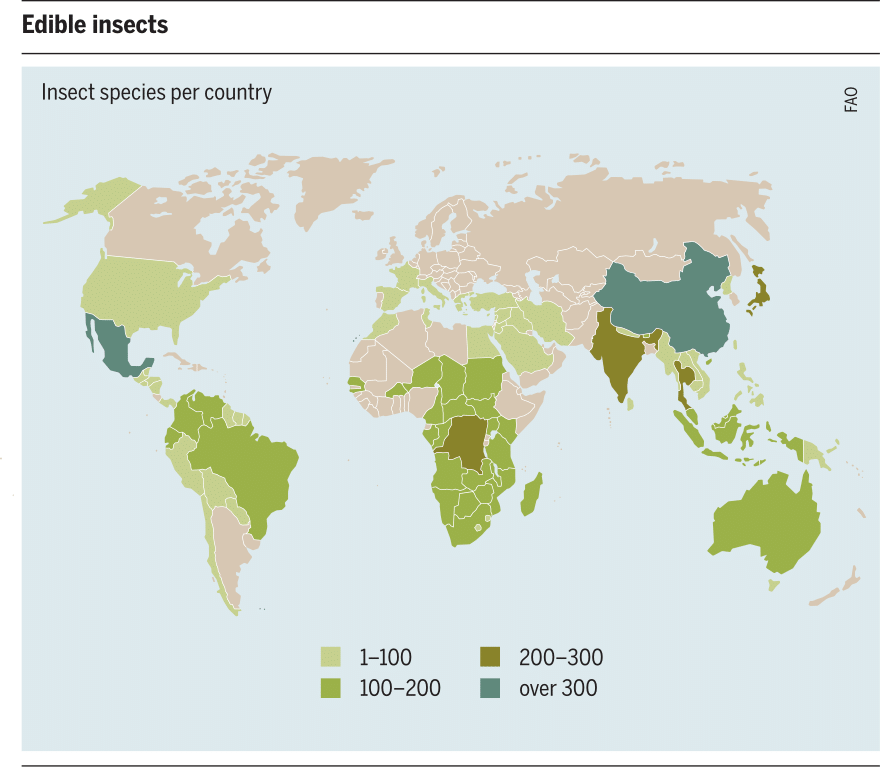
Edible insects for industrialized mass production
To increase consumer interest in Western markets such as Europe and North America, insects have been processed into a non‐recognizable form, such as powders or flour. Policymakers, academics, as well as large-scale insect food producers such as Entomofarms in Canada, Aspire Food Group in the United States, Protifarm and Protix in the Netherlands, and Bühler Group in Switzerland, focus on seven insect species suitable for human consumption as well as industrialized mass production:
- Mealworms (Tenebrio molitor) as larvae
- Lesser mealworms (Alphitobius diaperinus) as larvae, mostly marketed under the term buffalo worms.[[File:InPact Protein Pancakes Strawberries.jpg|thumb|Pancakes made from insect powder, served with strawberries and [[skyr]]]]
- House cricket (Acheta domesticus)
- Tropical house cricket (Gryllodes sigillatus)
- European migratory locust (Locusta migratoria)
- Black soldier fly (Hermetia illucens)
- Housefly (Musca domestica) Cochineal (Dactylopius coccus) is collected to produce carmine, a red dye used for textiles and food. It was largely substituted with synthetic dyes like alizarin. Fears over the safety of artificial food additives renewed the popularity of cochineal dyes, and the increased demand has made cultivation of the insect profitable again, with Peru being the largest producer, followed by Mexico, Chile, Argentina and the Canary Islands. Mehlwürmer als Lebensmittel.jpg|Freeze-dried mealworms as food (or food ingredient) Buffalowürmer als Lebensmittel.jpg|Buffalo worms as food (or ingredient) Heimchen (Grillen) als Lebensmittel.jpg|House crickets as food (or ingredient) Wanderheuschrecken als Lebensmittel.jpg|Migratory locusts as food (or ingredient)
Nutritional profile
The nutritional profiles of edible insects are highly variable given the large number of species consumed. In addition to species differences, nutritional content can be affected by geographic origin and production method (wild or farmed), diet, age, development stage, and sex. For instance, female house crickets (Acheta domestica) contain more fat than males, while males contain more protein than females.
Some insects (e.g. crickets, mealworms) are a source of complete protein and provide similar essential amino acid levels as soybeans, though less than casein. They have dietary fiber, essential minerals, vitamins such as B12, riboflavin and vitamin A, and include mostly unsaturated fat.
Locusts contain between 8 and 20 milligrams of iron for every 100 grams of raw locust, whereas beef contains roughly 6 milligrams of iron in the same amount of meat. Crickets are also very efficient in terms of nutrients. For every 100 grams of substance crickets contain 12.9 grams of protein, 121 calories, and 5.5 grams of fat. Beef contains more protein, containing 23.5 grams in 100 grams of substance, but also has roughly triple the calories and four times the amount of fat as crickets do in 100 grams.
| Nutritional value | ||
|---|---|---|
| per 100 g | Mealworms | |
| (*Tenebrio molitor*) | Buffalo worms | |
| (*Alphitobius diaperinus*) | House crickets | |
| (*Acheta domesticus*) | Migratory locust | |
| (*Locusta migratoria*) | ||
| Energy | ||
| Fat | ||
| Of which saturated fatty acids | ||
| Carbohydrates | ||
| Of which sugars | ||
| Protein | ||
| Salt |
Organoleptic characteristics

The table below provides common flavor descriptors for a selection of edible insects. Flavors will vary with preparation method (e.g. raw, dried, fried, etc.). Insect development stage is provided when possible.
| Insect | Scientific name | Development stage | Flavor |
|---|---|---|---|
| Agave worm (white) | *Aegiale hesperiaris* | Larvae | Cracklings |
| Agave worm (red) | *Comadia redtenbacheri* | Larvae | Spicy |
| Ants | Family Formicidae | Adult | Sweet, nutty |
| Carpenter ant | *Camponotus* spp. | Adult | Charred lemon |
| Wood ant | *Formica* spp. | Adult | Kaffir lime |
| Black witch moth | *Ascalapha odorata* | Larvae | Herring |
| Cockroach | Order Blattodea | - | Mushroom |
| Cricket | Superfamily Grylloidea | Adult | Fish |
| Corn earworm | *Helicoverpa zea* | Larvae | Sweet corn |
| Dragonfly | Infraorder Anisoptera | Larvae | Fish |
| Grasshopper | Suborder Caelifera | Adult | Fish |
| Honey bee | *Apis* spp. | Brood | Butter, milk, herbal, vegetal, meaty, mushroom |
| Mealworm | *Tenebrio molitor* | - | Nutty (larvae); whole wheat bread (adult) |
| Mealybug | Family Pseudococcidae | - | Fried potato |
| Stinkbug | Family Pentatomidae | Adult | Apple |
| Termite | Infraorder Isoptera | Adult | Nutty |
| Treehopper | Family Membracidae | - | Avocado, zucchini |
| Wasp | Suborder Apocrita | - | Pine nut |
| Water boatmen | Family Corixidae | - | Caviar (egg); fish, shrimp (adult) |
Farming, production, and processing
Edible insects are raised as livestock in specialized insect farms. In North American as well as European countries such as the Netherlands or Belgium, insects are produced under strict food law and hygiene standards for human consumption.
Conditions such as temperature, humidity, feed, water sources, and housing, vary depending on the insect species. The insects are raised from eggs to larvae status (mealworms, lesser mealworms) or to their mature form (crickets, locusts) in industrialized insect farms and then killed via temperature control. Culled insects may be freeze-dried and packed whole, or pulverized to insect powder (insect flour) to be used in other food products such as baked goods or snacks.
In addition to nutritional composition and digestibility, insect species are selected for ease of rearing by the producer based on factors such as disease susceptibility, feed conversion efficiency, rate of development, and generational turnover.
Insect food products
The following processed foods are produced in North America (including Canada), and the EU:
- Insect flour: Pulverized, freeze-dried insects (e.g., cricket flour).
- Insect burger: Hamburger patties made from insect powder / insect flour (mainly from mealworms or from house cricket) and other ingredients.
- Insect fitness bars: Protein bars containing insect powder (mostly house crickets).
- Insect pasta: Pasta made of wheat flour, fortified with insect flour (house crickets or mealworms).
- Insect bread (Finnish Sirkkaleipä): Bread baked with insect flour (mostly house crickets).
- Insect snacks: Crisps, flips or small snacks (bites) made with insect powder and other ingredients.
Food and drink companies such as the Australian brewery Bentspoke Brewing Co, Canadian Crickstart Food, and the South African startup Gourmet Grubb have introduced insect-based beer, protein bars, a milk alternative, and insect ice cream.
While these products are more and more available, recent research suggests that insect-based foods are unlikely to significantly replace traditional meat. Only a small minority of consumers would consider replacing meat with insects, which are generally viewed as a complement rather than a substitute. In the US and Europe, where insects are not traditionally eaten, cultural barriers limit adoption, making plant-based alternatives a far more promising solution.
File:Insect based food (142934).jpg|Insect energy bar made with processed crickets File:Entis BugBites oat snacks with cultivated cricket flour.jpg|Insect snacks (bites) with cultivated cricket flour and oat
Food safety and regulation
Safety assessment and authorisation
EU
In the European Union, edible insects – whole or in parts, e.g., legs, wings, or heads – fall within the definition of novel food, given by the European Commission. Dossiers for several insect species are currently under review by the European Food Safety Authority.
In August 2018, EFSA published a first risk profile for the house cricket as food. According to a risk assessment published by EFSA on 13 January 2021, the yellow mealworm is safe for human consumption. On 2 July 2021, EFSA published another scientific opinion stating that migratory locust in frozen, dried or ground state is safe for human consumption. On 17 August 2021, EFSA published a safety assessment with view to house crickets (Acheta domesticus) stating that frozen and dried formulations from whole house crickets are safe for consumption. On 4 July 2022, EFSA published an opinion confirming the safety of frozen and freeze-dried formulations of the lesser mealworm (Alphitobius diaperinus in larval state) for human consumption.
Following EFSA's assessment, the European Commission has authorized the following edible insects as novel food in the EU:
- Dried Tenebrio molitor larvae (mealworms) with the Commission Implementing Regulation (EU) 2021/882 of 1 June 2021 (in force on 22 June 2021).
- Frozen, dried and powdered forms of migratory locust (Locusta migratoria) with the Commission Implementing Regulation (EU) 2021/1975 of 12 November 2021 (in force on 5 December 2021).
- Frozen, dried and powdered forms of house cricket (Acheta domesticus) with the Commission Implementing Regulation (EU) 2022/188 of 10 February 2022.
- Frozen, paste, dried and powder forms of lesser mealworm larvae (Alphitobius diaperinus) with the Commission Implementing Regulation (EU) 2023/58 of 5 January 2023.
Switzerland
On 1 May 2017, Switzerland approved the following insect species as food:
- House cricket (Acheta domesticus)
- European locust (Locusta migratoria)
- Mealworms (Tenebrio molitor as larvae) Under certain conditions, these may be offered to consumers whole, pulverized, or processed in food products.
UK
After the Brexit transition period, the regulation regarding edible insects changed in the United Kingdom on 21 January 2021, making them non-marketable without authorization. Insect food products that had been on the market had to be recalled. Insect food products have to be authorized by the Food Standards Agency (FSA) in a novel food authorization process. In February 2022, UK insect industry association Woven Network CIC submitted a first dossier for the authorization of house crickets (Acheta domesticus) as novel food to the FSA.
United States and Canada
In the United States and Canada, insects for human consumption are not classified as novel food and the import and sale is permitted. In the United States, insect food products must comply with Food and Drug Administration (FDA) standards and food labeling regulations (including allergy risk labelling).
Within the Federal Food, Drug, and Cosmetic Act of 1938 (FD&C Act), the FDA states that "The term 'food' means (1) articles used for food or drink for man or other animals, (2) chewing gum, and (3) articles used for components of any such article." Thus, with insects falling under said category, they must be safe and may not bear any added poisonous or added deleterious substance that is unsafe. Said items may not be prepared, packed, or held under insanitary conditions, and must be produced in accordance with current Good Manufacturing Practice (GMP), regulations for manufacturing/processing, packing, or holding human food. The FD&C Act also includes requirements that pertain to the labeling of food and preventive controls, as applicable. Manufacturers have a responsibility to ensure that the food they produce for the United States market is safe and complies with the FD&C Act and FDA's implementing regulations.
In Canada, insects are subject to the same standards and guidelines as other foods sold in stores or online.
Singapore
Singapore Food Agency (SFA) has approved 16 species of insects, such as crickets, silkworms and grasshoppers, for human consumption in the second half of 2023.
The approval of the insects for consumption will be subject to food safety requirements, including treatment processes to kill pathogens and ensuring that they are packed and stored safely to prevent contamination.
Discussed health risks
Like other foods, the consumption of edible insects could present health risks stemming from biological, toxicological, and allergenic hazards. Biological hazards include bacteria, viruses, protozoa, fungi and mycotoxins; toxological risks are poisons, pesticides, heavy metals and antinutrients; allergenic hazards relate to arginine kinase, tropomyosin and α-Amylase. Additionally, recent studies have indicated that proteins from yellow mealworm (Tenebrio molitor) may act as allergens, potentially triggering immunoglobulin E (IgE)-mediated allergic reactions and cross-reactivity, especially in individuals already sensitized to crustaceans or other arthropods.
Chitin, a component of insect exoskeletons and other body parts, induces cytokine production in the digestive systems of humans and other mammals. Enzymes break the chitin down into smaller fragments, which trigger an immune response that results in inflammatory and allergic reactions. The human immune response to chitin is thought to be related to the abundance of dust mites as a cause of airway inflammatory disease and parasites as a cause of numerous diseases.
In general, insects harvested from the wild pose a greater risk than farmed insects, and insects consumed raw pose a greater risk than insects that are cooked before consumption. Feed substrate and growing conditions are the main factors influencing the microbiological and chemical hazards of farmed insects.
The table below combined the data from two studies published in Comprehensive Reviews in Food Science and Food Safety and summarized the potential hazards of the top five insect species consumed by humans.
| Insect order | Common name | Hazard category | Potential hazard |
|---|---|---|---|
| Coleoptera | Beetle | Chemical | Hormones |
| Cyanogenic substances | |||
| Heavy metal contamination | |||
| Lepidoptera | Silkworm | Allergic | |
| Chemical | Thiaminase | ||
| Honeycomb moth | Microbial | High bacterial count | |
| Chemical | Cyanogenic substances | ||
| Hymenoptera | Ant | Chemical | Antinutritional factors (tannin, phytate) |
| Orthoptera | House cricket | Microbial | High bacterial count |
| Hemiptera | Parasitical | Chagas disease | |
| Diptera | Black soldier fly | Parasitical | Myiasis |
The hazards identified in the above table can be controlled in various ways. Allergens can be labelled on the package to avoid consumption by allergy-susceptible consumers. Selective farming can be used to minimize chemical hazards, whereas microbial and parasitical hazards can be controlled by cooking processes.
As a further guarantee for consumers, quality labeling has been introduced by the Entotrust programme, an independent and voluntary product certification of insect-based foods, which allows producers to communicate the safety and sustainability of their activities.
Environmental benefits
Insects require significantly less feed, can be used in feed, and release fewer CO2 emissions than conventional animal food sources. They can be used to address the issue of depleted agricultural lands as they do not need much space to be reared as compared to livestock. Insects may be a sustainable commercial farming option to support populations struggling with food security due to their nutrition and farming capacities, taking less room to cultivate than other protein sources. Additionally, since insects can eat food waste, and they require less feed, they are a good option to address food waste. However, insect consumption remains less sustainable overall than plant-based food, and insects are often used as feed for aquaculture and livestock rather than for direct human consumption.
Challenges
There are challenges associated with the production, processing, and consumption of insects as food.
Production
Mass production in the insect industry is a concern due to a lack of technology and funds to efficiently harvest and produce insects. The machinery would have to house proper enclosure for each life cycle of the insect as well as the temperature control as that is key for insect development.
Processing
The availability of wild-harvested insects can be seasonally dependent. This presents a challenge, as many wild-harvested insects have a short shelf life, sometimes of only a day or two. Identifying methods of processing and storing that extend the shelf life of seasonal insects will improve the efficiency of their harvest and consumption.
Aversion
The concept of eating insects is generally taboo in Western cultures. Although recent studies show some emerging interest, public polling in the US and Europe indicates that only about 20% would consider eating insects, compared to 91% of respondents willing to try plant-based "alternative meats",. In recent years however, a certain level of interest was observed according to related consumer studies.
Insect welfare
There are concerns that insect farming may involve large-scale suffering. Although the ability of insects to suffer is debated, the number of animals involved is particularly large. As of 2023, there are no widely adopted welfare standards in the industry.
Awareness
World Edible Insect Day, held on 23 October, was introduced by Belgian entrepreneur Chris Derudder in 2015 to raise awareness globally for the consumption of edible insects, with a focus on Europe, North America, and Australia.
Footnotes
References
- (2021). "Edible insects as future food: chances and challenges". Journal of Future Foods.
- Pap, Fundacja. (2018-03-05). "Expert: More than 2 billion people worldwide eat insects every day".
- Jongema, Yde. (2017-04-01). "List of edible insects of the world (April 1, 2017)".
- (2013). "Nutritional composition and safety aspects of edible insects". Molecular Nutrition & Food Research.
- (2021-10-11). "Nutritional Qualities and Enhancement of Edible Insects". Annual Review of Nutrition.
- (2019). "Edible Insects Processing: Traditional and Innovative Technologies". Comprehensive Reviews in Food Science and Food Safety.
- (2021-08-13). "Regulations on insects as food and feed: a global comparison". Journal of Insects as Food and Feed.
- (2024). "The global atlas of edible insects: analysis of diversity and commonality contributing to food systems and sustainability". [[Scientific Reports]].
- Huis, Arnold van. (2013). "Edible insects: future prospects for food and feed security".
- Stork, Nigel E.. (2018-01-07). "How Many Species of Insects and Other Terrestrial Arthropods Are There on Earth?". Annual Review of Entomology.
- Harris, Marvin. (1998). "Good to eat: riddles of food and culture". Waveland Press.
- Lesnik, Julie J.. (2017). "Not just a fallback food: global patterns of insect consumption related to geography, not agriculture". American Journal of Human Biology.
- Cruz y Celis Peniche, Patricio. (January 2022). "Drivers of insect consumption across human populations". Evolutionary Anthropology: Issues, News, and Reviews.
- (October 2015). "How much have we learned about seasonality in tropical insect abundance since Wolda (1988)?: Seasonality in tropical insect abundance". Entomological Science.
- (2019). "Edible Insects Processing: Traditional and Innovative Technologies". Comprehensive Reviews in Food Science and Food Safety.
- Christos I Rumbos, Christos G Athanassiou (3 April 2021): ''
'Insects as Food and Feed: If You Can't Beat Them, Eat Them!'—To the Magnificent Seven and Beyond''. In: Journal of Insect Science, Volume 21, Issue 2, March 2021, 9, https://doi.org/10.1093/jisesa/ieab019. - Carson, Erin. (12 October 2017). "You're going to be eating crickets, so just get over it". Cnet.
- van Huis, Arnold. (2017-09-15). "Insects As Food and Feed: From Production to Consumption". Wageningen Academic Publishers.
- (1998-04-15). "Natural Enemies of Cochineal (Dactylopius coccus Costa): Importance in Mexico". Journal of the Professional Association for Cactus Development.
- (25 March 2022). "Cochineal, a red dye from bugs, moves to the lab". Knowable Magazine.
- (2020-09-01). "Effect of developmental stage on the nutritional value of edible insects. A case study with Blaberus craniifer and Zophobas morio". Journal of Food Composition and Analysis.
- (2019-01-30). "Effect of sex on the nutritional value of house cricket, Acheta domestica L.". Food Chemistry.
- (2013-12-15). "Extraction and characterisation of protein fractions from five insect species". Food Chemistry.
- (2015). "Edible insects contributing to food security?". Agriculture & Food Security.
- (2018). "Determination of vitamin B12 in four edible insect species by immunoaffinity and ultra-high performance liquid chromatography". Food Chemistry.
- https://www.huffingtonpost.com/2014/02/10/eating-bugs-food_n_4726371.html?slideshow=true Here's Why You Should Start Eating (More) Bugs
- FAO: ''Edible insects: future prospects for food and feed security''. Online: [http://www.fao.org/docrep/018/i3253e/i3253e06.pdf PDF] {{Webarchive. link. (2019-02-04 .)
- Stevenson, Alan. (2022-05-08). "Locust and chips".
- (2016-10-01). "Nutritional and sensory quality of edible insects". NFS Journal.
- Ramos-Elorduy, Julieta. (1998). "Creepy crawly cuisine: the gourmet guide to edible insects".
- "Insects as Food {{!}} Nebraska Extension in Lancaster County".
- (2022). "The flavour of edible insects: A comprehensive review on volatile compounds and their analytical assessment". Trends in Food Science & Technology.
- (2020-01-01). "Sensory attributes of edible insects and insect-based foods – Future outlooks for enhancing consumer appeal". Trends in Food Science & Technology.
- (2021). "Sensory and Chemical Characteristic of Two Insect Species: Tenebrio molitor and Zophobas morio Larvae Affected by Roasting Processes". Molecules.
- (2021). "Comadia redtenbacheri (Lepidoptera: Cossidae) and Aegiale hesperiaris (Lepidoptera: Hesperiidae), two important edible insects of Agave salmiana (Asparagales: Asparagaceae): a review". International Journal of Tropical Insect Science.
- (2023-03-08). "Mezcal worm in a bottle: DNA evidence suggests a single moth species". PeerJ.
- ''The Atlantic'' (2015-09-24): [https://www.theatlantic.com/health/archive/2015/09/americas-cricket-farmers/406843/ "The companies farming crickets for human consumption"].
- ''Forbes'' (2018-01-39): [https://www.forbes.com/sites/alexknapp/2018/01/30/farming-the-next-big-food-source-crickets/#57c655c31168 "Farming The Next Big Food Source: Crickets"].
- (2015). "Feed Conversion, Survival and Development, and Composition of Four Insect Species on Diets Composed of Food By-Products". PLOS ONE.
- Food Navigator (2018-10-12): ''[https://www.foodnavigator.com/Article/2018/10/12/Bugfoundation-s-vision-To-change-the-eating-habits-of-a-whole-continent Article on the insect burger by German start-up Bugfoundation]''.
- Reuters (2017-11-23): ''[https://www.reuters.com/article/us-finland-ediblebugs/finland-baker-launches-bread-made-from-crushed-crickets-idUSKBN1DN17E Finland baker launches bread made from crushed crickets].''
- Bug Burger (2019-3-11): ''[https://www.bugburger.se/test/future-food-now-finnish-bugbites-and-norwegian-mealworm-bread/ Future food now: Finnish Bugbites and Norwegian mealworm bread].''
- Hardy, Karen. (22 November 2019). "Hop into a BentSpoke beer made of crickets and flies". Canberra Times.
- (15 January 2018). "This Canadian food startup wants you to eat crickets. Here's why".
- Bailey, Stephanie. (25 July 2019). "Could this insect ice cream convince you to eat bugs?".
- Milman, Oliver. (2025-06-25). "'Yuck factor': eating insects rather than meat to help the planet is failing, study finds". The Guardian.
- [[European Commission]] (2018-01-03): ''[https://ec.europa.eu/food/sites/food/files/safety/docs/fs_novel-food_leg_q-n-a-new-regulation-nf_en.pdf Questions and Answers: New Novel Food Regulation]''
- European Food Safety Authority (28 August 2018): ''[https://www.efsa.europa.eu/en/efsajournal/pub/e16082 Novel foods: a risk profile for the house cricket (Acheta domesticus)]''.
- European Food Safety Authority (13 January 2021): ''[https://www.efsa.europa.eu/en/efsajournal/pub/6343 Safety of dried yellow mealworm (Tenebrio molitor larva) as a novel food pursuant to Regulation (EU) 2015/2283].'' In: EFSA Journal.
- Boffey, Daniel. (2021-01-13). "Yellow mealworm safe for humans to eat, says EU food safety agency".
- EFSA (2 July 2021): ''[https://efsa.onlinelibrary.wiley.com/doi/full/10.2903/j.efsa.2021.6667 Safety of frozen and dried formulations from migratory locust (Locusta migratoria) as a Novel food pursuant to Regulation (EU) 2015/2283].'' In: EFSA Journal. Vol. 19, Issue 7. DOI: https://doi.org/10.2903/j.efsa.2021.6667.
- EFSA (17 August 2021): ''[https://www.efsa.europa.eu/en/efsajournal/pub/6779 Safety of frozen and dried formulations from whole house crickets (Acheta domesticus) as a Novel food pursuant to Regulation (EU) 2015/2283]''. In: EFSA Journal 2021;19(8):6779.
- EFSA (4 July 2022): ''[https://www.efsa.europa.eu/en/efsajournal/pub/7325 Safety of frozen and freeze-dried formulations of the lesser mealworm (Alphitobius diaperinus larva) as a Novel food pursuant to Regulation (EU) 2015/2283]''. In: EFSA Journal 2022;20(7):7325. doi: https://doi.org/10.2903/j.efsa.2022.7325
- EU Commission (2 June 2021): ''[https://eur-lex.europa.eu/legal-content/EN/TXT/?uri=CELEX%3A32021R0882&qid=1622617276506 Commission Implementing Regulation (EU) 2021/882 of 1 June 2021 authorising the placing on the market of dried Tenebrio molitor larva as a novel food under Regulation (EU) 2015/2283 of the European Parliament and of the Council, and amending Commission Implementing Regulation (EU) 2017/2470]''.
- EU Commission (15 November 2021): ''[https://eur-lex.europa.eu/legal-content/EN/TXT/?uri=CELEX:32021R1975 Commission Implementing Regulation (EU) 2021/1975 of 12 November 2021 authorising the placing on the market of frozen, dried and powder forms of Locusta migratoria as a novel food under Regulation (EU) 2015/2283 of the European Parliament and of the Council and amending Commission Implementing Regulation (EU) 2017/2470].''
- EU Commission (11 February 2022): ''[https://eur-lex.europa.eu/legal-content/EN/TXT/?uri=CELEX:32022R0188 Commission Implementing Regulation (EU) 2022/188 of 10 February 2022 authorising the placing on the market of frozen, dried and powder forms of Acheta domesticus as a novel food under Regulation (EU) 2015/2283 of the European Parliament and of the Council, and amending Commission Implementing Regulation (EU) 2017/2470].''
- EU Commission (6 January 2023): ''[https://eur-lex.europa.eu/legal-content/EN/TXT/?uri=CELEX%3A32023R0058 Commission Implementing Regulation (EU) 2023/58 of 5 January 2023 authorising the placing on the market of the frozen, paste, dried and powder forms of Alphitobius diaperinus larvae (lesser mealworm) as a novel food and amending Implementing Regulation (EU) 2017/2470]''.
- Bundesamt für Lebensmittelsicherheit und Veterinärwesen (2017-04-28): [https://www.blv.admin.ch/blv/de/home/lebensmittel-und-ernaehrung/lebensmittelsicherheit/einzelne-lebensmittel/insekten.html#-399311545 "Insects as food"] (German only)
- Food Manufacture (4 November 2021): ''[https://www.foodmanufacture.co.uk/Expertise/Legal/What-is-the-legal-status-of-insects-in-the-UK Edible insects left in legal limbo] {{Webarchive. link. (2021-11-30 ''.)
- Vice World News (28 October 2021): ''[https://www.vice.com/en/article/edible-insects-that-could-help-stop-climate-change-are-banned-from-major-climate-summit/ Edible Insects That Could Help Stop Climate Change Are Banned From Major Climate Summit]''.
- Food Navigator/Oliver Morrison (2 February 2022): ''[https://www.foodnavigator.com/Article/2022/02/03/a-major-milestone-for-the-uk-edible-insect-sector-uk-edible-insect-makers-hope-for-novel-food-approval-by-2023 "A major milestone for the UK edible insect sector": UK edible insect makers hope for Novel Food approval by 2023]''.
- Mariod, Abdalbasit Adam (2020): ''The Legislative Status of Edible Insects in the World''. In: Mariod A.A. (eds) African Edible Insects As Alternative Source of Food, Oil, Protein and Bioactive Components. Springer, Cham. https://doi.org/10.1007/978-3-030-32952-5_9.
- "Federal Food, Drug, and Cosmetic Act".
- "Federal Food, Drug, and Cosmetic Act".
- (30 January 2020). "Food Current Good Manufacturing Practice Modernization Report (2005)".
- (2013). "Edible Insects: Future prospects for food and security". [[Food and Agriculture Organization.
- Government of Canada, Canadian Food Inspection Agency. (2021-09-27). "Edible insects: what to know before biting into bugs".
- cue. (2023-04-07). "Singapore to approve 16 species of insects like crickets and grasshoppers to be sold as food {{!}} The Straits Times".
- (2019-07-01). "Safety of wild harvested and reared edible insects: A review". Food Control.
- Imathiu, Samuel. (2020). "Benefits and food safety concerns associated with consumption of edible insects". NFS Journal.
- (2022). "Edible insects: A novel nutritious, functional, and safe food alternative". Food Frontiers.
- (2024). "IgE-based analysis of sensitization and cross-reactivity to yellow mealworm and edible insect allergens before their widespread dietary introduction". Scientific Reports.
- (1 March 2017). "Chitin and Its Effects on Inflammatory and Immune Responses.". Clinical Reviews in Allergy & Immunology.
- (2017). "Safety aspects of the production of foods and food ingredients from insects". Molecular Nutrition & Food Research.
- (2018). "Food Safety Issues Related to Uses of Insects for Feeds and Foods: Food safety of insects for feed/food…". Comprehensive Reviews in Food Science and Food Safety.
- (2013-11-01). "Safety of Novel Protein Sources (Insects, Microalgae, Seaweed, Duckweed, and Rapeseed) and Legislative Aspects for Their Application in Food and Feed Production". Comprehensive Reviews in Food Science and Food Safety.
- (2013-05-01). "Edible Insects in a Food Safety and Nutritional Perspective: A Critical Review". Comprehensive Reviews in Food Science and Food Safety.
- Lessard BD, Ponce-Reyes R (April 2021). "Edible insects. A roadmap for the strategic growth of an emerging industry"(PDF). [https://research.csiro.au/edibleinsects/wp-content/uploads/sites/347/2021/04/CSIRO-Edible-Insect-Roadmap.pdf] ''CSIRO (Commonwealth Scientific and Industrial Research Organisation)''. Australia's National Science Agency.: 35.
- (2021-12-31). "Edible Insects: Sustainable nutrient-rich foods to tackle food insecurity and malnutrition". World Nutrition.
- Mikkola, Heimo. (2020-01-29). "Edible Insects". BoD – Books on Demand.
- Lymbery, Philip. (2023-07-27). "Insect Farming Isn't Going to Save the Planet".
- Sebo, Jeff. (2021-07-27). "Don't farm bugs".
- Huis, Arnold. (2022). "Edible insects: Challenges and prospects". Entomological Research.
- Rumpold, B.A., & Schlüter O.K. (2013) Potential and challenges of insects as an innovative source for food and feed production. Innov Food Sci Emerg Technol 17, 1–11.
- (2022-04-18). "The effects of season, geography, and urbanization on the diversity of edible insects at food markets in Laos". PLOS ONE.
- Imathiu, Samuel. (2020-03-01). "Benefits and food safety concerns associated with consumption of edible insects". NFS Journal.
- "For Most People, Eating Bugs Is Only Natural".
- (2019-03-01). "Willingness to pay for insect-based food: The role of information and carrier". Food Quality and Preference.
- (2020-01-01). "Sensory attributes of edible insects and insect-based foods – Future outlooks for enhancing consumer appeal". Trends in Food Science & Technology.
- (2023-09-01). "Insects as food - Changes in consumers' acceptance of entomophagy in Hungary between 2016 and 2021". Appetite.
- (2019-10-31). "The willingness to consume insect-based food: an empirical research on Italian consumers". Agricultural Economics (Zemědělská ekonomika).
- Reynolds, Matt. (2023-03-16). "Insect Farming Is Booming. But Is It Cruel?".
- Edible Bug Farm (2015-10-03): [http://www.ediblebugfarm.com/blog/entoview-with-entomochef/ Interview with Chris Derudder on WEID.]
This article was imported from Wikipedia and is available under the Creative Commons Attribution-ShareAlike 4.0 License. Content has been adapted to SurfDoc format. Original contributors can be found on the article history page.
Ask Mako anything about Insects as food — get instant answers, deeper analysis, and related topics.
Research with MakoFree with your Surf account
Create a free account to save articles, ask Mako questions, and organize your research.
Sign up freeThis content may have been generated or modified by AI. CloudSurf Software LLC is not responsible for the accuracy, completeness, or reliability of AI-generated content. Always verify important information from primary sources.
Report