From Surf Wiki (app.surf) — the open knowledge base
Inner automorphism
Term in abstract algebra
Term in abstract algebra
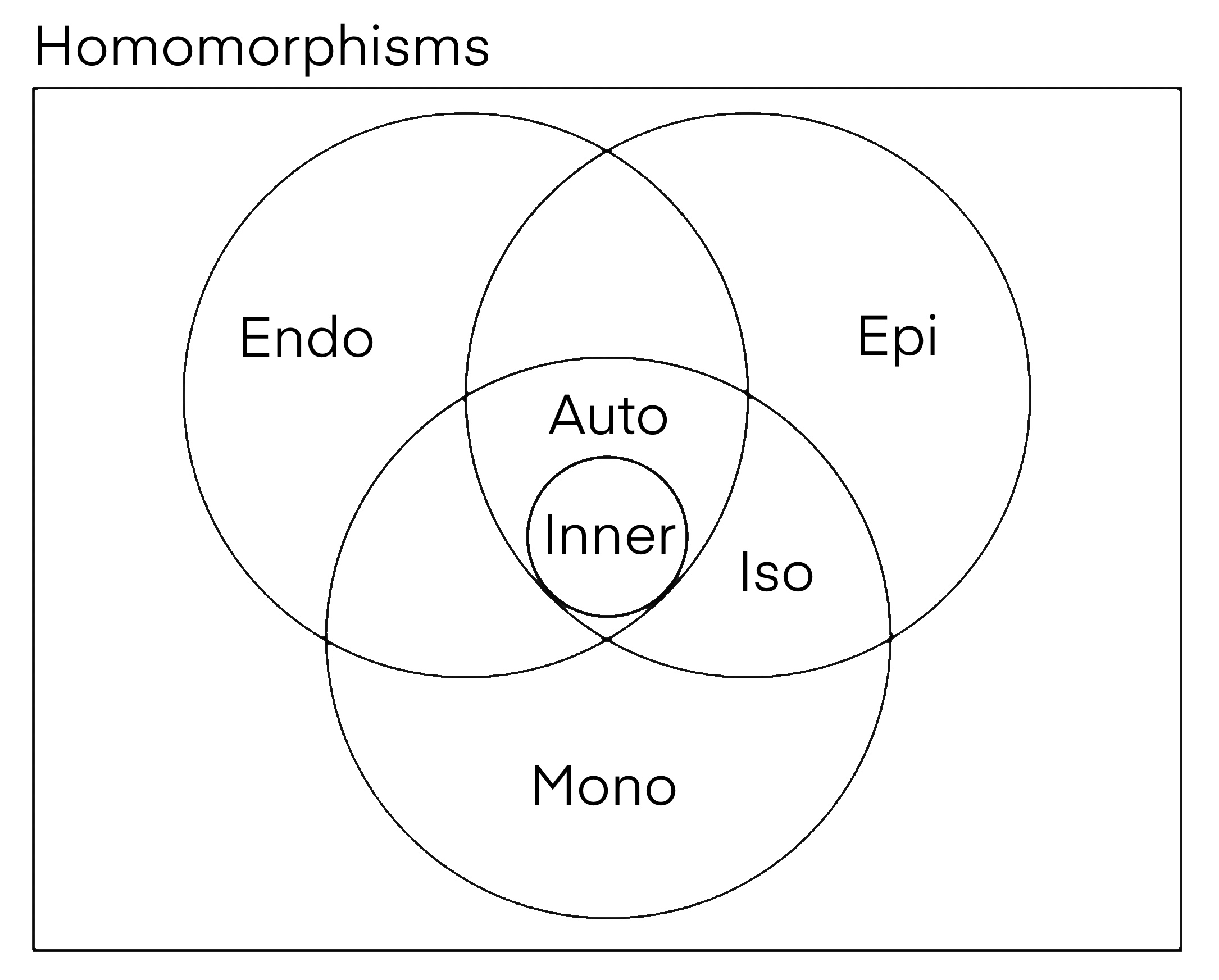
In abstract algebra, an inner automorphism is an automorphism of a group, ring, or algebra given by the conjugation action of a fixed element, called the conjugating element. They can be realized via operations from within the group itself, hence the adjective "inner". These inner automorphisms form a subgroup of the automorphism group, and the quotient of the automorphism group by this subgroup is defined as the outer automorphism group.
Definition
If G is a group and g is an element of G (alternatively, if G is a ring, and g is a unit), then the function
:\begin{align} \varphi_g\colon G&\to G \ \varphi_g(x)&:= g^{-1}xg \end{align}
is called (right) conjugation by g (see also conjugacy class). This function is an endomorphism of G: for all x_1,x_2\in G,
:\varphi_g(x_1 x_2) = g^{-1} x_1 x_2g = g^{-1} x_1 \left(g g^{-1}\right) x_2 g = \left(g^{-1} x_1 g\right)\left(g^{-1} x_2 g\right) = \varphi_g(x_1)\varphi_g(x_2),
where the second equality is given by the insertion of the identity between x_1 and x_2. Furthermore, it has a left and right inverse, namely \varphi_{g^{-1}}. Thus, \varphi_g is both an monomorphism and epimorphism, and so an isomorphism of G with itself, i.e. an automorphism. An inner automorphism is any automorphism that arises from conjugation.
When discussing right conjugation, the expression g^{-1}xg is often denoted exponentially by x^g. This notation is used because composition of conjugations satisfies the identity: \left(x^{g_1}\right)^{g_2} = x^{g_1g_2} for all g_1, g_2 \in G. This shows that right conjugation gives a right action of G on itself.
A common example is as follows:
_Example.jpg)
Describe a homomorphism \Phi for which the image, \text{Im} (\Phi), is a normal subgroup of inner automorphisms of a group G; alternatively, describe a natural homomorphism of which the kernel of \Phi is the center of G (all g \in G for which conjugating by them returns the trivial automorphism), in other words, \text{Ker} (\Phi) = \text{Z}(G). There is always a natural homomorphism \Phi : G \to \text{Aut}(G) , which associates to every g \in G an (inner) automorphism \varphi_{g} in \text{Aut}(G). Put identically, \Phi : g \mapsto \varphi_{g}.
Let \varphi_{g}(x) := gxg^{-1} as defined above. This requires demonstrating that (1) \varphi_{g} is a homomorphism, (2) \varphi_{g} is also a bijection, (3) \Phi is a homomorphism.
- \varphi_{g}(xx')=gxx'g^{-1} =gx(g^{-1}g)x'g^{-1} = (gxg^{-1})(gx'g^{-1}) = \varphi_{g}(x)\varphi_{g}(x')
- The condition for bijectivity may be verified by simply presenting an inverse such that we can return to x from gxg^{-1}. In this case it is conjugation by g^{-1}denoted as \varphi_{g^{-1}}.
- \Phi(gg')(x)=(gg')x(gg')^{-1} and \Phi(g)\circ \Phi(g')(x)=\Phi(g) \circ (g'xg'^{-1}) = gg'xg'^{-1}g^{-1} = (gg')x(gg')^{-1}
Inner and outer automorphism groups
The composition of two inner automorphisms is again an inner automorphism, and with this operation, the collection of all inner automorphisms of G is a group, the inner automorphism group of G denoted Inn(G).
Inn(G) is a normal subgroup of the full automorphism group Aut(G) of G. The outer automorphism group, Out(G) is the quotient group :\operatorname{Out}(G) = \operatorname{Aut}(G) / \operatorname{Inn}(G).
The outer automorphism group measures, in a sense, how many automorphisms of G are not inner. Every non-inner automorphism yields a non-trivial element of Out(G), but different non-inner automorphisms may yield the same element of Out(G).
Saying that conjugation of x by a leaves x unchanged is equivalent to saying that a and x commute: :a^{-1}xa = x \iff xa = ax.
Therefore the existence and number of inner automorphisms that are not the identity mapping is a kind of measure of the failure of the commutative law in the group (or ring).
An automorphism of a group G is inner if and only if it extends to every group containing G.
By associating the element a ∈ G with the inner automorphism in Inn(G) as above, one obtains an isomorphism between the quotient group G / Z(G) (where Z(G) is the center of G) and the inner automorphism group: :G,/,\mathrm{Z}(G) \cong \operatorname{Inn}(G).
This is a consequence of the first isomorphism theorem, because Z(G) is precisely the set of those elements of G that give the identity mapping as corresponding inner automorphism (conjugation changes nothing).
Non-inner automorphisms of finite {{mvar|p}}-groups
A result of Wolfgang Gaschütz says that if G is a finite non-abelian p-group, then G has an automorphism of p-power order which is not inner.
It is an open problem whether every non-abelian p-group G has an automorphism of order p. The latter question has positive answer whenever G has one of the following conditions:
- G is nilpotent of class 2
- G is a regular p-group
- G / Z(G) is a powerful p-group
- The centralizer in G, C, of the center, Z, of the Frattini subgroup, Φ, of G, C ∘ Z ∘ Φ(G), is not equal to Φ(G)
Types of groups
The inner automorphism group of a group G, Inn(G), is trivial (i.e., consists only of the identity element) if and only if G is abelian.
The group Inn(G) is cyclic only when it is trivial.
At the opposite end of the spectrum, the inner automorphisms may exhaust the entire automorphism group; a group whose automorphisms are all inner and whose center is trivial is called complete. This is the case for all of the symmetric groups on n elements when n is not 2 or 6. When , the symmetric group has a unique non-trivial class of non-inner automorphisms, and when , the symmetric group, despite having no non-inner automorphisms, is abelian, giving a non-trivial center, disqualifying it from being complete.
If the inner automorphism group of a perfect group G is simple, then G is called quasisimple.
Lie algebra case
An automorphism of a Lie algebra 𝔊 is called an inner automorphism if it is of the form Ad, where Ad is the adjoint map and g is an element of a Lie group whose Lie algebra is 𝔊. The notion of inner automorphism for Lie algebras is compatible with the notion for groups in the sense that an inner automorphism of a Lie group induces a unique inner automorphism of the corresponding Lie algebra.
Extension
If G is the group of units of a ring, A, then an inner automorphism on G can be extended to a mapping on the projective line over A by the group of units of the matrix ring, M(A). In particular, the inner automorphisms of the classical groups can be extended in that way.
References
References
- (2004). "Abstract algebra". Wiley.
- Grillet, Pierre. (2010). "Abstract Algebra". Springer.
- Lang, Serge. (2002). "Algebra". Springer-Verlag.
- (1987). "A characterization of inner automorphisms". American Mathematical Society.
This article was imported from Wikipedia and is available under the Creative Commons Attribution-ShareAlike 4.0 License. Content has been adapted to SurfDoc format. Original contributors can be found on the article history page.
Ask Mako anything about Inner automorphism — get instant answers, deeper analysis, and related topics.
Research with MakoFree with your Surf account
Create a free account to save articles, ask Mako questions, and organize your research.
Sign up freeThis content may have been generated or modified by AI. CloudSurf Software LLC is not responsible for the accuracy, completeness, or reliability of AI-generated content. Always verify important information from primary sources.
Report