From Surf Wiki (app.surf) — the open knowledge base
Information integration theory
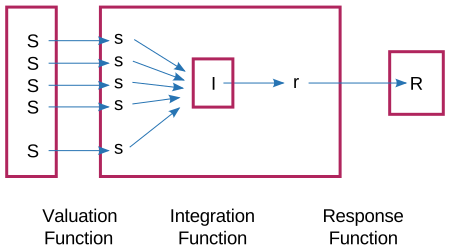
Information integration theory was proposed by Norman H. Anderson to describe and model how a person integrates information from a number of sources in order to make an overall judgment. The theory proposes three functions.
The valuation function V(S) is an empirically derived mapping of stimuli to an interval scale. It is unique up to an interval exchange transformation ( y = ax + b ).
The integration function r = I{s_1,s_2, .., s_n} is an algebraic function combining the subjective values of the information. "Cognitive algebra" refers to the class of functions that are used to model the integration process. They may be adding, averaging, weighted averaging, multiplying, etc.
The response production function R = M(r) is the process by which the internal impression is translated into an overt response.
Information integration theory differs from other theories in that it is not erected on a consistency principle such as balance or congruity but rather relies on algebraic models. The theory is also referred to as functional measurement, because it can provide validated scale values of the stimuli. An elementary treatment of the theory, along with a Microsoft Windows program for carrying out functional measurement analysis, is provided in the textbook by David J. Weiss.Weiss, D. J. (2006). Analysis of variance and functional measurement: A practical guide. New York: Oxford University Press.
Integration models
There are three main types of algebraic models used in information integration theory: adding, averaging, and multiplying. Adding models
R = reaction/overt behavior
F/G = contributing factors
R_1 = F_1 + G_1 (Condition 1)
R_2 = F_2 + G_2 (Condition 2)
Typically an experiment is designed so that:
R_1=R_2, and
F_1F_2, so that
G_1.
There are two special cases known as discounting and augmentation.
Discounting: The value of any factor is reduced if other factors that produce the same effect are added.
Example: F_2 is not present or has a value of zero. If F_1 is positive, then G1 must be less than G_2.
Augmentation: An inverse version of the typical model.
Example: If F_1 is negative, then G_1 must be greater than G_2.
Two advantages of adding models:
- Participants are not required to have an exact intuitive calculation
- The adding model itself need not be completely valid. Certain kinds of interaction among the factors would not affect the qualitative conclusions.
Notes
References
- Anderson, N. H. Application of an Additive Model to Impression Formation. Science, 1962, 138, 817–818
- Anderson, N. H. On the Quantification of Miller's Conflict Theory. Psychological Review, 1962, 69, 400–414
- Anderson, N. H. A Simple Model for Information Integration. In R.P. Abelson, E. Aronson, W.J. McGuire, T.M. Newcomb, M.J. Rosenberg, & P.H. Tannenbaum (Eds.), Theories of Cognitive Consistency: A Sourcebook. Chicago: Rand McNally, 1968
- Anderson, N. H. Functional Measurement and Psychophysical Judgment. Psychological Review, 1970, 77, 153- 170.
- Anderson, N. H. Integration Theory and Attitude Change. Psychological Review, 1971, 78, 171–206.
- Anderson, N. H. (1981). Foundation of information integration theory. New York: Academic Press.
- Norman, K. L. (1973). A method of maximum likelihood estimation for information integration models. (CHIP No. 35). La Jolla, California: University of California, San Diego, Center for Human Information Processing.
- Norman, K. L. (1976). A solution for weights and scale values in functional measurement. Psychological Review, 83, 80–84.
This article was imported from Wikipedia and is available under the Creative Commons Attribution-ShareAlike 4.0 License. Content has been adapted to SurfDoc format. Original contributors can be found on the article history page.
Ask Mako anything about Information integration theory — get instant answers, deeper analysis, and related topics.
Research with MakoFree with your Surf account
Create a free account to save articles, ask Mako questions, and organize your research.
Sign up freeThis content may have been generated or modified by AI. CloudSurf Software LLC is not responsible for the accuracy, completeness, or reliability of AI-generated content. Always verify important information from primary sources.
Report