From Surf Wiki (app.surf) — the open knowledge base
Infibulation
Ritual removal of the vulva
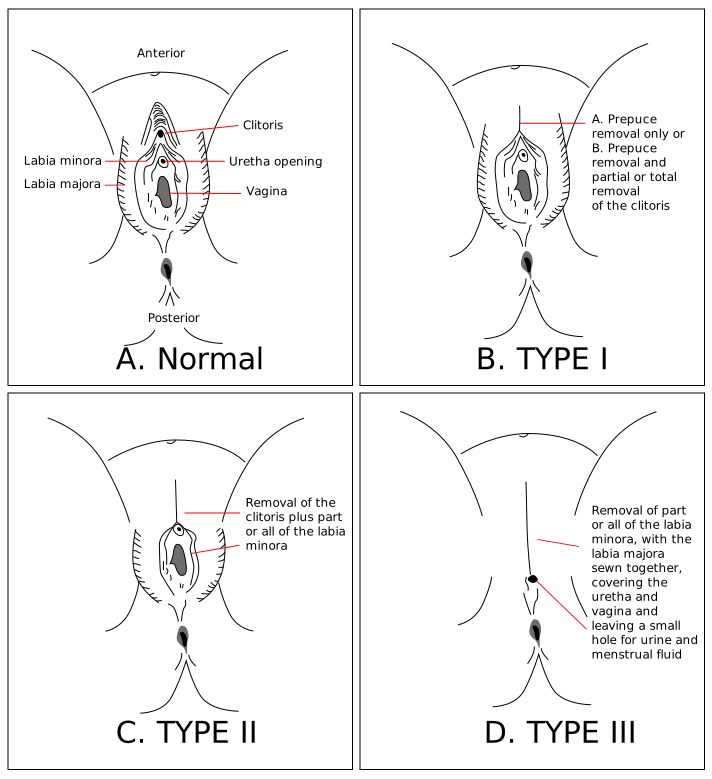
Ritual removal of the vulva
Infibulation is the ritual removal of the vulva and its suturing, a practice found mainly in northeastern Africa, particularly in Djibouti, Eritrea, Ethiopia, Kenya, Somalia, and Sudan. The World Health Organization refers to the procedure as Type III female genital mutilation.
The term can also refer to the entirely different practice of placing a clasp through the foreskin in men; for more information see the article Fibula (penile).
Female
The World Health Organization refers to female infibulation as Type III female genital mutilation. Often called "pharaonic circumcision" (or farooni) in countries where it is practiced. It refers to the removal of the inner and outer labia and the suturing of the vulva. It is usually accompanied by the removal of the clitoral glans. The practice is concentrated in Djibouti, Eritrea, Ethiopia, Somalia, and Sudan.
The procedure leaves a wall of skin and flesh across the vagina and the rest of the pubic area. By inserting a twig or similar object before the wound heals, a small hole is created for the passage of urine and menstrual blood. The legs are bound together for two to four weeks to allow healing.
The vagina is usually penetrated at the time of a woman's marriage by her husband's penis, or by cutting the tissue with a knife. The vagina is opened further for childbirth and usually closed again afterwards, a process known as defibulation (or deinfibulation) and reinfibulation. Infibulation can cause chronic pain and infection, organ damage, prolonged micturition, urinary incontinence, inability to get pregnant, difficulty giving birth, obstetric fistula, and fatal bleeding.
Male
Infibulation also referred to placing a clasp through the male foreskin.Favazza, Armando R. (1996).Bodies Under Siege: Self-mutilation and Body Modification in Culture and Psychiatry. Johns Hopkins University Press. pp. 190–191. In ancient Greece, male athletes, singers and other public performers used a clasp or string to close the foreskin and draw the penis over to one side, a practice known as kynodesmē (literally "dog tie"). In Rome, a fibula was often a type of ring used similarly to a kynodesme.
Kynodesmē was seen as a sign of restraint and abstinence, but was also related to concerns of modesty; in artistic representations, it was regarded as obscene and offensive to show a long penis and the glans penis in particular. Tying up the penis with a string was a way of avoiding what was seen as the shameful and dishonorable spectacle of an exposed glans penis, something associated with those without repute, such as slaves and barbarians. It therefore conveyed the moral worth and modesty of the subject.
References
References
- (March 2008). "Numbers of women circumcised in Africa: The Production of a Total". USAID, DHS Working Papers.
- "Female genital mutilation". [[World Health Organization]].
- "Genitalverstümmelung {{!}} Dieter Wunderlich: Buchtipps und mehr".
- El Dareer, Asma. (1982). "Woman, Why Do You Weep: Circumcision and its Consequences". Zed Books.
- For "pharaonic circumcision", also see [[Ellen Gruenbaum. Gruenbaum, Ellen]] (2001). ''The Female Circumcision Controversy: An Anthropological Perspective''. University of Pennsylvania Press. pp. 43–45.
- (2014). "Sudan Multiple Indicator Cluster Survey 2014". UNICEF.
- [[Comfort Momoh
- Abdulcadira Jasmine. (2011). "Care of women with female genital mutilation/cutting". Swiss Medical Weekly.
- Many ''kynodesmē'' are depicted on vases, almost exclusively confined to [[symposium. symposiasts]] and [[komos
- Schmidt, Michael (2004). ''The First Poets''. Weidenfeld & Nicolson. p. 263.
This article was imported from Wikipedia and is available under the Creative Commons Attribution-ShareAlike 4.0 License. Content has been adapted to SurfDoc format. Original contributors can be found on the article history page.
Ask Mako anything about Infibulation — get instant answers, deeper analysis, and related topics.
Research with MakoFree with your Surf account
Create a free account to save articles, ask Mako questions, and organize your research.
Sign up freeThis content may have been generated or modified by AI. CloudSurf Software LLC is not responsible for the accuracy, completeness, or reliability of AI-generated content. Always verify important information from primary sources.
Report