From Surf Wiki (app.surf) — the open knowledge base
Indole
Chemical compound

Chemical compound
1-benzazole Soluble in hot water (21.0 in DMSO) compounds](aromatic-compound) carbazole, carboline, indene, benzothiophene, indoline, isatin, methylindole, oxindole, pyrrole, skatole, benzophosphole}}
Indole is an organic compound with the formula . Indole is classified as an aromatic heterocycle. It has a bicyclic structure, consisting of a six-membered benzene ring fused to a five-membered pyrrole ring. Indoles are derivatives of indole where one or more of the hydrogen atoms have been replaced by substituent groups. Indoles are widely distributed in nature, most notably as amino acid tryptophan and neurotransmitter serotonin.. In plants, IAA is a common plant hormone which is a derivative of Indole.
General properties and occurrence
Indole is a solid at room temperature. It occurs naturally in human feces and has an intense fecal odor. At very low concentrations, however, it has a flowery smell, and is a constituent of many perfumes. It also occurs in coal tar. It has been identified in cannabis. It is the main volatile compound in stinky tofu.
When indole is a substituent on a larger molecule, it is called an indolyl group by systematic nomenclature.
Indole undergoes electrophilic substitution, mainly at position 3 (see diagram in right margin). Substituted indoles are structural elements of (and for some compounds, the synthetic precursors for) the tryptophan-derived tryptamine alkaloids, which includes the neurotransmitter serotonin and the hormone melatonin, as well as the naturally occurring psychedelic drugs dimethyltryptamine and psilocybin. Other indolic compounds include the plant hormone auxin (indolyl-3-acetic acid, IAA), tryptophol, the anti-inflammatory drug indomethacin, and the betablocker pindolol.
The name indole is a portmanteau of the words indigo and oleum, since indole was first isolated by treatment of the indigo dye with oleum.
History
Indole chemistry began to develop with the study of the dye indigo. Indigo can be converted to isatin and then to oxindole. In 1866, Adolf von Baeyer reduced oxindole to indole using zinc dust. In 1869, he proposed a formula for indole.
Certain indole derivatives were important dyestuffs until the end of the 19th century. In the 1930s, interest in indole intensified when it became known that the indole substituent is present in many important alkaloids, known as indole alkaloids (e.g., tryptophan and auxins), and it remains an active area of research today.
Biosynthesis and function
Indole is biosynthesized in the shikimate pathway via anthranilate. It is an intermediate in the biosynthesis of tryptophan, where it stays inside the tryptophan synthase molecule between the removal of 3-phospho-glyceraldehyde and the condensation with serine. When indole is needed in the cell, it is usually produced from tryptophan by tryptophanase. :[[File:Tryptophan biosynthesis (en).svg|left|480px|thumb|class=skin-invert-image|Indole is produced via anthranilate and reacts further to give the amino acid tryptophan.]]
As an intercellular signal molecule, indole regulates various aspects of bacterial physiology, including spore formation, plasmid stability, resistance to drugs, biofilm formation, and virulence. A number of indole derivatives have important cellular functions, including neurotransmitters such as serotonin.
Detection methods
Common classical methods applied for the detection of extracellular and environmental indoles, are Salkowski, Kovács, Ehrlich's reagent assays and HPLC. For intracellular indole detection and measurement genetically encoded indole-responsive biosensor is applicable.
Medical applications
Indoles and their derivatives are promising against tuberculosis, malaria, diabetes, cancer, migraines, convulsions, hypertension, bacterial infections of methicillin-resistant Staphylococcus aureus (MRSA) and even viruses.
Synthetic routes
Indole and its derivatives can also be synthesized by a variety of methods. According to a 2011 review, all known syntheses fall into 9 categories.
The main industrial routes start from aniline via vapor-phase reaction with ethylene glycol in the presence of catalysts:
:[[File:Indole from aniline and ethylene glycol 2.svg|400px|class=skin-invert-image|Reaction of [[aniline]] and [[ethylene glycol]] to give indole.]]
In general, reactions are conducted between 200 and 500 °C. Yields can be as high as 60%. Other precursors to indole include formyltoluidine, 2-ethylaniline, and 2-(2-nitrophenyl)ethanol, all of which undergo cyclizations.
Leimgruber–Batcho indole synthesis
Main article: Leimgruber–Batcho indole synthesis
:[[File:Leimgruber-Batcho Indole Scheme.png|500px|class=skin-invert-image|The Leimgruber–Batcho indole synthesis]] The Leimgruber–Batcho indole synthesis is an efficient method of synthesizing indole and substituted indoles. Originally disclosed in a patent in 1976, this method is high-yielding and can generate substituted indoles. This method is especially popular in the pharmaceutical industry, where many pharmaceutical drugs are made up of specifically substituted indoles.
Fischer indole synthesis
Main article: Fischer indole synthesis
:[[File:Fischer indole reaction scheme.svg|400px|class=skin-invert-image|The Fischer indole synthesis]]

One of the oldest and most reliable methods for synthesizing substituted indoles is the Fischer indole synthesis, developed in 1883 by Emil Fischer. Although the synthesis of indole itself is problematic using the Fischer indole synthesis, it is often used to generate indoles substituted in the 2- and/or 3-positions. Indole can still be synthesized, however, using the Fischer indole synthesis by reacting phenylhydrazine with pyruvic acid followed by decarboxylation of the formed indole-2-carboxylic acid. This has also been accomplished in a one-pot synthesis using microwave irradiation.
Other indole-forming reactions
- Bartoli indole synthesis
- Bischler–Möhlau indole synthesis
- Cadogan-Sundberg indole synthesis
- Fukuyama indole synthesis
- Gassman indole synthesis
- Hemetsberger indole synthesis
- Larock indole synthesis
- Madelung synthesis
- Nenitzescu indole synthesis
- Reissert indole synthesis
- Baeyer–Emmerling indole synthesis
- In the Diels–Reese reaction dimethyl acetylenedicarboxylate reacts with 1,2-diphenylhydrazine to an adduct, which in xylene gives dimethyl indole-2,3-dicarboxylate and aniline. With other solvents, other products are formed: with glacial acetic acid a pyrazolone, and with pyridine a quinoline.
Chemical reactions of indole
Basicity
Unlike most amines, indole is not basic: just like pyrrole, the aromatic character of the ring means that the lone pair of electrons on the nitrogen atom is not available for protonation. Strong acids such as hydrochloric acid can, however, protonate indole. Indole is primarily protonated at the C3, rather than N1, owing to the enamine-like reactivity of the portion of the molecule located outside of the benzene ring. The protonated form has a pKa of −3.6. The sensitivity of many indolic compounds (e.g., tryptamines) under acidic conditions is caused by this protonation.
Electrophilic substitution
The most reactive position on indole for electrophilic aromatic substitution is C3, which is 1013 times more reactive than benzene. For example, it is alkylated by phosphorylated serine in the biosynthesis of the amino acid tryptophan. Vilsmeier–Haack formylation of indole will take place at room temperature exclusively at C3.
:[[File:Indole Vilsmeyer-Haack Formylation.png|300px|class=skin-invert-image|The Vilsmeyer–Haack formylation of indole]]
Since the pyrrolic ring is the most reactive portion of indole, electrophilic substitution of the carbocyclic (benzene) ring generally takes place only after N1, C2, and C3 are substituted. A noteworthy exception occurs when electrophilic substitution is carried out in conditions sufficiently acidic to exhaustively protonate C3. In this case, C5 is the most common site of electrophilic attack.
Gramine, a useful synthetic intermediate, is produced via a Mannich reaction of indole with dimethylamine and formaldehyde. It is the precursor to indole-3-acetic acid and synthetic tryptophan.
:[[File:Gramine From Indole Scheme.png|250px|class=skin-invert-image|Synthesis of gramine from indole]]
N–H acidity and organometallic indole anion complexes
The N–H center has a pKa of 21 in DMSO, so that very strong bases such as sodium hydride or n-butyl lithium and water-free conditions are required for complete deprotonation. The resulting organometalic derivatives can react in two ways. The more ionic salts such as the sodium or potassium compounds tend to react with electrophiles at nitrogen-1, whereas the more covalent magnesium compounds (indole Grignard reagents) and (especially) zinc complexes tend to react at carbon 3 (see figure below). In analogous fashion, polar aprotic solvents such as DMF and DMSO tend to favour attack at the nitrogen, whereas nonpolar solvents such as toluene favour C3 attack.
:[[File:Indole anion reactions.svg|400px|class=skin-invert-image|Formation and reactions of the indole anion]]
Carbon acidity and C2 lithiation
After the N–H proton, the hydrogen at C2 is the next most acidic proton on indole. Reaction of N-protected indoles with butyl lithium or lithium diisopropylamide results in lithiation exclusively at the C2 position. This strong nucleophile can then be used as such with other electrophiles.
:[[File:Bergman Indole Lithiation.png|400px|class=skin-invert-image|2-position lithiation of indole]]
Bergman and Venemalm developed a technique for lithiating the 2-position of unsubstituted indole, as did Katritzky.
Oxidation of indole
Due to the electron-rich nature of indole, it is easily oxidized. Simple oxidants such as N-bromosuccinimide will selectively oxidize indole 1 to oxindole (4 and 5).
:[[File:Indole NBS Oxidation.png|600px|class=skin-invert-image|Oxidation of indole by N-bromosuccinimide]]
Cycloadditions of indole
Only the C2–C3 pi bond of indole is capable of cycloaddition reactions. Intramolecular variants are often higher-yielding than intermolecular cycloadditions. For example, Padwa et al. have developed this Diels-Alder reaction to form advanced strychnine intermediates. In this case, the 2-aminofuran is the diene, whereas the indole is the dienophile. Indoles also undergo intramolecular [2+3] and [2+2] cycloadditions. :[[File:Indole Cycloaddition Padwa.png|250px|class=skin-invert-image|Example of a cycloaddition of indole]]
Despite mediocre yields, intermolecular cycloadditions of indole derivatives have been well documented. One example is the Pictet-Spengler reaction between tryptophan derivatives and aldehydes, which produces a mixture of diastereomers, leading to reduced yield of the desired product.
Hydrogenation
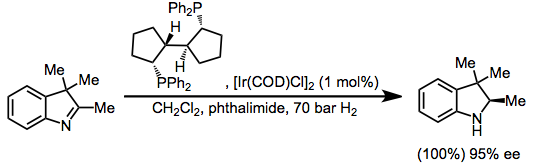
Indoles are susceptible to hydrogenation of the imine subunit to give indolines.
References
General references
References
- [[International Union of Pure and Applied Chemistry]]. (2014). "Nomenclature of Organic Chemistry: IUPAC Recommendations and Preferred Names 2013". [[Royal Society of Chemistry.
- "Olfactory Perception in Humans".
- (2023-10-12). "Minor, Nonterpenoid Volatile Compounds Drive the Aroma Differences of Exotic Cannabis". ACS Omega.
- (26 March 2012). "Analysis of Organic Volatile Flavor Compounds in Fermented Stinky Tofu Using SPME with Different Fiber Coatings". Molecules.
- (21 October 2019). "The Neuroprotective Effects of Melatonin: Possible Role in the Pathophysiology of Neuropsychiatric Disease". Brain Sciences.
- Baeyer, A.. (1866). "Ueber die Reduction aromatischer Verbindungen mittelst Zinkstaub". Annalen der Chemie und Pharmacie.
- (1869). "Synthese des Indols". Berichte der Deutschen Chemischen Gesellschaft.
- (1942). "Indole". [[Chem. Rev.]].
- {{Lehninger4th
- (1998-10-17). "Metabolic Engineering: Principles and Methodologies". Academic Press.
- (2010). "Indole as an intercellular signal in microbial communities". FEMS Microbiology Reviews.
- Ehmann, Axel. (1977-02-11). "The van URK-Salkowski reagent — a sensitive and specific chromogenic reagent for silica gel thin-layer chromatographic detection and identification of indole derivatives". Journal of Chromatography A.
- (December 2015). "A Rapid and Specific Method for the Detection of Indole in Complex Biological Samples". Applied and Environmental Microbiology.
- (2018). "Bacterial Production of Indole Related Compounds Reveals Their Role in Association Between Duckweeds and Endophytes". Frontiers in Chemistry.
- (January 2022). "Development and Characterization of Indole-Responsive Whole-Cell Biosensor Based on the Inducible Gene Expression System from Pseudomonas putida KT2440". International Journal of Molecular Sciences.
- (15 July 2020). "Indole chalcones: Design, synthesis, in vitro and in silico evaluation against Mycobacterium tuberculosis". European Journal of Medicinal Chemistry.
- (15 May 2020). "Indole-based derivatives as potential antibacterial activity against methicillin-resistance Staphylococcus aureus (MRSA)". European Journal of Medicinal Chemistry.
- (15 October 2019). "An insight into the medicinal perspective of synthetic analogs of indole: A review". European Journal of Medicinal Chemistry.
- (1 August 2019). "Medicinal chemistry of indole derivatives: Current to future therapeutic prospectives". Bioorganic Chemistry.
- (15 August 2020). "Current scenario of indole derivatives with potential anti-drug-resistant cancer activity". European Journal of Medicinal Chemistry.
- Gribble, G. W.. (2000). "Recent developments in indole ring synthesis—methodology and applications". [[J. Chem. Soc. Perkin Trans. 1]].
- (2005). "Synthesis and Functionalization of Indoles Through Palladium-catalyzed Reactions". [[Chem. Rev.]].
- (2006). "Practical Methodologies for the Synthesis of Indoles". [[Chem. Rev.]].
- Taber, Douglass F.. (September 2011). "Indole synthesis: a review and proposed classification". Tetrahedron.
- "Indole".
- "Indol NSP".
- (2008). "A new and efficient one-pot synthesis of indoles". Tetrahedron Letters.
- (1934). "Synthesen in der hydroaromatischen Reihe. XX. Über die Anlagerung von Acetylen-dicarbonsäureester an Hydrazobenzol". Justus Liebig's Annalen der Chemie.
- (1956). "An Extension of the Diels-Reese Reaction". [[J. Am. Chem. Soc.]].
- Dewick, Paul M.. (2013-03-20). "Essentials of Organic Chemistry: For Students of Pharmacy, Medicinal Chemistry and Biological Chemistry". John Wiley & Sons.
- (1959). "Indole-3-aldehyde". [[Organic Syntheses]].
- (1966). "Nitration of Indoles. IV. The Nitration of 2-Phenylindole.". [[Journal of Organic Chemistry.
- (2025). "Indole Derivatives as Anticancer Agent: Recent Developments". JioaVatar.
- (1974). "1-Benzylindole". [[Organic Syntheses]].
- (1992). "Efficient synthesis of 2-chloro-, 2-bromo-, and 2-iodoindole". [[J. Org. Chem.]].
- (1995). "Facile Synthesis of 2-Substituted Indoles and Indolo[3,2-''b'']carbazoles from 2-(Benzotriazol-1-ylmethyl)indole". J. Org. Chem..
- (2002). "Intramolecular Amidofuran Cycloadditions across an Indole π-Bond: An Efficient Approach to the ''Aspidosperma'' and ''Strychnos'' ''ABCE'' Core". [[Org. Lett.]].
- (1995). "The Pictet-Spengler condensation: a new direction for an old reaction". Chemical Reviews.
- (2000). "Enantiopure Tetrahydro-β-carbolines via Pictet–Spengler Reactions with ''N''-Sulfinyl Tryptamines". [[Org. Lett.]].
- (2005). "The intermolecular Pictet–Spengler condensation with chiral carbonyl derivatives in the stereoselective syntheses of optically-active isoquinoline and indole alkaloids". [[Arkivoc]].
- (2005). "New Methods for the Asymmetric Synthesis of Nitrogen Heterocycles". Research SignPost.
- (2002). "Solid-Phase Synthesis of Tetrahydro-β-carbolinehydantoins via the ''N''-Acyliminium Pictet–Spengler Reaction and Cyclative Cleavage". [[J. Comb. Chem.]].
- Zhu, G.; Zhang, X. ''Tetrahedron: Asymmetry'' '''1998''', ''9'', 2415.
This article was imported from Wikipedia and is available under the Creative Commons Attribution-ShareAlike 4.0 License. Content has been adapted to SurfDoc format. Original contributors can be found on the article history page.
Ask Mako anything about Indole — get instant answers, deeper analysis, and related topics.
Research with MakoFree with your Surf account
Create a free account to save articles, ask Mako questions, and organize your research.
Sign up freeThis content may have been generated or modified by AI. CloudSurf Software LLC is not responsible for the accuracy, completeness, or reliability of AI-generated content. Always verify important information from primary sources.
Report