From Surf Wiki (app.surf) — the open knowledge base
Imaginary number
Square root of a non-positive real number
Square root of a non-positive real number
| The powers of i |
|---|
| are cyclic: |
| \ \vdots |
| \ i^{-2} = -1\phantom{i} |
| \ i^{-1} = -i\phantom1 |
| \ \ i^{0}\ = \phantom-1\phantom{i} |
| \ \ i^{1}\ = \phantom-i\phantom1 |
| \ \ i^{2}\ = -1\phantom{i} |
| \ \ i^{3}\ = -i\phantom1 |
| \ \ i^{4}\ = \phantom-1\phantom{i} |
| \ \ i^{5}\ = \phantom-i\phantom1 |
| \ \vdots |
| i is a 4th |
| root of unity |
An imaginary number is the product of a real number and the imaginary unit i,j is usually used in engineering contexts where i has other meanings (such as electrical current) which is defined by its property . |chapter-url=https://books.google.com/books?id=SGVfGIewvxkC&pg=PA38 The square of an imaginary number bi is −b2. For example, 5i is an imaginary number, and its square is −25. The number zero is considered to be both real and imaginary.
Originally coined in the 17th century by René Descartes as a derogatory term and regarded as fictitious or useless, the concept gained wide acceptance following the work of Leonhard Euler in the 18th century, and Augustin-Louis Cauchy and Carl Friedrich Gauss in the early 19th century.
An imaginary number bi can be added to a real number a to form a complex number of the form a + bi, where the real numbers a and b are called, respectively, the real part and the imaginary part of the complex number.
History
Main article: History of complex numbers
Although the Greek mathematician and engineer Heron of Alexandria is noted as the first to present a calculation involving the square root of a negative number, it was Rafael Bombelli who first set down the rules for multiplication of complex numbers in 1572. The concept had appeared in print earlier, such as in work by Gerolamo Cardano. At the time, imaginary numbers and negative numbers were poorly understood and were regarded by some as fictitious or useless, much as zero once was. Many other mathematicians were slow to adopt the use of imaginary numbers, including René Descartes, who wrote about them in his La Géométrie in which he coined the term imaginary and meant it to be derogatory. The use of imaginary numbers was not widely accepted until the work of Leonhard Euler (1707–1783) and Carl Friedrich Gauss (1777–1855). The geometric significance of complex numbers as points in a plane was first described by Caspar Wessel (1745–1818).{{cite book |chapter-url= https://books.google.com/books?id=DRLpAFZM7uwC&pg=PA382}}
In 1843, William Rowan Hamilton extended the idea of an axis of imaginary numbers in the plane to a four-dimensional space of quaternion imaginaries in which three of the dimensions are analogous to the imaginary numbers in the complex field.
Geometric interpretation

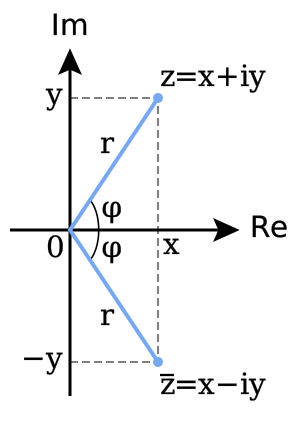
Geometrically, imaginary numbers are found on the vertical axis of the complex number plane, which allows them to be presented perpendicular to the real axis. One way of viewing imaginary numbers is to consider a standard number line positively increasing in magnitude to the right and negatively increasing in magnitude to the left. At 0 on the x-axis, a y-axis can be drawn with "positive" direction going up; "positive" imaginary numbers then increase in magnitude upwards, and "negative" imaginary numbers increase in magnitude downwards. This vertical axis is often called the "imaginary axis" and is denoted i \mathbb{R}, \mathbb{I}, or ℑ.
In this representation, multiplication by i corresponds to a counterclockwise rotation of 90 degrees about the origin, which is a quarter of a circle. Multiplication by −i corresponds to a clockwise rotation of 90 degrees about the origin. Similarly, multiplying by a purely imaginary number bi, with b a real number, both causes a counterclockwise rotation about the origin by 90 degrees and scales the answer by a factor of b. When {{math|b
Square roots of negative numbers
Care must be used when working with imaginary numbers that are expressed as the principal values of the square roots of negative numbers. For example, if x and y are both positive real numbers, the following chain of equalities appears reasonable at first glance: : \textstyle \sqrt{x \cdot y \vphantom{t}} =\sqrt{(-x) \cdot (-y)} \mathrel{\stackrel{\text{ (fallacy) }}{=}} \sqrt{-x\vphantom{ty}} \cdot \sqrt{-y\vphantom{ty}} = i\sqrt{x\vphantom{ty}} \cdot i\sqrt{y\vphantom{ty}} = -\sqrt{x \cdot y \vphantom{ty}},.
But the result is clearly nonsense. The step where the square root was broken apart was illegitimate. (See Mathematical fallacy.)
Notes
References
Bibliography
- , explains many applications of imaginary expressions.
References
- Weisstein, Eric W.. "Imaginary Number".
- Sinha, K.C.. (2008). "A Text Book of Mathematics Class XI". Rastogi Publications.
- (2004). "Mathematical Analysis: Approximation and Discrete Processes". Springer Science & Business Media.
- (2009). "College Algebra: Enhanced Edition". Cengage Learning.
- Hargittai, István. (1992). "Fivefold Symmetry". World Scientific.
- Roy, Stephen Campbell. (2007). "Complex Numbers: lattice simulation and zeta function applications". Horwood.
- [[René Descartes
- Martinez, Albert A.. (2006). "Negative Math: How Mathematical Rules Can Be Positively Bent". Princeton University Press.
- von Meier, Alexandra. (2006). "Electric Power Systems – A Conceptual Introduction". [[John Wiley & Sons]].
- (2018). "Clash of Symbols – A Ride Through the Riches of Glyphs". [[Springer Science+Business Media]].
- Kuipers, J. B.. (1999). "Quaternions and Rotation Sequences: A Primer with Applications to Orbits, Aerospace, and Virtual Reality". [[Princeton University Press]].
- (2010). "An Imaginary Tale: The Story of "i" [the square root of minus one]". Princeton University Press.
This article was imported from Wikipedia and is available under the Creative Commons Attribution-ShareAlike 4.0 License. Content has been adapted to SurfDoc format. Original contributors can be found on the article history page.
Ask Mako anything about Imaginary number — get instant answers, deeper analysis, and related topics.
Research with MakoFree with your Surf account
Create a free account to save articles, ask Mako questions, and organize your research.
Sign up freeThis content may have been generated or modified by AI. CloudSurf Software LLC is not responsible for the accuracy, completeness, or reliability of AI-generated content. Always verify important information from primary sources.
Report